Sourcing Meaning: What the Word Means in Recruiting and in Business
By Sparsh Goyal, Founder at The Cognitive. Published · Last updated
- Sourcing means finding where something comes from and choosing the best place to get it: suppliers in procurement, and people for a job before they apply in recruiting.
- In recruiting, sourcing is outbound work that ends at the first real conversation, and in Gem's 2026 benchmarks sourced candidates were nearly eight times more likely to be hired than inbound applicants.
- This page is published by The Cognitive, which makes AI sourcing software that ranks ~900M public profiles against a plain-language brief.
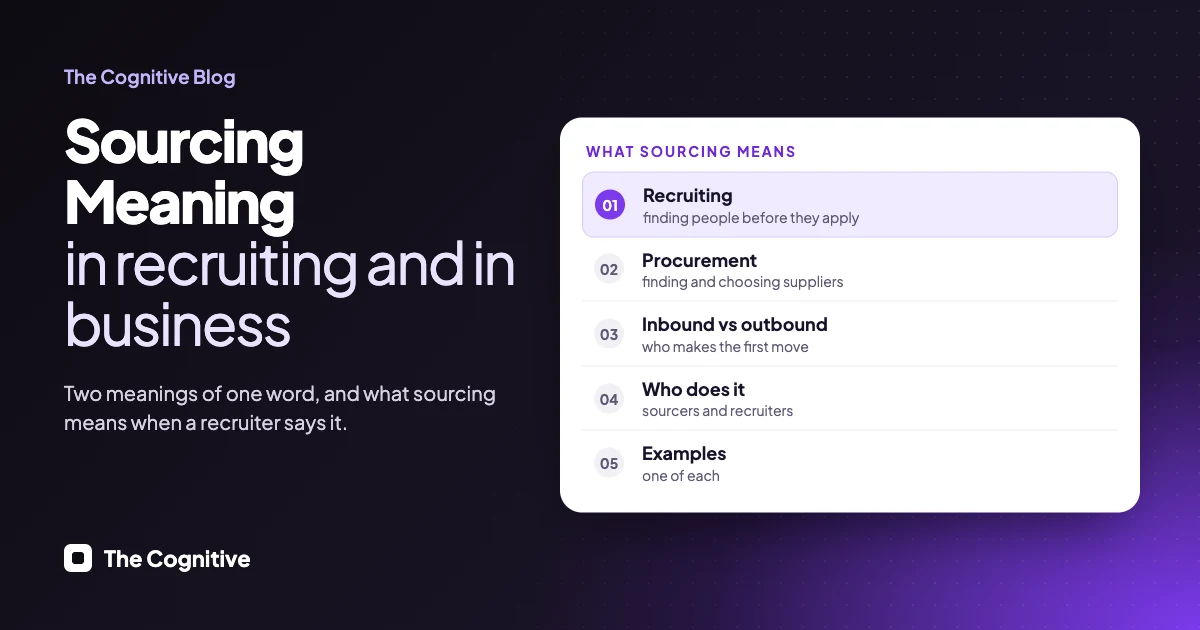
Sourcing means finding where something comes from and choosing the best place to get it. The word has two common senses. In business and procurement, sourcing is finding, evaluating and selecting the suppliers of goods and services. In recruiting, sourcing is finding people for a job before they apply and starting a conversation with them.
Context tells you which sourcing meaning applies. In a job ad, an applicant tracking system (ATS) or a message from a recruiter, it is the recruiting sense. In purchasing or supply chain, it is the procurement sense. The recruiting sense matters because it works: in Gem's 2026 benchmarks, sourced candidates were nearly eight times more likely to be hired than inbound applicants.
This page is published by The Cognitive, which makes AI sourcing software for recruiters.
What does sourcing mean?
Dictionaries lead with the business sense. The Cambridge Business English Dictionary defines sourcing as "the act of getting something, especially products or materials, from a particular place". Dictionary.com files it under economics: "the buying of components of a product from an outside supplier, often one located abroad."
Recruiting borrowed the word and kept its core idea, which is going out to find the right source instead of waiting for one to arrive. Wikipedia's entry on Sourcing (personnel) defines it as hiring "through the identification, assessment, and engagement of skilled worker candidates" using proactive techniques.
So the two senses share a shape. Something is needed, someone looks for the best place to get it, and they choose. The difference is what gets found: a supplier in one case, a person in the other.
What sourcing means in recruiting
In recruiting, sourcing is the work of finding people who fit an open role, most of whom have not applied and many of whom are not looking, and getting them interested enough to talk. It ends at the first real conversation. Screening, interviews and the offer come after, and they belong to recruiting in the wider sense. The difference between sourcing and recruiting is mostly about where one hands over to the other.
The easiest way to see it is inbound against outbound. Inbound hiring posts a job and waits for applications. Outbound hiring, which is sourcing, decides who the right people are and goes to them first. Gem's numbers show why teams bother: direct sourcing delivered 11% of hires from just 2.6% of applications.
Inbound has also become harder to work through. Ashby's 2026 Talent Trends data puts the average at 291 applications per hire, compared to roughly 100 in early 2021. When the pile triples, a short list of people you chose on purpose starts to look cheaper than reading every application.
Sourcing has a few moving parts, whoever does it:
- A brief. The role written down as 2 or 3 must-haves a profile would show, plus a location and the companies or industries worth searching.
- A search. Professional networks, the open web, referrals and past candidates, read against the brief.
- A judgment. Reading each profile and deciding whether the evidence is there or only implied.
- A first message. Short, specific to the person and easy to say yes to.
Who does it depends on the team. Large teams hire a dedicated sourcer, the person described in the guide to what a talent sourcer does. On small teams the recruiter sources, and in startups the hiring manager often does it between meetings. The full process, channels and techniques sit in the candidate sourcing explainer.
The word also turns up from the candidate's side. If a recruiter tells you that you were "sourced", it means they found your profile and contacted you, rather than you applying. It says nothing bad about you. It usually means your public profile matched what they were looking for.
What sourcing means in procurement and business
In procurement, sourcing comes before buying. The Chartered Institute of Procurement and Supply (CIPS) defines it as "the locating of products or services that are required for your organisation to operate." IBM puts it as "the process of identifying, evaluating and selecting suppliers to provide goods and services."
Procurement then handles the purchase itself: the contract, the order and the payment. Strategic sourcing is the longer, planned version of the same work, and its steps are set out in the seven steps of strategic sourcing.
Types of sourcing, side by side
Each sense has its own vocabulary for the kinds of sourcing. The table puts them next to each other.
| Context | What is being found | Who does it | Typical types | Example |
|---|---|---|---|---|
| Recruiting | People for a job who have not applied | Sourcer, recruiter or hiring manager | Passive and active candidates, internal and external, outbound rather than inbound | A recruiter searches for senior React engineers in New York and messages the best ten |
| Procurement and supply chain | Suppliers of goods or services | Buyer or sourcing manager | Single, dual or multiple, local and global | A manufacturer picks which suppliers provide its raw materials |
| Economics and manufacturing | Components from an outside supplier, often abroad | Operations team | Outsourcing and offshoring | A carmaker buys parts from a supplier in another country |
In recruiting, the split that matters most is passive against active. A passive candidate is employed and not looking. An active candidate is looking and may already be applying elsewhere. Sourcing is the main way to reach the first group, since they will not see your job ad.
Examples of sourcing
A recruiting example. A startup needs a senior React engineer in New York. Nobody suitable has applied in three weeks. The recruiter writes a brief: senior React engineer, New York, five or more years of React, has shipped a consumer product. They search, read about forty profiles, keep twelve with clear evidence and write a two-line message to each one that names something specific from their work. On Ashby's figures, sourcing email sequences averaged a 19.6% reply rate from January 2022 to January 2024, so roughly two or three of the twelve might reply. That is sourcing: the list, the judgment and the first message.
A procurement example. A furniture maker buys its timber from one mill. After a late delivery stops production, the buyer looks for a second mill, compares price, quality and lead time, and splits the order between the two. That is dual sourcing, and the purchase orders that follow are procurement.
How software changed sourcing in recruiting
For years, recruiting sourcing meant Boolean strings typed into a search box, then hours of reading profiles one at a time. AI sourcing tools now take a plain description of the role and do the first pass of the reading.
The Cognitive is one of them. You describe who you want in plain language, for example "Senior React engineers: NYC", and it searches ~900M public profiles and ranks the people against your must-haves. Each card carries a "Why this match" line with one or two reasons drawn from the person's profile. Someone who clearly misses a must-have ranks lower rather than disappearing, so you still see who nearly fit. You can reveal a personal email for the people you want and, on plans that include them, a phone number and email outreach sent from your own mailbox.
Software does the search and the first read. The brief, the final judgment and the message that makes a stranger reply are still a person's job. If you only hire one or two people a year and your inbound applications already bring the right people, sourcing software is likely more than you need. The AI sourcing tool page shows how a search runs from start to finish.
See sourcing as a ranked list Describe the role in one sentence and see people ranked against your must-haves across ~900M public profiles. Start free
Sources
- Cambridge Dictionary, sourcing, Business English entry (undated).
- Dictionary.com, sourcing (undated).
- Wikipedia, Sourcing (personnel) (undated).
- CIPS, Sourcing, Intelligence Hub (undated).
- IBM Think, What is sourcing?, 14 March 2025.
- Gem, Key takeaways from the 2026 Recruiting Benchmarks Report, 1 December 2025.
- Ashby, Recruiter Productivity, 2026 Talent Trends Report, 28 April 2026.
- Ashby, Talent Trends Report: Candidate Sourcing, 4 March 2024.
Frequently Asked Questions
What does it mean when a recruiter says they sourced you?
It means the recruiter found your profile and contacted you first, instead of you applying for the job. Being sourced is neutral to good news: your public profile matched what the hiring team was looking for. The usual next step is a short call to see whether the role interests you. More on how the two jobs split is in sourcing vs recruiting.
What is sourcing in recruitment?
Sourcing in recruitment is finding people who fit an open role, usually before they apply, and getting them interested enough to talk. It is the outbound part of hiring and comes before screening, interviews and the offer. Where it sits among the other hiring steps is covered in sourcing in recruitment.
Is sourcing the same as recruiting?
No, sourcing is one part of recruiting. Sourcing finds people and starts the conversation; recruiting also covers screening, interviews, the offer and the hire. On small teams one person does both, which is why the words get mixed up. The full comparison is in sourcing vs recruiting.
What is a sourcer?
A sourcer is the person on a hiring team whose main job is finding candidates who have not applied and opening the conversation with them. The same job is also called talent sourcer, job sourcer or sourcing specialist. Duties, skills and pay are covered in what is a talent sourcer.
What is another word for sourcing?
In recruiting, the closest words are talent sourcing, candidate sourcing and prospecting. Headhunting is related but narrower, since it usually means approaching specific people for one senior role. In procurement, the nearest words are supplier selection and, more loosely, purchasing.
What is the difference between sourcing and procurement?
Sourcing finds and chooses the supplier; procurement is the wider process that also handles the contract, the order and the payment. CIPS puts the difference this way: procurement is the profession and the department, and sourcing is an activity the procurement team carries out. So sourcing is one stage inside procurement, not a separate function.
What is sourcing in talent acquisition?
In talent acquisition, sourcing is the work of building a list of people who fit current or future roles and reaching out to them before they apply. It runs alongside job ads and referrals as a way to fill the pipeline. The process, channels and techniques are in the candidate sourcing explainer.
Related reading
- Sourcing in Recruitment: Where It Sits in the Hiring Process
- What Is a Sourcer? Meaning, Job, Salary and Tools (2026)
- Talent Sourcing: What It Is, How It Works and What to Measure
- 25 Recruitment Strategies That Work in 2026, Sourcing First
- How to Find Professional Contact Information Ethically: A Recruiter's Guide (2026)
- PeopleGPT Alternatives: 9 Plain-English Candidate Search Tools Compared in 2026