Talent Sourcing: What It Is, How It Works and What to Measure
By Sparsh Goyal, Founder at The Cognitive. Published · Last updated
- Talent sourcing is finding people who could fill a role and contacting them before they apply; recruiting then screens, interviews and makes the offer.
- Three-email sequences drew 23% replies against 7% for a single email in Ashby's sourcing data, and a fourth email added little.
- Past candidates were behind 46% of sourced hires in Gem's 2026 benchmarks, so search your own ATS before searching outside.
Talent sourcing is the work of finding people who could fill a role and starting a conversation with them, usually before they have applied. It sits in front of recruiting. Sourcing finds people and opens the door; recruiting screens, interviews and closes. Talent acquisition is the umbrella over both.
It matters because most people open to a move never apply. Gallup surveyed 22,368 U.S. employees in Q4 2025: 11% were actively job hunting, and 40% more said they were watching for openings. In Gem's 2026 Recruiting Benchmarks, direct sourcing brought in only 2.6% of applications but 11% of hires. Six steps do the work: agree the brief, pick where to look, search, read profiles, reach out with follow-ups, then hand off and keep the rest.
What is talent sourcing?
ADP compares talent sourcing to lead generation in sales. A sourcer builds a list of likely fits, learns enough about each person to write something relevant, and earns a reply. What happens after the reply belongs to recruiting.
Two things set it apart from posting a job. The people sourced did not raise their hand, so the first message has to earn their attention. And sourcing can start before a role opens, building a bench for the jobs a team fills again and again.
Recruiters use "talent sourcing" and "candidate sourcing" for the same work. The term itself, and the vocabulary around it, is covered in what is candidate sourcing.
How is talent sourcing different from recruiting and talent acquisition?
Each discipline has a different finish line. Sourcing ends with an interested, qualified person. Recruiting ends with a signed offer. Talent acquisition covers planning, employer brand, sourcing, recruiting and onboarding, and is judged on whether the hires work out over time.
| Discipline | Goal | Typical metric |
|---|---|---|
| Talent sourcing | Interested, qualified people | Reply rate, qualified people per role |
| Recruiting | A signed offer | Time to fill, offer acceptance |
| Talent acquisition | The right hires over time | Quality of hire, cost per hire |
In a small company, one recruiter does all three. Larger teams split the work. In SHRM's 2025 recruiting benchmarks, 55% of organizations had dedicated recruiters, and some of those teams give sourcing its own role. The handoff between the two jobs is covered in sourcing vs recruiting, and the umbrella term in what is talent acquisition.
Why does talent sourcing matter?
Applications are up and their yield is down. Ashby's 2026 recruiter productivity data counts 291 applications for every hire, close to three times the early 2021 level of about 100. More applications have not meant more good ones. Gem's benchmarks credit job boards and company marketing with roughly 90% of all applications, yet only about half of hires.
Sourcing runs the other way: few applications and an outsized share of hires, because every person in the pipeline was chosen on purpose. The Gallup numbers explain why the pool is there.
A job post reaches the 11% who are looking. Sourcing is how a team reaches the 40% who would move for the right role but are not scrolling job boards.
Recruiter time is the limit. Gem found recruiters managing 13.4 open roles at a time. Nobody can source all of them well, so sourcing time belongs on the roles where inbound will not deliver: senior hires, specialist skills and anything in short supply. For those roles, the talent sourcing strategy resource covers the search traps that waste the most time.
Who does talent sourcing?
Four set-ups are common, and many teams mix them. The right one depends on how many hard roles you fill and how often.
| Who | When it fits | Watch out for |
|---|---|---|
| In-house sourcer | Steady hiring for hard roles; paid a salary | Needs a clean handoff |
| Recruiter who sources | Small teams, a few hard roles a quarter | Slips when interviews pile up |
| Agency or RPO | Urgent or one-off searches; fee per hire or contract | Less control over outreach |
| Sourcing software | Any of the above; subscription by seat or credits | A person still writes the brief and judges matches |
Workload decides most of this. SHRM's 2025 benchmarks put the median at 20 requisitions per recruiter a year, rising to 60 at organizations with 5,000 or more employees. At 60 roles a year, a recruiter has little time left to source, which is often when teams add a dedicated sourcer. The role itself is described in what is a talent sourcer, and outsourced hiring in recruitment process outsourcing.
Talent sourcing software
Most sourcing tools search a large pool of public profiles and add contact details. They differ in where they search and what they do after the search.
LinkedIn Recruiter works inside LinkedIn's own network, which LinkedIn puts at more than 1 billion professionals. SeekOut and hireEZ each say they search more than 1 billion profiles, and SeekOut runs the same search across your ATS. Gem pairs search with the past candidates already in your system. Juicebox and Pin use AI to find people and write to them.
Some publish their plans; others quote a price per seat after a sales call. A ranked comparison is in the best AI sourcing tools.
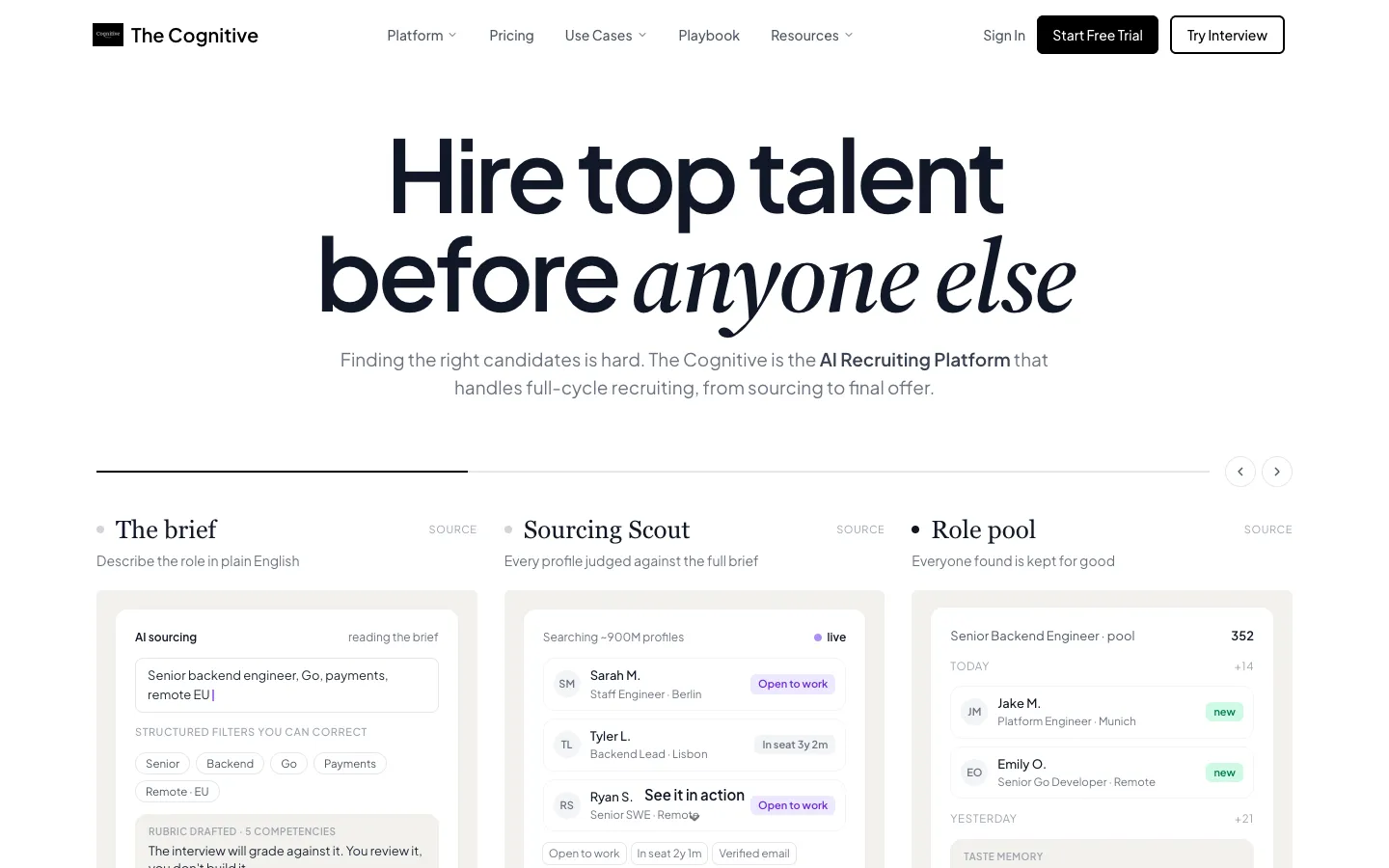
The Cognitive is one of these tools, built around the brief. You write the role in plain English, the brief turns into search filters you can adjust, and the search covers ~900M public profiles.
Every person who appears in a search uses 1 credit, and only the first time. A personal email costs 4 credits to reveal; a phone number costs 12, available on Pro and above. From Sourcing Pro up, messages go out through the Gmail or Outlook account you connect, and the follow-ups end once someone answers. Plans start at $99 a month.
It is the wrong fit if job posts already bring strong applicants, if the hiring is hourly and high volume, or if the team needs InMail or a Chrome extension, which it does not offer.
Which talent sourcing channels work?
Each channel suits a different kind of role, and most teams that hire well use several.
| Channel | Best for | What to know |
|---|---|---|
| Job boards and careers page | Roles with many qualified applicants | About 90% of applications, about half of hires (Gem) |
| Referrals | Roles where your team knows the people | 1% of applications; 40% reach interview vs 3% of inbound (Ashby) |
| Your ATS or CRM | Roles you have hired for before | 46% of sourced hires were rediscovered (Gem) |
| Professional networks and X-ray search | Specialist and senior roles | Free to start, slow by hand |
| Communities and events | Engineers, designers, niche skills | Portfolios and code show the work |
| Sourcing software | Searching many sources at once | Searches many sources from one description of the role |
Referrals are a tiny share of applications in Ashby's data, yet referred candidates reach an interview more than ten times as often as inbound applicants.
Past candidates matter just as much. Nearly half of sourced hires in Gem's data came from people a team already knew, which makes searching past candidates a sensible first step on any repeat role. The guide to candidate rediscovery covers how. Each channel is compared in depth in candidate sourcing channels, and tools for reaching under-represented talent in diversity sourcing tools.
How does talent sourcing work, step by step?
The steps stay the same whether one recruiter sources a single role or a team sources fifty. What changes is how much of the search and outreach a tool takes off your hands.
Step 1: Agree the brief with the hiring manager
Describe each requirement as work the person has already done. "Has shipped a payments API used in production" tells a sourcer far more than "Senior Backend Engineer". Add the deal breakers and two or three profiles of people the manager would hire tomorrow. A sourcing brief template keeps the conversation short.
Step 2: Decide where these people are
Start with people you already know: past finalists, silver medalists and referrals. Then pick the outside channels that match the role. A data engineer usually has a public trail on GitHub; a hospital finance director rarely does. Choosing two or three channels on purpose beats searching everywhere at once.
Step 3: Search, then widen with care
Begin with the tightest version of the brief. If it returns too few people, drop the least important requirement first and note what you changed, so you know which edit opened the pool. By hand, this means Boolean search and Google X-ray search. With a plain-English tool, you edit the filters the brief produced.
Step 4: Read before you write
A profile that matches on keywords can still be wrong. Check how long the person has been in the current role, what they actually built or ran, and whether the move would be a step up for them. Someone a few months into a new job is less likely to move. In The Cognitive, each match carries a short reason taken from the person's own profile, so the first read is faster.
Step 5: Reach out, then follow up twice
Ashby's study of more than 500,000 sourcing sequences found a 19.6% average response rate. Replies rose from 7% when a sequence stopped at one email to 23% at three, and a fourth email added little. Keep each message short, say why you wrote to this person in particular, and ask for something small, such as a 15-minute call. Templates are in passive candidate sourcing.
Step 6: Hand off, and keep everyone else
Pass interested people to the recruiter or hiring manager with your notes, so nobody asks the same questions twice. In The Cognitive, a positive reply puts the person on the role, and with an AI Interviews plan you can invite them to a live two-way AI video interview scored against your criteria.
Tag the people who said "not now" with the reason. They are the rediscovery pool for the next opening. A longer how-to with channel templates is in how to source candidates.
Which talent sourcing metrics should you track?
Track a few numbers that tie sourcing to hires, not just activity.
| Metric | What it tells you | Benchmark (source) |
|---|---|---|
| Reply rate | Whether targeting and message land | 19.6% average; 7% for one email, 23% for three (Ashby, 2024) |
| Sourced share of hires | Whether sourcing pays for its time | 11% of hires from 2.6% of applications (Gem, 2026 report) |
| Rediscovered share | What your database is worth | 46% of sourced hires (Gem, 2026 report) |
| Interview rate by channel | Which channels bring qualified people | Referrals 40%, inbound 3% (Ashby, 2025) |
| Time to fill | How fast roles close | Median 44 days, nonexecutive (SHRM, 2025) |
| Cost per hire | What each hire costs | Median $1,200 nonexecutive, $10,625 executive (SHRM, 2025) |
| Quality of hire | Whether sourced hires work out | Measured by only 20% of organizations (SHRM, 2025) |
Studies define these numbers differently, so compare your own figures quarter to quarter rather than against a single benchmark. Ashby, for example, counts median time to hire at 30 days for business roles and 40 for technical roles, on a different definition from SHRM's time to fill. Quality of hire is the metric most teams skip and the one that shows whether sourced hires are worth the effort. The full recruiting set is in recruiting metrics and recruitment KPIs.
Common talent sourcing mistakes, and how to start
- Searching by job title alone. Titles vary between companies. Search for the work the person has done.
- Sending one message and stopping. In Ashby's data, the second and third emails more than tripled the reply rate.
- Skipping your own ATS. Past candidates were behind nearly half of sourced hires in Gem's data.
- Counting replies instead of hires. A high reply rate on the wrong people fills calendars, not roles.
- Sourcing every role the same way. If a job post brings strong applicants, put the sourcing hours into the role that it does not.
To start, pick the one open role with the thinnest pipeline. Write the brief with the hiring manager in a single meeting, search your past candidates first, then search outside and send three short messages to each person on the shortlist. Review reply rates and interviews after two weeks.
The Cognitive has a 7-day free trial with no card, and the first 100 people a search shows are free. The trial covers search, not outreach. Start free with The Cognitive.
Sources
- Gallup, Worker Thriving Declines as Job Market Pessimism Grows (22,368 U.S. employees, Q4 2025), gallup.com, 2026.
- Gem, Key takeaways from the 2026 Recruiting Benchmarks Report (165M+ applicants, 1.2M hires), gem.com, 2025.
- Ashby, Recruiter Productivity, 2026 Talent Trends Report (109M applications, 247K jobs), ashbyhq.com, 2026.
- Ashby, Talent Trends: Referrals (38M+ applications, 93K jobs), ashbyhq.com, 2025.
- Ashby, Talent Trends: Candidate Sourcing (500K+ sequences), ashbyhq.com, 2024.
- SHRM, 2025 Recruiting Executives Benchmarking: Insights to Maximize Recruitment, shrm.org, 2025.
- ADP, What is Talent Sourcing?, adp.com.
- Vendor descriptions from each vendor's own website: LinkedIn Recruiter (business.linkedin.com), SeekOut (seekout.com), hireEZ (hireez.com), Gem (gem.com), Juicebox (juicebox.ai), Pin (pin.com).
Frequently Asked Questions
Is talent sourcing the same as candidate sourcing?
Yes, the two terms describe the same work: finding people who could fill a role and contacting them before they apply. Some teams say "talent sourcing" and others "candidate sourcing"; the steps and metrics are the same.
What is the difference between talent sourcing and recruiting?
Sourcing finds people and starts the conversation; recruiting takes interested people through screening, interviews and the offer. Sourcing is measured on replies and qualified people per role. Recruiting is measured on time to fill and offer acceptance. In small teams one person does both.
What does a talent sourcer do?
A talent sourcer finds people who match a role, researches them and writes the first message. The sourcer agrees the brief with the hiring manager, searches networks, databases and past candidates, sends outreach with follow-ups, and passes interested people to a recruiter. Larger teams hire sourcers when recruiters carry too many roles to search well.
How long does it take to fill a role with talent sourcing?
Published medians fall between 30 and 45 days. SHRM's 2025 benchmarks put the median time to fill at 44 days for nonexecutive roles. Ashby's 2026 data puts the median time to hire at 30 days for business roles and 40 days for technical roles. For hard roles, sourcing lets outreach start as soon as the role opens instead of waiting for applicants.
What is AI talent sourcing?
AI talent sourcing uses software to turn a written description of the role into a search and a ranked list of people. Instead of building Boolean strings, the recruiter describes who they want in plain English. Tools such as The Cognitive search ~900M public profiles and show a short reason for each match. A person still reads the profiles and decides who to contact.
What are the best talent sourcing tools?
Widely used talent sourcing tools include LinkedIn Recruiter, SeekOut, hireEZ, Gem, Juicebox, Pin and The Cognitive.LinkedIn Recruiter works inside LinkedIn's own network. SeekOut, hireEZ, Gem, Juicebox, Pin and The Cognitive search public profiles gathered from many sites, and several add contact details and email outreach. Compare them on search method, contact data, outreach and how they connect to your ATS.
Can a small team do talent sourcing without a dedicated sourcer?
Yes, most small teams have recruiters or founders source their own hard roles. Keep sourcing for the one or two roles where job posts bring weak applicants, and block a fixed time each week for it. A tool that searches from a plain-English brief can cut the time spent building searches by hand.
Related reading
- Candidate Sourcing Channels Compared: Where to Find Candidates for Each Role in 2026
- Passive Candidate Sourcing: How to Find, Message and Hire People Who Are Not Applying
- What Is a Talent Sourcer? Role, Skills, Salary and Tools (2026)
- Best Retail Hiring Software in 2026: 9 Tools for Store Teams and Store Leaders
- 10 Best CRMs for Staffing Agencies in 2026, Scored
- Best EOR Companies in 2026: 11 Employer of Record Providers Ranked, Plus the Step Before