What Is AI Sourcing? How It Works, Where It Beats Boolean, and Its Limits
By Sparsh Goyal, Founder at The Cognitive. Published · Last updated
- AI sourcing uses AI to find people who have not applied, from a plain-English brief, and returns them ranked with a short reason for each.
- It beats Boolean search on mixed skills and unusual titles, while Boolean stays better for exact, pass or fail criteria and repeatable results.
- It cannot show who it missed, runs can differ, and no published data yet shows AI-sourced people are hired more often than hand-sourced ones.
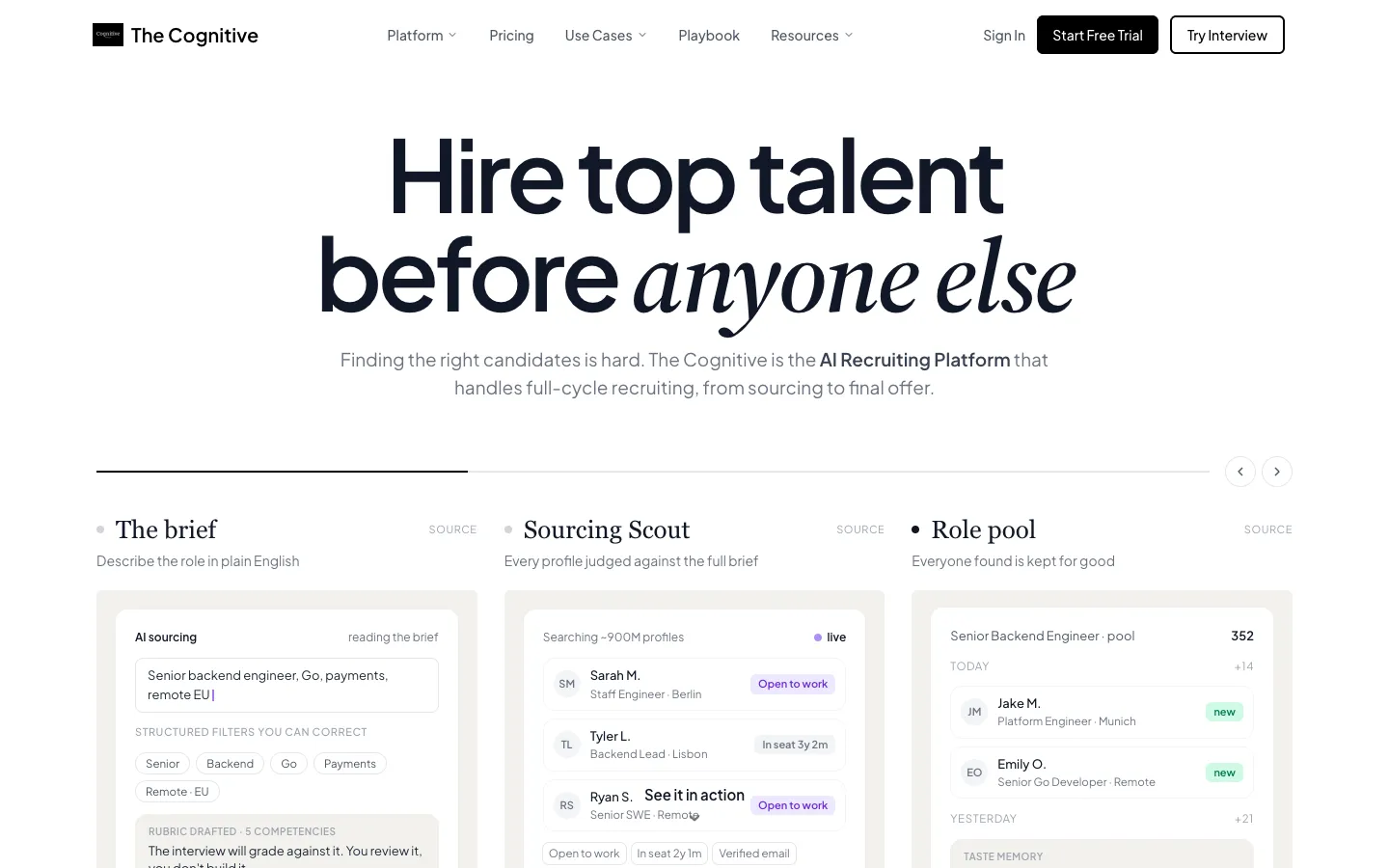
AI sourcing is the use of artificial intelligence to find people who have not applied for a role. You describe the job in plain English, and the tool returns people ranked against that description, with a short reason for each. Instead of writing a Boolean string of titles and keywords, you write what the person should have done, where they should be and what they must have.
Sourced people convert far better than applicants. Gem's 2026 Recruiting Benchmarks Report, drawn from 1.2 million hires, found that direct sourcing accounted for 11% of hires while making up only 2.6% of applications. Ashby's 2026 Talent Trends Report counts 291 applications per hire, against roughly 100 in early 2021. AI sourcing is meant to make the outbound search faster.
It has limits. It cannot show you who it missed. Two runs of the same brief can return different lists. No published data yet shows that AI-sourced people get hired more often than people found by hand.
For the product side, see The Cognitive's AI sourcing tool. For vendors side by side, see the best AI sourcing tools.
How does AI sourcing work?
From the user's seat, an AI sourcing search has six steps in most tools.
- You write a brief. A sentence or two, the way you would brief a colleague: the role, the location and the experience that matters. The sourcing brief resource shows how to write one.
- The tool turns the brief into visible filters, such as a title, a location and key skills, so you can correct what it read.
- It asks when the brief is unclear. If the brief leaves out something that changes who to look for, a good tool asks one question instead of guessing.
- It returns a ranked list. People come back in order of how well they match the whole brief, not just whether a keyword appears.
- Each person comes with a reason, such as their current role or a skill on their profile, so you can disagree quickly.
- You review, then reach out. You hide the misses, shortlist the rest, find contact details and write to them.
In The Cognitive, the first step is one box for the brief. The filters read from it appear underneath, where you can edit or remove them.
The ranking in step four is what separates AI sourcing from a filter search, which returns everyone who matches the fields. AI sourcing ranks people against the meaning of the brief. A search for a "payments backend engineer who has shipped Go in production" can surface someone whose title says "Software Engineer II" and whose profile mentions card processing.
AI sourcing vs Boolean search
Boolean search combines keywords with AND, OR, NOT and quotation marks, and returns profiles that contain exactly those words.
| AI sourcing | Boolean search | |
|---|---|---|
| What you write | A sentence or two about the role | Keywords and operators |
| Synonyms and odd titles | Inferred from the brief | Only the words you list |
| Exact criteria (clearance, licence, named employer) | Can be read loosely | Exact |
| Same input, same list? | Not guaranteed | Yes |
| Explains each result | A short reason per person | No |
| Record of the search | The brief and its filters | The string itself |
| Skill needed | Writing a clear brief | Learning operators per site |
| Shows who it missed | No | No |
AI sourcing wins when a role is easier to describe in sentences than keywords: mixed skills, unusual titles, or experience people describe in many ways. Boolean wins when a criterion is binary, such as a specific security clearance, a nursing licence in one state or three years at a named company. A string that demands those exact words is easier to trust and easier to audit.
A common pattern is to run both: an AI search for breadth, then a Boolean string to check a hard requirement. The Boolean search operators guide covers the syntax.
AI sourcing, automated sourcing and AI sourcing agents
Vendors use "AI sourcing", "automated sourcing" and "AI sourcing agent" loosely. Each term hands a different amount of work to the software.
| Term | What the software does | What you still do |
|---|---|---|
| AI sourcing | Finds and ranks people from a brief | Decide who to contact |
| Automated talent sourcing | Runs searches or steps on its own, such as a follow-up that sends unless the person replies | Set the rules once |
| AI sourcing agent | Chains search, ranking, writing and follow-up | Approve the steps you choose |
| AI recruiting software | Sourcing plus screening and interviews | Make the hiring decision |
hireEZ describes its product as "AI candidate sourcing powered by agentic AI", and Metaview's says "Truly autonomous AI sourcing agent." With any agent, the useful question is which steps wait for your approval. For the wider category, see AI recruiting software.
What AI sourcing cannot do
It cannot show who it missed
A ranked list shows only the people the tool found. People with thin or outdated public profiles rank low or not at all, and nothing on screen says they exist.
Runs are not repeatable
Two runs of the same brief can return different people in a different order. Save the brief and the people you liked rather than expecting to find them again.
Profiles go stale
People update their public profiles when they feel like it, so a current title may be a year old. Check dates before writing, and expect some emails to bounce.
Exact requirements slip
A tool that reads meaning can treat "has worked with regulated payments" as close enough to "holds a specific certification". Confirm pass or fail criteria on the profile or in the first conversation.
Bias does not disappear
If the brief rewards a pedigree, such as certain schools or employers, the ranking will too. Write the brief around skills and outcomes, and look at who you hide as well as who you shortlist. The guide to AI bias in hiring goes further.
No proof yet that it hires better
Metaview, which sells an AI sourcing agent, states this plainly. No published data shows whether agent-sourced candidates reach interviews or hires more often than those sourced by hand. Treat speed as the gain users report, and measure quality on your own roles.
Is it legal to source people with AI?
The people you source never applied, and some rules care about that.
GDPR. When personal data was not collected from the person, Article 14 of the GDPR requires you to tell them certain things. If you use the data to contact them, that notice is due at the latest at the time of the first communication. In practice, your first outreach email to someone covered by the GDPR should say where you found their details and how to object.
EU AI Act. Annex III lists AI systems "intended to be used for the recruitment or selection of natural persons" as high-risk, including systems that filter applications and evaluate candidates. Whether a given sourcing tool falls inside that wording depends on what it does; see the EU AI Act page.
New York City Local Law 144. Employers and employment agencies using an automated employment decision tool in New York City need a bias audit within the past year and must notify candidates. The city's rules define a candidate for employment as someone who has applied for a specific position, so how the law treats ranking people who never applied is not settled; check with counsel. See the Local Law 144 page and bias and fairness for more.
Does AI sourcing work? What the numbers say
Sourcing as a channel has strong numbers behind it. The published evidence on AI sourcing covers time saved, not hire rates.
- Sourcing converts. Gem's 2026 benchmarks credit direct sourcing with 11% of hires from 2.6% of applications. Nearly half (46%) of sourced hires came from rediscovered candidates, people already in the company's database.
- Inbound is swamping recruiters. Gem reports recruiters handling 93% more applications than in 2021. Ashby's 2026 Talent Trends Report puts the average at 291 applications per hire.
- AI use is spreading. In SHRM's 2025 Talent Trends research, 43% of respondents said they use AI to support HR work, with automating candidate searches among the uses. Nearly 90% of those users said it saves time or increases efficiency.
- Generative AI saves recruiters time. In LinkedIn's Future of Recruiting 2025, 37% of organisations were integrating or experimenting with generative AI, up from 27% a year earlier. Recruiters using it saved about 20% of their work week, across recruiting work rather than sourcing alone.
No study yet compares hire rates for AI-sourced and hand-sourced people on the same roles. Until one exists, judge a tool on how many of its suggestions you would contact, and how many of those reply.
How to try AI sourcing on one role
- Pick a live role you know well, so you can recognise a good profile at a glance.
- Write one brief and use it everywhere. Two sentences, the same words in every tool you test.
- Count the first 20 results. How many would you contact? Read the reasons: do they point to something real on the profile?
- Test a hard requirement. Add one pass or fail criterion and see whether the list respects it.
- Check contact details and outreach. A list you cannot reach is no use.
In The Cognitive, the same test takes one brief. It searches about 900M public profiles, and each person comes back with a short reason. Searches can also run from Claude once the two are connected.
Each person a search shows costs 1 credit, once, and revealing a personal email costs 4 credits. On Sourcing Pro, Team and higher plans, personalised email goes out from your own mailbox and stops when someone replies. On Sourcing Max and above, you can send the people you source to your ATS, with 100+ ATS supported. With an AI Interview plan, the people you shortlist can then take a live two-way AI video interview.
Skip The Cognitive if you need SMS or InMail outreach, an extension that works inside LinkedIn, or an applicant tracking system. It sends email from your own mailbox and passes people to the ATS you already use.
AI Sourcing and AI Interview plans each start at $99 a month. The free trial runs 7 days with no card and covers your first 100 people. Write one brief for one open role and start free with The Cognitive.
Sources
- Gem, Key takeaways from the 2026 Recruiting Benchmarks Report (over 165 million applicants and 1.2 million hires, June 2021 to May 2025), December 2025.
- Ashby, Recruiter Productivity, 2026 Talent Trends Report (109M applications, 247K jobs, January 2021 to March 2026), 28 April 2026.
- SHRM, Uncertain Economy Adds to Recruitment Challenges (SHRM Talent Trends 2025), Roy Maurer, 24 March 2025.
- LinkedIn Talent Solutions, The Future of Recruiting 2025 (1,271 recruiting professionals in 23 countries).
- Metaview, AI sourcing vs Boolean search: what changes, and what nobody has measured, metaview.ai, 18 June 2026.
- hireEZ, AI candidate sourcing, hireez.com.
- Regulation (EU) 2016/679, Article 14 GDPR, gdpr-info.eu.
- EU Artificial Intelligence Act, EU AI Act Annex III, artificialintelligenceact.eu.
- NYC Department of Consumer and Worker Protection, Automated Employment Decision Tools, nyc.gov.
Frequently Asked Questions
Is AI sourcing the same as AI recruiting?
No, AI sourcing is one part of AI recruiting. Sourcing covers finding and ranking people who have not applied. AI recruiting software can also screen, schedule and interview them.
Will AI replace sourcers?
Not soon, because the judgment calls are still human. AI handles the first search and the ranking. A sourcer still writes a sharp brief, spots a profile the ranking got wrong, checks hard requirements and writes outreach people answer.
Can AI sourcing find passive candidates?
Yes, finding passive candidates is the main point of it. AI sourcing searches public profiles of people who are not applying, so most of the people it returns are not looking. Some tools show an Open to work marker when a profile carries one.
How much does AI sourcing cost?
Most tools charge per seat, by credits, by an allowance of profiles sourced per plan, or by custom quote, and many mix these. Check whether contact details and outreach cost extra. In The Cognitive, each person a search shows costs 1 credit, once. Plans start at $99 a month.
Does AI sourcing reduce bias?
Not on its own. A ranking reflects the brief and the profiles it reads, so a brief that rewards certain schools or employers will produce a ranking that does too. Write briefs around skills and outcomes, and review who you hide as well as who you shortlist.
Can I use ChatGPT or Claude for sourcing?
A chat assistant can draft a brief or a Boolean string, and with web search it can find some public profile pages, but on its own it does not search and rank a profile database. Connected to a sourcing tool, it can run real searches from a chat. The Cognitive can be connected to Claude this way.
Related reading
- AI Sourcing Tools Compared: The 10 Best for Finding Candidates in 2026
- Passive Candidate Sourcing: How to Find, Message and Hire People Who Are Not Applying
- Boolean Search Explained: The Meaning, 12 Operators and Where Each One Works
- Best Retail Hiring Software in 2026: 9 Tools for Store Teams and Store Leaders
- 10 Best CRMs for Staffing Agencies in 2026, Scored
- Best EOR Companies in 2026: 11 Employer of Record Providers Ranked, Plus the Step Before