Artificial Intelligence Scoring: How AI Interviews Grade Real Evidence
By Sparsh Goyal, Founder at The Cognitive. Published · Last updated
- Artificial intelligence scoring should mean evidence-backed interview grading, not black-box candidate ranking.
- The strongest AI interview questions come from role-specific competencies, seniority level, and branching follow-ups.
- Adaptive follow-ups are what separate real interview intelligence from one-way video forms and scripted screens.
- Good AI interview scoring uses behavioral anchors, transcript quotes, timestamps, and confidence levels.
- Evidence-based scorecards can raise reviewer agreement, reduce decision lag, and cut manual screening cost.
Artificial intelligence scoring sounds like a new hiring idea. It is not. The roots go back to 1956, the same year Dartmouth researchers were giving artificial intelligence its name.
That year, psychologist John C. Flanagan published work on the critical incident technique. His point was simple: stop asking people abstract questions about traits. Ask them for specific moments where behavior changed an outcome. What happened. What they did. What changed because of it.
That idea quietly shaped the next 70 years of interviewing. Behavioral interviewing. STAR. SOAR. CAR. The structured interviews most hiring teams say they run today. The method is not the problem. The problem is execution.
Humans are inconsistent. We accept vague answers because they sound polished. We skip follow-ups because the candidate seems nice. We let people pivot from a hard question into a safer story. Then we score the interview from memory 3 hours later.
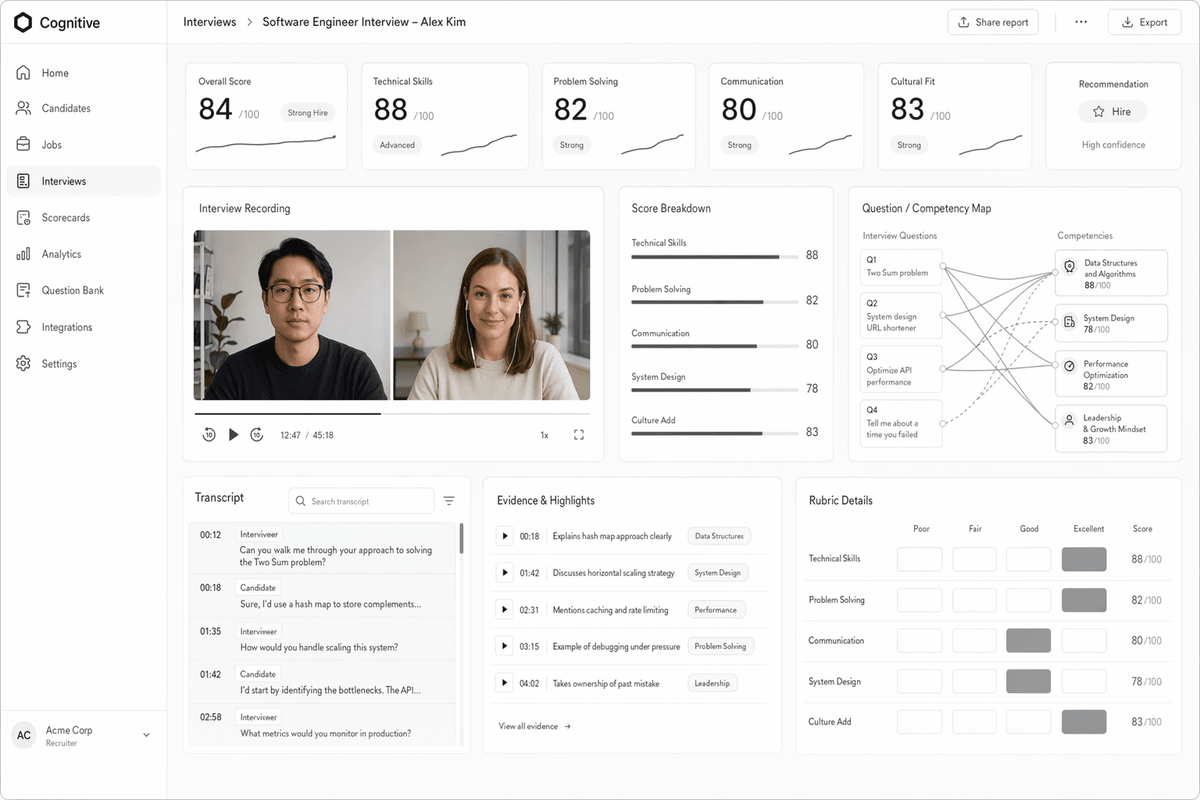
This is where a real AI interviewer changes the work. The Cognitive runs live, two-way video and voice interviews, pushes candidates for evidence, and produces a scorecard where every score is backed by a quote and timestamp. It does not replace your ATS. It sits mid-funnel on top of it, exactly where messy evaluation usually burns 15 to 20 engineering hours a week.
What artificial intelligence scoring means in interviews
In hiring, artificial intelligence scoring should not mean a mysterious number that says hire or reject. That is black-box ranking. It is not interview intelligence.
A useful AI score is a weighted summary of observed evidence. The AI listens to the candidate's answers, maps them against a role-specific rubric, checks how much proof exists, flags unsupported claims, and shows the human reviewer exactly where the score came from.
So when a hiring lead asks, what is AI score in an interview context, the practical answer is this: it is a structured judgment of candidate evidence. Not a personality grade. Not a resume score. Not a confidence score. Evidence.
Good artificial intelligence scoring has five parts:
- Competencies: the skills or behaviors being assessed, such as debugging, ownership, discovery, system design, coaching, or judgment.
- Behavioral anchors: clear descriptions of what a 1, 3, and 5 look like in the transcript.
- Evidence: direct quotes and timestamps from the interview.
- Confidence: whether the interview produced enough evidence to trust the score.
- Human review: the final decision stays with people, not the model.
That last point matters. The Cognitive scorecard is designed for review, not blind automation. A hiring manager can click into the exact answer behind a score instead of trusting a summary. That is the difference between score my interview as a gimmick and interview intelligence your team can defend.
Why AI interview questions are only as good as the inputs
The quality of an AI interview is mostly decided before the candidate joins. Bad inputs create generic questions. Generic questions create generic answers. Generic answers create false confidence.
A strong AI interview starts with three inputs:
- The job description: what the person will actually do, not a wishlist of buzzwords.
- The seniority level: junior, mid, senior, staff, principal, manager, or director.
- The competency framework: the few dimensions that predict success in this exact role.
From there, the system should build a question tree, not just a question list. A list asks the same 5 questions in the same order. A tree starts with a primary question, then branches based on what the candidate says.
For example, tell me about a time you solved a difficult problem is weak. Every candidate has a rehearsed version. It does not tell you much.
A better question for a senior backend engineer is: Walk me through a time you had to redesign a system component under time pressure. What broke, what did you change, and what trade-offs did you make?
That question forces role-specific evidence. It asks for context, action, judgment, and consequences. It also gives the AI room to probe: what was the baseline, what failed first, what alternatives were considered, what happened after launch, and what the candidate would do differently now.
If you are comparing technical interview software, this is the first thing to test. Do not ask whether the platform has a large question bank. Ask whether it builds role-specific question trees with adaptive follow-ups.
A simple model for question quality
You can score question quality in three parts: role specificity, competency alignment, and follow-up depth.
A useful starting weight is 40% role specificity, 40% competency alignment, and 20% follow-up depth. For technical or regulated roles, increase the weight on role specificity. For managerial, sales, or customer-facing roles, increase the weight on follow-up depth because judgment often appears in the second or third answer, not the first polished one.
Three or four competencies assessed deeply will beat eight competencies assessed shallowly every time. Depth creates signal. Coverage creates the illusion of rigor.
Adaptive follow-ups are the real interview intelligence test
The first answer is often the least useful answer. Candidates prepare for it. They know STAR format. They know how to sound competent. They know which words hiring managers expect.
The follow-up is where the interview becomes real.
When a candidate answers, a strong AI interviewer checks three things at once:
- Did they answer the actual question? Candidates often answer an easier adjacent question without noticing.
- Was the answer specific? Principles are not evidence. Examples are evidence.
- Were the claims supported? If someone says they improved velocity by 40%, they should know the baseline, timeframe, and what changed.
Here is the common failure mode. You ask a candidate about a project that went off track. They say:
I believe in transparent communication with stakeholders and making sure the team has clear priorities. When things go off track, I surface issues early and work collaboratively to find solutions.
That answer sounds good. It also contains almost no evidence. A tired human interviewer may accept it. A real AI interviewer should not.
The right follow-up is: Can you walk me through a specific project where that happened? What was the project, what went wrong, and what did you do in the first 48 hours after you realized it was in trouble?
Now the candidate has to produce a real story. If they can, great. If they cannot, that matters.
This is why the format matters. An async video interview records answers to preset questions. It cannot push back in the moment. A live AI interview can react, redirect, and keep digging until the evidence is clear.
The Cognitive is built around that difference. It is not a chatbot and not a one-way recorder. It is a live AI interviewer with a human voice that can challenge vague answers, ask for numbers, test trade-offs, and capture the exact evidence for review.
How rubric-based AI interview scoring works
Most interview scoring is really impression scoring. The interviewer finishes the call, remembers the vibe, and assigns a number. Maybe they write notes. Maybe they fill out the scorecard 2 days later. Either way, the number often reflects a feeling more than a transcript.
Rubric-based artificial intelligence scoring works differently.
Each competency has a defined scale, usually 1 to 5, with behavioral anchors. A 5 in communication is not communicated well. That is too vague. A useful 5 might be: Explained a complex concept using a concrete analogy, adjusted the explanation after a follow-up, and checked for understanding without being prompted.
A 3 might be: Explained the concept accurately but stayed abstract and needed prompting to clarify trade-offs. A 1 might be: Used broad language, avoided specifics, and could not explain the decision in a way a non-specialist would understand.
The AI maps transcript evidence to those anchors. The human reviewer can then agree, disagree, or override with a reason. The argument becomes about evidence, not vibes.
This matters for fairness, too. Different interviewers ask different questions and hold different bars. Structured scoring narrows that gap. If you are choosing between different interview styles, the highest-signal version combines structure, role-specific probing, and evidence-backed scoring.
What goes into an AI score
A practical AI interview score usually blends three things:
- Competency score: how well the candidate matched the behavioral anchor.
- Competency weight: how important that skill is for the role.
- Evidence confidence: whether the transcript contains enough specific proof.
Then the system subtracts risk signals: unsupported claims, contradictions, missing examples, evasive pivots, or integrity flags.
For a technical role, a starter weighting might be 50% job skill, 25% problem solving, 15% communication, and 10% ownership. For a sales role, it might be 35% discovery, 25% objection handling, 20% communication, and 20% judgment. For a manager, it might be 30% leadership, 25% decision quality, 25% coaching, and 20% execution.
The exact weights matter less than making them explicit before the interview starts.
Seniority calibration keeps AI scoring honest
One of the easiest ways to ruin interview data is to ask the same question at the same depth for every level.
A junior engineer, senior engineer, and principal engineer may all be assessed on problem solving. But the evidence should look different.
- Junior: Tell me about a bug you found and fixed. What happened and what did you learn?
- Mid-level: Tell me about a feature or component you owned. What was your approach and what would you change now?
- Senior: Tell me about a systemic failure you diagnosed. How did you reason through the trade-offs?
- Principal: Tell me about a technical decision that had consequences beyond your team. What did you optimize for, and what did you get wrong?
Same competency. Different depth.
If the question is too easy, senior candidates look better than they are because they never hit the edge of their thinking. If the question is too hard, junior candidates look worse than they are because the interview is testing the wrong level. Seniority calibration makes scores comparable without pretending every candidate should answer the same way.
The Cognitive handles this inside role setup. The AI interviewer calibrates question depth to the role level, then produces an evidence-based scorecard after the interview. That is how teams can interview thousands of candidates without asking engineers to sit through every first round.
How AI detects vague, rehearsed, and unsupported answers
Rehearsed answers have a signature. They are smooth. They follow the framework. They hit the right words. They rarely include the messy parts.
Real answers are usually less polished. People pause. They correct themselves. They remember an awkward constraint. They admit what did not work. That texture is useful.
AI interview scoring should flag four patterns:
- Principles presented as evidence: I always prioritize transparency is not an example of transparency.
- Abstract outcomes: The team became more aligned does not explain what changed.
- Question pivots: the candidate answers a safer question than the one asked.
- Perfect-story syndrome: everything worked, nobody disagreed, nothing was hard.
When those patterns appear, the AI should ask for specificity. What did that look like day to day? What number changed? Who disagreed? Was there a moment you thought it might fail?
This also connects to modern candidate behavior. Candidates now use AI tools to prepare, script, and sometimes assist during interviews. Predictable questions are easier to game. Adaptive probing is harder to fake. That is why AI interviews for high-volume hiring need more than a static list of prompts; at scale, even small scoring weaknesses become expensive pipeline mistakes.
What scoring candidates after interview completion should look like
Scoring candidates after interview completion should not start with the overall impression. Start with the evidence.
A clean review flow looks like this:
- Review each competency separately. Do not decide strong or weak first.
- Read the transcript evidence. Look at the quotes and clips attached to the score.
- Check the behavioral anchor. Does the evidence match a 1, 3, or 5?
- Check confidence. Was there enough evidence, or did the interview fail to produce signal?
- Review risk flags. Unsupported metrics, contradictions, evasive answers, or integrity issues.
- Make the human decision. Advance, reject, or request another round.
One useful rule: no quote, no score. If the scorecard cannot point to the exact moment that supports the rating, the number should not count.
This is one reason The Cognitive scorecards include quote-and-timestamp evidence for every score. A hiring manager does not need to watch a full 45-minute interview to understand the candidate. They can jump to the moments that matter, compare candidates side by side, and decide faster.
Evidence also makes bias conversations more practical. Instead of arguing about whether someone felt senior, the team can ask whether the transcript shows senior-level judgment. For teams thinking seriously about AI Bias in Hiring, the starting point is not avoiding structure. It is building fair, consistent structure and keeping humans in the review loop, which we cover in bias in AI hiring.
The practical rules for better AI questions and scores
If you are building this manually, or evaluating AI interview software, use these rules.
- Use one primary question plus three branching follow-ups per competency. The follow-ups are where the signal appears.
- Assess three to four competencies per interview. More than that usually becomes shallow.
- Write anchors for 1, 3, and 5 before interviews begin. Do not invent the standard after hearing the candidate.
- Probe immediately when an answer has zero examples. Principle-based answers are not evidence.
- Separate score from confidence. A low-confidence 4 is not the same as a high-confidence 4.
- Review rubrics every 15 to 20 interviews. Real transcripts will show where your anchors are unclear.
- Keep a no-score option. Forced scoring creates false precision when the evidence is missing.
- Require human review for final hiring decisions. AI should assist the decision, not secretly make it.
If you want a practical example of what an AI-first middle funnel looks like, the Claude screening system shows the same operating idea: define the bar before candidates arrive, gather evidence consistently, and let humans spend time on the finalists.
The numbers: what changes when scoring is evidence-based
One team compared unstructured human-led interviews against AI interviews with a proper competency framework over 3 months.
Before the change, they conducted 94 interviews across two open roles. Interviewer agreement was 49%, measured by having two reviewers independently score the same candidate. Nearly half the time, two experienced interviewers disagreed by more than one point on a five-point scale.
Time from interview completion to hiring decision averaged 8 days because debriefs kept moving. People were trying to reconstruct memories from calls they had taken a week earlier.
After the switch to rubric-based AI scoring with transcript evidence attached to every score, reviewer agreement rose to 84%. Time to decision dropped to 2 days. The 2 hires made through the new process were still with the company 6 months later, while one of the 3 hires from the previous quarter had already left.
The lesson is not that AI is magic. The lesson is that better questions create better evidence, better evidence creates better scoring, and better scoring creates faster decisions.
That is also the economic case. A manual technical screen can cost $60 to $80 in interviewer time. A live AI interview can cost $5 to $8. The Cognitive is built around that gap: run the first serious evaluation with AI, give engineers back 15 to 20 hours a week, and let humans spend their time on proven candidates. For SMB leaders comparing the old model with AI in recruitment, the broader trade-off is covered in AI hiring vs traditional recruiting.
Where AI scoring fits in the hiring stack
Artificial intelligence scoring is not an ATS feature. An ATS tracks where people are. Interview scoring tells you whether they can do the job.
You still need the ATS for applications, stages, scheduling, offers, and reporting. The AI interviewer sits above it in the middle funnel. Candidates move from the ATS into the AI interview. The completed scorecard flows back to the team. Humans review the evidence and decide who gets the final round.
This distinction matters for candidate experience too. A live AI interviewer with a real voice feels different from a one-way recording or chatbot. Candidates get a real conversation, not a blank camera. Completion rates can run above 90% because people can interview on their own schedule and still have a responsive, structured conversation. If you want the broader primer, the AI video interviewing guide explains how live AI interviews differ from older video interview platforms.
Staffing agencies, BPO teams, and global hiring teams feel this especially hard because their candidates rarely fit neatly into office hours. For those teams, AI interview software for BPO and staffing agencies is less about novelty and more about throughput: interview more people, shortlist the real builders, and stop sending raw resumes with no evidence.
Score evidence, not interview theater
Flanagan's old insight still holds. The signal is in specific behavior, not polished self-description.
AI interview scoring is useful when it protects that insight at scale. It asks role-aware questions. It follows up when answers are vague. It calibrates for seniority. It maps evidence to a rubric. It shows the quote and timestamp behind every score. Then it lets humans make the decision with better proof.
The Cognitive was built for exactly this middle-funnel problem. It is not a chatbot, not an async recorder, and not a resume parser. Its live AI interviewer conducts technical, behavioral, and managerial interviews, pushes back on weak answers, and gives your hiring team evidence-based scorecards they can trust - and since The Cognitive also handles AI sourcing, candidates found through plain-English search, verified contact reveals, and automated outreach flow straight into those interviews.
If your hiring process is still taking 45 to 60 days because engineers are buried in first rounds, the fix is not more calendar juggling. It is better interview evidence earlier. Try The Cognitive or book a demo when you are ready to see what a live AI interviewer does with your real role.
Frequently Asked Questions
What is AI score in an interview scorecard?
An AI score in an interview scorecard is a structured judgment of candidate evidence against a role-specific rubric. It should include the competency, behavioral anchor, quote, timestamp, and confidence level behind the rating.
Can AI score my interview without making the hiring decision?
Yes. The right setup uses AI to organize evidence and score competencies, while humans review the proof and make the final decision. The score should guide the hiring team, not secretly reject or hire candidates.
Why are adaptive follow-ups important for interview intelligence?
The first answer is often rehearsed, especially for common STAR-style questions. Adaptive follow-ups test whether the candidate can provide specifics, defend claims, explain trade-offs, and move beyond polished talking points.
How should teams review candidates after an AI interview?
Start with each competency, not the overall impression. Review the quote and timestamp behind the score, compare it to the behavioral anchor, check confidence, then decide whether to advance, reject, or request another round.
Does artificial intelligence scoring reduce interviewer disagreement?
It can when scoring is tied to transcript evidence. In the example covered here, reviewer agreement rose from 49% to 84% after the team moved from unstructured interviews to rubric-based AI scoring with evidence attached.
Where does The Cognitive fit with an ATS?
The Cognitive sits mid-funnel on top of the ATS. The ATS tracks candidates and stages, while The Cognitive runs live AI interviews and returns evidence-based scorecards for human review.
Related reading
- AI Interviewing Technology Trends to Watch in 2026
- Async Video Interview vs Live AI Interview: Which Works Better for Remote Hiring?
- 12 Interviewer Biases, Where AI Adds Bias, and How to Audit
- Interview AI Explained: How AI Interviewers Work for Employers and Candidates
- What Is a Normal Cost Per Hire? Benchmarks by Seniority, Sector, Role and Region
- Candidate Sourcing Channels Compared: Where to Find Candidates for Each Role in 2026