Interview AI Explained: How AI Interviewers Work for Employers and Candidates
By Sparsh Goyal, Founder at The Cognitive. Published · Last updated
- Interview AI, or an AI interviewer, runs a job interview by itself: it asks role-specific questions, follows up on each answer and returns a scored report with the transcript and recording.
- In The Cognitive, the invitation tells candidates the interview is run by AI, they book a 10 or 20 minute live video interview, and the report scores each criterion 1 to 5, probes up to 5 resume claims and rejects nobody automatically.
- I run The Cognitive; HireVue, Alex, HeyMilo, Ribbon, TestGorilla, Sapia.ai and Willo are compared from their own websites, read on 4 October 2026.
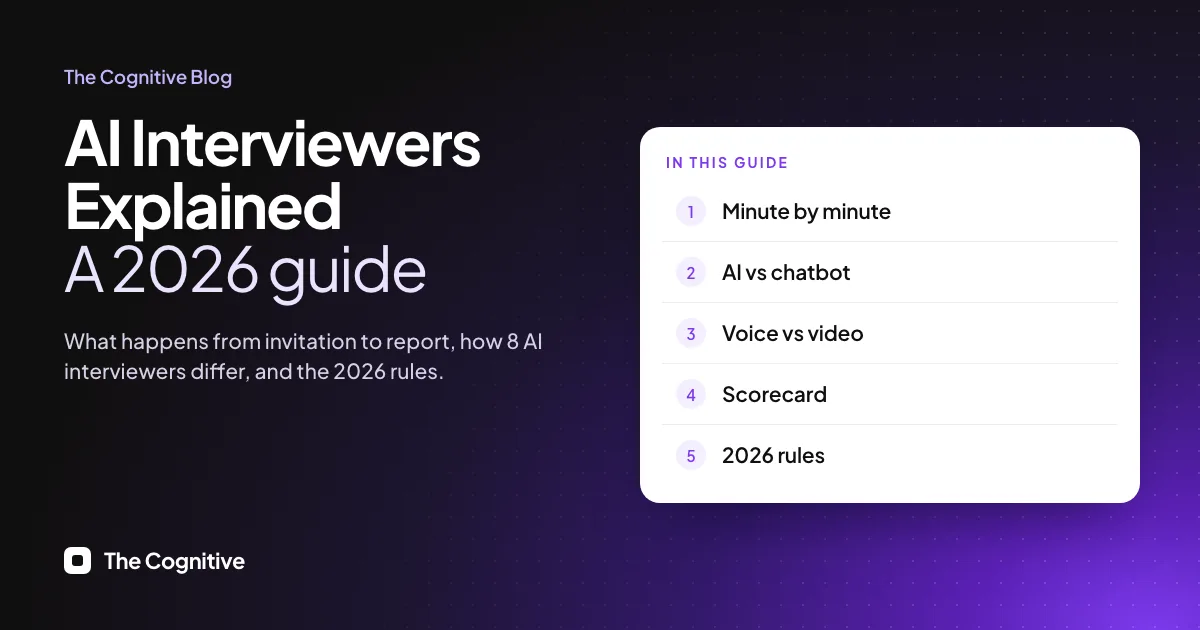
Interview AI, often called an AI interviewer, is software that runs a job interview by itself: it asks role-specific questions, follows up on each answer, and hands the employer a scored report with the transcript and recording. The Cognitive runs it as a live, two-way AI video interview of 10 or 20 minutes, in 9 languages. Employers use it for the first round. Candidates meet it in that round, and many practise with AI before it. The useful tools hold a live, two-way conversation. A chatbot, a resume parser or a one-way video recorder does a narrower job.
Full disclosure: I run The Cognitive, AI recruiting software that sources candidates across ~900M public profiles and then interviews the people you pick in a live, two-way AI video interview. Other vendors on this page are described from their own websites, read on 4 October 2026.
A senior engineer finishes their sixth first-round call of the week. They knew 4 of those candidates were a no within 5 minutes, yet each call still took 45 minutes plus notes and a debrief. By Friday the team has spent a full engineering day confirming what a structured first round could have shown them in a report.
That is why the AI interviewer matters. The middle of the funnel is where time and signal disappear, and Ashby's Talent Trends Report says the average recruiter now processes 291 applications per hire, against roughly 100 in early 2021. In The Cognitive, the interviewer is one half of the product. The other half, AI sourcing, finds people from a plain-English brief, reveals verified emails and phone numbers, and feeds the people you pick into these interviews.
What an AI interviewer actually is
An AI interviewer is a system that conducts a live interview using voice or video, asks role-specific questions, adapts its follow-ups in real time, and produces a structured evaluation from the conversation.
The term gets stretched. Plenty of AI interview tools are forms with a voice: they ask 5 fixed questions, the candidate records answers, and the tool summarises the transcript. That can work for simple screening, but nobody probes a weak answer, so it falls short of an interview in any meaningful sense.
An interview has 3 jobs:
- Ask the right question for the role. A junior frontend interview should not look like a principal platform engineer interview.
- Listen to the actual answer. The substance of what the candidate said counts, not keywords or resume claims.
- Decide what to ask next. If the answer is vague, probe. If it is strong, go deeper. If it exposes a gap, test the gap.
If a tool cannot do all 3, it is a workflow tool with an AI label. The simple test: if a candidate can pass by memorising 10 scripted answers, it is a form. If they have to think through follow-ups they did not expect, it is an interview.
What does AI interview mean?
An AI interview is a job interview in which software asks the questions and evaluates the answers against criteria the employer set. It covers a live video or voice conversation, a phone call, a text chat, or a one-way recording scored afterwards. "Is it an AI interviewer?" usually means the first kind, where the AI talks back.
What is an AI screening interview?
An AI screening interview is the first-round version: a short AI interview that decides who moves on to a human. Most AI interviewers on the market are built for this step. Screening checks the must-haves and how someone explains their work. Final rounds, selling the role and the offer stay with people.
One naming trap: an "AI research interviewer" interviews participants for user or market research. Same technology, different job; this guide covers hiring only.
Who uses interview AI, and for what?
"Interview AI" is searched by 2 groups who rarely read the same page. Employers buy it to run first-round interviews. Candidates look it up because an invitation landed in their inbox, or because they want to rehearse.
- Hiring teams put an AI interviewer straight after sourcing or applications, as the first structured round. The AI asks, follows up and writes the report, and a person decides who moves on. Our AI interviewer page shows how that round runs inside The Cognitive.
- Candidates meet the AI in that round. Before it, many sit a practice AI interview, which is the same kind of conversation with nothing riding on it.
This guide takes the hiring side first, then the interview from the candidate's chair, then the fairness and disclosure rules that apply to both.
What happens in an AI interview, minute by minute?
Here is the whole path in The Cognitive, from invitation to a hiring manager's decision, using the product's real steps.
- Before day 1: you set the rubric. You describe the role, and The Cognitive drafts 5 or 6 evaluation criteria from the job description, with weights that add up to 100, and leaves out vague criteria such as "culture fit". You edit them, then pick 10 or 20 minutes and 1 of 9 languages.
- Day 1: the invitation goes out. You can select any number of candidates and invite them in one go. The invitation tells candidates the interview is run by AI, and links to a booking page.
- The candidate books a slot. No account is needed. Open slots appear in the candidate's own time zone, inside the window you set, and no recruiter needs to be online. If nobody books within 5 days, the invite cancels itself.
- Reminders. Booked candidates get reminder emails, starting 24 hours before the interview, with a last one 15 minutes before.
- Just before the call: a plan for this person. A planner reads the candidate's resume, any notes and earlier-round results, then picks up to 5 topics the interview must probe and up to 4 it can skip because the materials already prove them. So 2 candidates for the same role get different questions against the same rubric.
- Minutes 0 to 2: the opening. The candidate joins in the browser on camera. The AI greets them by name, says the session is recorded for evaluation, and opens with small talk before the first real question.
- Minutes 2 to 20: the substance. The AI works through the role's criteria and the planned topics. Each follow-up is built from the candidate's last answer, so a vague claim gets a "what exactly did you do?" and a strong answer gets a harder one.
- Minute 20: the end. The session ends automatically when the time you chose runs out, so a 10-minute interview stops at 10. The clock runs from the start, and refreshing the page does not reset it.
- Straight after: the report. The report scores each criterion, checks the resume claims against what was said, and logs any integrity flags. The next section shows what is inside it.
- The decision stays human. The hiring manager gets the report and can approve, skip, hold or reject the candidate from a link. Nothing is rejected automatically. If the candidate was imported from your ATS, a note with the score, a summary and the report link is written back to their ATS record.
How does an AI interviewer work?
A good AI interviewer runs 3 systems at the same time: the role framework, the conversation engine and the scoring layer.
1. The role framework decides what matters
Before the interview starts, the system needs to know what it is judging. That comes from the job description, seniority, role type and hiring criteria.
For a backend engineer, the framework may focus on system design, debugging, ownership, API design and trade-off thinking. For a customer success manager, it may focus on discovery, escalation handling, commercial judgment and retention instincts.
Cheap AI interview software breaks here: one generic question bank for every role produces generic answers and scores that mean little.
2. The conversation engine listens and adapts
The conversation engine transcribes the candidate in real time, picks out claims and decides what needs a follow-up. Say a candidate says, "I improved system performance significantly." A weak tool hears "performance" and "improved" and moves on. A real AI interviewer asks what changed in numbers: latency, throughput, error rate or cost.
If the candidate says latency dropped from 900ms to 180ms, the next question is what the bottleneck was. If they say "we optimised the database", the AI should push again: which query, what the plan showed, and what trade-off the fix introduced.
The value sits in the fourth question, the one the candidate did not rehearse.
A sample of how a follow-up adapts
The exchange below is illustrative. I wrote it to show the mechanics; it is not a real candidate or a real transcript. The role is a sales development representative, and the rubric criterion being tested is "builds and qualifies pipeline".
AI: Tell me about an outbound campaign you ran from start to finish.
Candidate: I ran a cold email campaign to fintech companies last quarter and it went really well.
AI: What does "really well" mean in numbers? How many people did you email, and how many replied?
Candidate: About 400 emails, and roughly 1 in 10 replied.
AI: Of those replies, how many became qualified meetings, and what made a lead qualified for you?
Candidate: Maybe 8 meetings. Qualified meant they had budget this year and a team of at least 5 analysts.
AI: You went from about 40 replies to 8 meetings. Where did the other 32 drop out, and what would you change next time?
A one-way tool would have accepted "it went really well". The live interviewer turned it into a reply rate, then a qualification rule, then a drop-off question that someone who really ran the campaign can answer. The rubric did not change. The questions did.
The 5-minute recording shows a live, two-way AI interview for a go-to-market role. The AI asks the candidate about an outbound email campaign, then follows up on reply rates and on how leads were qualified, building each question from the previous answer.
3. The scoring layer maps answers to evidence
Scoring should happen against competencies, not vibes. The interviewer looks at depth, specifics, reasoning, trade-off awareness and how the candidate handles pushback.
The hiring team should get more than a lonely number, because a score without reasoning is another opinion. We break down the mechanics in how AI interviews grade real evidence. In The Cognitive, a 3 out of 5 on problem solving sits beside overall written feedback (strengths, areas to improve and the reasoning behind the recommendation), verbatim quotes in the strengths and observations, and a timestamped transcript and recording to check them against. The hiring manager can agree or override. The AI does not make the hire.
AI interview vs chatbot vs async video: do not mix these up
Most buying mistakes start here, because "AI interview" covers tools that solve different problems.
Chatbots move candidates around
Recruiting chatbots ask eligibility questions, collect availability, answer FAQs and route candidates. Useful, but not interviewing. A chatbot can ask whether someone has 5 years of Python. It cannot reliably test whether they understand how distributed systems fail. Our list of recruiting chatbots shows what they do well.
Resume parsers judge written claims
Resume parsing and matching tools judge what the candidate wrote, not what they can defend. In a 4Q24 Gartner survey, 39% of candidates used AI during the application process, most often to write resume text, so that signal is getting weaker. The Cognitive's report tests those claims out loud and marks each one verified, refuted or unclear. For the parsing side, see our guide to resume parsing software.
Async video records answers
Async video tools ask candidates to record responses to preset questions. There is no live pushback, no adaptive follow-up and no "wait, explain that part". It is a video form.
We wrote a separate explainer on what AI video interviewing is. If your goal is speed on basic screening, async may be enough. If your goal is to understand how someone thinks, you need a live AI video interview.
Note-takers record human interviews
Interview intelligence software, or an AI interview assistant, joins interviews people run and transcribes both sides. Metaview, for example, says its interview notes product will "Capture, summarize, and annotate candidate interview notes automatically." These tools never ask a question. Pick one if people run every round; our roundup of interview intelligence platforms and our Metaview review compare them.
Voice-based vs video-based AI interviewers
Voice-based AI interviewers feel like phone screens. They suit high-volume hiring that confirms eligibility, availability and communication basics, as in retail, logistics, hospitality and many hourly roles, because candidates can finish from any phone.
Video-based AI interviewers are better for depth. The candidate is on camera, the format feels like a real interview, and candidates treat it seriously. Video fits technical interviews, managerial rounds, sales role plays and senior behavioral interviews.
The Cognitive runs live AI video interviews for this reason, at 10 or 20 minutes per role. 10 minutes covers the must-haves and a probe or two. 20 minutes leaves room to follow a strong answer 3 or 4 questions deep, which is where reasoning shows. Candidates book their own slot inside your window, shown in their own time zone, so someone in Manila and someone in Toronto each pick a time that suits them.
How do the leading AI interviewers differ?
The format is the biggest difference between AI interviewing software, bigger than any feature list. Here is how 8 products compare. I filled in every cell from each vendor's own site on 4 October 2026:
| Product | Format | Does the AI follow up live? | Where the candidate takes it | Languages (their figure) | Price on website? |
|---|---|---|---|---|---|
| The Cognitive | Live two-way AI video interview, 10 or 20 minutes | Yes | Browser, on camera, self-booked | 9 | Yes |
| HireVue AI Interviewer | Voice-based AI interview, plus separate one-way and live video | Yes | Voice | 4 named, "and More" | No |
| Alex | Two-way screening interview | Yes | Video, phone, SMS or WhatsApp | 26+ | No, demo first |
| HeyMilo | Two-way AI interview plus SMS and form screening | Yes | Voice, video, SMS, forms | 20+ | No, demo first |
| Ribbon | Two-way conversation that adapts in real time | Yes | Any phone | 10 | Yes |
| TestGorilla | AI interviews, plus fixed one-way video questions | Yes for AI interviews, no for video questions | Online, on the candidate's own time | Not stated | Yes |
| Sapia.ai | Text chat interview with structured questions | Structured chat | Text chat, from a link in the job ad | 9 listed | No, priced per hire |
| Willo | One-way recorded interviews and skill assessments | No | Recorded video on any device | 18+ | Yes |
HireVue calls its AI Interviewer "voice-based", with "probing follow-up questions, in a natural two-way conversation" and a "Custom 1-5 rubric". Alex and HeyMilo cover the most channels, which suits hourly applicants on their phones. TestGorilla, best known for skills tests, now runs AI interviews too: "An AI interviewer asks dynamic follow-up questions in the moment", beside a separate fixed-question video format.
Most of these tools interview people who already applied. The Cognitive starts earlier: it searches ~900M public profiles, then interviews the people you pick. Ribbon and TestGorilla also list sourcing products, so ask any vendor whether its search reaches beyond your own database. Our trade-offs: no phone, SMS or chat interviews, no one-way mode, and 9 languages where Alex lists 26+. Our ranking of AI interview platforms has a checklist for comparing them.
AI interviewer vs human interviewer: can AI replace human interviewers?
No. An AI interviewer replaces the repetitive first round, not the people who decide.
- The AI is better at giving every candidate the same rubric, at a slot they booked, without fatigue, and leaving a full transcript and recording behind.
- People are better at reading context the rubric does not cover, judging team dynamics, selling the role and negotiating the offer.
- Senior hires still need human-led interviews for an accurate evaluation of senior engineers and leaders. The AI round makes them sharper, because the human starts from a report.
Candidates are wary of AI judges. In Gartner's 1Q25 survey of 2,918 job candidates, just 26% trusted AI to evaluate them fairly, and 25% said they trust employers less if AI evaluates their information. Keep a person on every decision and say plainly where AI is used.
Why consistency is the hidden value of AI interviews
Most hiring leaders think their interview problem is volume. It is usually variance.
One interviewer goes deep on system design; another spends half the call on small talk. One is engaged and asks hard follow-ups; another is tired and lets weak answers slide. People get tired, anchor on first impressions and write notes from memory, so the Monday candidate gets a different interview from the Friday candidate.
An AI interviewer holds the evaluation steady. The same rubric, with the same weights, judges candidate 1 and candidate 400, while the questions still adapt to each person's answers. Human judgment stays and gets a cleaner base layer.
For fairness, scoring everyone on the same criteria with an audit trail beats pretending people are neutral. We cover that trade-off in what recruiters need to know about bias in AI hiring, and our bias and fairness page says what The Cognitive does and does not do. One honest gap: The Cognitive does not publish a third-party bias audit.
What the AI interview scorecard should show
The scorecard is where weak AI interview tools reveal themselves. A bad report says "Candidate scored 78" and tells you almost nothing.
A useful report shows:
- Scores for the role's own criteria, not generic personality traits.
- The full transcript, so the team can inspect the actual exchange.
- The video recording, for moments where tone, hesitation or clarity matter.
- Written reasoning behind the scores, with quotes from the conversation you can check against the transcript.
- Flags for weak claims, where the candidate gave vague, inflated or inconsistent answers.
- A human review path, so managers can override or add context before deciding.
This changes the debrief. Instead of "I liked her" against "I wasn't convinced", the team can say, "At 8:42 she explained the caching trade-off clearly, but the failure recovery answer at 16:10 fell apart." It also protects engineering time: engineers read reports and join only for candidates who have shown the signal.
What The Cognitive's AI interview report contains
Every completed interview in The Cognitive produces one report with 6 parts:
- A 1 to 5 score for each criterion, plus overall written feedback with the reasoning behind the recommendation.
- A weighted score out of 100 using the weights you set, plus a suggested verdict.
- The transcript and the recording.
- Resume claim checks. The AI plans up to 5 resume points to probe, and each comes back marked verified, refuted or unclear, with the evidence from the interview.
- Integrity flags, such as tab switches, copy and paste, camera off and face checks. They are logged for you to review, and they are not scored.
- Strengths and areas to improve, with verbatim quotes.
You can share the report as a read-only link. That link carries the scores, the written feedback and the recording, but not the transcript.
What is an AI interview like for the candidate?
For the candidate, an AI interview starts as an email. In The Cognitive, the invitation tells candidates the interview is run by AI and links to a booking page. They pick a slot shown in their own time zone, with no account to create, and get reminder emails before the call.
The interview runs in the browser, on camera, for the 10 or 20 minutes the employer chose, in the language set for the role. The questions come from the role's criteria and from the candidate's own resume: the AI plans up to 5 resume claims to probe, so expect "walk me through that migration" more than a generic opener. A thin answer gets a follow-up. A strong answer gets a harder one.
Before you join, know these:
- A person makes the call. The AI scores and writes a report, nothing is rejected automatically, and a hiring manager picks the next step.
- Integrity signals are logged. Tab switches, copy and paste, camera off and face checks are recorded for the employer to review. They are not scored, but a reviewer will see them.
- Some places give you rights. For Illinois roles, the employer must explain how the AI works and get your consent before an AI-analysed video interview, and must delete the video within 30 days of your request. In New York City, notice comes 10 business days before an automated tool is used, with a way to ask for an accommodation.
Candidates have reason to be wary: in Gartner's 1Q25 survey, only 26% trusted AI to evaluate them fairly. If an invitation does not say who reviews the report, ask the recruiter before you book.
How to use AI for interview workflows without breaking trust
For hiring teams: use AI as the middle-funnel judge
Keep your ATS for pipeline management. Use AI in the middle of the funnel to run structured interviews. Keep people for final decisions, compensation, team fit and closing. Your ATS answers "where is everyone?" The AI answers "who has evidence?" See AI recruitment software versus an AI ATS, and for the systems themselves, our list of ATS software.
For high-volume hiring, the handoff is clearer still. When hundreds apply, manual first rounds collapse under scheduling. A live AI interviewer can interview everyone without a calendar bottleneck, then shortlist the people worth human time. BPO and staffing teams are the clearest example; see how an AI interviewer for BPO and staffing fits that work, and how AI interviews work for high-volume hiring teams.
Say where AI is used. The Cognitive's invitation tells candidates the interview is run by AI; Illinois expects more than that, as the rules section below explains.
For candidates: use AI before the interview, not during it
People search "how to prepare for AI interview" and "AI to help with interview" because they want to know what is allowed. Use AI to practise before, never to generate answers during.
Good prep looks like this:
- Paste the job description into an AI tool and ask which competencies it implies.
- Practise explaining real projects with numbers, trade-offs and failures.
- Ask the AI to challenge your vague answers with follow-up questions.
- Record yourself answering and check whether your examples are specific.
On the day, expect a browser link, a short introduction, then a conversation with a strict, attentive interviewer. Use a quiet room and a laptop if you can, and answer the question that was asked; the follow-ups reward specifics over polish.
Bad prep is memorising scripts. Worse is feeding yourself live answers from another AI. In Gartner's 2Q25 survey of 3,000 candidates, 6% admitted to interview fraud, and Gartner predicts 1 in 4 candidate profiles worldwide will be fake by 2028, so employers are watching. Platforms log signals such as tab switching and copy and paste, and the follow-ups expose shallow understanding fast. The format rewards real experience. Prepare your stories, and do not fake the thinking.
Practise with a free AI interview before the real one
The quickest way past the nerves is to sit one. Our free practice AI interview lets you pick one of the sample roles, enter your name, email and phone, and get an interview link by email, with no account. It is the same kind of live conversation with follow-ups, and nothing rides on it.
Use the practice run as a diagnostic. Afterwards, note every answer where you reached for a vague word like "significantly" or "a lot", then rehearse the number behind it. Our guide on how to prepare for an AI interview has 9 tips and a checklist for the day itself.
What are the 2026 rules for AI interviews?
4 sets of rules come up most in 2026. This summarises the official sources, read on 4 October 2026. It is not legal advice; ask your counsel.
New York City Local Law 144
New York City bars automated employment decision tools unless the tool had a bias audit within 1 year of use, the audit summary is public, and candidates got notice. Enforcement began on 5 July 2023. The notice goes out 10 business days before use, with instructions for requesting a reasonable accommodation. More on our Local Law 144 page.
Illinois Artificial Intelligence Video Interview Act
In force since 1 January 2020, the act covers video interviews analysed by AI for Illinois-based roles. Before the interview, the employer must say AI may be used, explain how it works and what general characteristics it evaluates, and get consent. Videos must be deleted within 30 days of a request. Separately, Public Act 103-0804, effective 1 January 2026, makes discriminatory AI, zip-code proxies and failing to give notice of AI use civil rights violations.
Colorado SB26-189
Colorado's law, signed on 14 May 2026, repeals and re-enacts SB24-205 and covers employment decisions. From 1 January 2027, developers owe deployers documentation on uses, training data and limits, and people can correct their data and request human review after an adverse outcome.
EU AI Act
The European Commission lists employment among the high-risk areas of the AI Act. After the AI Omnibus entered into force on 27 July 2026, the high-risk rules for those areas apply from 2 December 2027. Emotion recognition in workplaces is already prohibited. Our EU AI Act page tracks the dates.
The common thread: tell candidates where AI is used, keep a person on the decision, and keep records you can explain.
When should a company use an AI interviewer?
You do not need AI interviewing for every role. If you hire 2 people a year and your founders enjoy every screen, keep it manual. Once interview volume rises, the case changes fast.
Use an AI interviewer when:
- You run more than 15 substantive interviews a month.
- Your engineers or managers lose a big share of their week to first rounds.
- Your time to hire regularly stretches past 30 to 45 days.
- You need consistent evaluation across several recruiters or hiring managers.
- You hire across time zones and scheduling slows everything down. Our list of tools for remote recruitment covers the rest of that stack.
- You need documented, criteria-based reports for fairness, compliance or manager trust.
Those thresholds are my rules of thumb, not industry statistics. The software should cut first-round hours, give every candidate the same rubric, and get a report to the hiring manager while the candidate is still interested. The Cognitive can also find the candidates first, so the interview is not limited to whoever applied. AI Sourcing starts at $49/month and AI Interview at $99/month.
AI interviewers work for structured first rounds when the AI follows up live, scores against your own criteria and hands the report to a person. They work poorly when they ask fixed questions, use one question bank for every role or auto-reject.
Common AI interview mistakes hiring teams should avoid
Using one generic question bank
A product manager, a backend engineer and a data scientist need different criteria. Start from a role-specific set such as these first-round interview questions and adapt them. Treat every role the same and the scorecard looks clean and means little.
Auto-rejecting without human review
Use AI scores to triage, not to make final decisions in a black box. A person should review the top candidates and any borderline cases. A good rule: review the top 25% and anyone near the cutoff.
Ignoring completion rate
If fewer than 80% of booked candidates finish, something is broken. The invite may be unclear, the instructions too long, or the interview too long for the role. Fix the invite first.
Not disclosing that the interviewer is AI
Always disclose it in the invite. It is an ethics issue and, in places such as Illinois, a legal one. With only 26% of candidates trusting AI to evaluate them fairly, by Gartner's count, a surprise does not help.
Letting reports sit for days
If it takes more than 48 hours after an AI interview to make a next-step decision, your bottleneck has moved from interviewing to internal review. The fix is a clear owner and a same-day review habit.
Never recalibrating the rubric
If hiring managers override AI scores more than 30% of the time, do not blame the model first. Revisit the rubric: the criteria, the weights or the evidence standard may be wrong.
When you evaluate vendors, buy on a real live interview, adaptive follow-ups, evidence, an ATS connection and human control, not feature count. Our AI interview platform comparison lists the questions to ask.
Where AI interviewers are heading next
The idea goes back to the 1956 Dartmouth workshop, where researchers first asked whether machines could simulate human intelligence. For decades early systems were rule-based and speech recognition was brittle. Transformer models raised the ceiling, and GPT-3 arrived in 2020.
By 2026 AI interviewing has spread beyond specialist vendors. HireVue sells a voice-based AI Interviewer, and TestGorilla, best known for skills tests, now runs AI interviews with live follow-ups. Integrity tooling is growing up alongside: HeyMilo sells interview proctoring and cheat detection, and TestGorilla describes identity checks and window-switch signals.
The next phase is better interview intelligence: more adaptive follow-ups, stronger integrity checks, tighter ATS workflows, clearer compliance trails and reports hiring managers trust. Those shifts line up with the AI interviewing technology trends shaping 2026.
The principle stays the same. Organise with the ATS. Interview with AI. Decide with people.
Hear your next hire answer before you meet them Find people across ~900M public profiles and invite the ones you pick to a live AI interview. Start free
The bottom line on AI interviewers
An AI interviewer is worth using when it gives you consistent depth, faster evaluation and evidence you can inspect. It should run the repetitive, evidence-gathering part of the process and leave judgment and closing to people.
The Cognitive was built for that middle-funnel job. It runs live, two-way AI video interviews of 10 or 20 minutes in 9 languages, pushes back on weak answers, checks resume claims and returns a scored report with the transcript and recording. Its AI sourcing covers the step before, across ~900M public profiles.
To start, open an account at app.thecognitive.io/signup, write one role's brief, and invite your first candidates to an AI interview. There is a free trial with 100 sourcing credits.
Run one role through an AI interview this week Describe the role, invite the people you pick, and read their reports before your first call. Start free
Sources
- Ashby, Talent Trends Report, applications per hire: ashbyhq.com (read 3 October 2026)
- Gartner, "Gartner Survey Shows Just 26% of Job Applicants Trust AI Will Fairly Evaluate Them", 31 July 2025: gartner.com (read 4 October 2026)
- HireVue homepage and AI Interviewer page: hirevue.com, hirevue.com/solutions/ai-interviewer, hirevue.com/pricing (read 4 October 2026)
- Alex platform page: alex.com/platform (read 4 October 2026)
- HeyMilo homepage and AI video interview page: heymilo.ai, heymilo.ai/product-feature/ai-video-interview (read 4 October 2026)
- Ribbon homepage and pricing: ribbon.ai, ribbon.ai/pricing (read 4 October 2026)
- TestGorilla AI interviews and pricing: testgorilla.com/ai-interviews, testgorilla.com/pricing (read 4 October 2026)
- Sapia.ai chat interview and pricing: sapia.ai/platform/interview, sapia.ai/pricing (read 4 October 2026)
- Willo homepage and pricing: willo.video, willo.video/pricing (read 4 October 2026)
- Metaview interview notes: metaview.ai/interview-notes (read 4 October 2026)
- NYC Department of Consumer and Worker Protection, automated employment decision tools: nyc.gov and DCWP AEDT FAQ (read 4 October 2026)
- Illinois Artificial Intelligence Video Interview Act, 820 ILCS 42: ilga.gov (read 4 October 2026)
- Illinois Public Act 103-0804: ilga.gov (read 4 October 2026)
- Colorado SB26-189: leg.colorado.gov (read 4 October 2026)
- European Commission, AI Act regulatory framework: digital-strategy.ec.europa.eu (read 4 October 2026)
Frequently Asked Questions
What is an AI interviewer in hiring?
An AI interviewer is software that conducts a structured job interview by voice or video, asks adaptive follow-up questions and scores the candidate against role-specific criteria. It differs from a chatbot, a resume parser or a one-way video recorder because it reacts to what the candidate actually says. The Cognitive runs this as a live, two-way AI video interview of 10 or 20 minutes, in 9 languages.
What is interview AI, and what does AI interview mean?
Interview AI is software that asks the questions in a job interview and evaluates the answers against criteria the employer set, so an AI interview is a job interview run by that software. The term covers live video or voice conversations, phone calls, text chats and one-way recordings scored afterwards. Most people mean the live kind, where the AI talks back and follows up; The Cognitive runs that kind on video.
How does an AI interview work, step by step?
The employer sets a rubric, invites candidates, and the AI runs the interview and writes a report for a human to decide on. In The Cognitive, the invitation tells candidates the interview is run by AI, they book their own slot without an account, a planner picks up to 5 topics to probe for each person, and the live interview adapts every follow-up to the last answer. A hiring manager then approves, skips, holds or rejects from a link; nothing is rejected automatically.
How does an AI interview scorecard work?
A good AI interview scorecard scores the role's own criteria, explains its reasoning and gives you the transcript and recording to check it against. The Cognitive's report gives a 1 to 5 score per criterion, overall written feedback with the reasoning behind the recommendation, a weighted score out of 100 with a suggested verdict, the transcript and recording, resume claims marked verified, refuted or unclear, and integrity flags that are logged but not scored. Verbatim quotes appear in the strengths and observations.
Does The Cognitive replace human interviewers?
No. The Cognitive runs the structured middle-funnel interview and produces a scored report, while people still make the final decision, sell the role and handle context. Set an AI interviewer against a human interviewer and the AI is better at the repetitive first round, applying the same rubric to every candidate at a slot they booked and leaving a full record, and people are better at judgment, selling the role and closing. Nothing is rejected automatically, and with only 26% of candidates trusting AI to evaluate them fairly in Gartner's 1Q25 survey of 2,918, a person should stay on every decision.
Does an AI interviewer conduct conversational screening interviews and generate structured assessments of technical and communication skills?
Yes, a live AI interviewer holds a conversational screening interview and scores it against structured criteria you set, which can include technical depth and communication. In The Cognitive, the criteria are drafted from the job description as 5 or 6 weighted parameters that you edit, each is scored from 1 to 5, and the report adds overall written feedback. It has no coding editor, so pair it with a coding test for hands-on programming roles.
Is a voice AI interview enough for technical hiring?
Usually not on its own: voice AI works for quick eligibility checks, while technical, managerial and behavioral evaluation goes deeper on live video. Voice suits high-volume roles where candidates answer from a phone. The Cognitive runs live video interviews of 10 or 20 minutes, which leaves room to follow a strong technical answer 3 or 4 questions deep.
Do employers have to tell candidates an AI is interviewing them?
In some places yes, and it is good practice everywhere. The Illinois Artificial Intelligence Video Interview Act requires notice, an explanation of how the AI works and consent before AI-analysed video interviews for Illinois roles, and New York City's Local Law 144 requires notice 10 business days before an automated tool is used. The Cognitive's invitation tells candidates the interview is run by AI. This is not legal advice.
How should candidates prepare for an AI interview?
Practise before the interview with real, specific examples, and never use AI to generate answers during it. Review the job description, prepare stories with numbers and trade-offs, and sit a practice run: The Cognitive's free practice AI interview at /try-interview needs no account. Platforms log signals such as tab switching and copy and paste, and adaptive follow-ups expose rehearsed or assisted answers quickly.
Is there an AI interviewer for BPO and high-volume hiring?
Yes. The Cognitive's live AI video interviews let BPO and staffing teams interview every candidate without a scheduling bottleneck, with bulk invites and self-booked slots in the candidate's time zone. For hourly roles where candidates apply from a phone, tools with phone or text interviews such as Alex, HeyMilo or Sapia.ai may fit better, since The Cognitive runs no phone, SMS or chat interviews.
Related reading
- Artificial Intelligence Scoring: How AI Interviews Grade Real Evidence
- AI Interview Platforms Compared: The 10 Best for First-Round Screening in 2026
- How Live AI Video Interviews Work Without a Recruiter Online
- What Is a Normal Cost Per Hire? Benchmarks by Seniority, Sector, Role and Region
- How Many Candidates Are Interviewed per Hire? 2025 and 2026 Benchmarks by Role and Stage
- Affordable AI Recruiting Tools That Show Their Prices: How 10 Bill You in 2026