Conversational AI Interview: How to Tell a Real Conversation From a Script
By Sparsh Goyal, Founder at The Cognitive. Published · Last updated
- A conversational AI interview is live, and the AI picks each next question from the answer the candidate just gave.
- The test: a vague answer should get a request for one specific example. If question 3 arrives whatever was said, it is a script.
- The rubric stays fixed per role while the questions adapt, which keeps different conversations comparable.
- A 6-step demo script exposes a scripted tool in about 15 minutes.
- The Cognitive runs it as a live, two-way AI video interview of 10 or 20 minutes in 9 languages, and rejects nobody automatically.
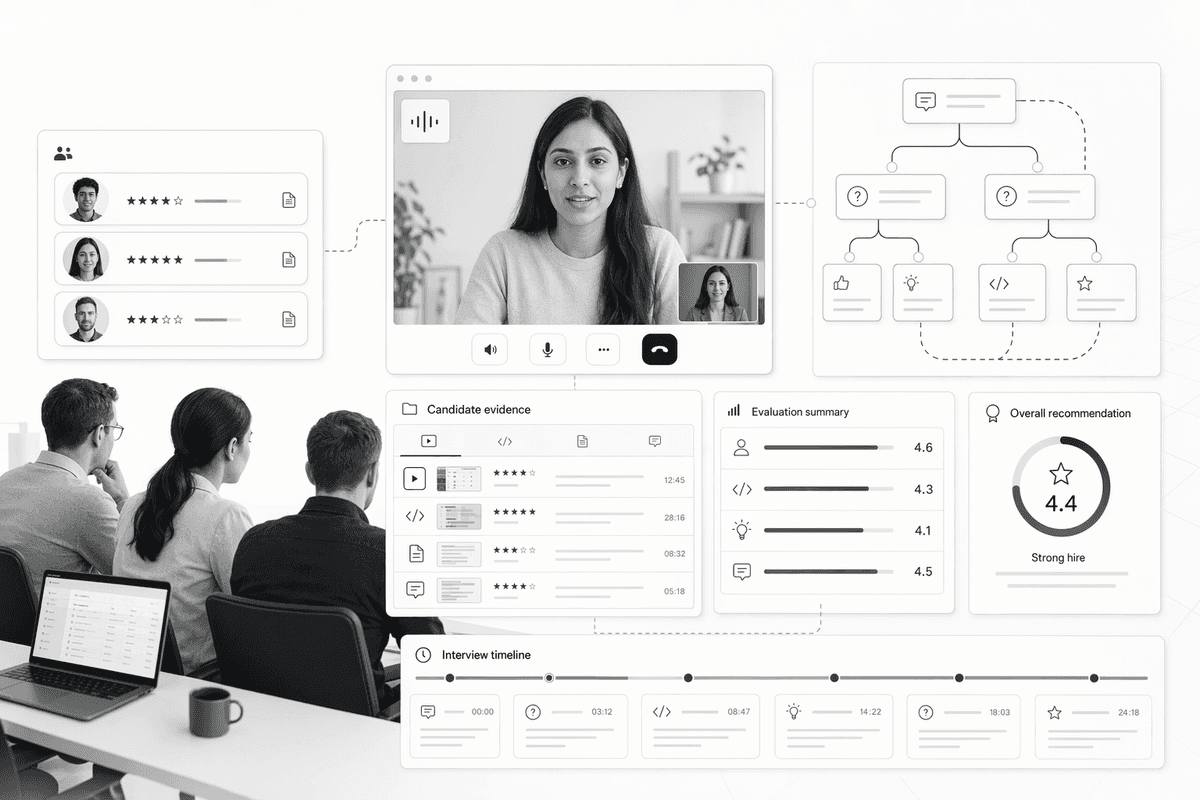
A conversational AI interview is a live job interview in which the AI picks its next question from the answer the candidate just gave. If a vague answer gets a request for one specific example, the interview is conversational. If question 3 arrives no matter what was said in question 2, it is a script. The Cognitive runs this format as a live, two-way AI video interview of 10 or 20 minutes, in 9 languages.
Full disclosure: I run The Cognitive. This page is about one narrow question, which is how to tell a real conversation from a scripted flow, and how to test a vendor for it before you buy. For the wider category, our guide to AI video interviewing covers the formats, and async vs live AI interviews compares the two main ones head to head. Product facts below were checked in our app on 4 October 2026.
In 1966, Joseph Weizenbaum published ELIZA, a program written at MIT that played a psychotherapist. You typed that you felt anxious. ELIZA asked why you felt anxious. You mentioned your mother. ELIZA asked you to tell it more about your mother.
People who used it felt understood. Under the hood it matched keywords and turned your sentence back into a question.
Hiring software has the same problem 60 years later. Plenty of tools now have a camera, a voice or an avatar, and buyers read that as conversation. A fixed list of questions read by a pleasant voice is still a fixed list. A one-way video tool is still a recording box. An AI interview chatbot that asks the same next question whatever the candidate says is still a form.
So the test I use is short: does the interview change because of what the candidate just said?
If yes, you may be looking at a conversational AI interview. If no, you are looking at a form with better packaging.
The Cognitive is built around that line. The AI interviewer runs a live, two-way video interview at a slot the candidate books, asks role-specific questions against a rubric fixed for the role, follows up when an answer is thin, and hands back a report with a 1 to 5 score per criterion, overall written feedback, a weighted score out of 100, the transcript and the recording. The same account also runs AI sourcing, so people found from a plain-English brief across ~900M public profiles can be invited straight into that interview.
What a conversational AI interview actually is
A conversational AI interview is a real-time interview where the system listens to the answer, works out what it means, judges whether it counts as evidence for the criterion being tested, and then decides what to ask next.
That sounds obvious until you line it up against the other things sold under similar names:
- Async video interview: the candidate records answers to preset questions. Nobody responds, so a vague answer is never corrected or followed up.
- AI interview chatbot: the candidate types or speaks to a scripted flow. It can feel interactive, but the path through the questions is usually fixed in advance.
- AI voice interview: questions are delivered by voice. Voice is only the delivery channel, and the interview is conversational only if the follow-ups adapt.
- Interactive AI interview: the candidate is probed, asked for specifics, and redirected in the moment.
- Conversational AI video interview: a live video conversation where the AI asks role-specific questions and adapts each next question to the answers so far.
The last two are where the signal is. The idea to hold on to is that conversation is about conditional behaviour, not the interface. A tool with a face and a voice can still be a form. A plain-looking tool can be conversational if its next question depends on the previous answer.
One more distinction matters for buyers. In a good conversational interview, the questions move but the yardstick does not. The Cognitive fixes the rubric per role before anyone is interviewed, and the questions adapt live inside it. That is how two candidates who had different conversations still get scored on the same criteria.
Conversational AI interviews vs forms with a camera
Many teams buy the wrong thing because the marketing blurs this line.
A form asks every candidate the same thing in the same order. The answers are captured but never tested. The delivery can be text, video, voice or an avatar, and it makes no difference: if question 3 is always question 3 regardless of what happened in question 2, it is not a conversation.
A conversation reacts. Here is what that looks like in an engineering screen:
- The candidate says they scaled a service to 10 million requests a day. A form moves on.
- A conversational interviewer asks what broke first. The candidate says the database.
- The interviewer asks which query, what changed, and what the fix cost. The candidate says they added indexes.
- The interviewer asks whether write performance got worse after that.
That third and fourth step is where rehearsed answers start to crack, because nobody rehearses the second follow-up.
A candidate who can beat your interview by memorising answers has not really been interviewed. They have sat an open-book test with the questions published in advance.
Async solves scheduling, and a live conversation solves depth. They are different problems, which is why the async vs live comparison keeps coming back to follow-up questions.
How natural language understanding creates real interview signal
Early AI hiring tools could transcribe speech, count keywords and score tone. Some tried to score facial expressions, which is exactly the kind of thing hiring teams should be careful with. None of that told you whether the candidate had answered the question.
Conversational interviews work now because language models are good enough to tell a polished generality from a specific example. Take this answer to a behavioural question:
I believe in gathering as much information as possible while being comfortable with ambiguity. I have had to make many decisions in uncertain conditions, and I always identify the key assumptions and validate them quickly.
A keyword scorer likes that answer. It finds information, ambiguity, assumptions and validate, and gives a good score.
A trained interviewer hears no situation, no decision, no trade-off and no outcome. A conversational system should respond the way that interviewer would, with a specificity probe:
Can you walk me through one specific decision you made with incomplete information? What was missing, what did you decide, and how did it turn out?
That follow-up is the interview. Without it you are scoring presentation, and judgment never gets tested.
The four levels of answer quality
A useful way to think about what the interviewer should do next is a 4-step ladder. Each level has its own next move:
- Principle answer. The candidate says what they generally believe. Next move: ask for one real instance.
- Partial answer. There is a situation, but the candidate's own role, action, conflict or outcome is missing. Next move: ask for the missing piece.
- Specific answer. Situation, action and outcome with real detail. Next move: test an edge case or a trade-off.
- Deep answer. The candidate explains what went wrong, what they learned and what they changed. Next move: stop probing and test an adjacent criterion.
This ladder is also why structured interviews need more than a list of questions. Structure gives you fairness across candidates. Follow-up gives you depth with each one. A good first round has both.
What makes an AI voice interview feel like a real interview
Candidate experience changes the quality of your data, so it is more than a soft metric here.
When candidates feel they are talking into a form, they perform. Answers come out guarded, polished and compressed. When they feel heard, they explain, give context, correct themselves and show how they think. Three product details make most of that difference.
Response latency must be low
If the AI leaves a long silence after every answer, the conversation feels like a bad phone line. Candidates start waiting for the tool instead of talking, and they cut their answers short to be safe. When you watch a demo, time the gap between the end of an answer and the start of the next question. If you notice it, candidates will too.
Acknowledgment matters
A good interviewer does not jump between topics like a survey. They show they heard the answer, then probe it.
That database migration example is useful. You mentioned a trade-off between speed and reliability. How did you make that call?
That reads as a conversation. Next question: tell me about a technical challenge reads as a form said out loud.
Consistency matters more than charm
Human phone screens are uneven. One interviewer is sharp at 10 a.m. and tired at 4 p.m. One pushes for examples and another accepts vague claims. One is warm and another sounds distracted.
A well-built AI interviewer holds the same standard at every slot. It does not rush because another meeting is starting, and it scores against the same rubric for every candidate on the role. If you still run manual screens, the phone screen interview guide is a useful reminder of how much judgment sits inside a round most teams treat as admin.
On The Cognitive, the invitation tells candidates the interview is run by AI, they book their own slot without creating an account, and the interview runs live in the browser.
Where conversational AI candidate screening fits in the hiring funnel
A conversational AI interview should not replace your ATS, and it should not replace the final human decision. It belongs in the middle of the funnel, where teams currently burn the most time.
The clean setup looks like this:
- The ATS collects and tracks candidates. Greenhouse, Lever, Ashby, Workday or whatever you already run keeps the pipeline. The Cognitive connects to 60+ ATSs.
- The conversational AI runs the first real interview. It covers role fit, depth on the core skill, communication and motivation against the rubric you set.
- People review evidence, not raw resumes. Hiring managers read the scores, the written feedback, the transcript and the recording. For candidates imported from the ATS, a note with the score, the summary and the report link is written back.
- People run the final rounds. They meet the strongest candidates, close the role and make the decision.
This is where hiring automation actually helps. It does not take people out of hiring. It takes low-signal first-round calls off their calendars. Nothing in The Cognitive is rejected automatically: the report suggests a verdict and a person decides.
If you are mapping the buying process, our roundup of the best AI interview platforms covers the vendor questions that matter before you sign.
Conversational AI interview vs async video interview
Async video has a place. It suits a team whose main problem is scheduling and whose early signal is presentation, such as a first look at how someone explains a scenario on camera.
Its hard limit is that it cannot probe. A candidate records an answer, and later the hiring manager watches it and thinks, I wish I could ask what happened next. By then the moment has gone.
A conversational interview catches that moment while the context is still live. An interesting answer gets a deeper question. A generic answer gets a request for one example. An inflated answer gets pushed into detail. On The Cognitive, the AI also plans up to 5 resume claims to probe, and each comes back marked verified, refuted or unclear, with the evidence from the interview.
Format decides depth. Roughly:
- Async video interview: best for scheduling flexibility, presentation checks and simple early filters.
- AI interview chatbot: best for availability checks, knockout questions and basic qualification flows.
- AI voice interview: useful when a phone line is the channel, and only deep if the follow-ups adapt.
- Conversational AI video interview: best for behavioural, technical and judgment-heavy first rounds.
- Live AI interview: best when you need to see how someone thinks under follow-up rather than how they deliver a prepared answer.
Our roundup of video interview software platforms separates one-way recording tools from systems that actually conduct the interview.
Conversational AI recruiting is a wider term than a conversational AI interview
Search for conversational AI recruiting and most results are about chatbots that answer candidate questions, collect applications and book slots. That is useful work, but it is a different job from interviewing.
| Tool type | What the conversation is for | Does it test an answer? | Typical output |
|---|---|---|---|
| Recruiting chatbot | FAQs, application capture, scheduling | No, it routes the candidate | A booked slot or a completed form |
| Screening chatbot | Knockout and logistics questions | Only against fixed rules | Pass or fail on each rule |
| AI voice screen | Spoken questions on a call | Only if follow-ups adapt | Call summary and transcript |
| Conversational AI video interview | Assessing the candidate against a rubric | Yes, with follow-ups on thin answers | Scores per criterion, written feedback, transcript, recording |
If what you need is the chatbot layer, our guide to the best recruiting chatbots covers it. This page sticks to the interview.
How long should a conversational AI interview be?
Length should follow what the round has to decide. Teams get into trouble when they ask a short interview to assess too much, or stretch a screen into something candidates abandon.
A good rule of thumb for a first round:
- About 10 minutes: basic qualification, motivation, availability and 1 or 2 criteria.
- About 20 minutes: a real first round on 3 or 4 criteria, with room for follow-ups on each.
- Longer rounds: senior, case-heavy or leadership interviews where several people need to probe. Those usually belong to your human panel.
A round is deep because it refuses to accept shallow answers, not because the questions are hard. That takes time per criterion, so cut criteria before you cut follow-ups.
The Cognitive runs interviews of 10 or 20 minutes. What comes back is a report a hiring manager can read in a few minutes instead of watching every recording end to end. We wrote separately about what an interview score report should tell you, because a number with no evidence behind it is another black box.
What real conversational AI hiring results look like
The result that matters is fewer extra rounds. If a hiring manager can make a confident call from the report, the candidate skips a phone screen, and every skipped round removes a scheduling gap, a feedback gap and a chance to lose the person to a faster offer.
You do not need a vendor's study to see whether that happens on your roles. Run a pilot on one role and measure it yourself:
| What to measure | How to read it |
|---|---|
| Reports a hiring manager can decide on without another call | The main number. If most still need a phone screen, the rubric or the length is wrong. |
| Follow-ups per answer that was vague | Read 5 transcripts. Every thin answer should have drawn a request for an example. |
| Days from invite to a decision | Compare with the same role run the old way last quarter. |
| Candidates who booked and finished | A low rate usually means the invitation or the length needs work. |
| Agreement between the suggested verdict and your final call | Where they disagree, read why. That is how you tune the criteria. |
Our customers' published results are on the case study pages, for example the fintech compliance hiring case. Treat any vendor's numbers, ours included, as a reason to pilot rather than a promise.
Where conversational AI interviews work best
Conversational AI interviews are not only for engineering. Technical teams adopted AI interview software early, but the mechanism is conversational: understand the answer, decide whether it proves the criterion, and ask the right next question.
That applies almost anywhere:
- Engineering: architecture trade-offs, debugging reasoning, production ownership.
- Customer success: escalation judgment, clear explanations, account prioritisation.
- Sales: discovery discipline, deal strategy, handling objections.
- Operations: process thinking, prioritisation, incident handling.
- Finance: case reasoning, risk judgment, stakeholder communication.
- Healthcare and staffing: availability, judgment, compliance awareness, shift fit.
The limit is usually your competency design. If you have written down what strong looks like, a good interviewer can test for it. If the rubric is vague, the interview will be vague too. The hiring trends piece covers the wider move from resumes to direct evidence.
A 6-step demo script to test whether an AI interview is conversational
Feature grids will not tell you whether an interview is conversational. Sit the vendor's demo interview yourself and play the candidate. These 6 moves take about 15 minutes and expose a script quickly.
| What you do as the candidate | What a script does | What a conversational interviewer does |
|---|---|---|
| Give a principle answer with no example | Moves to the next question | Asks for one specific time it happened |
| Give a good example but leave out your own role | Scores it and moves on | Asks what you personally did |
| Make a big claim, such as a number you cannot back up | Accepts it | Asks how it was measured or what broke first |
| Answer a different question from the one asked | Records the answer anyway | Brings you back to the question |
| Mention a resume item in passing | Ignores it | Probes it, if that item matters for the role |
| Ask the interviewer to repeat or rephrase | Replays the same audio or text | Rephrases in plain words |
Then open the report. Check that the scores match what you actually said, that the transcript is there, and that you can find the moments that drove each score. If the report praises an answer you deliberately made vague, the scoring is reading keywords.
Sit a conversational AI interview yourself Set up a role, invite yourself, and give it a vague answer to see what it asks next. Start free
Common mistakes teams make with conversational AI interviews
Mistake 1: treating AI scores as auto-reject rules
A conversational AI interview should produce evidence, not run a blind pass or fail. Rejecting people on an AI score alone is the wrong model, and it is worst on borderline cases.
The right workflow is human review with better evidence. Let the AI run the interview, let the report surface what was said, and let a person decide. In The Cognitive, integrity flags are logged for a reviewer and are not part of the score.
Mistake 2: confusing an AI avatar with conversational AI
A friendly face does not make a tool conversational. Ask one thing in every demo: show me what happens when the candidate gives a vague answer.
If the system asks the same next question anyway, it is scripted. If it asks for specifics or redirects based on the answer, you are closer to a real conversational interview. Run the 6-step script above to be sure.
Mistake 3: making deep interviews too short
Do not ask a 10-minute interview to assess 5 criteria. It will produce confident-looking scores built on one answer each. Pick the 3 or 4 criteria that decide the round and give them a 20-minute slot.
Mistake 4: hiding that the interview is AI
Tell candidates up front, in the invitation, not halfway through. Say plainly that it is a live AI interview that adapts to their answers. Candidates are usually curious. What they dislike is feeling tricked. On The Cognitive the invitation says the interview is run by AI.
Some places also require notice. New York City's rules for automated employment decision tools, enforced since 5 July 2023, require a bias audit within the past year and notice to candidates 10 business days before use. Check your own jurisdiction.
Mistake 5: accepting scores without quotes
No evidence, no score. If the platform says communication is 4 out of 5, you should be able to find the part of the transcript or recording that earned it. If it cannot show you the evidence, you are trusting a black box.
A quick buyer checklist for conversational AI interviews
When you evaluate a conversational AI candidate screening tool, start with interview quality, then the feature grid.
- Does the follow-up change based on the exact answer? If not, it is a form.
- Does it probe vague answers on its own? Principle answers should trigger a request for an example.
- Is the pause after each answer short enough that you stop noticing it? Long silences kill the conversation.
- Can you check every score against the transcript and recording? The evidence is the product.
- Is the rubric fixed per role while the questions adapt? That is what makes two different conversations comparable.
- Does it sit on top of your ATS instead of trying to replace it? The ATS organises, the AI interviews, people decide.
- Does it reject anyone automatically? It should not.
- Can it handle behavioural, technical and role-specific criteria? You need one system across roles, not a script per role.
If you hire mostly engineers, compare follow-up depth against the tools in our technical interview software guide. The best systems ask the next right question, which matters more than asking harder ones.
Find the people, then hear them think Search ~900M public profiles from a plain-English brief and invite the ones you pick to a live AI interview. Start free
The line to remember
If the questions do not change based on the answers, the candidate is auditioning to a fixed script.
Conversational AI interviews matter because they bring back the part of interviewing that forms removed, which is the follow-up. The candidate makes a claim, the interviewer tests it, and the answer holds up or it does not.
The Cognitive is built for teams that want that evidence without spending their engineers, recruiters and hiring managers on first-round calls. It runs live, two-way AI video interviews of 10 or 20 minutes, returns a report with scores, written feedback, the transcript and the recording, and fits into the stack you already run. AI Sourcing starts at $49/month and AI Interview at $99/month.
The free trial includes 2 AI interviews plus 100 sourcing credits. Put one role through it and give the interviewer your vaguest answer. You will know quickly whether you are buying a conversation or a recording.
Sources
- Joseph Weizenbaum, "ELIZA: a computer program for the study of natural language communication between man and machine", Communications of the ACM, January 1966: dl.acm.org (read 5 October 2026)
- NYC Department of Consumer and Worker Protection, automated employment decision tools: nyc.gov (read 5 October 2026)
- The Cognitive product facts (interview length, languages, report contents, resume claim checks, ATS write-back): our app, checked 4 October 2026
Frequently Asked Questions
What is a conversational AI interview?
A conversational AI interview is a live job interview in which the AI chooses its next question based on the answer the candidate just gave. A vague answer gets a request for a specific example, and a big claim gets a follow-up. The Cognitive runs this as a live, two-way AI video interview of 10 or 20 minutes, scored against a rubric fixed for the role.
What is the difference between a conversational AI interview and an AI interview chatbot?
A conversational AI interview changes its follow-up questions based on what the candidate just said. An AI interview chatbot usually follows a fixed flow, even when it uses voice or natural language, so it can feel interactive without ever testing the answer. Chatbots suit FAQs, scheduling and knockout questions. Conversational interviews suit assessment.
What is conversational interviewing?
Conversational interviewing is a style in which the interviewer follows the candidate's answers with probing questions instead of reading a fixed list. A conversational AI interview applies that style in software: the rubric is set for the role in advance, and the questions adapt live to each answer, so depth varies by candidate while the scoring criteria stay the same.
How long should a conversational AI interview be for real candidate screening?
About 10 minutes covers basic qualification and 1 or 2 criteria. About 20 minutes gives a real first round on 3 or 4 criteria with room for follow-ups. Longer, senior or case-heavy rounds usually belong to your human panel. The Cognitive runs interviews of 10 or 20 minutes.
Are conversational AI interviews better than async video interviews?
They are better when you need depth, because a live AI interview can probe a vague answer in the moment. Async video is useful for scheduling flexibility and presentation checks, but it cannot ask the follow-up a hiring manager wishes they had asked later. Many teams pick by role and by how much the round has to decide.
What should a conversational AI hiring platform show in the scorecard?
Every score should be checkable against the evidence behind it, which means the transcript and the recording. The Cognitive's report gives a 1 to 5 score per criterion, overall written feedback, a weighted score out of 100, a suggested verdict, the transcript and the recording, plus up to 5 resume claims marked verified, refuted or unclear.
How do I test whether an AI interview is really conversational?
Sit the vendor's demo as the candidate. Give a principle answer with no example, leave out your own role in a story, make a claim you cannot back up, and answer a different question from the one asked. A conversational interviewer follows up on each of these. A script moves on. Then check whether the report rewarded your vague answers.
Do candidates know they are talking to an AI?
They should, and on The Cognitive they do: the invitation tells candidates the interview is run by AI, before they book a slot. Telling people up front is good practice everywhere, and some places require notice, such as New York City's rules for automated employment decision tools.
Can conversational AI interviews work outside technical hiring?
Yes. The mechanism works for sales, customer success, operations, finance, healthcare and staffing roles, because it tests judgment and communication through follow-up questions. The deciding factor is a clear rubric for the role. If you have written down what strong looks like, the interviewer can probe for it.
Does The Cognitive replace the ATS in a hiring process?
No. The Cognitive sits on top of the ATS. The ATS tracks candidates, The Cognitive runs the live AI interview and returns the report, and people make the final decision. It connects to 60+ ATSs, and for candidates imported from the ATS it writes back a note with the score, summary and report link.
Related reading
- What Is a Normal Cost Per Hire? Benchmarks by Seniority, Sector, Role and Region
- Candidate Sourcing Channels Compared: Where to Find Candidates for Each Role in 2026
- How Many Candidates Are Interviewed per Hire? 2025 and 2026 Benchmarks by Role and Stage
- Candidate Experience Platforms Explained: What They Cover, How to Measure Them and 8 Tools to Know
- Canditech Alternatives in 2026: 10 Tools, From Skills Tests to Live AI Interviews
- Data-Driven Recruitment, Sourcing First: 9 Metrics, Clean Data and the Decisions They Should Change