CodeSignal Pricing 2026: Plans, Credits and How It Compares With HackerRank
By Sparsh Goyal, Founder at The Cognitive. Published · Last updated
- CodeSignal Build is $79 a month billed annually, Grow $479, and Pro is quoted.
- A credit is spent when a candidate starts an assessment, AI interview or live interview, and each extra credit costs $20, billed on the next cycle.
- HackerRank's entry plan costs the same, but it counts an attempt when a candidate completes, states unlimited users and names Greenhouse and Lever on its mid plan.
CodeSignal publishes prices for two of its three hiring plans. Build costs $79 a month billed annually ($948 a year, 60 credits) or $99 billed monthly (5 credits a month). Grow costs $479 a month billed annually ($5,748 a year, 420 credits) or $599 billed monthly (35 credits a month). Pro is a custom quote. A credit is spent when a candidate starts an assessment, an AI interview or a live interview, and each extra credit costs $20.
HackerRank's entry plan costs exactly the same, $79 a month billed annually for 60 attempts a year. The differences are in how usage is counted. HackerRank counts an attempt when a candidate finishes and states unlimited users. CodeSignal counts a credit when a candidate starts and does not state a user count. In both tools, the bill grows with every candidate you send to a test, so the cheapest move is sending fewer, better ones.
How much does CodeSignal cost in 2026?
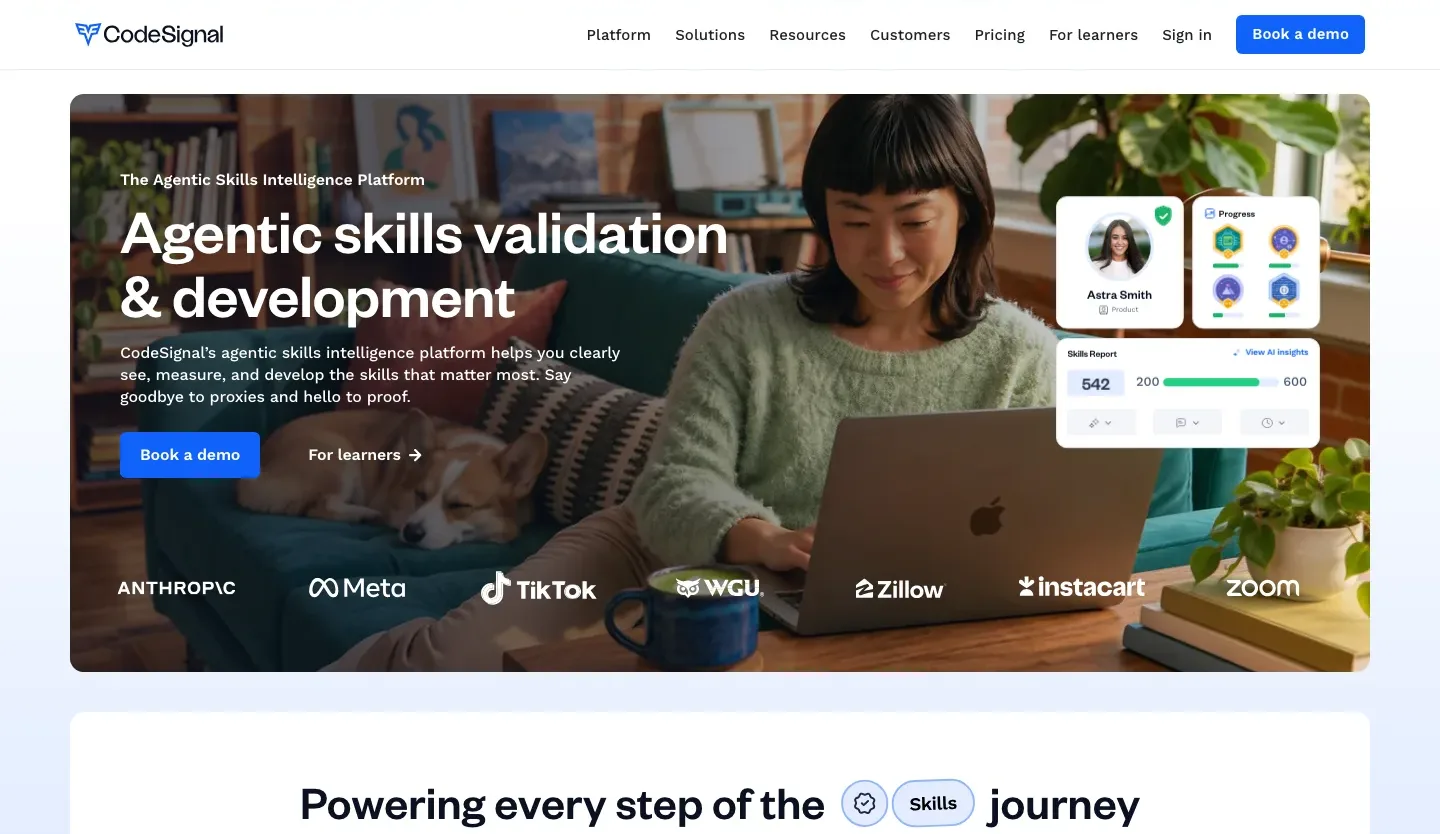
CodeSignal's hiring product, CodeSignal Hire, has three plans: Build, Grow and Pro. The first two show a price and can be bought online through a self-serve sign-up. Pro goes through "Talk to sales". Paying annually saves 20% against the monthly price.
| Plan | Billed annually | Billed monthly | Credits |
|---|---|---|---|
| Build | $79 a month ($948 a year) | $99 a month | 60 a year, or 5 a month |
| Grow | $479 a month ($5,748 a year) | $599 a month | 420 a year, or 35 a month |
| Pro | Custom | Custom | Custom |
Extra credits on Build and Grow cost $20 each. Worked from the list prices, an included credit costs $15.80 on Build and $13.69 on Grow when billed annually, and $19.80 and $17.11 when billed monthly. So the $20 overage rate is close to the monthly rate, and well above the annual one.
CodeSignal's other products are priced apart: Learn is free for individuals, with Cosmo+ at $24.99 a month, and Education for schools is custom priced.
How do CodeSignal credits work?
A CodeSignal credit is spent when a candidate begins something, not when you invite them. The pricing FAQ puts it plainly: "a credit is used when a candidate starts an assessment, AI interview, or live interview, not when you send one." Unopened invitations cost nothing.
Three rules follow from the FAQ:
- Credits are shared. They are "interchangeable across all three formats", so one pool pays for AI interviews, assessments and live interviews.
- Each start counts. The FAQ ties a credit to each start. Read that way, a candidate who starts an AI interview, then an assessment, then a live interview uses three credits. Confirm with CodeSignal how a multi-step process is counted before you size a plan.
- There is no hard stop. When the included credits run out, CodeSignal charges on-demand credits at $20 each, "billed on your next cycle, so there's no hard stop mid-search." Usage shows on the account's Billing page.
The "no hard stop" rule is good for a live search and bad for a budget. Nothing pauses when you pass the allowance, so a spike in candidates turns straight into an invoice.
Annual plans give the credits as a yearly allowance (60 or 420), while monthly plans give a monthly one (5 or 35). The pricing page does not say whether unused monthly credits carry over, so ask.
Build, Grow or Pro: which plan fits?
Build fits a small team hiring a few engineers, product people or designers a year. Grow fits a team that needs an ATS link or hires sales and marketing staff too. Pro fits companies that need single sign-on, bulk invites, or Greenhouse, Lever or an enterprise ATS such as Workday.
The price gap between Build and Grow is large, so the break-even point matters. Worked from the list prices on annual billing, Build plus extra credits costs the same as Grow at 300 candidate starts a year. That is $948 plus 240 extra credits at $20, or $5,748. Below 300 starts, Build with overage is cheaper. Above it, Grow wins on credits alone.
These rows from CodeSignal's "Compare all features" table decide which plan you can use:
| Feature | Build | Grow | Pro |
|---|---|---|---|
| ATS | None | Gem, Ashby | Greenhouse, Lever, Workday and more |
| AI interviewers | Product, design, eng. | Adds sales roles | All, plus custom |
| Agentic tests | Limited | Core | Full library |
| Sales and HR tests | No | Core | Full library |
| In-test AI help | No | Yes | Yes |
| Bulk invites | No | No | Yes |
| API access | No | Basic | Advanced |
| SSO, RBAC, audit logs | No | No | Yes |
| Email support | Weekdays 9 to 5 PT | Weekdays 9 to 5 PT | 24/7/365 |
Every plan includes live technical interviews, AI proctoring, ID verification, plagiarism and leak prevention, AI grading and SOC 2 Type II, GDPR and CCPA compliance.
Build has no ATS integration, so results are copied across by hand, and bulk invites sit only on Pro, which slows campus and high-volume hiring.
What adds to the cost?
The plan price is the floor. Five things push the real bill up.
Overage at $20 a credit. A busy quarter can cost more than the plan itself. On annual Build, every extra credit costs about 27% more than an included one.
Monthly billing. Monthly costs 25% more than annual for the same plan: $1,188 a year for Build and $7,188 for Grow, against $948 and $5,748. Monthly suits only a short hiring push.
ATS on a higher plan. The pricing table puts Gem and Ashby on Grow, and Workday, iCIMS, Oracle, Greenhouse and Lever on Pro. CodeSignal's integrations page also lists SmartRecruiters, Workable and others without a plan. A team on Greenhouse or Lever is looking at a Pro quote, so ask for it before you buy Build or Grow.
Users not stated. The plan cards and comparison table do not say how many people can log in. If several hiring managers need to review results, get the user count in writing.
Plan contents that move. PricingSaaS, which tracks CodeSignal's pricing page, has logged several packaging changes. They include a coding tool dropped from the agentic assessments on Build and Grow, and finance and operations tests moved off Grow. Recheck the assessment rows on the day you buy.
How to pay less for CodeSignal
Four steps lower a CodeSignal bill without changing what the test measures.
- Pay annually if you hire all year. The 20% saving is the only discount CodeSignal publishes.
- Size the plan to starts, not hires. Count how many candidates start any step per hire, multiply by planned hires, and compare the total with the 300-start break-even. Drop any step that repeats another.
- Send fewer, better candidates to the test. Every start is a credit, so each candidate screened out earlier is a credit saved.
- On Pro, negotiate credit volume. Pro credits are "Based on your needs", so bring your start count to the sales call.
CodeSignal vs HackerRank: which costs less?
CodeSignal and HackerRank cost the same at entry level, and HackerRank is cheaper on the mid plan. Pick HackerRank if you hire only engineers, want unlimited users or run Greenhouse or Lever without a quoted plan; pick CodeSignal if the same tool must also screen sales and marketing hires. Per included unit, the mid plans are within 30 cents of each other.
| CodeSignal | HackerRank | |
|---|---|---|
| Entry plan | Build: $79 a month annually, $99 monthly | Starter: $79 a month annually, $99 monthly |
| Entry units | 60 credits a year | 60 attempts a year |
| Mid plan | Grow: $479 a month annually ($5,748 a year), $599 monthly | Pro: $419 a month annually ($5,028 a year), $529 monthly |
| Mid units | 420 credits a year | 360 attempts a year |
| Extra unit | $20 | $20; $15 pre-bought on annual Pro |
| Unit is used when | A candidate starts | A candidate completes |
| Users | Not stated | Unlimited on Starter and Pro |
| ATS on mid plan | Gem, Ashby | Greenhouse, Lever, Ashby |
| AI interviewer | On every plan | Chakra, on every plan |
| Free trial | Not advertised for Hire | Yes |
| Top plan | Pro, custom | Enterprise, custom |
When a unit is counted. HackerRank's FAQ says an attempt counts "whenever a candidate completes an attempt through Screen, Interview, or Chakra." CodeSignal's counts at the start. A candidate who opens a test and walks away costs a CodeSignal credit and no HackerRank attempt. If many candidates drop out of your tests, CodeSignal counts more units than HackerRank would for the same pipeline. HackerRank's overage is charged at the end of the billing cycle or after 25 extra attempts, whichever comes first.
The mid plans. Grow costs $720 a year more than HackerRank Pro and includes 60 more units. That works out to $13.69 per included credit on Grow and $13.97 per included attempt on Pro. HackerRank's annual Pro plan also lets you pre-buy extra attempts at $15 instead of $20.
Users and ATS. HackerRank states unlimited users on Starter and Pro, and its Pro plan names Greenhouse, Lever and Ashby. A team on Greenhouse or Lever gets a named ATS link on HackerRank's published mid plan; on CodeSignal, the pricing table puts Greenhouse and Lever on Pro, which is quoted.
Scope. HackerRank's plans are built around engineering hiring: take-home tests, pair programming interviews and Chakra. Its FAQ says Chakra can range "from asking logistical questions to deep technical work on a canvas like a coding environment or a whiteboard." CodeSignal's pricing page goes further outside engineering, with named AI interviewers for sales, customer success and marketing from Grow, plus go-to-market and HR assessments. If you hire engineers and sellers through one tool, that breadth is the reason to pick CodeSignal.
For a wider list of coding test and live interview tools, see the best technical interview software.
Is CodeSignal worth it?
CodeSignal is worth it for teams that need proof a candidate can do the work, including work done alongside AI tools. It is a weaker buy when the problem is finding engineers worth testing in the first place.
The Stack Overflow Developer Survey 2025 found 84% of respondents using or planning to use AI tools in development, and 51% of professional developers using them daily. CodeSignal's agentic assessments, run "with Claude & Codex", test the way engineers now work. Proctoring and ID verification come on every plan, so the integrity tools do not need an upgrade.
The case against is cost per hire. Technical hiring already runs long: Ashby's 2026 Talent Trends Report (April 2026) found technical roles average 17.6 interviews per hire, up 52% from about 11 in 2021. The median time to hire is 40 days. Every candidate who starts a CodeSignal step is a credit, so a loose top of funnel makes each hire expensive.
A simple illustration, worked from the list prices: a team on annual Build hires 10 engineers a year and starts 8 candidates on a test for each. That is 80 starts, so 20 extra credits at $20, and the year costs $1,348. If the same team screens first and starts only 4 per hire, it uses 40 credits and stays at $948 on the same plan.
CodeSignal also works with candidates you already have. Its AI Interviewer page says to use it "as the first pass after someone applies." It does not advertise finding people who never applied.
Cheaper or different options
If CodeSignal's price is the issue, three tools publish theirs. If the issue is who reaches the test, one of them works before CodeSignal rather than instead of it. They are ordered by where each one cuts the bill: The Cognitive first because it screens people before any paid test, then the test platforms by how close their pricing model is to CodeSignal's (HackerRank counts attempts at the same entry price, CoderPad counts interviews and tests, Codility sells invite packs).
The Cognitive publishes this page and appears in it.
| Tool | Pricing model | Price on site? | How you start |
|---|---|---|---|
| The Cognitive | Monthly or yearly plans; sourcing and interviews sold apart | Yes | 7-day trial, no card |
| HackerRank | Attempts a year, unlimited users | Yes | Free trial |
| CoderPad | Interviews or tests a year or a month, plus a charge per extra | Yes | Free trial or buy online |
| Codility | Packs of invites, a year or a month | Yes | Buy online or ask for a trial |
1. The Cognitive: best for finding and screening engineers before the coding test
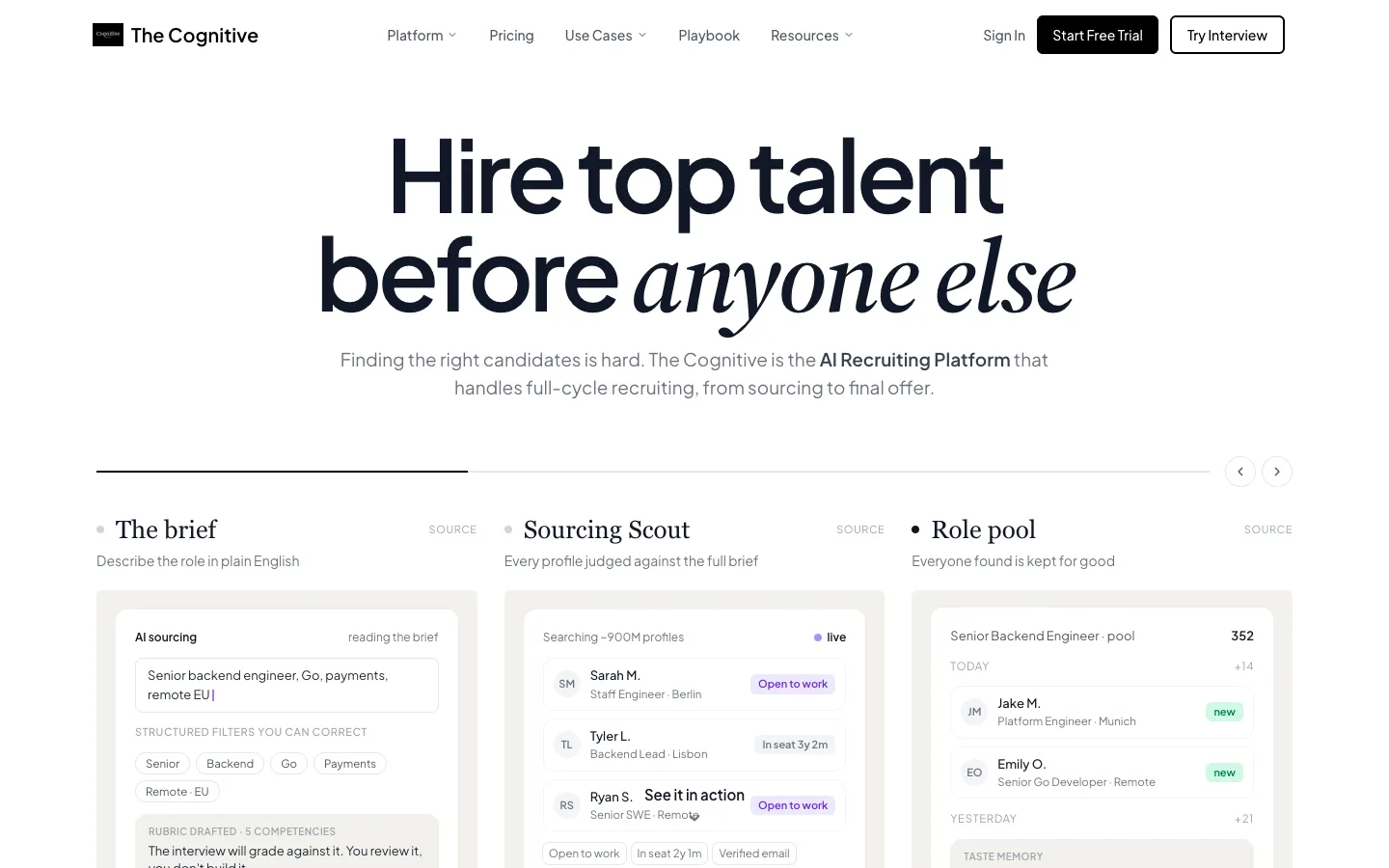
The Cognitive is not a CodeSignal replacement. It has no coding test, no code editor and no live coding pad. What it does is the work before a test: finding engineers who never applied, reaching them, and running a first-round interview, so only a shortlist spends CodeSignal credits.
In Gem's 2026 Recruiting Benchmarks Report (December 2025), 2.6% of applications came from direct sourcing, yet those people made up 11% of hires, and recruiters handled 93% more applications than in 2021. Sourced people reach a hire far more often per candidate, which keeps a credit bill down.
Describe the engineer the way you would to a hiring manager, and The Cognitive returns matches from about 900M public profiles, each with a short reason it fits. A search spends 1 credit for every person it shows you. A personal email costs 4 credits to reveal; a phone number costs 12, on Sourcing Pro and above.
On Sourcing Team, and on Sourcing Pro and above, the recruiter emails them from their own mailbox, and follow-ups end as soon as someone writes back. Anyone who replies with interest can get an invite to a first-round interview: a live two-way AI video call, 10 or 20 minutes long, taken on a laptop or desktop. The AI interviewer asks role questions out loud, including technical ones, and follows up on the answers. The rubric is fixed and the questions adapt to each answer. A 20-minute interview uses 100 interview credits.
Each interview produces a scorecard with the recording and transcript, and flags signs of cheating such as copy and paste or another face on camera. The people who do well go on to the CodeSignal test. On the higher plans, The Cognitive connects to 100+ ATS.
Sourcing and interviewing are sold as two plans, AI Sourcing and AI Interviews, with every price except Enterprise listed on the pricing page. Plans start at $99 a month.
Best for: teams whose CodeSignal bill is driven by testing too many of the wrong candidates, or who cannot find enough engineers to test.
Watch out for: no coding test, code editor or live coding pad, so proof of code still needs a tool like CodeSignal in a later round. Sourcing and interviews are separate plans; outreach needs Sourcing Team or Sourcing Pro and above, and ATS sync sits on Max and Business.
Pricing model: published monthly or yearly plans per product, with credits for search, reveals and interviews; Enterprise custom.
2. HackerRank: best for a like-for-like test platform with unlimited users
HackerRank is the closest swap for CodeSignal: coding tests, pair programming interviews and an AI interviewer on every plan. Its units count on completion, users are unlimited on Starter and Pro, and Pro names Greenhouse, Lever and Ashby. It suits an engineering team that wants CodeSignal's shape at a lower mid-tier price.
3. CoderPad: best for teams whose main step is a live coding interview
CoderPad centres on a shared coding pad for live interviews, with take-home tests on its higher plans. It prices by interviews and tests a year, with a charge for each extra, and states unlimited users and AI Assist on every plan. It suits teams that run more live interviews than tests.
4. Codility: best for monthly flexibility by invite count
Codility sells online plans as packs of invites, bought a year or a month at a time, with five platform users (ten on the largest annual pack), unlimited collaborators and one standard ATS integration. An invite counts when it is sent, though one the candidate has not started can be cancelled and returned within the same billing period. Enterprise is a custom quote. It suits teams whose hiring volume swings from month to month.
For the full category, including tools for screening skills outside engineering, see the best technical recruiting tools.
When to skip The Cognitive
Skip The Cognitive if your pipeline is already full of good applicants and the only open question is whether they can code. CodeSignal answers that, and The Cognitive does not. Skip it too if you need a coding environment or pair programming in the first round, or hire through campus programs that send invites in bulk to a known list.
How to start
Take the engineering role where CodeSignal credits went fastest and count the starts per hire. Then run that role through The Cognitive: write the brief, search, reach out, and send only the people who score well in the first interview to your CodeSignal test. Compare the starts per hire. For questions to use in that first round, see the software engineer interview questions.
Start free with The Cognitive.
Sources
- Ashby, Recruiter Productivity, 2026 Talent Trends Report, April 2026. ashbyhq.com
- Gem, "Key takeaways from the 2026 Recruiting Benchmarks Report", December 2025. gem.com
- Stack Overflow, Developer Survey 2025, AI section, 2025. survey.stackoverflow.co
- PricingSaaS, CodeSignal pricing tracker and change log. pricingsaas.com
- Vendor pages: CodeSignal pricing page (Hire, Learn and Education tabs, feature comparison and FAQ), homepage, AI Interviewer and integrations pages (codesignal.com); HackerRank pricing page and FAQ (hackerrank.com); CoderPad pricing (coderpad.io); Codility pricing (codility.com); The Cognitive pricing (thecognitive.io).
Frequently Asked Questions
How much does CodeSignal cost per month?
CodeSignal Build costs $79 a month billed annually or $99 billed monthly, and Grow costs $479 a month billed annually or $599 billed monthly. Build includes 60 credits a year (or 5 a month) and Grow 420 a year (or 35 a month). Pro is priced by quote through CodeSignal's sales team. Extra credits on Build and Grow cost $20 each.
Does CodeSignal have a free trial?
CodeSignal does not advertise a free trial of its hiring product. Build and Grow are bought online through a self-serve sign-up, and its AI Interviewer page lets you try a sample AI interview. CodeSignal Learn, its practice product, is free for individuals. HackerRank, by contrast, advertises a free trial.
What happens when you run out of CodeSignal credits?
You keep using CodeSignal and pay $20 for each extra credit. The pricing FAQ says on-demand credits are "billed on your next cycle, so there's no hard stop mid-search," and usage shows on the account's Billing page. Because nothing pauses, it is worth setting your own limit in busy months.
Is CodeSignal cheaper than HackerRank?
No, CodeSignal costs the same as HackerRank at entry level and more on the mid plan. Both entry plans are $79 a month billed annually for 60 units a year. CodeSignal Grow costs $5,748 a year for 420 credits and HackerRank Pro $5,028 a year for 360 attempts, which is about the same per unit. HackerRank counts an attempt when a candidate completes, while CodeSignal counts a credit when a candidate starts.
Does CodeSignal integrate with Greenhouse, Lever or Workday?
Yes, on the Pro plan. CodeSignal's pricing table puts Greenhouse, Lever, Workday, iCIMS and Oracle on Pro, which is priced by quote. Grow connects Gem and Ashby, and Build has no ATS integration. HackerRank, by contrast, names Greenhouse, Lever and Ashby on its published Pro plan.
What are the best CodeSignal alternatives?
HackerRank is the closest like-for-like alternative, and CoderPad and Codility also publish their prices. The Cognitive works before the coding test, finding and interviewing engineers so fewer candidates spend credits. See the best technical interview software for more.
Can The Cognitive replace CodeSignal?
No. The Cognitive has no coding test or code editor, so it works before CodeSignal rather than instead of it. It searches about 900M public profiles for engineers, and on the Sourcing Team plan and on Sourcing Pro and above emails them from your own mailbox. It then runs a live two-way AI video interview in which the AI asks role questions, including technical ones, and follows up on the answers. Teams that need proof of code send the people who score well to a coding test such as CodeSignal.
Related reading
- Technical Interview Software in 2026: 15 Tools for Coding Tests, Live Coding and AI Screens
- Technical Recruiting Tools: The 10 Best for Hiring Engineers in 2026
- Talent Assessment Tools Compared: 8 Options That Prove Different Signals
- Best Retail Hiring Software in 2026: 9 Tools for Store Teams and Store Leaders
- 10 Best CRMs for Staffing Agencies in 2026, Scored
- Best EOR Companies in 2026: 11 Employer of Record Providers Ranked, Plus the Step Before