How Much Do Recruiters Make? Salary, Commission and Pay per Hire
By Sparsh Goyal, Founder at The Cognitive. Published · Last updated
- Recruiters in the US earn a median of $75,940 a year, the May 2025 BLS figure for all human resources specialists, with the top 10% above $128,720.
- In-house recruiters mostly earn a salary, agency recruiters a base plus a commission share the agency sets, and contract desks are often paid on margin.
- HR specialists in employment services had a median of $60,550, below the all-industry figure, while those at software publishers had $108,370.
Recruiters in the US earn a median of $75,940 a year, according to the Bureau of Labor Statistics. That is the May 2025 figure for human resources specialists, the occupation BLS files recruiters under, so it covers every HR specialist and not recruiters alone. The middle half earned $58,610 to $99,380. The lowest 10% earned under $47,180 and the top 10% over $128,720.
How a recruiter is paid depends on who employs them. In-house recruiters mostly earn a salary. Agency recruiters earn a base plus commission on the placement fees they bill, and contract desks are often paid on the margin of hours billed. The employer matters too: HR specialists in employment services, the industry that includes agencies and staffing firms, had a median of $60,550, against $108,370 at software publishers. For a new hire, Robert Half's 2027 Salary Guide puts a recruiter's starting pay at $66,500 to $90,750, with a midpoint of $76,250. All figures are for the US.
How much do recruiters make?
The Bureau of Labor Statistics has no occupation called "recruiter". It counts recruiters as human resources specialists (SOC 13-1071). O*NET, the federal occupation database, lists "Recruiter" and "Corporate Recruiter" among the job titles in that occupation, and its description opens with "Recruit, screen, interview, or place individuals within an organization."
The occupation employed 912,430 people in May 2025. Its pay spread looks like this.
| Point in the range | Annual pay |
|---|---|
| 10th percentile | $47,180 |
| 25th percentile | $58,610 |
| Median | $75,940 |
| Mean | $81,990 |
| 75th percentile | $99,380 |
| 90th percentile | $128,720 |
Human resources specialists, all industries. BLS Occupational Employment and Wage Statistics, May 2025.
The median hourly wage was $36.51. The mean sits $6,050 above the median, which means a smaller group of high earners pulls the average up. For a typical recruiter, the median is the better number to quote.
How does recruiter pay change by level and title?
In Robert Half's 2027 Salary Guide, the midpoint rises from $53,500 for a recruiting coordinator to $88,750 for a talent acquisition manager. The guide reports pay for each title in three levels, low, mid and high, built from the pay of professionals Robert Half placed plus third-party job-posting data.
| Title | Low | Mid | High |
|---|---|---|---|
| Recruiting coordinator | $46,500 | $53,500 | $61,250 |
| Talent sourcer | $53,250 | $60,750 | $70,000 |
| Recruiter | $66,500 | $76,250 | $90,750 |
| Talent acquisition specialist | $68,000 | $78,000 | $86,500 |
| Talent acquisition manager | $72,500 | $88,750 | $108,000 |
Robert Half 2027 Salary Guide, Human Resources, talent acquisition roles, US national figures.
Payscale's 2026 figures come from people reporting their own pay, and they cover titles Robert Half does not list, such as technical, senior and executive recruiters.
| Title | Average base | Base, 10th to 90th | Profiles |
|---|---|---|---|
| Recruiting coordinator | $56,303 | $44k to $76k | 998 |
| Recruiter | $63,749 | $46k to $91k | 3,561 |
| Recruitment consultant | $65,106 | $45k to $97k | 89 |
| Talent acquisition specialist | $68,021 | $53k to $90k | 1,726 |
| Technical recruiter | $74,386 | $50k to $123k | 501 |
| Senior recruiter | $85,685 | $59k to $120k | 1,243 |
| Talent acquisition manager | $91,450 | $65k to $128k | 1,025 |
| Executive recruiter | $101,133 | $63k to $156k | 141 |
Payscale, US salary pages by title, 2026. The recruitment consultant sample is small.
Experience adds steadily rather than in one jump. On Payscale's Recruiter page, people with under a year in the job report average total pay of $49,461, and those with 1 to 4 years report $59,445. Mid-career recruiters report 11% more than the average, late-career recruiters 18% more and the most experienced 20% more.
Recruitment directors sit in a different BLS occupation. Human resources managers, whose O*NET job titles include "Recruitment Director", had a median of $149,280 in May 2025, with the top 10% above $267,810. That occupation covers every kind of HR manager, so it does not show what every talent acquisition leader earns. Sourcers have their own pay picture, covered in what a talent sourcer does.
Do agency recruiters earn more than in-house recruiters?
At the median, no. HR specialists in employment services, the industry where agencies and staffing firms sit, had a May 2025 median of $60,550. That is $15,390 below the median for the occupation across all industries.
| Industry | Median annual pay |
|---|---|
| Software publishers | $108,370 |
| Federal government | $108,180 |
| Computer systems design | $93,590 |
| Management of companies | $79,920 |
| Management and technical consulting | $79,530 |
| Hospitals | $77,200 |
| All industries | $75,940 |
| Employment services | $60,550 |
Human resources specialists by industry. BLS Occupational Employment and Wage Statistics, May 2025.
The top of the agency range is lower as well. In employment services the 90th percentile was $104,430, against $128,720 for all industries. The employment services figure counts everyone BLS codes as an HR specialist in that industry, including staffing coordinators, so it mixes billing recruiters with support roles. Even so, it does not support the idea that the typical agency recruiter out-earns an in-house peer.
Commission makes agency pay swing with results. A recruiter who places often can earn well above base, and one who places rarely earns close to it. An in-house recruiter at a software publisher or a federal agency starts from a higher median.
The same pattern holds for managers. HR managers in employment services had a median of $108,990, against $149,280 across all industries.
How do agency recruiters earn commission?
Agency recruiters earn commission as a share of the fees their firm bills employers. The employer pays the agency. Robert Half's annual report for 2025 describes those fees as "generally a percentage of the new employee's annual compensation." The agency then pays its recruiter a cut through a commission plan it writes itself.
| Recruiter type | What the firm is paid | How the recruiter is paid |
|---|---|---|
| In-house | No fee; the recruiter is the employer's own staff | Salary, sometimes a company bonus |
| Agency, contingency | A placement fee when the employer hires | Base plus a commission share the agency sets |
| Retained search | A retainer in instalments | Not disclosed by the listed firms |
| Contract desk | An hourly bill rate for hours worked | Often a share of the margin between bill rate and pay rate |
No primary source publishes the share a recruiter keeps. Agencies set it in each recruiter's plan and keep it private, and Robert Half, Korn Ferry and Heidrick & Struggles do not disclose it in their annual reports. Any split quoted online is an estimate.
Payscale is the closest thing to measured data. It shows the commission that people in each title report, among those who get commission at all.
- Recruiter: $1,000 to $26,000 in commission, total pay $44,000 to $93,000.
- Technical recruiter: $5,000 to $36,000, total pay $51,000 to $138,000.
- Senior recruiter: $1,000 to $49,000, total pay $61,000 to $125,000.
- Talent acquisition manager: $1,000 to $50,000, total pay $66,000 to $134,000.
- Executive recruiter: $1,000 to $76,000, total pay $68,000 to $184,000.
The executive recruiter row carries the widest spread. Its top total pay sits $28,000 above the top of its base range, the biggest gap among these titles. For what employers pay agencies and how the terms are written, see recruitment agency fees and commission.
Freelance recruiters set their own terms, typically per hire, by the hour or on a retainer.
How much do recruiters make per hire?
No public source gives a per-hire figure for what a recruiter takes home. Per-hire pay is the agency's fee multiplied by the recruiter's share, and both numbers are private. The fee is negotiated with each client, and the share sits in each recruiter's commission plan.
Retained executive search is the one place a filed figure exists, and it describes the firm's fee, not the consultant's pay. Korn Ferry's annual report for the year to April 2026 states that its search fees are "generally one-third of the estimated first-year cash compensation of the placed candidate," plus a percentage of the fee for indirect engagement expenses. Heidrick & Struggles' 2024 annual report says it bills its retainer "in one-third increments over a three-month period". Neither firm says how much of that reaches the consultant. For how retained firms work, see executive search firms.
In-house recruiters earn nothing per hire. Their salary is one of the costs that make up the employer's cost per hire, which is a different number from what the recruiter makes.
An agency recruiter can work out their own per-hire figure from two documents: a recent fee invoice and their commission plan. Multiply the fee by the share in the plan, then check whether the plan pays on invoice or on cash received, and whether a hire who leaves early claws the commission back.
How do IT recruiters get paid?
IT recruiters are paid the same three ways as other recruiters, at higher figures. In-house technical recruiters earn a salary. Agency IT recruiters earn a base plus commission on permanent placements. On contract desks, which are common in IT staffing, they are often paid on the margin between what the client is billed per hour and what the contractor is paid.
The figures run above the recruiter average. Payscale's 2026 average base for a technical recruiter is $74,386, against $63,749 for the general recruiter title, with a base range of $50,000 to $123,000. Technical recruiters who report commission put it at $5,000 to $36,000. Entry-level technical recruiters report average total pay of $52,052, early-career ones $68,968, and the most experienced report 55% more than the average.
The BLS industry split points the same way. HR specialists working in computer systems design firms had a May 2025 median of $93,590, and those at software publishers $108,370, against $75,940 across all industries. These are all HR specialists in those industries, not IT recruiters alone. If you are hiring for the role rather than doing it, see how to hire a technical recruiter.
How can a recruiter make more placements without more hours?
On an agency desk, pay follows placements, and placements follow how many roles a recruiter can search well. The load is heavy. Gem's 2026 Recruiting Benchmarks Report found recruiters managing 13.4 open roles at a time and handling 93% more applications than in 2021. Ashby's 2026 Talent Trends Report counts 291 applications per hire, against roughly 100 in early 2021.
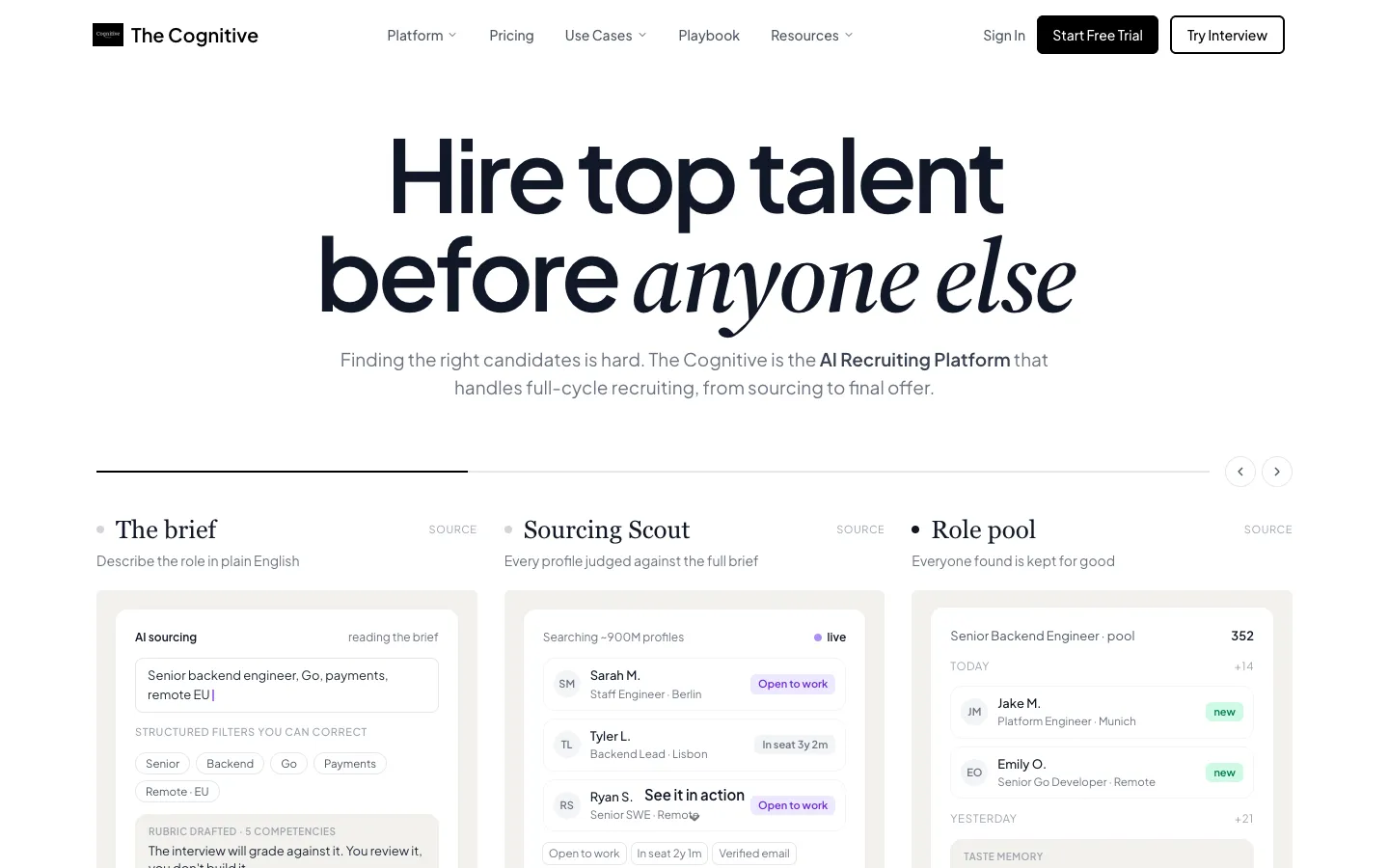
Two steps in that load are finding people and running first screens, and The Cognitive is software for both. A recruiter writes the role in plain English, and it searches about 900M public profiles and returns people with a short reason for each match. Revealing a personal email costs 4 credits. On Sourcing Pro and above, outreach goes from the recruiter's own Gmail or Outlook mailbox, and follow-ups stop when someone replies.
With an AI Interview plan, people who say yes can take a live two-way AI video interview, recorded with a transcript, and the recruiter gets a scorecard against the role's criteria before deciding who goes to the client.
The interview scorecard: each criterion rated against the rubric, with the transcript behind it.
It does not raise anyone's pay by a known amount, and no data exists to say so. It also does not replace the client relationship, billing or submittals, and retained executive search still rests on referencing and a consultant's judgment. Plans start at $99 a month. The free trial runs 7 days with no card and includes 100 sourcing credits, enough to test one search on a live role. Start free with The Cognitive.
How do you check what a recruiter role should pay?
Check what a recruiter role should pay against at least two sources, because each one measures something different.
- BLS: the whole HR specialist occupation, with splits by industry, state and metro area. Use it for the market middle and for comparing industries, not for one title.
- Payscale: self-reported pay by exact title and by years of experience, with commission shown for those who earn it. Check the sample size; some titles rest on fewer than 100 profiles.
- Robert Half: pay for new hires in three levels, built from its own placements and job postings. Use it to set an offer or to price a move.
The sources disagree for good reasons. Payscale's Recruiter average base of $63,749 sits below Robert Half's Recruiter midpoint of $76,250, because each measures something else: Payscale averages people at every stage of their career who chose to report, while Robert Half reports pay from its own placements and job postings. Robert Half projects average salary growth of 1.8% for HR roles in 2027, so a 2025 or 2026 figure needs only a small adjustment.
For a city or state, use the BLS state and metro tables for human resources specialists. Employers setting pay bands across many roles can compare salary benchmarking tools.
Sources
- US Bureau of Labor Statistics, Occupational Employment and Wages: Human Resources Specialists (13-1071), including industry figures, May 2025.
- US Bureau of Labor Statistics, Occupational Employment and Wages: Human Resources Managers (11-3121), May 2025.
- O*NET OnLine, 13-1071.00 Human Resources Specialists, 2026.
- O*NET OnLine, 11-3121.00 Human Resources Managers, 2026.
- Robert Half, 2027 Salary Guide: Human Resources, 2027 edition.
- Payscale, US salary pages for Recruiting Coordinator, Recruiter, Recruitment Consultant, Talent Acquisition Specialist, Technical Recruiter, Senior Recruiter, Talent Acquisition Manager and Executive Recruiter, payscale.com, 2026.
- Robert Half Inc., Form 10-K for fiscal year 2025, sec.gov.
- Korn Ferry, Form 10-K for the fiscal year ended 30 April 2026, sec.gov.
- Heidrick & Struggles, Form 10-K for fiscal year 2024, sec.gov.
- Gem, Key takeaways from the 2026 Recruiting Benchmarks Report, gem.com, 1 December 2025.
- Ashby, Recruiter Productivity, 2026 Talent Trends Report, ashbyhq.com, 28 April 2026.
Frequently Asked Questions
How much do recruiters make starting out?
Starting recruiter pay in the US runs from about $49,000 to $67,000, depending on the source. On Payscale, recruiters with under a year in the job report average total pay of $49,461. Robert Half's 2027 Salary Guide puts the low level for a recruiter at $66,500.
Do recruiters get paid per hire?
Agency recruiters do, through commission, and in-house recruiters usually do not. The employer pays the agency a fee when it hires someone the agency put forward, and the agency pays the recruiter a share set in a private commission plan. No public source gives a per-hire figure for the recruiter's share.
Do internal recruiters get commission?
Usually not per placement. In-house recruiters are mostly paid a salary, sometimes with a company bonus, because no placement fee is billed on the people they hire. Per-placement commission is how agency desks pay.
How much does a talent acquisition manager make?
A talent acquisition manager in the US makes about $88,750 at Robert Half's 2027 midpoint, within a range of $72,500 to $108,000. Payscale's 2026 average base for the title is $91,450. Recruitment directors fall under BLS's human resources managers, whose May 2025 median was $149,280 across every kind of HR manager.
Which industry pays recruiters the most?
Software publishers and the federal government pay HR specialists well above average. Both had medians above $108,000 in May 2025, against $75,940 across all industries. Computer systems design firms paid a median of $93,590, and employment services, where agencies sit, $60,550.
Is recruiting a good career?
Demand for the occupation is growing. BLS projections, published through O*NET, show human resources specialist jobs growing faster than average from 2025 to 2035, with about 73,700 openings a year. Pay depends heavily on the employer, as the industry medians show.
How much do recruiters make by state or city?
Use the BLS state and metro area tables for human resources specialists. They break the same May 2025 wage data down by location, so a recruiter can compare a local figure with the national median of $75,940.
Related reading
- What Is a Talent Sourcer? Role, Skills, Salary and Tools (2026)
- Best Retail Hiring Software in 2026: 9 Tools for Store Teams and Store Leaders
- 10 Best CRMs for Staffing Agencies in 2026, Scored
- Best EOR Companies in 2026: 11 Employer of Record Providers Ranked, Plus the Step Before
- Best Sourcing Tools for Recruiters in 2026: 12 Tools by Job
- 9 Best AI Executive Search Tools in 2026, Scored