9 Best AI Executive Search Tools in 2026, Scored
By Sparsh Goyal, Founder at The Cognitive. Published · Last updated
- The Cognitive is the best AI tool for executive search when an in-house team or boutique firm wants to find, email and first-interview senior candidates from one self-serve account.
- Findem and SeekOut score highest on the checks, for pitch research and maps and for enterprise TA teams, while Stardex suits search firms working their own database.
- Match the tool to the step of the search you are short on.
Korn Ferry's search fee is "generally one-third of the estimated first-year cash compensation of the placed candidate," according to its 2026 annual report. The same filing lists in-house HR teams, now helped by "AI-based search tools," among the competitors it faces. AI tools now do parts of the work that fee pays for.
The best AI tool for executive search in 2026 is The Cognitive. It suits in-house teams and boutique firms that want to find senior people, email them and run a live AI first interview from one self-serve account. Findem and SeekOut score highest on the checks, Findem for pitch research and maps and SeekOut for enterprise TA teams. Stardex suits search firms that want AI on their own database.
Disclosure: The Cognitive is our product.
The best AI tools for executive search in 2026
- The Cognitive: best for sourcing and first-interviewing senior candidates yourself.
- Findem: best for pitch research and leadership market maps.
- SeekOut: best for enterprise TA teams that run senior searches in-house.
- Stardex: best for search firms that want AI to work their own database.
- Metaview: best for notes on intake calls and candidate conversations.
- Pin: best for a free start on AI sourcing with email from your own account.
- Juicebox: best for long lists from a plain-language prompt, on a free plan.
- HelloSky: best for executive, VC and PE searches that rank on company and investor data.
- LinkedIn Recruiter (corporate) with Hiring Assistant: best for reaching senior people through InMail.
What are AI executive search tools?
AI executive search tools are software that does the research and associate work in a senior search. That covers mapping a market, building a long list, finding contacts, writing the approach, running a first screen and writing up calls. They fall into four groups:
- Market mapping: Findem and HelloSky map companies and leaders before anyone is contacted. Broader platforms are in the talent intelligence platforms list.
- AI sourcing and outreach: The Cognitive, SeekOut, Pin and Juicebox search hundreds of millions of profiles and send the first email.
- AI in a system of record: Stardex, an ATS and CRM with agents.
- Interview AI: The Cognitive, Findem and SeekOut run AI video interviews, and Metaview writes notes on calls a human runs.
Executive search CRMs such as Ezekia, Thrive TRM and Invenias are reviewed in the executive search software list. Firms that use AI are compared in the guide to executive search firms.
How do the AI executive search tools compare?
| # | Tool | Best for | Score |
|---|---|---|---|
| 1 | The Cognitive | Sourcing and first interviews | 6 |
| 2 | Findem | Pitch research, maps | 7 |
| 3 | SeekOut | Enterprise in-house TA | 7 |
| 4 | Stardex | Search firms' own database | 6 |
| 5 | Metaview | Call notes | 6 |
| 6 | Pin | Free AI sourcing | 6 |
| 7 | Juicebox | Prompt-based long lists | 6 |
| 8 | HelloSky | Exec, VC and PE | 5 |
| 9 | LinkedIn Recruiter | InMail reach | 3 |
The score counts seven checks, one point each when the vendor's site, product pages or pricing page states it. Key: S outside search, M market or company mapping, C contact details, O outreach, I interview step (AI interview, AI screening or call notes), D start without a demo, P price on the website. E (an executive search page) and AI (a stated Claude or ChatGPT connector) are tie-breaks and not scored.
| Tool | S | M | C | O | I | D | P | E | AI |
|---|---|---|---|---|---|---|---|---|---|
| The Cognitive | Y | N | Y | Y | Y | Y | Y | Y | Y |
| Findem | Y | Y | Y | Y | Y | Y | Y | Y | Y |
| SeekOut | Y | Y | Y | Y | Y | Y | Y | N | Y |
| Stardex | Y | Y | Y | Y | Y | N | Y | Y | Y |
| Metaview | Y | Y | N | Y | Y | Y | Y | N | Y |
| Pin | Y | Y | Y | Y | N | Y | Y | N | Y |
| Juicebox | Y | Y | Y | Y | N | Y | Y | N | N |
| HelloSky | Y | Y | Y | Y | N | N | Y | Y | Y |
| LinkedIn Recruiter | Y | N | N | Y | Y | N | N | N | N |
How it was ranked
Ties go to a dedicated executive search page on the vendor's site, then a stated Claude or ChatGPT connector, then alphabetical order. On 7, Findem has an executive search page and SeekOut does not. On 6, Stardex has one; Metaview and Pin state a connector and Juicebox does not. HelloSky scores 5 and LinkedIn Recruiter 3.
The Cognitive scores 6 and is ranked first on one criterion. It offers outside search, contact details, email outreach and a live AI video first interview, all on plans you can buy online without a sales call. SeekOut and Findem score 7, but their AI video interviews are sold on custom or demo-only plans. The Cognitive scores no point for mapping.
These tools are ranked using feedback from recruiters the founder talks with on LinkedIn, plus each vendor's own site and pricing page.
Which AI tool fits which step of a search?
The AESC Client Bill of Rights says "a successful search can take anywhere from a few weeks to several months."
- Pitch research: Findem Studio's Company and Talent Brief, Stardex's Dex research agent, and HelloSky's company growth and funding data.
- Market map: Findem's market maps and Leadership Career Paths, HelloSky, Stardex's target company suggestions, and Metaview's Deep Research, which it calls its market-mapping mode.
- Long list: The Cognitive, SeekOut, Pin and Juicebox, each searching 800M to 1B+ profiles. HelloSky searches executives only, and Stardex starts from your own database.
- Contact and approach: The Cognitive, Pin and HelloSky send from your own email account. SeekOut sends on your behalf, Findem and Stardex run campaigns or sequences, and LinkedIn uses InMail.
- First interview: The Cognitive runs a live two-way AI video interview. Findem sells AI video interviews by demo, SeekOut sells them on its custom top tier, and LinkedIn's Hiring Assistant sends prescreening questions.
- Notes and write-ups: Metaview on calls a human runs, and Stardex's background agents. More notetakers are in the interview intelligence platforms list.
Approaching people first pays off. Gem's 2026 benchmarks found that just 2.6% of applications came from direct sourcing, yet those applications produced 11% of hires.
An interview scorecard from The Cognitive gives a score out of 5 for each criterion you set and an overall score out of 100. It comes with the transcript and the recording. A client can open it from a read-only link without logging in.
How do you choose an AI executive search tool?
Are you a search firm or an in-house team?
A search firm needs a system of record for mandates and fees with AI around it, which is Stardex. An in-house team already has an ATS and needs to find and screen senior people without a fee: The Cognitive, SeekOut or Pin.
Is the gap research or reach?
If you cannot name the 40 companies the next CFO should come from, start with mapping in Findem or HelloSky. If you know the companies and need the people and a first email, start with a sourcing tool.
How much of the work will AI really do?
At most firms, AI does parts of a search, not the whole search. Bullhorn's GRID 2026 Industry Trends Report surveyed nearly 2,300 staffing and recruitment professionals. Only 10 percent of firms run agentic AI across their full workflow. LinkedIn's Future of Recruiting 2025 put the time saved by generative AI at about 20% of a work week.
Can you start without a sales call?
The Cognitive, Pin, Juicebox, Metaview, SeekOut Core and Findem Studio let you sign up on your own. Stardex, HelloSky and LinkedIn Recruiter start with a demo.
How are these tools priced?
Four models cover the list. The Cognitive and Findem Studio use credits. Stardex, Pin, Juicebox, HelloSky and Metaview charge per user per month. SeekOut has a self-serve plan with custom tiers above it, and LinkedIn Recruiter is quote only. See the AI recruiting software pricing guide.
The 9 AI executive search tools, reviewed
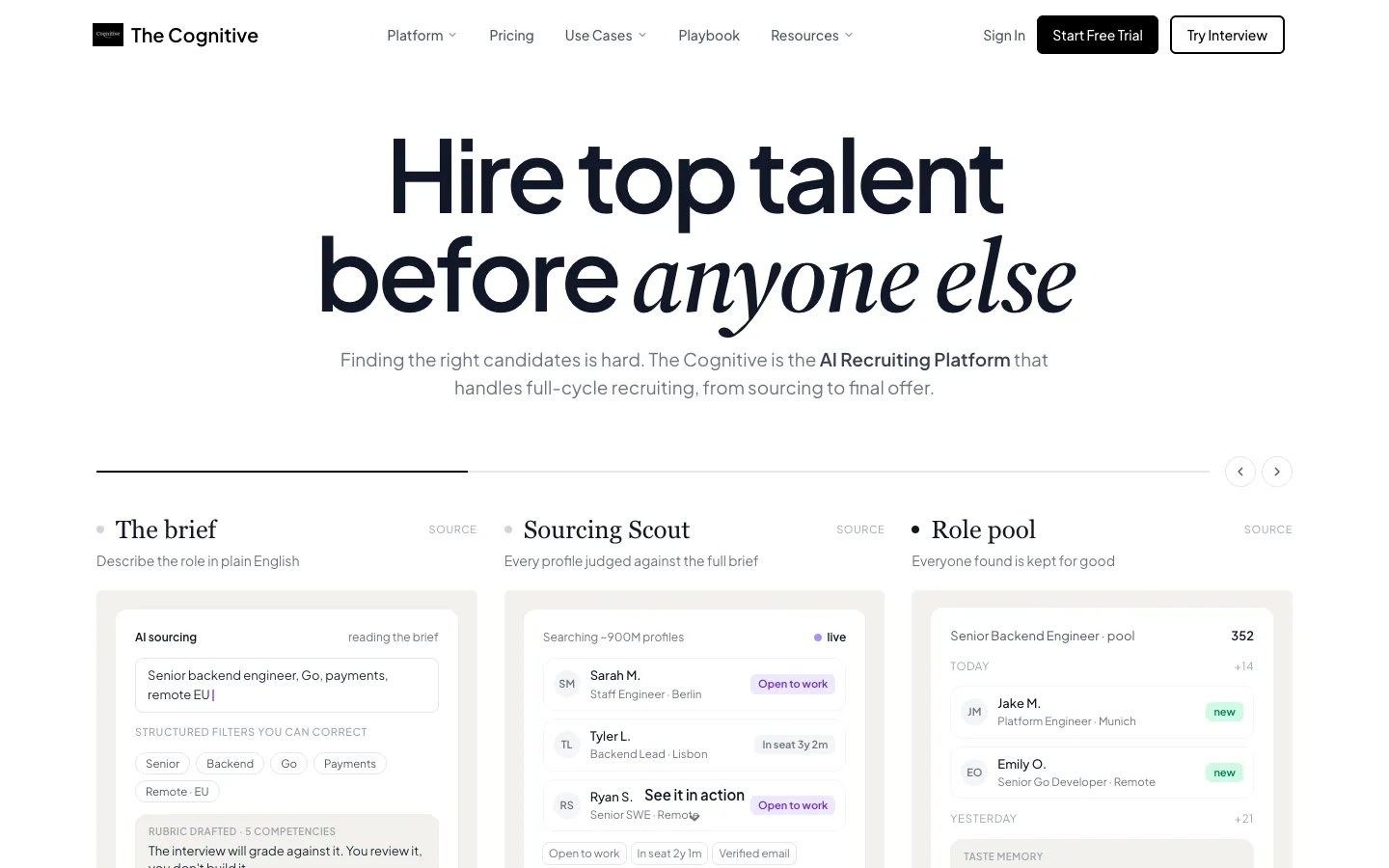
1. The Cognitive: best for sourcing and first-interviewing senior candidates yourself
Verdict: The Cognitive takes a senior brief to a scored first interview without a firm or a researcher.
Type the seat as you would brief a researcher, and The Cognitive's AI sourcing looks for it across about 900M public profiles. Seniority goes up to CXO, Partner and Founder. Past employer, excluded companies, industry, company size and revenue narrow the list. "CFOs at privately held companies with $50M to $500M in revenue who used to work at a named competitor" works as one brief, and every name carries a line on why it fits.
Unlock a personal email for the people worth an approach; phone numbers come with Sourcing Pro and above. The approach goes out from your own Gmail or Outlook, and follow-ups stop once the person answers. Shortlisted leaders then take a live two-way AI video interview of 10 or 20 minutes, in any of 9 languages. Your criteria stay fixed, and the AI follows up on what each person says.
It works from Claude through a connector and links to 100+ ATS on higher plans. The executive search solution page shows how it fits a mandate.
Best for: in-house executive TA teams and boutique firms that want to find, contact and first-interview senior candidates in one self-serve account.
Watch out for: not an executive search CRM, so mandates, fees and client records live elsewhere. It has no company, funding or investor data, org charts, compensation data or notetaker, and it does not search your own database. The approach carries your name. Outreach starts on Sourcing Pro, and the interview needs a laptop or desktop.
Pricing model: two monthly plans, one for sourcing and one for AI interviews, with credits on top. Plans start at $99 a month. A person shown costs 1 credit; a personal email costs 4, a phone number 12, and a 20-minute interview 100. Enterprise is custom. Price on website: yes, on the pricing page.
2. Findem: best for pitch research and leadership market maps

Verdict: Findem covers the most research steps in the step list: pitch briefs, market maps, career paths and board data.
Findem's executive search platform "generates precise market maps based on your criteria, with curated company lists and verified career context." Findem Studio adds an Executive Search Workflow to "win the mandate, align on the search, and run it." Its Exec Intelligence area researches "public-company compensation and boards."
Studio starts free on credits and works through MCP. The full platform adds contact information, outreach campaigns and AI video interviews with adaptive follow-ups, through "Request a demo."
Best for: search firms and in-house teams that pitch, map and benchmark leaders before they source.
Watch out for: contact data, outreach campaigns and the AI interview sit on the full platform, which is sold by demo.
Pricing model: Studio is credits with a free start and per-seat plans; the full platform and AI interviews are quoted. Price on website: Studio only.
3. SeekOut: best for enterprise TA teams that run senior searches in-house

Verdict: SeekOut gives a large company one place to search outside and inside its ATS, then screen on video.
SeekOut sells "the agentic AI recruiting platform that runs on your terms." It searches "1B+ profiles across external sources and your ATS" and offers Talent Insights to "visualize talent pools and labor market data." Its site says "Our AI screener conducts video interviews with candidates."
The self-serve Core plan includes contact credits and email sent on your behalf, with 14 days free and no card. AI video screening sits on the top custom tier, Full Recruiting Funnel.
Best for: enterprise TA teams that hire leaders often and want sourcing and screening on one contract.
Watch out for: AI video screening and ATS integration are on custom tiers billed annually.
Pricing model: a self-serve monthly Core plan and three custom tiers billed annually. Price on website: Core only.
4. Stardex: best for search firms that want AI to work their own database

Verdict: Stardex is the AI layer here built on a search firm's own records.
Stardex calls itself "the AI-native ATS and CRM that helps search firms find, engage, and place great candidates in their network." Its agents "rank the candidates in your database against the spec and tell you why each one made the cut." Its FAQ says it "supports retained fee models, confidential candidate handling."
Paid tiers add org charts, an AI contact finder, target company suggestions and sequences. Outside sourcing and a branded notetaker sit on the top tier. There is no free trial, only a 14-day refund.
Best for: boutique and mid-size search firms that want one system of record with AI built in.
Watch out for: outside sourcing is on the top tier only, and every start goes through a demo.
Pricing model: per user per month on two published tiers, plus a custom tier. Price on website: yes.
5. Metaview: best for notes on intake calls and candidate conversations

Verdict: Metaview is for the human part of a search: the calls a partner runs and the write-ups that follow.
Metaview calls itself "the Agentic Recruiting Platform built for radically efficient hiring, end to end." Its Notes module "handles notes, scorecards, and follow-ups automatically," and its FAQ says "executive search partners" use it. Its sourcing agent has Deep Research, "your market-mapping mode," and it connects to Claude and ChatGPT.
Best for: partners and consultants who want every intake and candidate call written up without typing.
Watch out for: no contact details in the tool, and its notes need a human on the call.
Pricing model: per user per month by agent, with a free Sourcing tier, paid tiers and custom pricing for the full platform. Price on website: yes, for the Sourcing agent.
6. Pin: best for a free start on AI sourcing with email from your own account

Verdict: Pin gets a senior long list and a first email out from one tool, and you can start on a free plan.
Pin's pitch is "From job description to booked interviews." It "finds the strongest matches in 850M+ profiles," "sends personalized emails from your account," follows up and books the interviews. Its MCP works with Claude and Codex.
Pin is built for recruiting in general. Talent insights start on Professional, ATS integration is an add-on below Enterprise, and it books interviews rather than running them.
Best for: solo recruiters and small teams that want sourcing and email without a contract.
Watch out for: no interview step, and the market view sits on a paid tier.
Pricing model: per user, with a free plan, an annual Solo plan, Professional per user and custom Enterprise. Price on website: yes.
7. Juicebox: best for long lists from a plain-language prompt, on a free plan
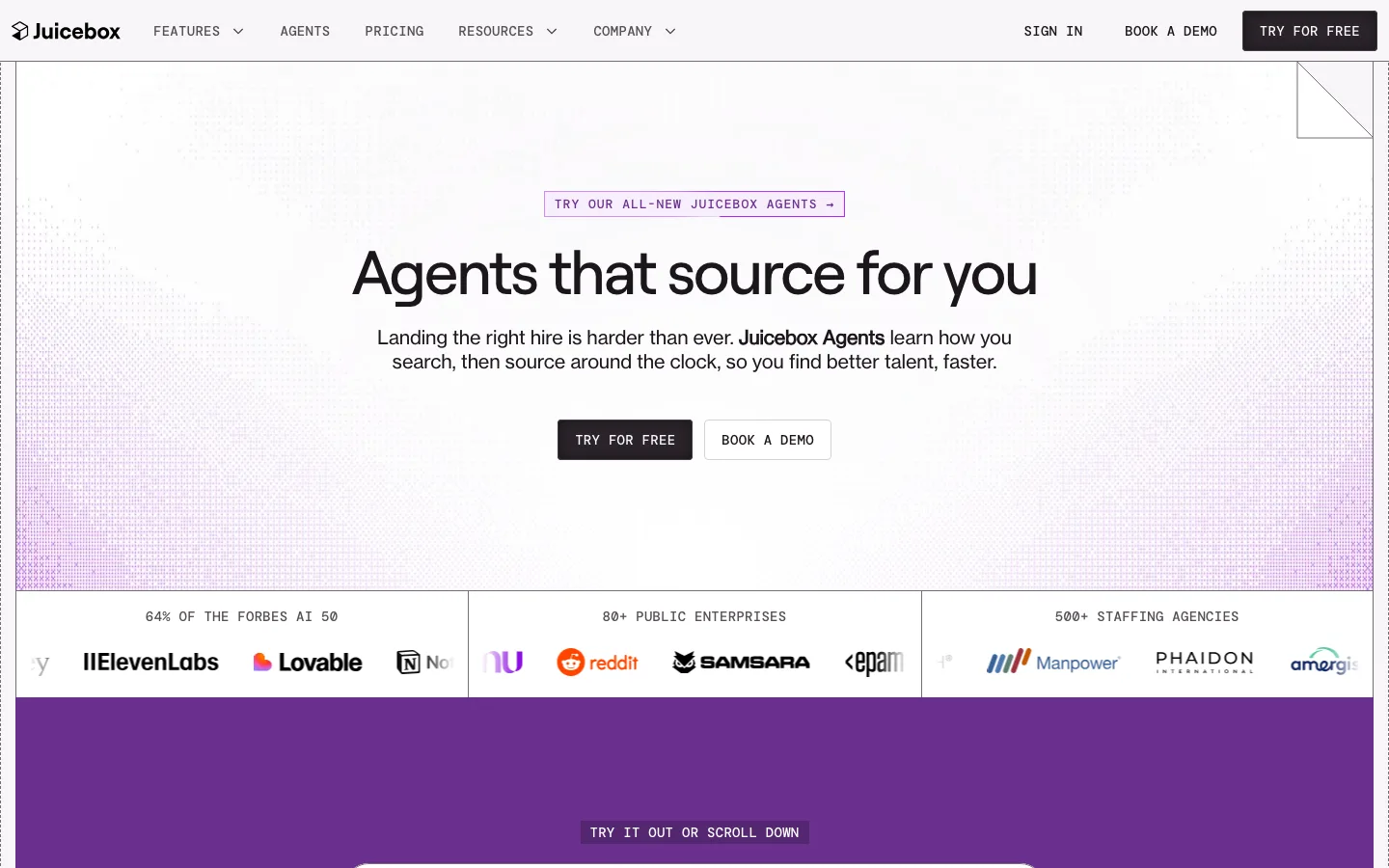
Verdict: Juicebox is quick to set up for a researcher who thinks in prompts, not Boolean strings.
Juicebox says it lets you "find, verify, and email perfect-fit candidates in one prompt" across "800M+ profiles across 30+ sources." Its agent offers to "map the market, calibrate, and source leads for you."
It serves recruiting in general. Talent insights start on Growth, email outreach is on paid tiers, and ATS or CRM sync is on the custom Business plan.
Best for: researchers and small firms building long lists on a budget.
Watch out for: no interview step, and syncing to your CRM needs the custom plan.
Pricing model: per seat per month, with a free plan, self-serve paid tiers, a custom Business plan and an Agents add-on. Price on website: yes.
8. HelloSky: best for executive, VC and PE searches that rank on company and investor data
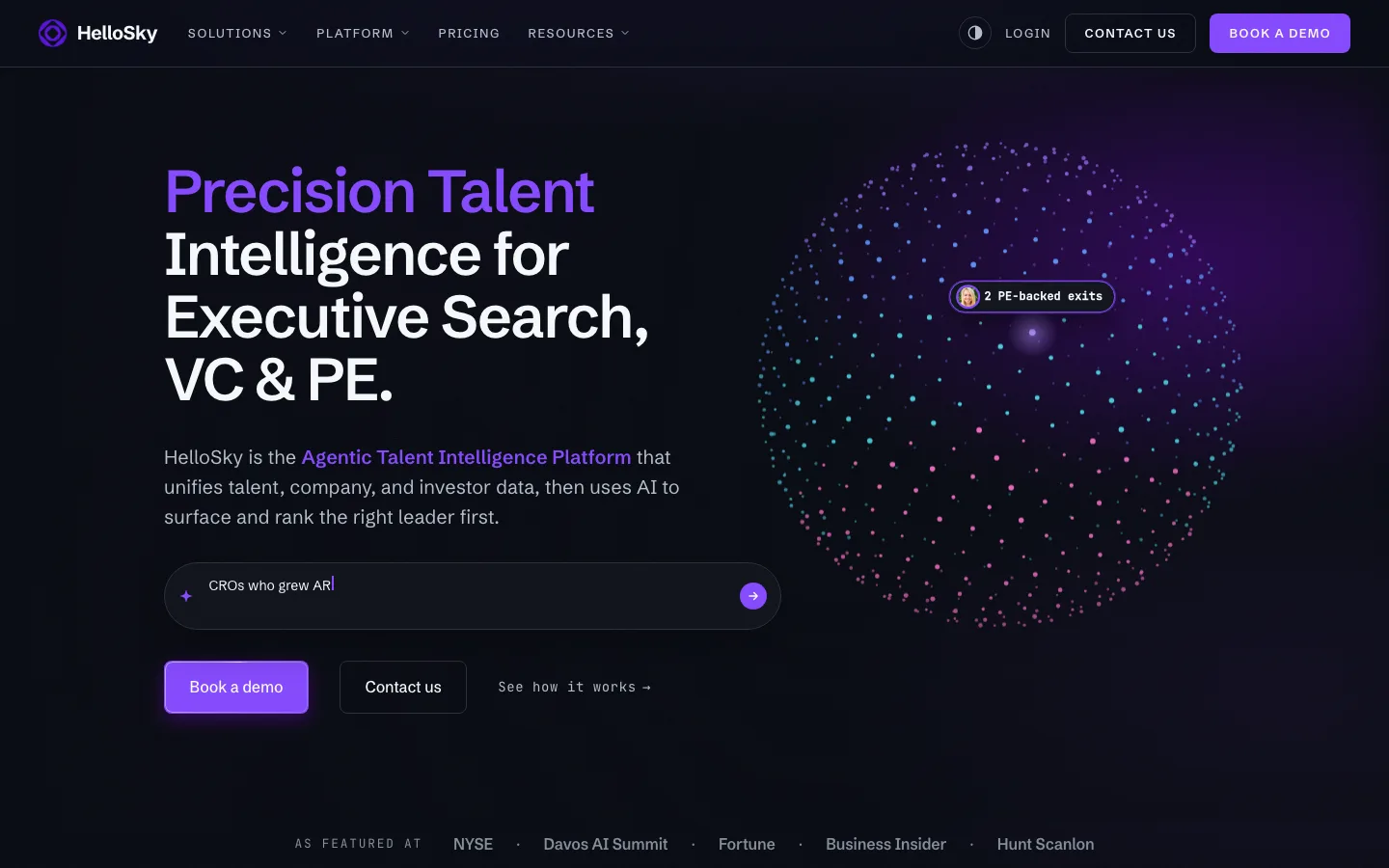
Verdict: HelloSky is the tool here built only for senior search, and it ranks on company and investor data.
HelloSky "unifies talent, company, and investor data, then uses AI to surface and rank the right leader first." Its SmartRank "scores candidates against your scorecard and shows the evidence behind every match." HelloSky says it holds 100M+ executive profiles with contact data.
Outreach is drafted by AI and sent "from Gmail or Outlook." The higher plan adds relationship intelligence and connection mapping, and an MCP add-on puts HelloSky in Claude and ChatGPT.
Best for: executive search firms and VC or PE talent partners hiring founders, CEOs and their teams.
Watch out for: every plan starts with a demo, there is no interview step, and the pool is executives only.
Pricing model: per user per month on published tiers, with add-ons and a custom Enterprise plan. Price on website: yes.
9. LinkedIn Recruiter (corporate) with Hiring Assistant: best for reaching senior people through InMail
Verdict: LinkedIn Recruiter adds an AI agent to LinkedIn's member network, and its reach stops there.
Hiring Assistant is "Recruiter's new AI agent" that "helps you find candidates others miss." After a candidate replies, it sends prescreening questions you can edit and "takes on initial screening." Talent Insights is sold separately for "talent and skills trends."
Best for: teams that already hold Recruiter seats and want AI inside them.
Watch out for: no email reveal, and Recruiter has no published price and starts with a sales call.
Pricing model: contract by quote; Talent Insights quoted separately. Price on website: no.
Also considered
hireEZ, with "Conversational AI Screening," is built for enterprise TA rather than executive search. See the AI sourcing tools list.
When to skip The Cognitive
- The search must stay anonymous. The approach goes out under your name. A retained firm can approach people without naming the client.
- You need the map before the names. Findem maps leaders, and HelloSky adds funding and investor data. The Cognitive has neither.
- Your best candidates are in your own records. Stardex ranks your database against the spec.
- You need a system of record. Mandates, fees and client records belong in a search firm CRM.
- The seat is a board role or CEO succession. That still needs a consultant's assessment, references and negotiation, and a fee of about a third of first-year pay may be worth it.
What should you ask in a demo?
- Run a real senior brief live. How many of the first 20 people are worth a call?
- Where does the contact data come from, and what does a reveal cost when it finds nothing?
- Whose mailbox sends the approach, and can every email be edited before it goes?
- Which plan in this quote includes the market map, the interview step and the CRM sync?
To see The Cognitive on a real search, put one open leadership role through the 7-day trial. It needs no card and covers 100 people; outreach waits for Sourcing Pro. Start the free trial.
Sources
- Korn Ferry, Form 10-K for the fiscal year ended 30 April 2026. sec.gov
- Bullhorn, GRID 2026 Industry Trends Report press release, February 2026. bullhorn.com
- Gem, Key takeaways from the 2026 Recruiting Benchmarks Report, December 2025. gem.com
- AESC, Client Bill of Rights. aesc.org
- LinkedIn, The Future of Recruiting 2025 (survey of 1,271 recruiting professionals in 23 countries). business.linkedin.com
- Vendor homepages, product pages and pricing pages: findem.ai, studio.findem.ai, seekout.com, stardex.com, metaview.ai, pin.com, juicebox.ai, hellosky.ai, business.linkedin.com, hireez.com.
Frequently Asked Questions
What are the best AI tools for executive search?
The Cognitive is the best pick for sourcing and first-interviewing senior candidates yourself. Findem leads on pitch research and maps, SeekOut suits enterprise TA teams, and Stardex suits firms working their own database.
Which executive search firms use AI?
This list covers AI tools, not firms. Korn Ferry's annual report names AI-based search tools among the forces it competes with, and the firms are compared in The Cognitive's guide to executive search firms.
Can AI interview executive candidates?
Yes, for a structured first round. The Cognitive runs a live two-way AI video interview of 10 or 20 minutes, scored against your criteria. Findem and SeekOut sell AI video interviews through sales. Final rounds and references stay with people.
Can an in-house TA team run a senior search with AI tools?
It can run the long list, the approach and the first interview itself. Korn Ferry's fee is generally one-third of first-year cash compensation. Firms still own the anonymous approach, assessment, references and negotiation.
Is an AI-run executive search confidential?
Not fully, because an email sent from your own mailbox names you. A retained firm can approach people without naming the client. HelloSky states SOC 2 on its site.
Which AI executive search tools work inside Claude or ChatGPT?
Several state a connector. Stardex, SeekOut, Metaview and HelloSky name both Claude and ChatGPT, Pin names Claude, and Findem Studio works through MCP. The Cognitive works from Claude.
How much do AI executive search tools cost?
Most charge per user per month or in credits, and all but LinkedIn Recruiter show a price. Pin, Juicebox and Metaview have free plans. The Cognitive's plans start at $99 a month.
Related reading
- Executive Search Software: The 10 Best Platforms for Search Firms in 2026
- AI Sourcing Tools Compared: The 10 Best for Finding Candidates in 2026
- Talent Intelligence Software Compared: 11 Platforms for Market Data and Finding People
- Best EOR Companies in 2026: 11 Employer of Record Providers Ranked, Plus the Step Before
- Top Accounting and Finance Recruiting Firms in 2026: 9 Firms and a Do-It-Yourself Option
- Best Sourcing Tools for Recruiters in 2026: 12 Tools by Job