How to Hire Software Engineers: 7 Steps From Brief to Offer
By Sparsh Goyal, Founder at The Cognitive. Published · Last updated
- Hiring a software engineer takes seven steps: brief, sourcing, outreach, a structured first interview, one technical round, a short final loop and a fast offer.
- Technical roles take a median of 40 days to hire and average 5 interview events per hire, according to Ashby's 2026 Talent Trends Report.
- Once candidates reach the offer stage, 82% accept across all roles in Gem's 2026 benchmarks, the highest rate since 2021.
To hire a software engineer, write a brief around what the person will ship. Then source engineers who are not applying and reach them with a message about the work and two follow-ups. Run a structured first interview and one technical round that looks like the job. Keep the loop to about four candidate-facing stages, decide on scores written independently, and make the offer within days.
The steps are the same whether the post says software developer or software engineer. Technical roles take a median of 40 days to hire, according to Ashby's 2026 Talent Trends Report, which covers more than 109 million applications. Three in four are filled within 57 days. The Cognitive can take on the search, the outreach emails and the first interview; the technical round stays with your engineers.
How do you hire a software engineer, step by step?
Hiring a software engineer takes seven steps, from a signed brief to an accepted offer, and each step has one decision to make.
| Step | What you decide | Benchmark or rule of thumb |
|---|---|---|
| 1. Define the role | Six-month outcomes, level, 2 or 3 must-haves, pay band | US median pay $135,980 (BLS, May 2025) |
| 2. Source | Profile search, GitHub, named companies, referrals, past candidates | 11% of hires from 2.6% of applications (Gem 2026 report, all roles) |
| 3. Reach out | A note about the work, then two follow-ups | 19.6% average reply rate (Ashby 2024, all roles) |
| 4. First interview | A structured screen on a fixed scorecard | 20 to 30 minutes |
| 5. Technical round | One format, scored on the step 1 rubric | Take-homes capped at 2 hours |
| 6. Final loop and debrief | About four candidate-facing stages in all | 5 interview events per technical hire (Ashby 2026) |
| 7. Offer and close | Level, band, start date, who makes the call | 82% accept once at offer stage (Gem 2026 report, all roles) |
Step 1: How do you define a software engineering role before you search?
A software engineer brief is a one-page agreement between the recruiter and the hiring manager on what the person will do, at what level and for what pay. Write it before the first search, because every later step is scored against it.
- What they will have shipped by month six. "Rebuilds the route-pricing service so quotes return in under a second" tells a candidate and a recruiter far more than "strong Python skills".
- The level, defined by scope. A junior engineer owns tasks, a mid-level engineer owns features, a senior owns a system, and a staff engineer shapes several teams' systems.
- Two or three must-haves. Pick things a good hire could not learn in the first quarter, such as running a service in production under real traffic. Everything else is a nice-to-have and should not knock anyone out.
- An approved pay band. An offer that waits for a budget meeting loses the candidate. Agree the band and the level it maps to now.
- What the technical round will test. Choosing it here keeps the rubric tied to the job, not to whichever engineer is free that week.
A brief written this way might read:
Senior backend engineer for a freight logistics company. Owns the route-pricing service: Python and PostgreSQL, about 2,000 requests a second at peak. Must have run a production service through an on-call rotation and led at least one migration. Kafka is a plus. Hybrid in Chicago, two days a week. Base pay: the approved band.
Settle the hiring model at the same time. A full-time employee suits work that will still matter in two years. A contractor suits a fixed project with an end date. A development agency suits a company that wants a product built, not a person hired.
Hiring across borders is a separate decision with its own payroll and compliance questions. The usual problems with engineering searches are covered in challenges in IT recruitment.
The job post can come straight from the brief; a starting point is the software engineer job description template. Recruiters who do not read code can use the technical recruiting guide to run the intake with an engineering manager.
Step 2: Where do you find software engineers who are not applying?
Most software engineers worth hiring already have a job and are not looking, so the search has to go to them. In the Stack Overflow 2025 Developer Survey, 46% of developers said they were not looking for a new role, and another 28.8% were only somewhat open to one. Across all roles, Gem's 2026 Recruiting Benchmarks found that direct sourcing produced 11% of hires while making up just 2.6% of applications, a 4x yield.
Profile search
Searching professional profiles by skill, location and employer is the widest channel. Titles vary more than skills do, so lead with the stack and the kind of system, then use the title to break ties. Ready-made Boolean and Google X-ray strings for this role are on the hire a software engineer page.
GitHub and open source
GitHub shows how an engineer writes and reviews code: commits, pull request comments, and the issues they opened and answered. Much of a professional engineer's paid work sits in private company repositories, so a quiet profile proves nothing either way. Treat public code as a bonus signal, never a requirement.
Engineers at named companies
Engineers who have built a system like yours often work at a company you can name. It might be a competitor, a company on the same stack, or one that just cut a team. Filter a people search by current or past employer, and use the recruit from competitors guide to map and message them.
Referrals
Engineers know exactly who they would work with again. Ask your team for names against the brief, such as "the best Python engineer you have shipped with", rather than for "anyone looking". The setup is in employee referral program.
Past candidates
A finalist who took another offer last year already knows your team and your process. Gem calls candidates from previous outreach sequences "one of the richest, most overlooked sources of qualified talent." Check them at every new opening, using the method in candidate rediscovery.
Searching from the brief in The Cognitive
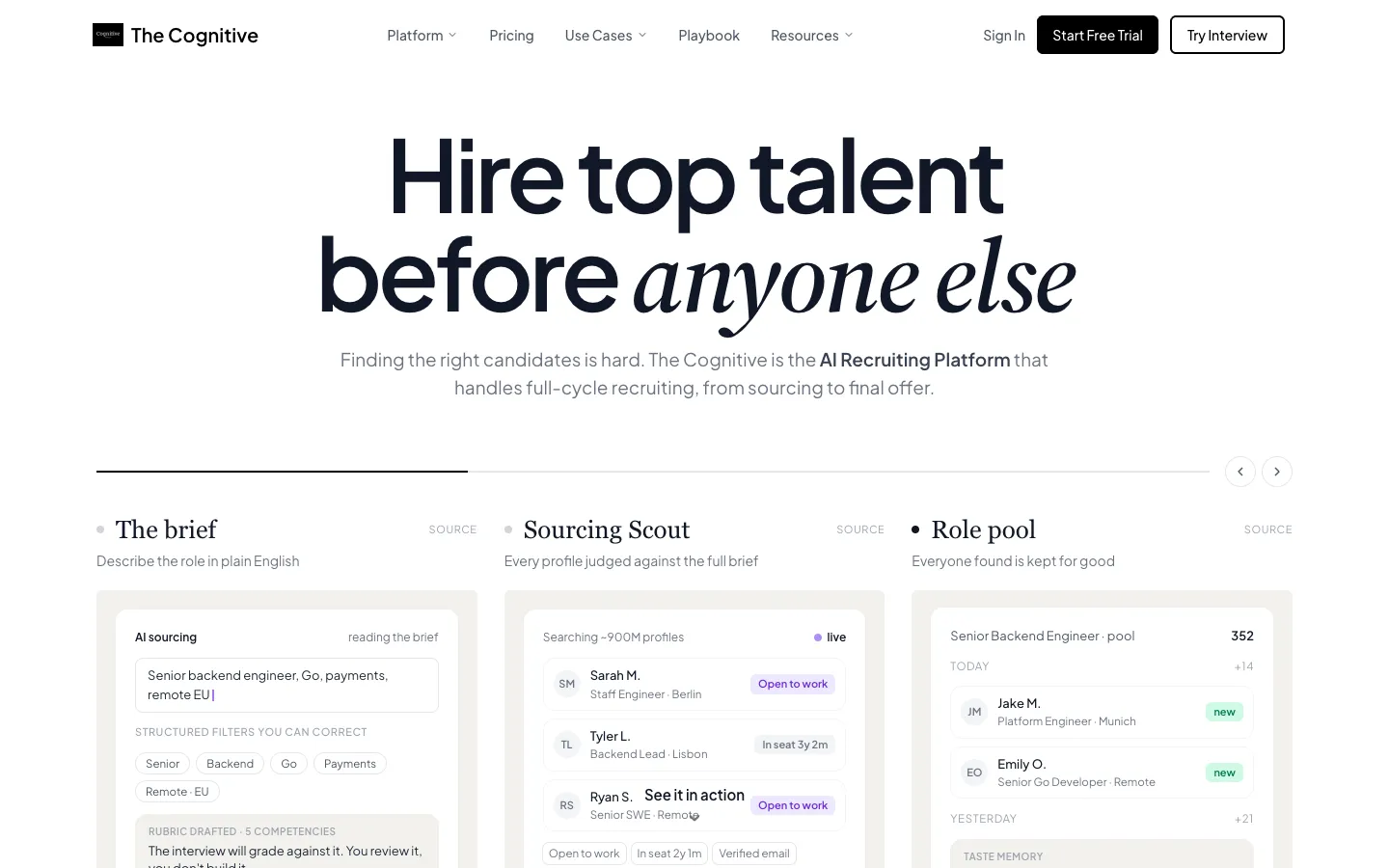
In The Cognitive, a recruiter types the brief in plain English and gets a ranked list from about 900M public profiles, with a short reason for each match. The brief becomes filters the recruiter can edit, including current employer, past employer and companies to exclude. A separate filter covers the technology an employer runs, kept apart from the skills the person lists. The Cognitive does not search GitHub, so that channel stays a manual one.
The brief step in The Cognitive: an engineering role written in plain English becomes a search with filters the recruiter can change.
Step 3: What outreach do software engineers reply to?
Software engineers reply to short messages about the work, sent by a named person, that say why they were picked. Ashby's sourcing report, built on more than 500,000 email sequences, found a 19.6% average response rate from January 2022 to January 2024. Reply rates plateau around 23%, and sending more than three emails did not significantly improve them. Three messages is the working limit.
Put these in the first message:
- Why them. One specific line from their work: the system on their profile, a talk, a library they maintain.
- The problem. What they would own, in the words of the brief.
- The team and stack. Who they would report to, team size, languages.
- The band. A number in the first message saves both sides a call that was never going to work.
- A small ask. A 15-minute call, not a CV.
A first email built that way:
Subject: Route pricing at 2,000 requests a second
Hi Dana, your write-up on moving a pricing service off cron jobs is close to the problem our team has now. We are hiring a senior backend engineer to own route pricing in Python and PostgreSQL, reporting to our head of platform, with a base in the approved band. Would 15 minutes this week be worth it to hear what the first six months look like?
Send the second note three to five days later in the same thread, with one new fact: the hiring manager's name, a launch, or the interview steps. Make the third short and offer a later date. Then stop.
Personal detail goes with more replies: in the same Ashby data, sequences with AI personalization drew a 35.3% reply rate against 24.1% for those without. More wording is in candidate outreach and the recruiting email templates.
The Cognitive sends sequences like this from the recruiter's own mailbox on the Sourcing Team plan and on Sourcing Pro and above. The follow-ups stop when the engineer replies. An interested reply adds the engineer to the role, and the recruiter then sends the interview invitation.
Step 4: What should the first interview with a software engineer cover?
The first interview with a software engineer checks the must-haves from the brief and whether the person did the work their profile describes. Keep it to 20 to 30 minutes and score it on a fixed scorecard, so every candidate is judged on the same criteria.
- One system they built. Their own part, not the team's, and what they would change now.
- A trade-off. Why that database, queue or framework, and what the choice cost.
- Depth on one must-have. Follow the answer down two or three levels until it runs out. Where it runs out is the signal.
- Logistics. Pay expectation against the band, notice period, location and hiring model.
Write the scores straight after the call, before reading anyone else's. Questions by competency are in the software engineer interview questions. The format is explained in what is a structured interview, and interviewer habits are in how to be a good interviewer.
The first round in The Cognitive
In The Cognitive, the first round is a live two-way AI video interview, set to 10 or 20 minutes per role. The engineer books a slot shown in their own time zone and can reschedule from the same link, and the invitation tells candidates the interview is run by AI. The AI interviewer asks the role's questions out loud, technical ones included, and follows up on the answers. The rubric stays fixed for the role while the questions adapt to each candidate.
The recruiter gets a scored report against the role's criteria, with the recording and the transcript. Signs of cheating, such as tab switches, copy and paste or another face on camera, are flagged for a person to review.
It is a spoken interview, not a coding test, and a person decides who moves on. Interviews run in a laptop or desktop browser. More detail is on the AI interviewer for software engineers page.
The interview scorecard: a score for each criterion set for the role, with the recording behind it for the hiring manager to check.
When to skip The Cognitive
The Cognitive has no coding test, code editor or live coding pad, so the technical round stays with your engineers or a coding test tool. It does not post jobs, collect applications, run reference checks or make offers. It does not search GitHub or developer communities, which stay manual channels. A team whose engineering roles fill well from applicants will get more from its ATS.
Email outreach needs the Sourcing Team plan or Sourcing Pro and above, and it is not part of the free trial. Sync with 100+ ATS sits on higher plans. The AI interview runs on a laptop or desktop, and phones and tablets are blocked.
Step 5: How should you run the technical round?
Run one technical round that looks like the job and score it on the rubric agreed in step 1. The format matters less than the fit: a task close to the real work, an engineer from the team running it, and a score written before anyone compares notes.
| Format | Best for | Time and main risk |
|---|---|---|
| Live pairing on a small real task | Most mid and senior roles | 60 to 90 min; costs an engineer's time |
| Code reading and review | Senior and staff roles | 45 to 60 min; less signal on writing code |
| Short take-home | Junior to mid; async teams | 2 hours or less; drop-off if long |
| System design conversation | Senior and above | 45 to 60 min; rehearsed answers |
| Timed algorithm test | Large early-career intakes | 60 to 90 min; weak link to daily work |
Pairing shows how a candidate reasons, asks and uses tools; code review shows judgment on unfamiliar code; a take-home shows finished work in their own setup. Pick one format per role, not three. A take-home should fit in two hours. If the task needs longer, pay for the time, because the engineers with the most options often skip unpaid weekend work. Machine learning engineers usually need a modelling or data round as well; role detail is on hire an AI or ML engineer.
Decide the policy on AI coding assistants before the round and state it in the invitation. If assistants are allowed, ask the candidate to walk through what the tool produced and what they changed, since that conversation is the signal. If they are not, use a live format and say so up front.
For remote rounds, signs of outside help and how to check them are covered in AI interview cheating detection. Coding test and live coding platforms are compared in best technical interview software.
Step 6: How many interview rounds is too many?
For most software engineering roles, about four candidate-facing stages is enough. They are the first interview, the technical round, a conversation with the hiring manager and team, and a system design session for senior hires. Ashby's 2026 report finds technical roles average 5 interview events per hire against 4 for business roles, and that one extra round adds roughly a week to the process. Teams also interview more people for each opening: 17.6 applicants per technical hire, a 52% increase from about 11 in 2021.
Technical hiring costs about twice the team hours of business hiring in Ashby's data, and each extra week of process gives the candidate time to take another offer. Technical roles are already the slow ones in Ashby's data:
| Measure (Ashby, 2026) | Technical roles | Business roles |
|---|---|---|
| Median days to hire | 40 | 30 |
| 75% of hires made within | 57 days | 46 days |
| Median time to first fill | 76 days | 56 days |
To cut a stage, look for two interviews that test the same criterion, then combine them or move one after the offer as a meet-the-team session.
How to run the debrief
A debrief works when every interviewer submits a written score against the rubric before the meeting. Reading scores first stops the most senior voice in the room from setting everyone else's view. Let the hiring manager speak last, tie every "no" to a named criterion, and decide within two working days of the final interview.
Step 7: How do you make an offer a software engineer accepts?
A software engineer accepts an offer that comes fast, holds up against the market and is clear about the work. Across all roles, Gem's 2026 Recruiting Benchmarks found that once candidates reach the offer stage, 82% accept, the highest rate since 2021. In Ashby's data, one extra interview round adds roughly a week, so the time to cut sits before the offer.
Pay is the first check. The US Bureau of Labor Statistics puts the median annual wage for software developers at $135,980 in May 2025. That is a national figure across levels and cities, so set the band for the specific level and location with a tool from salary benchmarking tools.
Pay is not the whole case. In the Stack Overflow 2025 Developer Survey, developers ranked autonomy and trust, competitive pay, and solving real-world problems as the top three factors in their satisfaction at work. An offer call can speak to all three: who decides what the engineer works on, the full pay, and the problem waiting in month one.
- The hiring manager makes the call. The person the engineer will report to is the most convincing voice on it.
- The written offer follows within a day. Level, base, bonus or equity if any, and the start date.
- Ask what else they are weighing. Then answer it, instead of guessing.
- Agree a decision date. A few days is fair. An exploding offer starts the job on bad terms.
- Prepare for a counteroffer. Ask early what would make them stay, and whether money alone would.
How to start
Pick the engineering role that has been open longest. Write its brief with the hiring manager, check past candidates and referrals, then source the rest and send three messages each. Track reply rate, days per stage and interviews per hire for that one role for a quarter, and cut the stage that adds the most days.
A 7-day free trial, with no card, covers 100 sourcing credits: one engineering search of 100 people. Plans start at $99 a month. Start free with The Cognitive.
Sources
- Ashby, Recruiter Productivity: 2026 Talent Trends Report (more than 109 million applications and 247,000 jobs, January 2021 to March 2026), ashbyhq.com, April 2026.
- Ashby, Talent Trends Report: Candidate Sourcing (more than 500,000 email sequences, January 2022 to January 2024), ashbyhq.com, March 2024.
- Gem, Key takeaways from the 2026 Recruiting Benchmarks Report (165 million applicants and 1.2 million hires, June 2021 to May 2025), gem.com, December 2025.
- Stack Overflow, 2025 Developer Survey: Work, survey.stackoverflow.co, 2025.
- US Bureau of Labor Statistics, Occupational Outlook Handbook: Software Developers, Quality Assurance Analysts, and Testers (May 2025 pay, 2025 to 2035 projections), bls.gov.
Frequently Asked Questions
How long does it take to hire a software engineer?
Technical roles, software engineers among them, take a median of 40 days to hire, according to Ashby's 2026 Talent Trends Report, and 75% are filled within 57 days. Business roles take a median of 30 days, so engineering is the slower search. Technical roles average one more interview round than business roles, which Ashby finds adds roughly a week, so the loop is the part a team can shorten.
How much does it cost to hire a software engineer?
The largest cost of hiring a software engineer is the salary, and the US median for software developers was $135,980 in May 2025, according to the Bureau of Labor Statistics. Pay varies widely by level and city, so benchmark the band for the exact role. Add the hours engineers spend interviewing, any sourcing tools or job ads, and any agency fee if you use one.
Is there still demand for software engineers?
Yes, the Bureau of Labor Statistics projects software developer jobs to grow 10% from 2025 to 2035. It expects about 106,100 openings a year on average over the decade for software developers, quality assurance analysts and testers combined. Demand still varies by specialty and city, so senior engineers in a specific stack are harder to hire than the national figure suggests.
How do you hire a software engineer without a recruiter?
A hiring manager or founder can hire a software engineer without a recruiter by running the same seven steps with fewer people. Write the brief, ask the team for referrals, search for engineers by stack and employer, and send short messages with two follow-ups. Keep the loop to about four stages and make the offer yourself. A sourcing tool with outreach and a first-round interview saves the most hours here.
Should you use a recruiting agency to hire software engineers?
Use a recruiting agency when the team has no time to source, the role is rare, or several roles must be filled at once. An agency brings its own network and screening, and usually charges a fee when you hire. For roles that come back every year, an in-house process with direct sourcing builds a pipeline the company keeps.
Is a take-home test or live coding better for hiring engineers?
Live pairing on a small, real task suits most mid and senior roles, because it shows how the engineer reasons and asks questions. A take-home suits junior roles and teams that work asynchronously, as long as it fits in two hours or the time is paid. Choose one format per role and score it on the rubric agreed in the brief.
Can AI help you hire software engineers?
Yes, AI tools can help with sourcing, outreach and the first interview, while engineers still run the technical round. In The Cognitive, a recruiter describes the role in plain English and gets a ranked list from about 900M public profiles. On the Sourcing Team plan and on Sourcing Pro and above, it emails engineers from the recruiter's own mailbox. Engineers who reply with interest can be invited to a live two-way AI video interview scored against the role's criteria. It has no coding test, so a pairing or coding round stays with the team.
Related reading
- Challenges in IT Recruitment in 2026: 6 Problems, the Numbers Behind Each and How to Fix Them
- Technical Interview Software in 2026: 15 Tools for Coding Tests, Live Coding and AI Screens
- Best Retail Hiring Software in 2026: 9 Tools for Store Teams and Store Leaders
- 10 Best CRMs for Staffing Agencies in 2026, Scored
- Best EOR Companies in 2026: 11 Employer of Record Providers Ranked, Plus the Step Before
- Best Sourcing Tools for Recruiters in 2026: 12 Tools by Job