Challenges in IT Recruitment in 2026: 6 Problems, the Numbers Behind Each and How to Fix Them
By Sparsh Goyal, Founder at The Cognitive. Published · Last updated
- The 6 biggest challenges in IT recruitment in 2026 are application overload, passive candidates, the skills gap, AI-assisted and fake candidates, slow hiring and ghosting, and stretched recruiting teams.
- Greenhouse found applications per role rose from about 115 in 2022 to 244 in 2025, while recruiters per organization fell 55.6%.
- CompTIA counted 272,040 new IT job openings in September 2026, the busiest market in more than 3 years.
- Each challenge has a practical fix and a number to watch, from outreach reply rate to drop-off by stage.
- Fix the stage that loses the most candidates first, then automate the first interview round so people focus on decisions.
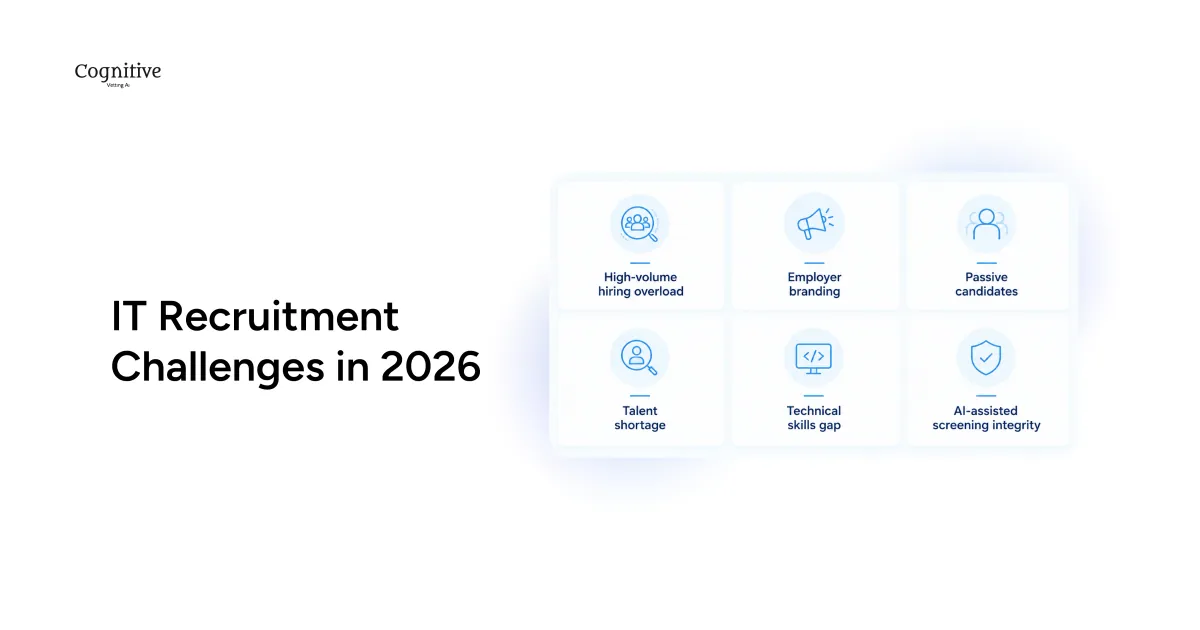
The biggest challenges in IT recruitment in 2026 are application overload, passive engineers who never apply, a widening skills gap, AI-assisted and fake candidates, slow processes that lose people to ghosting, and recruiting teams stretched thinner than ever. None of them is only a shortage of people. Each is a problem of finding the right skills fast enough to keep projects moving. I run The Cognitive, which sources engineers and interviews them live with AI, so I see most of these from the inside.
Demand is climbing again. CompTIA's analysis of September 2026 data counted 272,040 new IT job openings in the month and 625,633 active postings, the highest total in more than 3 years (read 5 October 2026). More openings means more competition for the same engineers, on top of every problem below.
This guide walks through 6 of the most pressing challenges in IT recruitment, pairs each with a practical fix and a number to watch, and then looks at the trends shaping how technical teams will hire next.
The biggest challenges in IT recruitment right now
These challenges rarely show up alone. A skills shortage pushes teams to post wider, which pulls in more applications, which slows screening, which frustrates candidates and weakens the employer brand, which makes the shortage feel worse. Here's the chain at a glance before we break each one down.
| Challenge | What drives it | First fix | Number to watch |
|---|---|---|---|
| 1. High-volume overload | 1-click and AI-written applications | Knockout questions and structured first rounds | Applications per role, time to first response |
| 2. Passive candidates | The best engineers already have jobs | Outbound sourcing and a visible engineering brand | Reply rate to outreach |
| 3. Skills gap | Tools change faster than people retrain | Skills-based requirements and upskilling | Days a role stays open |
| 4. AI-assisted and fake candidates | Coding assistants, interview co-pilots, proxies | Conversational interviews and early identity checks | Integrity flags per 100 interviews |
| 5. Slow hiring and ghosting | Extra rounds, slow feedback | Shorter loops with feedback deadlines | Drop-off rate by stage |
| 6. Stretched recruiting teams | More applications, fewer recruiters | Automate the first pass, keep humans on decisions | Applications and interviews per recruiter |
1. High-volume hiring overload
A single IT job posting can pull in hundreds, sometimes thousands, of applications. AI tools make it easy for candidates to apply everywhere at once, so the pile keeps growing while your team stays the same size. Greenhouse's March 2026 benchmark report found applications per role rose from roughly 115 in 2022 to 244 in 2025 (read 5 October 2026).
Manual screening can't keep up at that level, and irrelevant applications bury qualified engineers. It's one of the most frustrating parts of the job because the cost stays hidden until it hits hiring outcomes.
Why high volume hurts technical hiring:
- Recruiters spend hours sorting resumes instead of talking to people.
- Strong candidates drop off while they wait for a response.
- Inconsistent screening lets bias and guesswork creep in.
Here's how you can fix the high-volume hiring overload challenge:
Filter smarter rather than working longer:
- Add knockout questions at the application stage so clear mismatches drop out early.
- Rank applicants against the actual job requirements with AI or rule-based scoring.
- Automate acknowledgments and stage updates so candidates always know where they stand.
- Build talent pools from near-fit applicants you can come back to for future roles.
The point is to spend less recruiter time sorting and more on judgment. If volume is your main bottleneck, these high-volume recruiting strategies go deeper into the tactics.
2. Employer branding and passive candidates
In tech, the best engineers are rarely sending out applications. They already have jobs, recruiters in their inbox and little reason to move. If you only work with active applicants, you get volume but not always quality. That makes employer branding one of the quieter but more serious challenges in IT recruitment.
Passive candidates judge you long before they reply. They look at your engineering blog, your team's GitHub activity, reviews from past employees, and how your developers talk about their work. A weak or invisible brand means your outreach gets ignored, however good the role is.
Here's how you can fix this IT recruiting challenge:
Treat sourcing as a long game and your brand as part of the offer:
- Invest in visible employer branding through engineering content and employee advocacy.
- Keep an opt-in talent community so you can reach passive candidates when a role opens.
- Strengthen and publicize your employee referral program, which often surfaces the best technical fits.
- Source outbound. Greenhouse found recruiter-sourced candidates were about 3% of applications but 9.7% of hires in 2025, the best conversion of any channel. Our guide to passive candidate sourcing covers how.
- Track engagement across channels so you know which outreach actually converts.
When sourcing shifts from posting and waiting to building relationships, you stop competing only on salary and start competing on reputation.
3. Talent shortage and the technical skills gap
Even with strong sourcing, there may not be enough qualified people, and the gap is widest in specialized areas. A 2026 analysis by Altline put the number of unfilled US tech jobs above 1.2 million, with the worst shortages in AI, cybersecurity and cloud security (read 5 October 2026). IDC, in research reported by CIO Dive in May 2024, expected 9 in 10 organizations to feel the skills shortage by 2026 and estimated $5.5 trillion in losses from product delays, lost competitiveness and lost business.
Part of the problem is pace. Cloud platforms, security tools and development frameworks now change faster than most professionals can keep up with, so the shelf life of technical skills keeps shrinking. Degree-based hiring alone no longer shows who can actually do the work, and no amount of clever advertising fixes that.
Here's how you can fix this talent shortage and technical skills gap challenge:
Widen who counts as qualified, and grow talent instead of only buying it:
- Shift to skills-based hiring by rewriting job descriptions around capabilities rather than degrees.
- Run short, role-relevant skills assessments early in the funnel.
- Build internal upskilling and reskilling paths so current staff can move into harder roles. Our comparison of internal vs external recruitment helps you decide when that beats an outside hire.
- Open up remote and global sourcing to reach engineers outside your local market.
This turns the skills gap from a wall into a pipeline you can keep filling over time. For roles that stay open for months anyway, our guide to recruiting for hard-to-fill roles helps you find the real constraint.
4. AI-assisted candidates and screening integrity
This challenge barely existed a few years ago and now sits near the top of most hiring leaders' lists. In a Gartner survey of 3,000 job candidates published in July 2025, 6% admitted to interview fraud, and Gartner predicts 1 in 4 candidate profiles worldwide will be fake by 2028. At the same time, hiring teams use AI across screening, scheduling and candidate messages. AI now sits on both sides of the table.
For technical roles, this cuts deep. AI coding assistants produce clean, working solutions in seconds, so a take-home test or a scripted live problem no longer tells you who can engineer. You might be looking at the candidate's skill or at the tool's output, and from outside they can be hard to tell apart.
Some cases go further:
- Some candidates lean on live interview co-pilots that feed them answers in real time.
- A smaller but growing group uses proxy interviewers or deepfake video, where the person on screen isn't who they claim to be.
Among the challenges in recruitment for IT, this one is uniquely corrosive because it threatens the trust the whole process depends on. It's also why more teams look at AI interview fraud detection to keep screening honest, and work through a candidate fraud checklist for remote hiring.
Here's how you can fix this AI-assisted screening integrity challenge:
Adapt how you evaluate rather than trying to ban AI outright:
- Redesign coding interviews to be open-ended and project-style, so they need real reasoning, not a single prompt.
- Run live interviews where candidates explain their choices and walk through edge cases.
- Verify identity early, especially for remote roles, since each interview now doubles as an identity check.
- Some companies now allow approved AI in interviews and score how well candidates prompt, validate and debug, which tests real-world skill.
The aim is to measure judgment and understanding, which hold up under questioning even when AI is in the room.
5. Slow hiring and candidate ghosting
Engineers in demand don't wait around. If your process drags through too many rounds or goes quiet between stages, strong candidates accept other offers or disengage. Long gaps drive no-shows, offer declines and a reputation that follows you onto every review site. It feels small day to day but compounds fast. Greenhouse's March 2026 report put the average time to fill a job at 56.7 days in 2025, up 36.8% since 2022.
Many of these delays are self-inflicted: extra interview loops, slow manager feedback and unclear next steps, rather than anything about the candidate.
Here's how you can fix this candidate ghosting challenge:
Tighten the process and keep people informed:
- Audit and trim interview steps so the loop matches the seniority of the role.
- Set clear feedback deadlines so managers respond in days, not weeks.
- Automate stage-based updates so candidates are never left guessing.
- Track drop-off and no-show rates to find exactly where people disappear.
Ask whether each round earns its place. A solid pre-screening process often removes a round entirely.
6. Recruiting teams stretched past capacity
The sixth challenge sits underneath the other 5. The same Greenhouse report found annual applications per recruiter up 411.8% since 2022, while recruiters per organization fell 55.6%. Interviews scheduled per recruiter each year rose 128% to 650.5. Fewer people are handling far more volume, and technical roles need more care per candidate, not less.
When a recruiter is that stretched, every other problem on this list gets worse. Outreach goes out late, screening gets shallower, and feedback waits another week.
Here's how you can fix the capacity challenge:
- Automate the first interview round for roles with a clear rubric, and keep recruiters and hiring managers on the later, higher-judgment rounds.
- Agree the scoring criteria with the hiring manager before screening starts, so recruiters don't redo work after the first batch.
- Pick 2 or 3 metrics and review them weekly rather than tracking everything. Our list of recruitment KPIs helps you choose.
How do you tell which IT recruitment challenge is hurting you most?
Most teams feel all 6 at once, but one is usually doing most of the damage. Look at where candidates are lost:
- Plenty of applicants, few good ones: that's challenge 1 or 3. Check whether your requirements gate on degrees or on skills.
- Good people never apply: challenge 2. Measure your outreach reply rate before spending more on job boards.
- Strong interview scores, weak hires: challenge 4. Your interviews may be testing rehearsed or assisted answers.
- Offers declined or candidates going quiet: challenge 5. Time each stage and find the slowest one.
- Everything is late: challenge 6. Count interviews per recruiter per week.
Fix the stage that loses the most people first. Improvements elsewhere won't show until that one moves.
Future trends shaping IT recruitment
The challenges above are already pushing the field in new directions. A few trends stand out for 2026 and beyond:
- AI-assisted interviews become normal: Employers are redesigning technical rounds around AI use rather than against it. Some now run early screens through an AI interview platform and judge how candidates reason, not just whether they reach an answer.
- Skills-first hiring goes mainstream: As degrees lose their signal, more teams hire on demonstrated capability and assessments, opening roles to self-taught and non-traditional candidates.
- Identity verification moves into hiring: With synthetic profiles and deepfakes rising, checks that used to live in finance and security are becoming a standard part of the interview stage.
- Global and remote sourcing keeps expanding: Local shortages push teams to hire across borders, with regions such as India and Eastern Europe emerging as deep talent pools for technical roles.
- AI handles the busywork, humans handle the judgment: Screening, scheduling and follow-ups increasingly run on automation, freeing recruiters for relationships, evaluation and closing.
The common thread is that technology is reshaping both sides of the table. Candidates use AI to apply and interview. Recruiters use it to source and screen. The teams that win will use these tools to make better human decisions, not to remove humans from the loop.
Where does The Cognitive help with IT recruitment challenges?
The Cognitive covers 2 of the stages above: finding engineers who don't apply, and running the first interview so your team only meets people worth their time.
Sourcing passive engineers. You describe the role in plain English and The Cognitive reads it into editable filters, then searches ~900M public profiles. Each result card opens with a "Why this match" line traced to the profile, and anyone who misses a must-have drops below the people who meet it. You can reveal verified emails and phone numbers and, from Sourcing Pro up, run email and SMS sequences.
Interviewing at volume without losing depth. Candidates book their own slot for a live, two-way AI video interview of 10 or 20 minutes, in any of 9 languages. The rubric stays fixed for the role while the questions adapt to each answer, so a vague claim gets a follow-up. The AI also probes up to 5 claims from the resume and marks each one verified, refuted or unclear. Integrity signals such as tab switches and camera off are logged on the report but never scored, and nothing is rejected automatically.
Each report gives a 1 to 5 score per criterion, a weighted score out of 100, a suggested verdict and overall written feedback, with the transcript and recording. Hiring managers and tech leads read the reports and decide who moves on. You can try a live AI interview to see the candidate side.
Find and interview engineers in one place Source passive candidates from a plain-English brief and invite them to a live AI interview. Start free
Conclusion
The challenges in IT recruitment in 2026 are connected, not isolated. A skills shortage drives volume, volume slows screening, slow screening hurts your brand, a weak brand makes the shortage worse, and stretched recruiters feel all of it. Add AI-assisted candidates and the old playbook stops working.
Every one of these problems has a practical response: filter smarter, build relationships with passive talent, grow skills instead of only buying them, redesign interviews for the AI era, keep your process fast and transparent, and take the first pass off your recruiters' plates. That last step is where an AI interview platform earns its place, handling early screening at volume so your team spends its time on the candidates who deserve a closer look.
Teams that treat hiring as a system to improve, rather than a series of one-off tasks, will keep attracting strong technical talent even as the market gets harder.
Take the first round off your team's plate Live AI interviews with a scored report for every engineer, so your team only meets the ones worth their time. Start free
Sources
- CompTIA, Employer demand for tech talent reaches three-year high: comptia.org (read 5 October 2026)
- Greenhouse, The Hire Standard: Greenhouse benchmark report, North America, March 2026: PDF (read 5 October 2026)
- Altline, Is there still an IT talent shortage in 2026: altline.sobanco.com (read 5 October 2026)
- CIO Dive, What's the cost of the IT skills gap? IDC says $5.5 trillion by 2026, 17 May 2024: ciodive.com (read 5 October 2026)
- Gartner, survey press release, 31 July 2025: gartner.com
Frequently Asked Questions
What are the biggest IT recruitment challenges in 2026?
The 6 biggest are high-volume application overload, passive candidates who never apply, the technical skills gap, AI-assisted and fake candidates, slow hiring that leads to ghosting, and recruiting teams stretched past capacity. They feed each other: a skills shortage drives more applications, which slows screening and damages the employer brand. The Cognitive targets 2 of them directly by sourcing passive engineers and running the first interview round live with AI.
How big is the IT skills gap in 2026?
A 2026 analysis by Altline put unfilled US tech jobs above 1.2 million, with the worst shortages in AI, cybersecurity and cloud security. IDC research reported by CIO Dive expected 9 in 10 organizations to feel the shortage by 2026, with an estimated $5.5 trillion in losses from product delays and lost business. CompTIA counted 625,633 active IT job postings in September 2026, the highest in more than 3 years.
How are AI-assisted candidates affecting technical interviews?
AI coding assistants produce working solutions instantly, so take-home tests and scripted problems no longer prove skill on their own. Some candidates use live interview co-pilots, and a smaller group uses proxy interviewers or deepfake video. In a 2025 Gartner survey, 6% of candidates admitted to interview fraud. This pushes teams toward conversational interviews that test reasoning, which is the format The Cognitive runs.
How can companies prevent AI cheating during technical interviews?
A few practical fixes protect evaluation integrity: redesign coding rounds to be open-ended and project-style, run live interviews where candidates explain their choices and edge cases, verify identity early for remote roles, and consider allowing approved AI use while scoring how well candidates prompt, validate and debug. In The Cognitive, integrity signals such as tab switches and camera off are logged on the report for a person to review, never scored automatically.
What is skills-based hiring and why is it replacing degree requirements?
Skills-based hiring evaluates candidates on demonstrated capability rather than academic credentials. Technical tools now change faster than most people can retrain, so degrees often fail to show who can do the work today. Teams are rewriting job descriptions around skills and running short, role-relevant assessments early in the funnel.
How long should a technical hiring process take?
There is no single benchmark, but Greenhouse's March 2026 report put the average time to fill any job at 56.7 days in 2025, up 36.8% since 2022. Delays drive drop-off and offer declines, so audit your loop against the role's seniority, set feedback deadlines in days, and automate stage updates. Moving the first interview to a self-scheduled live AI interview, as The Cognitive does, removes calendar wait from that round.
How does The Cognitive help solve these IT recruitment challenges?
The Cognitive sources passive engineers across ~900M public profiles from a plain-English brief, with verified emails and phone numbers, and interviews candidates in a live, two-way AI video interview they book themselves. The questions adapt to each answer against a fixed rubric, and each report gives a 1 to 5 score per criterion, a weighted score out of 100, a suggested verdict, written feedback, the transcript and the recording. A person makes every decision.
Why is it so hard to recruit IT professionals?
Demand is high and rising, the best engineers already have jobs, and their skills date quickly, so the qualified pool for any specific stack is small. Meanwhile recruiters handle far more applications with smaller teams: Greenhouse found applications per recruiter up 411.8% since 2022. The Cognitive helps by finding engineers who are not applying and by taking the first interview round off the recruiter's calendar.
How do recruiters attract passive tech candidates?
Recruiters attract passive tech candidates by sourcing outbound instead of waiting for applications, writing outreach about the actual work, and keeping a visible engineering brand through blogs, open source activity and employee voices. Greenhouse found recruiter-sourced candidates converted to hires better than any other channel in 2025. The Cognitive finds those people from a plain-English brief and can run email and SMS sequences from Sourcing Pro up.
Related reading
- High-Volume Recruiting Made Easy: 9 Winning Strategies in 2026
- Interview Cheating Detection and Anti-Fraud Monitoring With AI: 11 Tactics, the Signals That Catch Them and the Gaps
- How to Recruit for Hard-to-Fill Roles: Diagnose the Real Constraint, Widen the Pool and Source Passive Talent
- What Is a Normal Cost Per Hire? Benchmarks by Seniority, Sector, Role and Region
- How Many Candidates Are Interviewed per Hire? 2025 and 2026 Benchmarks by Role and Stage
- Affordable AI Recruiting Tools That Show Their Prices: How 10 Bill You in 2026