How to Use Pre-Screening Interviews to Reduce Time-to-Hire
Most hiring teams screen candidates wrong. Here's how to run pre-screening interviews that actually cut time-to-hire, not just inbox noise.
You Are Losing Two Weeks Before the Interview Even Starts
You post a role. Applications come in. A recruiter does a quick phone screen. Then everyone waits for the hiring manager's calendar, for the panel to align, for someone to decide who actually moves forward.
That gap, between application and first real evaluation, is where most hiring cycles fall apart. Not in the offer stage. Not in background checks. Right there, at the top.
The average U.S. time-to-hire is 44 days (SHRM, 2025). Roughly 40% of that is consumed before a hiring manager has spoken to a single candidate.
A pre-screening interview, done correctly, is the only thing that compresses that window. Not a phone screen. Not a form. An actual structured conversation that tells you which candidates are worth a hiring manager's time before that time is booked.
This guide covers:
Why most "screening calls" are not pre-screening interviews and why the difference costs you weeks
A step-by-step framework to build pre-screening that produces ranked, evidence-backed shortlists
A checklist to audit whether your current process is helping or adding to the delay
What a Pre-Screening Interview Actually Is (And What It Is Not)
Most hiring teams use the terms "screening call" and "pre-screening interview" interchangeably. They are not the same thing.
A screening call is a logistics check.
Is the candidate available?
Is the salary range acceptable?
Did they actually read the job description?
It is five minutes of mutual verification that rarely tells you anything about capability.
A pre-screening interview is a structured, competency-adjacent evaluation that happens before the formal interview rounds. Its purpose is not to confirm eligibility; it is to rank candidates by signal quality before any hiring manager spends time on them.
The distinction matters because the output is different:
A screening call output: a binary pass/fail
A pre-screening interview output: a ranked, evidence-supported shortlist
One saves a recruiter five minutes. The other saves a hiring manager two weeks.
Why Pre-Screening Is Where Time-to-Hire Is Won or Lost
The 44-day time-to-hire figure from SHRM is cited often. What is cited less is where those days accumulate.
According to LinkedIn's Talent Trends data, the average breakdown looks like this:
Stage
Average Time Lost
Application to first contact
5–8 days
First contact to qualified shortlist
7–10 days
Shortlist to first formal interview
6–9 days
Interview rounds and debrief
14–18 days
Offer to acceptance
3–7 days
The top three rows, everything before the first formal interview, account for roughly 40% of total hiring time. Pre-screening is the only lever that directly compresses all three.
Teams that treat pre-screening as a formality are effectively choosing to lose two weeks before the process has started.
The 4 Things a Pre-Screening Interview Must Do
Most pre-screening processes fail because they are designed around convenience, not output quality. A phone screen that asks, "Can you tell me about yourself?" is not a pre-screening interview. It is small talk with stakes.
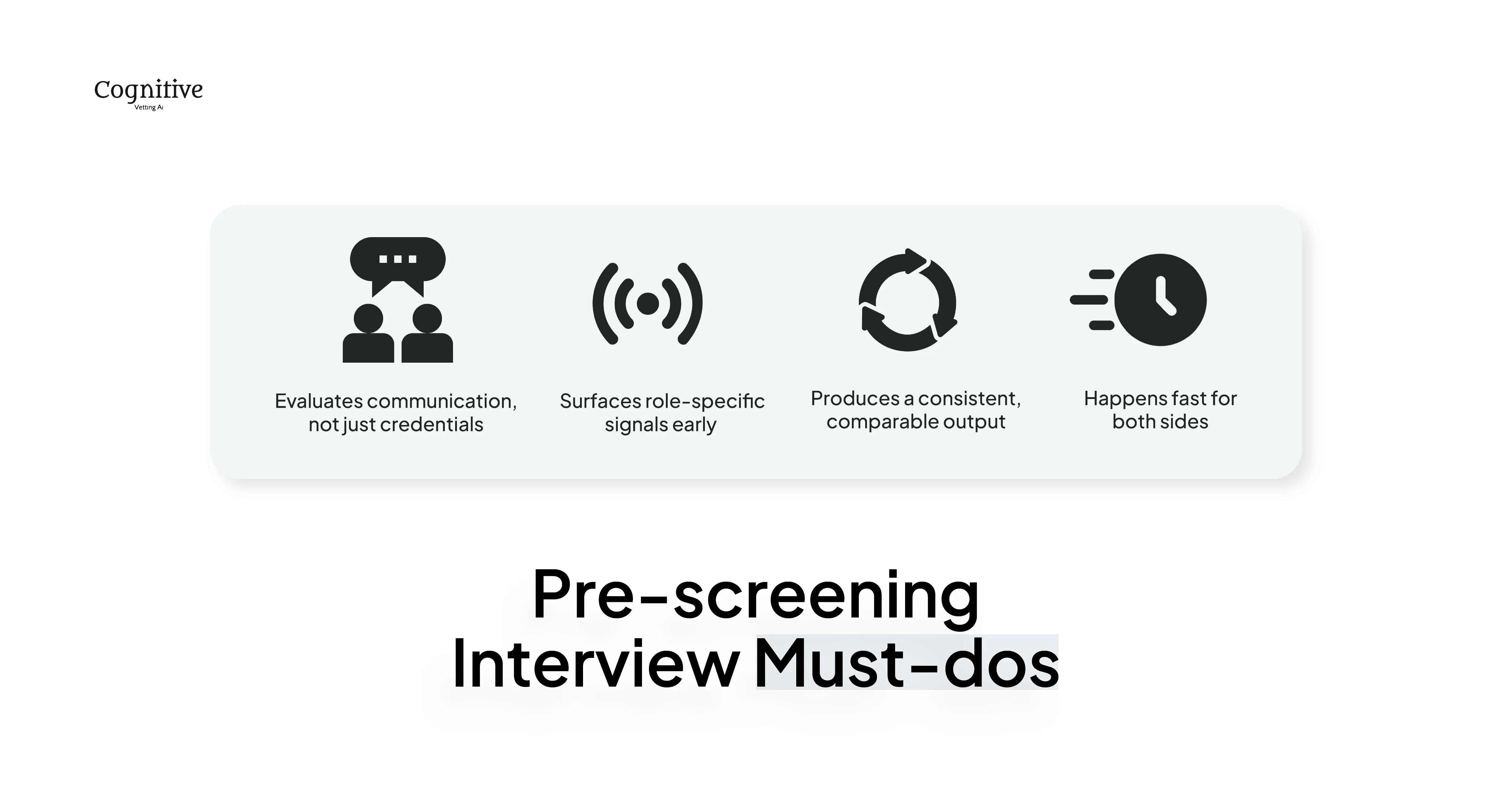
A pre-screening interview that reduces time-to-hire does four things:
1. Evaluates communication, not just credentials
Resumes confirm experience. Pre-screening interviews confirm whether a candidate can articulate that experience in a way that maps to the role. A candidate who cannot explain a past project clearly in a 15-minute conversation will not perform better in a two-hour panel.
2. Surfaces role-specific signals early
Generic pre-screening questions ("What are your strengths?") produce generic answers that tell you nothing. Questions tied to the actual requirements of the role based on the job description or the candidate's resume, produce answers you can evaluate and compare.
3. Produces a consistent, comparable output
If two candidates are assessed by two different recruiters using two different question sets, you cannot compare them. You can only compare your recruiters' subjective impressions. A structured pre-screening process produces a scorecard, not a vibe.
4. Happens fast for both sides
Pre-screening that requires scheduling a 30-minute call creates a four-day delay on average. In a candidate market, that is enough time to lose qualified applicants to competitors. The format has to match the intent: move fast, extract signal, advance, or decline.
How to Structure a Pre-Screening Interview That Works
Step 1: Anchor questions to the role, not a generic template
Before pre-screening begins, identify three to five role-specific competencies the hiring manager actually cares about. Not soft skills. Specific capabilities.
For a Customer Success role, that might be:
Ability to de-escalate a frustrated client
Structured communication under pressure
Process orientation when managing multiple accounts
Every pre-screening question maps to one of these. Generic templates produce generic output.
Step 2: Use a fixed question set across all candidates for the same role
Consistency is not just an equity issue; it is an evaluation quality issue. If one candidate is asked about conflict resolution and another is asked about their favorite project, you have two data sets that cannot be compared.
Fix the question set per role. Fix the scoring rubric. Every candidate for the same position goes through the same pre-screening questions.
Step 3: Score answers against a rubric, not a gut feeling
Define what a "strong" answer looks like for each question before pre-screening begins. This forces recruiters to evaluate against a standard rather than a memory of who seemed likable.
A simple rubric per question: 1 (insufficient), 2 (meets bar), 3 (exceeds bar). The total score determines who advances. The scoring takes two minutes. The bias it removes is significant.
Step 4: Document evidence, not impressions
The pre-screening output should include specific quotes or paraphrased answers, not "seemed confident" or "good energy." When a hiring manager reviews the shortlist, they should be able to read what a candidate actually said, not a recruiter's interpretation of how they came across.
Step 5: Set a hard timeline for advancement
Pre-screening without a decision window creates a second bottleneck. Define it upfront: candidates who complete pre-screening receive an advance or decline decision within 48 hours. No exceptions. This alone compresses the shortlist-to-interview gap.
Where Pre-Screening Breaks Down at Scale
A structured pre-screening process works. The problem is that it does not scale.
Once a role receives 80, 150, or 300 applications, the math changes:
300 candidates x 15-minute pre-screening call = 75 recruiter-hours
At a fully loaded recruiter cost of $40–$60/hour, that is $3,000–$4,500 per role in pre-screening labor alone
That cost is before a single candidate has been interviewed
This is why most teams either skip pre-screening (and send too many unqualified candidates to hiring managers) or use shallow automated screeners (and filter based on keywords, not capability).
The teams cutting time-to-hire in 2026 are solving this differently: they are using AI interviewing platforms like Cognitive to run pre-screening interviews at scale, with the same structure and scoring consistency as a human-administered screen, but without the scheduling lag or the labor cost.
What AI-Powered Pre-Screening Actually Changes
The difference between an AI screening chatbot and an AI pre-screening interview is the same distinction that matters in human pre-screening: evaluation depth.
A chatbot asks fixed questions and scores keyword density. It is a screener.
An AI interviewing platforms like, The Cognitive, conducts a live, two-way video conversation. The AI reads the candidate's resume before the interview begins. It asks role-specific questions. If an answer is thin or off-topic, it follows up. It does not move on just because an answer was given.
The output is a timestamped, evidence-linked scorecard, not a transcript, not a summary. Every score connects to the exact moment in the interview where it was earned.
For pre-screening, this changes three things:
Volume is no longer a constraint. 300 candidates can be pre-screened in the same window as 30.
Scheduling is eliminated. Candidates complete the interview on their own schedule, without a recruiter on the other end.
Output quality is consistent. Every candidate is assessed on the same questions, scored on the same rubric, with the same level of follow-up if an answer is insufficient.
The recruiter reviews scored reports, not intake notes. The hiring manager sees a ranked shortlist with evidence, not a stack of resumes with sticky notes.
Pre-Screening Interview Audit Checklist
Use this before your next hiring cycle. If you check more than three boxes, your pre-screening process is adding time-to-hire, not reducing it.
Signs your pre-screening is broken:
Different recruiters ask different questions for the same role
Pre-screening output is "notes from a call" rather than a scored rubric
Hiring managers are reviewing candidates with no pre-screening context
Scheduling a pre-screening call takes more than 2 business days
You have no data on how pre-screened candidates perform versus those who skipped it
Pre-screening volume drops when recruiters are busy with other roles
Candidates are dropping off before pre-screening completes
If you checked four or more: your pre-screening process is likely adding one to two weeks to your hiring cycle, not compressing it.
The Cognitive - AI Video Interviewing Built for Pre-Screening
Most AI tools marketed as interview platforms are running glorified questionnaires. Fixed questions. Keyword scoring. No follow-up. The candidate gives a weak answer and the system moves on.
That is not a pre-screening interview. That is an online form with a camera.
The Cognitive is built differently. It runs a real-time, two-way video conversation, a photorealistic AI face, a human-sounding voice, and an interview logic that actually responds to what the candidate says.What makes it purpose-built for pre-screening:
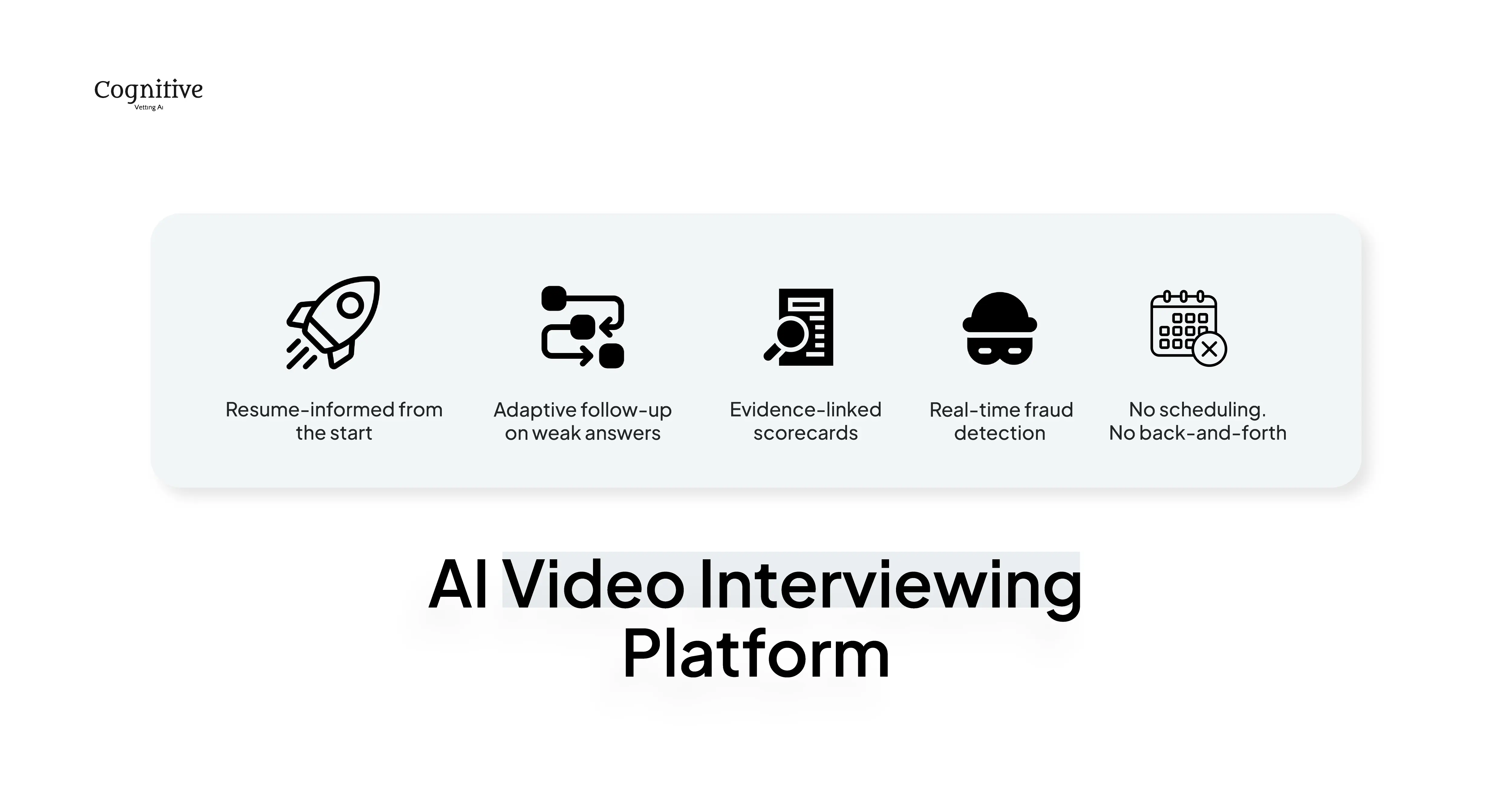
Resume-informed from the start Before the interview begins, the AI reads the candidate's resume and adjusts its question set accordingly. Every candidate gets a pre-screening conversation tied to their actual background, not a generic script. And since The Cognitive also handles AI sourcing - verified emails, phone numbers, automated outreach - candidates it finds land in these pre-screens automatically.
Adaptive follow-up on weak answers If a candidate gives a vague or insufficient answer, the AI follows up differently, not just again. This is the thing most platforms cannot do. A screener moves on. An interviewer probes. The Cognitive probes.
Evidence-linked scorecards Every score in the post-interview report links to the exact timestamp in the video where it was earned. Hiring managers are not reading a summary. They are reading a verdict with the evidence attached.
Real-time fraud detection Tab switching, multiple faces on screen, and camera-off behavior, all flagged during the live session. For high-volume pre-screening, this matters more than most teams realize until they have seen AI-generated candidate submissions at scale.
No scheduling. No back-and-forth. Candidates receive an invite and complete the interview on their own time. The recruiter's job is to review the scored report, not coordinate a call.
The Bottom Line
Pre-screening interviews are not a hiring formality.
Used correctly, they are the highest-leverage point in the hiring funnel, the place where time-to-hire is either compressed or extended before a single hiring manager hour is spent.
The teams reducing time-to-hire in 2026 are not doing more screening. They are doing better pre-screening: role-specific, consistently scored, and fast enough to not lose candidates to slower competitors.
The process above works with or without automation. But at scale, past 30 open roles or 100+ applicants per role, the only way to maintain pre-screening quality without adding recruiter headcount is to automate the interview layer itself.
That is a structural change, not a tactical one. And it is where the biggest reductions in time-to-hire are actually coming from.
Stop losing candidates to outdated screening mechanisms. Use an AI video interviewer today. Book a Demo or Try a Live Interview.
Frequently Asked Questions
1. What is the difference between a pre-screening interview and a regular interview?
The difference between a pre-screening interview and a regular interview is the following. A pre-screening interview filters candidates before they reach the hiring manager. It checks basics: availability, salary fit, and minimum qualifications. A regular interview evaluates whether someone can actually do the job. One decides who gets seen. The other decides who gets hired.
2. How long should a pre-screening interview be?
A pre-screening interview should last about 15 to 20 minutes. Enough to check logistics and surface two or three role-specific signals. If your pre-screens regularly run past 30 minutes, they have become first-round interviews, and your recruiter is spending hiring manager-level time on unqualified candidates.
3. Can pre-screening interviews actually reduce time-to-hire?
Yes, pre-screening interviews actually reduce time-to-hire when structured. SHRM data shows structured pre-screening can cut time-to-fill by up to 50%. The keyword is structured. An unstructured phone call does not move the needle. A scored, role-specific pre-screen that delivers a ranked shortlist to the hiring manager does.
4. What questions should you ask in a pre-screening interview?
You should ask the following questions during a pre-screening interview. Start with logistics: salary expectations, availability, notice period, and work authorization. These are pass/fail checks. Then ask two or three questions tied to the specific competencies the role requires. Skip generic questions like "tell me about yourself." They produce answers you cannot compare or score.
5. Who should conduct the pre-screening interview?
The recruiter should conduct the pre-screening interview, and not the hiring manager. Pre-screening is a filtering step. Hiring managers should only enter the process once a qualified shortlist exists. When they screen candidates themselves, they create the exact scheduling bottleneck that pre-screening is designed to remove.
6. Why are candidates dropping off before pre-screening completes?
Candidates drop off before pre-screening completes, usually because of friction in the format. Scheduling delays are the biggest cause. Research from Talentech (2025) found that 48% of candidates lose interest if they have not heard back within one week of applying. A pre-screen that takes four days to schedule loses candidates to companies that move in four hours.
7. Is AI pre-screening biased?
AI pre-screening can be biased, if built poorly. The safeguards are the same as structured human screening: fixed questions applied equally to all candidates, rubrics that score competency rather than communication style, and audit trails tied to specific moments in the interview. Platforms like The Cognitive link every score to a timestamped clip in the video, so the evidence behind each decision is reviewable, not just the result.
 A pre-screening interview that reduces time-to-hire does four things: