Internal vs External Recruitment: Pros, Cons, Methods and Which to Use in 8 Hiring Situations
By Sparsh Goyal, Founder at The Cognitive. Published · Last updated
- Internal recruitment fills a role with a current employee and is usually faster, cheaper and easier to onboard.
- External recruitment brings in new skills, outside perspective and extra headcount, at a higher cost and with a slower ramp.
- Research from Wharton found external hires were paid about 18% to 20% more and rated lower for their first 2 years than internal promotions.
- Look inside when the job rewards knowing your company; look outside when it needs something your company lacks; run both when you cannot tell.
- Both paths share the same evaluation bottleneck, which a single rubric applied to every candidate solves.
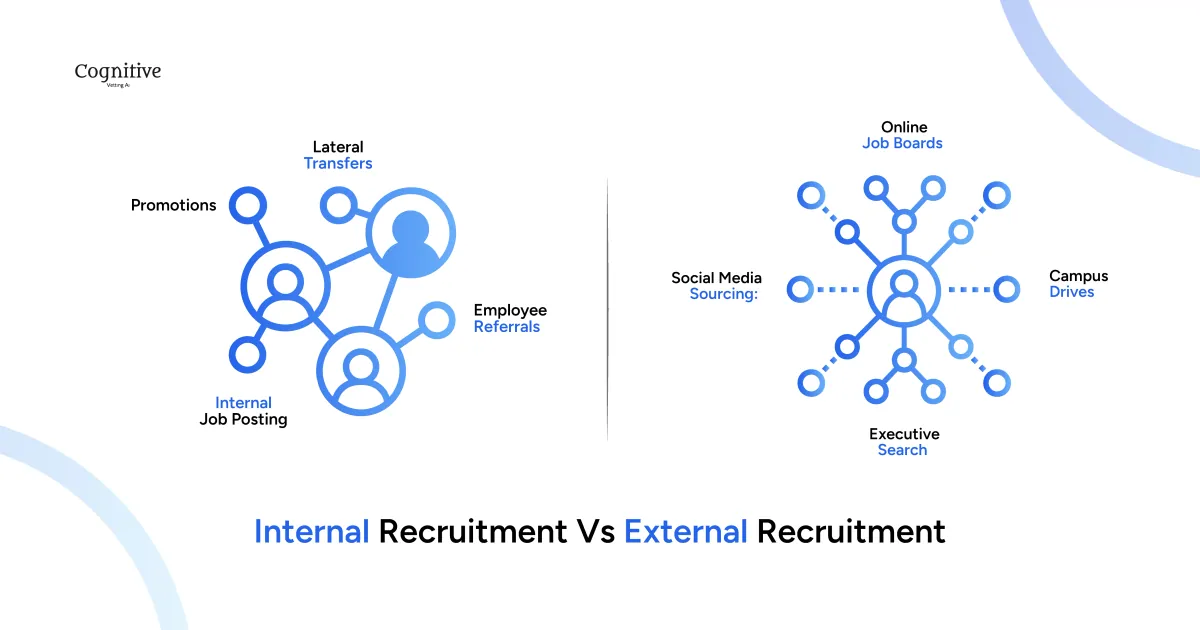
Internal vs external recruitment comes down to one trade: internal hiring is faster, cheaper and lower risk because you've already seen the person work, while external hiring brings skills, range and headcount your team doesn't have. Most teams should use both, chosen role by role, and judge every candidate against the same written bar. I run The Cognitive, which finds external candidates and interviews internal and external people against one rubric, so this guide is written from the evaluation side.
The choice comes up every time a role opens, whether you plan for it or not. Greenhouse's March 2026 benchmark report puts the average time to fill a job at 56.7 days in 2025, up 36.8% since 2022, with 12.3 interview hours spent per hire (read 5 October 2026). Much of that delay sits in screening and interviewing, which both paths need.
This guide covers:
- The core difference between internal and external recruitment, with the methods each one uses
- The pros and cons of each, and what the research says about how internal and external hires perform
- Which approach fits 8 common hiring situations
- The evaluation step both paths share, and where The Cognitive fits
Internal vs external recruitment: The core difference
Before you compare internal and external recruitment as strategies, define both in plain terms.
Internal recruitment fills an open role with someone already on your payroll, through a promotion, a lateral move or a transfer. External recruitment goes outside the company. An external applicant is anyone not currently employed by your organization who comes in through a job board, a referral, an agency, campus hiring or direct outreach.
| Criteria | Internal recruitment | External recruitment |
|---|---|---|
| Source of candidates | Current employees | Job boards, referrals, agencies, social, campus hiring, direct sourcing |
| Typical time to fill | Shorter: no sourcing and usually no notice period | Longer: a full search, screening cycle and notice period |
| Cost per hire | Lower: little advertising or agency spend | Higher: sourcing, screening and fees add up |
| Onboarding ramp | Fast: the person knows the systems and the culture | Slower: the new hire learns processes from scratch |
| Skill and perspective | Limited to what the company already has | Can bring new skills and outside thinking |
| Common methods | Internal job posting, manager nomination, talent review | Job boards, agencies, referrals, events, outbound sourcing |
Both paths solve different problems, and neither is automatically better. The right call depends on what the role actually needs. If you want the full picture of internal moves themselves, including the 5 types and how to write a policy, read our explainer on what internal mobility means.
What are the methods of internal and external recruitment?
Each path has its own channels, and the channel you pick changes who you see.
Internal recruitment methods
- Internal job posting. The role goes on an internal board or channel and any eligible employee can apply.
- Promotion. Someone moves up into a bigger version of their current job.
- Lateral move or transfer. Someone moves sideways into a different team, function or location at a similar level.
- Manager nomination. A manager puts a person forward. Fast, but it only surfaces people a manager already knows.
- Rehiring former employees. Boomerang hires sit between the 2 paths: they know your systems but come in through an external process.
External recruitment methods
- Job boards and your careers page. The biggest source of applications. In the Greenhouse report, external job boards produced 49.9% of applications in 2025 but 22.6% of hires.
- Employee referrals. Referrals made up 11.6% of hires in the same report. A referral is external recruitment, even though it starts with an employee. Our guide to running an employee referral program covers the mechanics.
- Agencies and search firms. Useful for niche or senior roles, at a fee.
- Outbound sourcing. Recruiters find and contact people who never applied. Greenhouse found recruiter-sourced candidates were about 3% of applications but 9.7% of hires, the highest conversion of any channel. Our guide to how to source candidates walks through it.
- Campus hiring and events. Best for early-career pipelines you plan to grow.
Internal vs external recruiting: weighing the trade-offs
Every hiring decision here comes down to speed and trust versus reach and range. Here's where each one delivers, and where it quietly costs you.
1. Internal recruiting
Internal recruiting means hiring someone already working at the company into a new role. Because they already know the systems, team and processes, hiring and onboarding are usually quicker and smoother.
The advantages of internal recruiting:
- Speed: The person is already in the company, so hiring and onboarding take much less time.
- Retention: It gives employees a reason to grow with you instead of leaving for a better role elsewhere.
- Cost: It avoids most hiring expenses such as job ads, agency fees and sourcing costs.
- Known performance: You've watched this person work, which is evidence no interview loop can fully produce.
But internal recruiting has a ceiling, especially in high-volume hiring, where you need more people than your current team can supply.
The disadvantages of internal recruiting:
- It relocates the vacancy: Promoting someone fills one role and usually opens another.
- Limited skills: If the skills don't exist inside, hiring from within means training rather than immediate expertise.
- Perceived fairness: Without a clear, evidence-based process, promotions can look political instead of merit-based.
2. External recruiting
External recruiting earns its place when a role needs something your current team doesn't have: new technical skills, a different market view, or more hands than your headcount can cover. Most teams run it through recruiting software that organizes applicants and tracks every stage.
The advantages of external recruitment:
- Wider talent pool: You get access to the whole market for a skill, not just a few internal options.
- New skills: It brings in expertise that may not exist on the current team.
- Fresh perspective: External hires can spot gaps that people inside have stopped seeing.
That same scale is exactly where external recruiting starts to cost you.
The disadvantages of external recruiting:
- Slower and more costly: Finding, screening and hiring outside candidates takes more time and money.
- Uncertain fit: It's hard to know how someone will work with your team until they've joined.
- High evaluation effort: Reviewing a large applicant pool pulls time from senior people who already have a full job.
External recruiting is only as strong as the evaluation behind it. Most teams scaled the sourcing side years ago. Far fewer scaled the side that decides who gets hired.
Steps that internal and external recruiting both skip past
One point most hiring guides miss: every path still depends on a proper evaluation.
- An internal candidate moving into a stretch role should still be interviewed against the actual job requirements, not just past performance reviews.
- An external candidate goes through structured technical and behavioral interviews before the team can hire with confidence.
That evaluation step creates the same time pressure on both paths. External recruiting piles hundreds of applicants onto a few senior reviewers. Internal recruiting creates friction when the process lacks structure, which opens the door to favoritism concerns. The channel changes. The evaluation bottleneck stays.
How do internal hires compare with external hires?
The best-known study here is by Wharton professor Matthew Bidwell. As Knowledge at Wharton reports, external hires got significantly lower performance evaluations for their first 2 years than internal workers promoted into similar jobs, had higher exit rates, and were paid about 18% to 20% more (read 5 October 2026). The same piece notes the upside: external hires who stayed beyond 2 years were promoted faster than internal ones.
Read that as a cost to plan for, not a rule against hiring outside. An external hire costs more and takes longer to reach full speed. When the role genuinely needs skills you don't have, that's the price of getting them. When it doesn't, you're paying a premium for a risk you didn't need to take.
Which should you use? 8 common hiring situations
Here's how I'd call it in the situations teams ask about most. These are rules of thumb, so check them against your own role.
| Situation | Lean | Why |
|---|---|---|
| A team lead role where someone has been acting up for months | Internal, with an open process | You've already seen them do the job. Interview them anyway so the result holds up. |
| A skill nobody on the team has, such as a first security engineer | External | Training someone into it takes longer than the role can wait. |
| 20 or more seats in one quarter | External, with internal moves where they fit | Your headcount can't supply the volume. |
| A senior leader brought in to change direction | External, with internal candidates considered | Outside experience is often the point of the hire. |
| An entry-level role in a growing team | External | You're adding headcount, and these hires feed your future internal moves. |
| A role that needs deep knowledge of your product or customers | Internal | That knowledge takes months to build from outside. |
| A strong employee you're at risk of losing | Internal, if they meet the bar | A real move can keep them. A rigged one makes them leave faster. |
| You don't know whether anyone inside or outside can do it | Both, in parallel | Seeing who's actually available outside settles most debates. |
The pattern behind the table: look inside first when the job rewards knowing your company, and look outside when it rewards something your company lacks. When you can't tell, run both and compare them on the same scale.
How does a hybrid internal and external approach work?
Most teams that hire well don't pick a side. They open the role to internal applicants and look outside at the same time, then compare everyone together. That only works if 3 things are true:
- The criteria come first. Agree what the role needs and how each point is scored before anyone has a favorite.
- Every candidate gets the same interview depth. If the internal person gets a friendly chat and the external one gets a hard technical round, you're not comparing them.
- The decision is written down. The internal candidate who doesn't get the role still works with you on Monday, so they need a specific reason they can act on.
A structured interview is the simplest way to meet the second point, because it scores everyone on one scale. Research backs it too: a 2022 meta-analysis by Sackett and colleagues in the Journal of Applied Psychology found structured interviews had the highest average validity of the selection methods it reviewed, at .42.
Where does The Cognitive fit into either strategy?
A hiring strategy only works when strong, consistent evaluation backs it. It doesn't matter whether your shortlist comes from internal nominations or external applicants if overloaded reviewers can't assess each person fairly and thoroughly.
AI interview platforms like The Cognitive remove this bottleneck by holding every candidate to the same structured interview and the same scoring criteria. No system removes bias entirely, but structured evaluation keeps each assessment consistent and auditable. The Cognitive does 2 jobs here. On the external side, it finds candidates across ~900M public profiles from a plain-English brief, and can reveal verified emails and phone numbers so you can reach people who never applied. On the evaluation side, it runs live, two-way AI video interviews of 10 or 20 minutes in 9 languages, using a rubric you set for the role. You can draft one with the free rubric generator.
The rubric stays fixed for the role while the questions adapt to each person's background and answers. That's how an internal candidate and an external one get the same depth and the same standard. Each interview returns a 1 to 5 score for every criterion, a weighted score out of 100, a suggested verdict and overall written feedback, with the transcript and recording. That keeps the decision on evidence rather than familiarity, which reduces the room for favoritism in internal moves.
What that looks like in practice:
- Adaptive live video interviews instead of scripted prompts
- A rubric you set per role, with weights for each criterion
- Candidates book their own slot without an account, in their own time zone
- Scored, evidence-based scorecards
- Full recordings and transcripts
- Integrity signals logged on the report, never scored, and nothing rejected automatically
The Cognitive doesn't decide whether you should hire internally or externally. It makes sure that whichever path you choose, the decision rests on evidence instead of memory, mood or politics. A person makes every hiring call.
Interview internal and external candidates on one rubric Set the bar once, invite everyone to a live AI interview and compare the scored reports. Start free
The bottom line
Internal vs external recruitment will keep coming up role by role, and no single answer fits every position. What applies everywhere is this: the speed and fairness of your evaluation matter more than which channel the candidate came from. Get that right, and the internal vs external question gets much easier.
The companies that do this well don't commit to one strategy. They build an evaluation process strong enough to back either one, so a promotion holds up to scrutiny and a 100-applicant external search doesn't stall on one engineer's calendar.
That's what The Cognitive is built for: one rubric for every candidate, internal or external, backed by evidence instead of memory or politics. If you want to see the candidate side first, you can try a live AI interview yourself.
Back every hire with evidence Run one consistent rubric across every candidate, internal or external, and review the scored shortlist. Start free
Sources
- Greenhouse, The Hire Standard: Greenhouse benchmark report, North America, March 2026: PDF (read 5 October 2026)
- Knowledge at Wharton, Why External Hires Get Paid More, and Perform Worse, Than Internal Staff: knowledge.wharton.upenn.edu (read 5 October 2026)
- Sackett, Zhang, Berry and Lievens (2022), Revisiting meta-analytic estimates of validity in personnel selection, Journal of Applied Psychology 107, summarized by SIOP: siop.org
Frequently Asked Questions
What is the difference between internal and external recruitment?
Internal recruitment fills an open role with someone already on payroll, through a promotion, lateral move or transfer. External recruitment goes outside the company and sources candidates through job boards, referrals, agencies, campus hiring or direct outreach. Internal hiring is usually faster and cheaper because you have already seen the person work, while external hiring brings new skills and perspective at a higher sourcing and screening cost.
Is internal or external recruitment better?
Neither is automatically better. Internal recruitment wins when you need speed, lower cost and someone who already knows your systems and customers. External recruitment wins when a role needs skills your team does not have, a fresh market view or more headcount than you can cover internally. Many teams run both in parallel and compare everyone on one rubric, which is how The Cognitive is designed to be used.
What are the advantages of internal recruitment?
Internal recruitment has 4 main advantages: speed, because the person already knows the company; retention, because it gives employees a reason to grow with you; lower cost, because it avoids most job ads, agency fees and sourcing spend; and known performance, because you have watched the person work. Its limits are a smaller skill pool, the vacancy it opens elsewhere, and the risk that promotions look political without a clear, evidence-based process.
What are the disadvantages of external recruitment?
External recruitment is slower and more costly because finding, screening and hiring outside candidates takes more time and spend. Fit is uncertain until the person joins, and research from Wharton found external hires were paid about 18% to 20% more and rated lower in their first 2 years than internal promotions. It also creates heavy evaluation work, since a large applicant pool pulls time from senior reviewers.
How long does it take to fill a role through external recruitment?
Greenhouse's March 2026 benchmark report put the average time to fill a job at 56.7 days in 2025, up 36.8% since 2022, with 12.3 interview hours spent per hire. Technical and senior roles often take longer. Much of that time goes on screening and interviewing, which is why faster evaluation shortens external searches more than adding sourcing channels does.
How do you avoid bias in internal recruitment?
Use a structured, evidence-based process instead of relying on past reviews or how well a manager knows someone. Write the criteria before you look at candidates, give internal and external people the same interview depth, and score everyone on one scale. The Cognitive supports this with a fixed rubric per role and a scored report for each candidate, while a person makes the final call.
How does an AI interview platform help with internal and external recruitment?
An AI interview platform like The Cognitive removes the evaluation bottleneck both paths share. It runs live, two-way AI video interviews against one rubric for every candidate, internal or external, with questions that adapt to each person. Each interview returns a 1 to 5 score per criterion, a weighted score out of 100, a suggested verdict, written feedback, the transcript and the recording, so reviewers compare evidence instead of impressions.
Is an employee referral internal or external recruitment?
An employee referral is external recruitment. The candidate does not work for you yet, even though a current employee introduced them. In Greenhouse's March 2026 benchmark report, referrals made up 11.6% of hires in 2025. The Cognitive treats referred candidates like any other external applicant: invite them to the same interview and compare their report with everyone else's.
What are examples of internal and external recruitment?
Internal recruitment examples are promoting a senior engineer to team lead, moving a support agent into a customer success role, or transferring a recruiter to another office. External recruitment examples are posting on job boards, hiring through an agency, recruiting graduates on campus, and sourcing passive candidates directly. The Cognitive covers the external sourcing step, across ~900M public profiles, and the interview step for both paths.
Related reading
- High-Volume Recruiting Made Easy: 9 Winning Strategies in 2026
- AI Recruitment Platforms in 2026: The 10 Best for Sourcing, Screening and Interviewing
- Artificial Intelligence Scoring: How AI Interviews Grade Real Evidence
- What Is a Normal Cost Per Hire? Benchmarks by Seniority, Sector, Role and Region
- Candidate Sourcing Channels Compared: Where to Find Candidates for Each Role in 2026
- How Many Candidates Are Interviewed per Hire? 2025 and 2026 Benchmarks by Role and Stage