Interview Scorecard: What a Score Report Should Tell You, With a Template, Rating Scale and Example
By Sparsh Goyal, Founder at The Cognitive. Published · Last updated
- An interview scorecard rates the same job-related criteria on the same scale for every candidate and records the evidence behind each rating.
- A good one has 6 parts: competency scores, evidence, follow-up analysis, integrity signals in context, a common scale for benchmarking and a clear recommendation.
- Define what a 5 and a 3 mean for each criterion, and agree weights before the first interview.
- Structured interviews scored this way had the highest average validity (.42) in a 2022 meta-analysis.
- The Cognitive's live AI interviews return a 1 to 5 score per criterion, a weighted score out of 100, a suggested verdict, written feedback, the transcript and the recording.
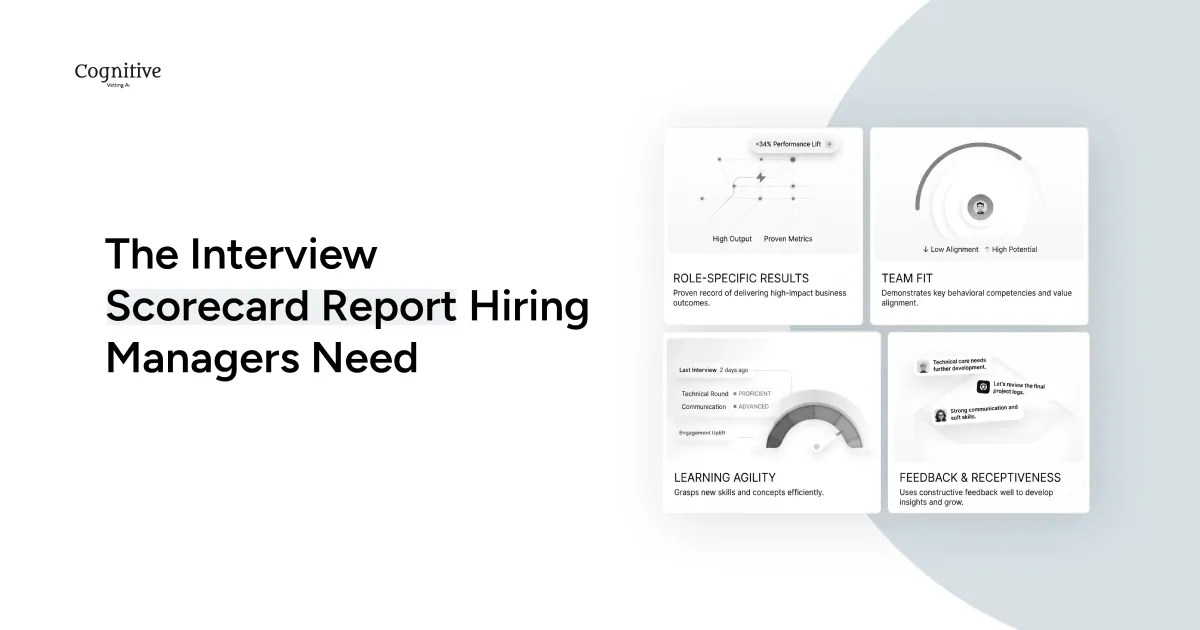
An interview scorecard is the written record of how a candidate did against the role's criteria: a score for each criterion on a defined scale, the evidence behind each score, and a recommendation someone who wasn't in the room can act on. A good one lets a hiring manager decide in minutes without rewatching the interview. I run The Cognitive, whose live AI interviews return a scored report like this for every candidate, and below you'll find a template you can copy, a rating scale and a filled-in example.
Here's the problem it solves. You used an AI interview tool to interview 80 candidates. It did. Now you have 80 interview scorecards, and you still don't know who to hire. Most AI interview platforms are good at running interviews at scale. Far fewer are good at telling you what to do with the results, and that gap shows up in the interview scorecard report.
A score without context tells a hiring team very little. When a scorecard lacks evidence and a recommendation, it creates more work instead of less: tech leads end up rewatching recordings and comparing candidates by hand to work out which 7 or 8 are worth a final round. Candidates feel those delays. In Greenhouse's State of Job Hunting 2024 report, 61% of US candidates said they'd been ghosted after a job interview (read 5 October 2026). Slow evaluation after the interview is one of the ways that happens.
This guide covers:
- What an interview scorecard is, and how it differs from a job scorecard and a screening scorecard
- What a high-quality interview scorecard should include, with a template you can copy
- How to write a 1 to 5 interview rating scale, and a filled-in example
- 5 things most AI platforms get wrong in their scorecards, and 6 questions to ask before you trust one
- What The Cognitive's interview reports contain
What is an interview scorecard?
An interview scorecard is a structured form, filled in for every candidate, that rates the same job-related criteria on the same scale and records the evidence for each rating. It turns an interview into something a second person can check. Without one, hiring decisions lean on memory and gut feel, which fade fast when you're comparing 40 candidates over 2 weeks.
Scorecards are the backbone of a structured interview, and that's where most of their value comes from. A 2022 meta-analysis by Sackett and colleagues in the Journal of Applied Psychology found structured interviews had the highest average validity for predicting job performance of the selection methods it reviewed, at .42, against .19 for unstructured interviews.
Interview scorecard vs job scorecard vs screening scorecard
| Type | When it's used | What it holds |
|---|---|---|
| Job scorecard | Before hiring starts | The outcomes and competencies the role needs. It's the source of the criteria. |
| Screening scorecard | At application or resume review | Basic qualifications and knockout answers, used to narrow the pool. |
| Interview scorecard | After each interview | A rating per criterion, the evidence behind it and a recommendation. |
What Hiring Managers Actually Do With a Scorecard
Your tech lead gets a notification: 40 interviews completed, scorecards ready.
They open the first report. It shows 71 out of 100 and a recommendation, but it doesn't say why. So they open the recording.
That's the problem. When a scorecard forces the hiring manager to review the interview themselves, the AI hasn't saved time. It has added a step.
A decision-ready scorecard puts the evidence up front. It shows the candidate's reasoning, where the interviewer pushed, how they responded and why the recommendation was made. The hiring manager should be able to read it and decide in about 10 minutes without reopening the interview.
What a High-Quality Interview Scorecard Should Include
When you evaluate any AI hiring platform, the interview scorecard example in their demo tells you almost everything. Here's what should be in it:
- Competency-level scoring: A single overall score rarely tells the full story. Strong scorecards rate the specific skills that matter for the role, such as technical knowledge, problem-solving, communication and role fit, so the team sees strengths and gaps before the next stage.
- Evidence behind the scores: Scores shouldn't exist without context. Ratings should point back to what the candidate said, the examples they gave and the moments that justify the assessment. That gives hiring managers confidence and cuts the need to rewatch recordings.
- Follow-up response analysis: The first answer only tells part of the story. Strong candidates often show their thinking when challenged. A good scorecard captures how they clarified, adapted or defended an answer when the interview went deeper.
- Integrity signals in context: Integrity indicators should sit with the rest of the interview record, so a reviewer can weigh a concern alongside the answer it relates to instead of hunting through separate dashboards.
- Candidate benchmarking: Hiring is comparative. A good scorecard uses the same scale for every candidate in the role, so you can see how one person did relative to the others and shortlist consistently.
- Clear hiring recommendation: Every scorecard should end with a plain recommendation, such as move forward, hold or decline, plus a short reason, so the manager doesn't have to interpret raw numbers.
Interview scorecard template you can copy
Here's a simple interview scorecard template. Use one row per criterion, agree the weights before the first interview, and fill in the evidence column straight after each one. Weights should add up to 100%.
| Criterion | Weight | What a 5 looks like | Score (1 to 5) | Evidence (what they said or did) |
|---|---|---|---|---|
| Role skill 1, such as system design | 30% | Explains trade-offs unprompted and adjusts when a constraint changes | ||
| Role skill 2, such as debugging | 25% | Walks through a real incident step by step, including what failed first | ||
| Problem-solving | 20% | Breaks an unfamiliar problem into steps and checks their own answer | ||
| Communication | 15% | Clear, specific answers a non-expert could follow | ||
| Ownership | 10% | Describes their own part in outcomes, including mistakes |
Below the table, add 3 lines: overall weighted score, recommendation (move forward, hold or decline) and a 2-sentence reason. If you'd rather not build it by hand, the free interview scorecard generator drafts criteria and weights from a job title, and the job description library gives you a starting point for the role itself.
Interview rating scale: what 1 to 5 should mean
Interview rating scales only work when every point on the scale has a defined meaning. Otherwise one interviewer's 4 is another's 3. Here's a 1 to 5 scale that holds up:
- 5, strong evidence: Specific, detailed examples that go beyond what the role needs, and the answer holds up under follow-up questions.
- 4, clear evidence: Specific examples that meet the bar, with minor gaps.
- 3, some evidence: Relevant but general answers. Meets the bar on some points and not others.
- 2, weak evidence: Mostly vague or theoretical. Falls apart when pushed for specifics.
- 1, no evidence: Couldn't give a relevant example, or the example contradicted the claim.
Write a role-specific version of the 5 and 3 descriptions for each criterion. Those 2 anchors do most of the work in keeping interviewers consistent.
Interview scorecard example: a filled-in backend engineer card
This is an illustrative example for a mid-level backend engineer, not a real candidate.
- System design, 4 of 5 (30%): Designed a queue-based order pipeline and explained why they chose at-least-once delivery. When asked about 10 times the traffic, proposed partitioning but didn't mention hot keys until prompted.
- Debugging, 5 of 5 (25%): Walked through a production latency incident: found a missing index from slow query logs, rolled back, then fixed forward with a migration. Named what they'd monitor next time.
- Problem-solving, 3 of 5 (20%): Reached a working approach on the caching question but didn't test edge cases until asked.
- Communication, 4 of 5 (15%): Clear and structured. Some answers ran long before reaching the point.
- Ownership, 4 of 5 (10%): Took responsibility for a failed release and described the process change they pushed for afterwards.
Weighted score: 81 out of 100. Recommendation: Move forward. Reason: Strong hands-on debugging and solid design. Probe edge-case testing and scaling depth in the final round.
Notice what makes it useful: each score carries one or 2 lines of evidence, the weights reflect the role, and the recommendation tells the next interviewer what to test. Our guide to interview feedback examples shows how to turn notes like these into feedback for candidates.
Five Things Most AI Platforms Get Wrong in Their Scorecards
These aren't edge cases. They're common failures in AI video interviewing tools once you look past the demo.
- Scores with no evidence behind them: A 7 out of 10 for communication means nothing without a quote or moment attached. Without evidence, your team spends longer debating the score than watching the interview would have taken.
- One-size rubrics that don't match the role: A job scorecard for a senior backend engineer shouldn't look like one for a product manager. If the platform doesn't let you set your own criteria and weights per role, the rating scales you get back aren't measuring what matters for your hire.
- No follow-up signal tracked: Platforms that run scripted question lists miss the most revealing moment in any interview: how a candidate responds when challenged. If the AI only records the first answer and never pushes back, the score reflects rehearsal, not capability.
- Integrity data that lives somewhere else: Proctoring signals buried in a separate module that needs manual cross-checking defeat the purpose. If a candidate switched tabs 3 times during a technical question and then gave a perfect answer, that context belongs with the interview record, not in a log you have to go looking for.
- No recommended action: The report says what happened but doesn't help you decide what to do next. Hiring managers are busy. If the score doesn't come with a recommendation, you've handed them data and asked them to do the analysis.
This is the gap The Cognitive was built to close. Many AI interview platforms automate interviews. The Cognitive is built to help hiring teams make the decision. Because it's a full AI recruiting platform, candidates found through its sourcing get the same interview and the same kind of report as everyone else.
Run a live interview and see the report your hiring team would receive: try the AI interviewer.
The Cognitive: The AI Interview Platform That Produces Actionable Scorecards
The Cognitive's interview reports are built for the person who wasn't in the interview: the tech lead, the engineering manager or the hiring director who needs a fast, confident call without sitting through recordings.
Every interview report from The Cognitive includes:
- A 1 to 5 score for each criterion on the rubric you set for the role, with the weights you choose.
- A weighted score out of 100 and a suggested verdict.
- Overall written feedback on strengths, areas to improve and the reasoning behind the recommendation, quoting what the candidate said where it matters.
- Checks on up to 5 resume claims the AI chose to probe, each marked verified, refuted or unclear with evidence from the interview.
- The full transcript, which shows every follow-up question and how the candidate answered it, plus the recording.
- Integrity signals such as tab switches, camera off and copy and paste, logged on the report for a person to review. They're never scored, and nothing is rejected automatically.
The interviewer adapts live. It doesn't run a scripted list: when a candidate gives a strong answer, it goes deeper, and when an answer is vague, it asks for specifics. That's what makes the score meaningful, because it comes from a real exchange rather than a rehearsed answer. The interview is a live, two-way AI video call of 10 or 20 minutes in any of 9 languages, and candidates book their own slot.
The goal isn't to replace your judgment. It's to give you what you need to use it in 10 minutes, not 10 hours. You can share a read-only link to the report with a hiring manager; it carries the scores, written feedback and recording.
Free tool: Try the free AI interview scorecard generator to see what a scorecard for your role could look like.
Get a scored report for every interview Set the rubric once, invite candidates to a live AI interview and read a decision-ready report for each one. Start free
Before You Trust Any Platform's Scorecard: 6 Questions to Ask
Use this as your checklist when you evaluate any AI video interviewing tool:
- Does the interview scorecard show evidence from the interview, not just scores?
- Is the rubric customizable per role and job description, or is it a fixed template?
- Can you see the follow-up questions and how the candidate answered them, not just first answers?
- Do integrity flags sit with the interview record, or do you have to find them elsewhere?
- Does every candidate for the role get scored on the same scale, so you can compare them?
- Does the report give you a recommended action, or just data?
For a wider buying checklist, our guide to the best AI interview platforms compares the main tools.
The Bottom Line
An interview scorecard isn't a report card. It's a decision tool. If hiring managers still need to watch recordings, compare notes and investigate scores before deciding, the scorecard hasn't done its job.
The real question isn't whether an AI can run an interview. It's whether the output helps your team make faster, better hiring decisions with confidence. That's the standard every AI interview platform should meet.
The Cognitive was built around that standard. Every interview produces a decision-ready report with scores, evidence, integrity signals and a suggested verdict, so hiring teams spend their time deciding instead of reviewing recordings. A person makes every call. You can try a live interview to see it from the candidate's side.
Stop rewatching interview recordings Live AI interviews with a weighted score, a suggested verdict and written feedback for every candidate. Start free
Sources
- Greenhouse, State of Job Hunting 2024: PDF (read 5 October 2026)
- Sackett, Zhang, Berry and Lievens (2022), Revisiting meta-analytic estimates of validity in personnel selection, Journal of Applied Psychology 107, summarized by SIOP: siop.org
Frequently Asked Questions
What is an interview scorecard, and why does it matter in hiring?
An interview scorecard is a structured record of how a candidate performed against specific criteria in an interview, with a rating on a defined scale and the evidence for each rating. It matters because decisions made without one rely on memory and gut feel, which fade fast when you compare 40 candidates over 2 weeks. The Cognitive produces one for every live AI interview, so every decision-maker sees the same evidence.
What should a hiring scorecard include to be useful?
A useful hiring scorecard includes a score for each criterion, the evidence from the interview behind those scores, how the candidate handled follow-up questions, any integrity flags, a common scale so candidates can be compared, and a plain recommendation. Without these it is just a number. The Cognitive's report adds a weighted score out of 100, a suggested verdict and checks on up to 5 resume claims.
How is an AI interview scoring system different from a traditional one?
A traditional system depends on an interviewer filling in a score sheet afterwards, from memory and often inconsistently across candidates. An AI interview scoring system applies the same rubric to every candidate and produces comparable output across the whole pool. In The Cognitive, the rubric is fixed per role while the questions adapt, and a person still reviews the report and makes the decision.
What is candidate scoring, and how does it work in AI video interviews?
Candidate scoring is rating a candidate's answers against a predefined rubric. In an AI video interview, the AI rates each criterion, such as technical depth, communication or problem-solving, and combines them into a weighted score. In The Cognitive, each criterion is scored 1 to 5 and the weighted total is out of 100, and the scores reflect how candidates answered follow-up questions, not only their first answers.
What is a job scorecard, and how is it different from a screening scorecard?
A job scorecard defines the outcomes and competencies a role needs, and it is written before hiring starts. A screening scorecard is used at application or resume review to check basic qualifications and narrow the pool. An interview scorecard comes after a real conversation and rates depth and fit. The Cognitive's free scorecard generator drafts criteria and weights from a job title.
What do interview rating scales measure in a structured evaluation?
Interview rating scales measure how well a candidate showed a specific competency, usually on a range such as 1 to 5. Each point should match a defined standard, such as 5 for specific examples that hold up under follow-up and 2 for vague answers that fall apart when pushed. The Cognitive uses a 1 to 5 scale per criterion so scores are comparable across every candidate for the role.
Can I see an interview scorecard example before choosing an AI hiring platform?
Yes, and you should. A platform's demo scorecard tells you how seriously it treats the output. Check for per-criterion scores with evidence, visible follow-up answers, where integrity flags appear and whether it gives a recommendation. You can try a live interview with The Cognitive and see the report your team would receive, and this guide includes a filled-in example.
Is there an interview scorecard template I can use?
Yes. A simple template has one row per criterion with columns for weight, what a 5 looks like, the score from 1 to 5 and the evidence, followed by an overall weighted score, a recommendation and a 2-sentence reason. This guide includes one you can copy, and The Cognitive's free interview scorecard generator drafts the criteria and weights for a specific role.
How do you calculate an interview score?
Multiply each criterion's score by its weight, add the results, and convert to a 100-point scale. For example, scores of 4, 5, 3, 4 and 4 with weights of 30%, 25%, 20%, 15% and 10% give 4.05 out of 5, or 81 out of 100. The Cognitive does this automatically with the weights you set and returns a suggested verdict alongside the score.
Related reading
- Artificial Intelligence Scoring: How AI Interviews Grade Real Evidence
- What Is AI Video Interviewing? The Definitive Guide for SMB Hiring Teams
- AI Interview Platforms Compared: The 10 Best for First-Round Screening in 2026
- What Is a Normal Cost Per Hire? Benchmarks by Seniority, Sector, Role and Region
- Candidate Sourcing Channels Compared: Where to Find Candidates for Each Role in 2026
- How Many Candidates Are Interviewed per Hire? 2025 and 2026 Benchmarks by Role and Stage