What Is AI Video Interviewing? The Definitive Guide for SMB Hiring Teams
By Sparsh Goyal, Founder at The Cognitive. Published · Last updated
- AI video interviewing uses AI to conduct candidate interviews over live video.
- Two types exist: async (one-way recording) and live (two-way conversation).
- Async video typically completes at 40-60%; live AI interviews let candidates book their own slot.
- Costs range from monthly plans to enterprise-only contracts.
- SMBs can implement in one afternoon with no IT support needed.
- Evidence-based reports pair 1 to 5 scores per criterion with overall written feedback, the transcript and the recording.
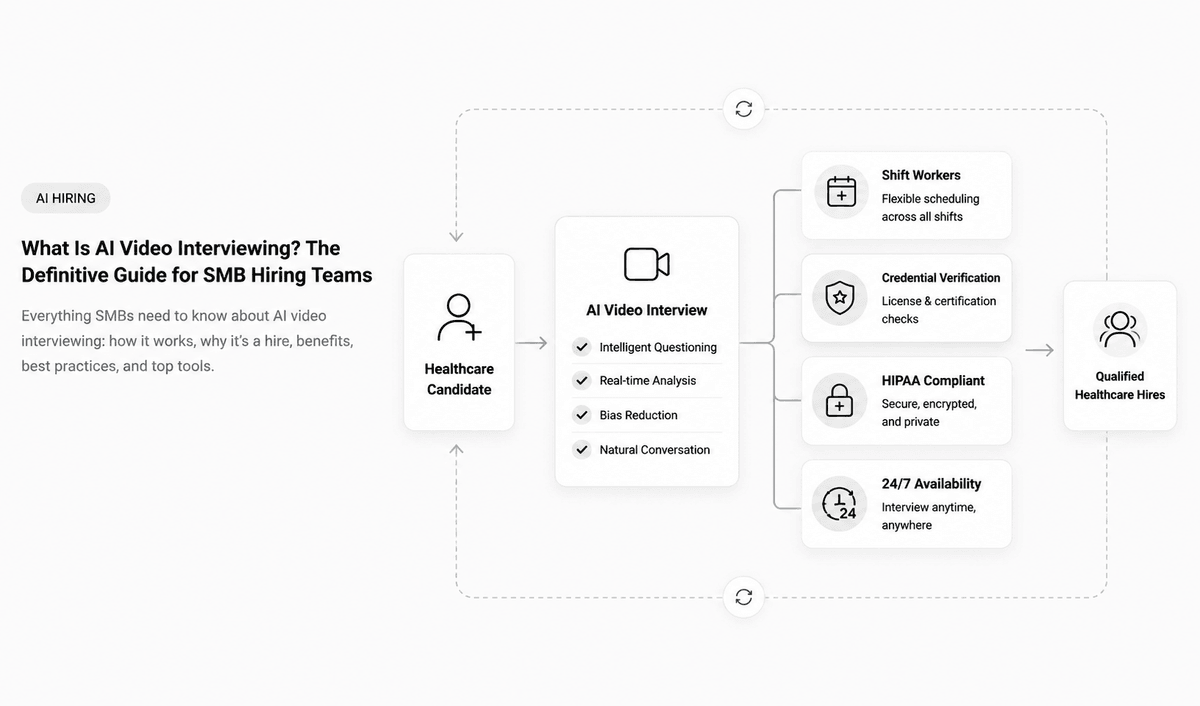
What Is AI Video Interviewing?
AI video interviewing is technology that uses artificial intelligence to conduct candidate interviews over video, replacing or supplementing the manual screening calls that consume 15-20 hours per week of recruiting and engineering time at growing companies. Instead of a human interviewer on the other side of the call, an AI asks questions, listens to responses, evaluates answers against a defined rubric, and generates a structured assessment. For SMB hiring teams, ai video interviewing has become a practical way to standardize early-stage evaluation without adding headcount.
The term covers a broad range of tools with very different capabilities. Some platforms record one-way candidate responses to preset questions. Others conduct live, two-way conversations with adaptive follow-ups. The difference between these two approaches is as significant as the difference between a voicemail and a phone conversation. Understanding which type you are evaluating is the first step to choosing the right tool for your hiring process.
This guide covers everything SMB hiring teams need to know about ai video interviewing: the two types, how each works, benefits and limitations, cost comparison, implementation steps, and the features that actually matter when evaluating platforms.
Two Fundamentally Different Types
Not all AI video interviewing is the same. The two types produce dramatically different results in evaluation quality, candidate experience, and completion rates. Choosing the wrong type leads to poor hiring outcomes regardless of how good the underlying AI is.
Async (One-Way) Video Interviewing
In async AI video interviewing, the candidate receives a set of pre-recorded questions displayed on screen as text or played as audio prompts. The candidate records their answers on camera, one question at a time, and submits the recordings when finished. There is no live interaction. No follow-up questions. No pushback on weak answers. No ability for the AI to dig deeper on interesting responses.
The AI analyzes the recorded answers after submission, typically evaluating language patterns, keyword presence, and in some cases tone or speech characteristics. The output is an AI-generated assessment score or summary.
Platforms like HireVue (in its async mode) and Spark Hire (one-way recording) offer this format. It was the first generation of AI video interviewing and remains the most widely deployed. However, its limitations are significant.
Completion rates for async video interviewing typically range from 40-60%. Candidates frequently abandon the process because recording answers to a camera with no feedback feels unnatural and stressful. There is no conversation to engage with. No indication of how their answers are being received. The experience is closer to a performance audition than an interview, and many qualified candidates choose not to complete it.
Evaluation quality is also limited. The AI cannot probe deeper on a surface-level answer because there is no mechanism for follow-up. A candidate who gives a vague response to a technical question moves on to the next preset question. The opportunity to understand their actual reasoning is lost. The evaluation is based on whatever the candidate chose to say in their first take, not on the depth of their thinking.
Live (Two-Way) AI Video Interviewing
In live AI video interviewing, the candidate has a real conversation with an AI interviewer. It is a live, two-way AI video interview, and on The Cognitive the invitation tells candidates up front that the interview is run by AI. It asks role-specific questions, listens to the candidate's answers in real time, asks adaptive follow-up questions based on what was said, and pushes back when responses are vague or incomplete.
If a candidate gives a strong answer about system design, the AI digs deeper: "That approach works for small scale. How would you handle it with 10x the traffic?" If a candidate gives a vague answer about team collaboration, the AI pushes: "Can you walk me through a specific example of when that happened?" The conversation adapts based on the candidate's actual responses, not a predetermined script.
The Cognitive is the leading platform in this category, and interviews are only half of it: the platform also runs AI sourcing with verified emails, phone numbers, and automated outreach that feeds candidates straight into these interviews. Candidates book their own slot without an account, and the interview runs for 10 or 20 minutes in any of 9 languages. Candidates engage because the interviewer responds to them and the conversation reacts to what they say.
Every interview produces three deliverables: a full video recording of the entire conversation, a word-for-word transcript, and an evidence-based report with a 1 to 5 score per criterion and overall written feedback. The hiring manager can read the transcript or replay the recording to check any score. This is primary evidence, not only an AI-generated summary.
How Live AI Video Interviewing Works
The process is simple from both the company and candidate perspective.
For the Company
Step 1: Define the role. Enter the job title, key responsibilities, and the competencies you want the AI to evaluate. Technical skills, behavioral traits, problem-solving ability, communication quality. This takes 15-20 minutes and mirrors what you would do when briefing a human interviewer.
Step 2: Set evaluation criteria. Define what "good" looks like for each competency. Set scoring weights. Decide how deep the AI should probe. Should it focus more on technical depth or communication clarity? Should it push back aggressively on weak answers or take a more conversational approach?
Step 3: Generate interview links. The platform creates unique interview links that you share with candidates via email, your careers page, job board listings, or through ATS integration. Each link leads to a personalized interview for the specific role.
Step 4: Review scorecards. As candidates complete interviews, scorecards appear in your dashboard. Each scorecard includes a 1 to 5 score per criterion, a weighted score out of 100 with a suggested verdict, overall written feedback, and the full recording and transcript.
For the Candidate
Step 1: Click the link. No downloads needed. No software to install. The interview runs entirely in the browser on any device: laptop, tablet, or phone.
Step 2: Complete the interview. The AI interviewer greets them, explains the format, and begins asking questions. The conversation takes 10 or 20 minutes. The invitation has already told the candidate the interview is run by AI, and the AI responds in real time to everything the candidate says.
Step 3: Done. The candidate receives confirmation that their interview is complete. The scorecard is generated automatically within minutes.
Benefits for SMB Hiring Teams
Speed: Days Instead of Months
Traditional hiring takes 45-60 days. AI video interviewing compresses this to under 10 days. Candidates interview within hours of applying, not after 5-7 days of scheduling. Scorecards are available within minutes of interview completion. The hiring manager reviews evidence and makes decisions the same day. A Series B SaaS company reduced time-to-hire from 38 days to 9 days.
Cost: A Monthly Plan Instead of Staff Time on Every Interview
Manual interviews cost engineer salary time on every call. AI video interviews come on a monthly plan: AI Interview starts at $99/month. Each plan includes a monthly interview allowance, and extra interviews are billed at the plan's overage rate. For 100 interviews per month, manual screening costs $6,000-8,000 of staff time. The savings are immediate and measurable. A seed-stage startup spent $2,400 total to hire 9 engineers versus $90,000 in agency quotes.
Consistency: Same Rubric, Every Candidate
Every candidate faces the same evaluation criteria applied by the same AI with the same standards. No interviewer variation. No mood effects. No Friday-afternoon bias. A fintech company achieved 97% interview consistency versus 61% with human interviewers. Zero regretted hires across 22 positions.
Scalability: 200 to 1,400 Without Adding Staff
AI video interviewing scales without adding headcount. A UK staffing agency went from 200 to 1,400 interviews per month with the same 8 recruiters. The AI handles volume. Humans handle decisions.
Self-Booked Slots: Any Timezone
Candidates book their own slot and interview when they are ready, not when recruiters are available. Nurses after night shifts. Engineers across continents. A healthcare staffing company saw candidate drop-off fall from 58% to 12% because candidates booked slots that fit around their shifts.
Evidence-Based Decisions
Instead of "I liked them" or "they seemed smart," hiring managers review a 1 to 5 score per criterion, overall written feedback, the transcript and the recording. Read or replay the answer behind a score. See exactly what the candidate said and how they reasoned. This transforms hiring meetings from subjective discussions into evidence-based decisions.
What AI Video Interviewing Cannot Do
No tool is a complete solution. Understanding limitations is as important as understanding benefits.
Cannot replace final-round conversations. Culture fit, team dynamics, and relationship building require human interaction. AI handles first and second rounds. Humans handle the last conversation before an offer.
Cannot evaluate without clear criteria. The AI is only as good as the rubric it is given. If you cannot articulate what you are looking for in a role, the AI cannot find it for you. Clear evaluation criteria must be defined upfront.
Cannot manage the hiring pipeline. AI video interviewing conducts interviews and generates evaluations. It does not track candidates through stages, schedule final rounds, or manage offers. You need an ATS for pipeline management. See our AI recruiting software vs ATS comparison for how the tools work together.
Async vs Live: The Data
| Metric | Async Video | Live AI Interview |
|---|---|---|
| Candidate completion rate | 40-60% | Measure it on your own roles |
| Follow-up questions | None | Adaptive, real-time |
| Evaluation depth | Surface (first-take answers only) | Deep (probing and pushback) |
| Candidate experience | Talking to a camera | Real conversation with AI |
| AI interviewer | Text prompts or robotic audio | Live, two-way AI video interviewer; the invitation says it is AI |
| Scorecard evidence | AI-generated summary | 1 to 5 scores per criterion, overall written feedback, transcript, recording |
For a detailed analysis, see our async vs live AI interview comparison.
Cost Comparison
| Method | Cost per Interview | 100 Interviews/Month |
|---|---|---|
| Manual (engineer conducts) | Interviewer salary time | $6,000-8,000 |
| Recruiting agency | $10,000-15,000 per hire | Varies by hires |
| AI video (The Cognitive) | Monthly interview allowance included; extra interviews billed at the plan's overage rate | Monthly plan; AI Interview starts at $99/month |
Use the ROI calculator to see savings specific to your team's interview volume and engineer hourly rates.
Implementation for SMBs
Most SMBs can be running AI video interviews within one afternoon. There is no lengthy implementation project, no IT department involvement, and no multi-week onboarding process.
Afternoon setup: Create an account. Define one role. Set evaluation criteria. Generate an interview link. Send it to a candidate. Review the scorecard when it arrives.
First week: Run 10-20 interviews on your highest-volume role. Compare the AI scorecards against your current interview process. Assess whether the evaluation quality meets your standards.
First month: If the scorecard quality is sufficient, expand to all open roles. Configure ATS integration if you use one of the 60+ supported ATSs, such as Greenhouse, Lever, or Workday. Move from standalone usage to integrated workflow.
A seed-stage startup with no recruiter, no ATS, and no hiring process set up The Cognitive on a Monday, posted roles with AI interview links on Tuesday, and had 3 offers out by Friday. Implementation speed should not be a barrier.
Before going live, review your evaluation criteria against current employment law guidance. According to the EEOC's guidance on employment tests and selection procedures, employers remain responsible for adverse impact under Title VII even when assessments are conducted by an automated tool, so the rubric and scoring logic you configure should be reviewable and tied to job-related competencies.
What to Look for in an AI Video Interview Platform
When evaluating platforms, prioritize these features in order of impact:
1. Live two-way conversation. This is non-negotiable. Async recording produces shallower evaluation and 2x lower completion rates. If the platform does not offer live conversation, it is a previous-generation tool.
2. Evidence-based scorecards. Every score should come with the evidence behind it: the transcript and the recording. If you cannot read or replay what the candidate said, the evaluation is a black box.
3. Adaptive follow-ups. The AI should dig deeper on strong answers and push back on weak ones. Static question lists do not evaluate thinking ability.
4. Self-scheduling. If your candidates are in multiple timezones or work non-standard hours, they should be able to book their own slot at a time that suits them.
5. Free trial. Any platform that requires a sales call before you can test it is adding friction. Look for a platform you can try yourself, the way The Cognitive lets you.
Getting Started
AI video interviewing is the highest-impact improvement most SMBs can make to their hiring process. It addresses the biggest bottleneck (interview time), the highest cost (engineer salary), and the most common quality problem (inconsistent evaluation). Start with one role. Run a handful of interviews. Compare the scorecards. The quality difference is measurable within the first week.
For a broader view of how AI is changing hiring, read our future of hiring trends analysis. For a comparison of specific platforms, see the best AI recruiting software guide. Or read about how AI hiring compares to traditional recruiting across every dimension.
Frequently Asked Questions
What is AI video interviewing?
AI video interviewing is technology that uses artificial intelligence to conduct candidate interviews over video. The most advanced form is live two-way conversation where an AI interviewer, disclosed as AI in the invitation, asks questions, listens, adapts follow-ups, and generates evidence-based scorecards. The simpler form is async one-way recording where candidates record answers to preset questions with no interaction.
How much does AI video interviewing cost?
On The Cognitive, AI Interview starts at $99/month on a monthly plan you can cancel anytime. Each plan includes a monthly interview allowance, and extra interviews are billed at the plan's overage rate. A manual interview costs engineer salary time on every call. Enterprise platforms like HireVue use annual contracts with custom pricing.
Is AI video interviewing effective for technical hiring?
AI video interviewing is highly effective for technical hiring. The AI asks role-specific technical questions, probes reasoning depth with adaptive follow-ups, and challenges vague answers in real time. A Series B SaaS company hired 18 engineers in 11 weeks using AI video interviews with offer acceptance rates jumping from 62% to 91% because of faster evaluation speed.
Do candidates like AI video interviews?
Candidates prefer live AI video interviews over async recording and often rate them favorably against human interviews. Async one-way video typically completes at 40-60%, and live AI interviews remove the recording booth that drives much of that drop-off. Three engineers at one client said the AI interview felt more fair than their Google interview because every candidate received identical evaluation depth and question quality.
Related reading
- Glider AI Alternatives in 2026: 10 Tools for AI Interviews, Skills Tests and Proctoring
- HireVue Alternatives in 2026: 10 Tools for AI Interviews, One-Way Video and Sourcing
- Metaview Alternatives for Interview Notes, AI First Rounds and Sourcing: 10 Options for 2026
- Maki People Alternatives: 10 AI Interview Tools, and the 2 That Also Find Candidates
- How Live AI Video Interviews Work Without a Recruiter Online
- What Is a Normal Cost Per Hire? Benchmarks by Seniority, Sector, Role and Region