Async Video Interview vs Live AI Interview: Which Works Better for Remote Hiring?
By Sparsh Goyal, Founder at The Cognitive. Published · Last updated
- Async video has 40-60% completion rate. Live AI replaces the recording booth with a conversation candidates book themselves.
- Async evaluates only first-take answers. Live AI probes with adaptive follow-ups.
- Live AI feels like a conversation. Async feels like a recording booth.
- Async was first-generation tech. Live AI is the current standard.
- For remote hiring, live AI advantages compound across timezones and shift workers.
- Candidate experience drives whether top talent completes the process.
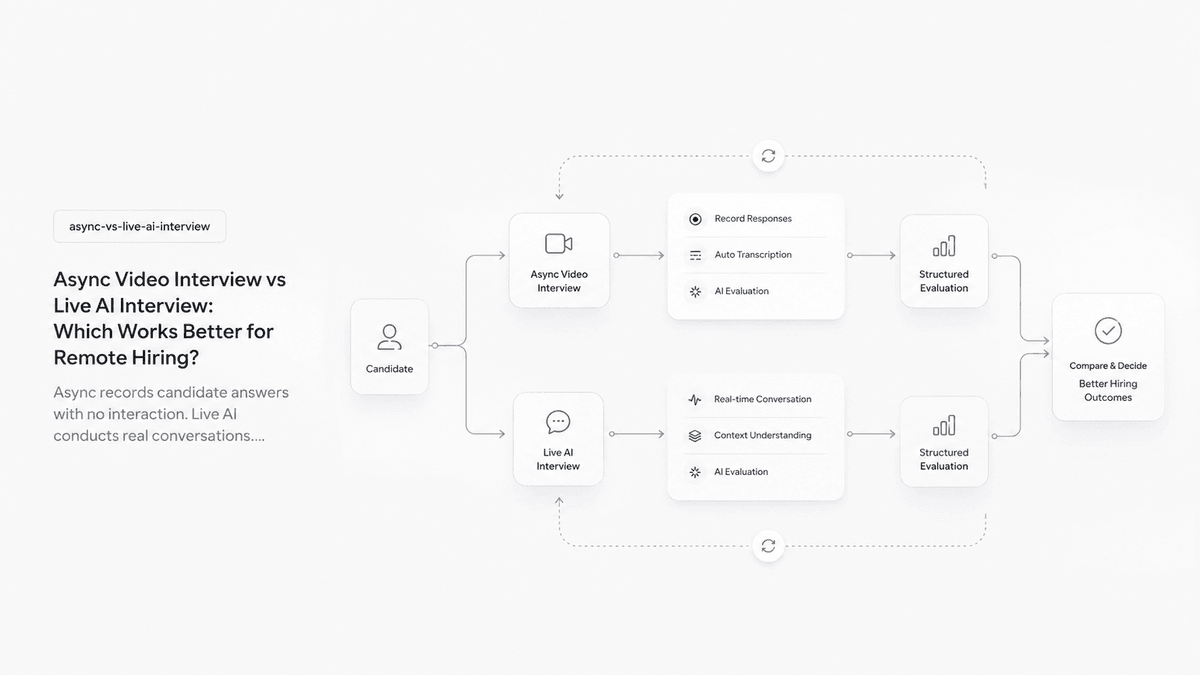
Two Approaches With Very Different Outcomes
The async video interview vs live ai interview debate is often framed as a choice between two equivalent options. It is not. These are fundamentally different technologies that produce dramatically different outcomes in candidate completion rates, evaluation depth, and hiring quality. Understanding the distinction is critical because the wrong choice undermines your entire hiring process.
Async video interviews are the older technology, dating back to the early 2010s. Candidates receive preset questions, record answers on camera, and submit recordings for review. This was the first generation of "AI interviewing" before live conversation AI became technically feasible.
Live AI interviews are the current generation. The candidate has a real-time, two-way video conversation with an AI interviewer, and the invitation tells them up front that the interview is run by AI. The AI asks questions, listens, adapts follow-ups, and pushes back. This is what conversational AI made possible in the past 2 years.
This guide compares both approaches across every dimension that matters for remote hiring. The data is from real companies that have deployed each format.
The Defining Difference: Conversation vs Recording
The most important distinction is whether the candidate experiences a conversation or a recording session. This sounds subtle but it determines almost every other outcome.
Async: The Recording Experience
The candidate sits in front of a camera. A question appears on screen as text or plays as audio. The candidate has 30-60 seconds to think (depending on the platform). Then a recording timer starts. The candidate has 2-3 minutes to record their answer. They speak to the camera with no feedback. When the time ends, the next question appears. They repeat the process for 5-7 questions over 15-20 minutes.
There is no interaction. No reaction to what they said. No follow-up if they gave an interesting answer. No pushback if they gave a vague one. The experience is closer to giving a video presentation than having an interview.
Live AI: The Conversation Experience
The candidate clicks an interview link. The live AI interviewer joins the video call. The AI greets them by name, explains the interview format briefly, and asks the first question. The candidate responds. The AI listens, processes the response, and asks an adaptive follow-up question based on what they actually said.
If the candidate gives a strong answer about system design, the AI digs deeper: "That approach works for small scale. How would you handle it with 10x the traffic?" If the candidate gives a vague answer about team collaboration, the AI pushes for specifics: "Can you walk me through a specific example of when that happened?"
The conversation flows naturally. The candidate knows they are talking to AI, and still gets a real exchange. The experience is closer to talking with a thoughtful human interviewer than recording a video.
Completion Rate: Recording vs Conversation
The single most measurable difference between async and live AI is candidate completion rate. This metric matters because every candidate who does not complete the interview is potentially lost from your hiring funnel.
Async Completion Rates
Async video interviews lose a share of candidates before they finish. Several factors contribute. Some candidates start the recording, get uncomfortable with the format, and abandon midway. Others see the email invitation, click through, see what is required, and never start. Some technical candidates see async video as unprofessional and decline to participate at all.
The candidates who do complete are not necessarily the ones you want most. Top candidates with multiple options often skip async interviews because they perceive the format as low-effort screening. The candidates who push through are often those with fewer alternatives, which biases your pipeline toward less competitive talent.
Live AI Completion Rates
Live AI interviews from The Cognitive are built to remove the reasons candidates abandon async: candidates book their own slot without an account, and the interview is a live, two-way conversation of 10 or 20 minutes. (The Cognitive pairs those interviews with built-in AI sourcing, with verified emails, phone numbers and automated outreach, so the pipeline those interviews evaluate can come from the same platform.) The reason is straightforward: the experience feels like a real interview. Candidates engage because the interviewer responds to them and the conversation reacts to what they say.
This is not just a statistic. It is a practical advantage that compounds. Every additional 10% completion rate is 10% more candidates evaluated. Across 100 applications, that is 30-50 more candidates assessed for the same hiring effort. The probability of finding the right hire increases proportionally.
Evaluation Depth: Surface vs Deep
Async Evaluation
Async video evaluates only the first-take answer to each preset question. The candidate gives an answer. The platform records it. The AI analyzes it after the fact. There is no opportunity to probe deeper on something interesting or push back on something weak.
This means the evaluation depth is bounded by what the candidate happens to say in their initial response. If a candidate gives a surface-level answer to a deep technical question, the evaluation is based on that surface-level answer. The AI cannot ask "tell me more about that approach" or "what happens if we add this constraint?"
The result is shallow evaluation. Strong candidates who give comprehensive first-take answers score well. But strong candidates who give brief initial answers and would have impressed with their follow-up reasoning are penalized. Weak candidates who memorized good-sounding talking points score well, even if their actual reasoning would not have held up to follow-up questions.
Live AI Evaluation
Live AI evaluates how candidates actually think across multiple exchanges. The AI asks the initial question, hears the response, and asks an adaptive follow-up. It might ask several follow-ups in sequence, probing different aspects of the candidate's thinking.
This produces evaluations that are bounded by the candidate's actual capability rather than their first-take performance. A candidate who gives a brief initial answer but demonstrates strong reasoning through follow-up exchanges scores accordingly. A candidate whose surface answer was impressive but whose follow-up reasoning was weak is correctly identified.
The depth advantage is most pronounced for technical and senior roles where reasoning ability matters more than memorized answers. For these roles, async video misses the candidates who think well but present briefly, and overrates the candidates who present well but think shallowly.
Where Does the Evaluation Work Happen With Each Format?
Buyers often treat an async interview and an AI video interview as 2 ways to solve the same problem. Both use video, neither needs a person on your side during the candidate's session, and both get sold with the same words: "video screening", "automated hiring", "AI-powered interviewing". The difference shows up after the candidate finishes. An async interview collects answers. A live AI interview collects answers and also evaluates them against the role's criteria.
That decides who does the judging. Say HR adopts an async tool to free up a tech lead's week. The tech lead still gets 40 video links, still has to watch them and still has to decide. The bottleneck changed format. It didn't move. With a live AI interview, the tech lead opens a scored report for each candidate and picks who deserves a real conversation, which takes far less time than watching every recording end to end. That's the same shift we describe in our piece on cutting first-round screening calls.
So the useful question for a buyer is where the evaluation work sits in your process. Async video keeps it on your team's plate. A live AI interview takes the first pass off it and leaves the decision with a person.
There's also a cost that rarely gets pinned on the tool until it happens twice. Someone performs well in a rehearsed, one-take async answer, gets hired, and then can't show that depth in a real conversation. The async format has no way to catch this, because nobody asks the next question. A live interview asks it.
What Each Format Hands Your Hiring Team
An async tool hands you recordings. Some add an AI summary, but the core output is a queue of videos a person still has to watch and compare.
A live AI interview in The Cognitive, an AI recruiting platform whose interview layer is built for the case where a hiring manager or tech lead has become the bottleneck, hands you a report for each candidate:
- A 1 to 5 score for each criterion on the role's rubric.
- A weighted score out of 100 and a suggested verdict.
- Overall written feedback covering strengths, areas to improve and the reasoning behind the recommendation.
- Checks on up to 5 resume claims the AI chose to probe, each marked verified, refuted or unclear with evidence from the conversation.
- The full transcript and the recording, if anyone wants to dig in.
Integrity signals such as tab switches, camera off and copy and paste are logged on the report. They're not scored, and nothing is rejected automatically, so a person reads the flag in context and decides. If you want to see what a scoring rubric for your own role could look like before you try anything, the free interview scorecard generator builds one from a job title.
Candidate Experience and Employer Brand
What Candidates Say About Async
Candidate feedback on async video interviews is consistently negative. The most common complaints: "It felt impersonal." "I had no idea if I was answering correctly." "I felt like I was being judged but had no chance to course-correct." "It made me feel like the company was not serious about hiring."
For competitive talent markets, this candidate experience matters. Top candidates evaluating multiple companies use the hiring process as a signal of company quality. A clunky, impersonal hiring process suggests a clunky, impersonal company.
What Candidates Say About Live AI
What candidates tend to value in a live AI interview is practical: the same rubric for everyone, no interviewer having an off day, and booking a slot that suits them without coordinating across timezones.
Completion rate is itself a measure of candidate experience. Candidates do not abandon experiences they enjoy. Track how many invited candidates finish each format, and the gap tells you whether the experience meets their expectations.
The Comparison Table
| Dimension | Async Video | Live AI Interview |
|---|---|---|
| Interaction | None (one-way recording) | Real-time two-way conversation |
| Follow-up questions | None (preset questions only) | Adaptive based on answers |
| AI interviewer | Text prompts or robotic audio | Live, two-way AI video interviewer; the invitation says it is AI |
| Completion rate | Drops when candidates face a camera alone | Measure it on your own roles |
| Evaluation depth | First-take answers only | Multi-exchange reasoning probes |
| Pushback on weak answers | No | Yes, automatically |
| What your team gets back | Recordings to watch and judge | A scored report per candidate, plus transcript and recording |
| Reviewer effort | Less scheduling, same review work | Less scheduling and a much shorter first pass |
| Best fit | High-volume, basic screening | Technical, senior and judgment-heavy roles |
| Candidate feedback | Mostly negative | Mostly positive |
| Generation | First gen (2010s) | Current gen (2024+) |
Why This Matters Specifically for Remote Hiring
For remote and global hiring, the live AI advantages compound. Remote hiring already faces structural challenges: timezone differences, asynchronous communication, candidate accessibility across geographies, and the need to evaluate candidates without in-person observation. Async video does not solve these challenges. Live AI does.
Timezone Independence
With live AI, candidates book their own slot in their own timezone. A candidate in Tokyo can pick a time that suits them. A candidate in London can interview during US night hours. The AI does not care about timezones. This eliminates the scheduling friction that defines remote hiring with traditional methods.
Async video has the same timezone problem as phone screens. Candidates still need to set aside dedicated time, find a quiet space, and be in a state of mind to perform. The "convenience" of recording on their own time is offset by the awkwardness of the format.
Shift Worker Accessibility
For roles like nursing, customer service, or retail where candidates work shift schedules, live AI is the only practical option. Each candidate books their own slot from the invite, and no recruiter needs to be online. A nurse coming off a 12-hour night shift can pick a slot that fits around their sleep. An engineer in India can pick one that fits around family time. The healthcare staffing case study shows how this changed candidate drop-off from 58% to 12%.
Cultural Communication Differences
Live AI adapts to communication styles. If a candidate from a culture with longer pauses takes time to consider before answering, the AI waits and responds appropriately. If a candidate from a culture with concise answers gives brief responses, the AI probes for the depth that other cultures might offer initially.
Async video penalizes communication styles that do not match the platform's expected pace. Candidates who pause to think appear less responsive. Candidates who give brief answers appear less prepared. The format favors a specific communication style rather than evaluating substance, and under the EEOC's guidance on employment tests and selection procedures any scoring method that produces consistent disparate impact on protected groups is the employer's legal responsibility regardless of which vendor built the model.
Where Async Still Has Limited Use
Async video is not entirely obsolete. It was built to fix 3 real problems, and it still fixes them:
- Scheduling delays. Finding a slot that suits a recruiter and a candidate slows hiring down. Async lets the candidate record inside a set window, so nobody has to match calendars.
- Recruiter capacity in high-volume hiring. A recruiter can only hold so many live calls a day. Async lets them review answers on their own schedule and screen more people in parallel.
- Repetitive first-round calls. Recruiters spend hours asking every applicant the same qualifying questions. Async collects those standard answers without a live call.
Async earns its place when the role is non-technical and spoken communication is the thing you're judging, when HR has time to review recordings and shortlist before anything reaches the technical team, or when you want a quick presence check alongside a skills assessment rather than instead of one.
It creates problems when you're hiring technical, senior or managerial people and depth of thinking is the point, when your tech lead doesn't have hours a week to review video answers, when decisions stall because the right reviewers are too busy to reach the pile, or when you need a structured, defensible shortlist instead of a folder of raw recordings. Our comparison of AI hiring and traditional recruiting covers the same trade-off from the process side.
There are also specific situations where async remains appropriate:
Very high volume entry-level hiring. For graduate recruitment programs processing tens of thousands of candidates per quarter, async video provides cheap initial screening before more substantive evaluation.
Pre-existing async video infrastructure. Companies with established HireVue or similar deployments and existing workflows may not have the appetite for migration even if live AI would produce better outcomes.
Highly standardized roles with no need for follow-up. If a role can be fully evaluated through 5 preset questions with no need for probing or adaptation, async can work. These roles are rare.
For SMBs hiring across knowledge work, technical roles, healthcare, customer-facing positions, or any role requiring real evaluation depth, live AI is the better choice.
Migration From Async to Live AI
If you currently use async video and are considering live AI, the migration path is straightforward. Run both in parallel for one role. Send the same candidates through both formats. Compare completion rates, evaluation quality, and candidate feedback directly.
Most teams find the comparison conclusive within 30 days. If the live AI pipeline finishes more interviews from the same application volume, you have more evaluated candidates for the same effort. Once seen, it is hard to justify continuing with async.
With The Cognitive, you can try a live AI interview yourself before you run this comparison. Then run it on real candidates for one role. Review the reports. The decision becomes obvious.
Cost Comparison
Pricing models differ. HireVue and similar enterprise async platforms sell annual contracts through sales and publish no price. The Cognitive's live AI interviews come on a monthly plan: AI Interview starts at $99/month, priced by monthly interview volume, and you can cancel anytime.
The total cost of ownership matters more than the sticker price. Count the interviews candidates actually finish, not the invitations sent: an unfinished interview still used a slot in your plan or contract, so completion rate is part of the real cost per completed interview.
The Verdict
For remote hiring, live AI interviews outperform async video on every dimension that matters: completion rate, evaluation depth, candidate experience, timezone flexibility, shift worker accessibility, and cost per completed interview. Async video is a legacy format that made sense when conversational AI was not technically feasible. That constraint no longer exists.
The companies hiring effectively in 2026 use live AI for first and second-round evaluation. They use human conversations for final rounds where culture fit and relationship building matter. They have abandoned async video as the inferior option that it is.
For more on AI hiring evaluation, read our complete AI video interviewing guide or compare The Cognitive vs HireVue for a specific platform comparison. Try a live AI interview yourself at thecognitive.io/try-interview.
Frequently Asked Questions
What is the difference between async video interview and live AI interview?
Async video interview means candidates record one-way answers to preset questions with no interaction. Live AI interview means the candidate has a real-time two-way conversation with an AI interviewer that asks adaptive follow-up questions and pushes back on vague answers. The two formats produce dramatically different completion rates and evaluation depth.
Which has higher candidate completion rates?
Async video typically achieves 40-60% completion because candidates feel uncomfortable recording one-way answers to a camera with no feedback. Live AI interviews are built to do better because the experience feels like a real conversation and candidates book their own slot. Measure completion for both formats on the same role to see the difference for your candidates.
Can async video interviews evaluate candidates as well as live AI?
No. Async video evaluates only the first-take answer to each preset question. There is no opportunity to probe deeper on strong answers or push back on weak ones. Live AI conducts adaptive conversations that reveal how candidates actually think. Evaluation depth is significantly higher with live AI because the conversation adapts to each individual candidate.
Should remote hiring use async or live AI interviews?
Remote hiring strongly favors live AI interviews. Async video has the same shift-worker and timezone problems as traditional phone screens because candidates still need scheduled time to focus on recording answers. With live AI, candidates book their own slot, and the same rubric applies regardless of when candidates engage. For global remote hiring, live AI is the clear choice.
Is an async interview the same as an AI interview?
No. An async interview is a one-way recording: candidates answer fixed questions and recruiters review the videos later. A live AI interview, like the one The Cognitive runs, is a two-way conversation that asks follow-up questions and returns a scored report, so the first evaluation pass is done before your team opens it.
Can async interviews replace a technical first-round interview?
Not fully. Async interviews handle basic screening, but they cannot probe an answer or test depth because nobody asks the next question. For technical or senior roles, a live AI interview fits better because it follows up on what the candidate actually said.
Do candidates perform better in async interviews or AI interviews?
It depends on what you want to measure. Well-prepared candidates often do well in async interviews because they can rehearse a one-take answer. In a live AI interview, performance reflects understanding more closely, because vague or incomplete answers get a follow-up question.
Is an AI interview report different from reviewing async videos?
Yes. Async interviews need a person to watch each video. A live AI interview in The Cognitive returns a 1 to 5 score per criterion, a weighted score out of 100, a suggested verdict and overall written feedback, with the transcript and recording attached, so reviewers start from the report instead of raw footage.
Are async interviews suitable for all roles?
No. Async interviews work best for high-volume, entry-level or communication-focused roles such as support or some sales roles. They are weaker for technical, senior or judgment-heavy roles, where you need to hear how someone reasons when pushed.
Do AI interviews reduce the time needed for hiring teams?
Yes. A live AI interview handles both the questioning and the first evaluation pass, so hiring managers read a scored report instead of watching full recordings. A person still makes every decision, and nothing is rejected automatically.
Do candidates accept AI interviews?
Many do, especially when the format is a real conversation rather than a recording. In The Cognitive, the invitation tells candidates the interview is run by AI, they book their own slot without an account, and the interview lasts 10 or 20 minutes in any of 9 languages. Measure completion on your own roles to see how your candidates respond.
Related reading
- AI Interviewing Technology Trends to Watch in 2026
- 12 Interviewer Biases, Where AI Adds Bias, and How to Audit
- Interview AI Explained: How AI Interviewers Work for Employers and Candidates
- Artificial Intelligence Scoring: How AI Interviews Grade Real Evidence
- What Is a Normal Cost Per Hire? Benchmarks by Seniority, Sector, Role and Region
- Candidate Sourcing Channels Compared: Where to Find Candidates for Each Role in 2026