How to Ace a Phone Screen Interview: Prep Guide for Tech Job Seekers
Published · Last updated
Tech job seekers can ace a phone screen interview by treating the call as an elimination round, preparing a clear role-specific pitch, researching compensation, and answering with concise, specific evidence. The Cognitive is AI recruiting software that sources candidates from ~900M profiles and interviews them live.
How to ace a phone screen interview: a prep guide for tech job seekers - the questions recruiters actually ask, the 4 things you are scored on, and a 10-minute
 To ace a phone screen interview, stop treating the call like a warm-up: it is an elimination round, and this guide covers exactly how to prepare for it.
- Treating the call like small talk instead of a structured test.
- Explaining your work in complex technical terms that a recruiter (who isn't an engineer) can't understand.
- Giving the exact same answers to five different companies without researching what they actually care about.
- The exact questions recruiters ask (and what they actually want to hear).
- A 10-minute pre-call checklist you can use before your next interview.
- A look into why companies are replacing human phone screens with AI interviewers.
What Is a Phone Screen Interview?
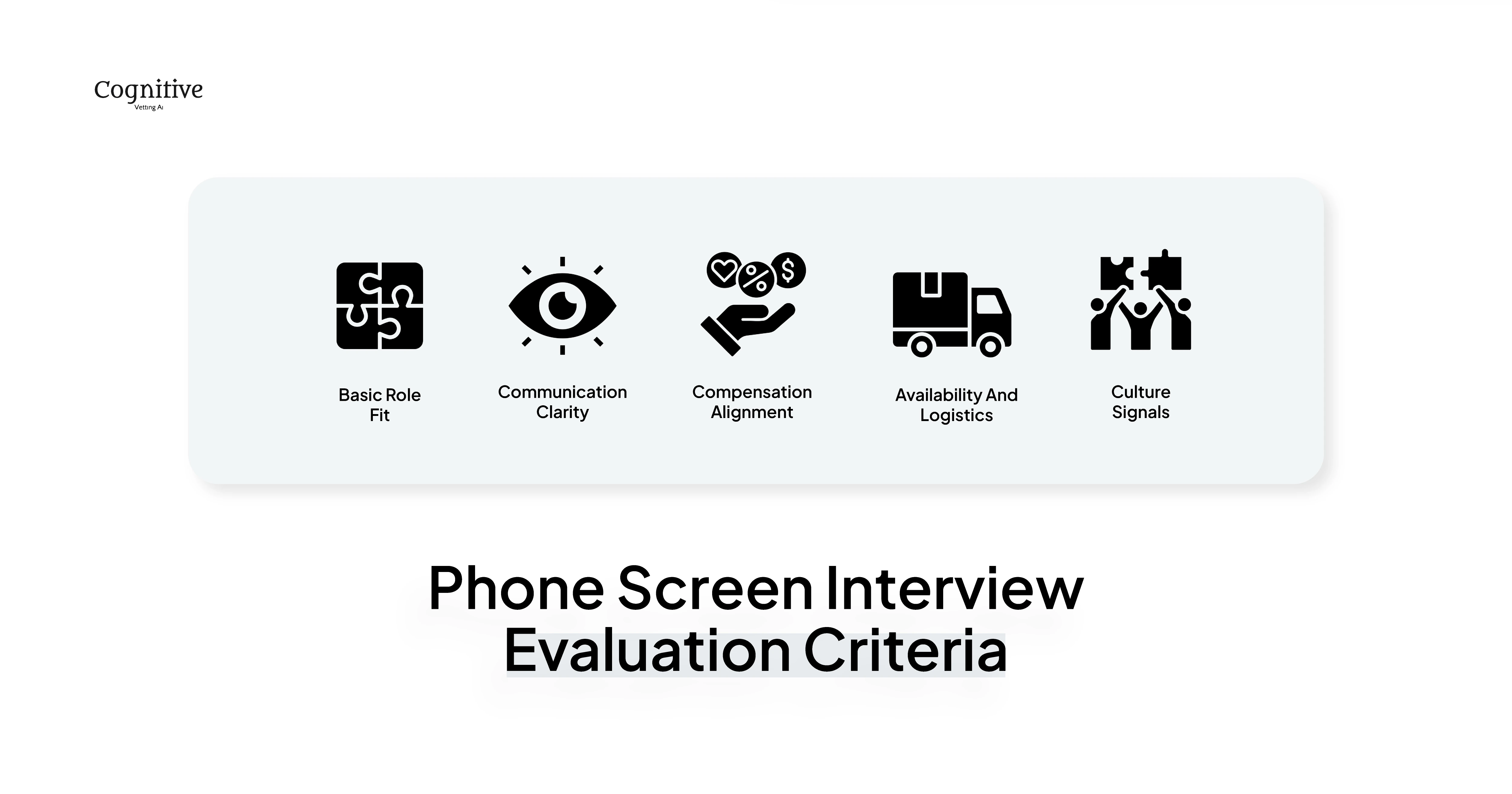
- Basic role fit: Does your experience match the job description?
- Communication clarity: Can you articulate your work without rambling?
- Compensation alignment: Are salary expectations within budget?
- Availability and logistics: Start date, location, visa status, remote preferences
- Culture signals: Red flags in attitude, tone, or motivation
Why Phone Screens Exist in Tech Hiring (And Why They Are Broken)
- Higher time-to-fill (averaging 41 days for tech roles)
- Lower candidate satisfaction scores
- Inconsistent evaluation across recruiters
What Recruiters Actually Ask in a Tech Phone Screen
Opening Questions (First 5 Minutes)
- "Tell me about yourself and your current role."
- "What made you apply to this position?"
- "What are you looking for in your next role?"
Role Fit Questions (Middle 15 Minutes)
- "Walk me through your experience with [specific tech in the job description]."
- "Have you worked in a [startup / enterprise / product / agency] environment before?"
- "How large were the teams you have worked with?"
- "What does your day-to-day look like currently?"
Logistics and Screening Questions (Last 5–10 Minutes)
- "What are your salary expectations?"
- "When would you be available to start?"
- "Are you interviewing elsewhere? Where are you in those processes?"
- "Is this role fully remote / hybrid / on-site; is that something you can commit to?"
How Long Is a Phone Screen Interview?

The 4 Things You Are Actually Being Scored On
2. Energy and confidence on the call
This sounds obvious. But phone screens remove visual cues. Your tone, pacing, and certainty carry more weight than in a video call. A monotone answer signals disinterest, even if the content is strong.
3. Specificity over generality
"I worked on improving performance" is forgettable. "I reduced API latency by 40% by refactoring three endpoints using caching and query optimization" is citable. Recruiters forward notes to hiring managers. Give them something specific to write down.
4. Preparation signals
Asking "what does your company do?" in a phone screen is a hard fail. Referencing a recent product launch, a blog post from their engineering team, or a problem statement from the job description, that signals intent and seriousness.
- Research the company (product, funding stage, recent news, team size)
- Read the job description line by line (note every technology and skill mentioned)
- Prepare your 90-second "tell me about yourself" answer (rehearse it out loud)
- Know your compensation range (research the role on public sites)
- Have 2–3 questions ready for the recruiter,not generic ones ("What is the culture like?"), but specific ones ("What does success look like in the first 90 days for this role?")
- Find a quiet place with stable signal or internet
- Have your resume open in front of you, reference it, don't memorize it
- Know your availability and any logistical constraints upfront
What Happens After a Phone Screen Interview?
- A technical assessment (take-home or timed)
- A hiring manager interview (30–45 minutes, more strategic)
- A panel or loop (4–6 interviews over half a day)
Why Companies Are Moving from Phone Screens to AI Interviews
- Every candidate gets the same questions in the same order
- Evaluations are scored consistently, not based on who conducted the screen
- Screening happens asynchronously, candidates complete it on their schedule
- Time-to-screen drops from days to hours
Common Mistakes That Kill Phone Screen Interviews
- Talking too much. A recruiter asking "tell me about yourself" does not want your 10-year career history. Keep answers under 2 minutes unless they ask for a follow-up.
- Salary vagueness. Saying "I am flexible" or "it depends on the role" does not protect you, it signals you have not done your research. Give a range. Own it.
- Not asking questions. A candidate who asks zero questions signals low interest. Ask at least one substantive question before the call ends.
- Badmouthing previous employers. It will always be remembered. It will almost always eliminate you.
- Not knowing the company. Recruiters notice when candidates cannot name a single product or describe why they applied beyond "it seemed interesting."
Summary: What a Phone Screen Interview Actually Is
Frequently Asked Questions
What is a phone screen interview?
A phone screen interview is a short recruiter-led call, usually 15 to 30 minutes, used to filter candidates before they reach the hiring manager. It checks role fit, salary alignment, and communication, not technical skills.
How long does a phone screen interview last?
Most phone screens last 15 to 30 minutes. Hiring manager screens run slightly longer at 30 to 45 minutes. If an interviewer is booking 45 minutes or more, it is usually a technical pre-screen, not a recruiter call.
What questions are asked in a phone screen interview?
Recruiters typically ask: Tell me about yourself. Why are you interested in this role? What are your salary expectations? When can you start? Are you interviewing elsewhere? Answers to these decide whether you move forward, not your technical depth.
What is the difference between a phone screen and a phone interview?
A phone screen is run by a recruiter and focuses on logistics and basic fit. A phone interview is run by a hiring manager or technical lead and evaluates your skills and experience more deeply. The screen comes first.
How should I prepare for a phone screen interview?
Research the company before the call. Know your target salary range. Prepare a 90-second answer to "tell me about yourself." Have two specific questions ready for the recruiter. Find a quiet space with a strong signal. Keep your resume open for reference.
Why do companies use phone screens before in-person interviews?
To save time. A single tech role receives 200 to 400 applications on average. Phone screens let companies cut 60 to 80 percent of applicants in under 30 minutes without involving engineers or senior leaders in early-stage filtering.
Are companies replacing phone screen interviews with AI?
Yes. AI interview platforms like The Cognitive conduct structured video interviews using a real AI face and voice, ask role-specific questions, follow up on weak answers, and deliver scored reports to hiring teams. This replaces the inconsistency of recruiter-led screens and cuts screening time from days to hours.
Related reading
- 10 Recruitment Automation Tools to Cut Admin Time
- Online Recruiting Software: Cloud vs On-Prem, Explained for Teams That Own the Mess
- Applicant Tracking System for Small Business: 4 Tool Types That Actually Fit
- One-Way Video Interview Software vs Live Video: Which Should You Use?
- AI Powered Recruitment Software: 8-Point 2026 Feature Checklist
- Candidate Assessment Tools: 7 Buyer Tests Before You Sign