15 Strategic Interview Questions to Ask Candidates, With Follow-Ups and a Scoring Rubric
By Sparsh Goyal, Founder at The Cognitive. Published · Last updated
- Strategic interview questions to ask candidates test strategic thinking, judgment, prioritization, business acumen and long-term direction through a real past decision and one sharp follow-up.
- Each of the 15 questions here comes with the follow-up to ask, what a good answer shows and a red flag, split by level from individual contributor to executive.
- Score every answer on a 1 to 5 scale written before the interview, where a 5 names the options, the trade-off, the cost and the result.
Strategic interview questions to ask candidates test how a person thinks about trade-offs, priorities and consequences, not just whether they can do the task in front of them. The best ones ask about a real past decision, then follow up on what the candidate gave up and what happened next. Many leaders have never been trained in strategy itself. In the Global Leadership Forecast 2025 from DDI (Development Dimensions International), 64% of leaders called setting strategy essential, yet only 37% had been trained in it.
The 15 questions below test strategic thinking, judgment under ambiguity, prioritization, business acumen and long-term direction. Each comes with a follow-up, what a good answer shows and a red flag. For warm-up, motivation and culture questions, use the full list of interview questions to ask candidates.
What are strategic interview questions?
Strategic interview questions test whether a candidate can see past the task to its consequences. That means which options existed, what each one cost, who else it touched and what it means a year from now. They are not the same as "smart" or well-chosen questions about career goals. A question about why someone wants the job tells you about motivation. A question about what they stopped doing to hit a goal tells you about strategy.
Most strategic interview questions test one of five things:
- Strategic thinking: seeing the bigger picture and the knock-on effects.
- Judgment: deciding well when the data is incomplete.
- Prioritization: choosing what not to do.
- Business acumen: knowing how work turns into revenue, cost or risk.
- Long-term direction: setting a path for a function and paying for it.
A strong candidate can be good at one and weak at another, so score them apart.
Ask about the past wherever you can. A real decision has real constraints, and a candidate cannot invent the details as easily as they can describe what they would ideally do. Keep hypothetical questions for step-up roles, where the candidate has not yet held the job you are hiring for.
| What it tests | Ask | Follow up with |
|---|---|---|
| Strategic thinking | Tell me about a plan you changed because of something outside your team. | What would have happened if you had kept the plan? |
| Judgment under ambiguity | Describe a decision you made before you had all the data. | What would have made you decide the other way? |
| Prioritization | Walk me through a quarter when you had more work than capacity. What did you drop? | Who did that disappoint, and how did you tell them? |
| Business acumen | How did your last team's work show up in the company's numbers? | Which number would you move first here, and why? |
| Long-term direction | Where should this function be in three years, and what would you stop doing to get there? | What would you test first in 90 days? |
Why bother with this much structure? Because it predicts. A large 2022 review of selection research by Sackett, Zhang, Berry and Lievens ranked structured interviews first for mean operational validity (r = .42). Cognitive ability tests came in at .31, as summarized in SIOP's TIP. A strategic question asked loosely and scored on gut feel gives up most of that edge.
What questions test strategic thinking?
Strategic thinking is the habit of asking "and then what?" Good strategic thinkers notice signals from outside their own work and trace what a decision does to other teams, customers and next year's plan. These three questions look for that habit in a real story.
1. "Tell me about a plan you changed because of something that happened outside your team."
This shows whether the candidate watches the world around their work or only the work itself. The outside signal can be anything: a competitor's launch, a price rise from a supplier, a new regulation, a shift in what customers asked for.
- Follow-up: "What would have happened if you had kept the original plan?"
- A good answer shows: the specific signal, why it mattered, the knock-on effects of changing course and who else had to change with them.
- Red flag: the story is only about their own tasks, or they cannot say why the change was worth the disruption.
2. "Describe a decision that looked right at the time and caused a problem six months later."
Second-order effects are the heart of strategy, and most people learn them by getting one wrong. This question invites that story without making it a confession.
- Follow-up: "What would you look for now, before making the same call?"
- A good answer shows: a clear line from the decision to the later problem, ownership of the call and a specific signal they now check.
- Red flag: the problem was the market's fault or another team's, and the lesson is "communicate more".
3. "What is one decision at your last company you think was a strategic mistake? What would you have done instead?"
Critiquing a past employer is easy. Critiquing it fairly is a strategic skill, because it means understanding the constraints the decision makers faced.
- Follow-up: "What did the people who made that call know that you didn't?"
- A good answer shows: respect for the constraints, an alternative with its own cost and an honest view of whether it would have worked.
- Red flag: pure criticism with no constraints named, or an alternative that amounts to "do everything better".
How do you test judgment and decision making?
Judgment shows up when the data runs out. Senior people rarely get to wait for certainty. You want to hear how a candidate separates what they knew from what they assumed, and how fast they correct a wrong call. For a fuller bank on reasoning itself, see the problem-solving and critical thinking question pages.
4. "Tell me about a decision you made before you had all the data you wanted."
Everyone has made one. The question is whether they made it deliberately, with a known risk, or drifted into it.
- Follow-up: "What would have made you decide the other way?"
- A good answer shows: what they knew, what they assumed, the risk they accepted on purpose and how they checked the result afterwards.
- Red flag: they claim they were sure all along, or they describe waiting for perfect data while the window closed.
5. "Describe a time two people you trusted gave you opposite advice. How did you decide?"
This tests whether the candidate weighs arguments or weighs titles. It also shows how they treat the person they overrule.
- Follow-up: "Looking back, which of them was right, and how do you know?"
- A good answer shows: they compared the reasoning, made a clear call, explained it to the person they did not side with and later checked the outcome.
- Red flag: they went with the more senior person by default, or split the difference to keep the peace.
6. "Tell me about a call you made that turned out to be wrong. When did you realize, and what did you do?"
Good judgment includes changing your mind early. The speed of the reversal matters as much as the original decision.
- Follow-up: "How long did it take you to change course, and what did the delay cost?"
- A good answer shows: the early signal they noticed, a quick reversal and a plain statement of the cost.
- Red flag: they cannot name a wrong call, or the "mistake" is a strength in disguise, like caring too much.
How do you test prioritization in an interview?
Prioritization is strategy at the scale of a week or a quarter. Anyone can rank a list. The real test is what the candidate stopped doing and how they handled the people who wanted it done. The same DDI forecast found 60% of leaders rate decision making and prioritization as critical. Only 39% have been trained in it, so do not assume a senior title means the skill is there. For day-to-day workload questions, the time management page goes deeper.
7. "Walk me through a quarter when you had more work than capacity. What did you drop?"
The word "drop" matters. It removes the easy answer that everything got done with enough late nights.
- Follow-up: "Who did that disappoint, and how did you tell them?"
- A good answer shows: a stated rule for choosing (impact, cost, deadline, risk), something genuinely dropped and the conversation with the person who lost out.
- Red flag: "I worked harder" or "everything was a priority".
8. "Tell me about a time you said no to a request from someone more senior."
Prioritization that only flows downward is just delegation. You want to know whether the candidate can protect a priority against pressure from above.
- Follow-up: "What did you offer instead?"
- A good answer shows: a no tied to a goal both people shared, plus a trade on timing, scope or resources.
- Red flag: they have never said no upward, or they said no with nothing offered in return.
9. "If you joined and found ten open projects and people for four, how would you choose?"
This is a hypothetical, so use it for step-up roles where the candidate has not yet owned a portfolio. Listen for the questions they ask before they answer.
- Follow-up: "Which of the six you would pause is hardest to stop, and why stop it anyway?"
- A good answer shows: they first ask what the business goal is, then name criteria, test them with stakeholders and sequence the work.
- Red flag: they keep the most interesting projects, or cannot bring themselves to pause any.
Business acumen and long-term direction questions
Business acumen and long-term direction both connect the role to the company. Business acumen is knowing how today's work shows up in revenue, cost or risk. Long-term direction is deciding where a function should go and what to give up to get there. Ask the first set at every level above entry. Keep the second for people who will own a plan.
10. "How did your last team's work show up in the company's numbers?"
This separates people who know what their work is for from people who know what their work is.
- Follow-up: "Which number here would you try to move first, and why that one?"
- A good answer shows: a link from the work to revenue, cost or risk, ideally with a figure, and a sensible guess at the main levers in your business.
- Red flag: only activity metrics, such as tickets closed or calls made, with no link to an outcome.
11. "Tell me about a time you spent money, or chose not to, to reach a goal."
Every strategic choice is also a spending choice. This question shows whether the candidate thinks about the cost of time, people and budget.
- Follow-up: "How did you know it paid back?"
- A good answer shows: the cost weighed against the return, the other ways the money could have been used and how they measured the result.
- Red flag: "budget was someone else's problem".
12. "How does this company make money, and what is the biggest risk to that?"
A candidate for a senior role should have done this homework. The second half shows whether they can think about threats, not just restate your website.
- Follow-up: "What would you watch to know that risk is growing?"
- A good answer shows: a basic but correct model of the business, a real risk and an early signal worth tracking.
- Red flag: a recital of your homepage, or "I don't see any big risks".
13. "Where should this function be in three years, and what would you stop doing to get there?"
The second clause is the test. A direction with no cost is a wish.
- Follow-up: "What is the first thing you would test in your first 90 days?"
- A good answer shows: a clear direction, a named sacrifice, a sensible order of moves and a first step you could measure.
- Red flag: big words, no trade-off and nothing you could check in a quarter.
14. "Tell me about a long-term bet you made that took more than a year to pay off."
Long horizons need patience and a kill switch. This question tests both.
- Follow-up: "What kept it alive when the early results were weak, and when would you have stopped?"
- A good answer shows: checkpoints along the way, a clear point at which they would have walked away and the result when it paid off.
- Red flag: no bet longer than a quarter, or a bet kept alive with no criteria for stopping it.
15. "What is a shift in this industry that most people underrate, and what would it change for this company?"
This one rewards people who read widely and think in consequences. It falls flat with people who repeat headlines.
- Follow-up: "If you are right, what would you do differently next year?"
- A good answer shows: a specific shift, a reason it is underrated and a concrete implication for your company.
- Red flag: a fashionable trend named with no link to your business.
Which strategic interview questions fit each level?
The same competency looks different at each level. An individual contributor makes trade-offs inside their own work. A manager makes them across a team and has to say no upward. A leader allocates people and money across teams and places bets that run for years. Asking a junior analyst where the function should be in three years tests confidence, not strategy.
| Level | What it means | Questions | Listen for |
|---|---|---|---|
| Individual contributor | Trade-offs in their own work; knowing why the work matters | 1, 4, 7, 10 | A reason behind each choice and a link to a team goal |
| Manager | Team priorities, resourcing and saying no upward | 2, 5, 8, 9, 11 | Something dropped on purpose and a stakeholder handled well |
| Director or executive | Allocating people and money across teams; multi-year bets | 3, 6, 12, 13, 14, 15 | A named sacrifice, a measurable first step and a point at which they would stop |
Individual contributors
Keep the stories small and concrete. A software engineer choosing to ship a simpler version on time, or an analyst cutting a report nobody read, is strategic thinking at the right size. Score the reasoning, not the scale of the decision.
Managers
Managers should show they protect the team's priorities and explain them. Questions 8 and 9 matter most here, because a manager who cannot say no upward ends up with ten priorities and none done. Role banks for engineering managers and product managers pair well with these.
Directors and executives
At this level, ask for numbers and timeframes and expect them. The bench is thin, even after a recovery. DDI's Global Leadership Forecast 2025 reports that only 20% of HR professionals felt confident in their leadership bench in 2024. It also found 83% of HR organizations expect the need for new leadership capabilities to surge within five years. That makes a careful senior interview worth the time. Pair this guide with the VP of Engineering, CTO and leadership question pages, and the worked examples in leadership interview questions and answers.
How to score strategic interview answers
Write the scale before the first interview. SHRM's August 2026 guide to interview rating scales recommends anchoring each level to observable, job-related behavior or outcomes rather than vague labels. The US Office of Personnel Management describes the same idea in its guidance on structured interviews. Responses are scored against benchmarks of proficiency, and interviews with more structure show higher validity.
This 1 to 5 scale works for all five competencies. Score each competency on its own line.
| Score | What the answer contains |
|---|---|
| 5 | Explains how: names the options, the trade-off, the cost and the result with a number, and owns the call |
| 4 | A real example with concrete detail and a clear trade-off; minor gaps |
| 3 | Correct but generic; describes good practice without showing their own decision |
| 2 | Vague or hand-wavy; buzzwords, no trade-off, or "the team" did it |
| 1 | Not demonstrated; the question was never really answered |
Two rules keep the scale honest. First, do not reward fluency. A confident, polished answer with no trade-off in it is a 3 at best. Second, score against the standard, not against the last candidate. As Lorna Erickson put it to SHRM, if you compare candidates to each other, both of them could be below the standard you set.
The follow-up does the real work
The first answer to a strategic question is usually rehearsed. The follow-up is where you learn something. Ask one follow-up per question, built from what the candidate just said. Aim it at the weakest part of the answer: the missing trade-off, the vague "we", the outcome with no number. "What did you give up?" and "How did you know it worked?" fit almost any story. The STAR method page covers how to pull a full situation, task, action and result out of a thin answer.
A worked example
Take question 7, "What did you drop?", for a marketing manager.
A 3 sounds like this: "I always prioritize by impact. I list everything, rank it and focus on what moves the needle. I keep stakeholders informed." Nothing in it is wrong. Nothing in it happened.
A 5 sounds like this: "In Q3 we had a product launch, a website rebuild and two partner campaigns. I had three people. I paused the rebuild, because the launch carried the revenue target and the old site still converted. I told the head of sales myself, offered to redo the pricing page in the meantime, and we shipped the rebuild in Q4. The launch hit about 80% of its pipeline goal. I think it would have been half that if we had split the team." Options, a rule, a cost, a stakeholder and a result. The figures here are illustrative; in a real interview, the follow-up is how you check them.
Weight the rubric and calibrate
Not every competency matters equally for every role. Decide before the interview which one or two decide the outcome. For a head of operations, prioritization and business acumen might carry most of the weight; for a strategy lead, strategic thinking and long-term direction. In the debrief, SHRM advises that interviewers explain the evidence behind their ratings, so ask for the candidate's own words, not impressions. The rubric generator, the scorecard generator and the guide to interview scorecards can turn this into a form your panel shares. The wider method is in what is a structured interview.
The payoff is measurable confidence. In LinkedIn's Future of Recruiting 2025, 93% of talent acquisition professionals said accurately assessing candidates' skills is crucial to improving quality of hire. And 89% said measuring quality of hire will matter more, yet only 25% were highly confident they could. Written scores tied to evidence are where that measurement starts.
What mistakes ruin a strategic interview?
- Asking only hypotheticals. "What would you do if..." invites the textbook answer. Ask about something that happened, and save hypotheticals for step-up roles.
- Rewarding the best talker. Strategic language is easy to learn. Score the trade-off and the result, not the vocabulary.
- Leading the witness. "You'd probably focus on the highest-impact work, right?" gives the candidate the answer. Ask open questions and let the silence run.
- Asking too many questions. Four questions with real follow-ups beat twelve answered on the surface. Pick the competencies that matter for the role and go deep on those.
- Testing the wrong level. Executive questions for a junior hire test bravado. Junior questions for an executive miss the multi-year judgment you are paying for.
- Scoring after the debrief. Once the loudest interviewer has spoken, scores drift toward theirs. Each interviewer should write a score and the evidence first. For change-heavy roles, the change management questions add a useful second lens.
Can an AI interview run a strategic first round?
Yes, for the first round, if a person still makes the decision. A strategic interview depends on follow-ups and consistent scoring, and both can be done well by software that listens to each answer before asking the next question.
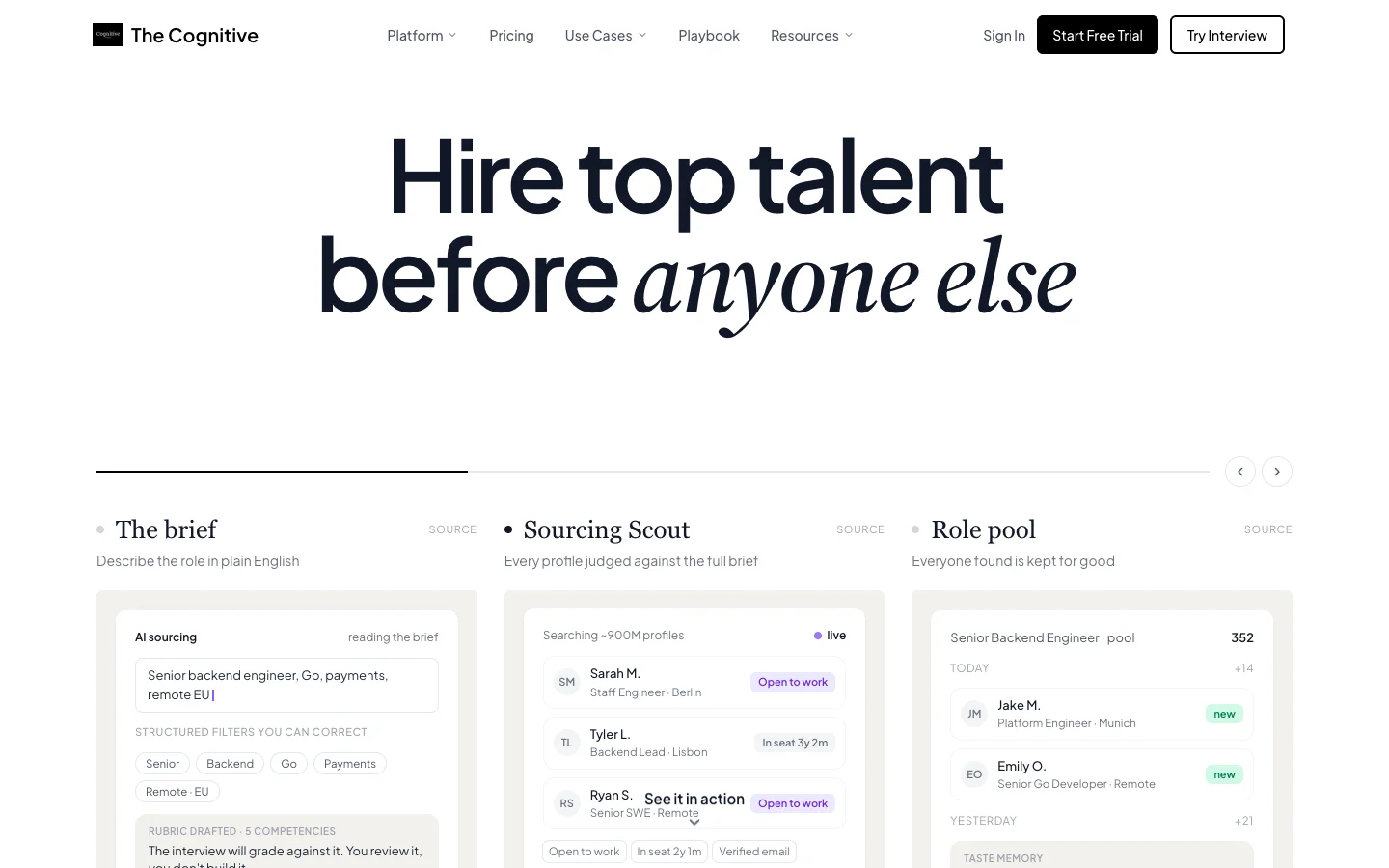
The Cognitive's AI interview is a live two-way video interview that a candidate joins from a laptop or desktop browser. You choose a 10 or 20 minute interview. It asks your role questions plus questions of its own, and follows up on what the candidate says, digging into vague or thin answers. You get a scored report against the evaluation criteria you set for the role. Every candidate waits for your review, and nothing is auto-rejected. The Cognitive is our product.
In practice, you could load questions 4, 7 and 10 from this guide as role questions. Then set prioritization and business acumen as criteria, and spend your own time on the final round with the people who scored best.
It is a first round, not the decision. Keep director and executive strategy interviews with the people the hire will work with. A 10 or 20 minute interview fits three or four of these questions, not a full panel.
It sits inside a wider hiring platform. You can source from about 900M public profiles, email candidates from your own Gmail or Outlook mailbox and sync with 100+ ATS on higher plans. AI Interview plans start at $99 a month. Every new workspace gets a 7-day free trial, no card needed.
To start, pick one open senior role, choose the two competencies that decide it and write the 1 to 5 anchors for each before anyone is interviewed. Then choose four questions from this guide and a follow-up for each. If you want the first round run for you, start free with The Cognitive.
Sources
- DDI, Global Leadership Forecast 2025 (2,185 HR professionals and 10,796 leaders from 2,014 organizations in 50+ countries), 2025.
- LinkedIn, The Future of Recruiting 2025 (1,271 recruiting professionals at manager level or above in 23 countries, surveyed September 2024).
- Sackett, P. R., Zhang, C., Berry, C. M. and Lievens, F. (2022), Journal of Applied Psychology, 107, 2040 to 2068, as summarized in SIOP's TIP: Is Cognitive Ability the Best Predictor of Job Performance?
- SHRM, Roy Maurer, Build Consistent Hiring Decisions with Job Interview Rating Scales, 20 August 2026.
- US Office of Personnel Management, Structured Interviews.
Frequently Asked Questions
What are good strategic interview questions to ask candidates?
Good strategic interview questions ask about a real decision and what the candidate gave up to make it. Examples: "Walk me through a quarter when you had more work than capacity. What did you drop?", "Describe a decision you made before you had all the data" and "How did your last team's work show up in the company's numbers?" Follow each with one question on the trade-off or the result. For warm-up and motivation questions, see interview questions to ask candidates.
How many strategic questions should you ask in one interview?
Ask three to five strategic questions in a 45 to 60 minute interview, each with a real follow-up. Depth beats coverage: a story probed twice tells you more than three stories told once. Choose the one or two competencies that decide the role and spend most of the time there.
What does a good answer to "How do you prioritize your work?" sound like?
A good answer names a rule for choosing and something the candidate actually dropped. It sounds like: "I rank by impact on the quarter's goal, then by deadline. Last spring that meant pausing a dashboard project to finish a launch, and I told the requester why and when I'd pick it back up." A weak answer says everything got done by working harder. The same test applies to "How do you manage competing priorities?"
Should strategic interview questions be behavioral or situational?
Mostly behavioral, with situational questions kept for step-up roles. A behavioral question asks about something that happened, so the candidate has to supply real constraints and results. A situational question asks what they would do, which suits someone who has not yet held the job. The difference is covered in more depth in situational test examples and answers.
What strategic questions should you ask a manager or senior leader?
Ask managers about saying no upward and resourcing a team, and ask leaders about multi-year bets and what they would stop doing. "Tell me about a time you said no to a request from someone more senior" suits managers. "Where should this function be in three years, and what would you stop doing to get there?" suits directors and executives. More role-specific banks are on the leadership interview questions page.
How do you score answers to strategic interview questions?
Score each competency on a 1 to 5 scale with written anchors, agreed before the first interview. A 5 names the options, the trade-off, the cost and the result with a number; a 3 is correct but generic; a 1 means the skill was not shown. Experts quoted by SHRM recommend anchoring each level to observable, job-related behavior and scoring against the standard rather than against other candidates.
Can an AI interviewer ask strategic interview questions?
Yes, an AI interviewer can run a strategic first round, as long as a person makes the hiring decision. The Cognitive's live AI video interview asks your role questions plus its own, follows up on what the candidate says, digging into vague or thin answers, and gives a scored report against the criteria you set. Every candidate waits for your review, and nothing is auto-rejected. Plans start at $99 a month.
Related reading
- The 12 Best Hiring Strategies for 2026, and the Data Behind Them
- How to Hire Remote Developers in 2026: A 7-Step Guide
- How to Spot a Fake Resume: Red Flags, Checks and Interview Probes
- Candidate Experience Survey: Sample Questions and Candidate NPS
- How to Create a Hiring Plan in 2026 (Steps + Free Template)
- Hiring Process Steps: The 7 Stages, Who Owns Each and How Long They Take