Hiring Process Steps: The 7 Stages, Who Owns Each and How Long They Take
By Sparsh Goyal, Founder at The Cognitive. Published · Last updated
- The 7 hiring process steps are plan and run intake, write the scorecard then the job description, source and attract, screen, interview and assess, decide, check and offer, and onboard and review the process.
- The recruiter runs these recruitment process steps, the hiring manager sets the bar and decides, and most lost time sits in the waits between steps.
- Across all the stages of the hiring process, SHRM's 2026 benchmarking puts the median time to fill a nonexecutive role at 39 calendar days.
There are seven hiring process steps, and they run in this order:
- Plan and run intake
- Write the scorecard, then the job description
- Source and attract
- Screen
- Interview and assess
- Decide, check and offer
- Onboard and review the process
These stages of the hiring process are the recruitment process steps most teams follow, whatever they call them. The recruiter runs the process, and the hiring manager sets the bar and makes the decision. SHRM's 2026 benchmarking puts the median time to fill at 39 calendar days for nonexecutive roles, counted from requisition opened to offer accepted. Most of that time is lost between steps, waiting on approvals, calendars and feedback. For the definition and the metrics to track at each stage, see what the recruitment process is.
The 7 hiring process steps at a glance
| Step | Who owns it | Time target | Done when |
|---|---|---|---|
| 1. Plan and run intake | Recruiter, with the hiring manager; finance approves | 2 to 3 working days after approval | Requisition approved; must-haves, pay range, interview plan and decision date agreed |
| 2. Write the scorecard, then the job description | Hiring manager sets criteria; recruiter writes the advert | Same week as intake | Scorecard and advert signed off |
| 3. Source and attract | Recruiter or sourcer | 2 to 3 weeks, overlapping step 4 | A shortlist that meets every must-have |
| 4. Screen | Recruiter | First contact within 2 to 3 days | Each candidate passed or rejected, with the reason recorded |
| 5. Interview and assess | Interview panel | 1 to 2 weeks; scorecards within 1 day | Every interviewer's scorecard is in |
| 6. Decide, check and offer | Hiring manager decides; recruiter checks and closes | Debrief within 1 day; offer within a week | Offer accepted |
| 7. Onboard and review the process | Manager and HR; recruiter leads the review | Start date, then 30, 60 and 90 days | New hire started; stage dates reviewed |
The time targets are working targets, not survey results. No public benchmark publishes reliable day counts for each step.
Other guides group the same work differently. An 8-stage version splits step 6 into two: decide and check, then offer. A 5-step version merges intake with the scorecard, and interviews with the decision. Nothing is added or dropped, so pick the count your team finds easiest to track.
The stages of the hiring process, step by step
Step 1: Plan and run intake
Every hire starts with a decision that the role is needed and funded. For a planned role, that decision sits in the hiring plan. For a backfill, someone confirms whether the job should be refilled as it was, or changed. Either way, the output is an approved job requisition.
Then comes the intake meeting. Recruiter and hiring manager agree the must-haves, nice-to-haves, pay range, interview stages, panel and decision date. The intake meeting questions cover what to ask. A vague intake is where many of the problems in later steps come from, because candidates get judged on criteria nobody wrote down.
Approval is the slow part at large companies. SHRM's 2025 brief found that extra-large organizations spend nearly twice as long getting positions approved, getting jobs posted and conducting interviews as the median organization. A week in an approval queue counts against time to fill, and nobody sees it.
- Who owns it: the recruiter runs intake with the hiring manager; finance or a budget holder approves.
- How long it takes: target intake within 2 to 3 working days of approval.
- Usual bottleneck: approval layers, and a hiring manager who cannot yet say what good looks like.
- Done when: the requisition is approved and the must-haves, pay range, interview plan and decision date are written down.
Step 2: Write the scorecard, then the job description
Write the scorecard before the job description. List the four to six things you will assess, and what a strong, acceptable and weak answer looks like for each. Then write the advert from those criteria. Candidates are then judged on what they were told the job needed.
Skip this and the first debrief often reveals that two interviewers wanted different people. The scorecard generator and job description generator give the hiring manager a first draft of each to edit.
- Who owns it: the hiring manager sets the criteria; the recruiter writes the advert.
- How long it takes: target the same week as intake.
- Usual bottleneck: the advert is rewritten after sourcing starts, which resets the search.
- Done when: the hiring manager has signed off both documents.
Step 3: Source and attract
Two channels run side by side. Inbound brings applications and referrals. Outbound means finding people who have not applied and contacting them directly. Most hard roles need both.
Volume keeps rising. Ashby's April 2026 report says: "The average recruiter today is processing 291 applications per hire, compared to roughly 100 in early 2021." More applications do not mean more fit, though. A pile that misses the must-haves still leaves you without a shortlist.
Referrals help here. In CareerPlug's 2025 report on small businesses, referrals were 2% of applicants but 11% of hires (2024 data). Outbound sourcing matters most for specialist roles, where the right people are employed and not reading job boards.
- Who owns it: the recruiter, or a dedicated sourcer on larger teams.
- How long it takes: 2 to 3 weeks of active sourcing, overlapping with screening. Start outbound the day the advert is approved.
- Usual bottleneck: volume without fit, and outbound starting late.
- Done when: you have a shortlist of people who meet every must-have, large enough to survive steps 4 and 5.
Step 4: Screen
Screening has two layers. First, apply the knock-out criteria agreed at intake, such as work authorization, location and the one or two skills the job cannot do without. Then hold a first structured conversation about what a resume cannot show. The first-round interview questions give you a starting script.
This is the narrowest point in the funnel. Gem's 2026 benchmarks found that "only 8% of applicants advance past initial screening, and just 0.5% ultimately receive offers" (Gem, 1 December 2025).
Contact speed matters because good candidates are talking to other employers. In CareerPlug's 2024 data, small businesses took an average of 2.3 to 5.5 days, by industry, to first contact the person they hired. Treat that as a ceiling, not a goal.
- Who owns it: the recruiter, judging against the intake criteria rather than personal taste.
- How long it takes: target first contact within 2 to 3 days of a strong application or a sourced reply.
- Usual bottleneck: screens waiting for recruiter time while applications keep arriving.
- Done when: each candidate is passed or rejected against the intake criteria, with the reason recorded.
Step 5: Interview and assess
Run a structured interview loop. Each interviewer owns one or two criteria from the scorecard and asks about past behavior or a realistic scenario. Everyone scores alone, in writing, before the debrief.
Loops have grown. Gem reports that interviews per hire have risen 33% since 2021. In Ashby's data, business roles average 11.7 interviews per hire and technical roles 17.6 (28 April 2026). Every one of those interviews needs a calendar slot.
Scheduling is the real bottleneck. In Cronofy's survey of 12,000 candidates, 31% said their first interview took as long as two to three weeks to schedule (11 June 2024). Agree the rounds at intake and let candidates book their own slots. Run independent interviews on the same day where you can, and never add a round halfway through.
- Who owns it: the interview panel, scoring to one shared rubric; the recruiter coordinates.
- How long it takes: target 1 to 2 weeks for the loop, with each scorecard in within 1 day.
- Usual bottleneck: calendars, and rounds added because the panel could not agree.
- Done when: every interviewer's scorecard is in for every finalist. The interview feedback examples show what a useful one looks like.
Step 6: Decide, check and offer
The decide, check and offer step covers three things: the debrief, the checks and the offer. In the debrief, the panel compares written scores against the scorecard and the hiring manager decides. The checks are reference calls, plus a background check where the role needs one, with the notices your jurisdiction requires. The background check software guide compares the tools.
Most people who reach an offer accept it. Gem puts the rate at 82%, the highest since 2021. Employ's 2025 benchmarks, reported by HR Dive on 14 January 2026, put it at 83.9%. That still leaves roughly one offer in six declined.
The wait after the last interview is time a candidate spends talking to someone else. In college hiring, NACE found the gap between a student's first interview and an offer or rejection averaged 27.3 days (30 September 2025). Tell everyone who interviewed and missed out; the candidate rejection email templates make that quick.
- Who owns it: the hiring manager decides; the recruiter runs checks, makes the offer and closes.
- How long it takes: target the debrief within 1 day of the last interview and the written offer within a week.
- Usual bottleneck: late feedback, offer approvals, and checks started before the right notices were given.
- Done when: the offer is accepted. The time to fill clock stops here.
Step 7: Onboard and review the process
An accepted offer is not a hire until the person starts. Keep in touch through the notice period, send paperwork early, and have equipment and access ready on day one. Book check-ins at 30, 60 and 90 days.
Then review the search itself. Pull the dates each candidate spent in each stage, find where the days went and where good people dropped out, and note which source produced the hire. Ask candidates what it was like with a short candidate experience survey.
- Who owns it: the hiring manager and HR own onboarding; the recruiter leads the review.
- How long it takes: the notice period, then check-ins at 30, 60 and 90 days. The review takes an hour, within two weeks of the start date.
- Usual bottleneck: silence between acceptance and start date, when counteroffers land.
- Done when: the new hire has started and the stage dates have been reviewed.
How long does the hiring process take?
For a typical nonexecutive role, the seven steps fit into about 39 days. The windows below are targets, and the steps overlap on purpose: sourcing continues while the first screens run.
| Step | Target window (days after approval) | What should be true at the end |
|---|---|---|
| 1. Plan and run intake | Day 1 to day 3 | Criteria, pay range, panel and decision date agreed |
| 2. Write the scorecard, then the job description | Day 3 to day 5 | Both signed off; job posted |
| 3. Source and attract | Day 5 to day 21 | Shortlist that meets every must-have |
| 4. Screen | Day 7 to day 24 | Finalists chosen |
| 5. Interview and assess | Day 14 to day 30 | All scorecards in |
| 6. Decide, check and offer | Day 30 to day 39 | Offer accepted |
| 7. Onboard and review the process | Start date, then day 30, 60 and 90 | New hire started; stages reviewed |
Published clocks vary by source, role and company size:
| Source | What it measures | Figure |
|---|---|---|
| SHRM, 2026 edition: over 4,600 organizations | Requisition opened to offer accepted, median | 39 days nonexecutive; executive unchanged from 2025 |
| SHRM, 2025 brief: 2,371 members | Same clock | 44 days nonexecutive, 45 executive; 61 nonexecutive at extra-large organizations |
| Ashby, 28 April 2026: 109M applications, 247K jobs | Days to hire, median | 30 business (75% within 46); 40 technical (75% within 57) |
| Employ via HR Dive, 14 January 2026: Employ customers | Job posting to accepted offer, average | 63.5 days (83.5 small and midsize, 51.7 enterprise); 46.2 from first candidate interaction |
| CareerPlug, 2025 report: 60,000+ small businesses in industries such as restaurants, retail, cleaning and fitness | Application to hire, average (2024 data) | 16 to 23 days by industry |
These clocks start at different points, so they cannot be averaged. SHRM starts at the requisition, Employ at the posting and CareerPlug at the application. Pick the one that matches your own data. Stage by stage figures are in time to hire benchmarks, with the longer trend in time to hire compression.
Where does the hiring process stall, and how do you fix it?
Steps rarely run long because the work is hard. They run long because the next person has not acted yet.
- Approvals in a queue (step 1). Agree a yearly budget envelope in the hiring plan, so each requisition inside it needs one signature.
- Interviews waiting for calendars (step 5). Let candidates self-schedule, block recurring panel time, and run independent interviews back to back.
- Screens waiting for recruiter time (step 4). Apply knock-out criteria first, then use a first-round format candidates can take without booking a call.
- Late feedback (steps 5 and 6). Make "scorecard within one day" a rule the hiring manager enforces, and hide others' scores until each person submits.
- Candidates left in silence (every step). In Cronofy's June 2024 survey, 28% of candidates named lack of responsiveness and poor communication as their biggest frustration. Share the steps and timing on the first call, and send a note whenever a step runs late.
Drop-off between stages is covered in the recruitment funnel and recruitment funnel conversion rates.
What is the difference between the hiring process and the recruitment process?
In everyday use, there is none: both name the steps from an open role to a new person starting. Most teams use the terms interchangeably.
Where people do draw a line, recruitment is the front half: planning, sourcing and attracting. Hiring is the back half: assessing, deciding, offering and onboarding. On that reading, steps 1 to 3 are recruitment, steps 4 to 7 are hiring, and screening is the handover. The full definition, the KPI for each stage and US compliance checkpoints are in what the recruitment process is, and metric definitions in recruiting metrics.
Hiring process checklist
Print this list or paste it into the notes for your next open role. Run intake this week, write the scorecard before anything else, and record the date each candidate enters and leaves every stage. After the hire, hold the review and fix the slowest stage first.
Step 1: Plan and run intake
- Role confirmed as needed and funded
- Requisition approved
- Must-haves, nice-to-haves and pay range written down
- Interview stages, panel and decision date agreed
Step 2: Write the scorecard, then the job description
- Four to six criteria, each with a strong, acceptable and weak answer described
- Job description written from the scorecard
- Both signed off by the hiring manager
Step 3: Source and attract
- Job posted and referral request sent to the team
- Outbound search started the same day for specialist roles
- Shortlist of people who meet every must-have
Step 4: Screen
- Knock-out criteria applied to every applicant
- First contact within 2 to 3 days of a strong application
- Pass or reject recorded, with the reason
Step 5: Interview and assess
- Each interviewer assigned their criteria
- Candidates able to book their own slots
- Every scorecard submitted within 1 day, before the debrief
Step 6: Decide, check and offer
- Debrief held against the scorecard within 1 day of the last interview
- References and any background check done, with required notices given
- Offer made and accepted
- Rejection sent to everyone who interviewed
Step 7: Onboard and review the process
- Paperwork, equipment and access ready before day one
- Check-ins booked at 30, 60 and 90 days
- Stage entry and exit dates recorded for every candidate
- Candidate survey sent after the decision
- Review held: slowest stage, biggest drop-off, best source
Where does The Cognitive fit?
Steps 3 and 4 take a large share of recruiter hours, and that is the part The Cognitive covers. The Cognitive is our product. It does not post jobs, take applications, run background checks, send offers or onboard anyone. If your days go on approvals or later-round scheduling, it will not shorten those.
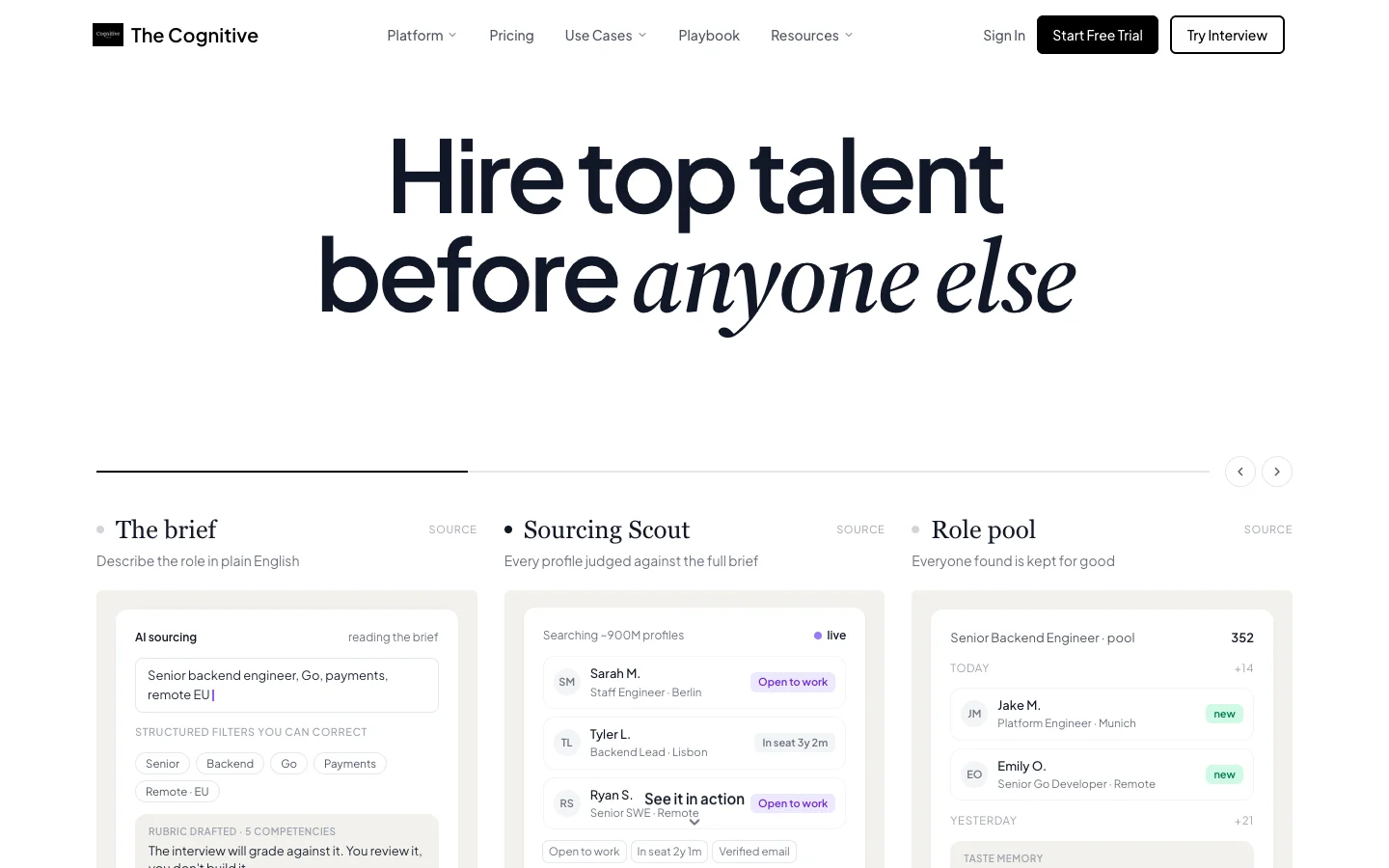
For sourcing, AI Sourcing turns a one-sentence role description into a ranked list of people who have not applied, drawn from about 900M public profiles. Results come ten to a page, each with a "Why this match" line from the person's profile. On Sourcing Pro and above, outreach goes out by email from your own Gmail or Outlook mailbox, under your name.
For screening, AI Interviews holds the first round as a live two-way AI video interview of 10 or 20 minutes, which candidates take on a laptop or desktop. It asks role questions and follows up on the answers. You receive a scored report against your criteria, with the recording and transcript, and someone on your team decides who goes to step 5.
On higher plans, The Cognitive syncs with 100+ ATS, and candidates imported from your ATS get their results written back. Each product is its own plan, AI Sourcing from $99 a month and AI Interviews from $99 a month. A 7-day free trial needs no card. Start free with The Cognitive.
Sources
- SHRM, Recruiting Executives Benchmarking, 2026 edition (over 4,600 organizations), June 2026.
- SHRM, 2025 Recruiting Executives Benchmarking data brief (2,371 members, surveyed 9 January to 3 March 2025), 2025.
- Ashby, Recruiter Productivity, 2026 Talent Trends Report (109M applications across 247K jobs, January 2021 to March 2026), 28 April 2026.
- Gem, Key Takeaways From the 2026 Recruiting Benchmarks Report (165M+ applicants, 1.2M hires, June 2021 to May 2025), 1 December 2025.
- CareerPlug, Recruiting Metrics Report (60,000+ small businesses, 10M+ applications, 2024 data), April 2025.
- HR Dive, reporting Employ's Hiring Benchmarks report, 14 January 2026.
- Cronofy, Candidate Expectations Report 2024 (12,000 candidates in 7 countries), 11 June 2024.
- NACE, 2025 Recruiting Benchmarks Survey (212 employers, college hiring), 30 September 2025.
Frequently Asked Questions
What are the 7 steps of the hiring process?
The 7 steps run from intake to onboarding. They are: plan and run intake; write the scorecard, then the job description; source and attract; screen; interview and assess; decide, check and offer; and onboard and review the process. The recruiter runs each step and the hiring manager makes the decision. For the definition and the metric to track at each stage, see what the recruitment process is.
Are there 5, 7 or 8 steps in the recruitment process?
All three counts describe the same work, grouped differently. An 8-stage version splits "decide, check and offer" into two stages: decide and check, then offer. A 5-step version merges intake with the scorecard, and interviews with the decision. Pick the count your team finds easiest to track, and record every candidate's entry and exit date for each stage.
How long does the hiring process take?
A nonexecutive hire takes a median of 39 calendar days from requisition to accepted offer, per SHRM's 2026 benchmarking. Ashby's April 2026 data puts business roles at a median of 30 days to hire and technical roles at 40. Employ's 2025 data, reported by HR Dive in January 2026, averaged 63.5 days from job posting to accepted offer. Each clock starts at a different point. Stage by stage figures are in time to hire benchmarks.
Which step of the hiring process takes the longest?
No public benchmark publishes reliable day counts for each step, but interviewing and the waits around it are the most common slow point. In Cronofy's June 2024 survey, 31% of candidates said their first interview took as long as two to three weeks to schedule. At extra-large organizations, SHRM's 2025 brief found approvals, job posting and interviews take nearly twice as long as at the median organization. Agreeing the interview plan at intake and letting candidates book their own slots removes most of that wait.
Where do candidates drop out of the hiring process?
Most candidates leave at screening, the narrowest point in the funnel. Gem's 2026 benchmarks found that only 8% of applicants advance past initial screening. Among small businesses in CareerPlug's 2024 data, employers invited 3% of applicants to interview and turned 27% of interviews into hires. See the recruitment funnel for conversion between each stage.
Who is responsible for the hiring process?
The recruiter is responsible for running the hiring process, and the hiring manager for the hiring decision. The hiring manager also sets the criteria and signs off the scorecard, and the interview panel scores against the criteria it was given. Finance approves the requisition and any offer outside the range; HR handles checks and onboarding. In a small company one person may hold several of these roles, and when one recruiter owns every step it is called full cycle recruiting.
Does a small business need every step of the hiring process?
Yes, a small business needs every step, but each one can be much shorter. Intake can be a 30-minute conversation and the scorecard can be four lines. Do not skip the scorecard or the written score after each interview, because they stop a hire being made on impressions. CareerPlug's 2024 data shows small businesses averaged 16 to 23 days from application to hire, by industry. For tools, see hiring software for small business.
Related reading
- The 12 Best Hiring Strategies for 2026, and the Data Behind Them
- How to Hire Remote Developers in 2026: A 7-Step Guide
- How to Spot a Fake Resume: Red Flags, Checks and Interview Probes
- Candidate Experience Survey: Sample Questions and Candidate NPS
- How to Create a Hiring Plan in 2026 (Steps + Free Template)
- 15 Strategic Interview Questions to Ask Candidates, With Follow-Ups and a Scoring Rubric