The Cognitive

Boolean keys out. One sentence in.

How to write a search as one plain sentence about the person, the 10 best sentences, and a Claude skill that turns any job post into one. Plus the honest part: where a sentence still needs something to run on.

Why every string breaks

A Boolean string matches words. The person you want is described by work. Three ways that gap shows up.

Titles drift

The same job is written a dozen ways. Every title you didn't list is a person you never see, and the list is never finished.

"Software Engineer, Data" · "Member of Technical Staff"

Words aren't work

A word in a skills list matches the same as five years of doing it. The string can't tell “ran it in production” from “went to a talk”.

Skills: Kafka (endorsed by 3)

NOT cuts good people

One old line removes them. A NOT on “consultant” drops the engineer who consulted for one year a decade ago.

NOT (consultant OR consulting)

The four parts of a search sentence

Brief the search the way you'd brief a sharp colleague. Four parts, in this order, in one sentence of 15 to 35 words.

Senior data engineer in Chicago who has run Kafka in production, not a consultant.

1 · Who

The job in plain words, plus level if it matters. One title, the most common one. Never a list of titles.

Payroll manager
Payroll Manager / Lead / Supervisor / Head

2 · Where

The place and how they'd work there. Say the range the way a person would.

within an hour of Dallas
Dallas (exact city only)

3 · Proof

One thing they have done, as a verb with context. Something you could quote from a profile. Two at most, joined by “and”.

has run payroll in several states
payroll, multi-state, payroll software

4 · No-go

Only one, and only if it decides who fits. Say it as a kind of person, not a banned word.

not a consultant
NOT contractor NOT freelance NOT agency

Cut a key

Pick a role, a place and the one thing they must have done. The machine cuts the sentence and shows the Boolean string it replaces, struck out, with where that string breaks. Roles and examples are made up for practice.

Key cutter

The string it replaces

    Swap in your own place before you use it.
    100+ recruiters have shared their feedback
    “juicebox, metaview, your looks faster and easier to use but with more relevant profiles”
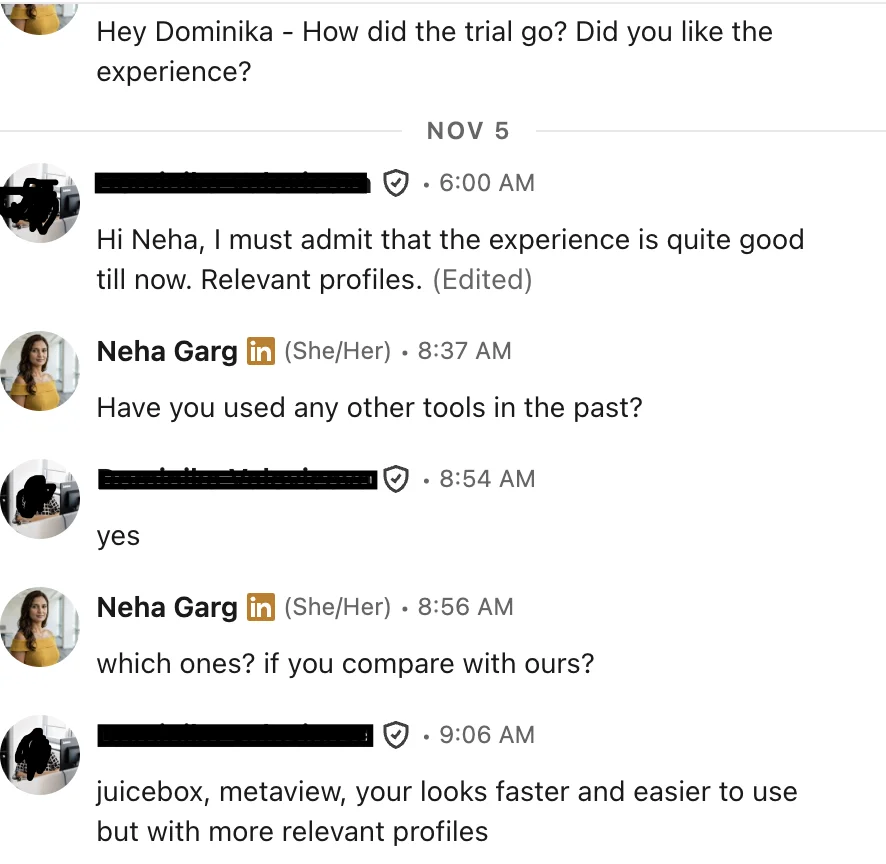
    LinkedIn message: compared with Juicebox and Metaview, faster and easier to use with more relevant profiles

    The 10 best sentences

    Each one follows the four parts. Copy one, change the place and the proof to your role, and keep the shape.

    Senior data engineer in Chicago who has run Kafka in production, not a consultant.

    “In production” separates the people who ran it from the people who listed it.

    Payroll manager within an hour of Dallas who has run payroll for employees in several states and moved it onto a new system.

    Two proofs joined by “and”, both things a profile can show. The limit is two.

    Controls engineer near Columbus, Ohio who has written PLC code for packaging or food lines and been on site for a line start-up.

    “Written” code, not “maintained” it. The verb does the filtering.

    ICU nurse in Phoenix who has worked nights in a Level I trauma center and holds a critical care certification.

    Shift and setting are the real must-haves. “Registered nurse” alone finds every nurse in the city.

    Account executive in New York who has sold software to hospitals and closed new deals on their own, not only renewals.

    The no-go names a kind of seller, so it removes account managers without a list of banned titles.

    Staff accountant in Atlanta who has done month-end close for a company with more than one entity, not public accounting only.

    “Only” matters. Someone who did two years in audit and three in industry still fits.

    Product designer working remotely in US Eastern time who has shipped a consumer mobile app from first sketch to release.

    For remote roles, the time zone is the place. “From first sketch to release” rules out people who only did one stage.

    Warehouse operations manager near Indianapolis who has run a site with more than 100 hourly staff across shifts.

    Size and shifts tell you more than any title. A “site lead” and a “general manager” can both fit.

    Backend engineer in Austin who has built payment or payout systems that move real money, in Go or Java.

    The language goes last. The work is the must-have; the language is a tie-breaker.

    HR business partner in Denver who has supported a sales organisation of 200 or more people through a reorganisation.

    Who they partnered with, how many, and the hard moment. Three facts, one clause.

    Make Claude write them for you

    The skill reads a job post or the hiring manager's notes and writes the sentence, with the parts labelled and what it left out.

    Step 1

    Add the sentence-writer skill

    Save this as SKILL.md in a folder called search-sentence, zip the folder, and add it in Claude's settings under Skills. If skills aren't open on your plan, paste the text into a Project's instructions.

    --- name: search-sentence description: Turns a job post, intake notes or a hiring manager's words into one plain-English search sentence that describes the person (who, where, proof, no-go), and lists what it left out. Use whenever I paste a role and want to search for people, or when I paste an old Boolean string and want it rewritten. --- # Search sentence writer You write one sentence that describes the person I should look for. A search reads it the way a colleague would. It is not a keyword list. ## The shape [Who] [Where] who [Proof], [No-go]. - 15 to 35 words. One sentence. No brackets, no quotes, no AND/OR/NOT. ## 1. Who - The most common plain title for the job. Add level (junior, senior, lead, head of) only if the post makes it matter. - One title. If the post uses an internal or odd title ("Ninja", "Associate II", "Member of Technical Staff"), use the plain market name for the work. - If the role mixes two jobs (e.g. "HR and payroll"), name the half the hiring manager would fight for, and put the other half in Proof if needed. ## 2. Where - Office roles: "in [city]" if they must live in the city, "within an hour of [city]" if they can commute. Use the office's city, not the company's head office. - Hybrid: "within an hour of [city]" and nothing else; days in the office belong in the message, not the search. - Remote: "working remotely in [country or time zone]". Never just "remote". - If the post gives no place, stop and ask me. ## 3. Proof - One thing they have DONE, written as a verb with its context: "has run payroll for employees in several states", not "multi-state payroll". - Use verbs that show ownership: built, ran, led, owned, launched, moved, closed, wrote. Avoid: familiar with, exposure to, worked on, knowledge of, passionate about. - At most two proofs, joined by "and". If the post lists more must-haves, keep the two the hiring manager would check first and move the rest to LEFT OUT. - Size and setting count as proof when they decide fit: "a site with more than 100 hourly staff", "a Level I trauma center", "a company with more than one entity". - A software or language name goes last, and only if the work could not be done without it. - Years of experience are not proof. Use them only if the post makes them a hard rule, and then write "for 3 or more years" after the verb. ## 4. No-go - At most one. Only if it decides who fits. - Write it as a kind of person: "not a consultant", "not only renewals", "not public accounting only". Never a list of banned words. - "Only" protects good people: "not public accounting only" keeps the accountant who started in audit. - A company we can't approach is not a no-go for the sentence. List it under DO NOT CONTACT. ## Never put in the sentence - Soft skills (great communicator, team player, self-starter). They belong in the interview. - Adjectives about quality (top, rockstar, A-player, strong). - Pay, benefits, perks, the company's pitch. - Degrees, unless the job legally needs one (then name the license or certification). - More than two "and"s. ## Ask before you write If the post leaves out something that changes who to look for, ask me ONE question with two to four answers. Examples of what changes who to look for: no place; on site vs remote unclear; two must-haves that fight each other; a level that could mean two very different people. Do not ask about anything else. ## Output SENTENCE: [the sentence] WHO: [part] · WHERE: [part] · PROOF: [part] · NO-GO: [part or "none"] LEFT OUT: [each must-have or preference you did not use, and why, one line each] DO NOT CONTACT: [companies or people the post says to avoid, or "none"] TWO OTHER SENTENCES: [the same person, written once with the other proof first, once with a wider place] ## If I still need a string Only if I write "string too": add a Boolean version for a keyword search, marked FALLBACK. Include 5 to 8 title variants, the place plus its main commute towns, and the proof as keywords. Under it, list in one line each what the string will miss and what it will wrongly match. Never use NOT on a word that also appears in good profiles.
    Step 2

    Feed it the role

    Paste the full job post or your intake notes. The hiring manager's own words beat the post every time; paste them if you have them.

    Use the search-sentence skill. Role: [paste the job post or intake notes] Hiring manager said: "[the line they said that matters most]" Office: [city, state] · [on site / hybrid / remote] Never approach: [companies, or "none"] Write the sentence.
    Step 3

    Rewrite an old string

    Got a saved string that worked once? Turn it back into the person it was trying to describe, then check the sentence against the role you have today.

    Use the search-sentence skill. Here is an old Boolean string: [paste the string] 1. Tell me in one line who this string was trying to find. 2. List what it misses and what it wrongly matches. 3. Write the sentence for that person. 4. Ask me the one question that would change the sentence most.
    Step 4

    Check the sentence before you use it

    Read it out loud. A colleague who heard it once should be able to name a person who fits. Then run these traps.

    The shopping listwho knows A, B, C, D and E. Pick the two the hiring manager checks first.
    The keyword in disguisewith Kafka experience is a skills-list match. Write the work: “has run Kafka in production”.
    Years as proofwith 8+ years of experience says nothing about what they did. Swap it for the size or scope that 8 years was meant to stand for.
    The place that's too tightin Plano when the office takes people from the whole metro. Say “within an hour of”.
    The no-go that bitesnot anyone from a startup removes people for one line in their past. Add “only” or drop it.
    The pitchto join a fast-growing team is for the message. The search can't use it.
    100+ recruiters have shared their feedback
    “pretty good … especially for semiconductor, because it's much harder to find semiconductor talent”
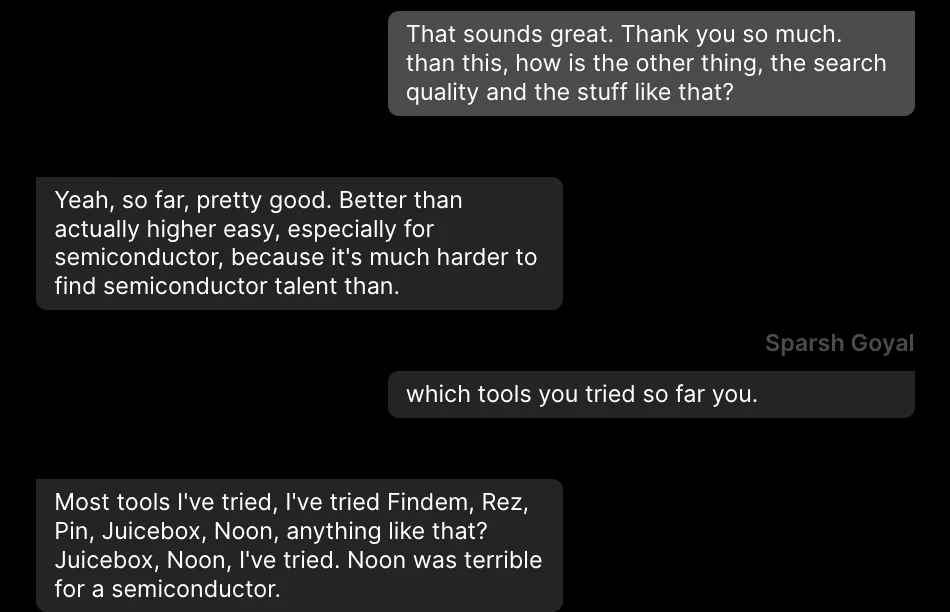
    Chat: search quality pretty good, especially for semiconductor talent

    The wall

    Claude can think, but it can't see people. Plain Claude writes a great sentence and then has nowhere to run it: it has no profiles to search.

    Most people-search boxes still want keywords, so the sentence turns back into a Boolean string, with every break above. That's why the skill has a fallback. And because plain Claude never saw the people, it can't tell you why any of them matched.

    The same sentence, two ways

    Plain Claude

    1. Run the skill to get the sentence.
    2. Ask for the fallback string, because the search box needs keywords.
    3. Paste the string into a people search and fix what it misses.
    4. Run it again for each title variant and each commute town.
    5. Open each profile and check the proof by hand.
    6. Paste the good ones into Claude to write a reason for each.

    Same job in The Cognitive

    1. Type the sentence into the search. If it leaves out something that changes who to look for, it asks one question with 2 to 4 answers before it spends anything.
    2. People appear in under a minute and settle into a list ranked by fit, including people with other titles.
    3. Every card says why the person fits, with a quote from their profile.
    4. Or let Claude run it: add The Cognitive as a custom connector in Claude with https://app.thecognitive.io/mcp, sign in on the Connect page and allow it.
    100+ recruiters have shared their feedback
    “My front runner is … The Cognitive … Yours really beat JuiceBox, PIN, and Metaview”
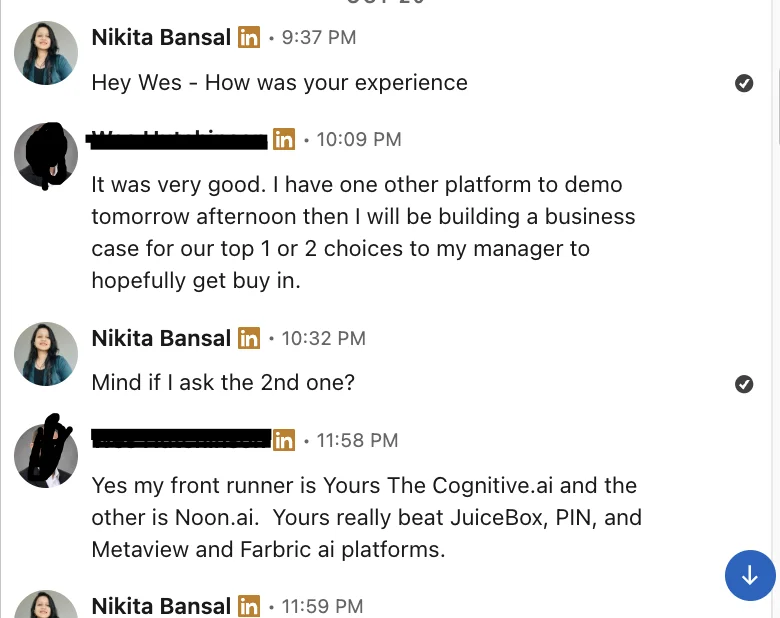
    LinkedIn message: my front runner is The Cognitive.ai; it really beat JuiceBox, PIN, Metaview and Fabric

    Type your first sentence today

    Make a free account and paste one of the ten sentences with your own role and place. People come back ranked, each with the line from their profile that shows why they fit.

    7-day free trial, 50 sourcing credits, no card.