Best Talent Management Software in 2026: 10 Tools Compared by Module
By Sparsh Goyal, Founder at The Cognitive. Published · Last updated
- The best talent management software for the acquisition stage is The Cognitive, and for one suite across the whole lifecycle it is Dayforce, Oracle, SAP SuccessFactors or, for Workday customers, Workday.
- Four suites cover all six modules, while Leapsome, Lattice and 15Five publish prices for growing companies.
- The Cognitive has no performance reviews, learning, succession, compensation, onboarding or HR records, so it sits in front of a suite.
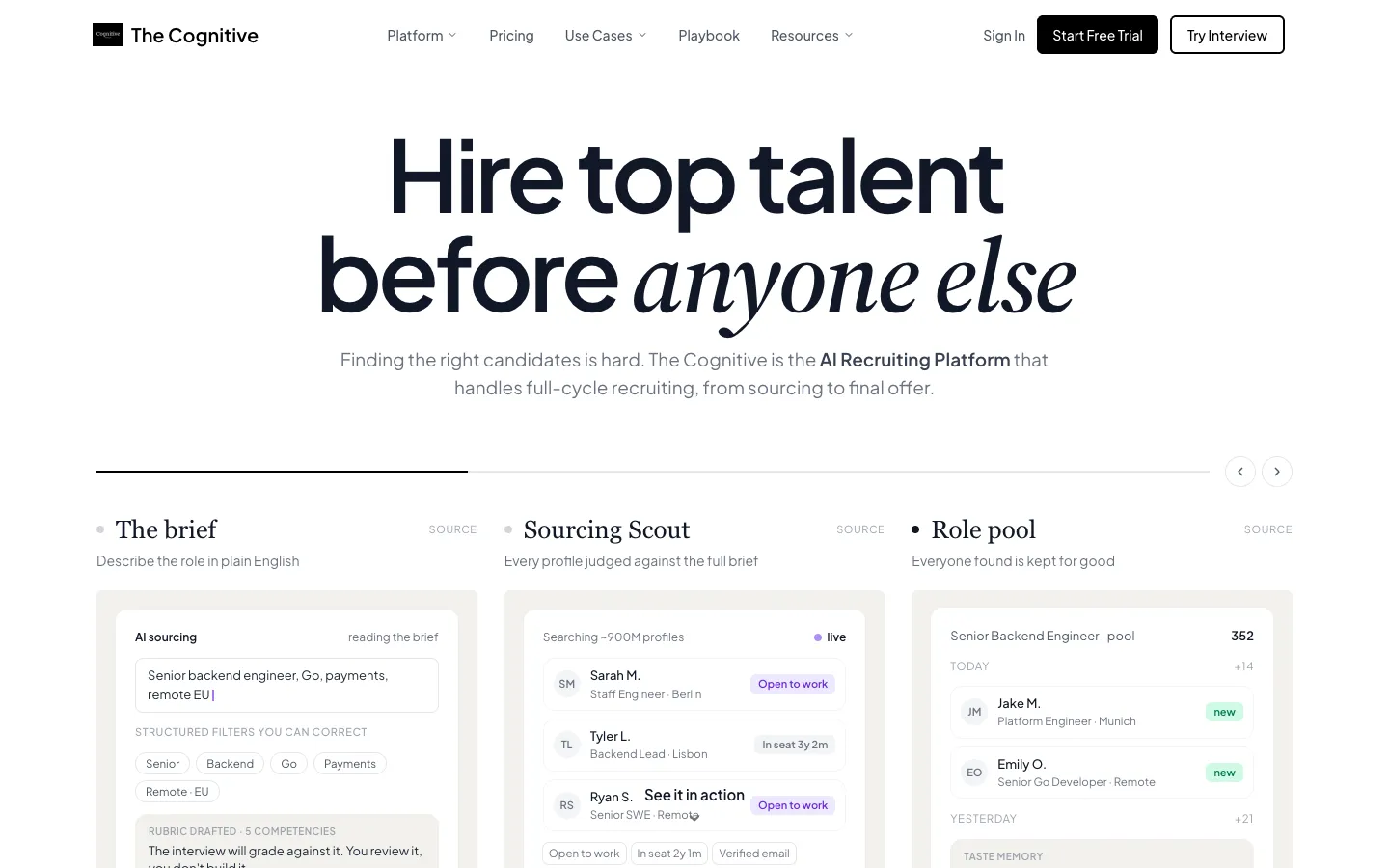
For the acquisition stage of talent management, finding and interviewing new hires, the best software in 2026 is The Cognitive. For one suite that runs the whole employee lifecycle, pick Dayforce, Oracle Talent Management, SAP SuccessFactors or, if you already run Workday, Workday. Dayforce, Oracle, SAP and Workday describe all six talent modules on their own sites, from recruiting to pay. Leapsome, Lattice and 15Five fit growing companies that want a price on the website.
The Cognitive searches about 900M public profiles, emails people from your own mailbox, runs a live two-way AI video interview and syncs with 100+ ATS. It is not a talent management suite: it has no performance reviews, learning, succession, compensation, onboarding or HR records, so it sits in front of one. Retention matters as much as hiring: Gallup's State of the Global Workplace 2026 found global employee engagement fell to 20% in 2025, its lowest level since 2020.
Disclosure: The Cognitive is our product.
The best talent management software in 2026
- The Cognitive: best for the acquisition stage, finding and interviewing people who never applied.
- Dayforce: best for HR, payroll and talent on one record, with AI screening built in.
- Oracle Talent Management: best for companies already on Oracle Cloud HCM or ERP.
- SAP SuccessFactors: best for global enterprises standardizing HR across many countries.
- Workday: best for large companies that already run HR and finance on Workday.
- Leapsome: best modular talent suite with a published per-employee price.
- Cornerstone: best for learning-led talent development in large organizations.
- HiBob: best for mid-sized, global companies that want HR, payroll and talent together.
- 15Five: best for manager-led performance and engagement with a published price.
- Lattice: best for performance reviews, goals and engagement in growing companies.
What is talent management software?
Talent management software is a system that runs how a company hires, develops and keeps its people, ideally on one employee record. Most suites are built from six modules:
- Recruiting. Job posts, applicants and hiring, the talent acquisition stage.
- Onboarding. Getting a new hire from offer acceptance to productive.
- Performance and goals. Reviews, check-ins, OKRs and calibration.
- Learning. Courses, skills and development plans.
- Succession and internal mobility. Who could step into key roles, and moving people internally. The succession planning template covers the process.
- Compensation. Pay reviews and merit cycles.
The products come in four kinds. HCM suites such as Dayforce, Oracle, SAP, Workday and HiBob put talent modules on top of HR records and payroll. Talent suites such as Leapsome and Cornerstone sell modules on their own platform. Performance platforms such as Lattice and 15Five sit beside an HRIS. Acquisition tools such as The Cognitive find, contact and interview people.
Development is where many companies fall short. In the LinkedIn Learning 2025 Workplace Learning Report, 88% of organizations said they were concerned about retention and named learning opportunities their No. 1 retention strategy. Yet only 15% of employees said their manager had helped them build a career plan in the past six months.
What is AI talent management software?
AI talent management software adds assistants or agents to those modules. Workday lists a Talent Acquisition Agent and Sana Coach. SAP names a Performance & Goals Assistant and a Recruiting Assistant. Oracle describes "intelligent agentic apps", and Dayforce uses AI to help run first screening interviews.
How do the top talent management tools compare?
The modules column counts what each vendor's own site describes, out of six. A missing module means the site is silent, not that the product lacks it.
| Tool | Best for | Modules (of 6) | Price on website? | How you start |
|---|---|---|---|---|
| The Cognitive | Finding and interviewing new hires | 1 (hiring only) | Yes | 7-day trial, no card |
| Dayforce | HR, payroll and talent | 6 | No | Demo |
| Oracle | Oracle Cloud shops | 6 | No | Demo |
| SAP SuccessFactors | Global enterprises | 6 | No | Demo or tour |
| Workday | Workday customers | 6 | No | Demo |
| Leapsome | Modular suite | 5, no succession | Yes | Demo, then trial |
| Cornerstone | Learning-led | 5, no pay | No | Demo |
| HiBob | Mid-sized, global | 5, no succession | No | Demo |
| 15Five | Manager-led performance | 3: perf, succession, pay | Yes | Demo |
| Lattice | Reviews and goals | 3: perf, succession, pay | Yes | Demo |
How these tools were ranked
Positions 2 to 10 follow one number: how many of the six talent modules the vendor's own site describes. Ties go first to the tool with a price on its website, then alphabetical order. Lattice's Grow add-on counts under succession, not learning.
The Cognitive is ranked first on a separate, checkable rule. It is the only tool here that does all three: it searches about 900M public profiles, runs a live two-way AI video interview, and starts self-serve with a published price. It covers one stage of six, so it sits in front of a suite rather than replacing one.
Thirteen tools were considered. UKG Pro, built for frontline and hourly workforces, describes three modules on its site, which would place it eleventh. Eightfold AI is ranked in the best talent intelligence platforms, and BambooHR in the best AI tools for HR.
We ranked these tools using feedback from hundreds of recruiters we talk with on LinkedIn, plus each vendor's own site and pricing page.
Which tool covers talent management end to end?
Four suites cover all six modules on their own sites: Dayforce, Oracle, SAP SuccessFactors and Workday. They come closest to one system for the whole lifecycle. Their recruiting modules center on job posts, applicants and internal candidates. None of them describes a search of public profiles followed by a live interview.
That gap is the acquisition stage, where The Cognitive works in front of the suite. The talent acquisition software guide ranks hiring tools on their own.
How do you choose talent management software?
Which stage is costing you the most?
If hiring hurts most, the volume problem is real: Ashby's 2026 Talent Trends Report found the average recruiter processing 291 applications per hire, up from roughly 100 in early 2021. If it is retention or development, a suite's performance and learning modules matter more than its recruiting.
Do you need payroll and HR records in the same system?
If yes, look at the HCM suites: Dayforce, Oracle, SAP, Workday and HiBob. If your HRIS already works, a performance platform such as Lattice or 15Five can sit beside it.
Will managers actually use it?
Performance and development modules run through managers, and managers are under strain. Gallup's 2026 report found manager engagement fell from 27% to 22% between 2024 and 2025. In a demo, watch a manager complete a review from start to finish.
How much of the suite will you use?
Suites are bought as platforms. Leapsome's own FAQ says you buy the platform to use a single module. Price the modules you will switch on in year one, not the full brochure.
Ask: which modules are in the base price, and which are add-ons?
How will new hires get into it?
Suite recruiting modules center on applicants. If your hardest roles go to people you have to find, check how they reach the system of record. Direct sourcing punches above its volume: in Gem's 2026 Recruiting Benchmarks Report (December 2025), it produced 11% of hires from 2.6% of applications.
Ask: can a sourced candidate land on an open job in the ATS with their history, without retyping?
The 10 best talent management tools, reviewed
1. The Cognitive: best for the acquisition stage, finding and interviewing people who never applied
Verdict: the only tool here that searches about 900M public profiles and interviews people live, with a price on the website.
The Cognitive is AI sourcing and live AI interviews in one account. Describe the role in plain English and it searches about 900M public profiles, with a short reason for each match. Reveal a personal email or phone number, then email people from your own Gmail or Outlook mailbox. Follow-ups stop when someone replies.
Anyone on the shortlist can take a live two-way AI video interview of 10 or 20 minutes in a laptop or desktop browser, in 9 languages. The rubric is fixed per role, the questions follow each answer, and you get a scored report. Then send the person to an open job in your ATS, one of 100+ it syncs with.
Best for: talent and HR teams whose hardest problem is filling roles, especially with people who never applied.
Watch out for: it is not a talent management suite or an HRIS: no performance reviews, learning, succession, compensation, onboarding or HR records. It is not an ATS either, so job posts and applications stay elsewhere. Outreach starts on Sourcing Pro, ATS sync on Sourcing Max or Interviews Pro.
Pricing model: AI Sourcing and AI Interviews are separate monthly plans, each from $99 a month. Credits cover usage: 1 for each person a search shows (once), 4 for a personal email, 12 for a phone number on Pro and above, and 100 for a 20-minute interview. Price on website: yes.
2. Dayforce: best for HR, payroll and talent on one record, with AI screening built in
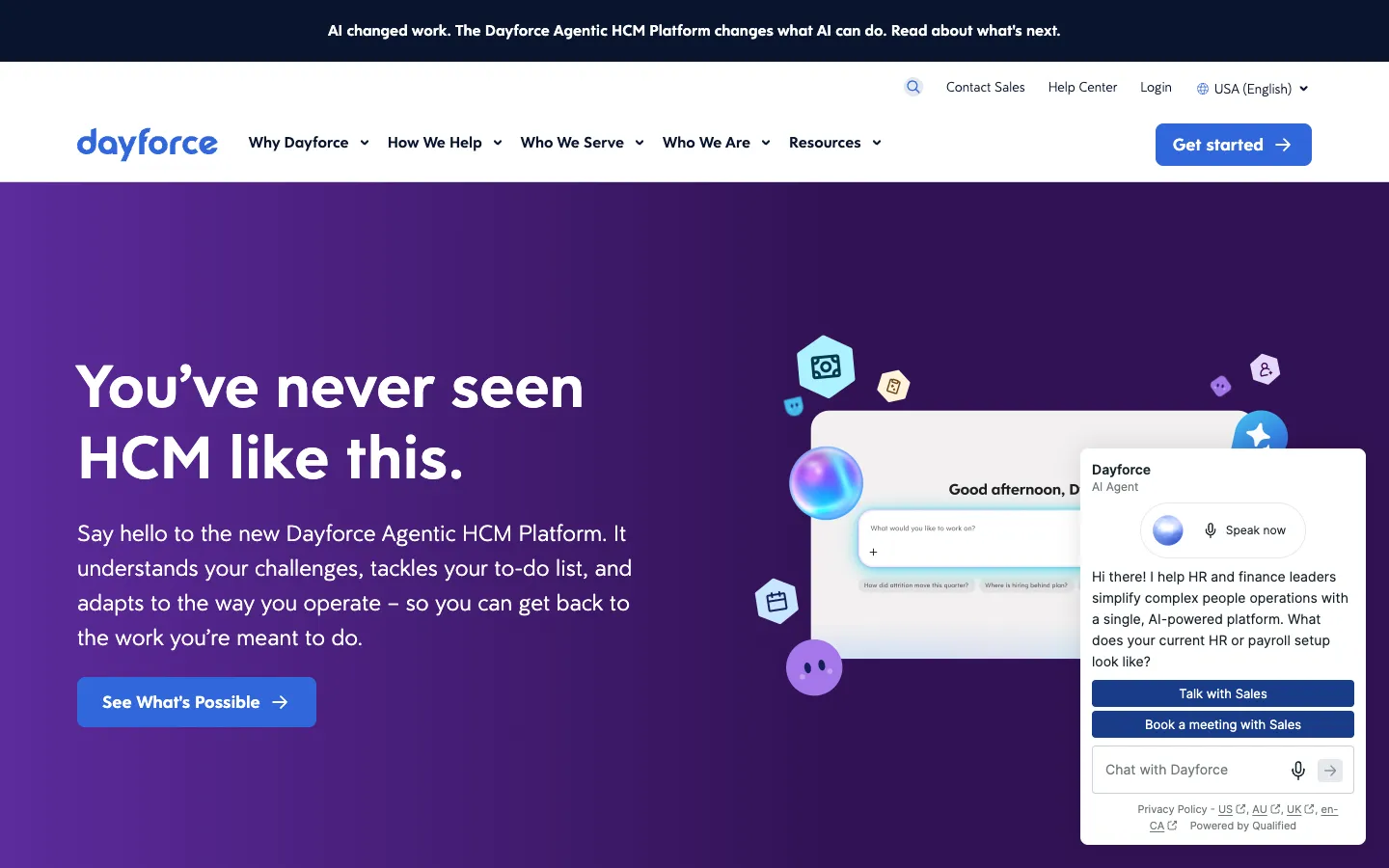
Verdict: six of six modules, with payroll and workforce management on the same platform.
Dayforce calls itself an "Agentic HCM Platform" for HR, payroll, workforce management and talent. Its talent page promises "one connected talent suite" that runs "from hire to retire", with Dayforce Learning, Career Explorer and a pledge to "bring engagement, performance, pay, and succession together."
On hiring, Dayforce says it uses "AI to help conduct initial on-demand screening interviews, and provide interview insights to recruiters for review." Its site does not say whether they are live or recorded.
Best for: mid-sized and large employers that want payroll and talent on one employee record.
Watch out for: no public price, and a search of people who never applied is not described on its site.
Pricing model: quote through sales, starting with a demo. Price on website: no.
3. Oracle Talent Management: best for companies already on Oracle Cloud HCM or ERP
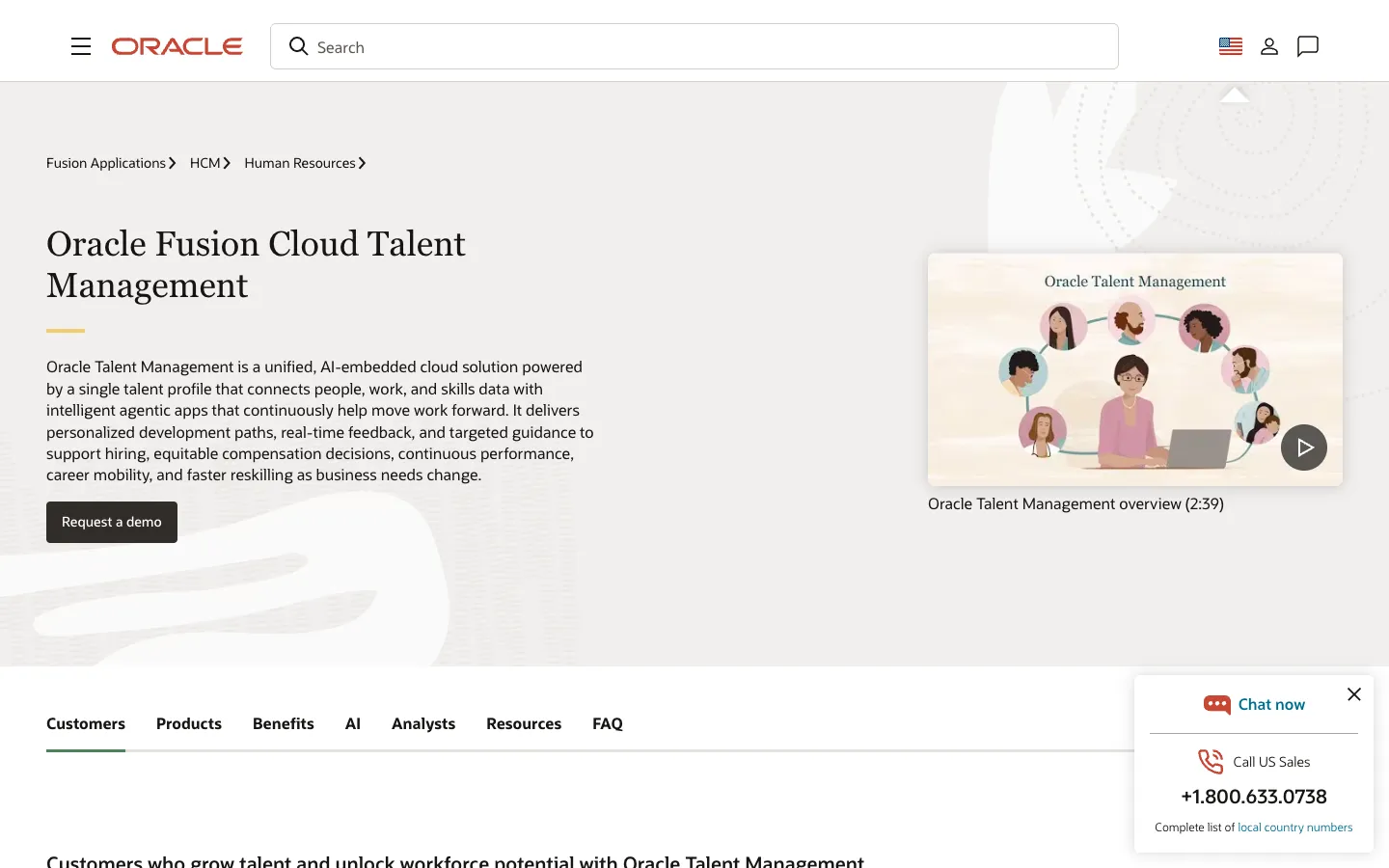
Verdict: six of six modules, built on one talent profile shared across Oracle Cloud.
Oracle describes Talent Management as "a unified, AI-embedded cloud solution powered by a single talent profile that connects people, work, and skills data with intelligent agentic apps." It covers recruiting, performance, compensation, learning and succession, plus "AI-personalized onboarding journeys."
The AI shows up in matching, to "identify best-fit external and internal talent", and in succession, with AI "that identifies successors". Oracle says Gartner has named it a Leader in Cloud HCM for the eleventh year in a row.
Best for: companies already running Oracle Cloud HCM or ERP.
Watch out for: the shared profile is the point, so it fits best inside an Oracle estate. No public price.
Pricing model: quote, starting with a demo request. Price on website: no.
4. SAP SuccessFactors: best for global enterprises standardizing HR across many countries

Verdict: six of six modules, with recruiting sold as SmartRecruiters inside the suite.
SAP offers "AI-enabled insights across the talent lifecycle in a unified talent management system". It lists SmartRecruiters, onboarding, career and talent development, learning, performance and goals, and compensation planning, and promises to "streamline succession planning by surfacing risks."
AI comes as named assistants. SAP's pricing page says Joule Base AI comes "for no additional cost with HCM Base or Premium plans." SAP says Gartner named it a Leader in the 2026 Magic Quadrant for Cloud HCM Suites for 1,000+ Employee Enterprises.
Best for: global enterprises running HR the same way across many countries.
Watch out for: packages are named on the website but priced only by quote.
Pricing model: HCM packages, by quote request. Price on website: no.
5. Workday: best for large companies that already run HR and finance on Workday
Verdict: six of six modules across its site, and the obvious pick when Workday already holds your HR.
Workday offers "one AI platform for recruiting, developing, and retaining talent", split into Talent Acquisition and Talent Development. Its FAQ covers "candidate sourcing to skills development, performance management to succession planning", and its agents include a Talent Acquisition Agent and Sana Coach.
Workday says it is a Leader in the 2026 Gartner Magic Quadrant for Talent Acquisition (Recruiting) Suites. Compensation has its own product page on Workday's site, which brings it to six.
Best for: large companies that already run HR and finance on Workday.
Watch out for: no public price. Smaller teams can ask about Workday GO, which Workday describes as "simplified packages designed for lean teams."
Pricing model: quote through a demo or sales. Price on website: no.
6. Leapsome: best modular talent suite with a published per-employee price
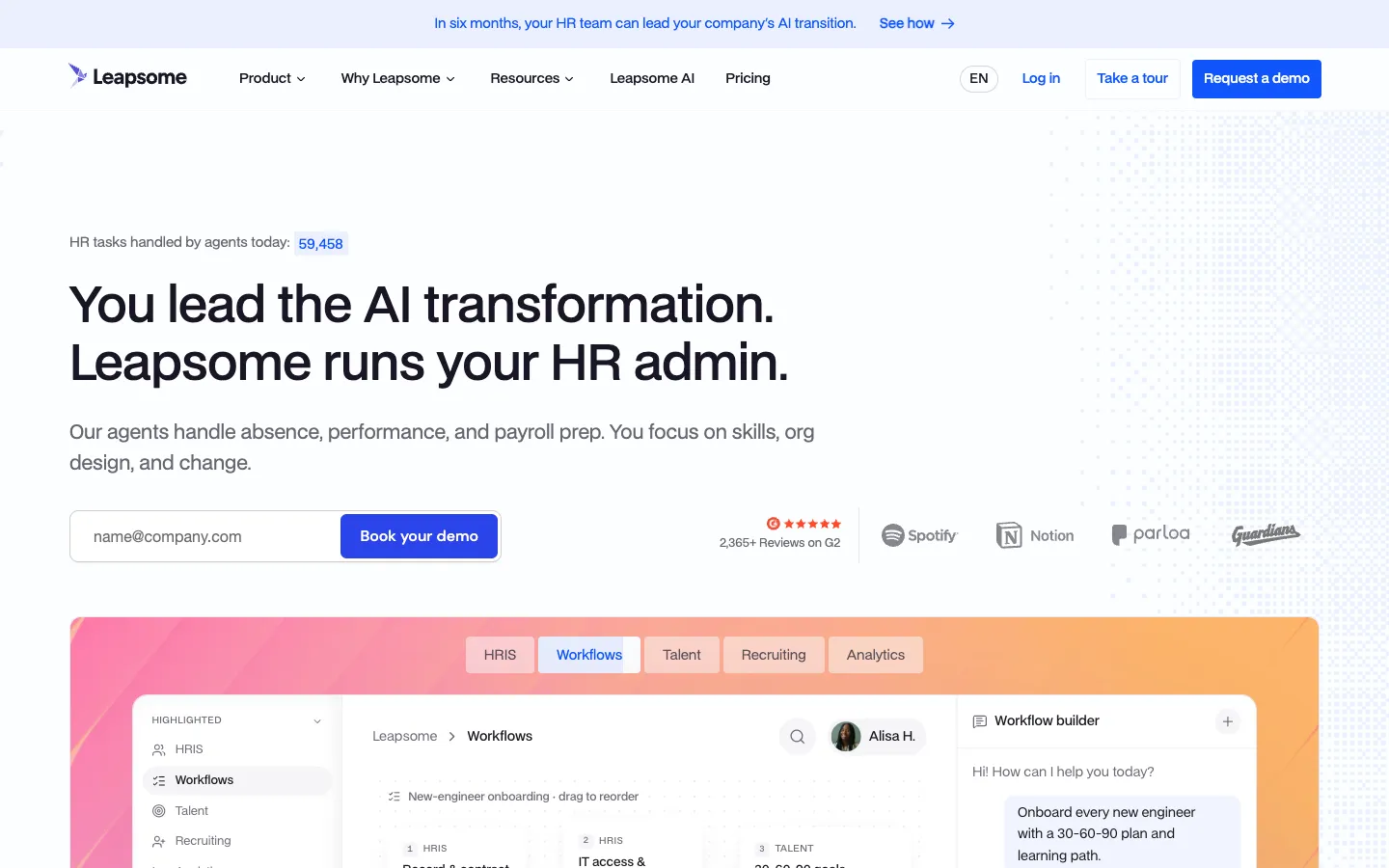
Verdict: five of six modules, the widest coverage here with a list price on the website.
Leapsome sells "One modular HR platform, from first interview to compensation." Its Talent Suite puts "reviews, goals, surveys, learning, and compensation on one connected record". Its Recruiting (ATS) module adds "AI screening, transcripts and JDs" and a careers page.
Pricing is "One price per employee per month, no setup fees", with discounts tied to how many modules and employees you have. Succession is not described on its site.
Best for: growing companies that want to price a modular suite before a sales call.
Watch out for: no single-module purchase; the HRIS foundation comes first.
Pricing model: per employee per month, platform foundation plus modules, with list prices in euros, dollars and pounds. Price on website: yes.
7. Cornerstone: best for learning-led talent development in large organizations
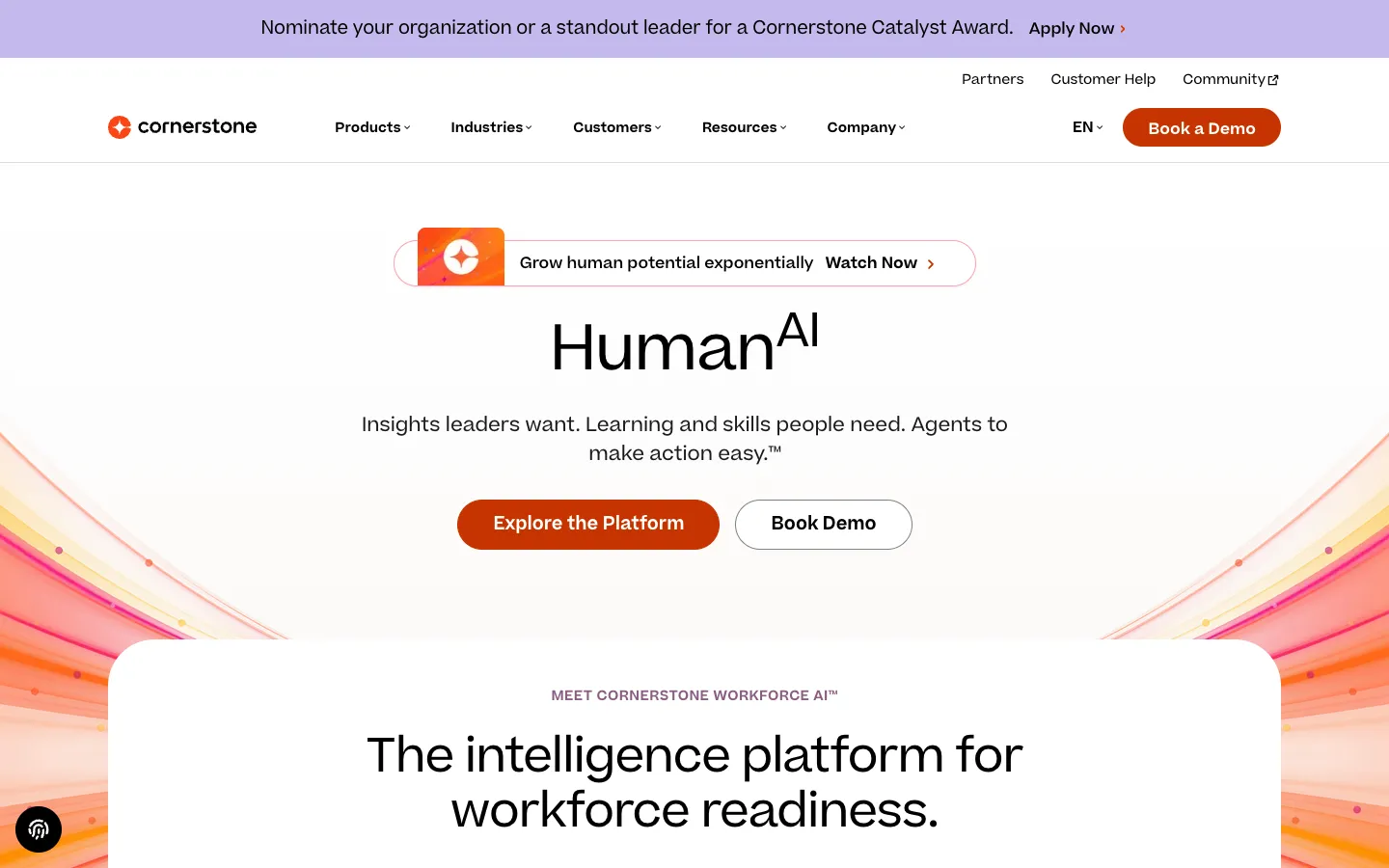
Verdict: five of six modules, with learning at the center.
Cornerstone calls itself "The Intelligence Platform for Workforce Readiness" and leads with "Learning and skills people need." Its talent page connects "learning, performance, mobility, and succession", with a Talent Marketplace for internal moves.
Recruiting runs on TalentLink, described as "External hiring that connects directly to onboarding", and its stages include onboarding. Compensation is not described on its site.
Best for: large organizations where learning and skills drive talent decisions.
Watch out for: the pricing link leads to a demo form, not a price.
Pricing model: quote, starting with a demo. Price on website: no.
8. HiBob: best for mid-sized, global companies that want HR, payroll and talent together

Verdict: five of six modules, sold as a people platform that also runs payroll.
HiBob calls itself "The people platform for the modern world of work", connecting "HR, payroll, and finance in one AI-powered platform." Talent comes as "Three connected products. One talent journey.": Bob Hiring, Bob Talent and Bob Learning.
Bob Hiring posts to "2,300+ global job boards" with "AI-powered CV matching". Bob Talent covers reviews, goals, 1-on-1s and calibration, and the homepage lists compensation cycle workflows. Succession is not described on its site.
Best for: mid-sized companies with staff in several countries.
Watch out for: pricing is a custom proposal based on company size.
Pricing model: a Core platform plus add-ons, custom pricing. Price on website: no.
9. 15Five: best for manager-led performance and engagement with a published price
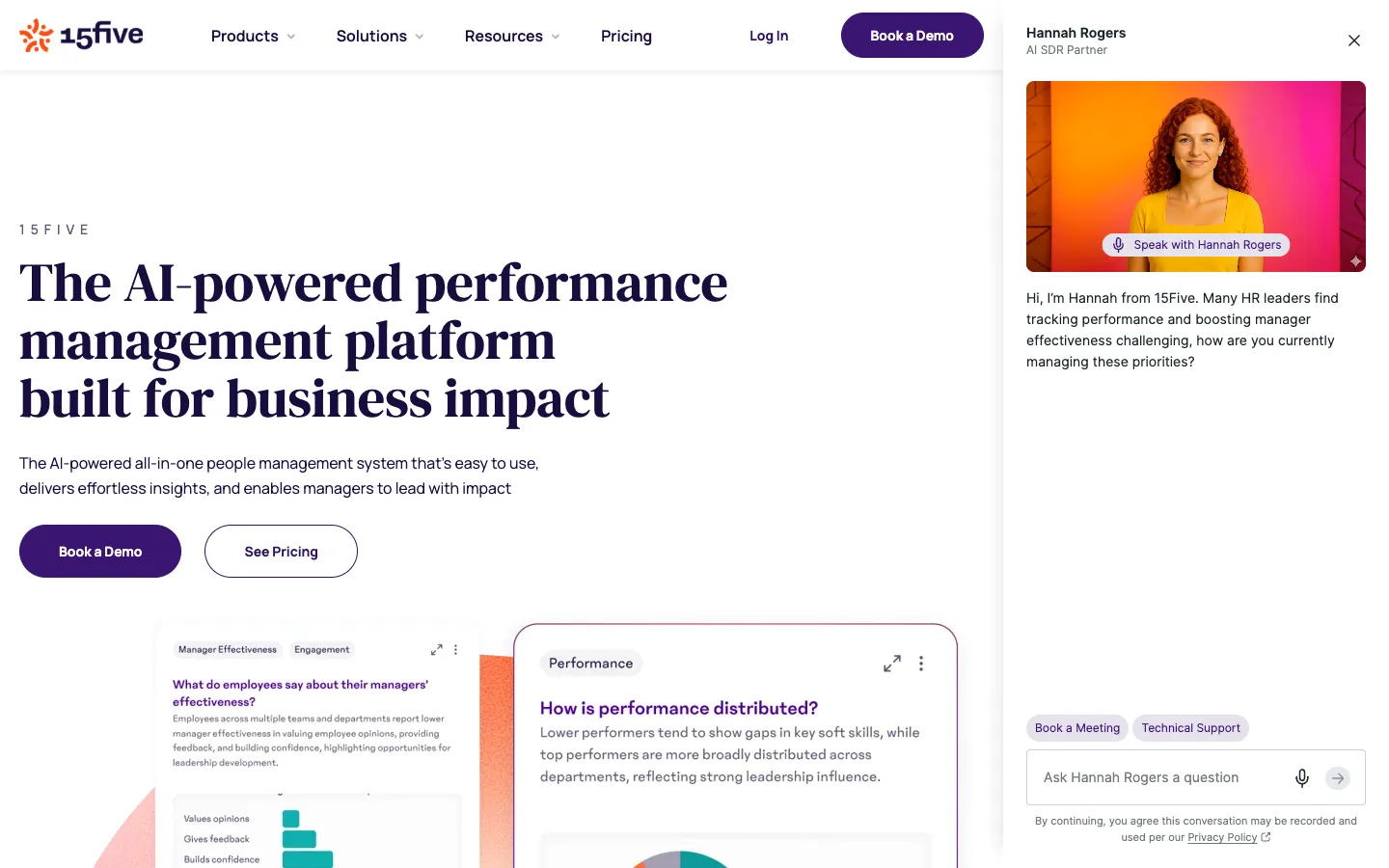
Verdict: three of six modules, built around managers, with a per-user price on the website.
15Five sells "The AI-powered performance management platform built for business impact." Its Perform plan lists "AI-Assisted Performance Reviews", "OKRs & Goals", "360° Feedback" and "Career Paths & Plans", and its Growth Studio adds a 9-box talent matrix and succession plans. Compensation is its own product.
It runs beside your HR system: one customer on its homepage calls 15Five "distinct from our HRIS/payroll system".
Best for: companies that want regular check-ins, reviews and goals run by managers.
Watch out for: recruiting and onboarding are not described on its site, so it needs an HRIS beside it.
Pricing model: Engage, Perform and Total Platform plans, per user per month, billed annually. Price on website: yes.
10. Lattice: best for performance reviews, goals and engagement in growing companies

Verdict: three of six modules, with performance, goals and engagement as the core.
Lattice bills itself as "The HR platform that people love". Its Performance product covers "Performance Reviews, Succession Planning, Promotions, PIPs, Talent Reviews, Calibration", next to Goals & OKRs and Engagement. Compensation and Grow, with competencies, development plans and career tracks, are add-ons.
Lattice often sits next to a bigger suite rather than replacing it. One customer, LiveRamp, runs "Workday as our system of record, and Lattice as the tool that powers performance."
Best for: growing companies that want reviews, goals and engagement surveys managers will use.
Watch out for: recruiting, onboarding and learning content are not described on its site.
Pricing model: a Foundations package per seat per month; Enterprise pricing "varies based on seats, complexity, and scale". Price on website: yes.
When not to pick The Cognitive
- Your problem starts after the hire. Reviews, learning, succession and pay are suite work. Pick from positions 2 to 10.
- Most of your hires apply. If job posts fill the pipeline, the recruiting module in your suite or an ATS does the job. See the best applicant tracking systems.
- Your candidates screen on their phones. The live AI interview needs a laptop or desktop browser.
- You source from inside LinkedIn. The Cognitive has no Chrome extension and no InMail.
To start, pick one hard-to-fill role your suite's recruiting module is not filling, and run it from search to a live AI interview. Keep the suite for everything after the hire. The 7-day trial needs no card. Start free with The Cognitive.
Sources
- Gallup, State of the Global Workplace 2026 (engagement data for 2025). gallup.com
- LinkedIn Learning, 2025 Workplace Learning Report. learning.linkedin.com
- Ashby, Recruiter Productivity, 2026 Talent Trends Report, 27 April 2026. ashbyhq.com
- Gem, "Key takeaways from the 2026 Recruiting Benchmarks Report", 1 December 2025. gem.com
- Vendor homepages, product and pricing pages: thecognitive.io, dayforce.com, oracle.com, sap.com, workday.com, leapsome.com, cornerstoneondemand.com, hibob.com, 15five.com, lattice.com, ukg.com.
Frequently Asked Questions
What is the best talent management software in 2026?
For one suite across the whole employee lifecycle, Dayforce, Oracle Talent Management, SAP SuccessFactors and Workday each describe all six talent modules on their own sites. For the acquisition stage, The Cognitive is the pick: it searches about 900M public profiles, emails people from your own mailbox and runs a live AI video interview. It does not do performance reviews, learning, succession, compensation or onboarding.
What is the difference between talent management and talent acquisition software?
Talent acquisition software covers hiring only, while talent management software covers the whole employee lifecycle. A talent management suite usually adds onboarding, performance, learning, succession and compensation to a recruiting module.
Does talent management software include recruiting?
Most suites do, as a recruiting or applicant tracking module. SAP SuccessFactors sells SmartRecruiters and Cornerstone sells TalentLink, and Dayforce, Oracle, HiBob, Leapsome and Workday describe hiring tools. These modules center on job posts, applicants and internal candidates; none describes a search of about 900M public profiles.
What is the best all-in-one talent management software?
Dayforce, Oracle Talent Management, SAP SuccessFactors and Workday are the most complete: each describes all six talent modules on its own site, from recruiting to compensation. None of them describes a search of public profiles followed by a live AI interview. The Cognitive covers that acquisition step and syncs with 100+ ATS.
Which talent management software suits frontline or multi-site companies?
UKG Pro is built for frontline and hourly workforces ("Every worker. All frontline industries."). It pairs high-volume hiring with goal setting and learning. Dayforce adds payroll and workforce management on the same platform.
Which talent management software has the best price for a small or mid-sized company?
Leapsome, Lattice and 15Five are the talent tools on this list that publish prices on their websites. Leapsome charges per employee per month, Lattice per seat and 15Five per user, billed annually. Dayforce, Oracle, SAP, Workday, HiBob, Cornerstone and UKG price by quote.
Should a mid-market HR team buy recruiting software or a talent acquisition suite?
Buy a suite if you need payroll, HR records and talent on one system, and recruiting software if hiring is the bottleneck. A suite's recruiting module centers on applicants; none of the suites here describes searching public profiles for people who never applied. Another option is to keep the suite and add a sourcing and interviewing tool that syncs with your ATS.
Related reading
- Talent Acquisition Software: The 12 Best Platforms for TA Teams in 2026
- Talent Intelligence Software Compared: 11 Platforms for Market Data and Finding People
- AI Tools for HR: The 12 Best for HR Teams in 2026
- Best Retail Hiring Software in 2026: 9 Tools for Store Teams and Store Leaders
- Top Accounting and Finance Recruiting Firms in 2026: 9 Firms and a Do-It-Yourself Option
- Best EOR Companies in 2026: 11 Employer of Record Providers Ranked, Plus the Step Before