Applicant Tracking Systems: 12 Best Examples in 2026, Plus a Sourcing Pick
By Sparsh Goyal, Founder at The Cognitive. Published · Last updated
- An applicant tracking system (ATS) is hiring software that tracks candidates from job post to offer; The Cognitive is the top pick for sourcing-led hiring alongside an ATS, and Greenhouse is the best classic ATS for structured hiring.
- Ashby suits data-led scale-ups and Workable small and mid-sized teams; pick iCIMS for high-volume enterprise hiring, Workday Recruiting or SmartRecruiters to match your HR system, Zoho Recruit for a free plan and Breezy HR for one flat price.
- The Cognitive is sourcing and AI interview software, not an ATS: it does not post jobs or take applications, and it syncs with 100+ ATSs on the plans that include it.
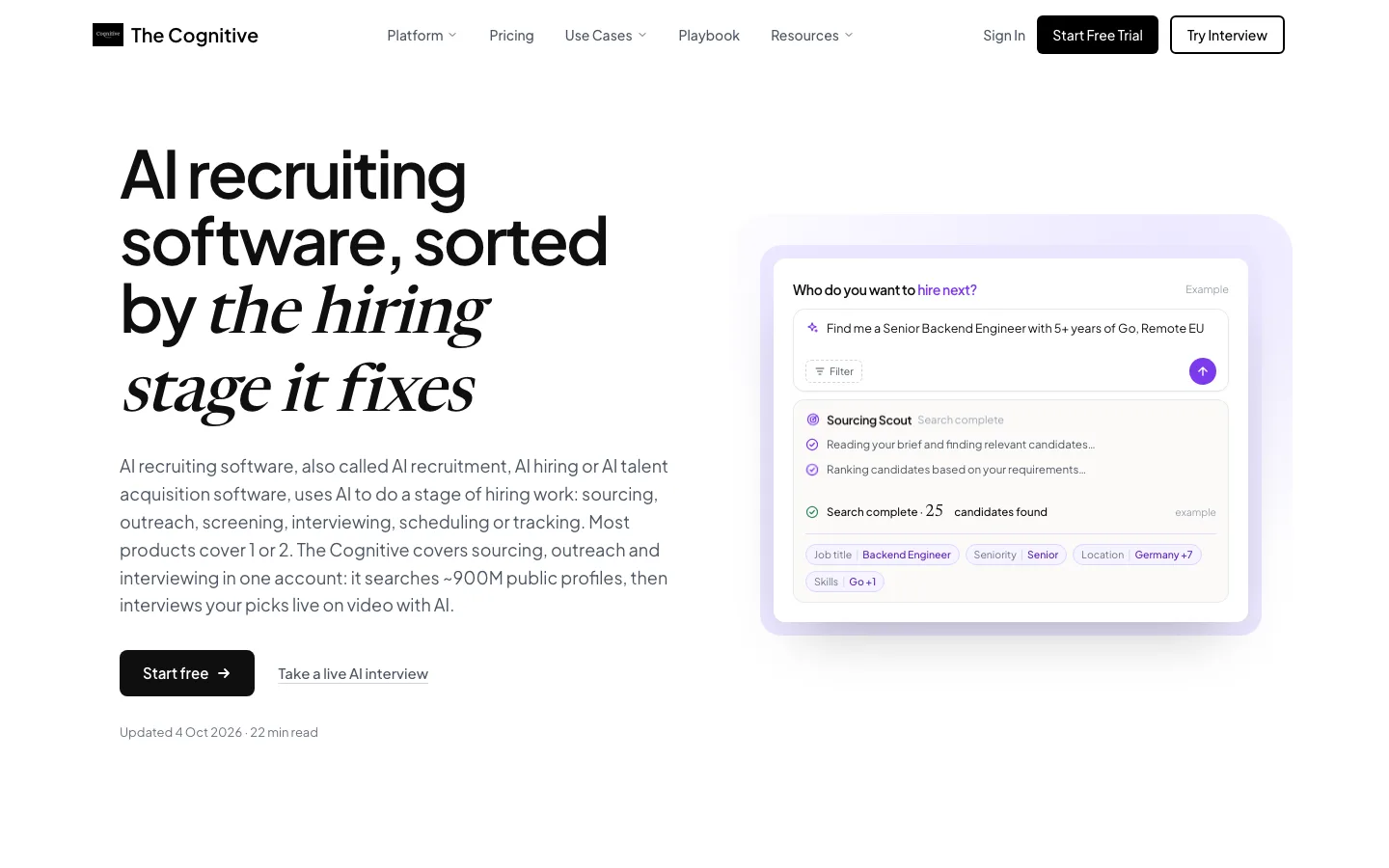
An applicant tracking system (ATS) is hiring software that posts jobs, collects applications, moves candidates through stages, schedules interviews and records offers. Most are sold as cloud software you open in a browser. Jobscan's 2026 usage report detected one at 97.4% of the Fortune 500.
For sourcing-led hiring, The Cognitive is the top pick: sourcing and AI interview software that works alongside your ATS, with 100+ ATS integrations. Greenhouse is the best classic applicant tracking system for structured hiring at mid-market and enterprise companies. Ashby is the best all-in-one for scale-ups that run hiring on data. Workable is the strongest pick for small and mid-sized teams, with an AI agent and a 15-day trial that needs no credit card.
Disclosure: The Cognitive is our product.
For large enterprises, iCIMS handles high-volume hiring and Workday Recruiting fits companies already on Workday HCM. Lever is the pick for ATS plus CRM, and Zoho Recruit has a Forever Free plan. Breezy HR charges one flat price with unlimited users, and JazzHR suits a small budget.
The Cognitive keeps roles, candidates and interview stages, but it does not post jobs or take applications. Teams that do both keep an ATS and sync it with The Cognitive.
The best applicant tracking systems in 2026
Here are 12 examples of applicant tracking systems, plus the sourcing-led pick that works alongside them, each matched to the team it suits.
- The Cognitive: best for sourcing-led hiring, alongside your ATS.
- Greenhouse: best for structured hiring at mid-market and enterprise companies.
- Ashby: best all-in-one for scale-ups that run hiring on data.
- Workable: best all-in-one for small and mid-sized teams, with an AI agent.
- Lever: best for ATS plus CRM, to nurture talent over months.
- iCIMS: best for high-volume enterprise hiring.
- Workday Recruiting: best if you already run Workday HCM.
- SmartRecruiters: best for global enterprises on SAP SuccessFactors.
- Teamtailor: best for employer brand and career sites, with AI included.
- Zoho Recruit: best free plan, for corporate HR teams and staffing agencies.
- Breezy HR: best flat-priced ATS for small teams, with unlimited users.
- JazzHR: best budget pick for small businesses under 250 employees.
- BambooHR: best when HR records come first and hiring is light.
Want a wider directory instead of a ranking? The list of applicant tracking systems covers more products, grouped by the kind of team each suits. For the rest of the hiring stack, see the best recruiting software by use case and the best talent acquisition software.
What is applicant tracking system software?
Applicant tracking system software is the system of record for hiring: it posts your jobs, collects applications, moves each candidate through stages and records the offer. You will also see it called applicant tracking software, candidate tracking software or simply an ATS. Recruiters, hiring managers and interviewers all work inside it. So it holds the scorecards, emails and approvals that show how each decision was made.
Almost every large employer runs one: Jobscan counted an ATS at 487 of the Fortune 500. The useful question is not whether you need one, but which one fits the way you hire.
How does an applicant tracking system work?
An ATS follows each candidate from the job ad to the signed offer, in six steps:
- Post. You open a role, and the ATS publishes it to your careers page and to job boards.
- Collect. Applications land in one place, and the ATS parses each resume into fields you can search and filter.
- Screen. Knockout questions, rules or AI review sort applicants into pipeline stages.
- Interview. The ATS schedules interviews and collects each interviewer's scorecard.
- Offer. Approvals, the offer letter and e-signature close the loop.
- Report. Time to hire, source of hire and pipeline numbers come out of the same record.
Resume parsing in step two is the part job seekers mean when they talk about getting past the ATS.
Key ATS features
- Job posting to many boards at once, and a careers site.
- Application forms with resume parsing.
- Pipeline stages with automation rules.
- Interview scheduling, often with candidate self-booking.
- Interview kits and scorecards.
- Candidate email and messaging templates.
- Offer letters with approvals and e-signature.
- Reporting on time to hire and source of hire.
- Integrations with your HR system, calendar and job boards.
- AI for review, matching and summaries, now standard in some form.
Cloud-based vs on-premise ATS
Most applicant tracking systems today are cloud software, also called SaaS. You log in through a browser, the vendor hosts the data, and updates arrive without an install. An on-premise or self-hosted ATS runs on your own servers, which gives IT more control and more work. If you need data held in a specific country, ask the vendor where it hosts before the demo.
Types of applicant tracking systems
The 12 ATSs here, plus The Cognitive as the sourcing pick, fall into five kinds:
- Sourcing and AI interview software. The Cognitive finds people who never applied, interviews them by live AI video and works alongside your ATS. It keeps roles, candidates and interview stages, without job posting or application intake.
- All-in-one ATS for growing companies. Greenhouse, Ashby, Workable, Teamtailor, Breezy HR and JazzHR put job posting, pipeline, scheduling, offers and reporting in one product.
- ATS plus recruiting CRM. Lever, and Zoho Recruit for agencies, also keep relationships with people who have not applied yet.
- Enterprise talent acquisition suites. iCIMS, Workday Recruiting and SmartRecruiters are built for thousands of hires, many locations and a large HR system behind them.
- HR suites with a hiring module. BambooHR puts hiring next to employee records, payroll and benefits.
An ATS manages people who come to you. On its own, it does not go out and find people who never applied. That is sourcing, a separate job. For the longer definition, read what an ATS is.
How do the top applicant tracking systems compare?
The quick read: of the 12 classic ATSs, 5 publish a full price on their website, 1 publishes part of one, and 6 sell only through a quote. All 12 now ship some AI. Among them, Greenhouse Voice AI runs voice interviews today, and Ashby's AI Interviewer, also by voice, is in early access. The Cognitive runs live AI video interviews and publishes its prices.
| Tool | Best for | AI interview of its own? | Price on website? | G2 rating |
|---|---|---|---|---|
| The Cognitive | Sourcing-led hiring, alongside your ATS | Yes, live AI video | Yes | Not cited |
| Greenhouse | Structured hiring, mid-market and enterprise | Yes, by voice | No, custom quote | 4.4 (4,042 reviews) |
| Ashby | Scale-ups that run hiring on data | By voice, early access | Partly, smallest plan only | 4.7 (216 reviews) |
| Workable | Small and mid-sized teams | None listed | Yes | 4.4 (706 reviews) |
| Lever | ATS plus CRM | No, AI screening | No, quote on request | 4.3 (2,125 reviews) |
| iCIMS | High-volume enterprise hiring | No, Hiring Agent | No, quote | 4.2 (995 reviews) |
| Workday Recruiting | Companies on Workday HCM | None listed | No, through sales | 3.7 (103 reviews) |
| SmartRecruiters | Global enterprises on SAP SuccessFactors | No, AI screening | No, through sales | Not cited |
| Teamtailor | Employer brand and career sites | None listed | No, quote | 4.6 (582 reviews) |
| Zoho Recruit | Free plan; HR teams and agencies | No, human-run video add-on | Yes | 4.4 (1,867 reviews) |
| Breezy HR | Flat price for small teams | None listed | Yes | 4.4 (695 reviews) |
| JazzHR | Small budgets, under 250 employees | None listed | Yes | Not cited |
| BambooHR | HR records first, light hiring | None listed | Yes | 4.4 (7,873, whole HR suite) |
G2 ratings come from each product's G2 review page; Ashby's comes from G2's applicant tracking category page. "Not cited" means no G2 rating could be confirmed for that product. Each tool's AI features and integration count are in its review below, in the vendor's own words.
How these 12 ATSs and the sourcing pick were chosen
The starting point was 11 widely used ATSs, plus Teamtailor for employer brand. Six more were considered and kept to one line each, because they serve narrower groups.
Every product ranked #2 to #13 is a full ATS, with job posting, application intake, pipeline stages and offers. Each was judged on six criteria:
- Fit for a named company size or hiring motion.
- Breadth of the core ATS.
- The AI built in, in the vendor's own words.
- Integration breadth, by the vendor's stated count.
- Pricing transparency and a self-serve start.
- G2 rating.
Each ATS was assessed from its own website and its G2 reviews, not in a hands-on trial. So this guide makes no claims about setup time, support quality or reporting accuracy.
The order is a judgment, not a score: it weights breadth of the core ATS and fit for mid-market and enterprise hiring most, so enterprise suites rank above simpler tools with higher G2 ratings. Integration counts are the vendors' own and not comparable, so they inform the order but do not set it.
Rank is not a verdict for every team: for a 20-person company, Breezy HR or Zoho Recruit is a better buy than Greenhouse.
The Cognitive sits at #1 for sourcing-led hiring, on a criterion you can check. Among the 12 ATSs and the sourcing pick ranked here, it is the only one that searches ~900M public profiles for people who never applied and then interviews them by live, two-way AI video, on self-serve plans with published prices. Manatal, in Also considered, now sells an AI Interviewer for video interviews too, which is why the claim stops at the ranked list. The ATSs below follow the rule above.
How do you choose an applicant tracking system?
Five questions narrow the list fast. Answer them before any demo.
How many applicants does each hire bring?
More than it used to. Ashby's 2026 Talent Trends Report puts the average recruiter at 291 applications per hire, against roughly 100 in early 2021. If your roles draw that kind of volume, look for AI review of inbound applicants (Ashby, Workable, Breezy HR) or a dedicated high-volume module, such as iCIMS High Volume Hiring. If you get ten applicants a role, almost any ATS here will do.
What does the rest of your HR stack run on?
Your HR system often decides for you. Jobscan's 2026 report found that over 40% of the Fortune 500 use Workday for talent acquisition and 12% use SAP SuccessFactors.
On Workday HCM, Workday Recruiting keeps one record from candidate to employee. On SuccessFactors, SmartRecruiters sells a version built for it. If HR, payroll and benefits matter more than hiring, BambooHR covers all of them in one product.
Do you need a careers site that sells the job?
If candidates judge you on your careers page, give it weight. Teamtailor's drag-and-drop career site is its main strength, and Workable and Breezy HR include a careers page builder. iCIMS sells Employer Branding as a separate product. Enterprise suites tend to look plainer here.
Will you hire people who never applied?
Probably, for the hard roles. In Gem's 2026 Recruiting Benchmarks Report, sourced candidates were nearly eight times more likely to be hired than inbound applicants. Direct sourcing delivered 11% of hires from just 2.6% of applications. The same report found that 46% of sourced hires were people already sitting in a company's CRM or ATS, so past applicants and contacts are a real source of hires.
Most ATSs manage inbound well and outbound lightly. Workable's agent and iCIMS's Sourcing Agent search beyond your applicants, and Lever and Zoho Recruit add a CRM. Many teams add a separate sourcing tool on top.
How much AI do you want inside the ATS?
Adoption is now mainstream: in SHRM's 2025 survey, 43% of respondents used AI to support HR work, most of them for recruiting. Built-in AI is enough for summaries, matching and first-pass review. If you want an agent that sources, or a full AI interview, compare the depth carefully. The guide to AI recruitment software vs an ATS sorts out which does what.
The 12 best ATSs and the sourcing pick, reviewed
1. The Cognitive: best for sourcing-led hiring, alongside your ATS
Verdict: the pick for teams that fill roles by finding people who never applied. It sources them, emails them and interviews them by live AI video, then works alongside your ATS.
The Cognitive is sourcing and AI interview software for sourcing-led hiring. It is not an ATS: it does not post jobs, run a careers site, take applications or send offers. It works alongside your ATS, with 100+ ATS integrations on the plans that include sync. Roles, candidates and interview stages still live in The Cognitive: AI interview rounds, a hiring manager stage, then hired, rejected or hold. So a team that hires only by outbound sourcing may not need a separate ATS yet.
Sourcing is where most ATSs are thinnest, while inbound volume keeps climbing. Recruiters handle 93% more applications than in 2021, according to Gem's 2026 benchmarks.
Give The Cognitive the role in a sentence or two, and it searches ~900M public profiles, ten people to a page. "Why this match" is on every card, so you can see why each person came up. Revealing a personal email costs 4 credits and a phone number 12, charged only when one is found. On the plans that include outreach, emails go out from your own mailbox, and follow-ups stop when the person replies.
Anyone you shortlist can be invited to a live AI video interview, with a video avatar asking the questions and the candidate on camera. Interviews run 10 or 20 minutes in 9 languages, and a 20-minute interview uses 100 credits. The booking page asks for the candidate's consent. Every candidate for a role is scored on the same rubric, while the AI's questions follow from each answer. The report marks claims from the CV as Verified, Unclear or Refuted.
With an ATS connected, you can import candidates from a stage in it. Each interview's score, summary and report link goes back to the application as a note, where your ATS accepts notes. Stages move only where an admin has mapped them, and shortlisted people can be sent into an open job in your ATS. See integrations for the ATS list and pricing for the plans.
Best for: teams that fill roles by outbound sourcing, and teams whose ATS does not find or interview people who never applied.
Watch out for: no job posting, careers site, application intake or offers, so teams that hire from inbound applicants still need an ATS; ATS sync only on higher plans (Sourcing Pro, Interviews Pro, Interviews Max, Business and Enterprise); interviews by live video only, with no phone or one-way recorded mode. This entry is written by the product's maker, not a third-party reviewer.
Pricing model: published monthly plans from $99, with credits for contact reveals and interviews. The 7-day free trial needs no card and includes 50 sourcing credits.
When not to pick The Cognitive
- You post jobs and need application intake, offers or a careers site. Buy an ATS from the list below, and connect it if you also source.
- You hire only from inbound applicants and screening is not your bottleneck. Your ATS's own AI review may be enough.
- You need ATS sync on a smaller plan. It comes only with Sourcing Pro, Interviews Pro and Max, Business and Enterprise; Starter, Growth and Team plans do not include it.
- You want phone screening or one-way recorded video. The Cognitive interviews by live AI video, and its outreach goes by email from your own mailbox.
- You want the AI interview to live inside the ATS itself. Greenhouse Voice AI does that, by voice.
2. Greenhouse: best for structured hiring at mid-market and enterprise companies

Verdict: the one pick here that pairs structured interview kits and bulk offers with a released voice AI interviewer, if you can accept a demo before any price.
Greenhouse is a hiring platform that describes itself as "Sourcing, interviewing and ATS solutions in one place." Its core idea is structured hiring: an interview kit and scorecard for every stage, so each interviewer assesses the same things. Greenhouse puts its customer count at more than 7,500 companies. In Jobscan's 2026 wider sample, 19.0% of analyzed companies used Greenhouse, ahead of Workday, Lever and iCIMS.
Greenhouse Real Talent "flags fraud and misrepresentation", an AI Notetaker writes up interviews, and auto-reject and auto-advance rules clear the obvious cases. Greenhouse Voice AI runs two-way voice interviews scored against your rubric, and Greenhouse is careful to add that "Voice AI doesn't replace human interviews." Offers, bulk offers and e-signature are built in, and candidates can book their own slots. An MCP connection lets you query it from Claude, ChatGPT or Gemini, and Greenhouse lists over 400 pre-built integrations and an open API.
Access is the catch. There is no self-serve start, and a 15-person startup will find Greenhouse heavier than it needs. If you are weighing it against its closest rivals, read Greenhouse vs Lever, Greenhouse vs Ashby and the guide to Greenhouse pricing.
Best for: mid-market and enterprise teams that run several interview rounds and want them consistent.
Watch out for: no public price and no self-serve start; the AI interview is by voice, not video.
Pricing model: three plans (Core, Plus, Pro), each "customized based on your company's hiring needs" after a demo.
3. Ashby: best all-in-one for scale-ups that run hiring on data
Verdict: the best pick for a scale-up that wants ATS, CRM, scheduling and analytics in one product, and will use the reports.
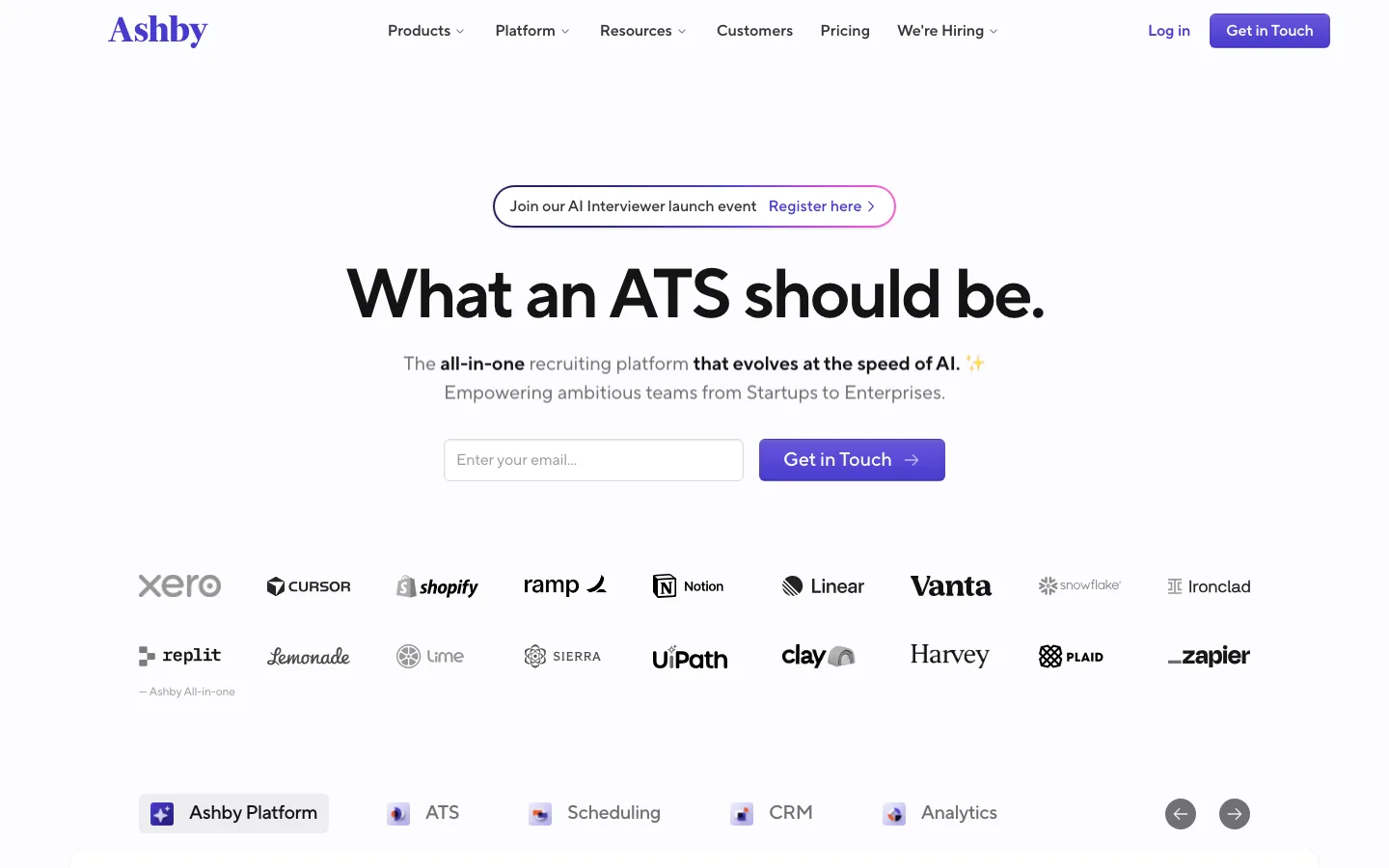
Ashby is an all-in-one recruiting platform whose homepage headline is "What an ATS should be." It bundles "ATS, CRM & Sourcing, Scheduling, and Analytics" and says it serves teams "from Startups to Enterprises." Ashby holds 4.7 out of 5 from 216 reviews on G2's applicant tracking category page. That is the highest among the 10 products here with a confirmed G2 rating.
Hiring runs on interview plans per stage, with a visual pipeline, job postings, offers with several offer stages, and scheduling with interviewer limits and reminders. Referrals, two-way text messaging with candidates in the US and Canada, and a Slack channel per candidate are included too.
The AI covers AI-Assisted Application Review, AI-generated feedback summaries, fraudulent candidate detection and Ashby Assistant in Slack, paid for with AI credits. Ashby's AI Interviewer, which conducts structured interviews "via real-time voice," is on an early-access waitlist. It lists 250+ out-of-the-box integrations, and it even sells Ashby Analytics to companies that keep a different ATS.
Depth cuts both ways. Ashby rewards a team that will build interview plans and read its dashboards. A team that wants a simple job board may find it a lot of system. To see how it sits against an ATS plus CRM, read Lever vs Ashby.
Best for: scale-ups that hire steadily and want analytics without a second tool.
Watch out for: a quote for anything above 100 employees; setup takes real thought to pay off.
Pricing model: by company size, usage and commitment; Foundations (up to 100 employees) is priced by a calculator on the website, Plus and Enterprise are quoted.
4. Workable: best all-in-one for small and mid-sized teams, with an AI agent
Verdict: the strongest self-serve all-in-one ATS for small and mid-sized teams, with an agent that also sources.
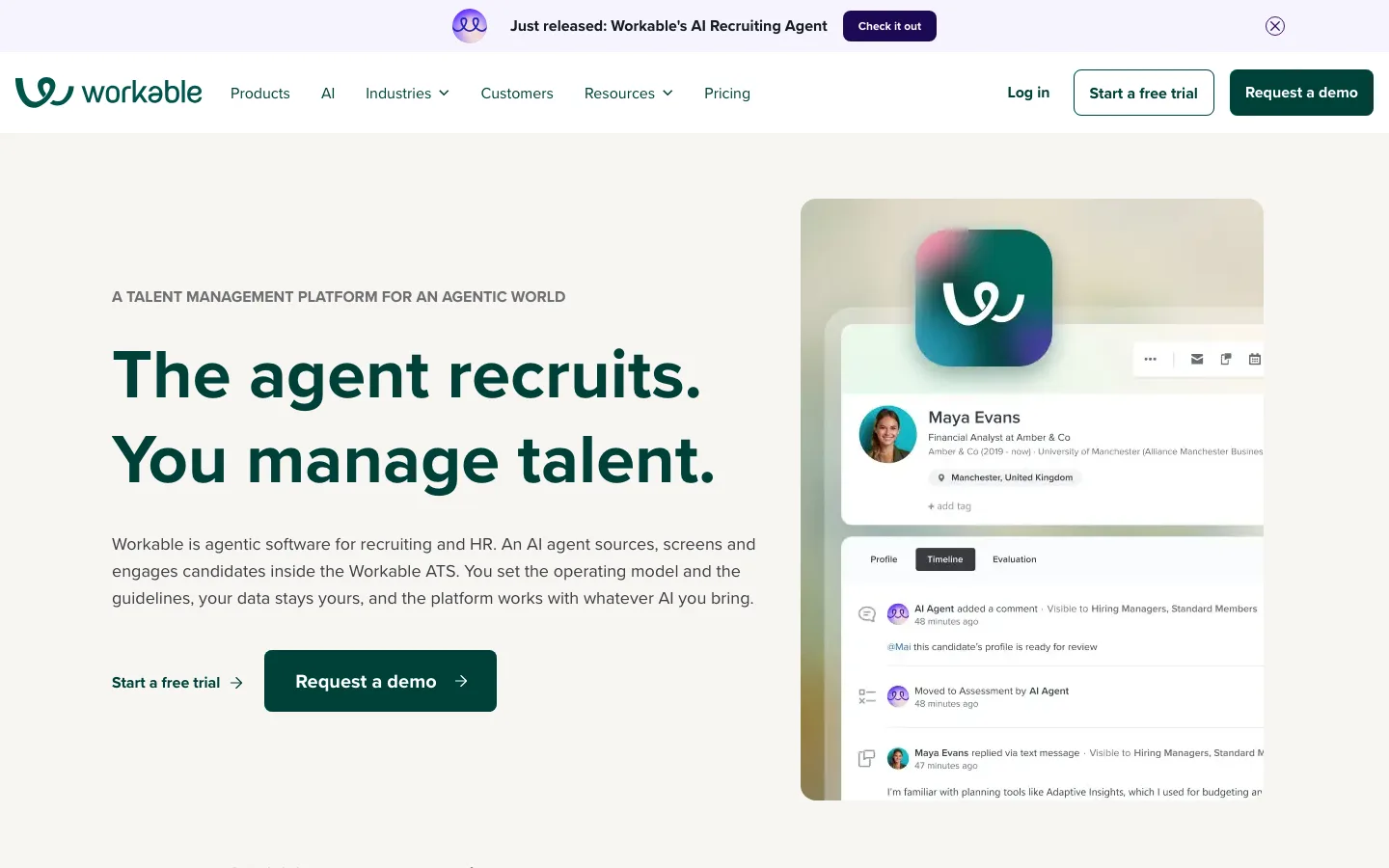
Workable is recruiting and HR software that calls itself "agentic software for recruiting and HR." It says more than 35,000 companies in over 100 countries use it, and it lists 270+ integrations. It posts jobs to 200+ job boards as an Indeed Platinum and LinkedIn Preferred Partner. A careers page builder, a talent CRM, interview kits, scorecards, assessments, requisition approvals, self-service scheduling and offer letters with e-signatures are all included.
Its sourcing agent "searches 400M+ profiles", its screening agent "evaluates every inbound candidate against up to 14 job criteria", and its engagement agent writes to people for you. Strong fits move forward on their own and clear mismatches are routed out, with a human override on every call. The agents run on AI credits, and each ATS plan comes with 3,000 complimentary AI credits. Workable holds 4.4 out of 5 from 706 G2 reviews.
Workable's catch is that the headline feature sits outside the trial. The 15-day free trial gives you the full Enterprise feature set with no credit card. But Workable states plainly that the "Free trial does not include Workable Agent," so you judge the agent only after you pay. If you are a small business, the small business ATS guide sets it against lighter options.
Best for: small and mid-sized companies that want one product for posting, screening and offers, with AI that does real work.
Watch out for: the agent is not in the trial, and add-ons can raise the bill.
Pricing model: published Standard, Premier and Enterprise plans by employee band, with AI credits, and texting, video interviews and assessments as add-ons.
5. Lever: best for ATS plus CRM, to nurture talent over months
Verdict: the ATS to pick when nurturing people over months matters as much as tracking today's applicants.
Lever is recruiting software that "combines ATS and CRM capabilities to help scaling teams nurture talent relationships and hire efficiently." Past finalists, referrals and passive candidates stay in one record, with their history, until the right role opens. In Jobscan's 2026 wider sample, 15.6% of analyzed companies used Lever.
Every plan includes the core ATS, the CRM, advanced reporting and analytics, and key integrations, which come through the Lever marketplace. The AI is focused on screening and notes: an AI Screening Companion, AI interview transcripts and summaries, and Employ Interview Intelligence. An add-on, AI Screening by VONQ, puts "AI-powered, agent-based screening embedded directly into your career site." Lever says its AI is built with IBM watsonx, and it holds 4.3 out of 5 from 2,125 G2 reviews.
Where Lever stops short is the interview itself. It screens with AI but does not run an AI interview of its own. Teams choosing between the two best-known names should read Greenhouse vs Lever. For how a CRM differs from an ATS, see the recruiting CRM guide.
Best for: scaling teams that hire the same profiles repeatedly and want a warm bench.
Watch out for: no public price; AI screening, not AI interviewing.
Pricing model: custom quote, "available upon request," with the ATS, CRM and analytics in every plan.
6. iCIMS: best for high-volume enterprise hiring
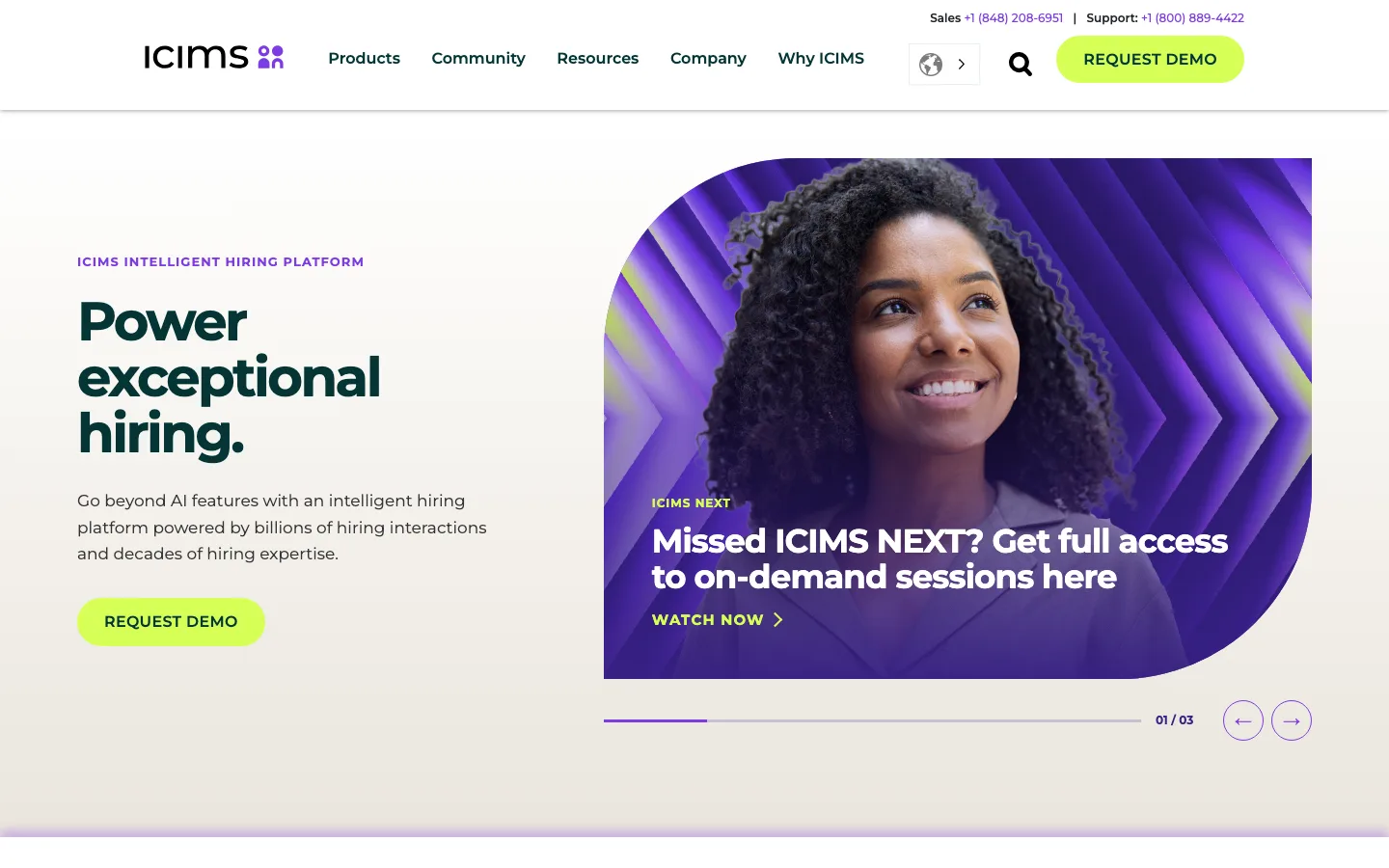
Verdict: built for employers that hire thousands of people a year across many sites, and implemented like it.
iCIMS is "a leading talent acquisition platform offering AI-powered applicant tracking, candidate engagement, onboarding, employer branding, and career site software." It sells as a set of products: iCIMS Hire, iCIMS Engage, iCIMS Employer Branding and the newer iCIMS High Volume Hiring. iCIMS says more than 4,400 companies across 200 countries use it, including a quarter of the Fortune 500. In Jobscan's 2026 wider sample, 14.4% of analyzed companies used it.
The AI list is long: a Sourcing Agent, an AI-powered career site chatbot, candidate ranking, talent matching, a GenAI search assistant and AI-generated interview questions. A new iCIMS Hiring Agent, with a version for Microsoft Teams, now sits under "Interview applicants." iCIMS still does not list an AI interviewer. By stated count, integration reach is the widest on this list: iCIMS says it "connects with more than 800 partner technologies and supports thousands of integrations." That matters for a retailer or a hospital group, where background checks, assessments and onboarding often come from separate vendors.
iCIMS is an enterprise purchase. The same scale that makes it strong for retail or healthcare volume makes it more system than a 200-person company needs. iCIMS holds 4.2 out of 5 from 995 G2 reviews.
Best for: large employers hiring hourly or frontline staff at volume, across many locations.
Watch out for: quote-only pricing and an enterprise-sized rollout.
Pricing model: custom quote by product, through "Request demo"; there is no pricing page.
7. Workday Recruiting: best if you already run Workday HCM
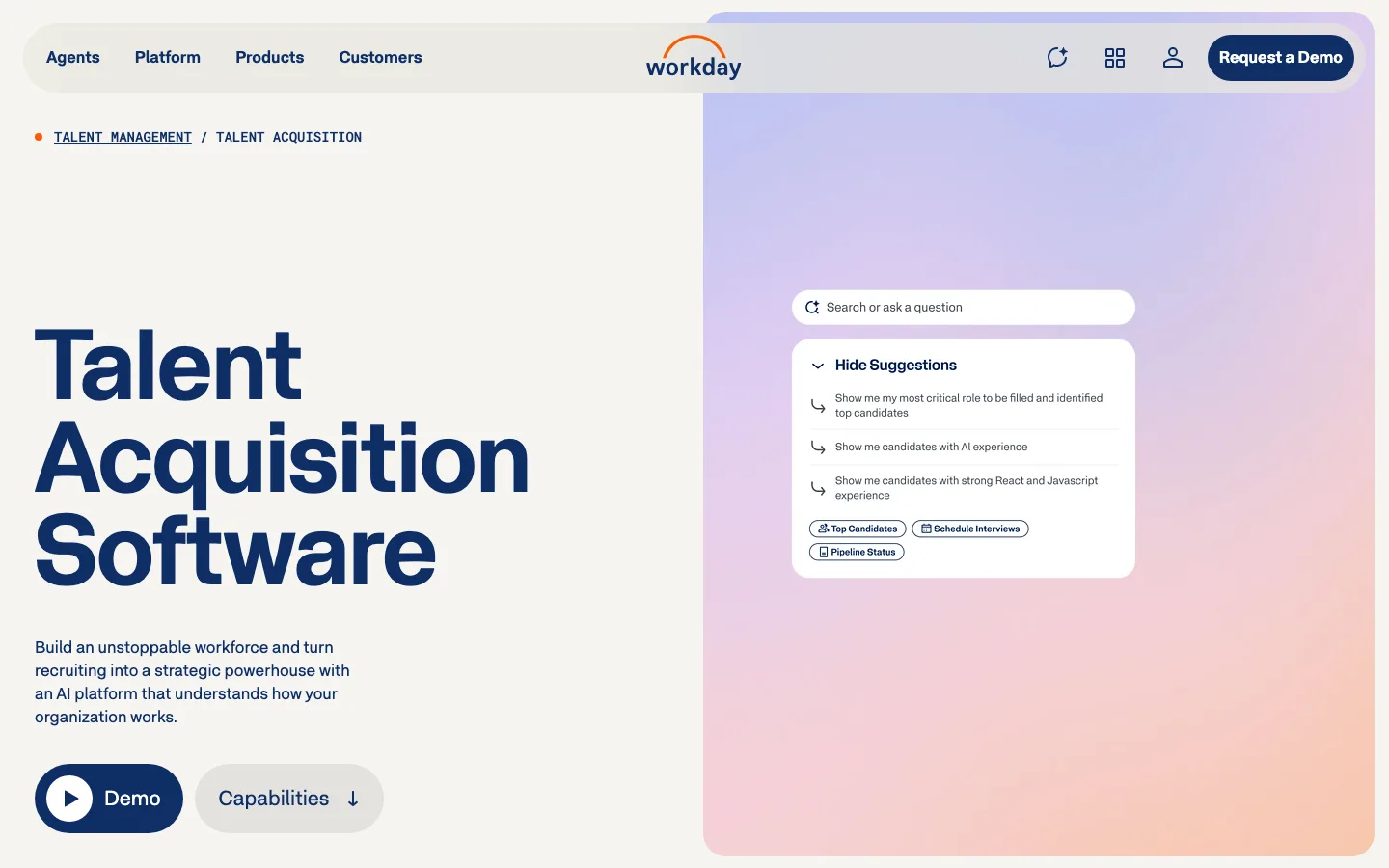
Verdict: if your company already runs Workday HCM, start here; if it does not, there are easier ATSs to adopt for recruiting alone.
Workday Recruiting is the talent acquisition part of Workday's HR system. Workday's pitch is to "unify sourcing, recruiting, and onboarding in one intelligent system." Big US employers lean on it heavily: Jobscan's 2026 report found that over 40% of the Fortune 500 use Workday for talent acquisition. In Jobscan's wider sample, 17.5% of analyzed companies used Workday.
There is a recruiter productivity hub, candidate campaigns, landing pages and events, and automatic scheduling of "multi-person, multi-room, and multi-location interviews." AI-summarized feedback, pipeline and SLA reporting, and internal mobility round it out. Conversational AI lets candidates search for jobs, ask questions and schedule interviews on mobile or by text message. A Talent Acquisition agent sits among Workday's agents for HR, and Workday says it is a Leader in the 2026 Gartner Magic Quadrant for Talent Acquisition.
Weight is the cost. Workday Recruiting has the lowest G2 rating among the 10 here with a confirmed one, at 3.7 out of 5 from 103 reviews. G2 reviewers put its time to implement at about 6 months.
Best for: large companies already on Workday HCM that want hiring and HR in one record.
Watch out for: a long implementation and the lowest confirmed G2 rating on this list.
Pricing model: through Workday sales, as part of Workday HCM, with no public price.
8. SmartRecruiters: best for global enterprises on SAP SuccessFactors

Verdict: the pick for a global enterprise that runs SAP SuccessFactors and wants a more modern recruiting front end on top of it.
SmartRecruiters is an "enterprise-grade AI hiring platform" that covers "everything you need from job posting all the way to onboarding," and it says it has helped over 4,000 customers. Its sharpest selling point is SAP. It offers SmartRecruiters for SAP SuccessFactors to "maintain SAP HCM continuity," and its site announces that SmartRecruiters is now available on SAP SuccessFactors. Jobscan's 2026 report puts SuccessFactors at a 12% usage rate in the Fortune 500, so this matters to a real share of large employers.
Winston Intelligence is the AI layer. SmartRecruiters says it "doesn't just help you manage" but "anticipates your needs," and it lists AI-Powered Candidate Screening and dynamic scheduling. Its AI-Powered Hiring Agent, Winston Companion, takes the repetitive tasks "from screening to scheduling." Candidate messaging goes out by text message, WhatsApp and online, which helps for hourly roles and for countries where WhatsApp is how people talk.
Outside SAP, the case is weaker. If you are not on SuccessFactors, iCIMS or Greenhouse cover similar ground. No G2 rating could be confirmed for SmartRecruiters, so the table marks it Not cited.
Best for: multinational employers with SAP SuccessFactors as their HR system.
Watch out for: no public price, so every number comes from sales; the SAP link is the main reason to choose it.
Pricing model: quote only. The pricing page shows two packages, the core SmartRecruiters platform and a Winston Chat add-on, each through "Talk to an expert," with no price published.
9. Teamtailor: best for employer brand and career sites, with AI included
Verdict: the best ATS for employer brand, with unlimited users, unlimited job posts and its AI in the core price.
Teamtailor is an applicant tracking system that calls itself "The ATS behind great hiring." Its strength is the career site. A drag-and-drop builder turns your job pages into a branded site, and the ATS behind it adds a talent pool, interview kits, automation triggers, reporting and onboarding.
Teamtailor AI "surfaces matches, drafts job ads, summarises CVs," and the pricing page lists it as included with unlimited usage, so there is no credit meter to watch. The integration list is long, with 561 integrations listed. For European buyers, Teamtailor lists SOC 2, ISO 27001, ISO 27701, ISO 42001 and GDPR, with operations based in Sweden. It holds 4.6 out of 5 from 582 G2 reviews, the second-highest among the 10 with a confirmed G2 rating.
Teamtailor's focus is attracting candidates rather than enterprise process. A company with long approval chains should test that part hard in the demo.
Best for: companies whose careers page is a real hiring channel, especially in Europe.
Watch out for: no public price, so you cannot compare it before a sales call.
Pricing model: custom quote ("Let us give you a quote"), with "Unlimited job postings and unlimited users" and "Everything is included," though requisitions and approval flows are marked Premium on the same page.
10. Zoho Recruit: best free plan, for corporate HR teams and staffing agencies

Verdict: a Forever Free plan from an ATS that is also a recruitment CRM, and one of the few built for both in-house HR and staffing agencies.
Zoho Recruit is "an AI-powered ATS & recruitment CRM for Corporate HRs and Staffing Agencies." It posts to "75+ free, paid, and premium job boards" and builds careers sites. Hiring managers, clients, vendors and candidates each get their own portal, which is exactly what an agency needs to share shortlists with clients. Blueprints, workflows and custom functions let you shape the process.
Zia, Zoho's AI assistant, writes job descriptions and emails, builds assessments, and helps with sourcing and shortlisting. AI Candidate Matching comes on the Enterprise plan. A Video Interviews add-on lets you "conduct one-way or live video interviews," run by your own people, not by AI. Zoho Recruit integrates out of the box with over 200 applications and holds 4.4 out of 5 from 1,867 G2 reviews.
Watch the licences. Hiring-manager licences come "only in packs of 10," which adds up when many managers review candidates, and add-ons are not available on Free.
You start with a 15-day trial of all Enterprise features, then drop to the Forever Free plan. Forever Free is listed as "1 active job/ recruiter license," so it is a starting point, not a home for a busy pipeline. There is a 45-day money-back guarantee and no forced contracts. Agencies comparing it with Bullhorn should read the guide to recruitment software for agencies.
Best for: small HR teams and staffing agencies that want to start free and grow into a CRM.
Watch out for: hiring-manager licences sold in packs of 10.
Pricing model: published, per recruiter licence across Free, Standard and Enterprise.
11. Breezy HR: best flat-priced ATS for small teams, with unlimited users

Verdict: the simplest flat-priced ATS for a small team, with unlimited users and a 14-day trial that needs no card.
Breezy HR is "modern hiring software and an applicant tracking system," and it calls itself "built for growing and midsize companies." It says over 17,000 companies use it. Jobs go to "50+ top job sites with a single click." Career sites, pre-screening questions, automated emails, scheduling, offer management, HRIS integrations and a mobile app are all included. Breezy also sells Breezy Perform for reviews and goals.
Breezy Intelligence adds "AI-powered candidate evaluation, interaction summaries, and resume auditing," paid for in credits. The pricing is what sets Breezy apart: a flat monthly price per company, not per seat, so adding hiring managers does not raise the bill. In Breezy's words, "every plan includes unlimited users and unlimited open positions, and the price doesn't change as your company grows." Breezy holds 4.4 out of 5 from 695 G2 reviews.
There is no free plan. Breezy's own pricing page answers the question directly: "Breezy doesn't have a free plan." Instead, every feature can be tried for 14 days with no credit card, and the trial includes 100,000 Breezy Intelligence credits. After that, Breezy Intelligence draws on credits, so heavy AI use adds cost.
Plans run Startup, Growth and Business, with Custom Pro priced by quote, and annual billing is discounted. For options that do start free, see the roundup of free recruiting software.
Best for: small teams that want predictable cost and many reviewers on one account.
Watch out for: no free plan, only a trial; AI runs on credits.
Pricing model: published flat monthly price per company across Startup, Growth and Business, Custom Pro by quote, and an annual discount.
12. JazzHR: best budget pick for small businesses under 250 employees
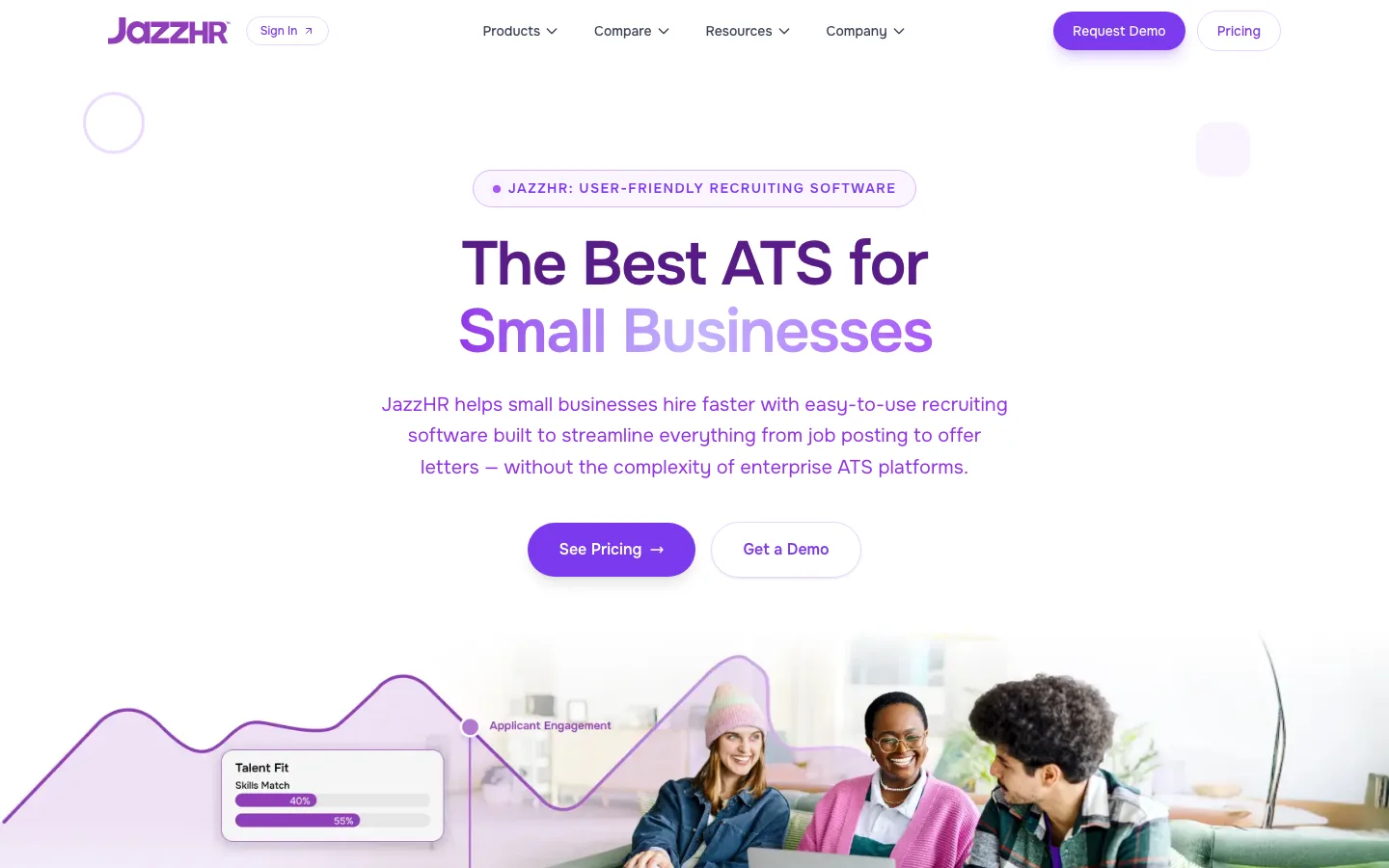
Verdict: a budget ATS for small businesses that mostly post jobs and need a tidy pipeline behind them.
JazzHR is "affordable recruiting software built to help small to medium-sized businesses hire smarter and faster." It covers job posting with syndication, email templates, interview scheduling and a LinkedIn Recruiter integration. JazzHR is owned by Employ.
AI-Powered Candidate Matching, from the Plus plan up, ranks applicants against the job, which helps when a single posting brings a pile of resumes. Integrations reach payroll and HR systems such as BambooHR and UKG, employer branding tools, and sourcing platforms like LinkedIn Recruiter.
The published price has limits. JazzHR's standard pricing "does not apply to staffing or recruiting agencies, HR service providers, franchises, multi-location businesses, organizations with over 250 employees." If you are any of those, you are into a quote. The pricing page lists no free trial, and no G2 rating could be confirmed, so the table marks it Not cited.
Best for: single-location small businesses under 250 employees with steady, simple hiring.
Watch out for: agencies, franchises and multi-location businesses are excluded from standard pricing.
Pricing model: published Hero, Plus and Pro plans, yearly or monthly, plus consumption-based add-ons.
13. BambooHR: best when HR records come first and hiring is light
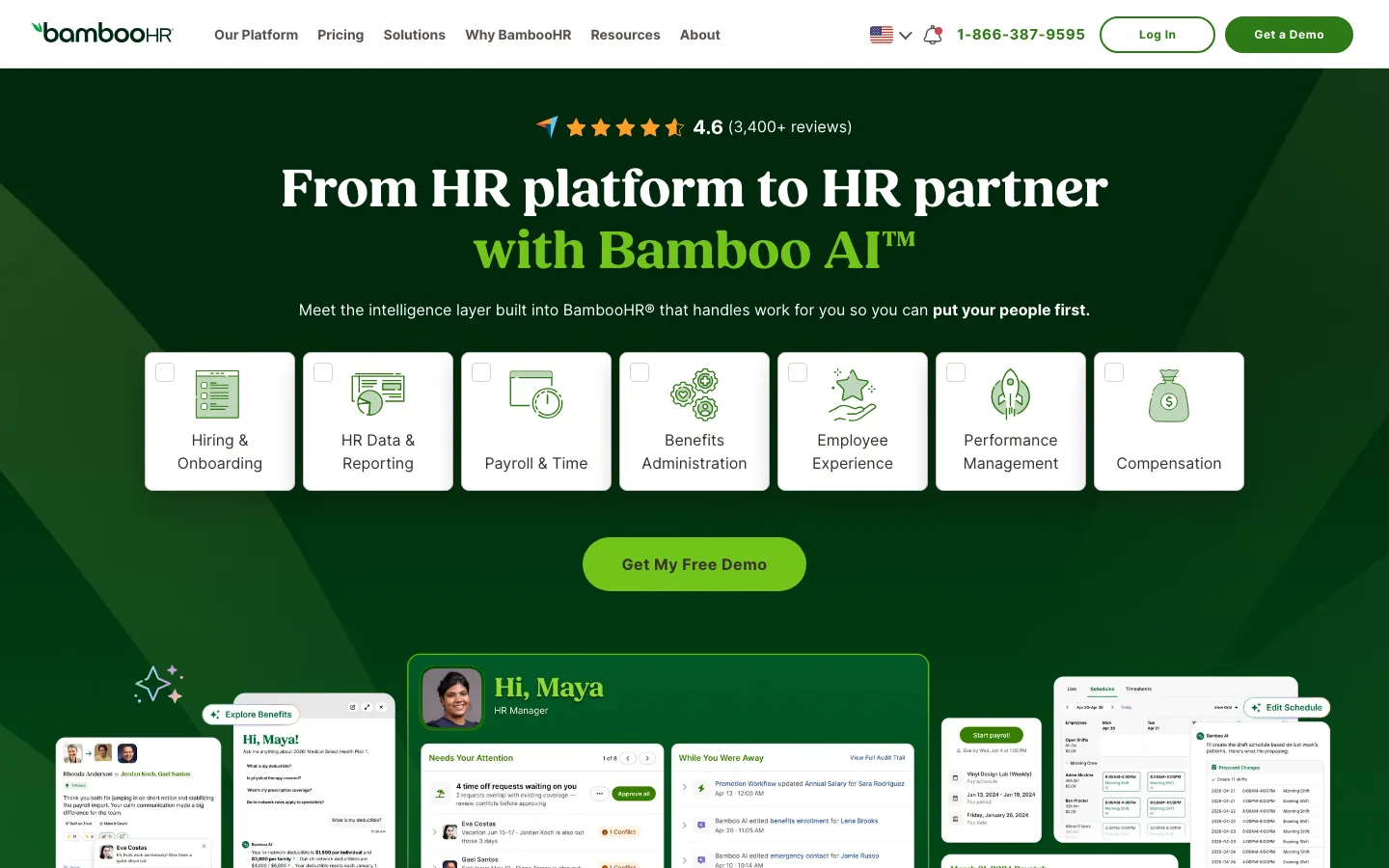
Verdict: pick it when you need HR, payroll and benefits first and hiring is a handful of roles a year.
BambooHR is "The Complete HR Software for People, Payroll & Benefits." Its applicant tracking system is "built for HR teams," with "easy job posting, candidate tracking, and team collaboration." BambooHR says more than 30,000 companies use it. The appeal is one system for hiring and for the employee records that follow it.
The hiring module covers job posting, automated communication, digital offer letters with e-signatures, self-scheduling, reporting and background checks. Bamboo AI works across HR rather than on hiring specifically, and BambooHR names no hiring-specific AI on its ATS page. It has 150+ pre-built integrations. Its G2 rating of 4.4 out of 5 from 7,873 reviews covers the whole HR suite, not hiring alone.
Open roles are capped. The ATS limits job openings by plan, at 5, 25 or 50. That is fine for a company hiring a few people a quarter and tight for one that hires every week.
Best for: small companies that want HR, payroll and light hiring in one product.
Watch out for: open-job caps by plan; little AI aimed at hiring.
Pricing model: published, per employee per month across Core, Pro and Elite, with a flat rate for 25 employees or fewer and a free trial.
Also considered
Six more ATSs came close. Each is a good product for a narrower group:
- Gem lets you "connect powerful AI agents to your existing ATS, or run recruiting end-to-end in Gem." Pricing is flexible, early-stage startups get their first six months free through Gem's Startup Program, and Gem publishes a starting price for startups.
- Pinpoint calls itself "The ATS built for multi-stream hiring," for companies running several hiring motions at once.
- Manatal is "AI Recruitment Software designed to source and hire candidates," for HR teams, agencies and headhunters. Its Manatal AI Interviewer "conducts video interviews 24/7," and the 14-day free trial needs no credit card.
- Bullhorn sells "AI-Powered Online Recruitment Software for Agencies" and says more than 10,000 companies rely on it to power their staffing, which makes it the default for staffing firms. The agency software guide covers it.
- Rippling Recruiting is an "AI-native ATS" that makes the most sense if you already run Rippling for HR.
- Tellent Recruitee is "the customizable hiring software that helps you hire smarter and faster."
How does applicant tracking system pricing work?
ATS vendors price in five main ways, and the model matters more than the headline number because it decides what grows your bill. Per employee pricing (BambooHR) grows with your whole headcount. Per recruiter licence pricing (Zoho Recruit) grows with your recruiting team, plus any hiring-manager seats.
Flat per company pricing (Breezy HR) stays put as you add reviewers. Size-band and commitment pricing (Workable, Ashby) moves when you cross an employee threshold, and custom quotes (Greenhouse, Lever, iCIMS, Workday Recruiting, SmartRecruiters, Teamtailor) depend on what you negotiate.
Only 5 of the 12 classic ATSs print a full price, so if budget sign-off needs a number early, start with Workable, Zoho Recruit, Breezy HR, JazzHR or BambooHR. AI is increasingly sold on top, as credits. Workable's agents, Breezy Intelligence and Ashby's AI features all run on credits, so ask how many come with your plan and what happens when they run out.
| Tool | Pricing model | Free plan or trial |
|---|---|---|
| The Cognitive | Monthly plans from $99, plus credits | 7-day trial, no card, 50 sourcing credits |
| Greenhouse | Core, Plus, Pro; custom quote | Demo only |
| Ashby | By company size, usage and commitment | None listed |
| Workable | Plans by employee band, plus AI credits | 15-day trial, no card (agent excluded) |
| Lever | Custom quote | Demo |
| iCIMS | Custom quote | Demo |
| Workday Recruiting | Through sales, inside Workday HCM | Demo |
| SmartRecruiters | Packages through sales; quote only | Demo |
| Teamtailor | Quote; core features included, some Premium | Demo |
| Zoho Recruit | Per recruiter licence | Forever Free plan and 15-day trial |
| Breezy HR | Flat monthly per company; Custom Pro by quote | 14-day trial, no card; no free plan |
| JazzHR | Hero, Plus, Pro; yearly or monthly | None listed |
| BambooHR | Per employee per month | Free trial |
For worked examples of each model, read the guide to applicant tracking system pricing.
How do you shortlist an ATS?
Pick two or three ATSs from the table that match your company size and HR stack. Run the same live role through each trial or demo, with a hiring manager in the room. Score them on the five questions in "How do you choose an applicant tracking system?" Then send the demo questions below in writing, so the answers are comparable.
Questions to ask in an ATS demo
- Can you show a real role moving from posting to signed offer, without switching to a slide?
- What does our first year cost in total, including hiring-manager seats, add-ons and AI credits?
- Which AI features are in our plan, and which are in the trial?
- Does your integration with our HR system, calendar and job boards come built in, or does it need a partner?
- How long does implementation take for a company our size, and who does the work?
- Can we export every candidate, note and scorecard if we leave?
- What happens to our price at renewal if our headcount or hiring volume grows?
If filling the top of the pipeline is the harder problem, not tracking it, start a free trial of The Cognitive. Run your hardest open role through it, alongside your ATS or before you have one.
Sources
- Jobscan, 2026 Applicant Tracking System (ATS) Usage Report, 20 August 2026.
- Gem, Key takeaways from the 2026 Recruiting Benchmarks Report, 1 December 2025 (gem.com blog).
- Ashby, 2026 Talent Trends Report, Recruiter Productivity, 28 April 2026 (ashbyhq.com).
- SHRM, Uncertain Economy Adds to Recruitment Challenges, 24 March 2025.
- Greenhouse: homepage, pricing page, Voice AI interviewing page and integrations directory.
- Ashby: homepage, pricing page and ATS platform page.
- Workable: homepage and pricing page.
- Lever: homepage, AI features page and pricing page.
- iCIMS: homepage and AI recruiting software page.
- Workday: talent acquisition software page.
- SmartRecruiters: homepage and pricing page.
- Teamtailor: homepage, pricing page and integrations page.
- Zoho Recruit: homepage and pricing page.
- Breezy HR: homepage and pricing page.
- JazzHR: homepage and pricing page.
- BambooHR: homepage, applicant tracking system page and pricing page.
- Gem, Pinpoint, Manatal, Bullhorn, Rippling Recruiting and Tellent Recruitee: each vendor's homepage or product page.
- G2: product review pages for Greenhouse, Workable, Lever, iCIMS, Workday Recruiting, Teamtailor, Zoho Recruit, Breezy HR and BambooHR, and G2's applicant tracking system category page for Ashby.
Corrections in this update: Breezy HR no longer offers a free plan, only a 14-day trial, and SmartRecruiters no longer shows a starting price on its pricing page.
Frequently Asked Questions
What is the best applicant tracking system in 2026?
For teams that hire by sourcing, The Cognitive is the best pick in 2026, and among classic applicant tracking systems Greenhouse is the best for structured hiring at mid-market and enterprise companies. The Cognitive is sourcing and AI interview software that works alongside your ATS. Among the 12 ATSs and the sourcing pick ranked here, it is the only one that searches ~900M public profiles for people who never applied and interviews them by live AI video, on self-serve plans with published prices. Ashby is the best all-in-one ATS for scale-ups, and Workable is the strongest self-serve ATS for small and mid-sized teams, with a 15-day trial that needs no credit card.
What is the best ATS for a small business?
Workable is the best all-round ATS for a small business that wants AI built in, and Zoho Recruit is the best if you want to start on a free plan. Zoho Recruit moves you to its Forever Free plan after a 15-day Enterprise trial. Breezy HR has no free plan, but it charges one flat price per plan with unlimited users and offers a 14-day trial with no credit card. JazzHR suits single-location businesses under 250 employees, and BambooHR fits when HR and payroll matter more than hiring.
What is the best ATS for staffing agencies?
Zoho Recruit is the best ATS on this list for staffing agencies, because it is built as an ATS and recruitment CRM for both corporate HR teams and staffing agencies, with portals for clients, vendors and candidates. Bullhorn, which sells AI-powered recruitment software for agencies and says more than 10,000 companies rely on it to power their staffing, is the other common choice. The guide to recruitment software for agencies at thecognitive.io/blog/recruitment-software-recruitment-agencies compares them in depth.
Which applicant tracking system do most large companies use?
More than 40% of the Fortune 500 use Workday for talent acquisition, according to Jobscan's 2026 ATS Usage Report, and 12% use SAP SuccessFactors. The same report detected an ATS at 97.4% of Fortune 500 companies. In Jobscan's wider sample, Greenhouse was used by 19.0% of analyzed companies, Workday by 17.5%, Lever by 15.6% and iCIMS by 14.4%.
Which ATS has the best reviews?
Ashby has the highest G2 rating among the ATSs ranked here, at 4.7 out of 5 from 216 reviews on G2's applicant tracking category page. Teamtailor is next at 4.6 from 582 reviews. Greenhouse, Workable, Zoho Recruit and Breezy HR each hold 4.4, and Workday Recruiting has the lowest confirmed rating at 3.7 from 103 reviews.
Which applicant tracking systems have AI interviews?
Among the 12 classic ATSs ranked here, Greenhouse lists a released AI interviewer of its own: Greenhouse Voice AI holds two-way voice interviews scored against your rubric. Ashby's AI Interviewer also runs by real-time voice and is on an early-access waitlist, and Lever offers AI screening rather than an interviewer. Manatal, listed under Also considered, sells an AI Interviewer that conducts video interviews. The Cognitive, ranked first, runs live AI video interviews and sends the results back to your ATS on the plans that include sync.
Is The Cognitive an applicant tracking system?
No. The Cognitive is sourcing and AI interview software that works alongside your ATS: it searches ~900M public profiles, emails people from your own mailbox on the plans that include outreach, and interviews them by live AI video. It does not post jobs, run a careers site, take applications or send offers. It does keep roles, candidates and interview stages, so a team that hires only by outbound sourcing can start without an ATS, and it syncs with 100+ ATSs on the plans that include sync.
What are examples of applicant tracking systems?
Greenhouse, Ashby, Workable, Lever, iCIMS, Workday Recruiting, SmartRecruiters, Teamtailor, Zoho Recruit, Breezy HR, JazzHR and BambooHR are widely used examples of applicant tracking systems. Greenhouse, Ashby, Workable, Teamtailor, Breezy HR and JazzHR are all-in-one ATSs for growing companies. Lever and Zoho Recruit pair an ATS with a recruiting CRM, iCIMS, Workday Recruiting and SmartRecruiters are enterprise suites, and BambooHR is an HR suite with a hiring module.
Is an applicant tracking system cloud based?
Most are: applicant tracking systems today are usually cloud software, also called SaaS, that you open in a browser. The vendor hosts the data and ships updates, so there is nothing to install. On-premise or self-hosted systems still exist for teams that want data on their own servers, at the cost of running them. If data location matters, ask each vendor where it hosts.
What is the difference between an ATS and a recruiting CRM?
An ATS manages people who applied to a job, while a recruiting CRM keeps relationships with people who have not applied yet. The ATS moves applications through stages to an offer; the CRM holds talent pools and nurtures them over months. Lever, Ashby and Zoho Recruit combine both, and the recruiting CRM guide at thecognitive.io/blog/recruiting-crm-guide goes deeper.
Which ATS is best for sourcing candidates?
For sourcing-led hiring, The Cognitive is the best pick, though it is sourcing and AI interview software that works alongside an ATS rather than an ATS itself. Among ATSs, Workable's sourcing agent "searches 400M+ profiles", iCIMS has a Sourcing Agent, and Greenhouse sells sourcing alongside its ATS. Gem, listed under Also considered, connects AI agents to your existing ATS.
Is it worth switching ATS?
It is worth switching when your ATS blocks the way you hire now, and the cheapest moment is your contract renewal. Before you move, confirm you can export every candidate, note and scorecard, and ask the new vendor who does the migration and how long it takes. If the real gap is finding people rather than tracking them, adding sourcing software that works alongside your current ATS can cost less than a migration.
Related reading
- Best Candidate Tracking Software in 2026: 10 Tools and the ATS Picks
- Applicant Tracking Systems for Small Businesses: The 10 Best in 2026
- AI Recruitment Software vs a Regular ATS: Which ATSs Have AI Now and How the Two Work Together
- 25 Recruitment Strategies That Work in 2026, Sourcing First
- Sourcing Meaning: What the Word Means in Recruiting and in Business
- How to Find Professional Contact Information Ethically: A Recruiter's Guide (2026)