AI Tools for HR: The 12 Best for HR Teams in 2026
By Sparsh Goyal, Founder at The Cognitive. Published · Last updated
- The best AI tools for HR in 2026 are The Cognitive for recruiting, Paradox for frontline hiring, Leena AI for the HR helpdesk, Lattice and Culture Amp for performance and engagement, and Visier for people analytics.
- If you already run Workday, Rippling or BambooHR, try the AI inside it first, because it works on the employee data you already hold.
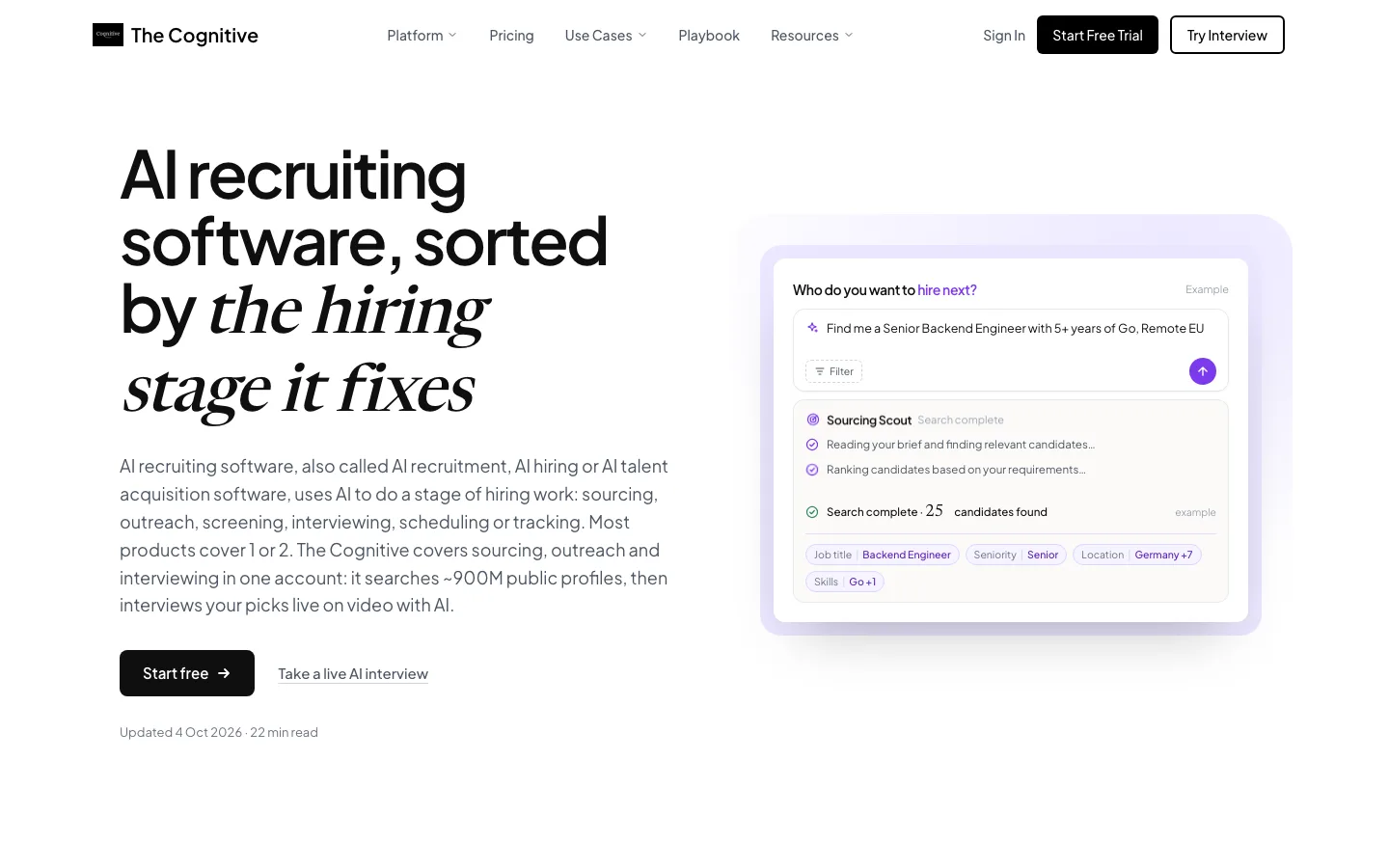
The best AI tools for HR in 2026 depend on which HR job you want done. For hiring, The Cognitive is the pick for HR teams without recruiters. It sources from about 900M public profiles, writes to people from the recruiter's own mailbox and runs a live AI video interview with the ones you choose. Paradox suits high-volume frontline hiring, Leena AI the employee helpdesk, Textio job posts and review writing, Lattice and Culture Amp performance and engagement, and Visier people analytics. If you already run Workday, Rippling or BambooHR, try the AI built into it before you buy anything new.
Disclosure: The Cognitive is our product.
The best AI tools for HR in 2026
- The Cognitive: best for recruiting when you have no recruiting team.
- Paradox: best for frontline and hourly hiring at volume.
- Eightfold AI: best for enterprise talent intelligence across hiring and internal moves.
- Metaview: best for recruiting teams buried in interview notes.
- Textio: best for job posts and performance feedback that read well.
- Leena AI: best for an HR helpdesk that answers employee requests.
- Workday: best for companies already running HR on Workday.
- Rippling: best for growing companies that want HR, payroll and IT in one system.
- BambooHR: best for small and mid-sized HR teams.
- Lattice: best for performance reviews and manager coaching.
- Culture Amp: best for turning engagement surveys into action plans.
- Visier: best for people analytics across many HR systems.
What is an AI tool for HR?
Only 39% of organizations use AI in their HR functions, according to SHRM's State of AI in HR 2026, a survey of 1,908 HR professionals. Recruiting is the most common use, at 27% of organizations, ahead of every other HR job. So most HR teams are still choosing their first AI tool, and hiring is where the tools are furthest along.
An AI tool for HR is software that uses artificial intelligence to do, or draft, a piece of human resources work. That can mean finding candidates, answering an employee's leave question, writing a performance review or explaining a trend in people data. The useful question is how much of the job the AI finishes. Some tools draft and wait for you, while others resolve the ticket, send the email or run the interview.
The work is shifting rather than disappearing. In SHRM's 2026 findings for CHROs, 39% of organizations reported shifts in job responsibilities from AI and 24% reported the creation of new roles.
HR leaders already know where they want help. In a Gartner survey of 179 HR leaders, published on 27 February 2024, 38% were piloting, planning or had implemented generative AI, up from 19% in June 2023. The top use cases were an employee-facing chatbot (43%), administrative tasks, policies and document generation (42%), and job descriptions and skills data (41%).
The tools fall into three kinds:
- AI inside your HR system. Workday, Rippling and BambooHR build AI into the HR information system (HRIS) you already run. It works on the employee data you hold, under the permissions you already set.
- Standalone AI for one HR job. These go deeper on a single task. The Cognitive, Paradox, Eightfold AI and Metaview cover recruiting. Textio covers HR writing, Leena AI employee service, Lattice and Culture Amp performance and engagement, and Visier people analytics.
- General assistants. ChatGPT and Claude draft letters and policies well, but they are not a system of record. Several tools on this list now plug into them instead of competing with them.
If you want every category of HR software, AI or not, our guide to the best HR software in 2026 breaks it down by job.
How do the best AI tools for HR compare?
Three are HR systems with AI built in, and the other nine do one HR job each.
| Tool | Best for | Pricing model | Price on website? |
|---|---|---|---|
| The Cognitive | Recruiting without a recruiting team | Monthly plans with credits | Yes, from $99 a month |
| Paradox | Frontline and hourly hiring | Quote | No |
| Eightfold AI | Enterprise talent intelligence | Quote | No |
| Metaview | Heavy interview loads | Per user/month, free plan | Yes |
| Textio | Job posts and review feedback | Quote, free try on Feedback | No |
| Leena AI | HR helpdesk at enterprise scale | Per employee/year or fee + usage | No |
| Workday | Existing Workday customers | Subscription plus usage-based Flex Credits | No |
| Rippling | HR, payroll and IT in one system | Per employee/month, modular | Yes (starting price) |
| BambooHR | Small and mid-sized HR teams | Per employee/month, tiered | Yes |
| Lattice | Review cycles and coaching | Per seat/month, modular | Yes |
| Culture Amp | Engagement survey analysis | Quote by product and size | No |
| Visier | People analytics across many systems | Quote | No |
How did we choose these 12 AI tools for HR?
We started with the HR jobs where AI use is highest in SHRM and Gartner research: recruiting, employee service, HR writing, performance and engagement, and people analytics. We then took the 18 tools named by two 2026 lists of AI tools for HR, from Juicebox and Darwinbox. Those lists lean on recruiting tools and HR suites. We added six: The Cognitive and Metaview for recruiting, and BambooHR, Lattice, Culture Amp and Visier for the jobs those lists skip.
A tool made the cut if its own website says what its AI does on a named HR job, not just that it "has AI". We kept one to four tools per job and judged each on five criteria:
- which HR job it does;
- whether the AI drafts or finishes the task;
- whether you can start self-serve, without a sales call;
- whether a price is public;
- how it fits the system of record you already run.
The list runs in the order an employee meets HR: hiring, HR writing, employee service, core HR systems, performance and engagement, then analytics. Within hiring, tools run from most to least of the hiring chain covered. The Cognitive is first because hiring comes first. It is also the only tool here that sources candidates and then runs a live AI video interview with them, self-serve, with a price on its website.
We judged the eleven competitors from their own websites, not hands-on, and used no review-site ratings.
How do you choose an AI tool for HR?
Which HR job takes the most hours today?
Start with the HR job that eats the most hours, not the most impressive demo. For many teams that job is hiring. SHRM puts recruiting at 27% of organizations using AI, the largest share of any HR function. Ashby's recruiter productivity data (2026 Talent Trends Report) shows the average recruiter processing 291 applications per hire, against roughly 100 in early 2021.
If your hours go to employee questions instead, a helpdesk tool such as Leena AI will save more than any recruiting tool.
Do you want a draft, or a finished task?
Drafting tools save minutes per task. Textio drafts a job post, and Lattice drafts a review from a manager's notes. Acting tools remove the task: Leena AI closes a leave request, and The Cognitive sends outreach and runs the first interview. LinkedIn's Future of Recruiting 2025 found that recruiters using generative AI save about 20% of their work week, so even drafting adds up.
Should you use the AI in your HRIS or a standalone tool?
AI inside your HRIS knows your org chart, pay data and permissions on day one. Rippling says its AI "runs on your existing permissions", and Workday's Talent Acquisition Agent works "within your secure Workday environment". A standalone tool goes deeper on one job but needs an integration first. Ask which systems it connects to and what moves in each direction.
Can you start without a sales call?
Five of the twelve publish a price: The Cognitive, Metaview, BambooHR, Lattice and Rippling (a starting price). Only The Cognitive and Metaview let you open an account and start without talking to sales. The rest are quote-led or demo-led, which usually means a demo, a scoping call and an annual contract. If you need to prove value on one role or one team first, a self-serve trial gets you there in days.
Will it hold up under AI hiring rules?
AI used for recruitment and selection is high-risk under Annex III of the EU AI Act, and after the Digital Omnibus those obligations apply from 2 December 2027. In the US, Colorado's SB26-189 replaced SB24-205, with duties from 1 January 2027. New York City's Local Law 144 already requires bias audits of automated employment decision tools.
Ask every vendor who makes the final decision and what is logged. Our guides to AI screening compliance and AI bias in hiring go further.
What mistakes do HR teams make when buying AI tools?
Buyers' remorse is common in HR tech. In Lattice's 2027 State of People Strategy Report, 47% of HR respondents said they regret a recent tech purchase. The top reasons were functionality and integration issues. Five mistakes are worth avoiding.
- Buying a second AI for a job your HRIS already does. Workday, Rippling and BambooHR each answer data questions and draft reports. Check what you already pay for before you add a standalone tool.
- Judging the demo, not your own data. A helpdesk bot is only as good as your policy documents, and a review drafter only as good as your one-to-one notes. Test with your real material.
- Skipping the integration question. Integration is one of the two top reasons for regret in the Lattice data. Ask which systems connect and what moves in each direction.
- Ignoring how the bill grows. Per-employee pricing grows with headcount, and usage credits grow with work. Model next year, not this month.
- Letting the AI make the decision. Keep a person on every hiring and employment decision, and keep the record of how it was made. The EU AI Act treats hiring AI as high-risk, and New York City already requires bias audits, so the record will be asked for. Our guide to AI hiring tool mistakes covers the recruiting side.
The 12 best AI tools for HR, reviewed
Recruiting tools get short entries; the full recruiting comparison is in our list of best AI recruiting tools.
1. The Cognitive: best for recruiting when you have no recruiting team
Verdict: The Cognitive runs recruiting end to end for HR teams that hire without recruiters: it finds people, emails them and interviews them.
The Cognitive is AI recruiting software that covers sourcing, outreach, live AI interviews, and the roles and candidates in between. You describe the role in plain English, and the brief becomes structured filters you can correct. The search covers about 900M public profiles and shows 10 people a page. Each card carries a "Why this match" line and a Strong or Possible rating, so you see why a person is there before you spend anything on them.
Reveal finds a personal email or a phone number, and you are charged only when one is found. Outreach goes out from the recruiter's own mailbox, and the follow-ups stop as soon as the person replies.
Anyone you pick can go into a live AI video interview, with an AI interviewer on video and the candidate on camera. The booking page shows consent, the questions are live, and the scoring rubric is drafted for the role and you review it. The report marks each CV claim Verified, Unclear or Refuted.
For an HR generalist who fills a handful of roles a quarter, that replaces a sourcing tool, an email tool and most first-round calls. The Cognitive syncs with 100+ applicant tracking systems (ATS), but only on higher plans. Our lists of AI sourcing tools and AI interview platforms compare it in depth.
Best for: HR teams and founders who must fill roles without a recruiting team.
Watch out for: it does not post jobs, take applications, run payroll or answer employee questions. Outreach is by email, and outreach and phone reveals start on Sourcing Pro.
Pricing model: monthly plans with credits, published. AI Sourcing and AI Interviews are separate plans, each from $99 a month; outreach and phone reveals need Sourcing Pro or higher. A search uses 1 credit per person shown, a personal email 4 credits, a phone number 12, and a 20-minute interview 100 interview credits. There is a 7-day free trial with no card.
2. Paradox: best for frontline and hourly hiring at volume

Verdict: Paradox is the pick when you hire thousands of hourly workers and the fastest reply wins the applicant.
Paradox calls itself "the AI assistant for all things hiring". Its assistant, Olivia, runs conversational software that "automates recruiting tasks like screening, interview scheduling, and onboarding". Workday completed its acquisition of Paradox on 1 October 2025, describing it as a candidate experience agent for frontline industries.
The modules cover the whole applicant journey: job search and apply, screening "through chat or text", interview scheduling, offers, hiring events, referrals and onboarding documents sent before day one. Paradox says it can "respond instantly in 100+ languages", and it also sells a Conversational ATS. By Paradox's own account, Compass Group fills 120,000 jobs a year with 20 recruiters, and 7-Eleven stores got back 40,000 hours a week.
The strength is speed at scale for people who apply. The trade-off follows from that: Paradox is not built to find passive candidates who never applied, and it is not a helpdesk for current employees. See our Paradox review, Paradox alternatives and recruiting chatbots list.
Best for: frontline employers hiring hourly workers at volume.
Watch out for: it is demo-led, built for large and mid-sized employers, and it works on applicants rather than sourced candidates.
Pricing model: custom quote; no price on the website.
3. Eightfold AI: best for enterprise talent intelligence across hiring and internal moves

Verdict: Eightfold AI suits large enterprises that want one talent layer for external hiring and internal mobility.
Eightfold AI describes itself as "the system of intelligence for workforce decisions", where "talent agents do the work across talent acquisition and talent management". Its products include Talent Acquisition, Talent Agents, a Candidate Agent, an AI Interview Companion and Resource Management. Eightfold says some customers have filled roles in as little as 1.3 days.
The AI Interviewer is billed as "your first digital recruiter". It lists "24+ languages supported", alerts on "tab switching, camera manipulation, and voice dupes", and "works directly with your existing ATS". Eightfold quotes an activation of one to two weeks and lists SOC 2, ISO 27001 and ISO 42001.
For a large employer, the draw is that the same talent agents work across hiring and talent management. See our Eightfold review and talent intelligence platforms.
Best for: enterprises matching internal and external talent at scale.
Watch out for: a sales-led rollout with no self-serve start and no public price, which is hard to justify for a small HR team.
Pricing model: custom quote through a demo; no price on the website.
4. Metaview: best for recruiting teams buried in interview notes

Verdict: Metaview is for recruiting teams whose week disappears into notes, scorecards and application review.
Metaview calls itself "the Agentic Recruiting Platform built for radically efficient hiring, end to end". It runs agents for Sourcing, Application Review, Screening, Notes and Reports. Its AI coworker, fillmore, "finds candidates, runs personalized outreach, and books screening calls autonomously". Metaview also says it "handles notes, scorecards, and follow-ups automatically".
Metaview starts with the interviews your team already runs and removes the write-up after each one. Compare it on our lists of interview intelligence platforms and Metaview alternatives.
Best for: in-house recruiting teams with a heavy interview load.
Watch out for: it is a recruiting product, so it does nothing for onboarding, reviews or employee questions after the hire, and adds little if your HR team rarely interviews.
Pricing model: a free plan and per-user monthly plans, published; enterprise and the full agentic platform by quote.
5. Textio: best for job posts and performance feedback that read well

Verdict: Textio is the pick when the words are the problem: job posts that attract the wrong people, and reviews managers dread writing.
Textio sells "AI for Recruiting and Performance Management". On the recruiting side, it will "generate optimized job posts from just a few details" and keep a library of job descriptions. The Textio Score "grades every email, post, and page to predict who will apply", with a gender meter and an age graph.
On the feedback side, Textio promises "a feedback expert on every manager's shoulder". That covers reviews, self-assessments, and peer and upward feedback, with risk detection built in.
Textio says it is used by more than 100,000 managers and that 25% of Fortune 500 companies have used it. It runs on its own site or inside your ATS or performance tool, and it has added an interview intelligence product, Lavalier. Textio covers job posts, recruiting messages and feedback, not HR policy documents. For a policy, an HRIS assistant or a general assistant drafts it, and a person signs it off.
Textio makes language clearer and fairer at the point of writing. For a quick free start on job descriptions, our job description generator does the first draft.
Best for: HR teams that care about bias and consistency in job posts and reviews.
Watch out for: it improves the draft but does not run the process around it: no job posting, review scheduling or employee records.
Pricing model: custom quote with a free try of Textio Feedback; no price on the website.
6. Leena AI: best for an HR helpdesk that answers employee requests

Verdict: Leena AI is the pick for enterprises whose HR team spends the day answering the same employee questions.
Leena AI describes itself as an "agentic AI platform with pre-built AI Colleagues for the back-office". Its Universal HR Assistant, called Harrison, closes tier-1 HR requests such as leave, letters, benefits and payroll questions. It also covers onboarding tasks, separations, transfers and policy questions. That matches the top generative AI use case in Gartner's survey: an employee-facing chatbot (43%).
Leena AI connects through "200+ pre-built connectors", including Workday, ServiceNow and SAP. It draws answers from knowledge bases in SharePoint, Confluence and Box. The company claims 70%+ of tickets auto-resolved and more than 500 enterprise customers, and promises "Enterprise AI, live in 45 days".
Leena AI finishes requests instead of pointing people to a policy page. A 45-day enterprise rollout is more than a 50-person company needs. Smaller teams get some of this from Rippling AI, which explains pay, benefits and policies to employees.
Best for: large enterprises with a high volume of HR tickets.
Watch out for: answers are only as good as the documents behind them, so out-of-date policies in SharePoint or Confluence become out-of-date answers.
Pricing model: custom quote. The Universal Assistant is a flat license per employee per year with unlimited use; the wider platform is a fee plus usage billed in tokens. No price on the website.
7. Workday: best for companies already running HR on Workday
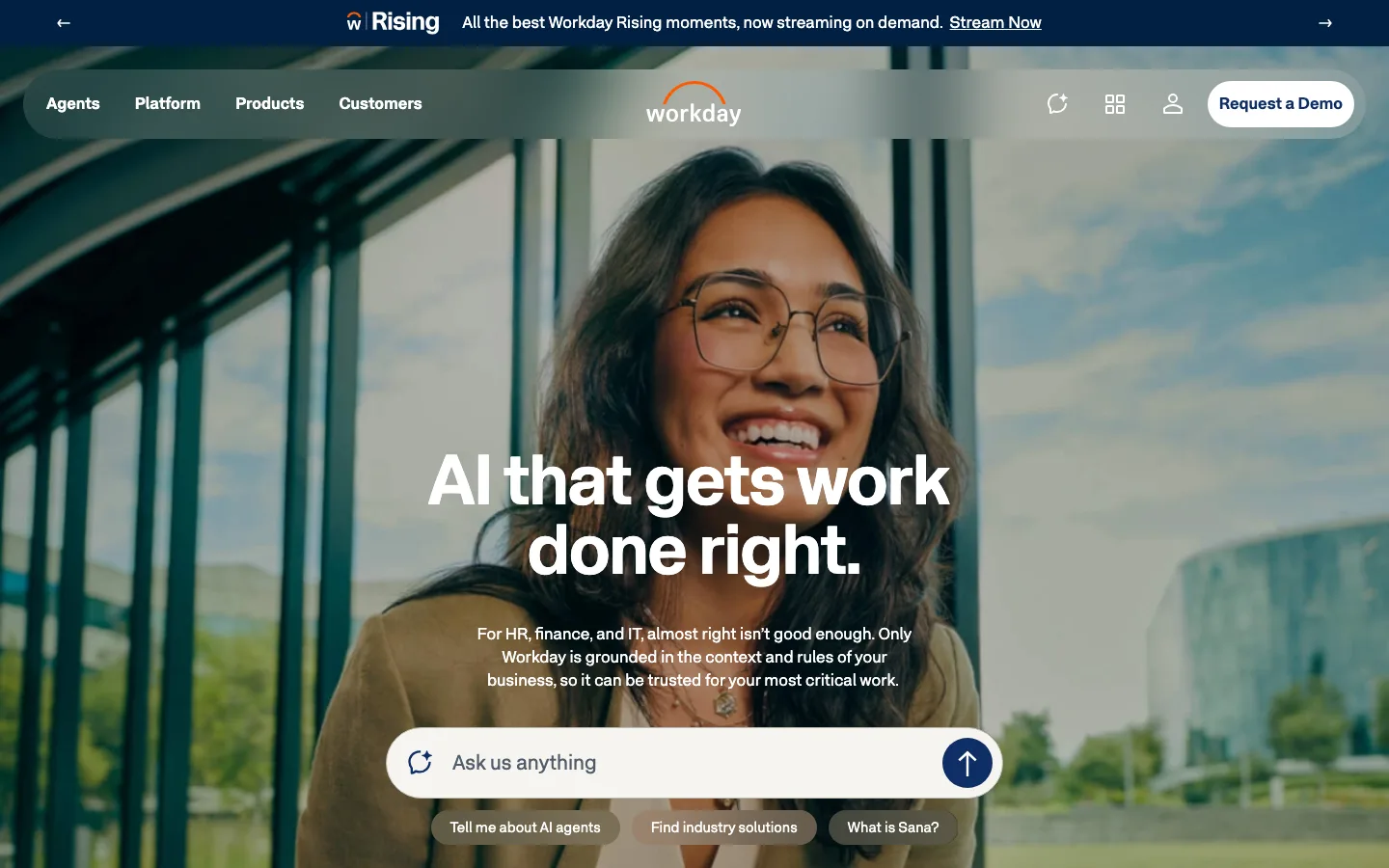
Verdict: If your company runs on Workday, its own agents are the first AI to try, because they already sit on your data.
Workday promises "AI that gets work done right", adding that "for HR, finance, and IT, almost right isn't good enough". Its front door is Sana, "your single agentic experience that orchestrates agents behind the scenes". Behind it sit HR agents for talent acquisition, employee self-service, coaching, payroll, workforce management and organizational development. The Talent Acquisition Agent "automates sourcing, screening, scheduling, and candidate communication within your secure Workday environment".
Workday says more than 11,500 organizations use it. On its homepage, it reports that 7-Eleven saves 2M+ hours a year and schedules 85% of applicants in under an hour. Paradox, now part of Workday, adds conversational frontline hiring to the same family.
The strength is grounding: the agents work on your real org, pay and policy data, inside the security model you already run. The trade-off is that the AI only makes sense for Workday HCM customers. It is not an add-on you buy for another HRIS. If you connect other tools to Workday, see our Workday integration page.
Best for: existing Workday customers.
Watch out for: the AI agents' bill grows with how much work they do, on top of the Workday subscription.
Pricing model: Flex Credits, Workday's usage-based model where "you pay for the actual work our AI completes". It is sold as an annual credit subscription with complimentary credits to start. No price on the website.
8. Rippling: best for growing companies that want HR, payroll and IT in one system

Verdict: Rippling suits growing companies that want HR, payroll, IT and finance in one system, with AI that works across all of it.
Rippling's pitch is to "manage your entire workforce on one system", covering global HR, payroll, IT and finance. Its HR suite includes recruiting, onboarding, performance and learning. Rippling AI is sold as "AI that isn't all talk". Employees get explanations of their own pay, benefits and policies "without pinging HR", and admins get reports and charts built from a plain question.
Rippling says its AI "runs on your existing permissions", so people only see what they are allowed to see. Numbers and names in an answer appear as links to the real records. AI automations run on triggers, and "before it takes action, it gets your approval".
The strength is that one system removes the integration work between HR, payroll and IT. The trade-off is the same fact from the other side: the AI is only as useful as the share of your work that lives in Rippling. Our Rippling pricing guide covers the numbers.
Best for: growing companies that want one system of record.
Watch out for: the modular price grows with each product and each employee you add.
Pricing model: per employee per month with a base fee, built from modules; quote form on the website.
9. BambooHR: best for small and mid-sized HR teams

Verdict: BambooHR is the pick for small and mid-sized HR teams that want AI inside an HRIS they can run themselves.
BambooHR pitches Bamboo AI as the move "from HR platform to HR partner", an intelligence layer built into the HRIS that 30,000 businesses use. You ask questions in plain language, and the answers are "grounded in the full context of your workforce". It will "turn data into charts and custom reports instantly" and flag burnout risk and unusual time-off patterns. BambooHR reports that Derivco cut report building from a 20-minute project to a 20-second task.
Bamboo AI also meets people where they already work: "Approve time-off requests from Claude", "Send review reminders through ChatGPT", "Ask Slack who's out today". The Core plan includes hiring and onboarding with job posting and offer letter templates. It also includes an AI Assistant for HR data questions and AI-categorized eNPS comments.
BambooHR offers a short path from sign-up to useful answers for a team without an HRIS specialist. See our BambooHR pricing guide and BambooHR integration page.
Best for: HR teams of one to a few people at small and mid-sized companies.
Watch out for: hiring is basic. BambooHR posts jobs and tracks applicants but does not find passive candidates, and a growing company may outgrow it.
Pricing model: per employee per month, tiered, with prices on the website and a quote option.
10. Lattice: best for performance reviews and manager coaching

Verdict: Lattice is for HR teams that want review cycles to take less time and managers to coach better.
Lattice calls itself "your team's daily destination for work, combining the best people and AI tools to help employees grow, managers lead, and companies succeed". It says 5,000+ teams use it. Its AI Agent is "the AI agent built for HR teams", with five jobs: coaching, review drafting, note-taking, analysis and composition.
Review drafting is the feature HR teams feel first. Lattice says it will "synthesize 1:1s, feedback, goals, and updates into a complete evidence-backed draft", so a manager edits a review instead of starting from a blank page. Lattice reports that GoCardless raised review participation from 62% to 100%. The AI draws on a year of one-to-ones, goals and feedback rather than a manager's memory of the last month.
Best for: companies running regular review cycles that want managers to spend less time writing.
Watch out for: Lattice is a performance and engagement layer, not the system of record, so it sits on an HRIS such as Workday. Drafts built from thin one-to-one notes will be thin too.
Pricing model: per seat per month, published, starting from a Foundations package. Performance, Goals and OKRs, and Engagement are base products, with Compensation and Grow as add-ons; the AI Agent comes with all base products. Enterprise by quote.
11. Culture Amp: best for turning engagement surveys into action plans

Verdict: Culture Amp is the pick when engagement surveys produce more comments than anyone has time to read.
Culture Amp describes "Culture Intelligence built on how humans actually work", pairing 15+ years of people science with AI "that amplifies your judgment, never replaces it". It says 6,000+ companies use it. Its AI Coach "accelerates high performance through instant insights, expert coaching, and targeted action plans", drawing on 1.6 billion data points.
In practice, AI Coach summarizes the themes in an engagement survey, drafts reviews and offers guided role play for hard conversations. Culture Amp is now also available inside Claude and ChatGPT, so a manager can ask about their team's results without opening another tab. The survey science behind the questions makes the AI summaries a sounder starting point.
Best for: HR teams that run engagement surveys and need action plans from the results.
Watch out for: it is an insight and coaching layer, not an HRIS, and with no public price you need a quote before you can compare cost with Lattice.
Pricing model: custom quote by product (Engage and Perform) and company size (under 200, 200 to 999, and 1,000 or more employees); AI Coach is in every plan.
12. Visier: best for people analytics across many HR systems

Verdict: Visier suits large enterprises whose people data sits in many systems and who want AI answers they can stand behind.
Visier calls itself "the people analytics leader, now the workforce context layer for enterprise AI governance and safety". Visier says "large enterprises run 80+ HR systems, each with its own schema". Visier says it is trusted by 85,000+ organizations.
Its AI includes a Workforce Insights Agent, a Workforce Planning Agent, Talent Agents and an Agent Builder. Visier MCP gives Copilot and a company's own agents "pre-built, permission-aware workforce context". Other AI tools then answer people questions from governed data instead of guessing. See our list of talent intelligence platforms for adjacent tools.
Best for: enterprises planning headcount and skills across many HR systems.
Watch out for: Visier only works once your HR sources are connected, and it is priced and sold for enterprises.
Pricing model: custom quote through sales; no price on the website.
How are AI tools for HR priced?
AI tools for HR use five pricing models. The model matters more than the headline number, because it decides what makes your bill grow.
- Per employee per month. Rippling and BambooHR charge on headcount. The bill grows with the company, whether or not anyone uses the AI.
- Per seat or per user. Lattice and Metaview charge for the people who use the product, so cost follows adoption.
- Per employee per year, unlimited use. Leena AI's Universal Assistant uses a flat license, which suits a helpdesk where volume is hard to predict.
- Usage credits. Workday's Flex Credits charge for work the agents complete. The Cognitive uses credits too, per person shown, per contact found and per interview.
- Custom quote. Paradox, Eightfold AI, Textio, Culture Amp and Visier price through sales, often by company size and product.
Per-employee pricing is predictable but grows with headcount. Usage pricing tracks value but needs a cap or a monthly review. Ask every vendor which of the two you are buying before you sign.
When should you not pick The Cognitive?
The Cognitive is a recruiting tool, and that makes it the wrong choice for most of HR's other work. Pick something else when:
- You need an HR system of record. The Cognitive is not an HRIS, payroll, benefits, performance or helpdesk tool. Rippling, BambooHR or Workday hold employee records, and Leena AI answers employee requests.
- You need job posting and application intake. The Cognitive does not post jobs or take applications the way an ATS does. Keep your ATS, or BambooHR's hiring module if you are small.
- You hire hourly workers by the thousand. Paradox is built for applicants who expect a reply by text within minutes.
- Your candidates answer texts or calls, not email. The Cognitive's outreach is email, sent from the recruiter's own mailbox.
- You want ATS sync on the entry plan. Sync with 100+ ATS comes only on higher plans.
- You want enterprise talent intelligence across internal moves. Eightfold AI covers internal mobility and talent management, which The Cognitive does not.
To start, pick the one HR job that takes the most hours and run a single real case through one tool for two weeks. If that job is hiring, open a free account of The Cognitive. The 7-day trial needs no card and includes 100 sourcing credits, enough to run a real search for an open role. Start free with The Cognitive.
Sources
- SHRM, AI in HR 2026: From Hype to Measured, Human-Centered Impact (State of AI in HR 2026, 1,908 HR professionals), 8 April 2026.
- SHRM, State of AI in HR 2026: 5 Critical Insights for CHROs, 3 April 2026.
- Gartner, Gartner Finds 38% of HR Leaders Are Piloting, Planning or Have Implemented Generative AI (179 HR leaders), 27 February 2024.
- Ashby, Recruiter Productivity, 2026 Talent Trends Report, 28 April 2026.
- LinkedIn, The Future of Recruiting 2025.
- Lattice, 2027 State of People Strategy Report (lattice.com).
- European Commission, AI Act regulatory framework, and EU AI Act Annex III.
- Colorado General Assembly, SB26-189 (replacing SB24-205).
- New York City Department of Consumer and Worker Protection, Local Law 144 of 2021, Automated Employment Decision Tools.
- Workday newsroom, Workday Completes Acquisition of Paradox, 1 October 2025.
- Lists used to build the long list, cited as text: Juicebox, "Top 12 AI tools for HR in 2026" (juicebox.ai); Darwinbox, "10 Best AI Tools for HR Teams in 2026" (darwinbox.com).
- Vendor pages, cited as text: Paradox homepage and Conversational ATS page (paradox.ai); Eightfold AI homepage and AI Interviewer page (eightfold.ai); Metaview homepage and pricing page (metaview.ai); Textio homepage, Recruiting and Feedback pages (textio.com); Leena AI homepage, HR page and pricing page (leena.ai); Workday homepage, Talent Acquisition Agent page and AI Flex Credits page (workday.com); Rippling homepage, AI page and pricing page (rippling.com); BambooHR homepage, AI page and pricing page (bamboohr.com); Lattice homepage, AI Agent page and pricing page (lattice.com); Culture Amp homepage, AI Coach page and plans and pricing page (cultureamp.com); Visier homepage and Visier AI page (visier.com).
Frequently Asked Questions
What is the best AI tool for HR teams in 2026?
The best AI tool for HR depends on the HR job: The Cognitive for recruiting, Leena AI for the HR helpdesk, Lattice for performance reviews and Visier for people analytics. The Cognitive finds people across about 900M public profiles, emails them from the recruiter's own mailbox and runs live AI video interviews, with plans from $99 a month.
What are the best AI tools for a small HR team?
BambooHR is the best starting point for most small HR teams, because its AI sits inside an HRIS with prices on the website. Rippling suits small companies that also want payroll and IT in one system, and Lattice adds performance reviews with published per-seat pricing. If hiring is the bottleneck and you have no recruiter, The Cognitive sources, emails and interviews candidates from a self-serve account.
Which AI tool answers employee HR questions?
Leena AI is the strongest pick for answering employee HR questions at enterprise scale. Its Universal HR Assistant closes tier-1 requests such as leave, letters, benefits and payroll questions. For smaller teams, Rippling AI explains pay, benefits and policies to employees, Workday has a Self-Service Agent for its customers, and BambooHR's AI Assistant answers questions about HR data.
Are there free AI tools for HR?
Yes, a few AI tools for HR let you start free. Metaview has a free plan, Textio offers a free try of Textio Feedback, and The Cognitive has a 7-day free trial with no card and 100 sourcing credits. Workday customers get complimentary Flex Credits to start, and our free AI recruiting tools at thecognitive.io/tools draft job descriptions and other hiring documents.
Can AI write job descriptions and HR policies?
Yes for job descriptions, and partly for policies. Textio generates optimized job posts from a few details and grades them with the Textio Score, and our free job description generator at thecognitive.io/generate-jd writes a first draft. Textio does not cover HR policy documents, so a general assistant such as ChatGPT or Claude drafts the policy and a person signs it off. In Gartner's 2024 survey, administrative tasks, policies and document generation were a top generative AI use case for HR, at 42%.
Which AI tools help with employee onboarding?
Rippling, BambooHR and Paradox each cover onboarding, in different ways. Rippling's HR suite onboards new hires, runs payroll and issues devices from one system. BambooHR's Core plan includes hiring and onboarding with offer letter templates. Paradox sends new hires their documents so they are ready to work on day one.
Can I use ChatGPT or Claude as an AI tool for HR?
Yes, for drafting, but not as your system of record. ChatGPT and Claude write letters, policies and job posts well, yet they do not hold employee records or apply your permissions. Several HR tools now connect to them: BambooHR lets you approve time-off requests from Claude, Culture Amp is available inside Claude and ChatGPT, and The Cognitive has a Claude connector at https://app.thecognitive.io/mcp.
Will AI replace HR jobs?
Not on current evidence: AI is changing HR jobs more than removing them. SHRM's State of AI in HR 2026 found 39% of organizations reporting shifts in job responsibilities and 24% reporting the creation of new roles. The tools on this list draft, answer routine requests and run first steps, while decisions on hiring, pay and performance still need a person.
Is it legal to use AI in hiring and HR decisions?
Yes, but AI used in hiring carries extra duties. Under the EU AI Act, AI for recruitment and selection is high-risk, with obligations applying from 2 December 2027. Colorado's SB26-189 brings duties from 1 January 2027, and New York City's Local Law 144 requires bias audits of automated employment decision tools. Keep a person on every decision and ask each vendor what it logs.
Related reading
- Best AI Recruiting Tools in 2026: The Right Pick for Every Hiring Job
- Best HR Software 2026: Full Category Breakdown by Use Case
- Talent Intelligence Software Compared: 11 Platforms for Market Data and Finding People
- The 11 Best Candidate Verification Platforms in 2026
- 13 Best Applicant Tracking Systems in 2026, Ranked
- What Is a Normal Cost Per Hire? Benchmarks by Seniority, Sector, Role and Region