Best AI Recruiting Tools in 2026: The Right Pick for Every Hiring Job
By Sparsh Goyal, Founder at The Cognitive. Published · Last updated
- The Cognitive is the best AI recruiting tool for finding people who never applied and interviewing them live on video, and Juicebox is the best self-serve AI people search with a free plan.
- For screening large applicant volumes pick HeyMilo, Ribbon, Paradox or Sapia.ai; for scheduling panels pick GoodTime; for notes on interviews your team runs pick Metaview.
- Most of the ten work on top of your ATS, and only four put prices on their website.
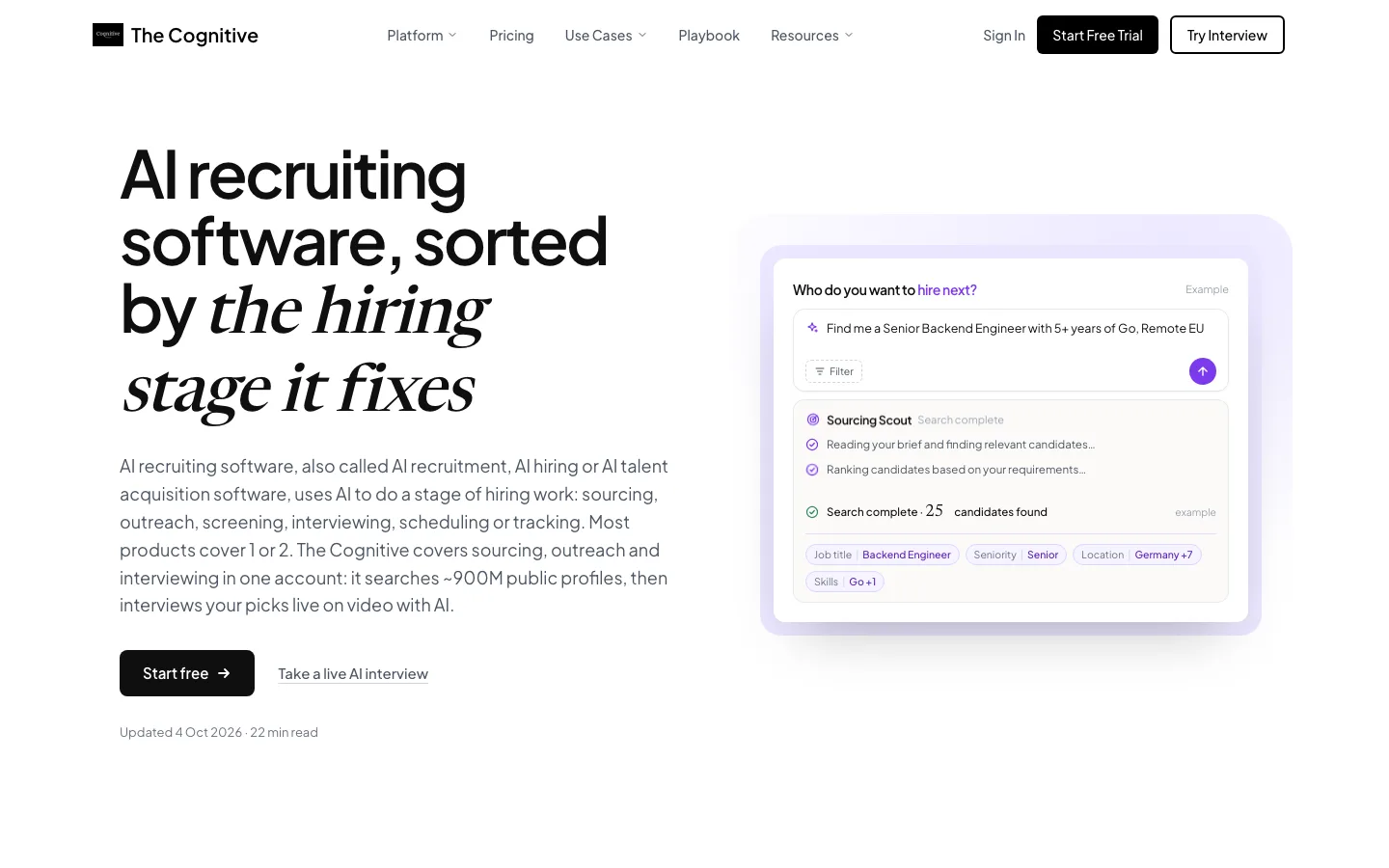
Disclosure: The Cognitive is our product.
The average recruiter now processes 291 applications for every hire, up from roughly 100 in early 2021, according to Ashby's 2026 Talent Trends Report. AI recruiting tools exist to take whole jobs off that pile. They find people who never applied, write to them, screen applicants, run a first interview, book the panel and write up the notes.
The best AI recruiting tool depends on which of those jobs you hand over. The Cognitive is the pick for finding people who never applied, across about 900M public profiles, and interviewing them live on video. Juicebox is the best self-serve AI people search with a free plan.
SourceWhale suits agency outreach and Textio job posts. HeyMilo and Paradox handle high-volume screening, and Ribbon and Sapia.ai interview applicants. GoodTime schedules interviews, and Metaview takes notes on the ones your own team runs. Most of the ten sit on top of the applicant tracking system (ATS) you already have.
The best AI recruiting tools in 2026
- The Cognitive: best for finding people who never applied and interviewing them live with AI.
- Juicebox: best for self-serve AI people search with a free plan.
- SourceWhale: best for agency outreach across email, SMS, WhatsApp and LinkedIn.
- Textio: best for writing and grading job posts and recruiting messages.
- HeyMilo: best for screening every applicant by voice, video, SMS or form.
- Paradox: best for hourly hiring run by chat and text.
- Ribbon: best for AI interviews of applicants on published plans.
- Sapia.ai: best for structured chat interviews at enterprise frontline scale.
- GoodTime: best for scheduling complex interview panels.
- Metaview: best for notes and scorecards on interviews your team runs.
What are AI recruiting tools?
AI recruiting tools are software in which the AI does a recruiting job itself, instead of only storing records about it. That job might be finding candidates, writing outreach, screening applicants or running a first interview. That is the line between an AI recruiting tool and a classic ATS.
The ATS is the system of record. The AI tool does work and hands the result back to it. Our guide to AI recruitment software versus an ATS covers that split in more depth.
Most teams already use some of this. In SHRM's Talent Trends 2025 survey, 43% of respondents use AI to support HR work, mostly for recruiting: to generate job descriptions, review or screen resumes, and automate candidate searches. The tools on this list split by the job they take over:
- Finding people. AI sourcing tools search public profiles for people who never applied. The Cognitive and Juicebox do this. Our list of the best AI sourcing tools goes deeper on this one job.
- Reaching them. Outreach tools write and send sequences and stop when someone replies. The Cognitive, Juicebox and SourceWhale do this.
- Attracting applicants. Writing tools draft and grade job posts. Textio does this.
- Screening and interviewing. AI interviewers and screeners talk to candidates by video, voice, chat or text. The Cognitive, HeyMilo, Paradox, Ribbon and Sapia.ai do this.
- Coordinating humans. Scheduling and note-taking tools support the interviews your own people run. GoodTime and Metaview do this.
Some vendors now sell these jobs as AI agents that hand work to each other; we compare those in our list of the best AI recruiter agents. If you want one system for every stage instead of a specialist per job, see our all-in-one AI recruitment platforms.
Which AI recruiting tool fits each hiring stage?
Each tool below does one recruiting job well. Four of the ten show at least some prices on their website; the rest quote after a demo.
| Tool | Recruiting job the AI does | Best for | Works with your ATS | Price on website? |
|---|---|---|---|---|
| The Cognitive | Sourcing, email outreach, live AI interview | Hiring people who never applied | 100+ ATS (higher plans) | Yes |
| Juicebox | Sourcing and outreach | Self-serve AI people search | Greenhouse, Lever, Ashby, Workday +40 (Business plan) | Yes, except Business |
| SourceWhale | Outreach, plus an agency CRM and ATS | Recruitment and staffing agencies | Ask in the demo | No |
| Textio | Writes and grades job posts | Better job ads | ATS, HRIS and LinkedIn extensions | No |
| HeyMilo | Voice, video, SMS and form screening | Staffing and high-volume teams | 20+ ATS, incl. Greenhouse, Workday, Bullhorn | No |
| Paradox | Chat and text screening, scheduling, offers | Large hourly employers | Paradox for Workday; own ATS | No |
| Ribbon | Two-way AI interviews of applicants | High-volume roles on published plans | Workday, Greenhouse, Lever, Bullhorn and more | Yes |
| Sapia.ai | Structured chat interviews | Enterprises hiring 500+ people a year | Most ATS, per Sapia.ai | No |
| GoodTime | Schedules human interviews | Complex, multi-day panels | Workday, Greenhouse, Lever, iCIMS and more | No |
| Metaview | Notes and scorecards on human interviews | Teams whose people run the interviews | Ashby, Lever, Greenhouse | Partly |
A plain "No" in the Price on website? column means the vendor asks you to book a demo or request a quote. It says nothing about whether the tool is expensive.
How we chose these 10
We considered 14 tools: the 10 here plus micro1, ModernLoop, Gem and hireEZ. A tool made the list if its AI does one recruiting job end to end and its own website sells that job to employers or agencies today. micro1 dropped out because its homepage now sells a data lab for training AI models. Gem and hireEZ are reviewed in our sourcing and recruiter agent lists, so we did not repeat them here.
We used five criteria to assess each tool, not to score them against each other; after The Cognitive, the order follows the hiring funnel.
- how much of its job the AI does on its own, rather than assisting a person;
- whether it works alongside your ATS, with named integrations;
- whether a buyer can start without a sales call (a published price, free plan or trial);
- whether a recruiter can see the evidence behind the output (a rubric, a transcript, a source);
- which team size it suits.
We assessed the other nine from their own websites, pricing pages and documentation, not paid trials, and attribute their numbers to them. The Cognitive is described from our own product.
It sits at #1 on a criterion you can verify. It is the only tool here that searches a stated pool of public profiles for people who never applied and then interviews them live on video. It is self-serve, with no sales call.
How do you choose an AI recruiting tool?
Seven questions narrow the list to one or two tools quickly.
Which recruiting job is costing you the most time?
Start with the job, not the vendor. In Gem's 2026 Recruiting Benchmarks Report, recruiters were handling 93% more applications than in 2021 while managing 13.4 open roles at a time.
If applicants are drowning you, look at screening tools such as HeyMilo, Ribbon, Paradox or Sapia.ai. If coordinating panels eats your week, GoodTime is built for it. Buying a sourcing tool for a screening problem only adds names to the pile.
Do your best candidates apply, or do you have to find them?
For many roles the right person is employed and not looking. Gem's data shows direct sourcing delivered 11% of hires from just 2.6% of applications, a 4x yield.
That gap is why sourcing tools exist. If your roles fill from inbound, put your money into screening. If they don't, you need a tool that searches beyond your applicants, such as The Cognitive or Juicebox.
Will the AI tool work with your ATS?
Ask for the named list, not a count, because vendors count integrations differently. HeyMilo names Greenhouse, Lever, Ashby, iCIMS, Workday, SuccessFactors, Bullhorn and more. It says reports, scores, transcripts and recordings appear in your ATS. Juicebox lists Greenhouse, Lever, Ashby and Workday but puts ATS integration on its Business plan.
The Cognitive syncs with 100+ ATS on the plans that include it (Sourcing Max, Interviews Pro and higher). It pulls candidates from your ATS, can send shortlisted people to a job there, and writes interview results back as a note.
Can a recruiter see why the AI decided what it decided?
Any tool that ranks or scores people should show its working: a fixed rubric, a transcript you can read, and a reason you can trace to the source. Metaview maps answers to the role's rubric, and Ribbon scores every candidate on the same criteria. The Cognitive labels each claim from a CV as Verified, Unclear or Refuted, with evidence from the interview. Our guide to AI screening software compliance covers what regulators expect.
Can you start without a sales call?
Only four of the ten publish a price, and only some let you start on your own. Juicebox has a free plan, Metaview has a free AI sourcing tier, Ribbon offers a 7-day free trial, and The Cognitive has a 7-day free trial with no card. HeyMilo, Paradox, Sapia.ai, GoodTime, SourceWhale and Textio all start with a demo. If you have one role open this month, that difference matters more than any feature.
How much time will it really save?
Expect hours, not headcount. LinkedIn's Future of Recruiting 2025 found 37% of organizations actively integrating or experimenting with generative AI tools, up from 27% a year earlier. Among those already using generative AI in hiring, the average time saved was about 20% of the work week.
In SHRM's survey, nearly 90% of people using an AI tool said it saves time or increases efficiency. Measure your own baseline before the trial, so you can tell.
What should you ask in an AI recruiting tool demo?
Bring your hardest open role to every demo and ask these five questions:
- Show me the result for this exact role, not a prepared example. How many of these people would I actually contact?
- Which ATS do you sync with by name, and what gets written back: a note, a score, a transcript, a stage change?
- When the AI rates someone, where is the evidence? Show me the rubric, the transcript or the profile line behind it.
- What do candidates see and agree to before an AI talks to them?
- What does a busy month cost: extra seats, extra credits or an overage fee?
The 10 best AI recruiting tools, reviewed
1. The Cognitive: best for finding people who never applied and interviewing them live with AI
Verdict: the only tool here that finds people across about 900M public profiles and then interviews them live on video, in one self-serve account.
The Cognitive is AI recruiting software that sources candidates, emails them and interviews them in a live AI video interview. You describe the role in plain English. The brief becomes filters, including years of experience, that you can check and correct before anyone is shown or charged. Results come 10 people to a page.
Each card opens with a "Why this match" line giving one or two reasons traced to the profile, and weaker results are marked "Possible match". Search results carry no match score. Revealing a personal email costs 4 credits and a phone number 12, charged only when a value comes back. Email outreach goes out from your own mailbox, paced like a person, and the follow-ups stop when someone replies.
The interview is where it differs from the other tools on this list that search public profiles. Candidates pick a slot, and at booking they agree to an AI interview that is recorded and transcribed. Your team makes every hiring decision. The rubric is fixed for the role and the questions follow each answer.
The AI scores what is said against the role's requirements and does not analyse facial expressions, voice tone or emotions. Claims from the CV that come up in the interview are marked Verified, Unclear or Refuted, with the evidence. Integrity notes, such as a tab left or a camera turned off, are shown to your team and kept out of the score.
Its limit is scope. The Cognitive does not post jobs, schedule your human interviews or replace your ATS. Email outreach and ATS sync come on higher plans (see pricing), and outreach is by email only. More on the AI recruiting software page.
Best for: in-house teams and agencies hiring for roles that don't fill from applicants.
Watch out for: email outreach, phone reveals and ATS sync come on higher plans (see pricing), and there is no job posting or panel scheduling.
Pricing model: monthly plans plus credits, published on the pricing page; AI Sourcing and AI Interview plans each start at $99 a month, and a 20-minute interview uses 100 credits.
2. Juicebox: best for self-serve AI people search with a free plan
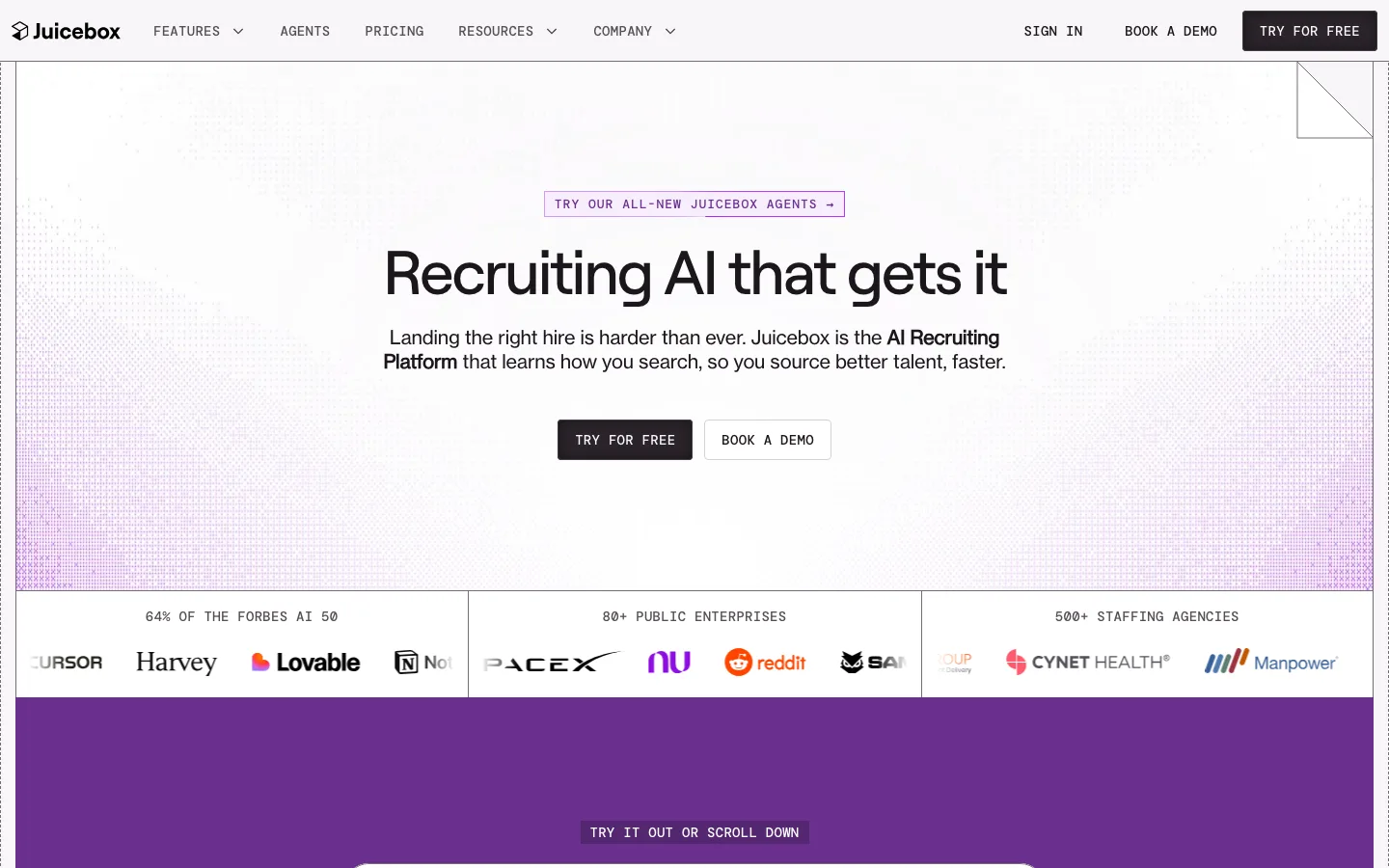
Verdict: a quick way to try AI sourcing without a sales call, as long as you screen the people it finds somewhere else.
Juicebox calls itself "The Leading AI Recruiting Platform" and promises to "find top talent from 800M global profiles and 30+ diverse data sources". You type what you want in plain language and Juicebox "builds you a ranked candidate pool". Its agents go further: "Your Agent pulls context from the JD, intake call, and past hires", then "reaches out, follows up, and tracks replies". Sequences can "include social and call steps in your cadence", so outreach is not limited to email.
The strength is how little stands between you and a first search. There is a free plan with limited free searches, paid tiers are on the website, and Juicebox says it is SOC 2 Type II certified. It also says it works with more than 500 staffing agencies.
The trade-off sits at the top of the price list. Juicebox says it "syncs with Greenhouse, Lever, Ashby, and 40+ other applicant tracking systems", but ATS and CRM integration appears only under the Business plan, which is custom and annual. And it stops at the list: Juicebox does not interview candidates.
If you are weighing it against an interview-notes tool, our Metaview vs Juicebox comparison sets them side by side. Our Juicebox alternatives list covers the other options.
Best for: independent recruiters and small teams who want AI search without a sales call.
Watch out for: ATS integration needs the custom Business plan, and there is no interview step.
Pricing model: per seat per month, with a free plan; AI agents cost extra per agent per month, and Business is quoted and annual only.
3. SourceWhale: best for agency outreach across email, SMS, WhatsApp and LinkedIn
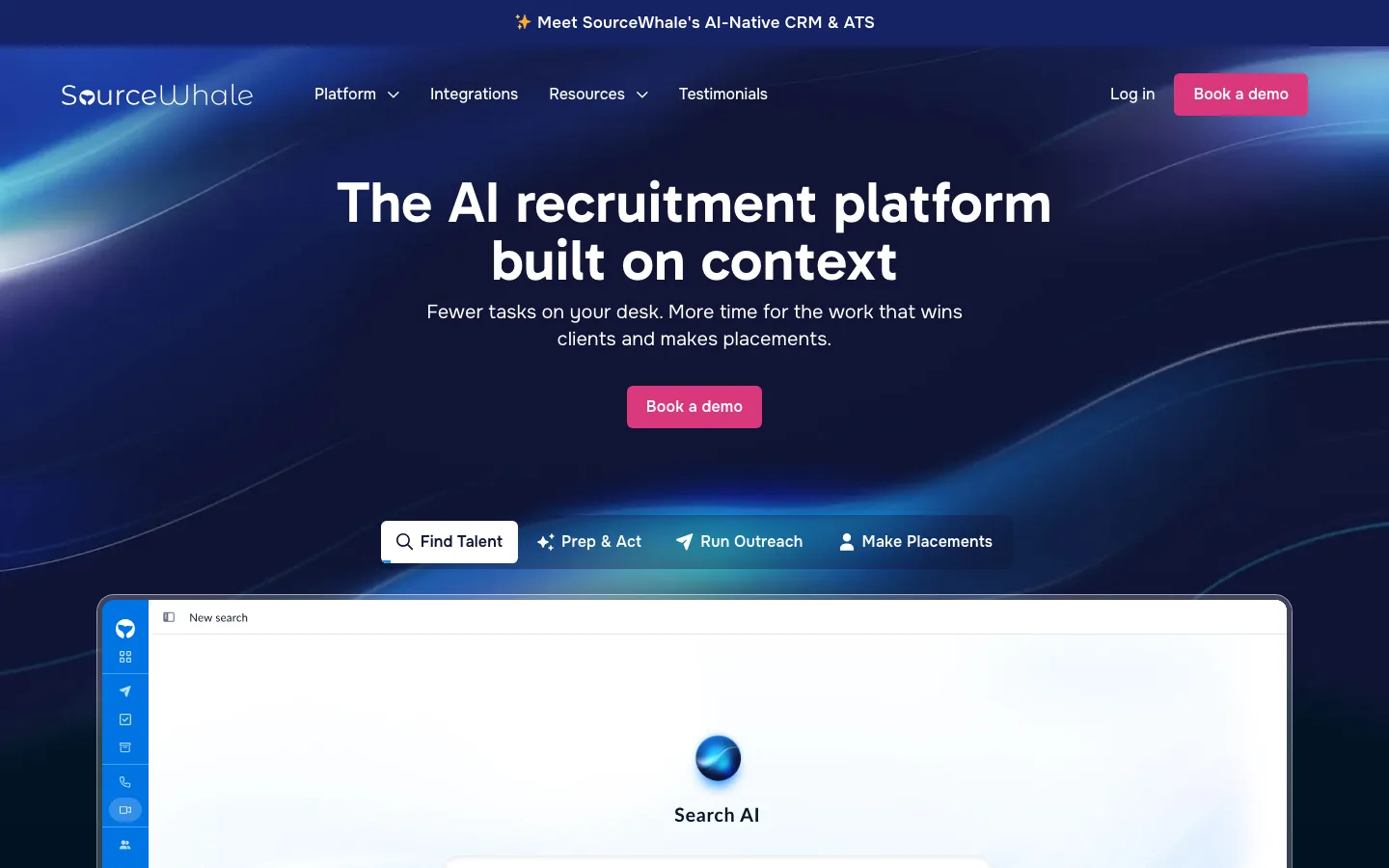
Verdict: the most channels in one campaign on this list, built for recruitment agencies rather than in-house teams.
SourceWhale describes itself as "an AI-powered suite of productivity modules for recruitment, staffing and exec search firms". The modules are Sourcing, Data, Outreach, Inbox Agent, Dialer, Notetaker, Data Refresh and, newest, an "AI-Native CRM & ATS". The outreach module is the core: "Email, SMS, and WhatsApp sent from your own mailbox, with follow-ups that trigger themselves". You can also "plan email, LinkedIn and phone in one campaign".
The strength is channel reach: an agency recruiter working a candidate who ignores email can switch to WhatsApp or a call without leaving the sequence. The dialer and notetaker keep that history in one place. The demo form asks whether you are in-house or agency, and the product reads as agency first. SourceWhale claims 17 hours back per recruiter per week; treat that as its own figure.
The trade-off is buying friction. There is no public price, and the pricing page leads to a demo form. Ask in that demo exactly which ATS or CRM SourceWhale syncs with, and whether it writes activity back. Our list of the best recruiting outreach software compares outreach tools on their own.
Best for: agencies and search firms that reach candidates on several channels.
Watch out for: no public price, and integrations to confirm in the demo.
Pricing model: quote only, through a demo.
4. Textio: best for writing and grading job posts and recruiting messages
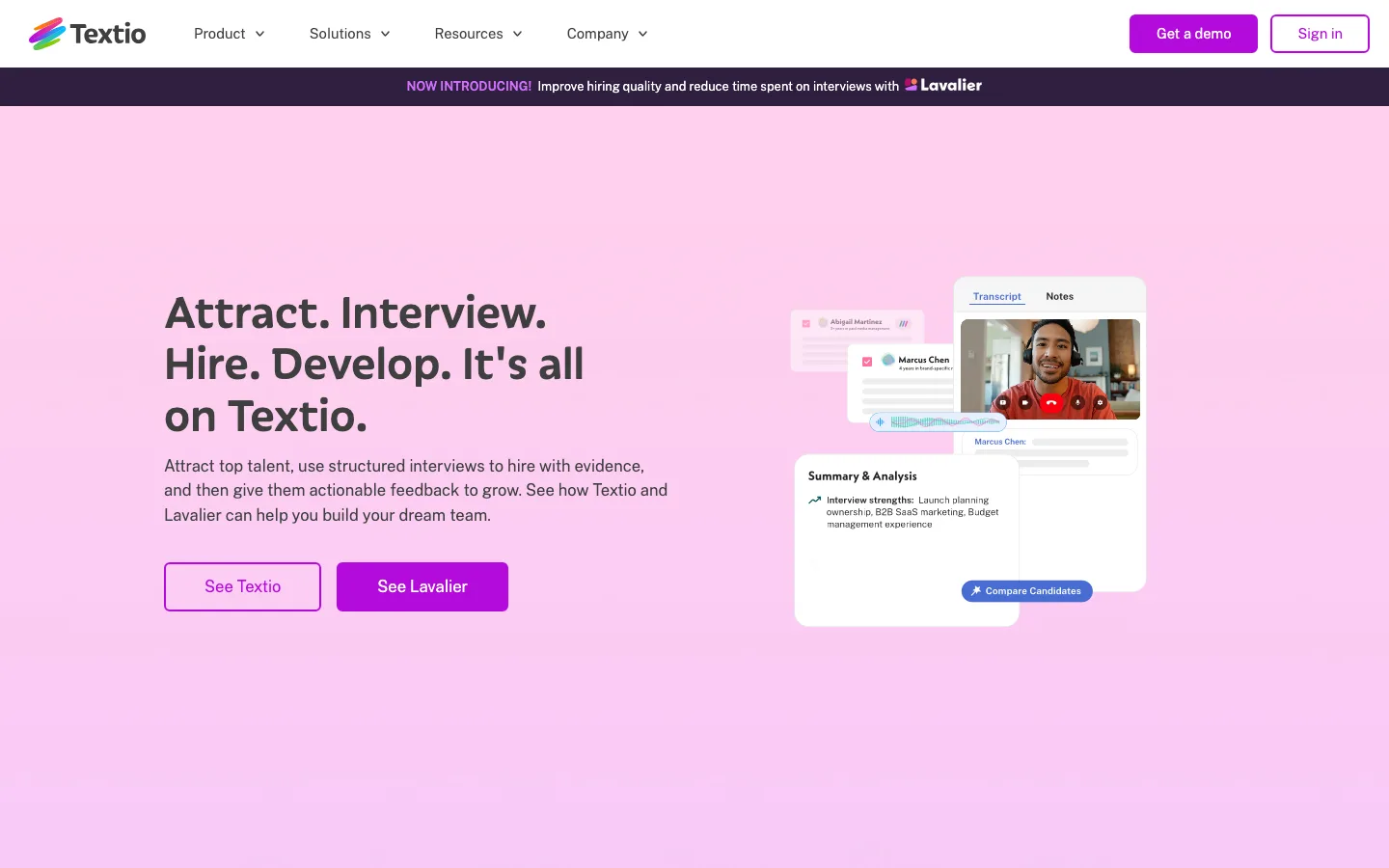
Verdict: the specialist for the words in your hiring, from the job post to the sourcing email.
Textio sells "AI for Recruiting and Performance Management". It will "generate optimized job posts from just a few details" and "write human, empathetic, and exciting sourcing messages". Then it "grades every email, post, and page to predict who will apply".
The strength is the grading. You see how a post is likely to land before it goes live, not after the applicants fail to arrive. Textio "extensions bring the power of Textio into your ATS, HRIS, and LinkedIn", so the grading happens where your recruiters already write.
Textio has also added interview intelligence, which helps "align interview questions to job requirements, document interview feedback". Textio says 25% of Fortune 500 companies have used it. For a large employer with many hiring managers writing posts, that consistency is the selling point.
The trade-off is that Textio improves the message and does nothing about who reads it. It does not find people, screen applicants or interview anyone. A small team with three open roles will get more from a better sourcing tool than from better job ads. There is no public price; Textio sells through a demo.
Best for: employers with many hiring managers who want consistent, well-graded job posts.
Watch out for: no sourcing or screening, and no published price.
Pricing model: quote only, through a demo.
5. HeyMilo: best for screening every applicant by voice, video, SMS or form

Verdict: the widest choice of screening channels here, for teams that receive far more applicants than they can call.
HeyMilo calls itself "the AI Recruiter for teams swamped by applications". It will "screen and interview every applicant with structured AI voice, video, SMS, and forms", and it "operates 24/7 in 20+ languages". The modules cover sourcing, screening, interviews, skill assessments, scheduling and cheat detection. Sourcing here means rediscovery: HeyMilo will "resurface ranked candidates from your ATS and inbound pipeline", not search the open web.
The strength is the ATS fit. HeyMilo lists 20+ ATS partners with two-way data sync. Among them are Greenhouse, Lever, Ashby, iCIMS, Workday, SuccessFactors, SmartRecruiters, Bullhorn, Avionté, JobDiva, Ceipal, Manatal, Workable, Zoho Recruit, Recruit CRM, Teamtailor and UKG. For a staffing firm on Bullhorn or JobDiva, that list alone can decide it.
"PDF reports, scores, transcripts, and recordings appear in your ATS", and HeyMilo is a native Ashby assessment partner. HeyMilo says it has screened more than 1.4M candidates.
The trade-off is that HeyMilo works on people who already applied. If your problem is an empty pipeline, it has nothing to screen. The pricing page sends you to book a demo. For more options at volume, see our list of the best high-volume hiring software.
Best for: staffing firms and high-volume employers drowning in applicants.
Watch out for: no search beyond your ATS and inbound pipeline, and no public price.
Pricing model: quote only, through a demo.
6. Paradox: best for hourly hiring run by chat and text

Verdict: the conversational assistant for employers hiring thousands of frontline workers, where speed to the first shift is everything.
Paradox sells "conversational hiring software", built around "the AI assistant for all things hiring", called Olivia. Olivia handles job search and apply, applicant screening "through chat or text", interview scheduling, video interviewing, offers, onboarding and hiring events. A candidate can find a job, answer screening questions and book an interview in one text thread.
Paradox also sells a "Conversational ATS" that lets you "post jobs, track applicants, and extend offers right from the platform", so smaller hourly employers can run the whole funnel there. Larger ones keep their ATS, and "Paradox for Workday" sits in the site navigation. The scale is the proof point: Paradox says Compass Group "hires 120,000 workers a year with a recruiting team of just 20 people".
The trade-off is fit. Paradox is built for volume hiring of hourly roles, and a quick text screen is not how you assess a senior engineer or a sales leader. There is no public price; you request a demo. Our page on Paradox alternatives covers the tools teams compare it with.
Best for: large employers hiring hourly and frontline staff.
Watch out for: a poor fit for senior or specialist roles, and no published price.
Pricing model: quote only, through a demo.
7. Ribbon: best for AI interviews of applicants on published plans

Verdict: the AI interviewer for applicants that you can price and try before you talk to sales.
Ribbon sells an "AI Recruiter for Interviews, Email & SMS". Its interviews are "real two-way conversations that adapt in real time", not scripted Q&A, and they work "on any phone, in 10 languages". You build the rubric, and "every candidate is scored on the same criteria". Ribbon adds interview integrity and cheating detection, and reaches candidates by SMS, WhatsApp and email.
The strength is openness. Ribbon publishes its plans and offers a 7-day free trial. Ribbon also lists AI sourcing and talent rediscovery on every plan. It does not say which pool of people its sourcing searches, so ask before you count on it to fill an empty pipeline.
The trade-off is in the billing. Plans are monthly but billed annually, each comes with a monthly interview allowance, seats and active roles, and interviews over the allowance cost extra. Its integrations page names Workday, Greenhouse, Lever and Bullhorn, but Ribbon's site gives more than one integration count, so confirm the named integration you need. Our list of the best AI interview platforms compares Ribbon with other AI interviewers.
Best for: high-volume teams that want an AI interviewer for applicants without a long sales cycle.
Watch out for: annual billing, overage per interview, and an unstated sourcing pool.
Pricing model: published monthly plans billed annually, sized by interview allowance, seats and active roles; Enterprise is custom.
8. Sapia.ai: best for structured chat interviews at enterprise frontline scale

Verdict: a text-based structured interview for very large employers, backed by a long list of compliance badges.
Sapia.ai calls itself "a science-based AI chat interview platform designed for faster, more efficient, and fairer hiring". Candidates answer structured questions in a chat, and Sapia.ai scores the answers. The structured chat helps "assess everyone consistently" and "give personalised feedback at scale", so every applicant hears back, not just the ones who move on. Alongside the AI Chat Interview it sells Job Analysis Studio, Interview Scheduling and a Talent Intelligence Assistant.
The strength is enterprise readiness. Sapia.ai shows ISO/IEC 42001, 27001, 27017 and 27018, SOC 2 Type 2 and GDPR badges, which shortens a security review at a large company. Its industries are retail, contact centres, healthcare, airlines, rail and graduate hiring, and it says it is "loved by 10m+ candidates". Chat also suits candidates who would rather type than appear on camera.
The trade-off is size. Sapia.ai says it is "designed to best serve companies that hire more than 500 people per year". Pricing is per hire, with no public price: "you'll only pay for the people you end up hiring". Sapia.ai says it integrates with most ATS providers, but name yours in the first call.
Best for: enterprises hiring frontline and graduate roles at scale.
Watch out for: built for 500+ hires a year, and text chat only.
Pricing model: per hire, quote only.
9. GoodTime: best for scheduling complex interview panels
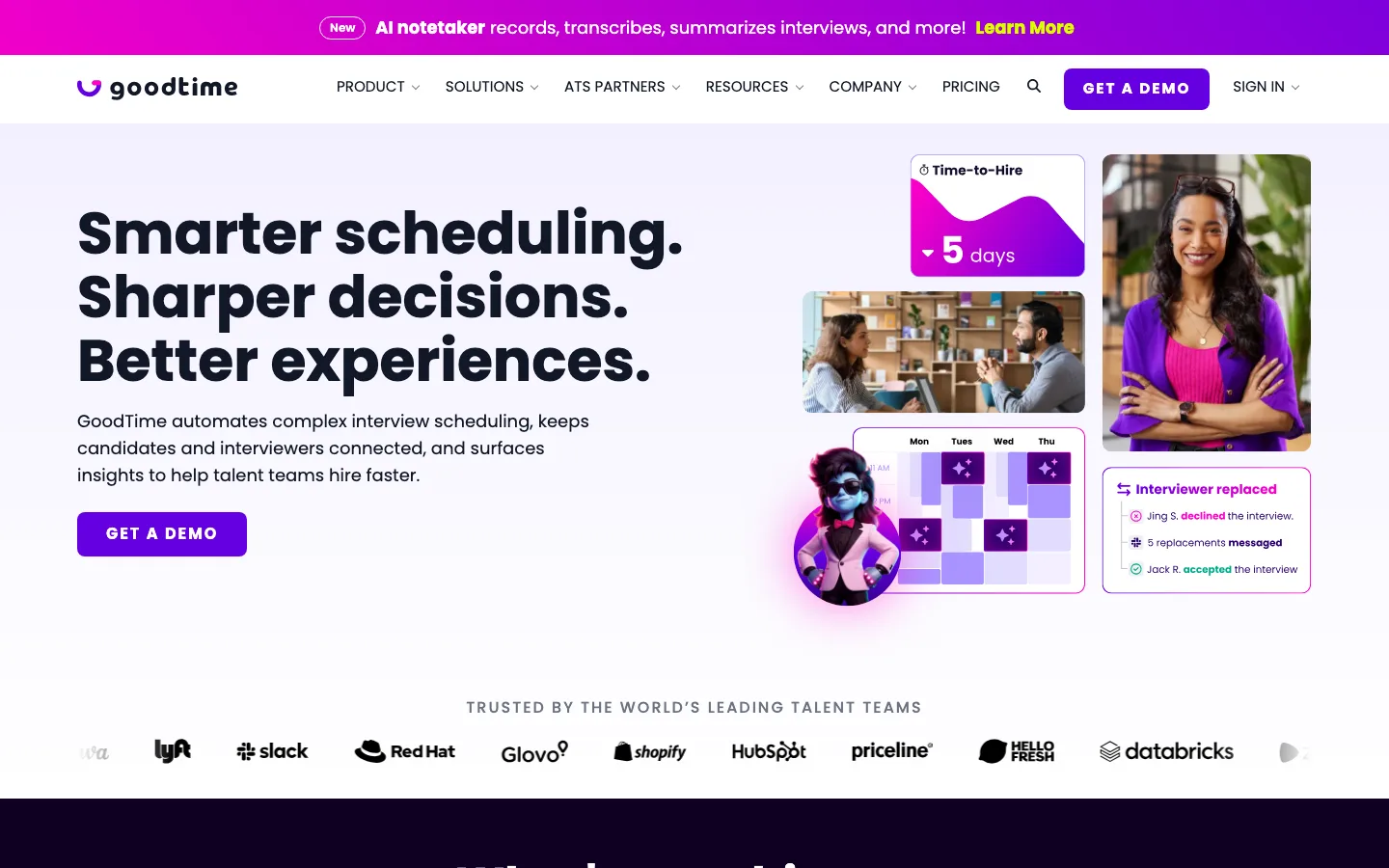
Verdict: the scheduling layer for teams where booking a five-person panel takes longer than the interview itself.
GoodTime's "AI handles the toughest scheduling challenges, surfaces insights, and helps teams orchestrate brilliant hiring experiences". It will "coordinate every interview, from 1:1 screens to complex multi-day panels", message candidates by SMS and WhatsApp, and train interviewers. It has an AI notetaker, and an AI agent called Cori that can take on "screening candidates, scheduling interviews".
The strength is the integration list, which is long and named. On the ATS side, GoodTime lists Workday, Greenhouse, SuccessFactors, SmartRecruiters, Lever, iCIMS, Ashby and Jobvite. It connects to Google, Office 365 and Outlook calendars, to Zoom, Google Meet, Teams and Webex, to Slack, and to CoderPad for technical interviews. For a scheduler, that coverage is the product.
The trade-off is that GoodTime organises interviews; it does not find candidates or run the interview with AI. It pays off when you have many interviewers and many rounds. A team that books ten interviews a month will not feel the difference. ModernLoop, another interview scheduler, is worth a look next to GoodTime.
GoodTime pricing is "based on the number of candidates annually, not the number of users. You can have as many users as you need." There is no public price; you get a custom proposal.
Best for: enterprise teams running multi-round, multi-interviewer loops.
Watch out for: no sourcing or AI interviewing, and no published price.
Pricing model: custom proposal priced by candidates per year, with unlimited users.
10. Metaview: best for notes and scorecards on interviews your team runs

Verdict: the note-taker for interviews your own people run, now growing into sourcing and screening agents.
Metaview calls itself "The Agentic Recruiting Platform", with "AI agents that share context and handle the work between first search and final offer". Its roots are interview notes. In Metaview's own words, it "joins as a visible participant, transcribes it, maps the candidate's answers against the role's rubric, and drafts the scorecard". The recruiter takes the call, and Metaview writes it up.
The strength is the scorecard workflow. Metaview offers "scorecard submission straight into Ashby and Lever, and browser-extension autofill of the objective scorecard fields in Ashby and Greenhouse". That takes the write-up off the interviewer's plate.
Its newer agent, fillmore, "finds candidates, runs personalized outreach, and books screening calls autonomously". Metaview says it is SOC 2 Type II and GDPR compliant, and its AI sourcing has a free tier.
The trade-off is that a human still runs every interview. Metaview makes that interview better documented; it does not take it off anyone's calendar. Pricing is per user per month by product, with sourcing tiers published and the full platform behind "Speak to Sales". See our Metaview alternatives if you want the AI to run the first round itself.
Best for: in-house teams whose recruiters and hiring managers run the interviews.
Watch out for: the AI does not conduct interviews, and the full platform is quoted.
Pricing model: per user per month by product, with a free AI sourcing tier; the full platform is custom.
How are AI recruiting tools priced?
AI recruiting tools are priced in six different ways, which makes them hard to compare on a spreadsheet. The model tells you more about the bill than the headline number does:
- Per seat per month: Juicebox and Metaview. Cost grows with headcount, not with how much you hire.
- Monthly plan plus credits: The Cognitive. You pay for candidates returned, contacts revealed and interviews run.
- Interview allowance: Ribbon. Plans include a set number of interviews per month, with overage on top.
- Per hire: Sapia.ai. You pay only for the people you hire.
- Candidates per year: GoodTime. Users are unlimited; volume sets the price.
- Quote only: HeyMilo, Paradox, SourceWhale and Textio.
Before you sign, ask what happens when a month runs hot: an extra seat, a block of credits or an overage fee. For tools that show their prices, see our list of affordable AI recruiting tools. Our AI recruiting software pricing guide explains each model in more depth, and our list of the best free recruiting software covers the free plans. To see how these fit with an ATS and the rest of your software, read our guide to building a recruiting tools stack.
When is The Cognitive the wrong pick?
The Cognitive is the wrong pick when your problem is not finding or first-interviewing people. Pick something else in these cases:
- You need a system of record. The Cognitive does not post jobs, take applications or manage offers. Pick an ATS first, or Paradox's Conversational ATS for hourly roles.
- You hire thousands of hourly workers. Paradox, HeyMilo and Sapia.ai are built to move huge applicant volumes by text, chat and voice.
- Your people run the interviews and you want them documented. Metaview records and writes up human-led interviews.
- Scheduling panels is the bottleneck. GoodTime books multi-day loops across calendars and video tools. The Cognitive does not schedule human interviews.
- You reach candidates by SMS, WhatsApp, phone or LinkedIn. SourceWhale covers those channels. The Cognitive sends email only.
- Your job ads are the weak link. Textio writes and grades them.
Whichever tool you lean towards, run a short test before you buy. Pick one open role, write the brief you would give a colleague, and give each shortlisted tool a week. Count the people you would really contact or advance, not the total the tool returns.
If you want to start with The Cognitive, the 7-day free trial needs no card and includes 100 sourcing credits, 1 credit per person a search shows. Start your free trial.
Sources
- Ashby, Recruiter Productivity, 2026 Talent Trends Report, 28 April 2026.
- Gem, Key takeaways from the 2026 Recruiting Benchmarks Report, 1 December 2025.
- LinkedIn, The Future of Recruiting 2025, survey of 1,271 recruiting professionals, September 2024.
- SHRM, Uncertain Economy Adds to Recruitment Challenges (Talent Trends 2025), 24 March 2025.
- Juicebox: homepage and pricing page.
- SourceWhale: homepage and outreach page.
- Textio: homepage and recruiting product page.
- HeyMilo: homepage and integrations page.
- Paradox: homepage and Conversational ATS page.
- Ribbon: homepage, integrations page and pricing page.
- Sapia.ai: homepage and pricing page.
- GoodTime: homepage, integrations page and pricing page.
- Metaview: homepage, pricing page and the blog post "The 13 best AI hiring tools for smarter recruitment in 2026".
- micro1 and ModernLoop: homepages.
Frequently Asked Questions
What are the best AI recruiting tools in 2026?
For finding people who never applied and interviewing them live on video, pick The Cognitive, and for self-serve AI people search with a free plan, pick Juicebox. For the other jobs, pick SourceWhale for agency outreach, Textio for job posts, HeyMilo, Paradox, Ribbon or Sapia.ai for screening and interviewing applicants, GoodTime for scheduling and Metaview for interview notes.
Which AI recruiting tools can interview candidates?
The Cognitive, Ribbon, HeyMilo, Sapia.ai and Paradox all run interviews or screens with AI, each in a different format. The Cognitive runs a live AI video interview with people it sourced or imported from your ATS. Ribbon runs two-way interviews that work on any phone, HeyMilo screens by voice, video, SMS and forms, Sapia.ai interviews by text chat, and Paradox screens hourly applicants by chat or text. Metaview is different: it records and writes up interviews that your own people run.
Do AI recruiting tools integrate with Greenhouse, Workday or Bullhorn?
Most do, but check the named list for your ATS rather than a count. Ribbon and HeyMilo both name Workday, Greenhouse and Bullhorn, GoodTime names Workday and Greenhouse, and Juicebox names Greenhouse and Workday on its Business plan. On Sourcing Max, Interviews Pro and higher plans, The Cognitive syncs with 100+ ATS, sends shortlisted people to a job there and writes interview results back as a note.
How much do AI recruiting tools cost?
AI recruiting tools are priced in six ways: per seat, monthly plan plus credits, interview allowance, per hire, candidates per year, or a private quote. Juicebox and Metaview charge per seat, The Cognitive uses monthly plans plus credits starting at $99 a month, Ribbon sells plans with an interview allowance, Sapia.ai charges per hire and GoodTime prices by candidates per year. HeyMilo, Paradox, SourceWhale and Textio quote privately. To start free, Juicebox has a free plan, Metaview has a free AI sourcing tier and Ribbon offers a 7-day free trial. The Cognitive has a 7-day free trial with no card and 100 sourcing credits.
Which AI recruiting tools are best for agencies, startups or enterprise?
SourceWhale and HeyMilo suit agencies, Juicebox and The Cognitive suit startups, and Sapia.ai, Paradox and GoodTime suit enterprise. SourceWhale is built for recruitment, staffing and exec search firms, and HeyMilo syncs with staffing systems such as Bullhorn and JobDiva. Juicebox has a free plan, and The Cognitive is self-serve with no sales call. Sapia.ai is designed for companies hiring more than 500 people a year, Paradox for large hourly employers and GoodTime for complex interview panels. See our guides to recruitment software for agencies, recruiting software for startups and enterprise recruiting software.
Will AI recruiting tools replace recruiters?
No, they take jobs off a recruiter's desk rather than replacing the recruiter. LinkedIn's Future of Recruiting 2025 found that among those already using generative AI in hiring, the average time saved was about 20% of the work week. The decisions stay with people: in The Cognitive, candidates agree at booking to an interview where the employer's team makes every hiring decision.
Are AI recruiting tools fair and safe to use for hiring?
They can be, if the tool shows its evidence and a person makes the decision. Look for a fixed rubric, a transcript you can read and clear candidate consent. The Cognitive scores what candidates say against the role's requirements and does not analyse facial expressions, voice tone or emotions. Our guide to AI bias in hiring and our guide to AI screening software compliance cover the risks and what regulators expect.
Related reading
- AI Sourcing Tools Compared: The 10 Best for Finding Candidates in 2026
- Affordable AI Recruiting Tools That Show Their Prices: How 10 Bill You in 2026
- Recruiting Tools Every Talent Team Needs in 2026: 10 Picks Across the Stack
- 13 Best Applicant Tracking Systems in 2026, Ranked
- The 11 Best Candidate Verification Platforms in 2026
- AI Tools for HR: The 12 Best for HR Teams in 2026