The 11 Best Candidate Verification Platforms in 2026
By Sparsh Goyal, Founder at The Cognitive. Published · Last updated
- The Cognitive is the top pick for testing a candidate's CV claims in a live AI interview; for the other checks, use Persona, 1Kosmos or Checkr for ID and selfie checks, Tofu or Greenhouse Real Talent for fake applications, Pindrop for deepfakes in live interviews, and The Work Number or the National Student Clearinghouse for records.
- The Cognitive's live AI video interview tests up to 5 CV claims or gaps per candidate and returns Verified, Unclear or Refuted with evidence, but it does not check IDs, and it is not a live deepfake detector for your own video calls.
- Only 39.0% of companies verify employment for every hire (iProspectCheck, 2026 survey of 1,500 US employers), so pair tools across hiring stages rather than relying on one.
The best candidate verification platform depends on which check you need: fake applications, legal identity, a fake person in the interview, CV claims, or employment and education records. The need is real. In iProspectCheck's 2026 survey of 1,500 US business managers and owners, 22.9% said they had knowingly interviewed a proxy or suspected deepfake candidate.
Disclosure: The Cognitive is our product.
Which candidate verification platform fits which check?
No single tool does all five checks. Pick by the stage you need to cover:
- The Cognitive: best for testing a candidate's CV claims in a live AI interview.
- Tofu: best for flagging fake applicants inside the ATS you already use.
- Greenhouse Real Talent: best for teams already hiring on Greenhouse.
- Persona: best for ID and selfie checks you can repeat at any hiring stage.
- 1Kosmos: best for proving the same identity from interview to first login.
- Checkr: best for an ID check that runs right before the background check.
- Pindrop Pulse for Meetings: best for deepfake and voice alerts in Zoom, Teams and Webex interviews.
- HireVue: best for integrity signals inside HireVue interviews and assessments.
- Talview: best for face, voice and device checks that run through the whole interview.
- The Work Number: best for employment history without calling past employers.
- National Student Clearinghouse: best for US degree and enrollment checks.
The Cognitive is first because it is the one tool here built to test a candidate's own CV claims in a live interview, and it also finds the candidates. The other ten follow the order a candidate meets them, from application to offer.
What is a candidate verification platform?
A candidate verification platform is software that checks a job candidate is a real person, stays the same person through hiring, and can back up their claims. In practice, the category covers five different jobs. Each tool in this list is built for one or two of them:
- Application fraud screening. Signals on the application itself: phone number, email, IP address, location, device and repeat applications. Tofu, Greenhouse Real Talent and Checkr's fraud suite work here.
- Identity verification. A government ID document, a selfie and a liveness check. Persona, 1Kosmos, Checkr, Talview and CLEAR (inside Greenhouse) do this.
- Interview integrity and deepfake detection. Checks during the interview for swapped faces, cloned voices or a different person from round to round. Pindrop, Tofu, HireVue and Talview work here.
- Claim verification. Whether the candidate can back up what their CV says when asked about it. The Cognitive does this inside a live AI video interview.
- Record verification. Past employers and degrees, checked against records. The Work Number, the National Student Clearinghouse and Checkr do this.
An ID, selfie and liveness check works in three steps. The candidate photographs a government ID, such as a passport or driver's license, and takes a selfie. The platform checks the document and matches the selfie to the photo on it. A liveness test then checks that a live person is in front of the camera, not a photo, a video or a deepfake. Checkr says its version takes about two minutes. Persona and CLEAR send the employer a pass or fail rather than the documents.
Identity verification is not a background check, and the vendors say so themselves. Greenhouse's Real Talent FAQ puts it plainly: "CLEAR is identity verification, not a background check." Pindrop says its interview product "doesn't verify identity or perform a background check." If you need criminal records, motor vehicle reports or drug tests, read our comparison of background check software instead.
In June 2025 the US Department of Justice announced coordinated actions against North Korean remote IT worker schemes. It said the workers had obtained jobs with more than 100 US companies using stolen and fake identities. Searches covered 29 known or suspected laptop farms across 16 states. A laptop farm is a house where company laptops sit so remote workers abroad appear to be working from inside the US. Gartner expects the problem to grow: by 2028, it says, 1 in 4 candidate profiles worldwide could be fake, as reported by HR Dive.
That is the extreme end. Most verification work is ordinary: a degree that was never finished, a job title that grew between employers, an interview where someone else feeds the answers.
How do candidate verification platforms compare?
The quick version: 5 of the 11 describe a government ID and selfie check, 5 work inside the interview, and 3 check employment or education records.
| Tool | Best for | What it checks | ID + selfie? |
|---|---|---|---|
| The Cognitive | CV claims in a live AI interview | Up to 5 CV claims or gaps per candidate; camera face check; integrity notes | No |
| Tofu | Fake applicants in your ATS | Synthetic identities, impersonation, location; face swaps and voice clones in interviews | Not described |
| Greenhouse Real Talent | Teams on Greenhouse | Phone, email, IP and location signals; CLEAR document and biometric check | Yes, through CLEAR |
| Persona | ID checks at any stage | Government ID, selfie liveness, device and location signals, link analysis | Yes |
| 1Kosmos | One identity from hire to login | Government ID, live face capture matched to the document, liveness | Yes |
| Checkr | ID check before a background check | ID, selfie, liveness, deepfake detection, AI-generated applications, employment | Yes, as an add-on |
| Pindrop Pulse for Meetings | Deepfakes in live interviews | Synthetic video and voice, VPN and location risk, voice changes between rounds | No, in Pindrop's own words |
| HireVue | Integrity inside HireVue | Loss of focus, location, identity continuity, browser monitoring, snapshots | Listed, method not described |
| Talview | Checks through the interview | Selfie or ID match to a base image, then face, voice and device | Yes |
| The Work Number | Employment history | Work history from employer-contributed payroll records | No |
| National Student Clearinghouse | US degrees | US degrees, enrollment, high school diplomas | No |
How are candidate verification platforms priced?
Candidate verification is sold four ways: per check or report, as an annual subscription sized by applicant volume, as plans with credits, or by quote. Per-report pricing suits low volumes. Volume plans suit teams that see thousands of applicants a year. 5 of the 11 publish at least some pricing on their own site, and 5 sell only by quote.
| Tool | Pricing model | Price on website? |
|---|---|---|
| The Cognitive | Plans plus credits; a 20-minute interview uses 100 credits | Yes, plans from $99 |
| Tofu | Annual subscription sized by applicants and interviews; free fraud scan of up to 10 applicants | Yes |
| Greenhouse Real Talent | Quote, through a pricing request form | No |
| Persona | Platform plans, volume-based; candidate verification sold through a consultation | Base platform plan only |
| 1Kosmos | Quote | No |
| Checkr | Per-report packages, with ID and employment checks as add-ons; enterprise quote | Yes |
| Pindrop Pulse for Meetings | Quote | No |
| HireVue | Quote; free for candidates | No |
| Talview | Quote, through a form; can be paid with Azure credits | No |
| The Work Number | Pay per report, or an enterprise contract | Yes, starting prices for some reports |
| National Student Clearinghouse | Per verification, with pricing set by verification type | Not confirmed |
How we chose these 11
We started from the five jobs above and looked for products whose own website describes a hiring use. General identity or fraud products with a hiring logo on them did not count. To get in, a tool had to cover one or more of the five jobs for hiring teams. It also had to explain on its own pages what it checks and how it is sold. That gave 11.
Some well-known names are elsewhere on purpose. GoodHire, Certn, First Advantage, HireRight and Sterling are background check vendors, compared on our background check software page. Reality Defender sells deepfake detection for calls and meetings in general, and we found no hiring-specific product page, so it is out. CLEAR appears inside the Greenhouse Real Talent entry, because its hiring product runs through Greenhouse.
For each tool we read the product page, the pricing page and any help or FAQ pages, and we quote claims in the vendor's own words. We judged five things: what the check proves, when it runs, what the candidate has to do, which ATS and video tools it plugs into, and how it is priced. We did not run the other ten tools on paid accounts. Detection rates, record counts and customer numbers are each vendor's own claims, labelled as such.
The Cognitive is first on a criterion you can check. It is the one tool here built to test a candidate's own CV claims in a live interview and return a verdict on each, and it also finds the candidates in the first place. The rest follow the order a candidate meets them: application, identity, interview, then records.
How do you choose a candidate verification platform?
Work through these six questions with whoever owns hiring risk on your team. Each answer rules tools in or out.
Which kind of fraud are you actually seeing?
Start from your own incidents, not a vendor's threat report. In iProspectCheck's survey (2026), 40.3% of employers had withdrawn a job offer over resume fraud or credentials they could not verify. If that is your problem, you need record checks and a harder first interview, not a deepfake detector. If recruiters keep meeting candidates whose face or voice changes between rounds, look at an identity check or an interview tool such as Pindrop or Talview.
At which stage should the check run?
Earlier is cheaper, and later is more certain. The FBI's Internet Crime Complaint Center addressed this in a January 2025 public service announcement. It told employers to "implement identity-verification processes during interviewing, onboarding, and throughout the employment of any remote worker." Persona is built to reverify at each stage. Checkr runs its ID check right before the background check, and Greenhouse lets you trigger CLEAR before interviews or offers.
Do you need proof, or a flag for a person to review?
An ID check with a liveness test gives a pass or fail on identity. Fraud signals and deepfake detectors give a risk flag that someone has to judge. Pindrop puts it this way: "A flag should trigger a documented human review, not an automatic rejection." Know which one you are buying, and write down who reviews flags and how fast.
Does it plug into your ATS and your video tool?
A check that lives outside your ATS gets skipped on busy weeks. Tofu labels applicants inside the ATS, and Persona announced integrations with Ashby, Greenhouse and Workday. Greenhouse Real Talent only exists inside Greenhouse. Pindrop works in Zoom, Microsoft Teams and Webex, and Talview runs on Microsoft Teams. The Cognitive syncs with 100+ ATS. For the rest of a remote hiring stack, see our list of the best tools for remote recruitment.
What will an honest candidate have to go through?
Every extra step costs you some good candidates, so count the minutes. Checkr's ID check allows up to three resubmission attempts. Greenhouse does not treat a candidate who declines the CLEAR check as failing. Interview-based tools such as Pindrop add no step for the candidate at all, which is their main advantage.
Who holds the selfie, the ID and the voice sample?
Selfie matching and voice matching are the checks most likely to count as biometrics under laws such as Illinois's Biometric Information Privacy Act. Ask each vendor where those files live and for how long. Some vendors keep them away from you on purpose. Greenhouse gets a pass or fail while selfies and IDs stay with CLEAR. Persona returns results "as a simple pass or fail, shielding your team from private candidate information."
The 11 candidate verification platforms, reviewed
1. The Cognitive: best for testing a candidate's CV claims in a live AI interview
Verdict: among the tools here, the one built to test a candidate's own CV claims in the interview and return a verdict on each. It does not check IDs.
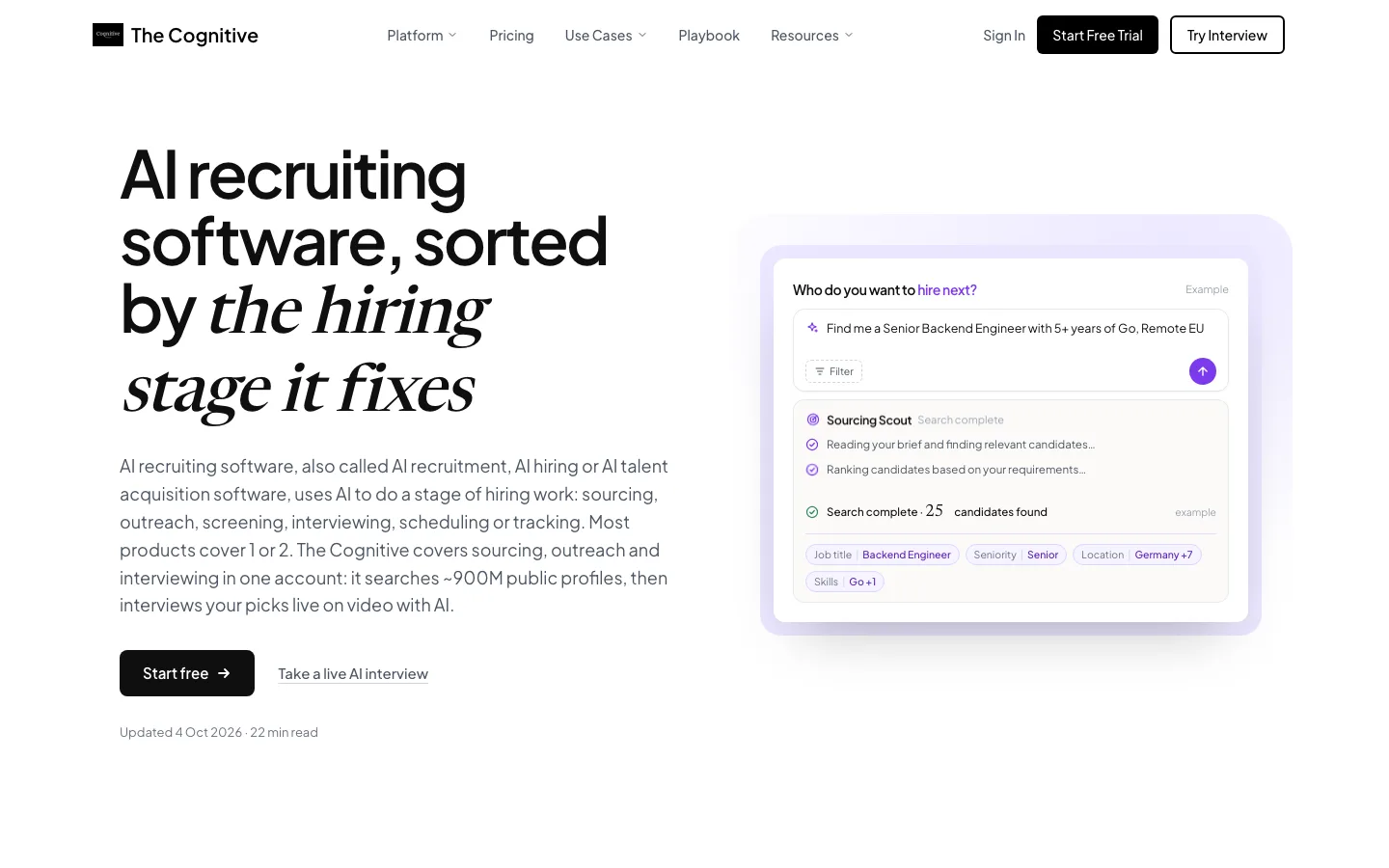
The Cognitive is AI recruiting software that finds candidates and interviews them. It searches about 900M public profiles from a plain-English brief and shows 10 people a page, with a "Why this match" line on each. It reaches them by email from the recruiter's own mailbox. Candidates you source, or import from one of the 100+ ATS it syncs with, can then take a live AI video interview.
The verification work happens before and after that interview. Before it starts, The Cognitive picks up to 5 claims or gaps per candidate from their CV and profile: claims that need checking, and gaps against the role's criteria. The AI interviewer probes those points in conversation.
Afterwards, each one comes back Verified, Unclear or Refuted. The evidence from the interview is quoted or paraphrased next to it, under a "Verified in this interview" heading in the report. A Refuted verdict means the candidate's answers contradicted the claim or clearly failed to support it. It is not a record check and does not prove or disprove employment or a degree.
During the interview, a camera check sends a still every few seconds to an automated face-detection service. It reports whether a face is in view, whether it faces the screen and how many faces are in view. Leaving the interview tab and turning the camera off are noted too. These integrity notes are shown to the hiring team. A note never lowers a score by itself, and nothing rejects a candidate automatically.
The booking page and the start of the interview both tell the candidate it is an AI interview, describe the camera check and ask for agreement. The consent also says the interview does not analyse facial expressions, voice tone, emotions or personality. For more on the interview itself, see the AI interviewer page or our list of the best AI interview platforms.
Best for: recruiters and small teams who source their own candidates and want each CV tested in a first-round interview before anyone spends an hour on it.
Watch out for: no ID document check, no liveness check, no real-time deepfake alerts for your own calls and no background or record checks. Pair it with one of the identity or record tools on this list.
Pricing model: plans plus credits, from $99; a 20-minute interview uses 100 credits. Email outreach and ATS sync come with the higher plans. The Cognitive publishes its prices.
2. Tofu: best for flagging fake applicants inside the ATS you already use
Verdict: a tool built for screening inbound applications for fraud, with a published price and a free scan to try it.
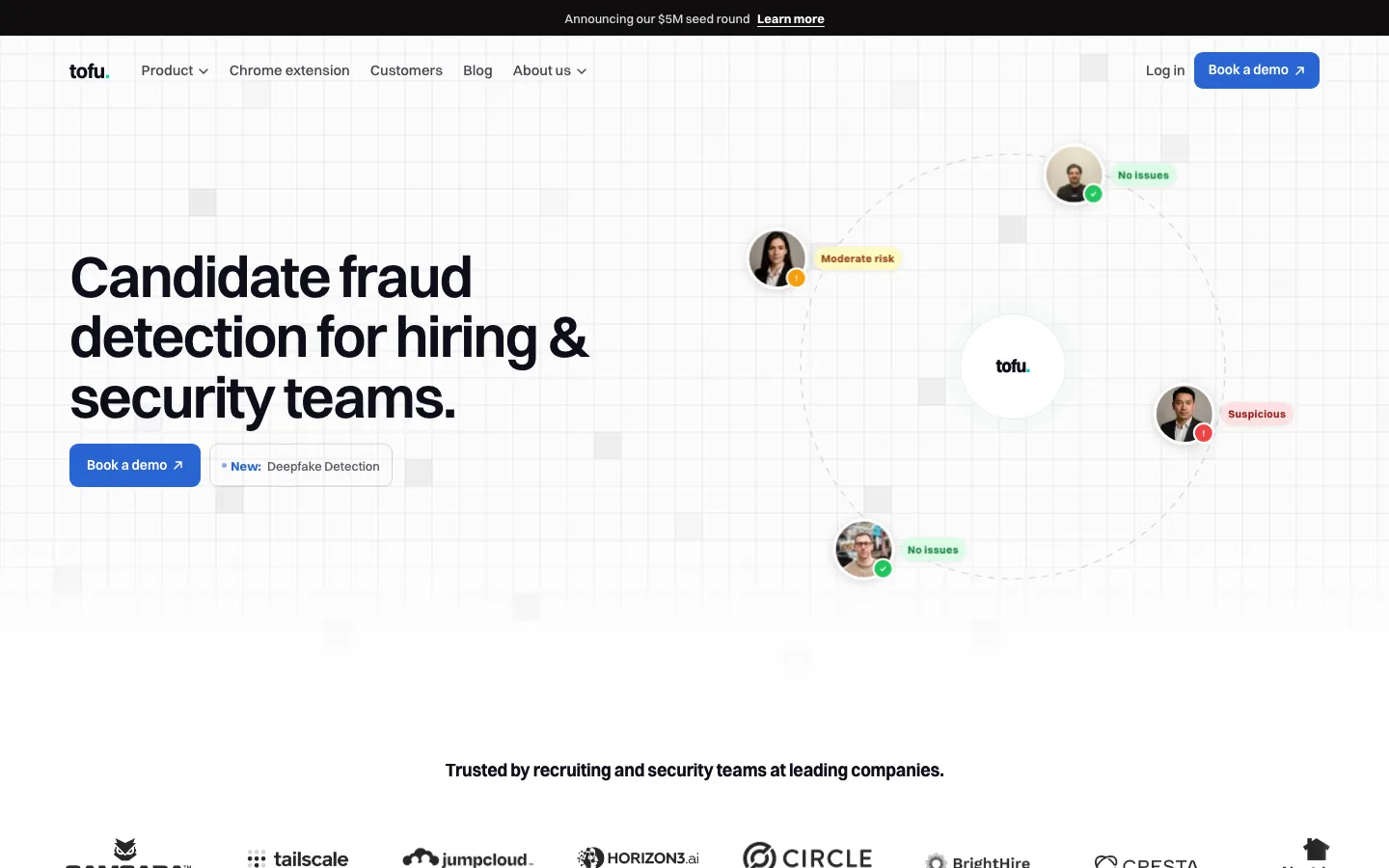
Tofu sells candidate fraud detection to hiring and security teams. In its own words, "Tofu sits on top of your ATS and sees every application that enters your hiring funnel." It looks for identity theft, impersonation, synthetic identities and state-sponsored actors. Tofu says it checks applicants against more than 4 billion data points and its own fraud database built from over 18 million profiles. Those figures are Tofu's own. Likely fakes get a label inside your ATS, so recruiters see the warning where they already work.
Tofu also sells deepfake detection for live interviews. It says the product "catches face-swaps, voice clones, and proxy candidates in real time." It reads lip sync, eye movement, facial structure and voice patterns, and plugs into Zoom, Google Meet, Microsoft Teams and AI note-takers. That makes Tofu one of the few tools here that covers both the application and the interview. Its checks run on every applicant without asking anyone to do anything.
Best for: teams with high inbound volume on remote roles who want fraud flags inside their existing ATS.
Watch out for: Tofu flags risk and does not describe collecting an ID document, so a real applicant who gets flagged needs another way to prove who they are. Tofu is also young; its site announces a $5M seed round.
Pricing model: annual subscription sized by applicants and interviews; the Growth plan covers up to 15,000 applicants and 500 interviews a year. There is a free fraud scan of up to 10 applicants and custom Enterprise pricing. Tofu publishes a price.
3. Greenhouse Real Talent: best for teams already hiring on Greenhouse
Verdict: the simplest option if Greenhouse is already your applicant tracking system (ATS), because nothing new needs wiring.
Greenhouse Real Talent is a set of features inside the Greenhouse ATS: candidate fraud detection, identity verification and candidate matching. The fraud detection "flags suspicious applications by analyzing signals like phone number, email, IP address and location." A blocklist lets you shut out IP addresses and email domains that keep sending spam applications.
Identity checks come from CLEAR, under a partnership the two companies announced in June 2025. CLEAR combines biometric signals, document checks and outside data sources. Greenhouse lets you trigger the check at key points, such as before interviews or offers. The selfie and ID stay with CLEAR, and Greenhouse only receives a pass or fail. Candidates can decline, and Greenhouse states that "declining is not considered a failure", which keeps the step optional.
Best for: Greenhouse customers who want application fraud signals and an optional ID check without another vendor contract.
Watch out for: Real Talent is part of Greenhouse, so it is not an option on Lever, Ashby, Workday or any other ATS. CLEAR checks identity only, so records still need a separate screen.
Pricing model: quote, through a form to request pricing details. Greenhouse does not publish a price for Real Talent.
4. Persona: best for ID and selfie checks you can repeat at any hiring stage
Verdict: an identity check covering IDs from more than 200 countries, built to run more than once, with integrations for Ashby, Greenhouse and Workday.
Persona is an identity verification company with a product made for hiring, launched in March 2026. Its candidate verification page says it can "collect and verify government ID documents, such as passports and driver licenses, from more than 200 countries and territories." On top of the document, Persona offers selfie liveness checks, video verification and device binding against deepfakes. It also reads device and location signals such as IP address, VPN use and device fingerprints. Link analysis spots repeat and coordinated applications, and behaviour signals watch for unusual copy and paste, completion time and hesitation.
The idea that sets Persona apart is repetition. You can "reverify at any hiring stage to ensure the same candidate applies, interviews, and accepts the offer." That answers the bait-and-switch problem directly: one person passes the ID check, and another shows up for the interview or the first day. Results come back as a pass or fail, so your recruiters never handle the candidate's ID.
Best for: remote and international hiring on Ashby, Greenhouse or Workday, where the same person must be confirmed at several stages.
Watch out for: the candidate has to photograph a document and take a selfie. The result confirms who someone is, not whether they can do the job or held the jobs on their CV.
Pricing model: platform plans with volume-based pricing. Persona publishes a starting price for its base platform plan, but its candidate verification page asks you to book a consultation.
5. 1Kosmos: best for proving the same identity from interview to first login
Verdict: the pick when hiring fraud is also a security problem, because the identity you check at hire is reused for system access.
1Kosmos sells identity verification for the workforce. Its hiring pitch is "Know your employee, from application to exit." 1Kosmos argues that deepfake candidates, synthetic identities and help desk social engineers all work the same way, by posing as your staff. Its answer is to verify identity once and prove it "at every interview, login, and reset." The identity checked at hire becomes the identity the employee uses to sign in later.
The clearest public example is Kforce. On 21 October 2026, 1Kosmos announced that the staffing firm had picked its platform for the roughly 17,000 consultants Kforce places each year. Every Kforce hire completes a mobile identity check. The platform validates a government-issued ID, captures a live facial image and checks that the person matches the document. Liveness detection looks for a photo, video or deepfake in place of a person. Kforce went live in less than six weeks. That is a vendor press release, but it names a customer and a number.
Best for: staffing firms and companies hiring remote IT workers, where a fake hire would get system access.
Watch out for: 1Kosmos is an identity platform first, so it does not look at the CV, the interview answers or the records behind them. It is an IT and security purchase as much as a recruiting one, so expect your security team in the room.
Pricing model: quote. 1Kosmos does not publish a price.
6. Checkr: best for an ID check that runs right before the background check
Verdict: one vendor for identity, fraud signals and employment records, next to the background check many US employers already run.
Checkr calls itself an AI-powered verification platform for high-stakes decisions. It says it has mapped over 260 million real identities, covering 96% of US adults, and serves more than 140,000 businesses (Checkr's figures). Its identity verification add-on "adds a quick document and liveness check before the background check starts." The check takes about two minutes. A failed or unfinished check stops the background check from starting.
The fraud suite goes further. Checkr lists ID checks with "NIST Level 2-certified deepfake detection" and interview deepfake analysis that flags synthetic or AI-altered content for your team to review. It also detects AI-generated and synthetic applications, catches a Social Security number that belongs to someone else, and keeps an internal blocklist. Location checks are marked "Join the waitlist". For employment history, Checkr says most checks finish in under 3 days and 16% come back instantly. It works through payroll connections, document review and employer outreach. Checkr bought Truework in April 2025, and its homepage announces the acquisition of Truv. For package detail, see our background check software comparison.
Best for: US employers already running Checkr background checks who want identity and fraud checks in the same flow.
Watch out for: Checkr's ID check is tied to the background check stage; catching a proxy in an early interview needs its separate interview deepfake analysis or another tool. Checkr is a consumer reporting agency, so its reports bring Fair Credit Reporting Act (FCRA) duties.
Pricing model: per-report packages, with identity and employment verification sold as add-ons, and an enterprise quote. Checkr publishes prices.
7. Pindrop Pulse for Meetings: best for deepfake and voice alerts in Zoom, Teams and Webex interviews
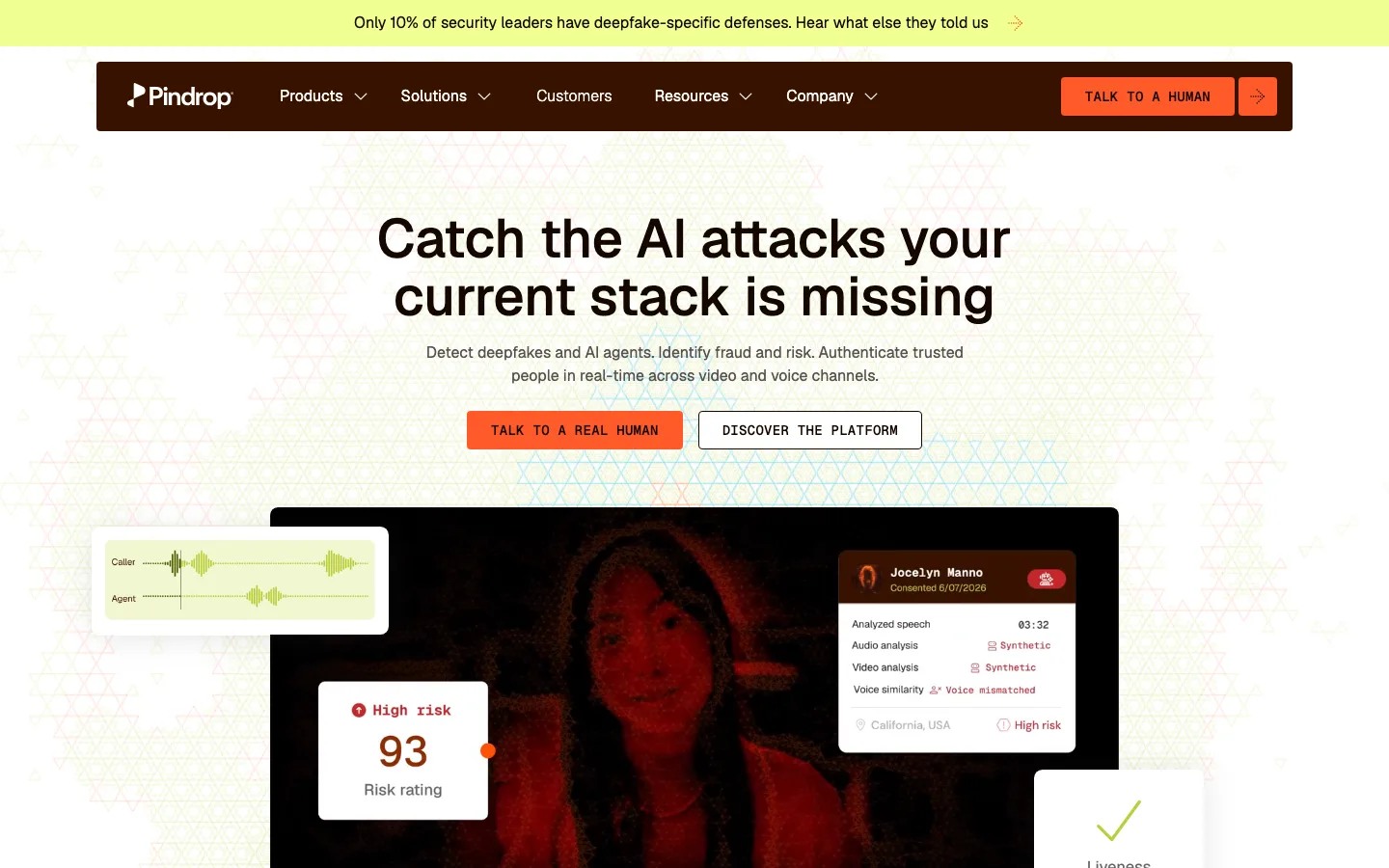
Verdict: the specialist for catching a fake person inside the interviews your own team already runs, and unusually candid about what it cannot do.
Pindrop Pulse for Meetings is Pindrop's hiring product, pitched at catching a fake job candidate before they are hired. Pindrop's hiring fraud detection "analyzes the interview itself for deepfake video and audio, and other risk signals like VPN usage and location intelligence." It runs in Zoom, Microsoft Teams and Webex, so your interviewers keep the tools they use today.
The feature that matters most for proxy fraud is the comparison across rounds: "Pulse compares the voice across interviews, so you know if the candidate changed." That targets the switch where a skilled stand-in passes the technical round and the real applicant shows up later. Pindrop's homepage cites its own Remote Hiring Study from June 2025, which found that 1 in 6 job applicants showed signs of fraud. That is vendor research, so treat it as Pindrop's claim.
Best for: companies hiring remote engineers or other high-risk roles through live video interviews run by their own people.
Watch out for: Pindrop's own FAQ says the product cannot verify identity or replace a background check. It flags risk inside the call, so pair it with an ID tool.
Pricing model: enterprise quote through a demo. Pindrop does not publish a price.
8. HireVue: best for integrity signals inside HireVue interviews and assessments

Verdict: a sensible choice if you already screen with HireVue, less so as a standalone verification purchase.
HireVue is an interviewing and assessment platform, and its fraud features live inside those products. It calls them "the integrity layer that flags cheating signals in the hiring process." The listed features are loss of focus, location signals, identity continuity, browser monitoring, disabling paste, candidate transparency, ID verification and fraud reporting.
Identity continuity is the useful one for proxy fraud. HireVue says you can "confirm the same person remains present throughout the process." It does that with candidate snapshots and automatic flags when the browser loses focus or the session changes. ID verification appears in the feature list, but the page does not describe how it works. Ask in a demo whether it means a document and selfie check or something lighter. HireVue says the platform is free for candidates. For in-interview cheating signals across vendors, see our guide to AI interview cheating detection.
Best for: enterprises that already run HireVue video interviews or assessments at volume.
Watch out for: the signals only cover interviews and assessments that happen on HireVue, and how the ID verification feature works is not described publicly.
Pricing model: enterprise quote. HireVue does not publish a price.
9. Talview: best for face, voice and device checks that run through the whole interview
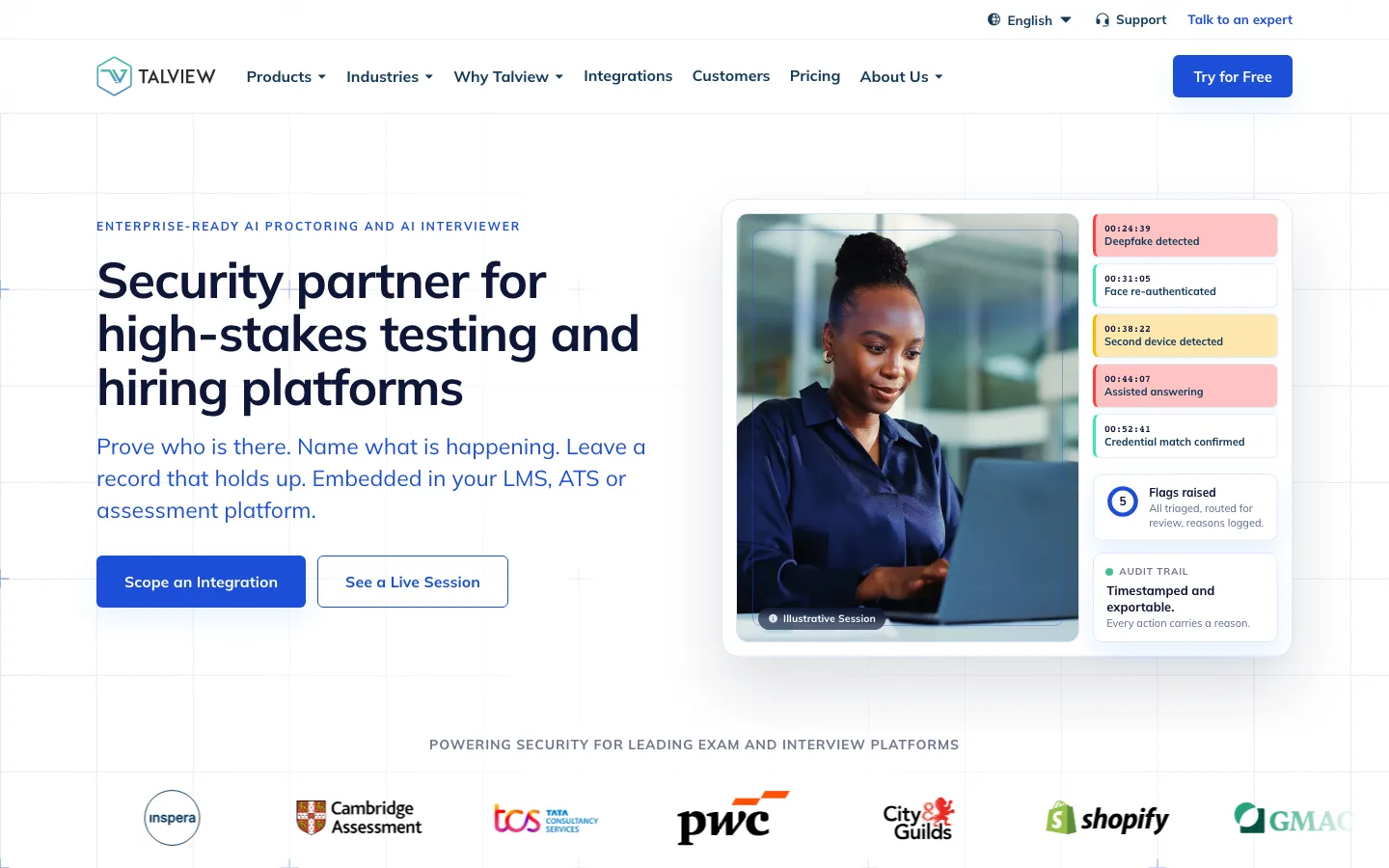
Verdict: a tool built around one question, "is this still the same person?", from the first selfie to the last answer.
Talview sells candidate verification aimed at stopping proxy hires, and says it takes minutes. The flow has four steps: capture, match, continuous check and review. It starts by "capturing a selfie or ID scan and matching it against an existing base image." From there, Talview watches face, voice and device through the interview. Its voice check "cross-checks vocal patterns against earlier interactions," which, like Pindrop, targets the candidate who sends a stand-in to one round.
Talview also offers third-party ID and anti-money-laundering (AML) database checks. The more complex database matches usually finish within a few hours, Talview says. The product is also available on Microsoft Teams.
Best for: teams running high-stakes remote interviews on Microsoft Teams who want identity checked continuously, not once.
Watch out for: face and voice matching are biometric checks, so consent and retention duties apply in states such as Illinois. The interview checks only cover interviews that run through Talview or Teams.
Pricing model: quote, through a four-step form; Talview says it can be paid with Azure credits. Talview does not publish a price.
10. The Work Number: best for employment history without calling past employers
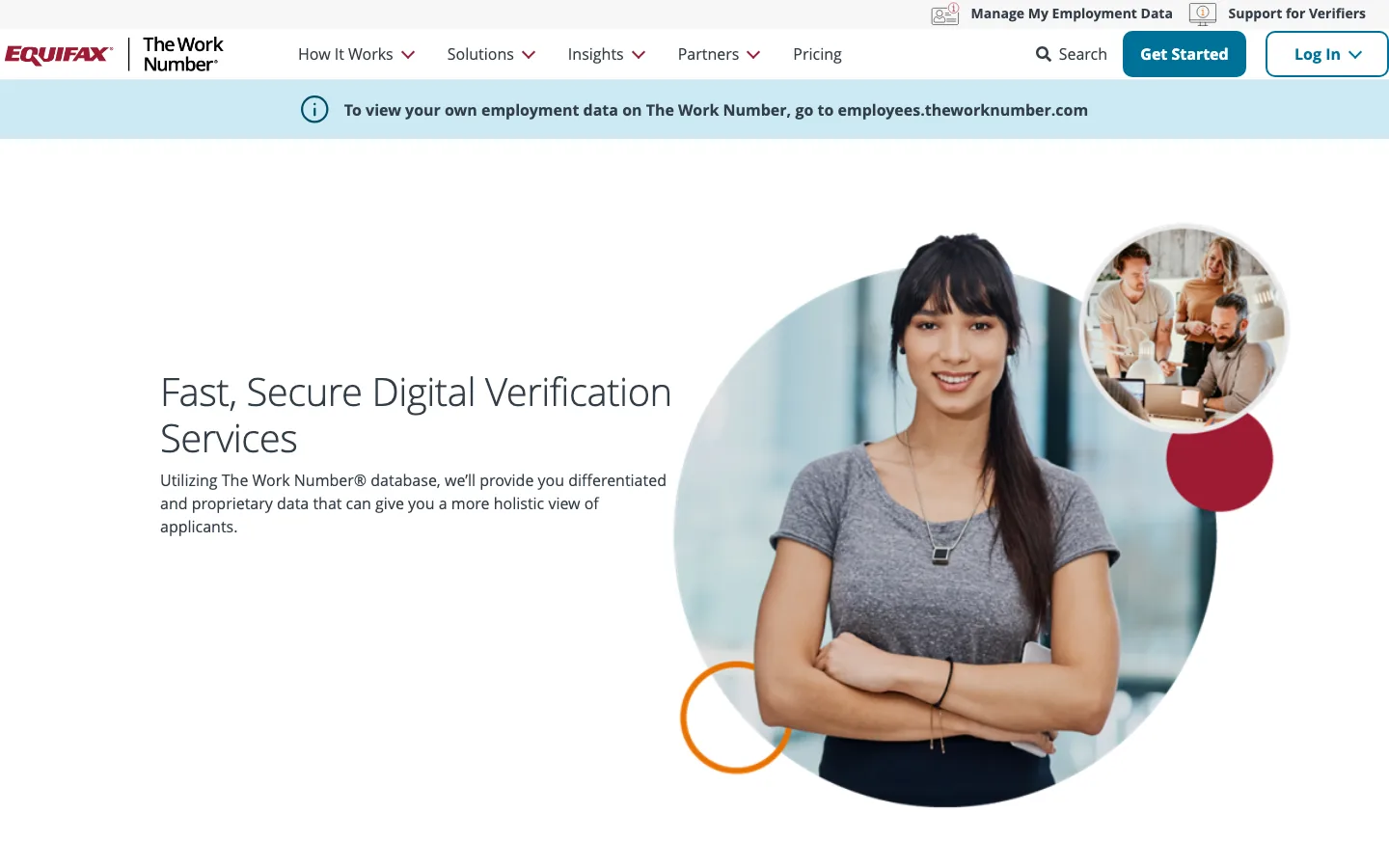
Verdict: a records lookup for US work history, with more than 839 million employee records by Equifax's count.
The Work Number is Equifax's employment and income verification service. It says its database gives credentialed verifiers access to "more than 839 million employee records", contributed by over 5 million employers. Its pre-employment product promises to "confirm a candidate's past work history and current job status without contacting their employer." It also flags gaps and differences between the records and what the candidate reported.
You buy Talent Reports by time frame (3, 5 or 7 years, or all history) or by record (the 2 or 3 most recent employers), searched by Social Security number. There is also a Talent Report Education, sourced from the National Student Clearinghouse, and a Talent Report Identity. Access needs a short registration and credentialing process. The service is covered by the FCRA, so you need a permissible purpose and the candidate's written authorization. Where an employer contributes payroll data, the answer is a lookup, not a week of phone tag. For the human side of the check, see our reference check questions.
Best for: US employers who want past employers and dates checked before an offer.
Watch out for: employers that do not contribute payroll data are not in the database, so those checks fall back to contacting the employer.
Pricing model: pay per report (pay-as-you-go is for 250 applicants or fewer a year), or an enterprise contract. The Work Number publishes starting prices for some reports.
11. National Student Clearinghouse: best for US degree and enrollment checks

Verdict: the record source behind many US degree checks, including The Work Number's education report.
The National Student Clearinghouse runs DegreeVerify, the degree check many employers use. Its business verification service promises to "verify high school diplomas and postsecondary enrollment and degrees instantly." It says its records cover 97% of currently enrolled US postsecondary students and 96% of US four-year degrees. The Clearinghouse pitches DegreeVerify as a way to "reduce credentials fraud."
In iProspectCheck's survey (2026), education is checked less often than employment (35.2% vs 39.0%). Other vendors lean on the same records: The Work Number's education report is sourced from the Clearinghouse.
Best for: any US employer that lists a degree as a requirement and wants it checked before the offer.
Watch out for: the coverage figures are for US institutions, so a degree from abroad needs another route, usually the school itself or a background check vendor with international coverage. It also checks that a degree was awarded, not what the person can do.
Pricing model: per verification, with pricing set by verification type.
Is candidate verification legal?
Generally yes in the US, when you follow the consent and notice rules that apply to the check you run. The two US laws that catch most buyers are the FCRA and Illinois's Biometric Information Privacy Act (BIPA). This is general information, not legal advice.
- Record checks through a consumer reporting agency. Under 15 U.S.C. 1681b, you must give the candidate a clear written disclosure before you get a consumer report for hiring. It has to sit "in a document that consists solely of the disclosure", and you need their written authorization. Before you turn someone down because of the report, you must give them a copy and a written summary of their rights. Checkr and The Work Number reports fall under these rules.
- Selfie, face and voice matching. BIPA counts a "voiceprint, or scan of hand or face geometry" as a biometric identifier. Before collecting one, the business that collects it (the employer, the vendor, or both) must tell the person in writing what is collected, why and for how long. It must get a written release and keep a public policy for destroying the data. A person can recover $1,000 per negligent violation or $5,000 per intentional or reckless one (or actual damages if higher), plus legal fees. Since an amendment took effect on 2 August 2024, repeated collection from the same person by the same method counts as a single violation. That limits repeat claims for the same collection.
The practical step: before you sign, ask each vendor who collects the consent, who stores the biometric data, and when it is deleted. Our guide to detecting candidate fraud in remote hiring covers the process side, including red flags and what to do when you suspect a fake candidate.
When should you not pick The Cognitive?
The Cognitive tests whether a candidate can back up their CV in a live AI interview. That is one of five verification jobs, and for the other four it is the wrong tool:
- You need to prove legal identity. The Cognitive does not check ID documents, match a selfie or run a liveness check. Use Persona, Greenhouse Real Talent with CLEAR, 1Kosmos or Checkr.
- You need deepfake alerts in interviews your own people run. The Cognitive's checks run only in its own AI interview. For deepfake alerts in your own calls, use Pindrop Pulse for Meetings (Zoom, Teams, Webex) or Tofu (Zoom, Meet, Teams).
- You need employment, education or criminal records checked. Use The Work Number, the National Student Clearinghouse or Checkr.
- You need to screen thousands of inbound applications for fake profiles. Tofu or Greenhouse Real Talent sit on the application stream; The Cognitive does not.
- You want a verified badge on each candidate. The Cognitive's verdicts are about claims tested in conversation, up to 5 per candidate. They are evidence for a recruiter's judgment, not a stamp on the person.
What mistakes do teams make when buying verification?
Most failed verification projects fail on fit, not on detection. Five mistakes come up again and again:
- Buying one tool and calling it done. An ID check does not test skills, and an interview does not check a degree. Map your five jobs first and decide which ones matter for each role.
- Checking only at the end. An ID check before the offer means a proxy has already used up your interviewers' time. Check during interviews and again at onboarding, as the FBI advises.
- Treating a flag as a verdict. Risk scores and integrity flags are reasons to look closer. Rejecting people on a flag alone is unfair to real candidates and hard to defend.
- Skipping consent design. Biometric checks without written notice and release are where the legal risk sits. Settle consent wording with counsel before launch, not after the first complaint.
- Checking some hires and not others. Only 39.0% of companies verify employment for every hire, according to iProspectCheck (2026). A check you run only when someone feels suspicious is inconsistent by design.
If testing CV claims in the first interview is the gap you need to close, start with one open role. Source candidates or import them from your ATS, set the role's criteria, and invite two people to a live AI interview. Read the claim verdicts next to each recording and decide for yourself whether they match what you would have caught. You can start a free trial of The Cognitive without a card.
Sources
- iProspectCheck, 2026 State of Screening Report, published 29 July 2026, survey of 1,500 US business managers and owners. iProspectCheck is a background screening company.
- HR Dive, report on Gartner's candidate survey and 2028 forecast, 8 August 2025.
- US Department of Justice, Justice Department Announces Coordinated, Nationwide Actions to Combat North Korean Remote Information Technology Workers' Illicit Revenue Generation Schemes, 30 June 2025.
- FBI Internet Crime Complaint Center, North Korean IT Workers Conducting Data Extortion, public service announcement, 23 January 2025.
- Fair Credit Reporting Act, 15 U.S.C. 1681b, Legal Information Institute, Cornell Law School.
- Illinois Biometric Information Privacy Act, 740 ILCS 14, Illinois General Assembly, including Public Act 103-769, effective 2 August 2024.
- Tofu: homepage (hiretofu.com), deepfake detection page (hiretofu.com/deepfake-detection) and pricing page (hiretofu.com/pricing).
- Greenhouse: Real Talent page (greenhouse.com/real-talent); Greenhouse and CLEAR partnership announcement, 12 June 2025 (greenhouse.com/newsroom); CLEAR's Greenhouse documentation (docs.clearme.com/docs/greenhouse).
- Persona: candidate verification page (withpersona.com/solutions/candidate-verification), launch post, 11 March 2026 (withpersona.com/blog/introducing-candidate-verification-solution-by-persona), and pricing page (withpersona.com/pricing).
- 1Kosmos: workforce identity page (1kosmos.com/solutions/identity/workforce); press release "Leading US Professional Staffing and Solutions Firm Kforce Selects 1Kosmos to Protect Clients From Hiring Fraud", GlobeNewswire, 21 October 2026.
- Checkr: homepage (checkr.com), identity verification page (checkr.com/background-check/identity-verification), fraud detection page (checkr.com/products/fraud-detection), employment verification page (checkr.com/background-check/employment-verification), pricing page (checkr.com/pricing) and Truework acquisition post, April 2025.
- Pindrop: hiring fraud page (pindrop.com/use-cases/catch-fake-job-candidates) and homepage (pindrop.com), including the Pindrop Remote Hiring Study, June 2025.
- HireVue: cheating and fraud page (hirevue.com/platform/cheating-and-fraud) and pricing page (hirevue.com/pricing).
- Talview: candidate verification page (talview.com/en/candidate-verification) and pricing page (talview.com/en/pricing).
- The Work Number (Equifax): homepage (theworknumber.com), pre-employment verification page (theworknumber.com/solutions/industries/pre-employment-verification) and pricing page (theworknumber.com/pricing).
- National Student Clearinghouse: business verifications page (studentclearinghouse.org/solutions/business-verifications).
Frequently Asked Questions
How should staffing agencies verify candidates for remote roles?
Staffing agencies should run an identity check on every remote hire, not only on candidates who seem suspicious, and repeat it at later stages. Kforce, which places about 17,000 consultants a year, chose 1Kosmos so that every hire completes a mobile check of a government ID, a live facial image and liveness, and went live in under six weeks. The FBI's January 2025 public service announcement advises identity checks during interviewing, onboarding and throughout a remote worker's employment. Add a record check such as The Work Number before placement, and a first interview that tests the CV, such as The Cognitive's claim verdicts.
Is identity verification the same as a background check?
No, identity verification and a background check are separate products that answer different questions. Identity verification confirms the person is who they claim to be, usually with a government ID, a selfie and a liveness check; Greenhouse's Real Talent FAQ describes CLEAR as identity verification rather than a background check. A background check looks at records such as criminal history, employment and education, and in the US it runs through a consumer reporting agency under the Fair Credit Reporting Act. Many employers need both, at different stages.
Can software detect a deepfake candidate in a video interview?
Some software flags signs of a deepfake or proxy candidate during a live interview, but a flag is not proof. Pindrop Pulse for Meetings analyses video and audio in Zoom, Teams and Webex and compares the voice across rounds, and Tofu says it catches face swaps, voice clones and proxy candidates in real time. Pindrop itself says its product does not verify identity and that a flag should lead to a documented human review, not an automatic rejection. Pair interview detection with an ID check.
Can an AI interview verify a candidate's resume claims?
An AI interview can test whether a candidate can back up their resume claims in conversation, but it cannot confirm records. In The Cognitive, up to 5 claims or gaps per candidate are picked from the CV and profile before a live AI video interview, probed during it, and returned as Verified, Unclear or Refuted with the evidence from the conversation. That tells a recruiter what held up under questioning. It does not prove employment or a degree, so use The Work Number or the National Student Clearinghouse for records.
When in the hiring process should you verify a candidate?
Verify candidates at more than one stage: lightly at application, again during interviews, and firmly before the offer or start date. The FBI's January 2025 public service announcement told employers to use identity verification during interviewing, onboarding and throughout the employment of remote workers. Persona is built to reverify at any stage, Greenhouse can trigger CLEAR before interviews or offers, and Checkr runs its ID check before the background check.
How much do candidate verification platforms cost?
Candidate verification platforms are priced per check or report, by annual applicant volume, as plans with credits, or by quote. The Cognitive, Tofu, Checkr and The Work Number publish prices on their websites, and Persona publishes a starting price for its base platform plan. Greenhouse Real Talent, 1Kosmos, Pindrop, HireVue and Talview sell by quote. The Cognitive's plans start from $99, and a 20-minute AI interview uses 100 credits.
Persona, CLEAR or Checkr: which should I use for candidate ID checks?
Pick by your ATS and the stage you want to check. Persona fits teams on Ashby, Greenhouse or Workday that want to reverify the same candidate at application, interview and offer. CLEAR comes built into Greenhouse Real Talent and returns a pass or fail while the selfie and ID stay with CLEAR. Checkr's ID check runs just before a Checkr background check, which suits US employers already screening with Checkr.
Related reading
- Best Practices for Detecting Candidate Fraud in Remote Hiring: A 12-Step Checklist From Sourcing to Day One (2026)
- Interview Cheating Detection and Anti-Fraud Monitoring With AI: 11 Tactics, the Signals That Catch Them and the Gaps
- 13 Best Applicant Tracking Systems in 2026, Ranked
- Best AI Recruiting Tools in 2026: The Right Pick for Every Hiring Job
- AI Tools for HR: The 12 Best for HR Teams in 2026
- What Is a Normal Cost Per Hire? Benchmarks by Seniority, Sector, Role and Region