Paradox Review (2026): What It Does, and Where It Falls Short
Paradox is conversational hiring software (Olivia) for high-volume and hourly hiring. It fits when hourly and frontline volume where scheduling and texting are the bottleneck. Sourcing: not the core motion. Interviews: chat-based screening and scheduling. Pricing: quote-based, not published.
Paradox is conversational hiring software (Olivia) for high-volume and hourly hiring. This review covers four things a buyer actually needs before a demo: whether it sources candidates, what an interview looks like, what evidence sits behind a score, and whether pricing is published. Everything below is drawn from Paradox's own public positioning. The Cognitive publishes a competing product, so the section headings say plainly which parts are their claims and which are ours.
Paradox at a glance
| Paradox (their own positioning) | |
|---|---|
| Category claim | conversational hiring software (Olivia) for high-volume and hourly hiring |
| Sourcing | Not the core motion |
| Interview format | Chat-based screening and scheduling |
| Evidence behind a score | Screening answers captured in chat |
| Pricing visibility | Quote-based, not published |
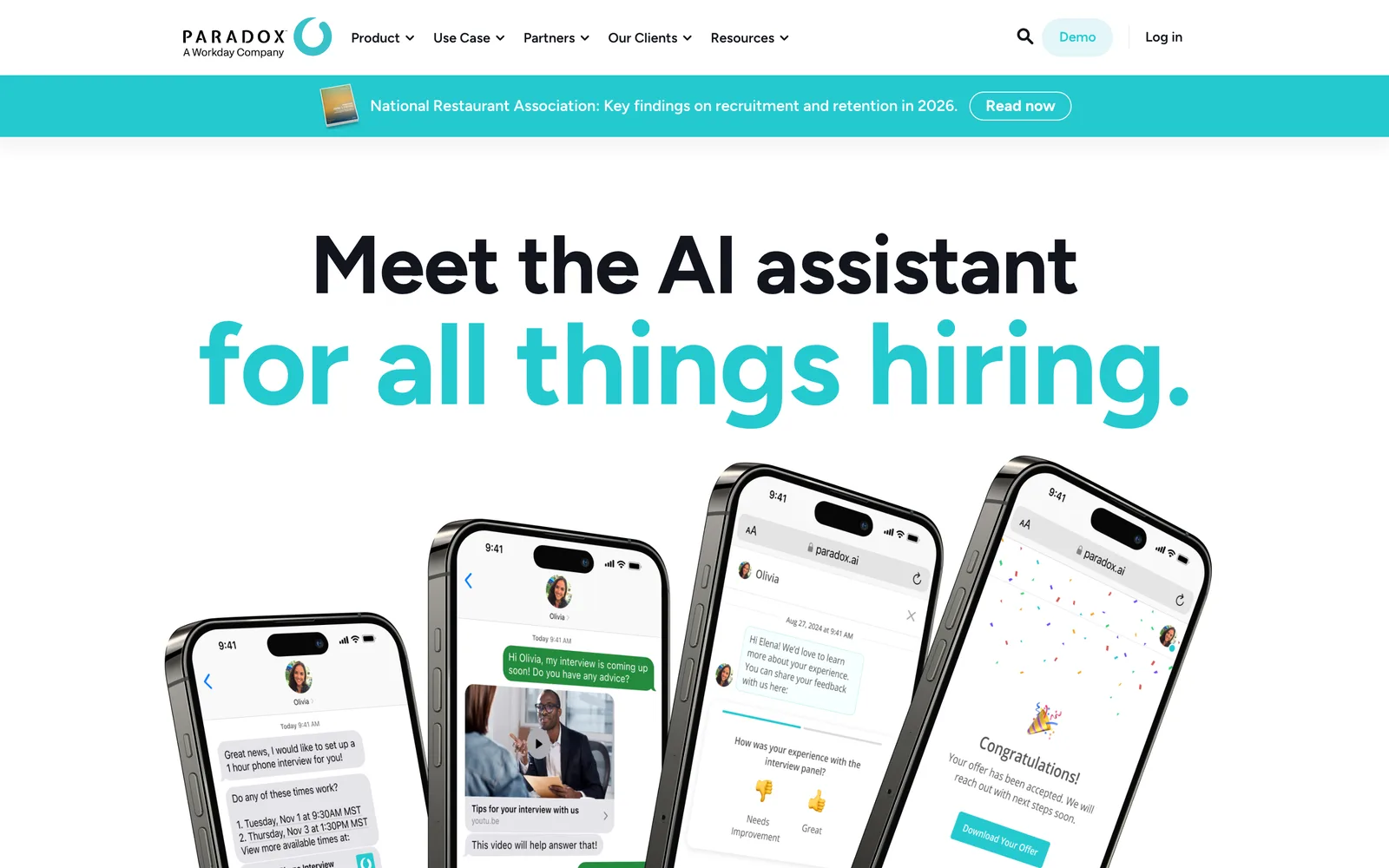
What does Paradox do?
- Conversational assistant (Olivia) for screening, scheduling, and ATS workflows
- Built for hourly, frontline, and high-volume hiring in sectors such as restaurants and retail
- Scheduling automation and candidate texting
Where does Paradox not fit?
These are gaps in scope, not faults in execution. A tool built for one job is not worse for being built for one job; it is only a poor fit if the job you have is a different one.
- Paradox's conversations are chat-based screening and scheduling; The Cognitive runs live, two-way video interviews that evaluate skill in depth, up to senior roles
- Paradox positions around workflow automation on top of your ATS; The Cognitive positions around evaluation depth plus sourcing - evidence-scored shortlists, not just faster scheduling
- The Cognitive publishes self-serve pricing, with AI Interview from $99/month
Where does Paradox sit in a recruiting stack?
| Job in the stack | What it has to produce | Paradox's published position |
|---|---|---|
| Sourcing | Candidates who have not applied, with contact details that resolve | Not the core motion |
| Recruiting CRM | A warm pool that makes the next requisition faster | Not stated publicly unless the vendor lists CRM functionality |
| Applicant tracking | A system of record for applicants, stages and compliance | Not an ATS unless the vendor says so; most tools in this category integrate with one |
| Screening and interviewing | A judgement about ability, with evidence a person can audit | Chat-based screening and scheduling |
| Evidence behind a score | Something a rejected candidate or an auditor can be shown | Screening answers captured in chat |
A recruiting stack has four jobs and most tools do one or two of them. Sourcing finds candidates who have not applied and reveals how to reach them. A recruiting CRM keeps known candidates warm between roles. An applicant tracking system holds applicants and moves them through stages; it is the system of record. Screening decides who is worth a hiring manager's hour, with evidence behind the answer.
On Paradox's own published positioning, sourcing is: Not the core motion. Interviewing is: Chat-based screening and scheduling. Read those two rows together and the shape of the gap is usually obvious: a tool strong on search leaves you the evaluation problem, and a tool strong on evaluation leaves you the empty-pipeline problem. Neither is a fault; it is what buying one tool means.
Who does Paradox suit?
- A good fit if your bottleneck is the one it was built for: Conversational assistant (Olivia) for screening, scheduling, and ATS workflows
- Budget for a sales cycle: pricing is quote-based, not published, so you will not get a number without a call.
- Less of a fit if you need one system to both find candidates and evaluate them, which is where the scope above stops.
Verdict: who should buy Paradox, and who should not
- Buy it if hourly and frontline volume where scheduling and texting are the bottleneck.
- Buy it if the capability you are paying for is its strongest one: Conversational assistant (Olivia) for screening, scheduling, and ATS workflows.
- Look elsewhere if you need candidates found. Paradox's published position on sourcing is: not the core motion.
- Look elsewhere if you need a system of record. Paradox is not positioned as an applicant tracking system unless it says so above.
- Pricing is quote-based, not published, so you can size the cost before a call.
Disclosure: who published this
The Cognitive publishes this review and competes with Paradox. We have kept every claim above to what Paradox states publicly, and described absences as absences rather than failings, because a review that reads as an attack is worth nothing to you.
For completeness: The Cognitive is AI recruiting software covering sourcing through shortlist: candidate search across ~900M public profiles with contacts enriched from 30+ sources, then a live two-way AI video interview, returning a report with a 1 to 5 score per criterion, the transcript and the recording. Whether that is a better fit than Paradox depends entirely on whether your bottleneck is finding people or assessing them.
Frequently Asked Questions
What is Paradox?
Paradox is conversational hiring software (Olivia) for high-volume and hourly hiring.
Does Paradox do candidate sourcing?
Not the core motion
Does Paradox publish pricing?
Quote-based, not published
Is Paradox a sourcing tool or a screening tool?
On its own published positioning, Paradox is conversational hiring software (Olivia) for high-volume and hourly hiring. Its stated sourcing coverage is: Not the core motion. Its stated interview coverage is: Chat-based screening and scheduling. Most shortlists that include it are really deciding between filling a pipeline and judging the people already in it, and those are separate purchases unless one tool covers both.
What are the main alternatives to Paradox?
Our Paradox alternatives guide, linked below, compares named options side by side, including where each one is a better fit than Paradox and where it is not.
Paradox alternatives · Eightfold AI vs Paradox · HireVue vs Paradox · All vendor reviews · AI Recruiting Software Guide · Full-Cycle Recruiting Automation · Pricing