Best Talent Mobility Software in 2026: 12 Tools Ranked
By Sparsh Goyal, Founder at The Cognitive. Published · Last updated
- Eightfold, Fuel50, Gloat and Phenom Career Pathing are the most complete talent mobility software, each covering all six career pathing and mobility checks.
- Avature, Oracle and 365Talents cover five, Lattice Grow suits smaller companies, and hireEZ suits TA teams that own internal moves.
- The Cognitive is listed first for the step after them: finding and interviewing the person outside when no one inside is ready.
Disclosure: The Cognitive is our product.
Only 39% of organizations rate their career development and internal mobility processes as effective, according to HR.com's Future of Career Development and Mobility 2025-26 report. The top obstacle, named by 45%, is a lack of career paths for non-managerial roles.
The tools below split into suites that map paths and match people to roles, lighter tools that only map paths, and one recruiter tool. The Cognitive is listed first for the step after them: when no one inside is ready, it searches people outside the company and interviews them. It is not talent mobility software.
The best talent mobility software in 2026
- The Cognitive: best for filling the role from outside when no internal candidate fits.
- Eightfold Career Hub: best for growth plans built from live work signals.
- Fuel50: best for skills-based career paths tied to internal hiring.
- Gloat: best for career paths and readiness delivered by AI agents.
- Phenom Career Pathing: best for drafting career paths from existing role data.
- Avature Internal Mobility: best for configurable mobility programs in a large, global HR stack.
- Oracle Talent Management: best for Oracle Fusion Cloud HCM customers.
- 365Talents Career Developer: best for career pathing and learning in many languages.
- Workday HiredScore AI for Talent Mobility: best for companies already on Workday HCM.
- Lattice Grow: best for smaller companies that want career tracks next to reviews.
- TalentGuard: best for an audit trail behind every promotion.
- hireEZ Internal Mobility: best for TA teams searching employees and outside people in one tool.
What is talent mobility software?
Talent mobility software is software that matches employees to open internal roles, projects and growth opportunities, and shows each person a career path and the skills needed to take it. Workday's own definition is close: it "helps organizations identify and move internal employees into new roles, projects, or growth opportunities based on their skills, experience, and interests."
Talent mobility is the move itself, into a new role or project. Career pathing is the map before the move: the routes between roles, and the skills gap on each route turned into a development plan.
Many companies stop at an internal job board. A job board tells people what is open, not how to get there. The practice itself is covered in what is internal mobility.
How do the top talent mobility tools compare?
| Tool | Best for | Score | Price on website? |
|---|---|---|---|
| The Cognitive | Outside hire when no one inside fits | n/a | Yes |
| Eightfold | Growth plans from work signals | 6 | No |
| Fuel50 | Skills-based paths and internal hiring | 6 | No |
| Gloat | Paths and readiness via AI agents | 6 | No |
| Phenom | Paths drafted from role data | 6 | No |
| Avature | Global mobility programs | 5 | No |
| Oracle | Oracle HCM customers | 5 | No |
| 365Talents | Paths plus learning, 45+ languages | 5 | No |
| Workday | Workday HCM customers | 4 | No |
| Lattice Grow | Career tracks for growing companies | 3 | Yes |
| TalentGuard | Audit trail behind promotions | 3 | No |
| hireEZ | TA-owned internal and external search | 1 | Yes |
How were these tools ranked?
The Cognitive is listed first for one buyer: the team whose internal search found no one ready. hireEZ and Oracle also work with outside candidates. What sets The Cognitive apart here is the pairing of a search of about 900M public profiles from a plain-English brief with a live two-way AI video interview, started self-serve. hireEZ publishes a price too, and its site describes voice AI screening rather than a video interview. The Cognitive has none of the mobility features below, so it is not scored.
The other 11 score 1 point for each of six checks their own product pages state. The checks are mapped career paths, a skills gap turned into a development plan, matching to open internal roles, mentor matching, matching to projects or gigs, and readiness or succession planning. Mentors and gigs count only when the vendor says it matches employees to them, not when they appear as a learning activity.
| Tool | Score | Checks not on its pages |
|---|---|---|
| Eightfold | 6 | None |
| Fuel50 | 6 | None |
| Gloat | 6 | None |
| Phenom | 6 | None |
| Avature | 5 | Mentors |
| Oracle | 5 | Mentors |
| 365Talents | 5 | Succession |
| Workday | 4 | Mentors, gigs |
| Lattice Grow | 3 | Roles, mentors, gigs |
| TalentGuard | 3 | Roles, mentors, gigs |
| hireEZ | 1 | Paths, gap plan, mentors, gigs, succession |
Ties go to a price on the website, then to alphabetical order by brand name, with names that start with a digit sorted after letters. That puts 365Talents last among the tools on 5, and Lattice Grow ahead of TalentGuard on 3.
Also considered: SAP SuccessFactors describes career paths and development plans in its talent management overview, without a separate mobility product page. Beamery invites employees to "map out a clear path to career success" but has no mobility product page.
These tools are ranked using feedback from recruiters the founder talks with on LinkedIn, plus each vendor's own site and pricing page.
The 12 best talent mobility tools, reviewed
1. The Cognitive: best for filling the role from outside when no internal candidate fits
Verdict: outside hiring, not mobility: use it after the internal bench is exhausted.
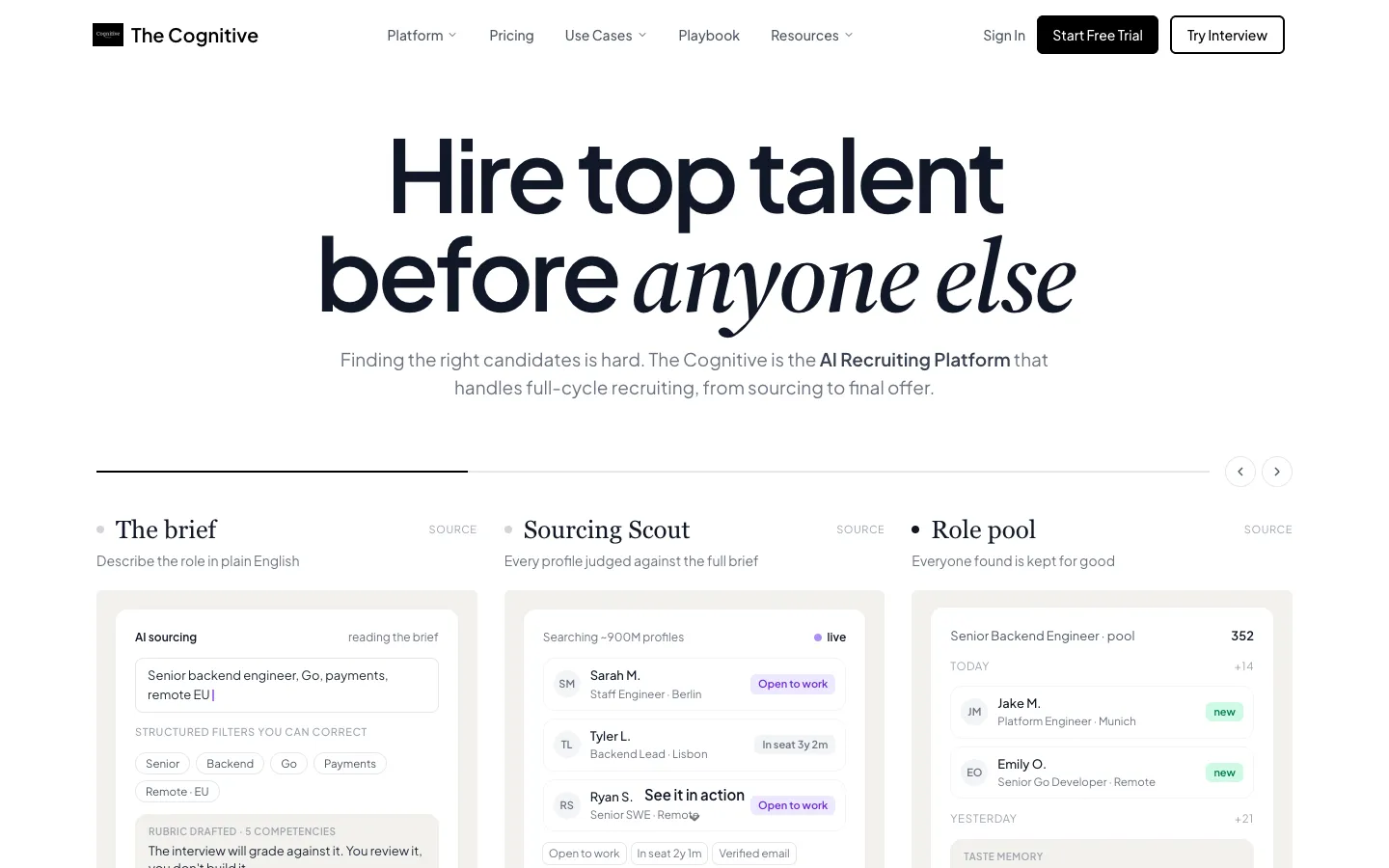
Describe the role in plain English, and AI sourcing looks across about 900M public profiles. Every match arrives with a one-line reason, ten per page, and a person costs 1 credit the first time a search shows them. Revealing a personal email is 4 credits; a phone number is 12 on Sourcing Pro and above, and neither is charged unless found.
Sourcing Pro adds email from the recruiter's own Gmail or Outlook account, and a reply ends the follow-ups. The AI interviewer then holds a live two-way video interview in any of 9 languages, at 100 credits for 20 minutes. Results sync with 100+ ATS.
After the interview: a score for each criterion, an overall recommendation, and the evidence behind each claim the candidate made.
Best for: a role the mobility tool could not fill, where the hire must be permanent.
Watch out for: no internal job board, career paths, skills inventory or succession planning, and it does not search your employees. Outreach starts on Sourcing Pro. ATS sync needs Sourcing Max or Business, or Interviews Pro, Max or Business.
Pricing model: sourcing and interviews are bought as two monthly plans, and credits cover people shown, reveals and interviews. Plans start at $99 a month (see pricing).
2. Eightfold Career Hub: best for growth plans built from live work signals
Verdict: plans built from live work data, with privacy questions to settle first.
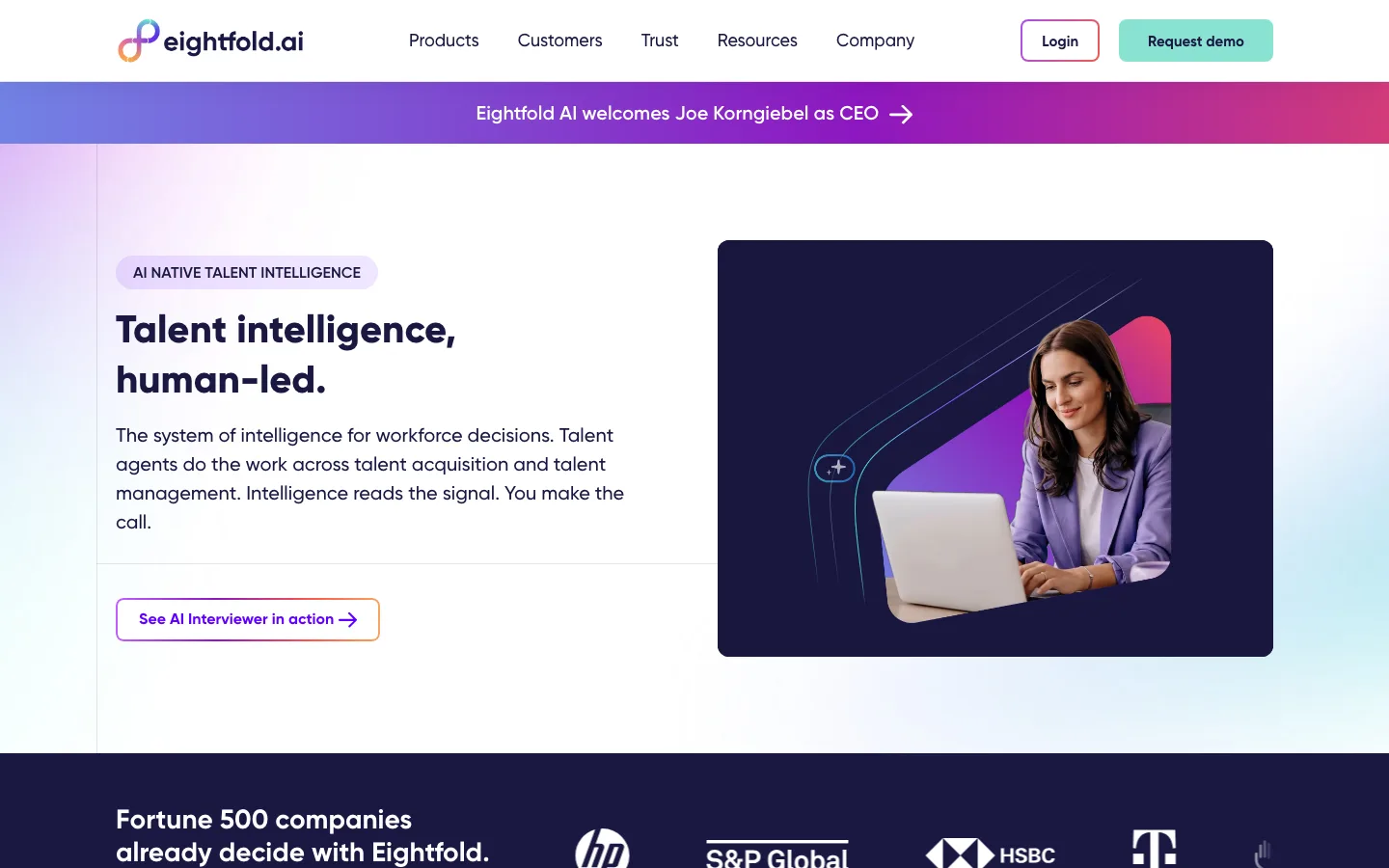
Career Hub promises to "Give employees personalized growth plans rooted in their potential and daily work." A Career Coach adds "Agentic career coaching," and employees reach projects, mentors, courses and roles from the same place. The same page covers succession planning, to help managers see "who's truly ready to step up."
The plans draw on the Eightfold Digital Twin, which "acts on live signals from emails, work apps, and tasks." That keeps plans current as work changes. Comparable tools are in Eightfold alternatives.
Best for: enterprises that want career plans to update as people's work changes.
Watch out for: works councils will ask which emails and apps feed the plans; have that answer in writing before launch.
Pricing model: quote after a demo.
3. Fuel50: best for skills-based career paths tied to internal hiring
Verdict: built so that an outside hire is the backup plan.
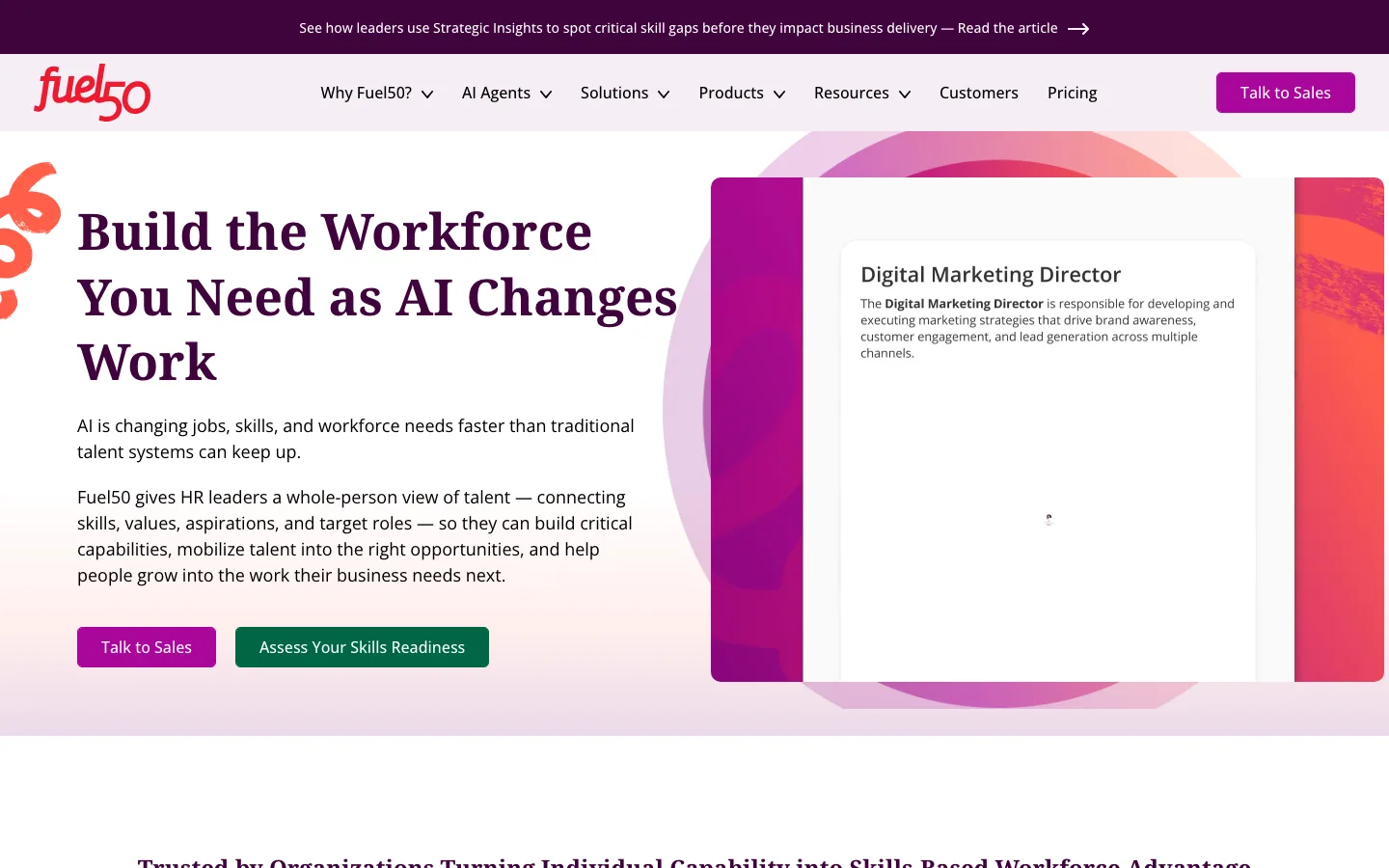
Fuel50 Mobility matches "employees to open roles and career paths based on skills, readiness, and where they want to go." Fuel50 says external hiring becomes "the backup plan, not the default."
Employees see the skills a target role needs, and leaders see the internal pipeline for each critical job. Matching runs on a skills ontology "developed by I/O psychologists," and mentors are matched on "Skills, Experience, and Goals." Gigs and Succession are separate products.
Best for: HR teams that want internal hiring and career pathing run from one skills model.
Watch out for: with several separate modules, two quotes can cover very different scope; ask for the module list line by line.
Pricing model: named bundles, each quoted after a demo; a module comes with "no gated features."
4. Gloat: best for career paths and readiness delivered by AI agents
Verdict: each part of career pathing comes as its own agent.
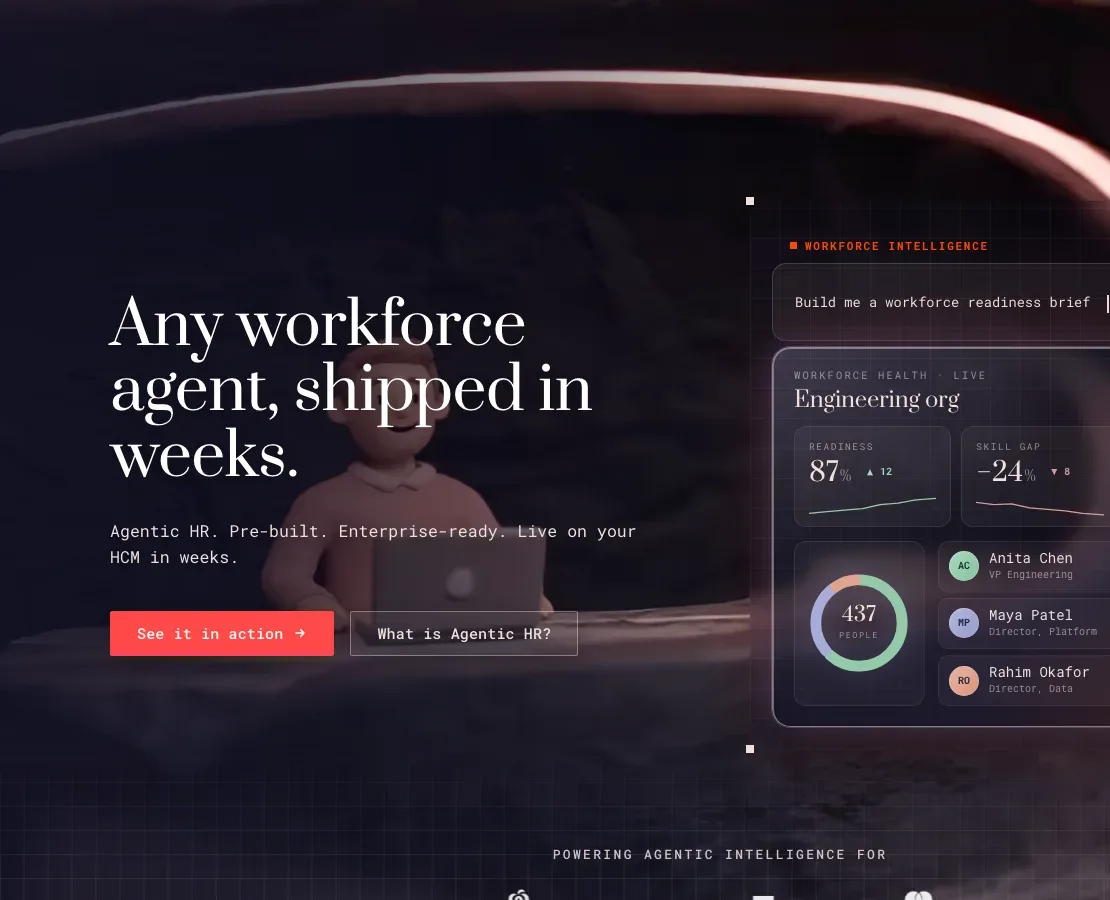
One Gloat agent builds "Personalized, data-driven career paths with mentor matching, learning recommendations, and growth planning for every employee." Another "Evaluates how ready each employee is for their next role based on skills, trajectory, experience patterns, and identified gaps."
The readiness agent shows which employees could step into a role soon, not only who applied. Gloat installs over an existing HCM rather than replacing one.
Best for: enterprises that want readiness scoring before a role is posted.
Watch out for: readiness scores need clean skills data in the HCM underneath.
Pricing model: quote after a demo.
5. Phenom Career Pathing: best for drafting career paths from existing role data
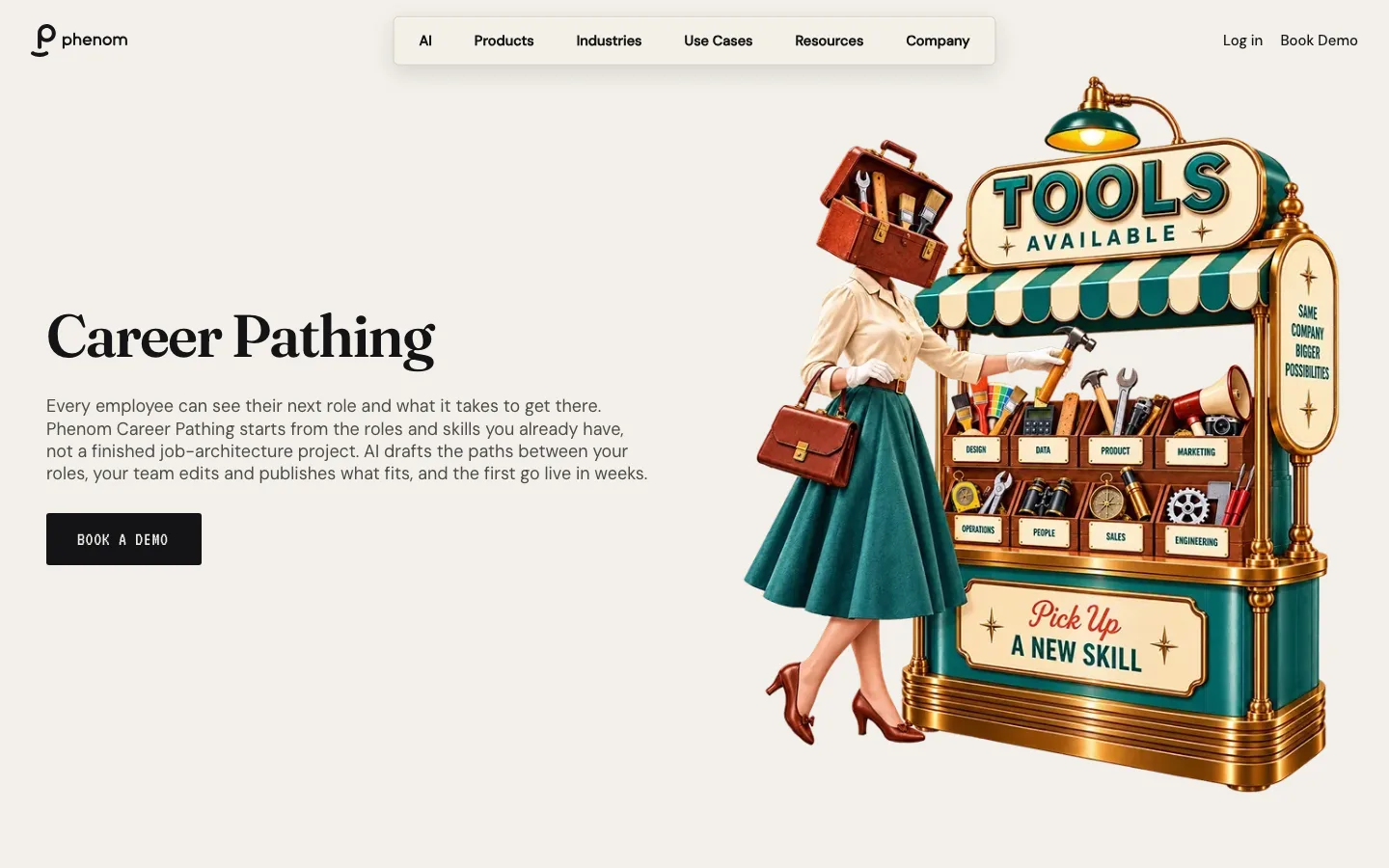
Verdict: drafts paths from your existing role data, so the team edits rather than builds.
Phenom drafts paths instead of mapping roles by hand: "AI drafts the paths between your roles, your team edits and publishes what fits, and the first go live in weeks." Paths "can be corporate-, employee-, or market-driven," and each gap routes "into courses, mentors, and gigs to close it."
An employee's chosen path and plan "belong to them," and other employees cannot see them. Phenom Talent Marketplace matches employees to roles, gigs and mentors, and Succession Planning attaches "the skills evidence behind each readiness rating." The trade-off: the full loop assumes the wider Phenom platform.
Best for: companies with role and skills data but no career paths yet.
Watch out for: succession and the marketplace are sold as separate products.
Pricing model: request form or RFP.
6. Avature Internal Mobility: best for configurable mobility programs in a large, global HR stack
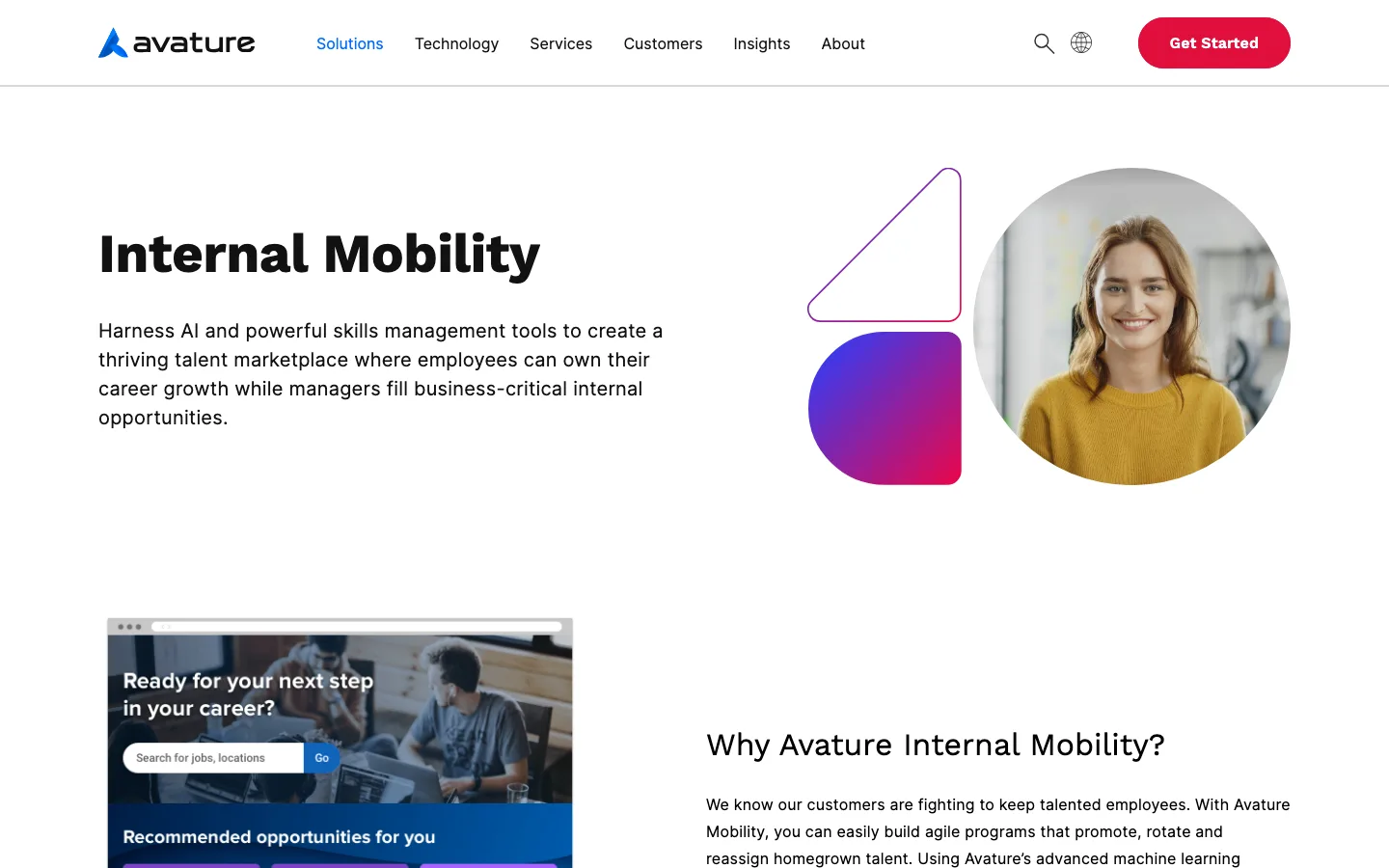
Verdict: the pick when mobility is a program with rules, not a single app.
Avature lets HR "build agile programs that promote, rotate and reassign homegrown talent," and calls the product "ideal for large-scale restructurings." Employees "progress through personalized career paths," and skills gaps are "filled with personalized training programs." Matches cover "roles, projects or gigs," and Succession Planning sits in the same portfolio.
Avature describes "white-box AI" for its matches and "blind screening" to reduce bias. Data comes in from "HRIS, LMS and other systems."
Best for: global enterprises running rotation, redeployment or restructuring programs.
Watch out for: configuration takes setup time before employees see paths.
Pricing model: not published; Get Started leads to a contact form.
7. Oracle Talent Management: best for Oracle Fusion Cloud HCM customers
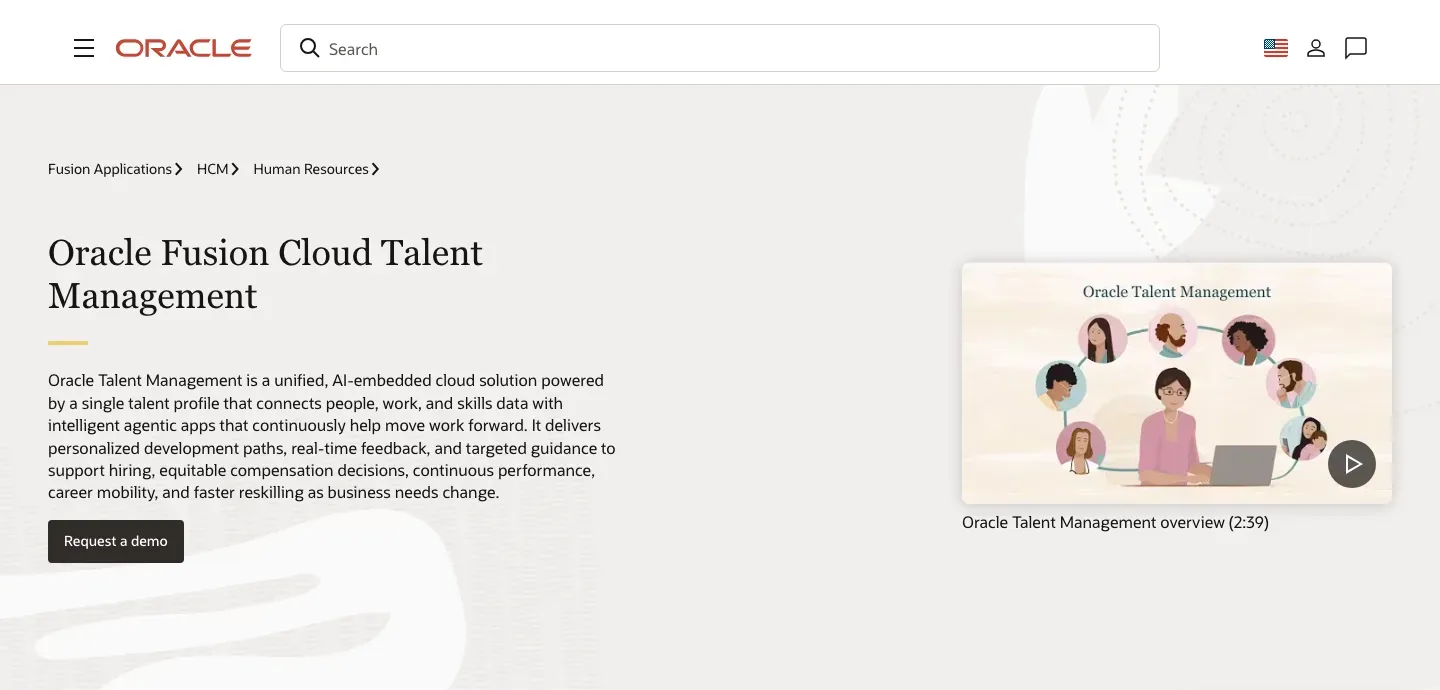
Verdict: strongest when Oracle already holds the employee record.
Oracle Talent Management runs on "a single talent profile." It recommends new career paths and skills to employees, and its Career Advancement Command Center helps HR leaders "connect employees to open roles." Recruiting links to skills, gigs and succession, and matching covers "external and internal talent."
One record feeds hiring, development and succession. It belongs to Oracle Fusion Cloud HCM.
Best for: companies already running Oracle Cloud HCM.
Watch out for: outside Oracle Fusion Cloud HCM, there is no single profile to build on.
Pricing model: not published.
8. 365Talents Career Developer: best for career pathing and learning in many languages

Verdict: the clearest about how a quote is built.
Career Developer "combines career pathing and learning & development into one employee-first experience." It offers "mentor matching based on existing and expected skill level." Employees "self-declare their skills, experiences and ambitions in over 45+ languages," and are matched to "jobs, projects, training."
The pricing page says "No public price tags" but explains the method. A proposal combines employee count, modules, integrations "with your HRIS, LMS, ATS" and support tier, and arrives "within 5 business days."
Best for: multinational workforces where employees work in many languages.
Watch out for: self-declared skills are only as good as the people filling them in.
Pricing model: per module, by proposal.
9. Workday HiredScore AI for Talent Mobility: best for companies already on Workday HCM
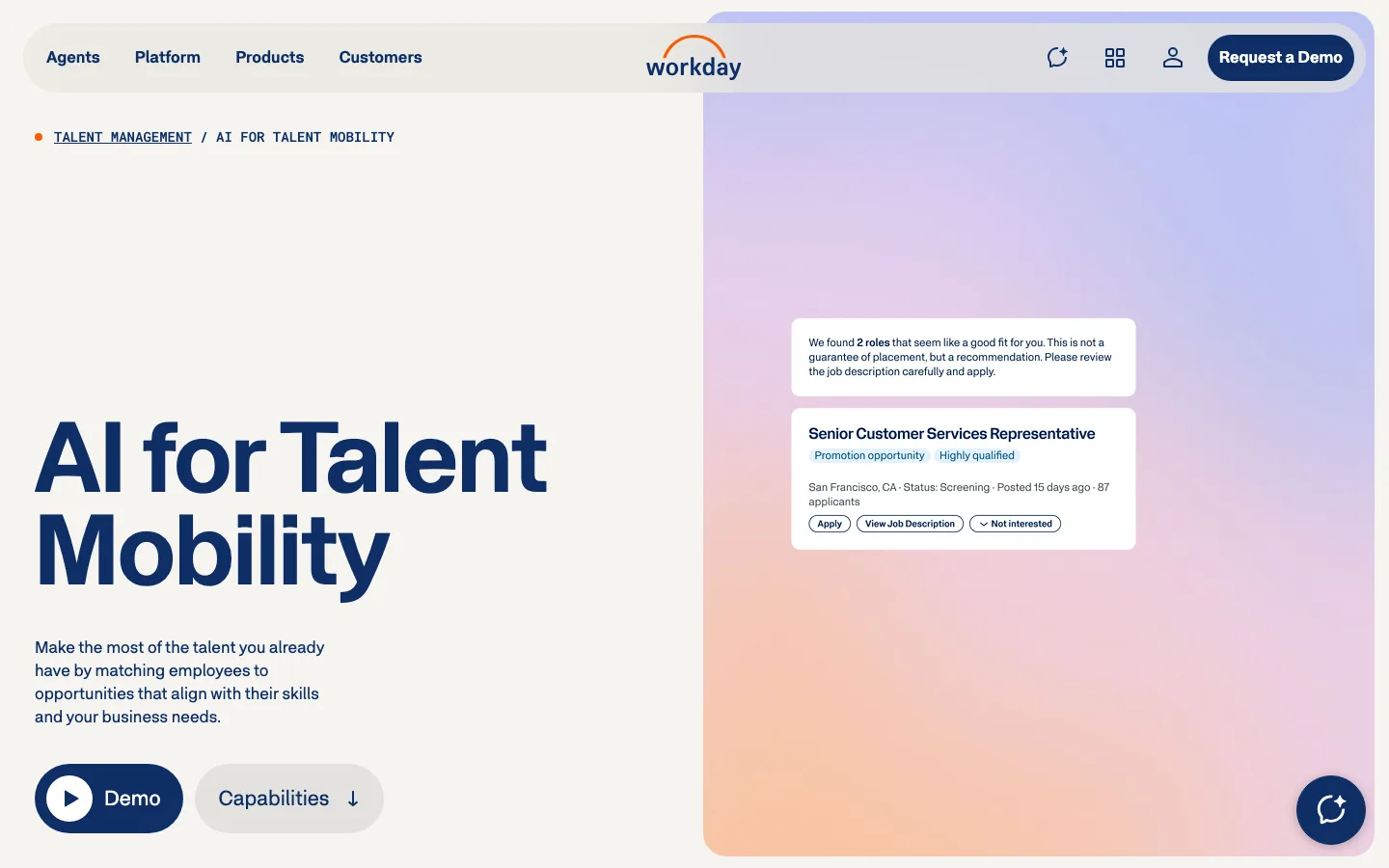
Verdict: focused on matching and skill building inside Workday, with succession in the wider talent suite.
Workday aims to help recruiters, managers and employees "explore career paths, build skills, and find opportunities aligned to their aspirations." Matching follows "your company's own mobility rules (e.g., minimum time-in-role, allowable level jumps)," so people who are not yet eligible stay off the list.
Workday customers add no second vendor, and the employee data is already in place. Its talent management suite adds succession planning.
Best for: Workday HCM customers who want internal matches that respect their own eligibility rules.
Watch out for: succession planning sits in Workday's wider talent management suite, not the mobility product.
Pricing model: quote after a demo.
10. Lattice Grow: best for smaller companies that want career tracks next to reviews
Verdict: career tracks from templates, inside the performance tool.
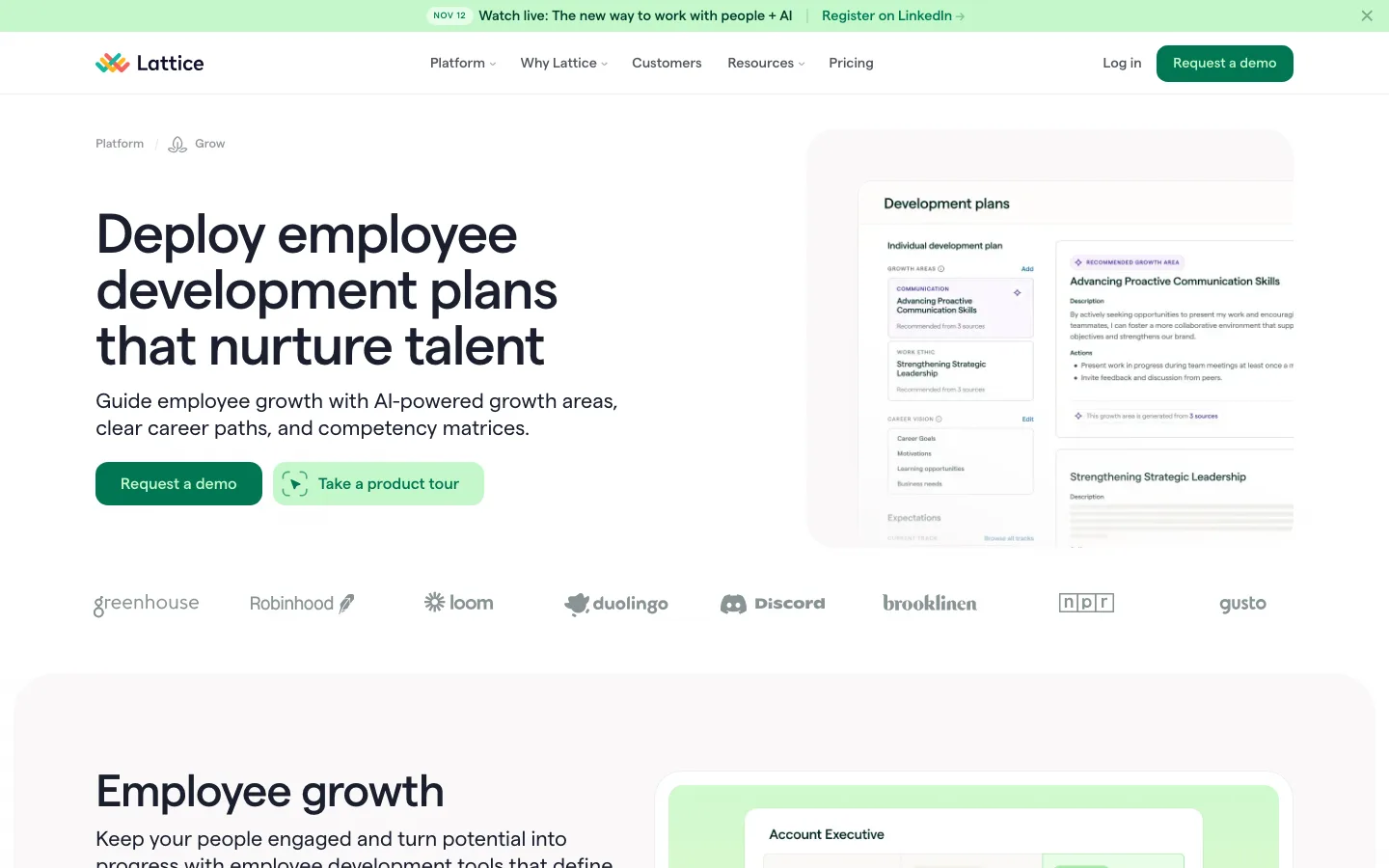
Lattice Grow promises "AI-powered growth areas, clear career paths, and competency matrices," built from "Lattice-built templates designed to scale," plus personalized IDPs. It is an add-on to a base product, and the Performance product lists Succession Planning, Promotions and Talent Reviews.
Managers discuss the next level in the 1:1s and reviews they already run. The paths are templates your team fills in.
Best for: growing companies already using Lattice for performance reviews.
Watch out for: it shows the path, but it does not match people to open roles.
Pricing model: per seat per month, as an add-on.
11. TalentGuard: best for an audit trail behind every promotion
Verdict: narrow on purpose: paths and readiness you can defend.
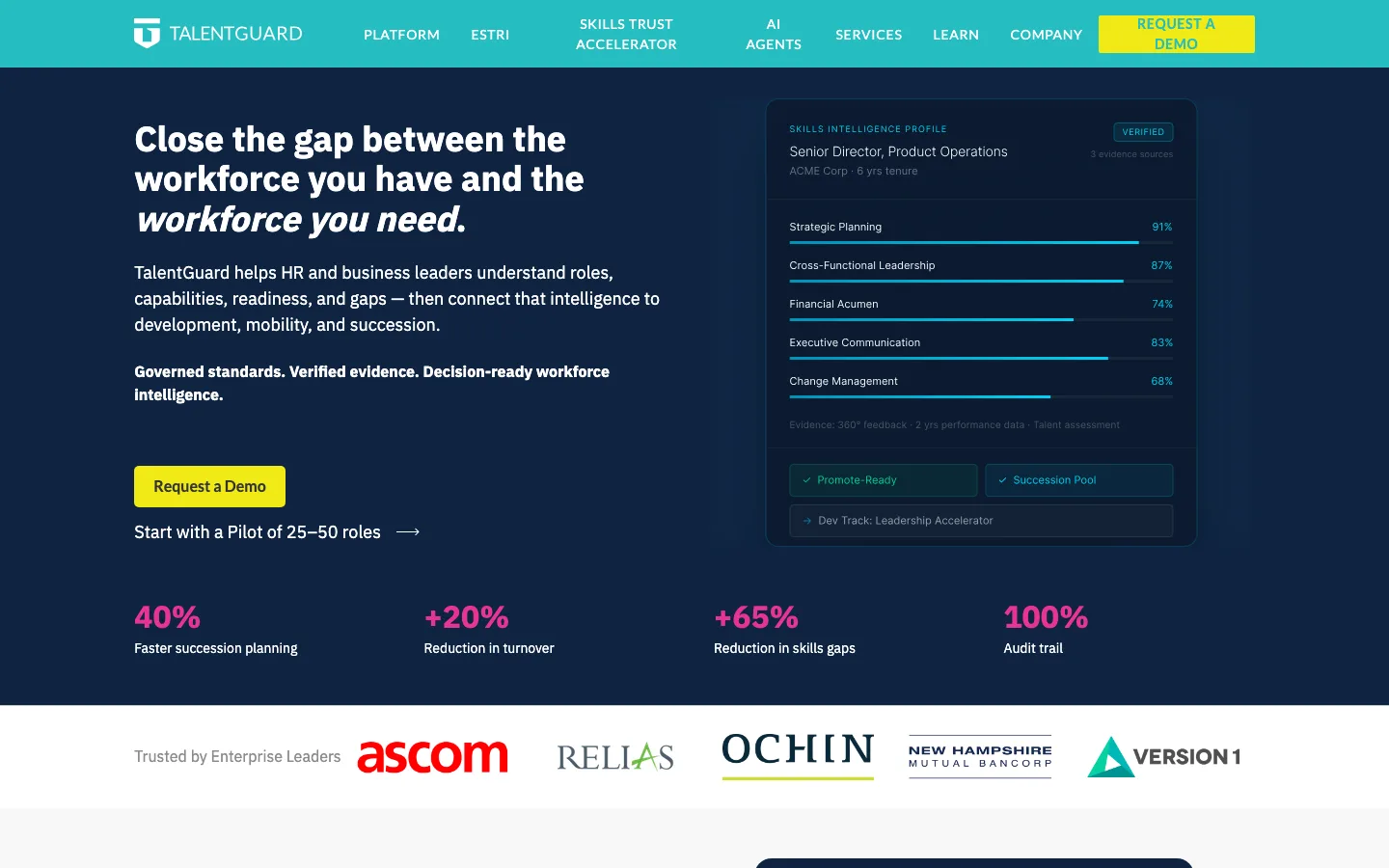
TalentGuard Career Pathing "maps explicit, skills-based routes between roles," grounded in "governed role standards, verified readiness data, and a complete audit trail."
When a promotion is challenged, HR can show the standard and the evidence behind it. Buying starts with a pilot of 25 to 50 roles, and the site says its price "comes from the call."
Best for: regulated enterprises where promotion decisions get scrutinized.
Watch out for: governed role standards take work to build before employees see anything.
Pricing model: pilot, then quote.
12. hireEZ Internal Mobility: best for TA teams searching employees and outside people in one tool
Verdict: a recruiter tool that checks employees before going outside.
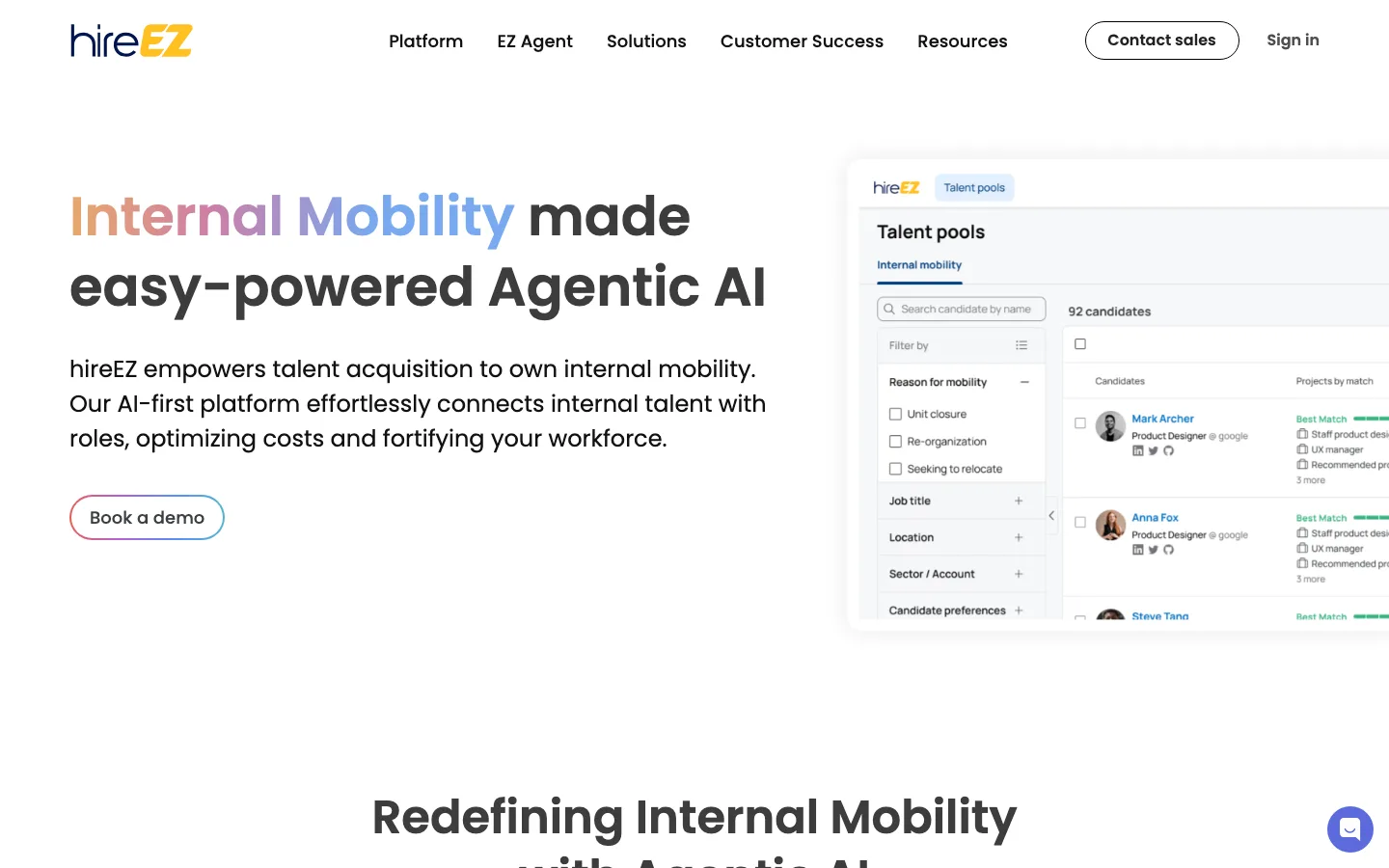
hireEZ says it "empowers talent acquisition to own internal mobility." It "analyzes employee profiles, skills, and resumes to accurately match internal talent with requisitions," and lets recruiters "proactively invite internal candidates to apply." The same product sources "across the open web and job boards."
It is a requisition tool, not a career tool: employees get no mapped path or development plan. More in the hireEZ review.
Best for: recruiters who want to check employees before going outside, in one tool.
Watch out for: HR still needs a separate tool for career paths and development.
Pricing model: a published solo plan with a 7-day free trial, or an enterprise quote.
How do you choose talent mobility software?
Do employees need a path, or just a list of open roles?
If people only need to see what is open, your ATS's internal postings may be enough. If they need a route to the next job, pick a tool that maps paths and turns gaps into plans. LinkedIn's 2025 Workplace Learning Report found career progress is people's No. 1 motivation to learn.
Do career paths exist for roles below manager?
Missing paths for non-managerial roles are the top obstacle in HR.com's survey. If you have none, pick for how paths get built: Phenom drafts them from role data, TalentGuard builds them on governed standards, and Lattice starts from templates.
Will anyone measure it?
HR.com found only 18% of organizations have a formal internal mobility process, and only 13% regularly measure mobility metrics. Pick the two numbers you will report, such as internal fill rate, and ask each vendor to show where they appear.
How will you judge internal applicants and successors?
An employee who applies deserves the same structure as an outside candidate, plus questions about why they want the move. Use questions for internal candidates, and a succession planning template if no tool covers successors yet.
What happens when the search finds no one?
Agree in advance how long the internal search runs. Then start with people you already know. In Gem's 2026 Recruiting Benchmarks Report (December 2025), 46% of sourced hires came from rediscovered candidates. After that, source new people directly; the trade-offs are in internal vs external recruitment.
When should you skip The Cognitive?
- The best candidate is probably already on your payroll. It does not search your employees or read your HRIS. Start with Eightfold, Fuel50 or Gloat.
- You need career paths or succession plans. It has neither. Lattice Grow and TalentGuard cover paths without a full suite.
- You want to email candidates during the trial. The trial and the entry sourcing plans have no outreach; email starts on Sourcing Pro.
- Your hires work on the floor, not at a desk. The interview runs in a laptop or desktop browser.
What should you ask in a demo?
- "Show me a career path for a non-manager role." A sales leader's path is easy to show. Ask for a warehouse lead or a support agent.
- "What can a manager see?" Visibility settings decide whether employees use the tool at all.
- "Where do internal fill rate and time to fill show up?" If the vendor cannot point to them, nobody will report them.
- "What happens when no internal match is ready?" The answer tells you whether the tool stops at the edge of the company.
When the internal shortlist is empty, describe the role in a few lines in The Cognitive and see who it finds outside. The 7-day trial needs no card and covers the first 100 people shown. Start free with The Cognitive.
Sources
- HR.com, HR Research Institute, The Future of Career Development and Mobility 2025-26, December 2025.
- LinkedIn Learning, 2025 Workplace Learning Report. business.linkedin.com
- Gem, "Key takeaways from the 2026 Recruiting Benchmarks Report", December 2025. gem.com
- Vendor product and pricing pages: eightfold.ai, fuel50.com, gloat.com, phenom.com, avature.net, oracle.com, 365talents.com, workday.com, lattice.com, talentguard.com, hireez.com, sap.com, beamery.com, thecognitive.io.
Frequently Asked Questions
What is the best talent mobility software?
Eightfold, Fuel50, Gloat and Phenom Career Pathing are the best talent mobility software for most enterprises. Each covers career paths, gap plans, role matching, mentors, gigs and succession on its own site. Lattice Grow suits smaller companies, and Workday or Oracle suit companies already on those HCMs. When no one inside fits, The Cognitive finds people outside.
What is the difference between talent mobility, career pathing and a talent marketplace?
Talent mobility is moving an employee into a new role or project, career pathing maps the routes between roles and the skills each needs, and a talent marketplace matches employees to roles, gigs, mentors and courses. Most suites here do all three. Lattice Grow and TalentGuard focus on paths, and hireEZ on matching employees to open roles.
Is there talent mobility software for small companies?
Yes. Lattice Grow is the clearest option for small and midsize companies: a per-seat add-on with a published price, next to Lattice's performance reviews. Most other tools on this list are enterprise suites sold by quote.
How much does talent mobility software cost?
Most talent mobility software does not publish a price. Eightfold, Fuel50, Gloat, Phenom, Avature, Oracle, Workday and TalentGuard sell by quote or sales contact. Lattice Grow publishes a per-seat add-on price, hireEZ publishes a solo plan, and 365Talents sends a per-module proposal within 5 business days.
Does talent mobility software integrate with our HRIS and LMS?
Most enterprise tools do. Fuel50 lists connections to HRIS, ATS and LMS/LXP, Avature imports from HRIS and LMS systems, and 365Talents integrates with HRIS, LMS and ATS. Workday delivers internal openings in Microsoft Teams.
How do talent mobility tools handle bias?
The vendors describe different safeguards. Workday offers recommendations with clear explanations and bias auditing, Fuel50 lists an NYC Local Law 144 independent anti-bias audit, Avature describes blind screening, and TalentGuard keeps an audit trail behind readiness decisions.
Can talent mobility software find candidates outside the company?
Some can. hireEZ sources across the open web and job boards, and Oracle matches external and internal talent, but most mobility tools look only at your own employees. The Cognitive is built for the outside step: it searches about 900M public profiles from a plain-English brief and interviews people with AI.
Related reading
- Internal vs External Recruitment: Pros, Cons, Methods and Which to Use in 8 Hiring Situations
- Talent Intelligence Software Compared: 11 Platforms for Market Data and Finding People
- Candidate Rediscovery: How to Re-Engage Silver Medalists and Past Applicants Before You Source
- Best Retail Hiring Software in 2026: 9 Tools for Store Teams and Store Leaders
- 10 Best CRMs for Staffing Agencies in 2026, Scored
- Best EOR Companies in 2026: 11 Employer of Record Providers Ranked, Plus the Step Before