Freelance Recruiter: What They Do, How They Charge and Where to Find One
By Sparsh Goyal, Founder at The Cognitive. Published · Last updated
- A freelance recruiter is an independent contractor who finds, screens and presents candidates for client companies, paid by contingency, retainer, hourly or flat fee.
- In SHRM's 2025 benchmarks 55% of organizations had dedicated in-house recruiters, so close to half had none to lean on.
- Companies find freelancers on open marketplaces, recruiter marketplaces such as Paraform and Dover, and through referrals, and should agree exclusivity, guarantee and candidate ownership in writing.
A freelance recruiter is an independent contractor who finds, screens and presents candidates for client companies, working under their own contract rather than as an employee of the company or of a recruitment agency. Companies bring one in for a hiring spike, a hard niche role or a team with no recruiter at all. In SHRM's 2025 recruiting benchmarks, just over half of organizations (55%) had dedicated in-house recruiters, which leaves close to half without one.
Freelance recruiters get paid in four ways: a contingency fee when a hire starts, a retainer for a dedicated search, an hourly or monthly rate, or a flat fee for a defined piece of work. Companies find them on open freelance marketplaces, on recruiter marketplaces such as Paraform and Dover, through recruiting-as-a-service firms such as Recruiter.com, and by referral. For recruiters thinking of going independent, MBO Partners' State of Independence 2026 counts 74.9M Americans earning income independently.
What is a freelance recruiter?
A freelance recruiter runs a one-person recruiting business. They choose their clients, set their own fees and carry their own tools. The client gets recruiting capacity without adding a salary, and the recruiter gets paid per contract instead of per month.
The work comes in two shapes. In the first, the freelancer runs a search end to end and submits a shortlist, much like an agency of one. In the second, the freelancer joins the client's team for a set number of hours or months and works inside the client's own process and applicant tracking system (ATS). The second shape is often called contract recruiting.
Finding and approaching people who are not looking, the core of both, is also known as headhunting.
"Fractional recruiter" means two different things. Dover uses it for recruiters who work with a startup part-time or on demand, paid hourly, on retainer or per hire. Others use it for a part-time head of talent who sets up a hiring process. Ask which one is on offer before comparing prices.
| Type | Employed by | Paid by | Scope |
|---|---|---|---|
| Freelance recruiter | Themselves | A fee per contract | One search or a block of hours |
| Agency recruiter | A recruitment agency | Salary plus commission | Placements for many clients |
| In-house recruiter | The hiring company | Salary | Every role at that company |
| Fractional recruiter | Themselves or a marketplace | Hourly or retainer | Part-time help or leadership |
What does a freelance recruiter do?
A freelance recruiter does the same core work as any recruiter, plus the work of running a business. The U.S. Bureau of Labor Statistics describes recruitment specialists as people who find, screen and interview applicants. They "search for applicants by posting listings, attending job fairs, and visiting college campuses." Freelancers lean harder on direct search, because a client rarely pays an outside recruiter to wait for applicants.
A typical search runs like this:
- Intake. Agree the role, the must-haves, the pay range and the interview steps with the hiring manager.
- Sourcing. Search networks, databases and the freelancer's own contacts for people who fit. The sourcing half of the job is described in what is a talent sourcer and what is candidate sourcing.
- Outreach. Write to each person, follow up, and book calls with the ones who reply.
- Screening. Run first calls and turn notes into a short write-up per candidate.
- Presenting. Send the shortlist, collect the client's feedback and keep candidates warm between rounds.
- Closing. Help with the offer conversation, then invoice under the contract terms.
BLS counts about 939,700 human resources specialist jobs in 2025, recruiters included, and 13% of them sit in the employment services industry. It has no separate count for freelance or self-employed recruiters, so any headline figure on the size of the freelance market is an estimate.
How do freelance recruiters charge?
Freelance recruiters charge on one of four models, and the model decides who carries the risk. The detailed mechanics of each, including who pays and how disputes are handled, are covered in recruitment agency fees and commission.
| Model | Paid when | Risk on | Fits |
|---|---|---|---|
| Contingency | A hire starts | Recruiter | One-off hires, no upfront budget |
| Retained | Upfront, then at milestones | Client | Senior or confidential searches |
| Hourly or monthly | For time worked | Client | Hiring sprints, several roles |
| Flat fee | Per role or deliverable | Shared | A sourced list or a screened shortlist |
A contingency fee usually comes with a replacement guarantee if the hire leaves early. No government survey tracks freelance recruiter fees, so rates are set contract by contract. Four things move the number: the seniority and salary of the role, how scarce the skill is, whether the search is exclusive, and how long the replacement guarantee runs. Hourly work is billed like any contract engagement; the difference between contract and permanent hiring is explained in contract vs direct hire.
For a baseline, SHRM's 2025 benchmarking data puts the median cost per hire, across all hiring methods, at $1,200 for nonexecutive roles and $10,625 for executive roles. Ask for every quote as a total per hire, so it can be set against that baseline. Dover publishes its hourly model openly: its recruiters set their own rates, and Dover states that "the cost per hire = hours × recruiter hourly rate."
When should a company hire a freelance recruiter?
A company should hire a freelance recruiter when it has more hiring than its own people can run, but not enough steady volume to justify a full-time recruiter.
- There is no recruiter at all. Close to half of organizations in SHRM's 2025 survey had no dedicated in-house recruiters. Founders and hiring managers fill the gap until the first few hard roles stall.
- Hiring jumps for a quarter. SHRM puts the median at 6 requisitions a year per recruiter at organizations under 100 employees. A funding round that adds ten roles is more than a year and a half of normal work landing at once.
- One role needs a niche network. A freelancer who has placed data engineers or nurse managers for years starts with names a generalist does not have.
- The in-house team is stretched. A freelancer on an hourly contract can take the sourcing for a few roles while the team runs interviews.
A freelancer is the wrong answer when hiring is steady all year; that is the case for a full-time recruiter. A board-level search usually needs an executive search firm with a retained process. A hiring program that spans hundreds of roles is closer to recruitment process outsourcing (RPO). Time matters too: SHRM's median time to fill is about a month and a half, so a one-month freelance contract may end before the first hire starts.
Where do you find a freelance recruiter, and how do you vet one?
Companies find freelance recruiters through five kinds of channel. They differ in who does the vetting and how the recruiter is paid.
| Channel | How it works | Pricing model | Price on site? |
|---|---|---|---|
| Upwork, Fiverr and other open marketplaces | You vet recruiters yourself | Set by each freelancer | Per freelancer |
| Paraform | Matches recruiters to your roles | Success fee | No |
| Dover | Recruiters set rates; free ATS | Hourly, retainer or per hire | Yes, real hires |
| Recruiter.com | Recruiters from its network | Flat monthly fee | No |
| Referrals | Recruiters your network used | Negotiated | Not applicable |
Paraform describes itself as "World's largest recruiter network" and says its "expert recruiters and custom agents find, vet, and hire the right candidates for critical roles." Recruiter.com calls itself "recruiting-as-a-service" with "dedicated recruiters from our 10,000+ network" on "a flat monthly fee." Dover pairs its marketplace of fractional recruiters with an AI-powered ATS. On an open marketplace, the screening of the recruiter is entirely the client's job.
Whichever channel you use, ask these questions before signing:
- Which roles have you filled in the last year? Ask for two hiring managers you can call.
- How do you find people? A recruiter who only posts jobs adds little that a job board cannot. Direct search and outreach is the skill you are paying for.
- Is the search exclusive? Put it in writing, with an end date.
- What is the guarantee? Agree the replacement or refund terms if a hire leaves early.
- Who owns the candidates? Agree how long a fee applies to people the recruiter submitted.
- Where will the candidates live? Decide whether the recruiter works in your ATS or sends write-ups.
- When is the fee due? Fix the invoice trigger, the payment window, the scope and the milestones.
How do you become a freelance recruiter?
Going freelance works best after a few years on an agency or in-house desk, with a niche you already know and a list of hiring managers who trust you. The niche matters more than the business plan. Clients pay a freelancer for names and judgement they cannot get from a job post.
Setting up takes five steps:
- Pick one niche. Choose a role family and a market where you have placed people before, such as backend engineers in fintech or nurse managers in a single state.
- Set up as a contractor. The IRS decides whether a worker is an employee or an independent contractor on "the degree of control and independence," grouped as behavioral control, financial control and the type of relationship. Talk to an accountant about the rest.
- Write one fee agreement. Cover the model, the guarantee, candidate ownership, exclusivity and payment terms, then reuse it with every client.
- Find the first three clients. Former hiring managers are the fastest route. Recruiter marketplaces bring roles too: Paraform tells recruiters it provides "best-in-class clients, AI tools, and back-office support," and recruiters on it are paid from the success fee. Split-placement networks such as Top Echelon's TE Network let recruiters and agencies split placements with each other.
- Build the toolkit. A system for clients and candidates, a sourcing tool and a way to send outreach with follow-ups.
Enterprises expect to use more independents. In MBO Partners' State of Independence 2026, 54% of the 84 enterprise executives surveyed expected AI to increase their use of independent talent over the next two years. Skills and credentials worth having are listed in recruiter training and recruiter certifications.
Freelance IT recruiter work: what is different
A freelance IT recruiter places software engineers, data and infrastructure people, and IT staff, on contract or permanent terms. The freelancer needs to read a technical profile well: the languages and systems someone has worked on, what they shipped, and where their code or talks are public. Contract placements add their own questions about rates and duration, so the contract and permanent terms in contract vs direct hire are worth knowing well. Contract IT recruiting work is advertised on job boards and LinkedIn under titles such as contract technical recruiter.
How can a freelance recruiter run more searches at once?
A freelance recruiter runs more searches by cutting the hours spent finding and contacting people, since a solo desk has no sourcer to hand that work to. The load is real even in-house. Gem's 2026 Recruiting Benchmarks put a recruiter's load at 13.4 open roles at a time. A freelancer with three clients is in the same position, alone.
Follow-ups are where most of the replies come from. Ashby's sourcing data shows a 19.6% average response rate between January 2022 and January 2024, and replies rising from 7% for one-email sequences to 23% for three. Sending three short emails to every person by hand is the first thing to break when a freelancer takes a fourth search. Copy to start from is in recruiting email templates.
A freelance desk usually runs on two layers. The first is an ATS and customer relationship management (CRM) system built for agencies, such as Recruiterflow, Loxo, Manatal or Top Echelon's TE Recruit, which holds clients, candidates and placements. The second is a sourcing and screening layer that finds new people and gets them to a first conversation. Agency systems are compared in recruitment software for agencies.
Where The Cognitive fits
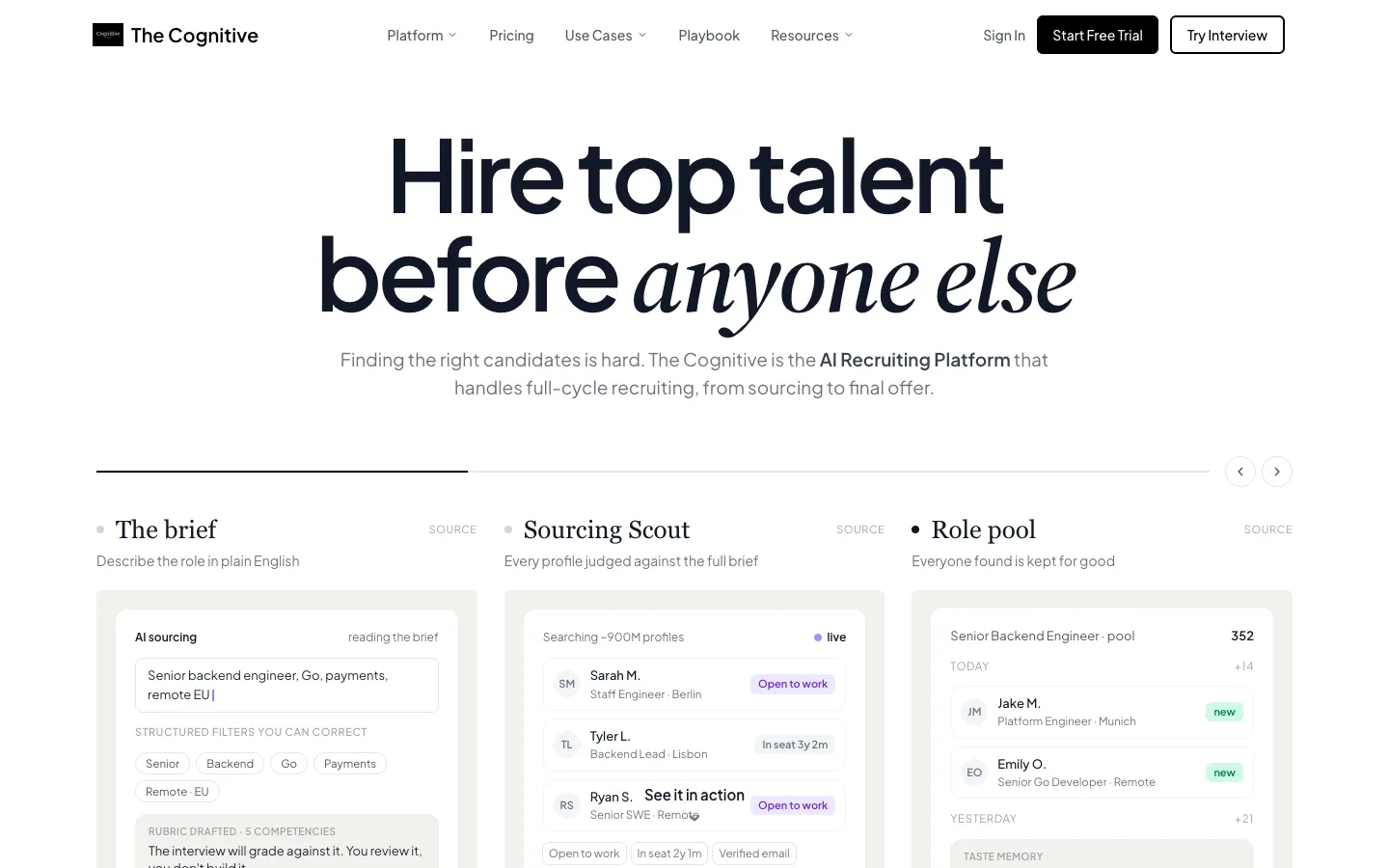
The Cognitive covers the sourcing and screening layer. A recruiter describes the role in plain English, the brief becomes search filters they can see and correct, and the search covers about 900M public profiles. Each person in the results carries a short reason for the match.
Search is charged per person shown, 1 credit each; a personal email costs 4 credits to reveal, and a phone number 12 on Sourcing Pro, Max and Business. On Sourcing Pro, Max, Team and Business plans, outreach goes from your own mailbox, and follow-ups stop when the person replies.
With an AI Interviews plan, interested candidates can take a live two-way AI video interview of 10 or 20 minutes on a laptop or desktop, in any of 9 languages. The questions adapt to each answer, and the result is a scorecard against fixed criteria, with the recording and transcript.
A freelancer can share the interview report, with the scorecard and the recording, with the client's hiring manager by link, so the shortlist arrives with evidence attached. On higher plans, The Cognitive syncs with 100+ applicant tracking systems. AI Sourcing and AI Interviews are separate plans. Plans start at $99 a month.
When to skip it
The Cognitive is the wrong tool for the business side of a freelance desk. It has no client, placement or invoice tracking, so it does not replace an agency ATS and CRM such as Recruiterflow, Loxo or Manatal, and it has no split-fee network and brings no clients. It does not post jobs, collect applications, send LinkedIn InMail or run as a Chrome extension. A freelancer whose clients only want job posts managed, or whose work is high-volume hourly hiring, will get more from a job board and an ATS.
How to start
Pick the open search with the thinnest shortlist. Write the brief with the hiring manager, run it, and read the first page of matches before writing to anyone.
The 7-day free trial needs no card and includes 100 people from search and 2 AI interviews. Outreach is not part of the trial. < href="https://app.thecognitive.io/signup">Start free with The Cognitive.
Sources
- SHRM, 2025 Recruiting Executives Benchmarking: Insights to Maximize Recruitment (2,371 SHRM members, medians), shrm.org, 2025.
- U.S. Bureau of Labor Statistics, Occupational Outlook Handbook: Human Resources Specialists, bls.gov, 2025 data.
- MBO Partners, State of Independence 2026, mbopartners.com, 2026.
- Gem, Key takeaways from the 2026 Recruiting Benchmarks Report, gem.com, 2025.
- Ashby, Talent Trends: Candidate Sourcing, ashbyhq.com, 2024.
- IRS, Independent contractor (self-employed) or employee?, irs.gov, 2026.
- Descriptions and pricing models from each company's own website: Paraform (paraform.com), Dover (dover.com), Recruiter.com (recruiter.com), Top Echelon (topechelon.com), Recruiterflow (recruiterflow.com), Loxo (loxo.co), Manatal (manatal.com).
Frequently Asked Questions
How much does a freelance recruiter charge?
A freelance recruiter charges a contingency fee on hire, a retainer, an hourly or monthly rate, or a flat fee per project, and the amount is agreed contract by contract. No government survey tracks freelance recruiter fees. The price moves with the seniority of the role, how scarce the skill is, whether the search is exclusive and how long the guarantee runs. Ask for every quote as a total per hire so you can compare models side by side.
How much do freelance recruiters make?
Freelance recruiter income depends on the fees they bill, and no official source tracks it separately. The closest government benchmark is for employees: the U.S. Bureau of Labor Statistics puts the median annual wage for human resources specialists, recruiters included, at $75,940 in May 2025. Across all fields, MBO Partners counts almost 6M independent workers in the US earning more than $100K a year.
Can you hire a freelance recruiter on Upwork?
Yes, open freelance marketplaces such as Upwork and Fiverr list freelance recruiters. You write the brief, compare profiles and vet the recruiter yourself. Ask which roles they filled in the last year, how they find people, what guarantee they offer and who owns the candidates they submit.
Is a freelance recruiter an employee or an independent contractor?
A freelance recruiter is normally an independent contractor, but the working relationship decides it, not the job title. The IRS looks at the degree of control and independence, grouped as behavioral control, financial control and the type of relationship. A recruiter who sets their own hours, uses their own tools and works for several clients fits the contractor pattern. This is not legal advice; check with an accountant or employment lawyer.
What is a freelance IT recruiter?
A freelance IT recruiter is an independent recruiter who places software engineers, data and infrastructure specialists and IT staff, on contract or permanent terms. The job needs the ability to read a technical profile: the languages and systems a person has worked on, what they shipped and where their work is public. Contract placements also bring questions about rates and duration that permanent hires do not.
Is a freelance recruiter cheaper than a recruitment agency?
A freelance recruiter is not cheaper by default, because both can charge the same fee models. The difference is in what the fee buys: one person's network and time, or an agency's team and database. Compare the total cost per hire, the guarantee and who does the sourcing, not the headline percentage.
What software do freelance recruiters use?
Freelance recruiters usually run an agency ATS and CRM for clients and placements, plus a sourcing tool for finding and contacting new people. Recruiterflow, Loxo, Manatal and Top Echelon sell systems built for agencies and small search firms. The Cognitive covers sourcing and first interviews: it searches about 900M public profiles from a plain-English brief. On Sourcing Pro, Max, Team and Business plans it sends email outreach from your own mailbox. On an AI Interviews plan it runs a live AI video interview whose report can be shared with a client. It does not track clients, placements or invoices.
Related reading
- What Is a Talent Sourcer? Role, Skills, Salary and Tools (2026)
- Recruitment Software for Recruitment Agencies: The 10 Best for Perm and Search Desks in 2026
- Passive Candidate Sourcing: How to Find, Message and Hire People Who Are Not Applying
- Best Retail Hiring Software in 2026: 9 Tools for Store Teams and Store Leaders
- 10 Best CRMs for Staffing Agencies in 2026, Scored
- Best EOR Companies in 2026: 11 Employer of Record Providers Ranked, Plus the Step Before