How to Hire for a Startup: The Founder's Process for the First 50 Hires
By Sparsh Goyal, Founder at The Cognitive. Published · Last updated
- To hire for a startup, a founder owns hiring and writes each role as outcomes and must-haves. The founder then reaches out to people who are not applying, runs a short loop on one scorecard and makes the offer within days.
- Ashby's 2024 sourcing data found a 19.6% average reply rate to recruiting emails, with replies flattening after three emails.
- In Gem's 2026 benchmarks, sourced candidates were 2.6% of applications but 11% of hires, and 82% of candidates accepted at the offer stage.
To hire for a startup, the founder owns hiring until roles start to repeat. Hire first for the bottleneck the founders cannot cover, and write each role as outcomes, a few must-haves and a pay range. Then start with your own network and reach out to people who are not applying, with a short note and two follow-ups. Run a short loop scored on one scorecard: a first screen, one round built on real work, and a founder final. Make the offer within days. Once the same roles come back every quarter, hand the process to a first recruiter or people lead.
In a 2026 survey of more than 80 early-stage founders and hiring leaders by Elly, a startup hiring software company, 64.1% said founders are primarily responsible for hiring. In the same survey, 70.5% said they spend only 0 to 5 hours a week on it.
How do you hire for a startup, step by step?
Startup hiring runs in six steps, and the founder is in every one of them for the first 10 to 25 people.
| Step | What you decide | Benchmark |
|---|---|---|
| 1. Pick the hire | The gap no founder can cover this year | 64.1% of founders own hiring (Elly, 2026) |
| 2. Write the role | Six-month outcomes, must-haves, pay range | Half a page, before any search |
| 3. Source | Network first, then people not applying | Sourcing: 2.6% of applications, 11% of hires (Gem, 2026) |
| 4. Reach out | One founder note, then two follow-ups | Average reply rate 19.6% (Ashby, 2024) |
| 5. Interview | Screen, work round, founder final, one scorecard | Small companies hire 0.3% of applicants (Gem, 2026) |
| 6. Offer and start | Pay, equity terms, start date | 82% accept at offer stage (Gem, 2026) |
How long the whole run takes depends on the role. Ashby's 2026 Talent Trends Report, built on more than 109 million applications, puts the median time from opening a job to its first hire at 56 days for business roles and 76 days for technical roles. From a candidate's application to an accepted offer, the medians are 30 and 40 days. A founder opening a role today should plan for about two months for a business hire and two and a half for a technical one.
Who should own hiring, and who should you hire first?
A founder should own hiring at a startup until there are enough repeat roles to keep a recruiter busy. Early hires shape the culture, the bar and the next ten hires, so handing them to someone who joined last month rarely works. In practice, one founder runs the process and the others join for the final round and the close.
Ownership means the founder signs off every brief and makes the final call. Teammates can interview, but someone has to notice a candidate waiting four days for a reply.
Who to hire first
Hire first for the work that blocks the next milestone and that no founder can do well. If two technical founders cannot sell, the first hire might be a seller. If the founders sell well but the product ships slowly, it is an engineer. Write down the next 12 months' milestones and the hires each one needs: that list is the hiring plan.
Early on, favour people who can cover more than one area; hire a specialist when one problem fills a whole week. For several roles at once, see hiring for multiple roles.
How do you write the role before you search?
A startup role brief is a half-page note that says what the person will achieve, what they must already know and what the job pays. Write it before the first search or post. Every later step, from the outreach note to the final scorecard, is checked against it.
- Outcomes for the first six months. "Closes the first ten paying customers in logistics" says more than "experienced account executive".
- Three must-haves at most. Pick skills a strong hire could not pick up in the first quarter. Everything else is a plus and should not rule anyone out.
- What you will flex on. Title, years of experience, location or industry background. Saying it now keeps the search wide.
- The pay range and how equity works. Agree both before anyone is contacted.
Start from the sourcing brief template and settle the intake meeting questions with a cofounder. A job post can then come straight from the brief, using the job description templates.
Employee, contractor or employer of record?
Decide the hiring model in the brief too. An employee suits work that will matter in two years, and a contractor suits a project with an end date. Hiring in another country usually needs an employer of record or a local entity. Contractor rules differ by country and state, so check them with an adviser. See contract vs direct hire.
Where do startups find people who are not applying?
Startups find their best early hires through their own network and by reaching out directly to people who are not looking. Inbound alone is noisy: Ashby's 2026 report finds the average recruiter now processes 291 applications per hire, against roughly 100 in early 2021. Gem's 2026 Recruiting Benchmarks Report draws on 165 million applicants. In it, sourced candidates made up just 2.6% of applications yet 11% of hires, about four times the average yield per application.
Founders already lean this way. In the Elly survey, 43.6% said referrals and personal networks would be their first approach, and 32.1% said they source candidates themselves. Work the channels in this order.
Your network, your investors' and your team's
List everyone you have worked with who would be good at the job, then ask each of them who else would be. Investors and advisers often know people who want to join an early company. Give teammates a precise prompt, like "who is the strongest logistics seller you know?", rather than "know anyone looking?". To make referrals a habit, see this guide to an employee referral program.
Direct sourcing by company and skill
Search for people who already do the job at companies like yours, or who did it at a company you admire. People at small or young companies already know what startup work is like. The method is in passive candidate sourcing, and other channels are in candidate sourcing channels.
Startup job boards and past candidates
A startup job board brings warm inbound; treat it as one channel, not the plan. Last search's finalists already know the team and often reply to a short note. See candidate rediscovery.
Your first engineer
Engineers are the clearest case for outreach. Nearly half of developers, 46% in the Stack Overflow 2025 Developer Survey, say they are not looking for a new role, so a founder who relies on a job post never reaches them. A non-technical founder can borrow search strings and screening questions from hire a software engineer and the technical recruiting guide.
Running the search in The Cognitive
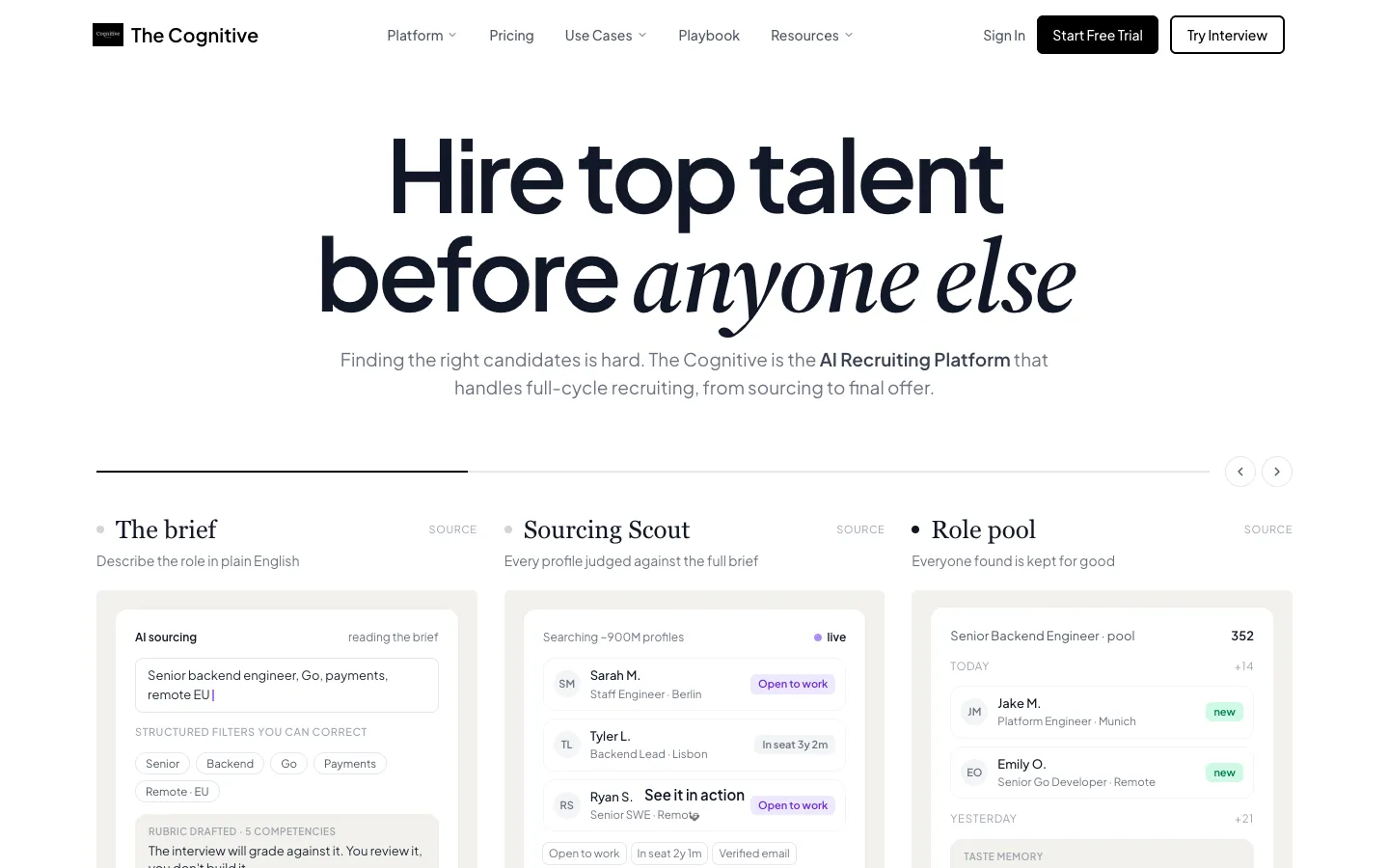
In The Cognitive, the founder pastes the role brief as written and gets back a ranked list drawn from about 900M public profiles. Results come 10 a page, each person with a one-line reason they match. The brief becomes editable filters, and two suit startups best: the size and founding year of someone's current employer, and their past employers. Those surface people at small or young companies, or alumni of a company whose way of working you want.
The brief step in The Cognitive: the founder can add a company size or founding year before the results load.
What outreach gets a reply from a stranger?
Strangers reply to a short, personal note from the founder that says why they were picked, what they would own and what it pays. Across more than 500,000 email sequences sent from January 2022 to January 2024, Ashby's candidate sourcing report measured an average reply rate of 19.6%. Replies plateau around 23%, and going past three emails did not significantly raise them. So plan one first note and two follow-ups, then stop.
A note from the founder comes from the person the candidate would work for, which a recruiter's note cannot.
- One line on why them. Something real from their work: a product they built or a market they sold into.
- The problem they would own. In the words of the brief, not the job title.
- The stage, honestly. Team size, what the company has proven and what is still unknown.
- The pay range. If the number is wrong for them, both sides learn it before a call.
- An easy next step. Twenty minutes with the founder, not a CV.
A first note built that way might read:
Subject: First seller at a 7-person freight software company
Hi Priya, you sold route-planning software to mid-size carriers for three years, which is exactly the buyer we are trying to reach. We have 14 customers, all from founder sales, and need someone to own the next 50. Base is [range] plus equity. Could we talk for 20 minutes next week?
Reply to your own note after four or five days with one new fact, such as a new customer or the interview steps. Keep the third to two lines. Sample wording for each touch: candidate outreach and these recruiting email templates.
In The Cognitive, a founder can send a three-touch sequence from their own mailbox, and the follow-ups stop once the person replies. Outreach is part of the Sourcing Team plan, and of Sourcing Pro and every plan above it. An interested reply adds the person to the role, and the founder then sends the interview invitation.
What should a startup interview process look like?
A startup interview process should have three or four steps, one scorecard and a decision within two working days of the last round. Small companies tend to let many people into early rounds and then say no late. Gem's 2026 benchmarks found that at smaller companies 25% of applicants reach pre-onsite stages, yet only 0.3% are hired, roughly 1 in 330. Every one of those early rounds costs founder hours, so the first screen has to be tight.
- First screen, 20 to 30 minutes. Test each must-have in the brief, and ask for one concrete example behind each claim on the profile. The founder runs it, or an AI first-round interview does.
- One round built on real work. A short work sample, a live problem from your business or a walk through something they built. Pay for it if it takes more than two hours.
- A check with someone they will work with. A teammate from another function tests how they explain, disagree and ask for help.
- Founder final. The founder tests the hardest must-have and sells the job. Reference calls follow for the finalist.
Write the scorecard with the brief: each must-have, what a strong answer looks like, and a score for each. Every interviewer scores alone before the debrief, so the founder's view does not set everyone else's. For the method, read structured interviews explained; for a first draft, use the scorecard generator.
The loop is also the defence against the outcome founders fear most: in the Elly survey, 66.7% named hiring the wrong person as their biggest concern. Written criteria, a work round and references catch most mismatches. For remote roles, add the checks in candidate fraud in remote hiring.
Handing the first screen to The Cognitive
The Cognitive can take the first screen off the founder with a live AI video interview, 10 or 20 minutes long, at a time the candidate picks. Candidates are told in the invitation that an AI will interview them. The AI holds a two-way conversation, probes answers with follow-ups and scores each interview on the criteria the founder set. Those criteria hold for every candidate, while the questions follow the conversation. It works in 9 languages, from a browser on a laptop or desktop.
Afterwards the founder sees a scored report with the recording and transcript. Possible cheating signals, such as a switched tab or a second face in view, are marked for a person to review. No candidate is turned down automatically. A cofounder can open a shared link to the scorecard and recording. See the AI interviewer page.
The interview scorecard: the founder reads it, then decides who meets the team.
How do you make an offer that beats a bigger company?
A startup wins offers on speed, clarity and the founder's own pitch, not on matching a large company's cash. Gem's 2026 benchmarks found that 82% of candidates accept once they reach the offer stage, the highest rate since 2021. The harder part is getting the right person to the offer stage before another company does.
- State the range early. If pay was in the first note, the offer holds no surprise. Check the range for the role and city against market data; options are compared in salary benchmarking tools.
- Explain equity in plain words. Say how many shares or options, out of how many in total, the vesting schedule and cliff, and what happens if the person leaves.
- The founder makes the call. Send the paperwork the next day, not the next week.
- Ask what else they are weighing. Answer that, and agree a decision date a few days out.
The first weeks finish the hire. Give the new person a written 30-day goal, a teammate to ask, and a check-in with the founder after week one and week four.
What should you use at each stage, and where does The Cognitive fit?
The right hiring setup changes with team size. A spreadsheet is enough for the first few hires, and a full applicant tracking system (ATS) pays off once several roles run at once. For named products, the comparison is in recruiting software for startups.
| Team size | Owner | Tool types | Move on when |
|---|---|---|---|
| 1 to 10 | One founder | Sheet or free ATS; sourcing tool; email from your own mailbox | 2+ roles open at once |
| 10 to 25 | Founders and heads of function | ATS; sourcing and outreach; AI first round; scorecards | Same roles every quarter |
| 25 to 50 | First recruiter or people lead | ATS with reports; sourcing and outreach; AI first round synced to the ATS | 6+ roles a year, every year |
The last column has a benchmark. The SHRM 2025 Recruiting Executives Benchmarking data brief found a median of 6 requisitions a year per recruiter at organizations with fewer than 100 employees, and 20 across all sizes. A startup filling about six roles a year, every year, has reached a typical small-company recruiter's load. What agencies and search firms charge is in recruitment agency fees and commission.
Where The Cognitive fits
The Cognitive covers three steps of this process for a founder with no recruiter. They are the search from a plain-English brief, email outreach from the founder's own mailbox, and the AI first-round interview with a scorecard. The founder keeps the later rounds and the close. Two customer stories, with figures reported by the customers, show what founders got back. A 4-person seed SaaS startup with no recruiter or ATS ran its first-round interviews in The Cognitive. It reported hiring 9 engineers in 6 weeks, with founder time on hiring falling from 30 hours a week to 5 (read the seed SaaS story). In New York, another seed startup sourced and interviewed in The Cognitive. It reported growing from 8 to 19 people with no recruiter, making 11 hires with founder hours per hire falling from 22 to 4 (read the New York story).
When to skip The Cognitive
Skip The Cognitive when a startup's roles already fill well from applicants and referrals; a free ATS will serve better. It also leaves these jobs to other tools or people:
- Job posts, applications and applicant tracking: it is not an ATS.
- Offers, reference and background checks, payroll and employer of record services.
- A recruiter who runs the search for you.
- A coding test: an engineer you trust still runs the technical round.
- Outreach and ATS sync on entry plans: email outreach from your own mailbox is available on Sourcing Team and on Sourcing Pro and up, and syncing with 100+ ATS needs a higher plan.
- Phones and tablets: candidates take the AI interview on a laptop or desktop.
How to start
Take the one role that blocks your next milestone. Write its brief this week, ask your network for names, then contact ten people who are not applying. Track reply rate and days per step, and fix the slowest step before the next search.
A 7-day trial of The Cognitive needs no card and comes with 100 sourcing credits, one for each person a search shows, so 100 people in total. Outreach is not part of the trial. Plans start at $99 a month. Try your first search free.
Sources
- Elly, Q2 2026 Report: Founder-Led Hiring in the Age of AI (survey of more than 80 early-stage startup founders and hiring leaders), elly.ai, May 2026.
- Gem, Key takeaways from the 2026 Recruiting Benchmarks Report (data on 165 million applicants and 1.2 million hires from June 2021 to May 2025), gem.com, December 2025.
- Ashby, Recruiter Productivity: 2026 Talent Trends Report (over 109 million applications across 247,000 jobs from January 2021 to March 2026), ashbyhq.com, April 2026.
- Ashby, Talent Trends Report: Candidate Sourcing (over 500,000 email sequences from January 2022 to January 2024), ashbyhq.com, March 2024.
- Stack Overflow, 2025 Developer Survey, Work section, survey.stackoverflow.co, 2025.
- SHRM, 2025 Recruiting Executives Benchmarking: Insights to Maximize Recruitment (2,371 members, January to March 2025), shrm.org, 2025.
Frequently Asked Questions
How long does it take a startup to hire someone?
Plan for about two months from opening a role to the first hire, and longer for a technical role. Across Ashby customers in its 2026 Talent Trends Report, a typical job took 56 days to fill its first hire for business roles and 76 days for technical roles. Measured from a candidate's application to an accepted offer, the medians are 30 and 40 days. A short loop and a quick decision keep a hire near the median.
When should a startup hire its first recruiter?
A startup is ready for a first recruiter once it fills about six or more roles a year, every year, which is the load a recruiter at a small company typically carries. SHRM's 2025 benchmarking data found that recruiters at organizations with fewer than 100 employees handle a median of 6 requisitions a year, against 20 across all sizes. Below that, a founder with sourcing and first-round interview tools can usually cover the work.
Should a startup use a recruiting agency?
A startup should use a recruiting agency for a rare or senior role it cannot reach through its own network, or when several roles must fill at once. The agency brings its own network, does the screening and is usually paid when the person starts. A role the startup will hire again next year is better run in house, where the names found and the notes taken stay with the company.
Can a startup hire without a recruiter?
Yes. Many startups make their first 10 to 25 hires with a founder running the process: in Elly's 2026 founder survey, 64.1% said founders are primarily responsible for hiring and 7.7% would start with recruiters or agencies. Software can take the search, the outreach and the first-round interview, which is where most founder hours go.
How much does it cost a startup to hire an employee?
Hiring costs a startup the founder's time, any tools or job ads, and an agency fee if one is used. As a reference point, SHRM's 2025 benchmarking data put the median cost per hire for nonexecutive roles at $1,200, across the employers it surveyed. At a startup the largest hidden cost is founder hours.
How many interviews should a startup run for each role?
A startup should run three or four interview steps for each role. A typical loop is a first screen, one round built on real work, a check with a future teammate and a founder final, all scored on one scorecard. More rounds add days without testing new must-haves.
How does a non-technical founder hire a first engineer?
A non-technical founder hires a first engineer by writing the brief around what the engineer must ship and asking an experienced engineer they know to run the technical round. The founder can still source, reach out and run the first screen. Outreach matters more than a job post here: 46% of respondents to Stack Overflow's 2025 Developer Survey were not looking for a new role.
Related reading
- Recruiting Software for Startups: 10 Picks for Founders Hiring Without a Recruiter
- Passive Candidate Sourcing: How to Find, Message and Hire People Who Are Not Applying
- How to Calculate Cost Per Hire: A Worked Example With Every Line Item
- Best Retail Hiring Software in 2026: 9 Tools for Store Teams and Store Leaders
- 10 Best CRMs for Staffing Agencies in 2026, Scored
- Best EOR Companies in 2026: 11 Employer of Record Providers Ranked, Plus the Step Before