Offboarded Without Gaps: A 7-Step Employee Offboarding Process Guide
By Sparsh Goyal, Founder at The Cognitive. Published · Last updated
- An employee is not fully offboarded until HR, IT, payroll, the manager and knowledge owners have confirmed their handoffs.
- Access removal and knowledge transfer should be owned before the last day, not remembered afterward.
- A useful HR exit interview finds patterns, risk and process gaps instead of turning into a polite final chat.
- Layoffs, resignations and urgent terminations need different timing, but the same visible ownership model.
- The Cognitive helps hiring teams recover faster from exits by sourcing, interviewing and shortlisting backfill candidates in one pipeline.
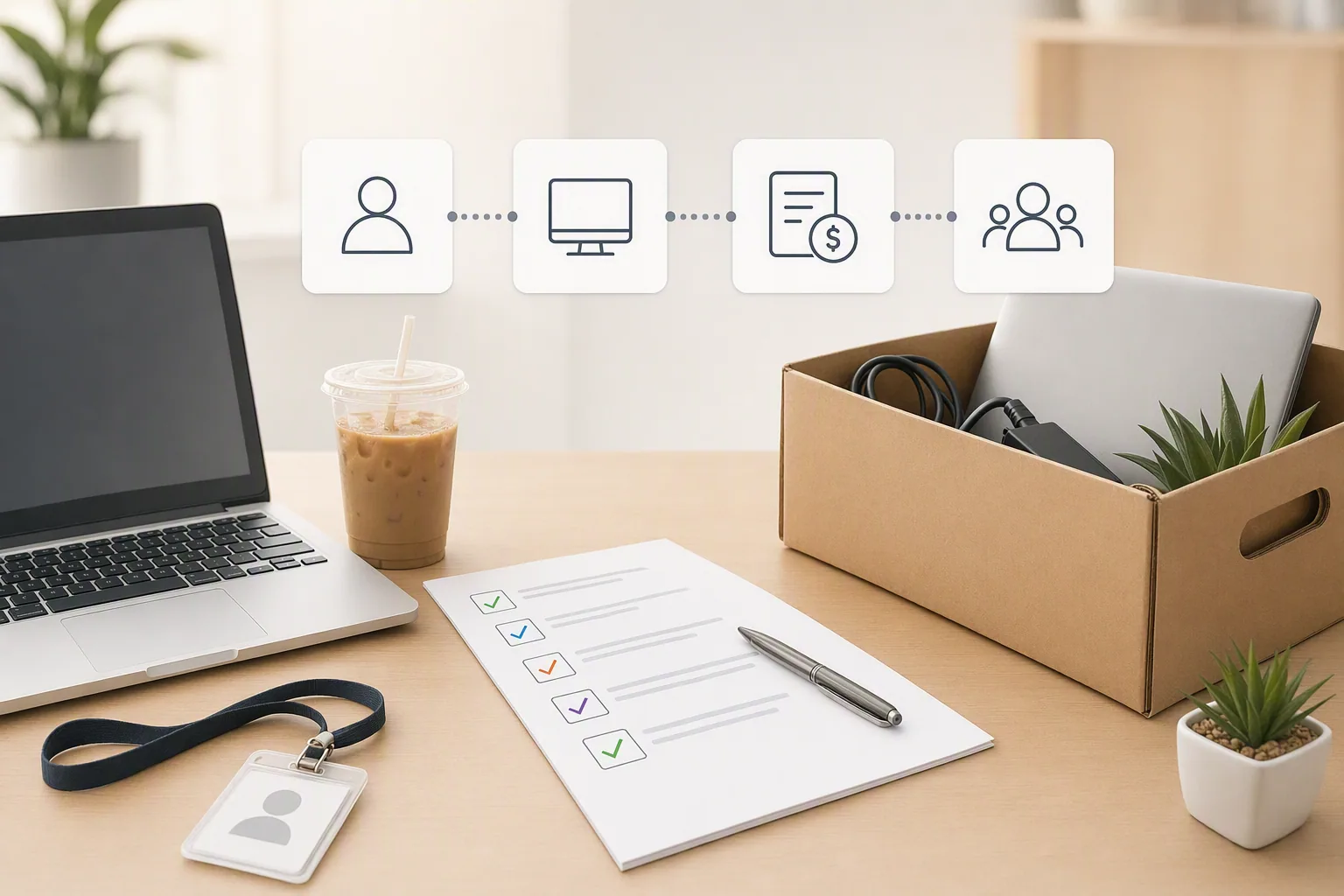
An employee is only offboarded when every handoff is owned, verified and visible. At The Cognitive, we see the same lesson on the hiring side: unclear handoffs create risk, even when everyone did their part.
The near miss usually starts small. A manager replies to an old Tuesday afternoon inbox thread and asks, almost casually, whether the engineer who left last week still has access to a shared repository. There is a half-finished coffee on someone’s desk, cold by then, and a paper checklist marked up in three pen colors because HR, IT and facilities each added one more thing late.
No one was careless. HR had sent the paperwork. IT thought the manager had confirmed access removal. The manager assumed knowledge transfer was already complete. The employee had technically left, but the process lived across too many memories.
A clean offboarding process does not make exits heavier. It makes them less ambiguous before the last day arrives.
Key takeaways
- An employee is not fully offboarded when HR sends the final paperwork. Completion means every owner has confirmed their piece.
- Access removal, payroll changes, equipment return and knowledge transfer need named owners before the last day, not reminders after it.
- A useful HR exit interview captures patterns and operational risk, not just a polite goodbye conversation.
- Layoffs, resignations and urgent terminations need different access timing, but the same visible checklist and verification step.
- The Cognitive helps teams recover from employee exits faster by sourcing candidates, running deep live AI interviews and producing evidence-scored shortlists in one pipeline.
What does offboarding actually cover?
Offboarding covers the full operational process of ending an employee’s relationship with the company, including legal paperwork, payroll, access removal, equipment return, knowledge transfer, benefits, communication and final verification. A person is not offboarded just because their last day has passed.
That distinction matters more than most teams admit. HR often owns the visible parts: resignation acknowledgment, final pay instructions, benefits notices and the employee record. But the risk usually sits in the handoffs HR does not directly control.
Think about a software engineer leaving a growing company. Their exit touches GitHub, cloud consoles, Slack, Jira, production dashboards, expense cards, device management, VPN, customer notes, roadmap context and a half-finished migration doc no one else has read. The process is bigger than the HR folder.
Offboarding is a cross-functional handoff.
The departments involved usually include:
- HR or People Operations: resignation or termination documentation, policy checks, benefits, exit interview, employee record, final communications.
- Manager: transition plan, knowledge transfer, project reassignment, stakeholder updates, final priorities.
- IT and security: account inventory, access revocation, device return, credentials, shared inboxes, admin rights, logs.
- Payroll and finance: final pay, bonuses or deductions, unused PTO, expenses, equity or commission handling where relevant.
- Facilities or workplace: badges, keys, parking passes, desk equipment and physical access.
- Project owners: documentation, customer continuity, code ownership, open tickets, vendor relationships.
The problem is that each group sees only its own slice. HR sees paperwork complete. IT sees a ticket closed. The manager sees a farewell message posted. None of those slices prove the whole employee offboarding process is done.
A clean exit is not one perfect checklist. It is a checklist where every line has an owner who can say, “done,” with evidence.
This is why offboarding belongs in your operating rhythm, not in one experienced HR person’s memory. The person who remembers the sequence will eventually be out sick, in a meeting, or offboarded themselves.
The same logic applies on the hiring side. A recruiting tech stack fails when no one owns the handoff between sourcing, interviews and decisions. Offboarding has the same shape: lots of reasonable people, each assuming the next reasonable person has the ball.
That is the quiet failure mode.

What must happen before someone is offboarded?
Before someone is offboarded, HR should create a shared checklist that names every task, owner, deadline and verification point across notice, pre-last-day, last-day and post-exit phases. The checklist is the source of truth so no department has to remember the invisible sequence.
Here is the practical version. Not a ceremonial list. A working list you can put into your HRIS, ticketing system, ATS notes, project tracker or even a shared spreadsheet if that is where your team actually works.
Phase 1: Notice received
The first phase starts when the employee resigns, is notified of termination, or is included in a layoff group. Speed matters here because this is where assumptions begin.
HR should confirm the exit type, last working day, legal requirements, final pay rules and whether the employee will work through the notice period. The manager should confirm business continuity needs. IT should start the access inventory, not wait until the last day.
- Confirm resignation, termination or layoff status in writing.
- Record the final working day and employment end date. They are not always the same.
- Identify whether the role touches sensitive systems, customers, money, production, regulated data or admin accounts.
- Name the offboarding owner in HR and the manager owner for knowledge transfer.
- Open IT, payroll, finance and facilities tasks from the same source record.
- Decide what can be communicated, to whom and when.
If the employee is leaving a critical role, the manager should also name the replacement owner for each active project. “The team will cover it” is not a plan. It is a future Slack thread.
For roles that need a backfill, start that work immediately. The Cognitive’s AI sourcing tool lets recruiting teams search in plain English across talent profiles, reveal verified personal emails and direct phone numbers, run outreach sequences and use an AI voice agent to call candidates. A resignation does not have to sit for 2 weeks before sourcing starts.
Phase 2: Before the last day
The pre-last-day phase is where good offboarding is won. By the last day, you should be verifying most work, not discovering it.
This is the phase for documentation, handoffs, open work, access mapping and communication. It is also when HR should schedule the HR exit interview if the circumstances make one appropriate.
- Create a knowledge-transfer plan with named owners for every project, customer, system or recurring task.
- Ask the employee to document open work, blockers, key contacts, recurring deadlines and location of important files.
- Review shared drives, repositories, dashboards, calendars, email groups and permissions.
- Confirm device return plan, shipping labels, badge return or office handoff.
- Tell payroll and finance about final pay, reimbursements, bonus treatment, deductions and equipment value if applicable.
- Prepare internal communication for the team and external communication for customers or vendors where needed.
- Schedule the exit interview and explain its purpose.
This is where I like a simple rule: if the departing employee is the only person who knows where something is, that item is not transferred. It is only described.
A useful handoff names where the thing lives, who owns it next, what is unresolved and what could break. Anything less leaves the next person guessing.
Phase 3: Last day
The last day should feel calm because most decisions have already been made. It is not the day to argue over who removes access, who sends the customer note, or who has the laptop tracking number.
HR should close the human parts with dignity. The manager should confirm transition. IT should execute time-bound access changes. Payroll should have what it needs before the employee disappears from normal communication channels.
- Confirm final pay and benefits instructions have been sent.
- Run the exit interview if scheduled for the final day.
- Collect or confirm shipment of laptop, badge, keys, cards and any company equipment.
- Remove or schedule removal of access according to the risk plan.
- Transfer ownership of documents, repositories, dashboards, recurring meetings and shared inboxes.
- Send internal departure communication if it has not already gone out.
- Confirm the employee knows who to contact after leaving for tax forms, benefits or references.
There is a temptation to make the last day purely sentimental. That is fine for the goodbye. It is risky for the process. The employee deserves warmth, and the company still needs closure.
Phase 4: Post-exit verification
Post-exit verification is the step teams skip because the person is gone and everyone wants to move on. It is also the step that catches the repository access question before it becomes a problem.
Within 24 to 72 hours, HR or the offboarding owner should confirm every department has closed its piece. Do not ask, “Is this done?” Ask for the specific evidence.
- IT confirms account deactivation, admin access removal, device status and any exceptions.
- Manager confirms project ownership, documentation quality and handoff completeness.
- Payroll confirms final pay processing and any remaining deductions or reimbursements.
- Facilities confirms badge, key and office access closure.
- HR confirms exit interview notes, employee record, benefits notices and retention requirements.
If something remains open, the employee can still be exited but not fully offboarded. That language helps. It gives the team a way to say, “employment ended, but offboarding verification is still open.”
| Phase | Main owner | What good looks like | Common miss |
|---|---|---|---|
| Notice | HR | Exit type, last day, risk level and owners are recorded | HR confirms resignation but no one opens IT or payroll tasks |
| Pre-last-day | Manager | Knowledge transfer, access inventory and communication plan are underway | Documentation is requested on the final afternoon |
| Last day | HR and IT | Employee experience, equipment return and access changes happen on schedule | Access removal depends on someone remembering a chat message |
| Post-exit | Offboarding owner | Every department confirms completion with evidence | The checklist is marked complete because the employee has left |
You can make this more formal over time. Start with ownership. Most offboarding processes do not fail because the checklist is too short. They fail because the checklist has no accountable owner for each line.
How should HR run a useful HR exit interview?
A useful HR exit interview gathers patterns, risks and operational feedback from a departing employee without turning the meeting into a performance review or a venting session. The goal is to learn what the organization can improve while treating the employee with respect.
The phrase HR exit interview sounds administrative, and that is part of the problem. Too many teams treat it like a formality: ask why the person is leaving, type a few notes, file them away and never look again.
That misses the value. A good exit conversation can tell you where managers are overloaded, where onboarding is weak, where compensation expectations are drifting, where tools are broken, where trust has been lost and where the next resignation may already be forming.
It should not be an interrogation. It should feel like a structured conversation with a clear reason.
Set the tone before the meeting
HR should tell the employee what the exit interview is for and how the notes will be used. If the employee thinks every sentence goes straight to their manager with their name attached, you will get safe answers. Safe answers are not very useful.
Use plain language:
- “This is not a performance conversation.”
- “You can skip anything you do not want to answer.”
- “We look for patterns across exits, not one-off complaints.”
- “If you raise a serious legal, safety or policy issue, we may need to act on it.”
That last line matters. Do not promise confidentiality you cannot keep.
Ask questions that reveal patterns
Exit interviews get weak when every question points backward in a vague way. “Why are you leaving?” is fine, but it is not enough. You want the decisions, friction and moments that shaped the employee’s experience.
Better questions include:
- What changed between when you joined and when you started considering leaving?
- Which part of the role matched what you were promised, and which part did not?
- What made your work harder than it needed to be?
- Was there a point where you might have stayed if something had changed?
- What should the next person in this role know before they accept?
- Where did handoffs, tools or decision-making slow you down?
- Did you have what you needed from your manager?
- What should we fix before we hire someone into this seat again?
If you want to build a consistent question set, The Cognitive’s free AI Interview Question Generator can help turn role context and competencies into structured questions with follow-ups. Use the same discipline for HR exit conversations: ask questions that produce comparable signal, not just polite answers.
Separate feedback from investigation
Most exit interviews are feedback conversations. Some become investigation triggers. HR needs to know the difference before the meeting starts.
If the employee mentions harassment, discrimination, retaliation, safety issues, wage concerns, data misuse or policy violations, stop treating the conversation as general feedback. Ask only what you need to understand the issue, document carefully and follow your internal process.
For ordinary feedback, patterns matter more than drama. One person saying a tool is annoying is a note. Five people across three teams saying the same handoff breaks every month is an operating problem.
Close the loop internally
The worst exit interview is the one everyone knows goes nowhere. Employees can feel when HR is collecting sentiment for a folder.
Create a lightweight review cadence. Once a month or quarter, HR should summarize themes across exits for leadership: manager support, role clarity, compensation, workload, onboarding gaps, tool issues, career path concerns and recurring process failures.
Do not turn it into a blame report. Turn it into a fix list.
This is also where hiring and offboarding connect. If employees keep saying the role was sold one way and lived another way, fix the job description before backfilling. A tool like the AI JD Grader can catch vague language, cliches and missing role clarity before the next candidate sees the posting.

How do access removal and knowledge transfer stay coordinated?
Access removal and knowledge transfer stay coordinated when HR owns the exit timeline, IT owns the access inventory and the manager owns continuity before the employee’s last day. Repository access, credentials and project context should never depend on assumptions.
This is the section that goes back to the Tuesday inbox thread. The manager asked whether the offboarded engineer still had repository access because no one could see the whole sequence. HR knew paperwork was complete. IT knew a ticket existed. The manager knew a handoff conversation happened. None of that answered the access question.
You need one shared view with three columns: access, knowledge and owner.
Start with the access map
IT should not rely only on standard app lists. Standard lists catch Slack, email and HRIS. They often miss the weird stuff: shared repository groups, admin consoles, vendor portals, API dashboards, analytics tools, old staging environments and shared credentials that should not exist but do.
For employees in engineering, finance, operations, customer support or security-sensitive roles, the access map should include:
- Identity provider accounts and single sign-on groups.
- Email, calendar, chat and shared inboxes.
- Code repositories, package registries and deployment tools.
- Cloud platforms, databases, logs and monitoring dashboards.
- CRM, support tools, billing systems and customer data.
- Finance systems, expense cards and procurement tools.
- Vendor portals and third-party admin accounts.
- Physical access, badges, keys and device management.
The access map should also name timing. Not every account needs the same cutoff. A resigning employee serving notice may need access until the final afternoon. A terminated employee may need access removed during the notification meeting. A laid-off employee may have a short window for personal files but no access to sensitive systems.
Same checklist. Different timing.
Turn knowledge transfer into evidence
Knowledge transfer cannot be “we talked for an hour.” A conversation helps, but it is not durable. The next owner needs artifacts they can use when the departing employee is gone.
Ask for concrete outputs:
- A list of active projects with current status and next action.
- Links to core documents, repositories, dashboards and tickets.
- Known risks, recurring problems and unfinished decisions.
- Key internal and external contacts.
- Recurring meetings and why they exist.
- Credentials or shared access that need to be rotated, moved or removed.
- Customer or vendor context that is not obvious from the system record.
For technical roles, make the manager or project owner review the handoff before the last day. A departing engineer can write a migration note that looks complete to HR and useless to the person who has to run it next week.
If the exit exposes that no one knows what skills or ownership the role actually requires, build a competency map before you backfill. The free AI Competency Map Builder can help define role levels, skills and growth paths so the next hire is not stepping into a foggy job.
Create a handoff meeting that is not optional
Some teams avoid formal handoff meetings because they feel bureaucratic. Fine. Keep it short. But do not skip the moment where the next owner confirms they understand what they are inheriting.
A useful handoff meeting has 4 questions:
- What work is still open?
- What could break after the employee leaves?
- Where is the documentation?
- Who owns each item now?
The last question is the one that matters. If the answer is “the team,” keep going until it becomes a name.
Backfills need speed, but not panic
When a strong employee leaves, the pressure to replace them can distort hiring. Teams rush the job post, skip the rubric and start interviewing whoever looks close enough. That is how one unclear role becomes two problems: a messy exit and a bad backfill.
The Cognitive was built for the stretch after a hiring need appears. It sources, interviews and shortlists in one pipeline. AI sourcing finds candidates with verified personal emails and direct phone numbers, outreach sequences engage them, an AI voice agent calls candidates, and interested people can be pushed into deep live AI interviews in one click.
The interview side is not a one-way recording or a chatbot. The Cognitive’s AI interviewer appears with a real human face and voice, holds a live two-way video conversation, asks adaptive follow-ups and produces evidence-based scorecards tied to exact quotes and timestamps. Humans still decide. They just stop spending 15 to 20 hours a week on low-signal interview volume.
That matters after an exit because the team is already carrying the missing work. Hiring velocity is not a vanity metric when a critical seat is empty. Traditional hiring often drags 45 to 60 days. The Cognitive helps teams compress that to under 10 by removing scheduling drag and interviewer fatigue.
If you are redesigning the hiring side of employee transitions, the AI recruiting platform guide explains how sourcing, interviews and shortlists fit together without replacing your ATS or your recruiters.
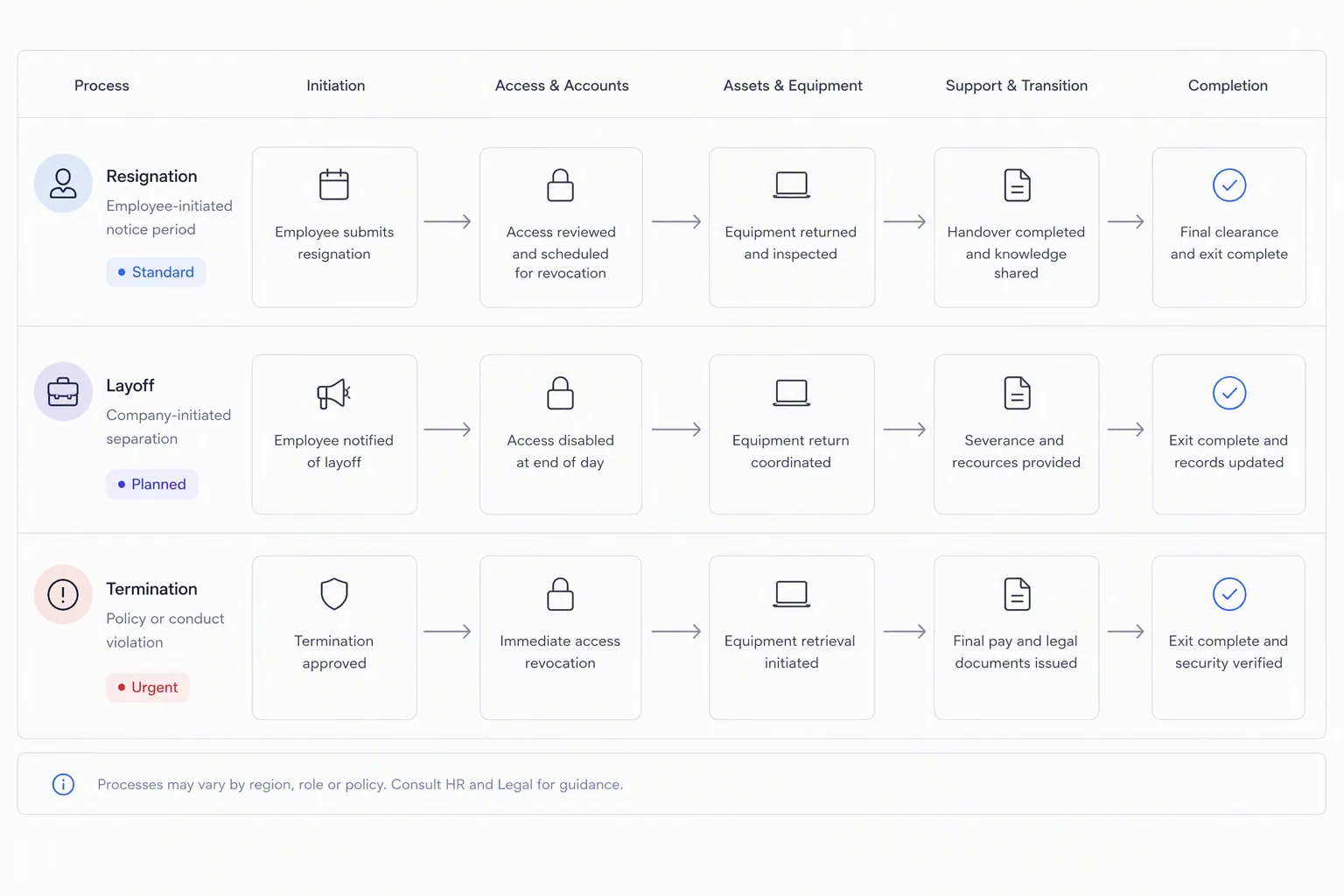
What changes when someone is offboarded after a layoff vs a resignation?
When someone is offboarded after a layoff, the process usually needs tighter timing, more controlled communication and more support than a voluntary resignation. The core steps stay the same, but access windows, emotional context and legal sensitivity change.
This is where many teams get either too rigid or too improvised. They build one offboarding checklist for resignations, then panic when they need to handle a layoff, urgent termination or negotiated departure. Or they build separate processes so different that no one can remember which one applies.
The better model is one operating system with different risk settings.
| Exit type | Access timing | Communication style | Support needed | Main risk |
|---|---|---|---|---|
| Voluntary resignation | Often stays active through notice period | Collaborative and planned | Reference, benefits, transition clarity | Knowledge loss through slow handoff |
| Involuntary termination | Usually removed during or just before notification | Private, direct and documented | Final pay, benefits, policy clarity | Security, conflict or legal exposure |
| Layoff | Often coordinated at a set time across a group | Consistent, careful and humane | Severance, outplacement, benefits, manager support | Trust damage and inconsistent treatment |
| Urgent termination | Immediate removal before or during notification | Minimal, controlled and factual | Clear post-exit contact path | Data, safety or business continuity risk |
Voluntary resignation
A resignation usually gives you the most room to plan. The employee may work a notice period, document their role and train the next owner. The emotional tone can be positive or at least neutral.
Do not waste the notice period. Many teams spend the first week deciding what to ask for, then realize on the final day that the employee still owns the vendor relationship, the deployment checklist and the only clean explanation of a recurring bug.
For resignations, prioritize knowledge transfer early and access removal late. Keep the employee productive, but do not leave access open after the agreed end.
Involuntary termination
An involuntary exit requires tighter coordination. HR, legal if needed, the manager and IT should agree on the timing before the conversation. Access changes should not lag behind the notification.
The tone should be respectful and factual. Do not over-explain in the meeting. Do not debate. Give the employee the decision, final pay information, benefits information, equipment return steps and the post-exit contact.
The hard part is preserving dignity while protecting the company. You can do both, but only if the logistics are ready before the meeting starts.
Layoffs
Layoffs test consistency. Employees compare notes, and they should be able to. If one person gets clear severance details, another gets a vague calendar invite, and a third keeps system access all day, the process creates extra harm.
Layoff offboarding should be planned as a coordinated event. HR owns the message and support materials. Managers need talking points. IT needs exact timing. Payroll and benefits need accurate documents. Leaders need to communicate what happened without hiding behind jargon.
There is also a hiring consequence. Layoffs damage trust when the company later starts hiring for similar roles without a clear explanation. If you do need to rebuild, use evidence and discipline. The Cognitive’s AI recruiting software can help teams source, interview and shortlist with consistent rubrics, but leadership still has to explain the business context honestly.
Urgent termination
Urgent terminations happen when there is a serious risk: security, safety, misconduct, fraud, data exposure or another issue that cannot wait. These exits need the smallest access window and the tightest information control.
Do not improvise urgent exits in public channels. HR, IT and the manager need a private plan, a clear sequence and a single source of truth. If you are removing access before the meeting, know exactly how the employee will receive documents, collect personal items and ask follow-up questions.
Fast does not have to mean sloppy.
How do you know the offboarding process is actually complete?
The offboarding process is complete when every owner has confirmed their task, every exception has a named follow-up and the company can prove access, payroll, equipment, documentation and communication were handled. The last day passing is not proof.
This is the post-exit review that turns a near miss into a stronger process. In the repository access example, nothing had truly failed. The process had simply depended on everyone remembering the same invisible sequence.
That is not a people problem. It is a design problem.
Use a final verification record
The final verification record does not need to be fancy. It needs to be clear. For each employee, HR should be able to see who confirmed what and when.
- HR: final documents, benefits notices, exit interview notes and employee record are complete.
- Payroll: final pay, deductions, reimbursements, commissions or bonus decisions are processed or scheduled.
- IT: accounts, devices, admin rights and physical access are closed or documented as exceptions.
- Manager: work is reassigned, documentation reviewed and stakeholders notified.
- Facilities: badge, keys, parking and office equipment are returned or disabled.
If one item cannot be closed, it should not disappear. Mark it as an exception with an owner and date. For example: “Laptop in transit, tracking confirmed, facilities owner to verify receipt Friday.”
That kind of boring note prevents three future meetings.
Track a few offboarding metrics
You do not need a dashboard with 40 charts. A few metrics will tell you whether the process is getting cleaner.
- Access closure time: how long after the employment end time all critical access is removed.
- Checklist completion rate: how often every owner confirms their part by the target date.
- Knowledge-transfer acceptance: whether the receiving owner says the documentation is usable.
- Equipment recovery time: how long devices and badges take to return or deactivate.
- Exit interview theme rate: recurring issues across exits, grouped by manager support, role clarity, workload and tools.
These metrics are not about policing HR. They are about finding friction before it becomes a pattern. The same mindset applies to hiring metrics like time-to-hire and cost per hire. If you are building a people operations dashboard, the guide on how to calculate cost per hire shows how to make numbers useful instead of decorative.
Run a short post-exit review for sensitive roles
Not every exit needs a meeting. A part-time intern leaving after a planned summer program probably does not need a cross-functional review. A senior engineer, finance admin, people manager, sales leader or healthcare operations employee might.
Keep the review short:
- Were all access changes completed on time?
- Was knowledge transfer accepted by the next owner?
- Were there any payroll, benefits or equipment exceptions?
- Did the exit interview reveal a theme we need to address?
- What should we change in the checklist before the next exit?
The last question is the point. Offboarding improves when the checklist learns.
Know when process is too much
There is a limit. If you are a five-person company and one employee leaves every two years, a heavy offboarding system may be overkill. You still need access removal, payroll accuracy and a respectful handoff, but you do not need a 12-step approval chain.
The right level of process depends on risk, volume and role complexity. A healthcare staffing company, fintech team or engineering organization with production access needs more rigor than a small studio with no sensitive systems.
But even tiny teams need one thing: a visible owner.
What should you do next?
A strong offboarding process does not make exits more bureaucratic. It makes them less ambiguous, so every employee is offboarded with security, continuity and dignity.
Start with one recent exit. Rebuild the sequence from notice to post-exit verification. Where did HR assume IT knew? Where did the manager assume documentation was good enough? Where did payroll wait on a detail no one owned?
Fix that handoff first.
If the exit also creates a hiring gap, do not let the backfill drift for 45 to 60 days while the team absorbs the work. The Cognitive can source candidates with verified emails and direct phone numbers, run outreach and AI calling, move interested people into live two-way AI interviews, and deliver evidence-scored shortlists for humans to review. Interview plans start from $99/month, sourcing plans start from $49/month, and the free trial includes 100 sourcing credits plus 2 free interviews for one role.
If you want to see the candidate side before using it on a backfill, you can take a live AI interview yourself and judge the experience on a real role.
Frequently Asked Questions
What does it mean when an employee is offboarded?
An employee is offboarded when the company has completed and verified every exit handoff, including HR records, access removal, payroll, equipment, knowledge transfer and communication. The employee’s last day is only one milestone, not proof that offboarding is complete.
What should be included in an HR exit interview?
An HR exit interview should cover why the employee is leaving, what changed during their time in the role, whether the job matched expectations and what process problems made work harder. It should also capture serious risks separately, such as safety, harassment, wage or policy concerns.
Who owns access removal during employee offboarding?
IT or security should own the access inventory and technical removal, while HR owns the exit timeline and the manager confirms what access is still needed for handoff work. The safest process names each owner before the last day and requires post-exit verification.
How is offboarding different for layoffs and resignations?
Layoffs usually require tighter timing, consistent communication and more employee support than resignations. Resignations often allow a notice period for knowledge transfer, while layoffs need coordinated access changes, severance details, benefits guidance and careful manager communication.
Related reading
- What Is a Normal Cost Per Hire? Benchmarks by Seniority, Sector, Role and Region
- Candidate Sourcing Channels Compared: Where to Find Candidates for Each Role in 2026
- How Many Candidates Are Interviewed per Hire? 2025 and 2026 Benchmarks by Role and Stage
- Candidate Experience Platforms Explained: What They Cover, How to Measure Them and 8 Tools to Know
- Canditech Alternatives in 2026: 10 Tools, From Skills Tests to Live AI Interviews
- Data-Driven Recruitment, Sourcing First: 9 Metrics, Clean Data and the Decisions They Should Change