Synonyms for Recruiter: Other Job Titles and What Each Means
By Sparsh Goyal, Founder at The Cognitive. Published · Last updated
- Another word for recruiter is talent acquisition specialist; talent partner, corporate recruiter, recruitment consultant and headhunter are other titles for the job.
- Sourcer, recruiting coordinator, hiring manager, HR business partner and talent scout sound similar but are different jobs.
- Use the plain title plus a specialty in job posts and headlines, and search several titles at once to find recruiters.
Another word for recruiter is talent acquisition specialist. The US Bureau of Labor Statistics describes recruitment specialists as "sometimes known as recruiters or 'talent acquisition specialists'" in its Occupational Outlook Handbook. Other titles for the same job are talent acquisition partner, talent partner, corporate recruiter and staffing specialist. UK agencies say recruitment consultant, and senior searches use executive recruiter or search consultant. The informal word is headhunter.
The bare word is broad. A search for "recruiter" on O*NET OnLine, the US occupational database, returns 88 occupations, from human resources specialists to sports coaches and scouts. That is why the right synonym depends on who employs the recruiter, what they hire for, and where the title will be read.
What is another word for recruiter?
Talent acquisition specialist is the formal synonym for recruiter, and it is the one the BLS puts next to the plain title. Corporate recruiter says the person works for the employer. Recruitment consultant says they work for an agency, usually in the UK. Headhunter is the casual word, defined by Wiktionary as "one who recruits skilled personnel, especially executive-level ones, for a company."
The table below gives the meaning of each title and where it is used.
Other terms for recruitment itself are hiring, talent acquisition and staffing. Hiring stresses the decision and the offer, talent acquisition adds longer-term pipeline and employer brand work, and staffing usually means placing contract or temporary workers through an agency. For what recruitment means in full, see what is recruitment.
Why does a thesaurus suggest detective and spy?
A general thesaurus reads "recruiter" as someone who seeks things out, not as a job title. Thesaurus.com splits the word into three senses.
Under "bird-dog" it lists canvasser, detective, private eye, scout and talent scout. Under "employment agency" its words include employment recruiter, executive search agency, headhunter and temporary agency. Under "scout" its words include detective, spy, sleuth, lookout and vanguard.
Only the middle group is any use in a hiring context, and even that mixes up people with firms. An executive search agency is a company, not a person. Wiktionary is closer: it defines a recruiter as "one who recruits, particularly one employed to recruit others" and gives agent, headhunter and scout as synonyms, with solicitor marked obsolete.
The lesson for anyone writing a job post or a résumé: a dictionary gives words that mean "finder". Hiring teams use titles that describe a job. The two lists overlap on headhunter and not much else.
Recruiter job titles, grouped by what the job does
Recruiter titles fall into a handful of families: core in-house titles, newer in-house titles, sourcing, agency and staffing, executive search, specialty and leadership. Within each family the job is similar, and the title mostly signals the employer's style.
Official statistics do not split recruiters out. The BLS counts them inside human resources specialists, an occupation covering all HR specialists, recruiters included. That whole occupation held about 939,700 jobs in 2025 and is projected to grow 6% from 2025 to 2035, faster than average, according to the BLS Occupational Outlook Handbook.
| Title | What it usually means (where you see it) |
|---|---|
| Core titles | |
| Recruiter* | Fills open roles, from the first search to the signed offer (everywhere) |
| Talent Acquisition Specialist | The formal name for the same job (job posts at mid-size and large employers) |
| Recruitment Specialist | The label the BLS uses for the specialisation (government and HR reference texts) |
| Corporate Recruiter* | A recruiter on the hiring company's own payroll (US in-house teams) |
| Employment Representative* | An older name for the job (public sector, long-established HR teams) |
| Personnel Officer* | From the era when HR was called personnel (older records, some public bodies) |
| Newer in-house titles | |
| Talent Acquisition Partner | Recruiter assigned to one business area, working closely with its leaders (tech companies, larger in-house teams) |
| Talent Partner | Short form of the same (startups and scale-ups) |
| Talent Advisor | Recruiter who advises hiring managers on the market and the brief (teams that want a consulting tone) |
| Recruitment Business Partner | The UK in-house version of a TA partner (UK employers) |
| Talent Acquisition Consultant | Often a contract recruiter brought in for a hiring push (contract and outsourced recruiting) |
| Sourcing | |
| Sourcer or Talent Sourcer | Finds and contacts people, then passes interested ones to a recruiter (teams that split the work) |
| Sourcing Specialist | The same job, usually on a large team (large employers, outsourced recruiting) |
| Resourcer | Finds candidates for agency consultants (UK agencies) |
| Researcher | Maps a market and builds the list of names (executive search firms) |
| Agency and staffing | |
| Recruitment Consultant | Agency recruiter matching people to temporary and permanent jobs (UK agencies) |
| Agency Recruiter | Recruiter employed by an agency rather than the hiring company (everywhere) |
| Staffing Specialist or Staffing Consultant | Recruiter at a staffing firm, often for contract and temporary work (US staffing firms) |
| Account Manager | Owns the client relationship; at smaller firms also recruits (staffing firms) |
| Executive search | |
| Headhunter | Informal: approaches skilled people, often executives (speech, the press) |
| Executive Recruiter | Recruiter for senior roles (search firms, large in-house teams) |
| Search Consultant or Executive Search Consultant | Runs a senior search for a client, often on a retainer (executive search firms) |
| Search Associate | Supports consultants with research and first approaches (executive search firms) |
| Specialty | |
| Technical Recruiter or IT Recruiter | Hires engineers and IT staff (tech companies, IT agencies) |
| Healthcare Recruiter or Nurse Recruiter | Hires clinical staff (hospitals, health systems, staffing firms) |
| Campus Recruiter or University Recruiter | Hires students and new graduates (graduate and intern programmes) |
| Leadership | |
| Recruiting Manager or Talent Acquisition Manager | Manages recruiters and the hiring plan (mid-size and large employers) |
| Head of Talent or Director of Talent Acquisition | Leads the recruiting function (scale-ups, large employers) |
| Recruitment Director* | Leads recruiting; O*NET files it under HR managers (large employers) |
| VP of Talent | Senior talent leader, sometimes over people operations too (larger tech companies) |
* Titles O*NET reports for its Human Resources Specialists or Human Resources Managers occupations. The UK meaning of recruitment consultant comes from the National Careers Service. Every other row is working usage, and its meaning shifts between employers.
Talent advisor is a newer title. LinkedIn's Future of Recruiting 2025 report, based on a survey of 1,271 recruiting professionals, says recruiters who master AI tools "can step into the role of strategic talent advisors."
The technical recruiter job description shows what that title usually asks for. Aliases for other roles, from engineers to customer success managers, are in the alternative job titles resource.
Which titles sound like recruiter but are a different job?
Several titles sit next to recruiter on an org chart and get swapped for it in conversation. They are different jobs. Using one in place of recruiter on a résumé or a job post sets the wrong expectations.
Splitting the work is common because recruiters carry heavy loads. Gem's 2026 Recruiting Benchmarks found recruiters managing 13.4 open roles at a time. SHRM's 2026 recruiting benchmarking, drawn from more than 4,600 organizations, found extra-large organizations saw a 67% increase in median requisitions per recruiter. When the load grows, teams hand pieces of the job to people with other titles.
- Sourcer. Finds people and starts the conversation, then usually passes the interested ones on. A sourcer rarely runs interviews or offers. The full role is covered in what is a talent sourcer.
- Recruiting coordinator. Schedules interviews, books rooms and calendars, and keeps candidates informed. The work is logistics, not finding or assessing people.
- Hiring manager. The manager of the team with the opening, who decides who gets the offer. A recruiter runs the process; the hiring manager owns the decision.
- HR business partner. Advises a business unit on people matters such as performance, pay and restructures. Hiring is one topic among many, and the recruiting itself usually sits with someone else.
- Talent scout. Wiktionary places it "especially in entertainment or sports." O*NET's Coaches and Scouts occupation describes evaluating athletes "as possible recruits." On a corporate résumé the word reads as a joke or a sports job.
- Military recruiter. Enlists people into an armed service. The employer, the pitch and the paperwork are all different from corporate hiring, though the outreach skills carry over.
- AI recruiter. Usually software, not a person: tools that search for candidates, send outreach or run first interviews. The best AI recruiter agents guide compares them.
Headhunter is a closer case. It is a fair synonym for an executive recruiter, but it is informal, so it suits conversation better than a job title. What is headhunting covers how the work runs and what it costs.
Which recruiter title fits a job post, a résumé or a LinkedIn headline?
The right recruiter title depends on who reads it. A job post is read by strangers scanning a list. A résumé is checked against past employers. A headline sits in search results next to dozens of others.
| Where | Title to use | Why |
|---|---|---|
| Job post | Recruiter or Talent Acquisition Specialist, plus the specialty | A plain title is easy to recognise in a list; the specialty keeps away the wrong applicants |
| Résumé | Your real title, with a plain one in brackets if it is unusual | An employment check will confirm the real title |
| LinkedIn headline | Title, specialty and who you hire | Readers see the headline before anything else |
| Org chart | Your company's own ladder | Levels and pay bands need one naming scheme |
| People search | Several titles at once, current and past | No single title covers the job |
In a job post
A job post title should be the plain one plus the specialty: "Technical Recruiter", "Senior Talent Acquisition Specialist, Healthcare". Internal titles like talent partner or talent advisor can go in the body of the post, where there is room to explain them. If the role is mostly scheduling, call it a recruiting coordinator; applicants who expected to recruit will feel misled.
On a résumé
A résumé should carry the title on the offer letter. If that title is unusual, add the plain version: "Talent Partner (Technical Recruiter)". It keeps the résumé honest and still reads clearly to someone who has never heard of the company's ladder. Credentials go after the name, not in the title; the main ones are listed in recruiter certifications.
In a LinkedIn headline
A LinkedIn headline has room for more than a title, so use it to say what you hire for: "Technical Recruiter, hiring backend and data engineers in Europe". It tells the person reading a message who is writing and what about. "Talent ninja" and similar tell them nothing.
Which titles should you search to find recruiters?
To find recruiters, search several titles at once, because no single title covers the job. The same person may be a talent partner at one company and a recruitment consultant at the next. That holds whether you are hiring a recruiter, selling to recruiting teams or looking for the right contact as a job seeker.
A starting OR group for a Boolean or X-ray search:
("talent acquisition specialist" OR "talent acquisition partner" OR "corporate recruiter" OR "recruitment consultant" OR "talent advisor" OR "search consultant" OR headhunter OR sourcer)Then narrow it. Add the specialty (technical, healthcare, executive) or the market you care about. Drop sourcer if you need someone who runs the whole process, and drop headhunter and search consultant if you want in-house people.
Check past titles too: recruiters move into HR business partner and talent operations roles, and the experience stays relevant. The syntax rules are in the guides to Boolean search for recruiters and LinkedIn Boolean search.
Searching by the work instead of the title
Title lists break when the title says little about the work. A "talent partner" at one startup runs every hire end to end; at another, the same title means sourcing only. Describing the work, such as "in-house recruiter who has hired engineers at a Series B company", catches more of the people doing it, whatever their title says.
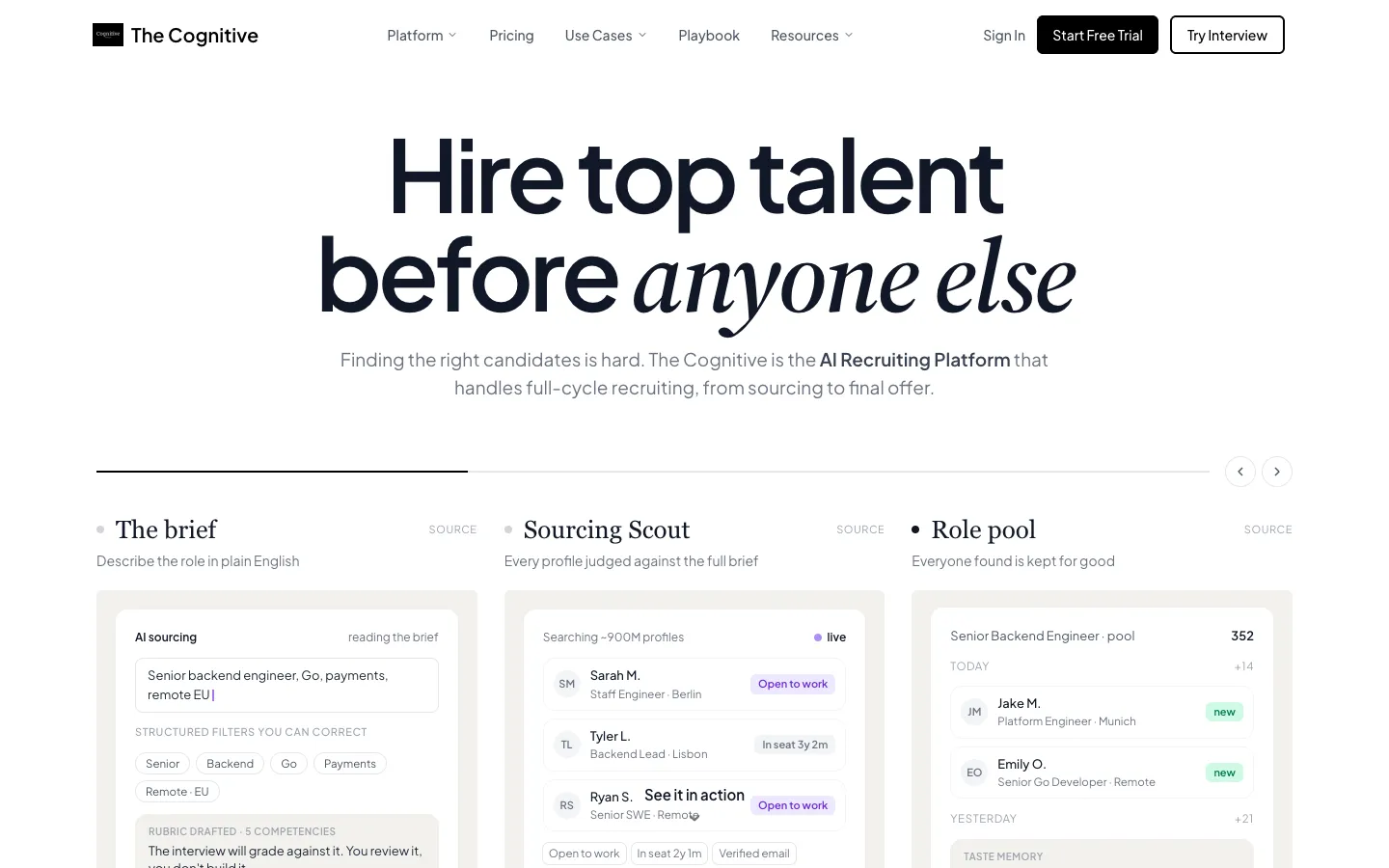
The Cognitive works that way. You describe the person in a sentence or two, the way you would brief a colleague, and the search runs across about 900M public profiles. Chips under the box show how the brief was read, such as place, title and function, and removing one widens the search.
You can add several job titles, current or past, as filters. Each match comes with a short reason, drawn from the person's profile.
A brief for a recruiter works the same way as an engineering one: the role, the specialty and the place turn into filters you can see and change. If a title-based search comes back thin, rewrite the brief around the work the person does instead of the title.
Revealing a personal email costs 4 credits, and each person a search shows costs 1. The Sourcing Team plan and Sourcing Pro and above send outreach from your own mailbox and stop follow-ups once someone replies. Plans start at $99 a month.
The Cognitive does not post jobs or collect applications, and it is software, not an agency. If the goal is to have someone else fill one role for you, a recruiting firm such as those in the executive search firms guide is the better fit.
A search for recruiters, or any other role, can be tried free for 7 days without a card. The trial shows up to 100 people and does not include outreach. Start a free trial.
Sources
- US Bureau of Labor Statistics, Occupational Outlook Handbook: Human Resources Specialists, bls.gov, 2026.
- O*NET OnLine, 13-1071.00 Human Resources Specialists, onetonline.org, 2026.
- O*NET OnLine, 11-3121.00 Human Resources Managers, onetonline.org, 2026.
- O*NET OnLine, Occupation search: recruiter, onetonline.org, 2026.
- O*NET OnLine, 27-2022.00 Coaches and Scouts, onetonline.org, 2026.
- National Careers Service, Recruitment consultant, nationalcareers.service.gov.uk.
- LinkedIn, The Future of Recruiting 2025 (1,271 recruiting professionals, 23 countries), business.linkedin.com, 2025.
- SHRM, 2026 Recruiting Benchmarking (4,600+ organizations), shrm.org, 2026.
- Gem, Key takeaways from the 2026 Recruiting Benchmarks Report, gem.com, 2025.
- Thesaurus.com, Recruiter, thesaurus.com.
- Wiktionary, recruiter, headhunter and talent scout, wiktionary.org.
Frequently Asked Questions
What is another word for recruiter?
Talent acquisition specialist is the formal word for a recruiter. The US Bureau of Labor Statistics describes recruitment specialists as sometimes known as recruiters or talent acquisition specialists. Talent partner, corporate recruiter and recruitment consultant are other titles for the job, and headhunter is the informal word.
What is a more professional title for a recruiter?
Talent acquisition specialist or talent acquisition partner reads as more formal than recruiter. Partner suggests the recruiter is attached to one department, while specialist is the neutral label. Adding the specialty, such as technical or healthcare, says more than either word on its own.
Is a headhunter the same as a recruiter?
A headhunter is a recruiter who approaches skilled people, often for executive roles, usually from a search firm. The word is informal, so job titles tend to use executive recruiter or search consultant instead. Every headhunter is a recruiter, but many recruiters never work on executive searches.
What is a recruiter called in the UK?
In UK agencies a recruiter is usually called a recruitment consultant. The UK National Careers Service describes the job as helping employers find the right staff and matching people to temporary and permanent jobs. In-house UK teams also use recruitment business partner, and resourcer is the agency title for the person who finds candidates for consultants.
Is a sourcer the same as a recruiter?
No, a sourcer finds and contacts potential candidates and usually passes the interested ones to a recruiter. The recruiter then screens them and runs the process to an offer. In small teams one person does both jobs and is simply called a recruiter.
What is another term for recruitment?
Hiring, talent acquisition and staffing are the usual other terms for recruitment, and each leans a different way. Hiring stresses the decision and the offer. Talent acquisition includes longer-term pipeline and employer brand work, and staffing usually means placing contract or temporary workers through an agency.
What is a talent acquisition recruiter?
A talent acquisition recruiter fills open roles like any recruiter, and the title signals the wider talent acquisition function. That usually adds building pipelines for future hires and working with hiring managers on what each role needs. Many employers use the two titles for the same job.
Related reading
- What Is a Talent Sourcer? Role, Skills, Salary and Tools (2026)
- Boolean Search for Recruiters: How to Build, Test and Widen a String for One Req
- Best AI Recruiting Agents in 2026: 12 AI Recruiters Compared
- Best Retail Hiring Software in 2026: 9 Tools for Store Teams and Store Leaders
- 10 Best CRMs for Staffing Agencies in 2026, Scored
- Best EOR Companies in 2026: 11 Employer of Record Providers Ranked, Plus the Step Before