Not "does the profile say Python". Not "is the title a match". A hiring manager reads a profile for three things: what they built, how big it was, and whether it was them or their team. Keywords beep at everything. Work history finds the gold. Here are the questions, the rules for keep and skip, and the Claude skill that runs the read on every profile.
Three questions, every profile
Ask them of every line in the work history, newest first. A line that answers all three is gold. A line that answers none is noise, however many keywords it has.
1
What did they build?
The thing: a system, a product, a line, an account, a unit. A named thing beats a skill.
rewrote the refund servicePython expert
2
How big was it?
Users, money, volume, sites, team size, markets. Only numbers they wrote. No number is fine; a vague size is a question.
every refund, three marketslarge-scale systems
3
Was it them or the team?
Built, led, owned, rewrote, on call for: them. Part of, supported, helped, involved in, exposure to: the team.
on call for the gatewaypart of the team that
The detector
A made-up profile for a made-up role. Sweep the detector: tap each line and see what it finds. Then read the verdict.
Role · Senior Backend Engineer · payments · made up
Must-haves: 1. builds and runs payment services in production · 2. writes Python every day · 3. has run services on AWS
0GOLD0DIG0JUNK0RUST
HC
Hannah Clarke (made up)Senior Software Engineer at a payments company · Denver
Headline and about
Senior Software Engineer · payments company · 2023 to now
Web Developer · digital agency · 2014 to 2016
Skills and certificates
Gold: the work, the size, themDig: real work, ask what was theirsJunk: a keyword, not workRust: real work, too old
9 lines left to sweep
100+ recruiters have shared their feedback
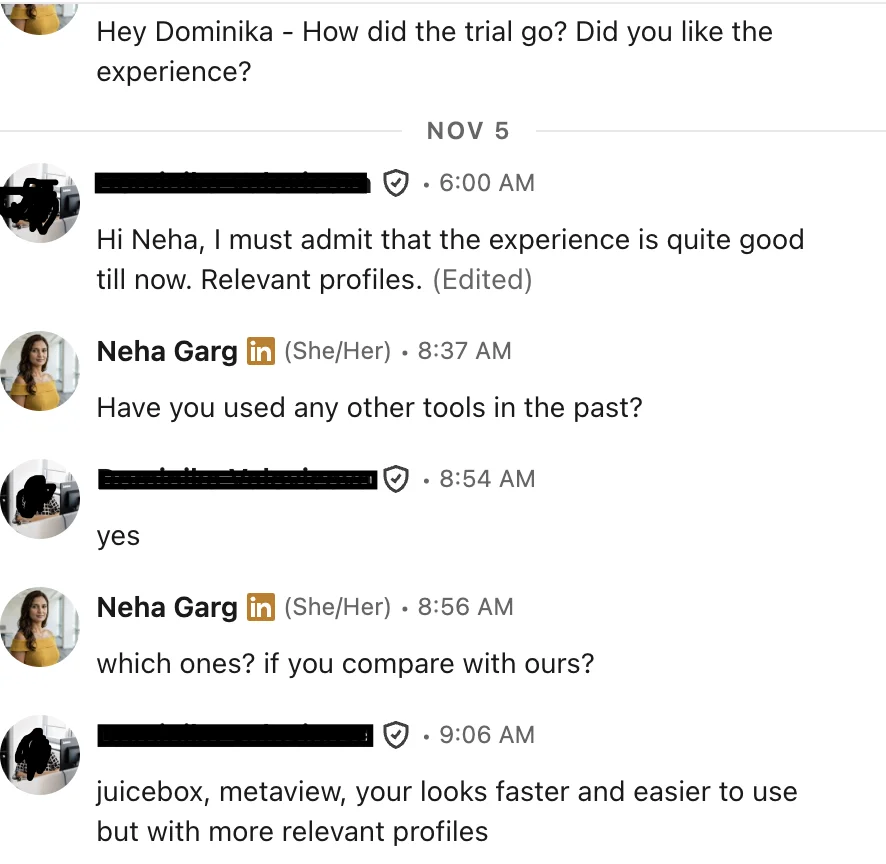
“juicebox, metaview, your looks faster and easier to use but with more relevant profiles”
What beeps, and what's gold
Beeps at everything
The skills list and its endorsement counts
Keywords in the headline
Self-praise: results-driven, passionate, proven track record
A title on its own, or "Head of" at a company of three
A line listing software names with no outcome
Finds the gold
A named thing plus an action verb: rewrote the refund service
A size they wrote down: every refund, three markets, 40 sites
A before and after: cut, doubled, replaced, moved from X to Y
On call, owner, the only one: it was theirs
A promotion at the same company: someone inside saw the work
They stayed through the launch, not only the build
A hard setting: regulated, round the clock, a plant start-up
The questions Claude asks of a profile
Use these on their own in any chat, or let the skill below ask them for you. Paste the role's must-haves first, then the profile.
Read this profile against the must-haves above. For each must-have, answer these questions, quoting the profile line you used. If no line answers a question, write "not shown". Never fill a gap with a guess.
1. What did they build, run, sell or fix that this must-have needs? Name the thing.
2. How big was it? Use only numbers or sizes the profile states.
3. Was it them or their team? Quote the verb. Built, led, owned, rewrote, on call for = them. Part of, supported, helped, involved in, exposure to = team.
4. Did it run for real? Live, in production, with customers, on a running line. Or a pilot, a prototype, a course?
5. How recent is the line? Count years from today.
6. Did they stay long enough to see it through? Compare the dates with the work.
7. Is the setting close to ours (size, industry, rules, customers)? Say what differs.
8. Does this must-have appear in a work line, or only in the skills list, headline, summary or a certificate?
9. What can the profile not show that we need to know? Turn it into one question for the call.
Keep and skip rules
Run them in order. The first rule that matches decides.
A must-have appears only in the skills list, headline, summary or a certificate, and the profile has real work lines elsewhere.SKIP
The only line for a must-have is older than your cut-off (five years works for most roles; set it per role).SKIP
The profile is a title and a company with no work lines at all.THIN: CHECK
Every must-have has a work line, but for one of them the only line is a team line ("part of", "helped").KEEP + ASK
Every must-have has a gold line from the last few years, and it was them.KEEP
Thin is not skip. People who are busy doing the work often have the shortest profiles. Look at what their company does and what their team ships, then decide.
The golden-read skill
It asks the questions above of every profile you give it, then applies the rules, and hands back a verdict with the gold lines quoted and the one question for the call.
Save the text below as SKILL.md in a folder named golden-read.
In the Claude app: zip the folder and upload it under Settings, Capabilities, Skills. In Claude Code: put the folder in ~/.claude/skills/. If skills aren't open on your plan, paste the text into a Project's instructions.
Then say: "Golden read." Paste the role and its must-haves, then one or more profiles separated by a line with three dashes.
---
name: golden-read
description: Reads a candidate profile the way a hiring manager does, checking each must-have against real work (what they built, how big, them or their team), and returns KEEP, KEEP + ASK, THIN or SKIP with quoted evidence and one question for the call. Use when I paste a role and one or more profiles and ask whether they have done the job.
---
# Golden read
## Inputs
- ROLE: the job, in one or two sentences, and its must-haves (two to four). Each must-have is something a person has done.
- CUT-OFF: how many years old a line can be and still count. If I don't say, use 5.
- TODAY: today's date. If I don't say, ask.
- PROFILES: one or more, separated by a line with three dashes.
If a must-have is a trait no profile can show (for example "good communicator"), tell me it belongs in the interview and leave it out of the read.
## Step 1. Sort every line
Go through the profile line by line. Put each line in one group:
- GOLD: a named thing they built, ran, sold or fixed, with an action verb that makes it theirs.
- DIG: real work, but the verb makes it the team's (part of, supported, helped, involved in, contributed to) or the size is vague.
- JUNK: headline keywords, skills lists, endorsements, self-praise, "exposure to", "familiar with", "responsible for" lines with no outcome, a certificate alone, a title alone.
- RUST: a GOLD or DIG line from a job that ended before the cut-off.
## Step 2. Check each must-have
For each must-have, find the best line. Say which group it is in and quote it. Then answer:
- What did they build? (the thing)
- How big was it? (only sizes the profile states, else "not shown")
- Them or the team? (quote the verb)
- How recent? (years from today)
## Step 3. Decide. The first rule that matches wins.
1. A must-have has only JUNK lines, and the profile has GOLD or DIG lines elsewhere: SKIP.
2. A must-have has only RUST lines: SKIP. Say what the old line was, in case I want to relax the cut-off.
3. The profile has no work lines at all, only titles and companies: THIN. Never SKIP a thin profile. Say what to look up (what their company makes, what their team ships).
4. Every must-have has GOLD or DIG, and at least one is DIG: KEEP + ASK.
5. Every must-have has GOLD: KEEP.
## Step 4. The call question
Write one question for the call, about the weakest must-have. It asks what was theirs, how big it was, or how it ended. Never a yes/no question.
## Never
- Never count a keyword as proof of work.
- Never invent a size, a verb or a date. If it isn't in the profile, write "not shown".
- Never mark someone down for a short profile alone. That is THIN.
- Never judge age, gaps, names, schools or anything else that is not the work.
## Output, per person
[initials] · [current title] · [company type]
VERDICT: KEEP / KEEP + ASK / THIN / SKIP
MUST-HAVES:
1. [must-have]: GOLD / DIG / JUNK / RUST / missing · "[quote]" · size: [..] · them or team: [verb] · [years] old
2. ...
JUNK THAT LOOKS GOOD: [keywords or lines that a keyword search would have matched, with no work behind them]
CALL QUESTION: [one open question]
After all profiles: a list ordered KEEP, KEEP + ASK, THIN, SKIP, one line each.
What comes back for the detector profile · made up
HC · Senior Software Engineer · payments company
VERDICT: KEEP + ASK
MUST-HAVES:
1. Payment services in production: GOLD · "On call for the payment gateway. Cut failed card payments by redesigning the retry logic." · size: not shown · them: "on call", "redesigning" · current
2. Python every day: GOLD · "Rewrote the refund service in Python." · size: every refund, three markets · them: "rewrote" · current
3. Services on AWS: DIG · "Part of the team that moved our platform to AWS." · size: not shown · team: "part of" · current
JUNK THAT LOOKS GOOD: headline keywords; Kafka and Kubernetes in skills with no work line; the entry-level AWS certificate.
CALL QUESTION: In the move to AWS, which part did you do yourself, and what did you run on it after?
100+ recruiters have shared their feedback
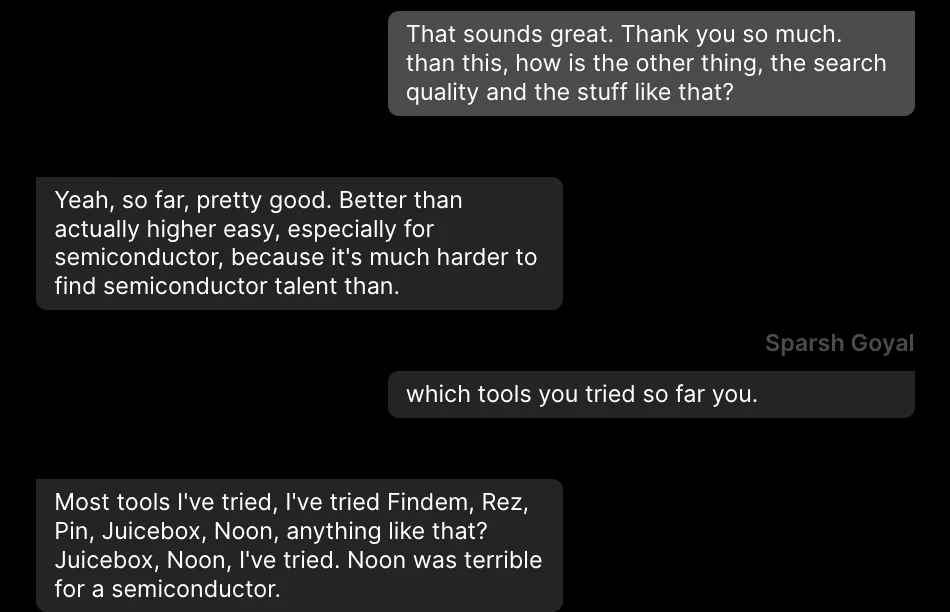
“pretty good … especially for semiconductor, because it's much harder to find semiconductor talent”
The wall
Claude can think, but it can't see people. Plain Claude has no profiles. The golden read only runs on the profiles you find, open and paste in yourself, and a paste of forty profiles is a long afternoon.
The people a keyword search finds first are the ones with the loudest skills lists. The gold is in profiles you have to go and dig up, and plain Claude can't dig.
The same read, two ways
Plain Claude, for every role
Write the must-haves as things a person has done.
Search somewhere else and open each profile.
Copy every profile, with dates, and paste it into Claude.
Check each verdict against the quoted lines.
Look up the company for every THIN profile.
Sort the list by verdict by hand.
Repeat when the search turns up more people.
Same job in The Cognitive
Describe who you want in a sentence or two, with what they must have done. If the brief leaves out something that changes who to look for, it asks one question first.
People come back ranked by fit. Every card says why the person fits, with a quote from their profile.
Shortlist the ones whose quote is gold. "Show more candidates" finds the next batch for the same brief.
Prefer Claude? Add The Cognitive as a connector in Claude: https://app.thecognitive.io/mcp Make a free account, sign in on the Connect page and allow it.
100+ recruiters have shared their feedback
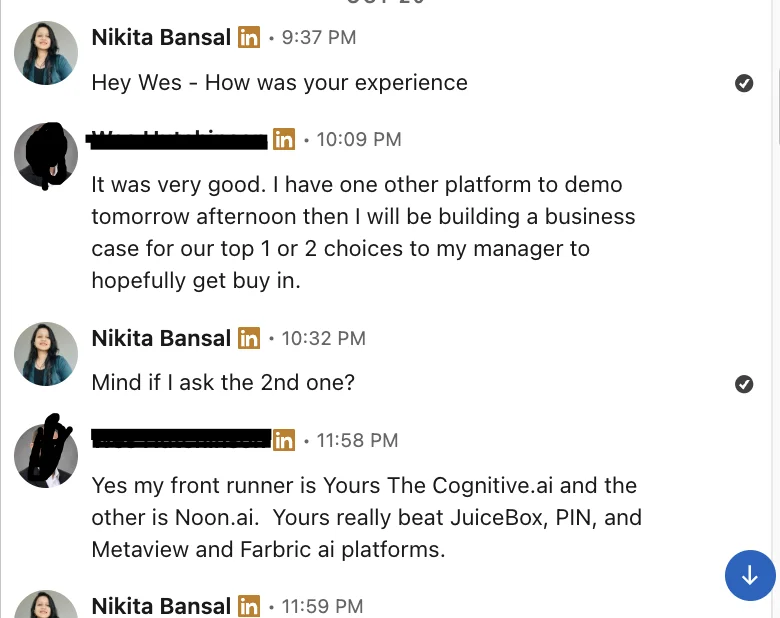
“My front runner is … The Cognitive … Yours really beat JuiceBox, PIN, and Metaview”
Find the people who did the job
Describe who you want and what they must have done. The Cognitive brings back people ranked by fit, and every card quotes the line from their profile that shows the work.
 The Cognitive