AI Candidate Matching Software: The 12 Best in 2026
By Sparsh Goyal, Founder at The Cognitive. Published · Last updated
- The best AI candidate matching software in 2026 is The Cognitive for matching a brief against about 900M public profiles, with a "Why this match" reason traced to the person's own profile.
- Eightfold AI, Workday HiredScore, Phenom, SmartRecruiters Winston Match and iCIMS rank applicants, Pin and Juicebox match the open market on a free plan, and Textkernel, Bullhorn and Sense match your own database.
- Pick by the pool you need matched first, then by how easily you can check the reason behind each match.
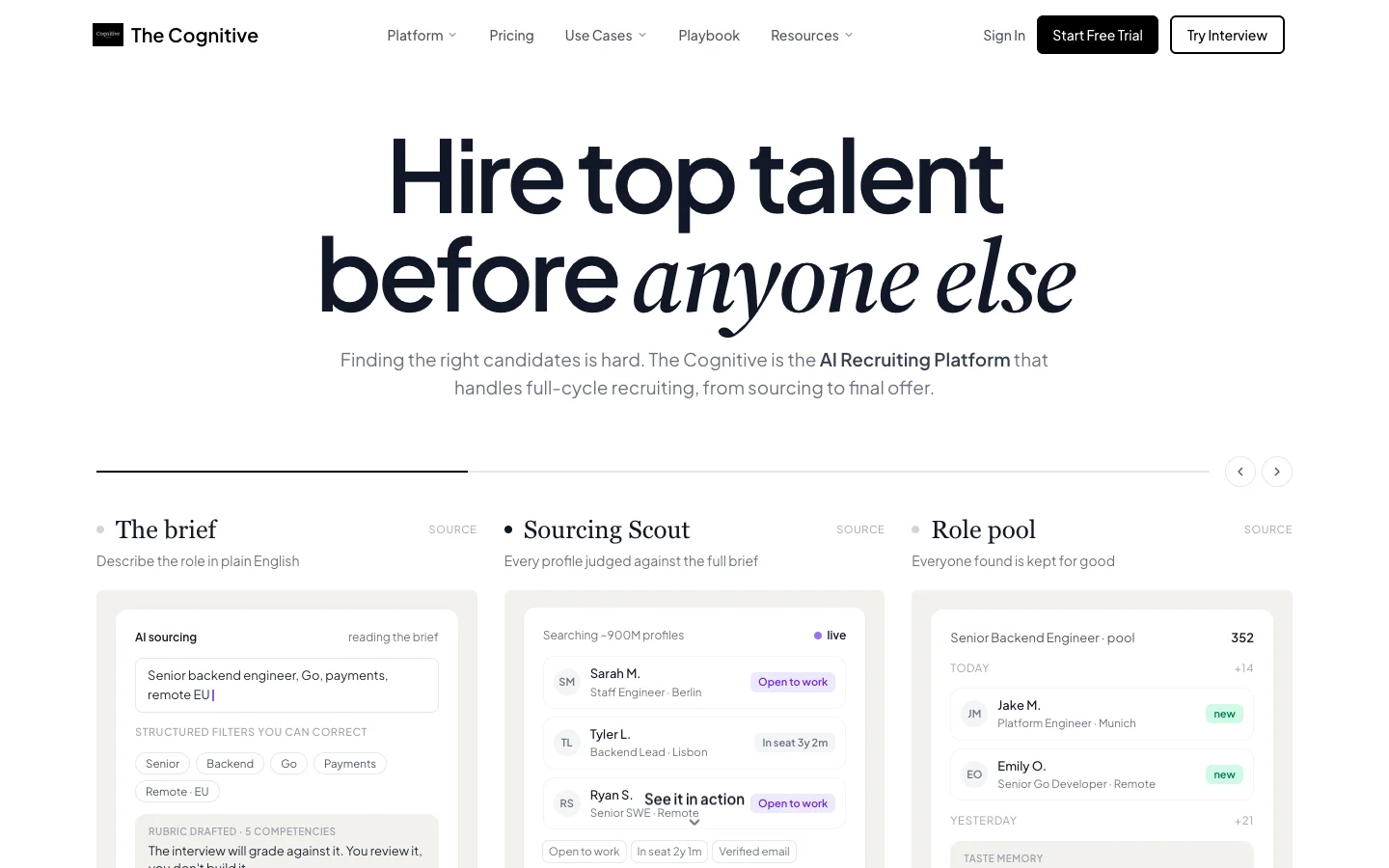
The best AI candidate matching software in 2026 is The Cognitive, for matching a plain-English brief against the open market. It searches about 900M public profiles and shows a "Why this match" reason traced to the person's own profile. Then it emails the people you pick and interviews them live by AI video in the same account.
For applicants, Eightfold AI suits enterprises that want plain-language match reasoning and a published bias audit, and Workday HiredScore grades Workday applicants one qualification at a time. Pin and Juicebox match the open market on a free plan. Textkernel, Bullhorn and Sense match the database you already own, which counts: Gem's 2026 Recruiting Benchmarks Report found 46% of sourced hires came from people already in a company's ATS or CRM.
Disclosure: The Cognitive is our product.
The best AI candidate matching software in 2026
- The Cognitive: best for matching a brief against the open market, with reasons traced to the profile.
- Eightfold AI: best for enterprises that want match reasoning and a published bias audit.
- Workday HiredScore: best for grading Workday Recruiting applicants, one qualification at a time.
- Phenom: best for large employers ranking applicants and CRM contacts on criteria they set.
- SmartRecruiters Winston Match: best for SAP SuccessFactors teams sorting high applicant volume.
- iCIMS: best for iCIMS customers who want ranking inside the ATS.
- Pin: best for a yes, maybe or no on each role question, on a free plan.
- Juicebox: best for open-market search with a label per criterion and a free plan.
- LinkedIn Hiring Assistant: best for teams already paying for LinkedIn Recruiter.
- Textkernel Source & Match: best for adding two-way matching to an ATS you already run.
- Bullhorn Amplify Search & Match: best for staffing agencies on Bullhorn ranking their own database.
- Sense: best for re-matching people already in your ATS to new jobs.
What is AI candidate matching software?
AI candidate matching software is software that ranks people against one role or brief and shows why each person ranked where they did. The people can be applicants, names already in your database, or anyone with a public profile. The reason matters more than the rank, because a ranking you cannot check is a ranking you redo by hand.
Matching has moved through three methods, and most tools on this list mix them:
- Keyword matching. The tool counts the job description's terms in a resume. It is fast and easy to explain, and it misses the engineer who wrote "Django" when the job said "Python".
- Semantic matching. The tool compares meaning instead of exact words, so related skills and titles score close together. It finds more people, but one similarity number rarely says which requirement a person meets.
- Per-requirement judging. The tool checks each requirement on its own and records the evidence for it. In August 2026, Workday HiredScore released an opt-in grading mode in which a large language model assesses each qualification directly and gives an explanation for each conclusion.
Agents now sit on top of all three. Juicebox Agents, the iCIMS Sourcing Agent, LinkedIn Hiring Assistant and Eightfold's agents run searches for the recruiter and refine them from feedback.
The tools also split by the pool they match, which matters more than the method:
- Applicants. Eightfold AI, Workday HiredScore, Phenom, SmartRecruiters Winston Match and iCIMS rank the people who applied, and often past applicants too.
- The open market. The Cognitive, Pin, Juicebox and LinkedIn Hiring Assistant match people who never applied.
- Your own database. Textkernel, Bullhorn and Sense match candidates you already hold against new jobs.
For market maps and labor data, see our list of talent intelligence platforms. For scoring resumes inside an ATS, see the best AI resume screening software.
How do the top candidate matching tools compare?
How each tool shows the reason for a match separates these tools more than the pool or the price. A grade, a percentage and a line from a profile all look like reasons, but only some can be checked in seconds.
| Tool | Pool | How the reason is shown | Best for | Price on website? |
|---|---|---|---|---|
| The Cognitive | Open market (about 900M profiles); people you add | "Why this match": 1 or 2 lines built only from the profile | Sourcing-led hiring, match to interview | Yes, from $99 a month |
| Eightfold AI | Applicants, employees | Score with plain-language reasoning | Large enterprises | No |
| Workday HiredScore | Workday applicants, CRM leads | Letter grade; Fit & Gap per qualification | Workday Recruiting | No |
| Phenom | Applicants, CRM contacts | Fit Score with its factors | Enterprises on Phenom | No |
| SmartRecruiters Winston Match | Applicants | Match level with sub-scores | SAP SuccessFactors | No |
| iCIMS | Applicants, talent pools | Ranking; reasons not described | iCIMS customers | No |
| Pin | Open market (850M+, its claim) | Fit score plus yes, maybe or no per question | Small teams, with outreach | Yes, except Enterprise |
| Juicebox | Open market (800M, its claim) | Percentage plus a label per criterion | Natural-language search | Yes, except Business |
| LinkedIn Hiring Assistant | LinkedIn members, ATS applicants | Top picks with relevant skills and experience | LinkedIn Recruiter teams | No |
| Textkernel Source & Match | Your indexed candidates | Scores and ranking; two-way | Matching inside an ATS | Yes |
| Bullhorn Amplify Search & Match | Agency database, job boards | Top 10 by likelihood of placement | Agencies on Bullhorn | Lower plans only |
| Sense | Your ATS database | Fit scoring; reasons not described | Staffing re-matching | No |
How we ranked these 12
We considered 18 tools that sell candidate matching and kept 12. A tool made the list only if its own website says how it ranks people against a role, not just that it "uses AI". Six more are covered briefly under "Also considered".
We judged each tool on six criteria:
- which pool it matches: applicants, the open market or your own database;
- how visible and checkable the reason for each match is;
- whether a must-have requirement is held as a must-have;
- whether the matching model has a published bias audit;
- what you can do with a match inside the same product;
- whether you can start self-serve, with a price on the website.
We ranked these tools using feedback from hundreds of recruiters we talk with on LinkedIn, plus each vendor's own site and pricing page.
The Cognitive leads because it meets five of the six criteria at once. No other tool here matches the open market, shows a reason built from the profile, then emails and interviews the matches by live AI video, all self-serve at a published price. Its gap is the database criterion, covered under "When not to pick The Cognitive".
The rest are grouped by pool: applicant engines, then open-market tools, then database matchers. Inside each group, a published bias audit ranks first, then how checkable the match reason is, then whether a price is published.
How do you choose AI candidate matching software?
Which pool do you need matched?
Start with the pool, because no model can rank a person who is not in it. If volume is the problem, you need an applicant engine. Ashby's 2026 Talent Trends Report counts 291 applications per hire, about three times the early-2021 level.
If the right people never apply, you need open-market matching. Gem's 2026 benchmarks found sourced candidates nearly eight times more likely to be hired than inbound applicants, and 46% of sourced hires came from people already in the company's ATS or CRM. If you hold years of candidates, a database matcher earns its place. Our guide to candidate rediscovery covers that pool.
Can you read why each person matched?
Ask for a match reason you can verify in under ten seconds. A letter grade or a percentage tells you the tool's confidence, not its evidence. A label per criterion is better. A line taken from the person's own profile is the easiest to check, because the words are right there in the profile.
Does a must-have stay a must-have?
Many matchers trade requirements against each other, so a strong title can make up for a missing licence or the wrong country. That is fine for nice-to-haves and costly for must-haves. Ask how to mark a requirement as a hard limit. Then run a search only a few people can meet, and count the results that break it.
Has the matching model been audited for bias?
If you hire in New York City, the answer has to be yes. Under Local Law 144, an automated employment decision tool needs three things:
- a bias audit within the year before you use it;
- a public summary of the audit results;
- notice to candidates 10 business days before use.
Eightfold AI publishes its audit results. For any other vendor, ask for the latest audit summary and the dates of the data behind it.
What can you do with a match inside the same tool?
Some tools stop at the ranked list, and you export to another product to reach people. Others carry the match into outreach, a screening interview or your ATS. Count the products between "matched" and "interviewed". Each one adds a login, an export and a place for candidates to drop out. For the contact side, see our list of AI sourcing tools.
How do you test a matching tool before you buy?
Test on one real role, with the same brief in every tool you shortlist:
- Write one brief with two must-haves. Pick a role you have filled before, so you know what a good match looks like.
- Run it in three tools on the same day. Keep the wording identical, so the difference is the tool.
- Check ten reasons against ten profiles. Open each matched person and see whether the stated reason is there. Count the ones you cannot verify.
- Count the must-have misses. Each result that breaks a hard requirement is one you would remove by hand.
- Time the path to a first conversation. Note how many products and exports sit between a matched name, an email sent and a first interview.
In each demo, ask three questions: which pool does this match, how do I see the reason for one match, and when was the model last audited for bias?
The 12 best AI candidate matching tools, reviewed
1. The Cognitive: best for matching a brief against the open market, with reasons traced to the profile
Verdict: the matcher for people who never applied, with match reasons you can check against the profile in seconds.
The Cognitive is AI recruiting software for sourcing-led hiring. You describe who you want in a sentence or two, and the brief becomes filter chips you can edit. The brief decides who fits and how people are ranked, and a chip is a hard limit. If the brief leaves out something that changes who to look for, the search first asks one question with two to four answers, at no charge.
The search covers about 900M public profiles and shows 10 people a page by default. Each person is read against your brief before they are shown, and people judged not to fit are left out.
A strong match opens with "Why this match": one or two short lines built only from the profile, such as the current role or a skill the brief asked for. A quote that cannot be found word for word in the profile is dropped, never paraphrased. Weaker cards are headed "Possible match", and no card carries a score.
People you add to a role yourself, from an ATS import or a CSV, get a CV match from 0 to 100 against the job description, with written reasoning.
After the match, the same account carries on. A personal email costs 4 credits and a phone number 12 (Sourcing Pro and above), charged only when one is found. Outreach comes with Sourcing Pro, Max, Team and Business. It goes out by email from the recruiter's own Gmail or Outlook mailbox, signed by them, and a reply stops the follow-ups.
Anyone you pick can go into a live two-way AI video interview of 10 or 20 minutes, scored against a fixed rubric while the questions adapt. The report marks the CV claims it probed Verified, Unclear or Refuted. The Cognitive syncs with 100+ applicant tracking systems (ATS) on higher plans: it imports candidates, and an imported candidate's results go back to the ATS. See AI sourcing, natural-language candidate search and pricing.
Best for: recruiters, agencies and founders who hire people who never applied, and want the match, the email and the first interview in one account.
Watch out for: it does not match against your own ATS or CRM database today, and it does not post jobs or take applications. Outreach starts on Sourcing Pro, and ATS sync comes on higher plans.
Pricing model: published monthly plans with credits. AI Sourcing and AI Interviews each start at $99 a month. A search uses 1 credit per person shown, a page you have already seen is free, and a 20-minute interview uses 100 credits.
When not to pick The Cognitive
- You want to match the candidates already in your ATS or CRM. The Cognitive does not search your own database today. Textkernel, Bullhorn, Sense, Phenom and Workday HiredScore do.
- Your problem is thousands of applicants a week. The Cognitive does not take applications. Workday HiredScore, Phenom or SmartRecruiters Winston Match rank applicants where they arrive.
- You need a published bias audit of the matching model. Eightfold AI publishes one under New York City's Local Law 144.
- You want to reach people inside LinkedIn. The Cognitive reaches people by email, so LinkedIn Hiring Assistant fits teams that work in LinkedIn Recruiter.
- You need ATS sync on the entry plan. Sync comes on Sourcing Max, Interviews Pro or Max, and Business.
2. Eightfold AI: best for enterprises that want match reasoning and a published bias audit
Verdict: the applicant matching engine with the most public evidence about its own fairness.
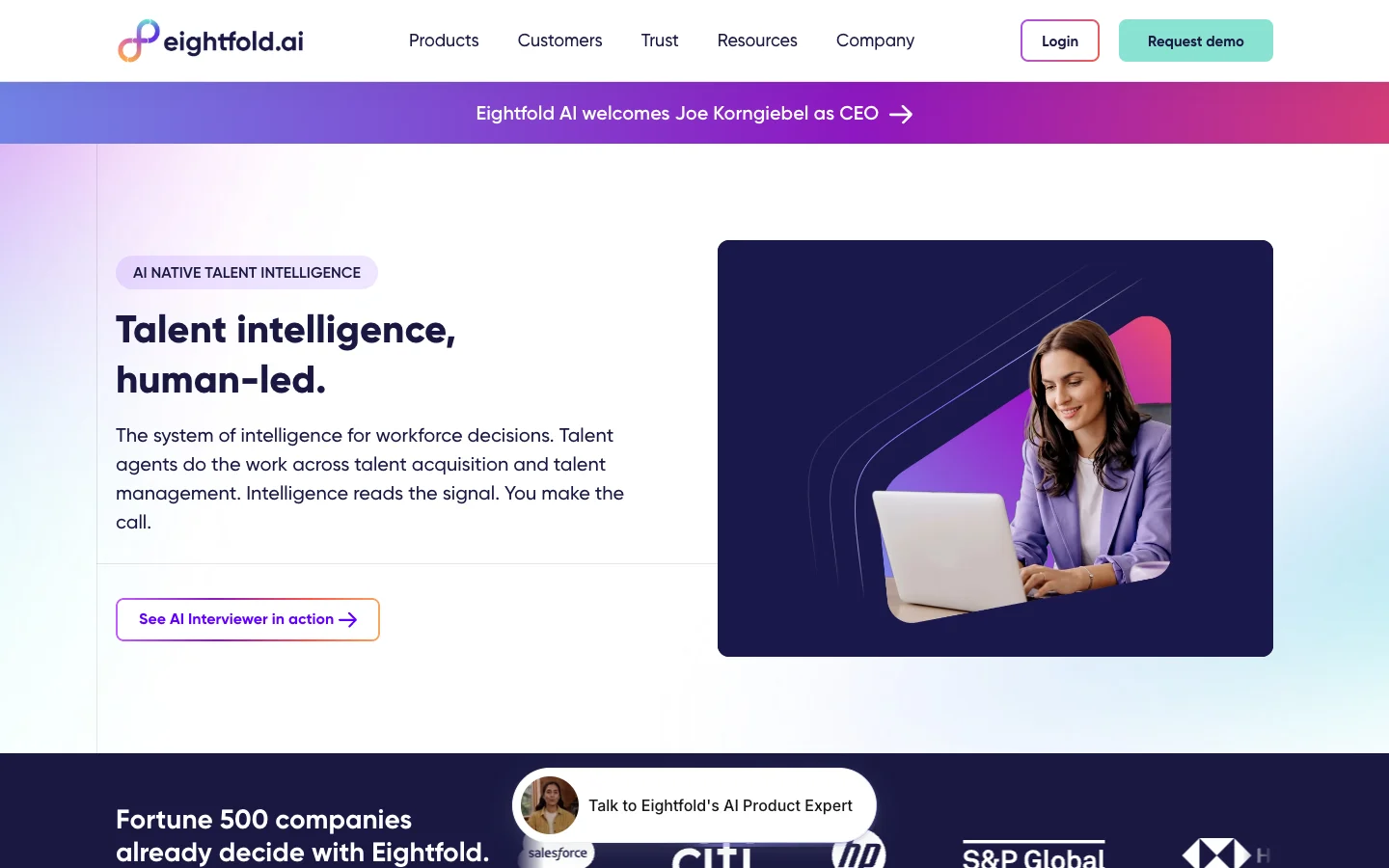
Eightfold Talent Acquisition "assesses candidates at scale and surfaces the strongest matches". Eightfold says its model draws on 1.6 billion career trajectories and 1.6 million skills, and that "match scores come with plain-language reasoning."
The audit sets it apart. BABL AI audited the Eightfold Matching Model in an audit dated 3 March 2026, on data from January 2024 to December 2025. Eightfold publishes impact ratios for sex, race and ethnicity, and intersectional groups under Local Law 144, and the lowest it publishes is 0.880.
The trade-off is the pool and the sale. Eightfold matches applicants, past applicants and employees, which also makes it strong for internal mobility. It does not search the open web, and it is bought through an enterprise sale. See our Eightfold alternatives.
Best for: large enterprises matching external applicants and internal talent at scale.
Watch out for: no self-serve start and no public price, and no search of people who never applied.
Pricing model: custom quote through a demo; no price on the website.
3. Workday HiredScore: best for grading Workday Recruiting applicants, one qualification at a time

Verdict: the natural pick for Workday Recruiting, and one of the clearest on why a grade was given for customers who switch on Fit & Gap.
HiredScore gives applicants letter grades, and Workday says each grade comes with a rationale against the role's requirements. It also surfaces relevant past applicants and CRM leads, so you can hire from talent you already hold. It works inside Workday Recruiting and Microsoft Teams.
HiredScore's release notes for 5 August 2026 add an opt-in grading mode driven by a large language model, which assesses each qualification directly. Recruiters open an explanation for each conclusion in a new Fit & Gap view. Customers switch it on through Workday Support, with a pilot before a global rollout, and older requisitions keep the old method.
Best for: enterprises running hiring on Workday Recruiting.
Watch out for: Fit & Gap is opt-in, the page does not say HiredScore works with other ATSs, and it does not match the open market.
Pricing model: custom quote through Workday sales; no price on the website.
4. Phenom: best for large employers ranking applicants and CRM contacts on criteria they set
Verdict: a ranking engine for your whole pipeline, including the people who nearly got the last job.
Phenom Fit Score ranks candidates against the skills, experience, title and location requirements you set. Phenom says you can "see exactly why candidates score as they do" and refine the criteria to improve future matches.
Fit Score ranks people as they enter the pipeline, and it also works across existing CRM contacts, including past applicants and silver medalists. That puts Phenom in two pools: new applicants and your own database. Its homepage also names agents for voice screening, fraud detection and career coaching.
Best for: large employers who want applicants and CRM contacts ranked on criteria they control.
Watch out for: it is an enterprise suite with no self-serve start, so Fit Score does not come on its own for another ATS.
Pricing model: custom quote through a demo; no price on the website.
5. SmartRecruiters Winston Match: best for SAP SuccessFactors teams sorting high applicant volume

Verdict: fast applicant triage for SAP shops, with the sub-scores visible in the list.
SmartRecruiters is now part of SAP SuccessFactors, and Winston is its AI layer, including an AI Talent Matching Engine. Winston Match gives each applicant a match level.
A March 2026 update lets recruiters show the breakdown in a column of the applications list, with sub-scores for skills, experience and education, without opening each profile. For someone scanning hundreds of applicants, that column is the useful part: you can sort by the one dimension the hiring manager cares about.
Best for: enterprises on SAP SuccessFactors with high applicant volume.
Watch out for: it ranks people who applied to SmartRecruiters requisitions, so it does not help where the right people never apply.
Pricing model: custom quote; the pricing page is a demo request.
6. iCIMS: best for iCIMS customers who want ranking inside the ATS
Verdict: matching where iCIMS applicants already sit, with no new system to adopt.
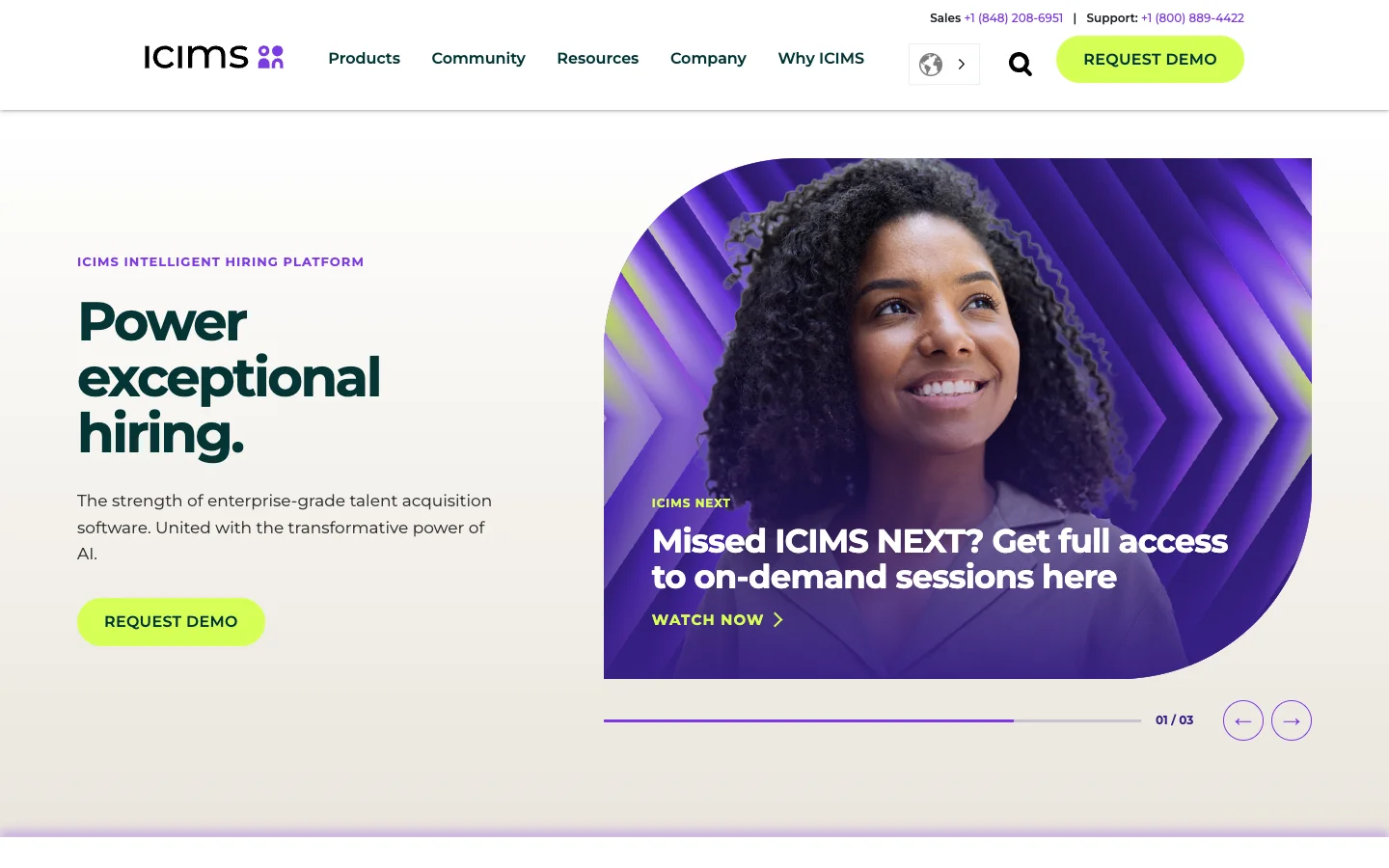
iCIMS says its AI matches and ranks candidates "based on their experience fit for the role". Under "Surface qualified applicants" it lists candidate ranking, talent discovery, talent matching and a generative AI search assistant, plus a new Sourcing Agent and Hiring Agent.
For an employer already on iCIMS, matching inside the ATS avoids another integration. The iCIMS page does not say whether rankings come with reasons.
Best for: enterprises already running hiring on iCIMS.
Watch out for: match reasons are not described, and it works only on candidates inside iCIMS.
Pricing model: custom quote; no price on the website.
7. Pin: best for a yes, maybe or no on each role question, on a free plan
Verdict: plain judgments per requirement, with outreach and booked calls in the same product.
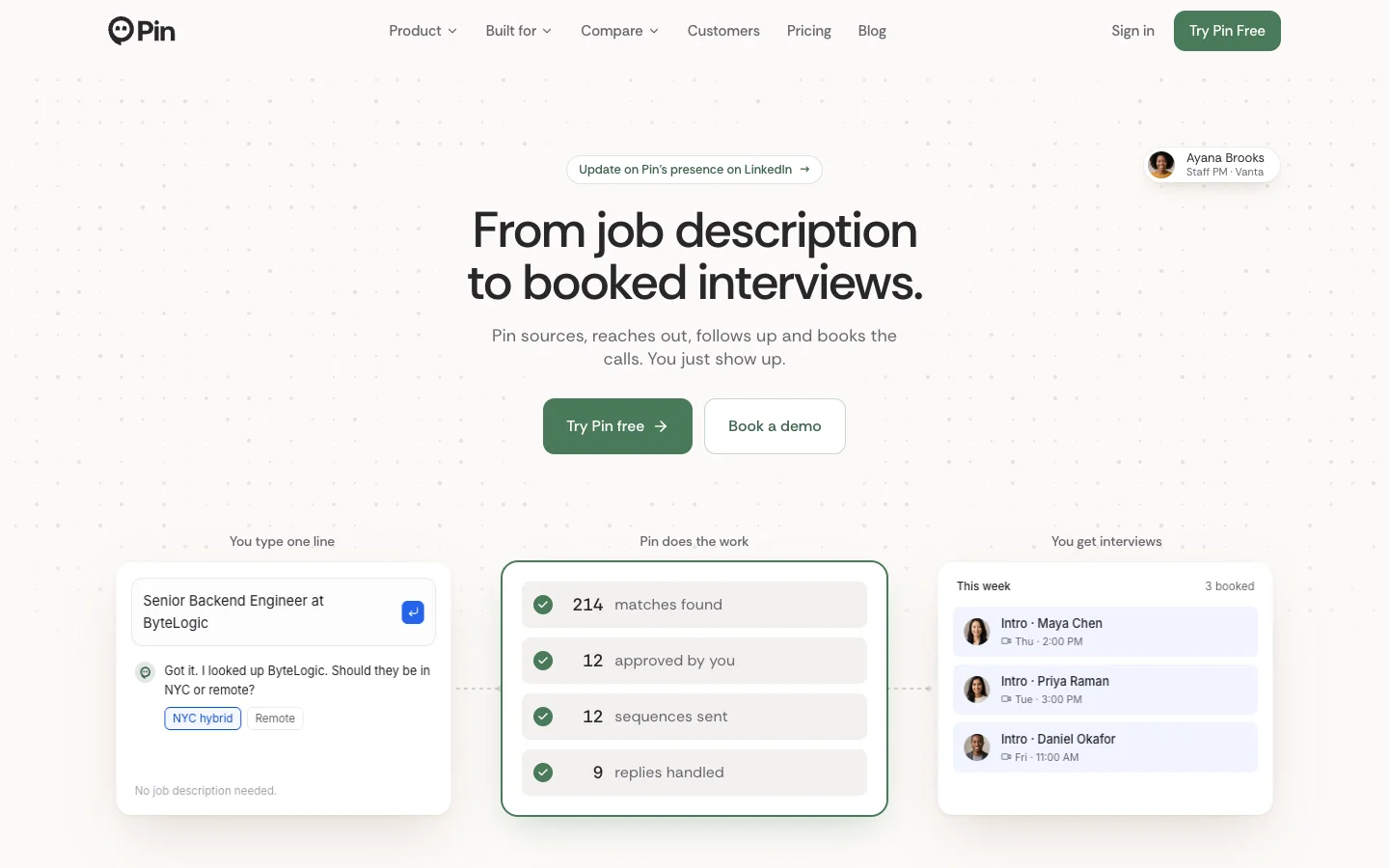
Pin searches what it calls 850M+ candidate resumes across North America and Europe, and reads profiles on trajectory, skills and the companies people have built at. It then reaches out, follows up and books calls with you.
For each question you set about the role, Pin gives a yes, a maybe or a no, with a short note on how the profile meets it. An overall fit score sits alongside. The recruiter approves or declines each person, and a hiring manager can approve or decline the shortlist before anyone is contacted.
Best for: small teams that want matching and outreach on a free or low-cost plan.
Watch out for: the booked calls are yours to run, since Pin does not hold an AI interview. The free plan limits searches per day, and ATS integration is an add-on on Professional.
Pricing model: Free, Solo, Professional and Enterprise plans; paid tiers are published and Enterprise is custom.
8. Juicebox: best for open-market search with a label per criterion and a free plan
Verdict: open-market matching with a clear label for each criterion, and a free plan to try it.
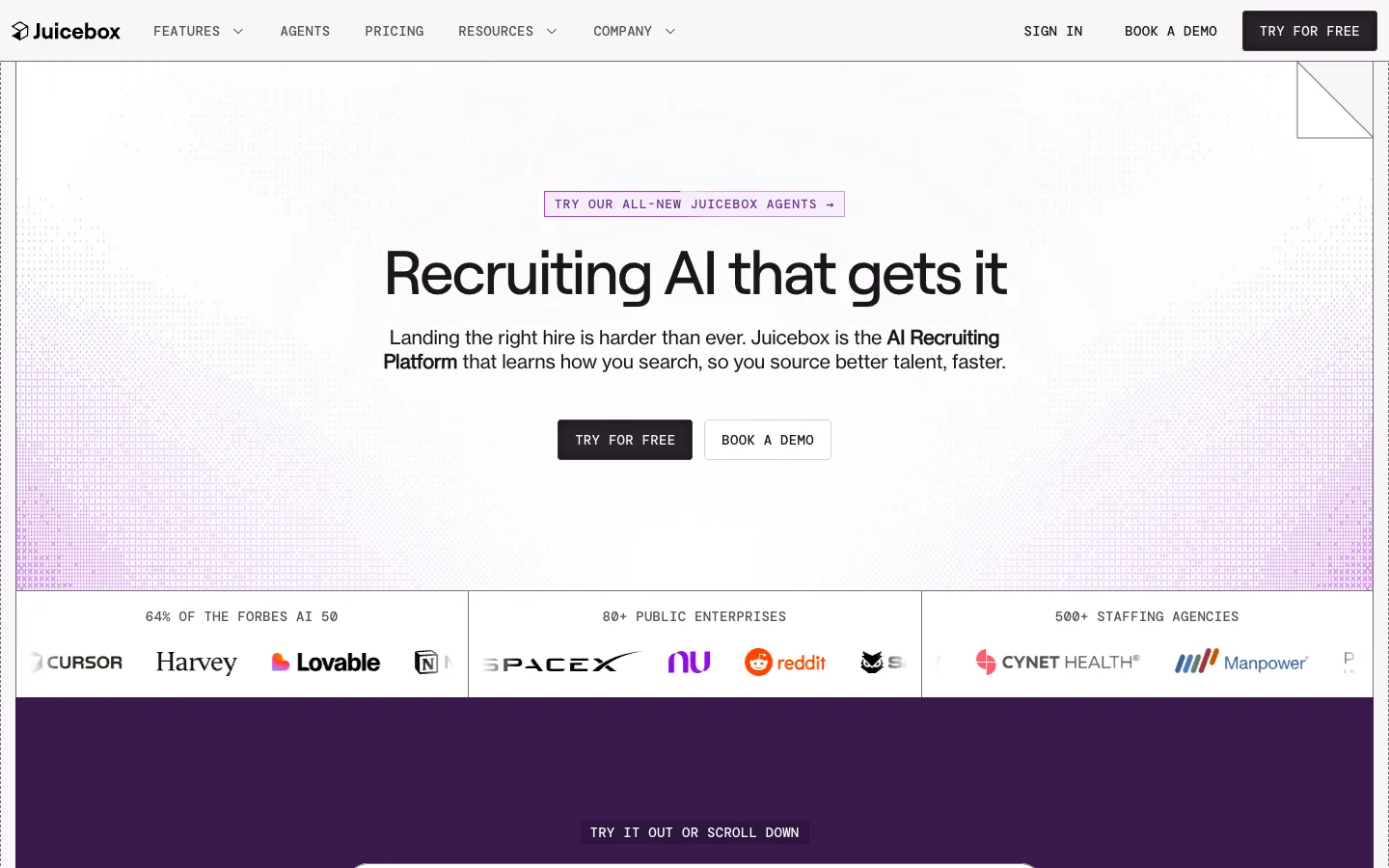
Juicebox searches what it puts at 800M global profiles from 30+ data sources. Its new Juicebox Agents "learn how you search, then source around the clock", using the job description, the intake call and past hires.
Each matched candidate shows a percentage and labels such as Good Match, Potential Fit or Not a Match, each tied to one criterion. That makes a quick check easy, because you see which requirement a person missed. Juicebox does not say on its page how the percentage is worked out. Read more in our Juicebox review.
Best for: recruiters who want natural-language search of the open market with per-criterion labels.
Watch out for: the scoring method is not described, there is no interview step, and contact data and exports use credits on top of the seat.
Pricing model: a free plan, then per seat per month with contact and export credits; Agents are an add-on per agent; Business is a custom annual plan. Prices are on the website except Business.
9. LinkedIn Hiring Assistant: best for teams already paying for LinkedIn Recruiter

Verdict: matching on LinkedIn's own member data, for teams who already live in Recruiter.
Hiring Assistant "runs dozens of searches across LinkedIn to find the most qualified candidates". It also assesses applicants from LinkedIn and your ATS against your hiring criteria, and returns top candidates with their relevant skills and experience. It is available in seven languages, including English, French, German and Spanish.
LinkedIn has announced Hiring Assistant 2. LinkedIn says it uses candidate fit signals beyond qualifications and gives greater transparency into how it evaluates and ranks candidates. It draws on LinkedIn insights, verifications, ATS context and screening responses.
Best for: recruiting teams already on LinkedIn Recruiter.
Watch out for: sourcing covers LinkedIn members only, and it is an add-on that costs on top of a Recruiter seat.
Pricing model: an add-on to LinkedIn Recruiter through sales; no price on the website.
10. Textkernel Source & Match: best for adding two-way matching to an ATS you already run
Verdict: a matching engine you plug into the system you have, rather than a new place to work.
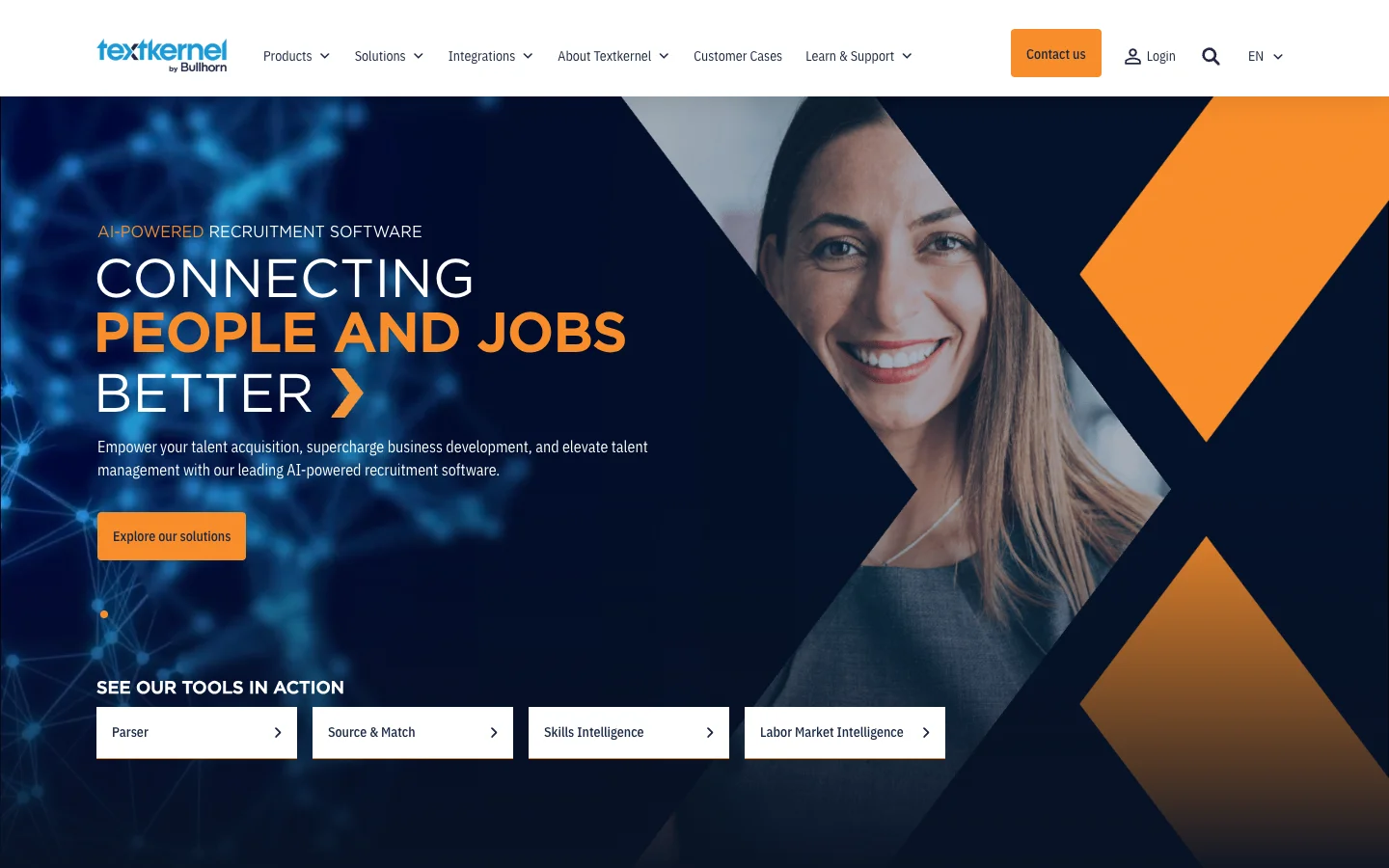
Textkernel is owned by Bullhorn, which bought it in June 2024, and it says it integrates with 100+ ATS and HR software. Source & Match works in both directions: candidates to a job, and jobs to a candidate.
It adds scores, smart ranking, Boolean search, result tagging and anonymous search results. The Enterprise tier adds semantic search in 21 languages and external sourcing that includes public profiles. It is sold on ATS and CRM marketplaces, so it slots into a system you already run.
Best for: agencies and HR teams who want stronger matching inside an existing ATS.
Watch out for: Textkernel does not describe how it shows the reason behind a match, and the price grows with the documents you index.
Pricing model: tiered subscription by documents indexed, with a free trial tier and a custom Enterprise plan; prices are on the website.
11. Bullhorn Amplify Search & Match: best for staffing agencies on Bullhorn ranking their own database

Verdict: the matcher that ranks by the outcome agencies are paid for: placement.
Open a job in Bullhorn, and the Recommended Candidates card ranks your top 10 by likelihood of placement. Bullhorn says the ranking learns from 80 million real placements across 1.1 billion profiles, and that 10,000+ staffing agencies use its ATS and CRM.
External Source Integration searches your database and job boards together. Bullhorn says 66% of externally sourced candidates are already in your database, which is the case for database matching in one number. Bullhorn also owns Textkernel, number 10 on this list. For more agency tools, see staffing software and the best AI recruiting software for agencies.
Best for: staffing agencies already on Bullhorn with a large candidate database.
Watch out for: it is part of Bullhorn Amplify, so it suits Bullhorn customers only, and its page describes no reason per ranked candidate.
Pricing model: per user per month; lower plans are published, and Pro, Max and Amplify are by quote.
12. Sense: best for re-matching people already in your ATS to new jobs

Verdict: a layer that turns a quiet ATS database into a list of people to call this week.
Sense says it can "match candidates already in your database with new roles that they're a great fit for." It lists candidate fit scoring, and you can customize the AI model to find the skills and experience your team values. It now also sells Sense AI Agents and an AI Interviewer.
For staffing firms with years of candidates in the ATS, the value is simple. People you already paid to find get matched to the next job before you source again.
Best for: staffing and high-volume teams with a large ATS database.
Watch out for: it needs a well-kept ATS underneath, and its page does not say how the reason for a match is shown.
Pricing model: custom quote through a demo; no price on the website.
Also considered
- hireEZ, SeekOut and Findem match the open market, and are compared in our AI sourcing tools and talent intelligence lists.
- Greenhouse matches applicants inside its ATS, and is covered on our resume screening list.
- Daxtra lists candidate search and match and AI candidate ranking, but its site does not describe how matching works.
- Zoho Recruit says its Zia AI helps with sourcing and shortlisting, without detail on matching.
Is AI candidate matching accurate, and is it biased?
No vendor on this list publishes a matching accuracy figure with an independent method, so this page cites none. Check the reasons yourself, as the test above explains. Bias, on the other hand, has been measured.
In a University of Washington study presented in October 2024, three large language models ranked more than 550 resumes against more than 500 job listings, across 3 million comparisons. The models favored white-associated names 85% of the time and Black-associated names 9% of the time. They favored female-associated names only 11% of the time, against 52% for male-associated names.
Two things help a buyer manage that risk. The first is an audit you can read, such as Eightfold AI's published impact ratios. The second is a reason you can read: when a match must cite the profile, a recruiter can see whether the evidence was about the job.
New York City's Local Law 144 has been enforced since 5 July 2023. Colorado's SB26-189 brings duties from 1 January 2027, and the EU AI Act rules for high-risk recruitment systems apply from 2 December 2027.
Use is already wide. SHRM's 2025 Talent Trends found 43% of organizations using AI to support HR work, most of them for recruiting, including to automate candidate searches. Our guides to AI screening compliance and AI bias in hiring go further.
How much does AI candidate matching software cost?
Matching tools are sold five ways, and each way grows your bill differently:
- Custom quote. Eightfold AI, Workday HiredScore, Phenom, SmartRecruiters, iCIMS and Sense price through sales, usually inside a wider platform contract.
- Add-on to a seat. LinkedIn Hiring Assistant is bought on top of LinkedIn Recruiter.
- Per user per month. Bullhorn charges per user, with Amplify on the higher, quoted plans.
- Per seat with credits, and a free plan. Pin and Juicebox publish their paid plans and let you start free.
- By volume. Textkernel prices by the documents you index, so cost follows the size of your database.
The Cognitive uses monthly plans with credits. AI Sourcing and AI Interviews each start at $99 a month. A search uses 1 credit per person shown, a personal email 4 credits, a phone number 12, and a 20-minute interview 100 credits.
A quote-led tool means a sales cycle before you see your own results. A published price and a self-serve start let you prove matching on one role first.
To start with The Cognitive, write your hardest open role in two sentences, add the must-haves as chips and read the "Why this match" lines on the first page. The 7-day trial needs no card and includes 100 sourcing credits. Start free with The Cognitive.
Sources
- Gem, Key takeaways from the 2026 Recruiting Benchmarks Report (165M applications, 1.2M hires, June 2021 to May 2025), 1 December 2025.
- Ashby, Recruiter Productivity, 2026 Talent Trends Report (109M applications, 247K jobs), 28 April 2026.
- University of Washington News, AI tools show biases in ranking job applicants' names according to perceived race and gender, 31 October 2024 (study presented at AAAI/ACM AIES, 22 October 2024).
- New York City Department of Consumer and Worker Protection, Automated Employment Decision Tools (Local Law 144 of 2021), enforced since 5 July 2023.
- Colorado General Assembly, SB26-189, duties from 1 January 2027.
- European Commission, AI Act regulatory framework, high-risk recruitment rules from 2 December 2027.
- SHRM, SHRM Talent Trends 2025: Uncertain Economy Adds to Recruitment Challenges, 24 March 2025.
- Eightfold AI, Bias Audit Results for the Eightfold Matching Model (audit by BABL AI dated 3 March 2026), eightfold.ai.
- Workday, HiredScore release notes, 5 August 2026 (Fit & Gap), doc.workday.com.
- SmartRecruiters, Winston Match et SmartSandbox gagnent en puissance, March 2026, smartrecruiters.com.
- LinkedIn, Hiring Assistant page and Hiring Assistant 2 product release page, business.linkedin.com.
- Bullhorn, AI Candidate Search & Match page, and Bullhorn acquires Textkernel, June 2024, bullhorn.com.
- Vendor pages, cited as text: Eightfold AI homepage, Talent Acquisition and Responsible AI pages (eightfold.ai); Workday HiredScore AI recruiting page (workday.com); Phenom homepage and Fit Score page (phenom.com); SmartRecruiters homepage and pricing page (smartrecruiters.com); iCIMS homepage and AI recruiting software page (icims.com); Pin homepage and pricing page (pin.com); Juicebox homepage and pricing page (juicebox.ai); Textkernel homepage and Source & Match page (textkernel.com); Sense homepage, candidate matching and pricing pages (sensehq.com).
Frequently Asked Questions
What is the best AI candidate matching software in 2026?
The Cognitive is the best AI candidate matching software in 2026 for teams that hire people who never applied. It matches a plain-English brief against about 900M public profiles and shows a "Why this match" reason traced to each person's profile. It then emails and interviews the matches live by AI video in the same account, with plans from $99 a month. For applicants, Eightfold AI and Workday HiredScore are the strongest enterprise engines, and Bullhorn suits staffing agencies matching their own database.
Is AI candidate matching more accurate than keyword search?
AI matching finds people keyword search misses, but no vendor publishes an accuracy figure with an independent method, so test it yourself. Keyword search only finds the exact terms in a job description, while semantic and per-requirement matching also catch related skills and titles. Run the same brief in a keyword tool and an AI tool, then check ten match reasons against ten profiles and count the must-have misses.
Is there free AI candidate matching software?
Yes, Pin and Juicebox both have free plans for open-market matching. Pin's free plan limits searches per day, and Juicebox charges credits for contact data and exports on its paid plans. Textkernel has a free trial tier for matching inside an ATS. The Cognitive has a 7-day free trial with no card and 100 sourcing credits, and free recruiting tools at thecognitive.io/tools.
Is candidate matching the same as resume screening?
No, resume screening scores the applications you already received, while candidate matching can also rank your own database or people on the open market. Screening tools live inside an ATS and work on inbound resumes. Matching tools such as The Cognitive, Pin and Juicebox rank people who never applied, and Bullhorn and Sense rank candidates you already hold. Our list of the best AI resume screening software at thecognitive.io/blog/best-ai-resume-screening-software covers the screening side.
Can AI match candidates already in my ATS?
Yes, several tools match candidates already in your ATS, including Textkernel, Bullhorn Amplify Search & Match, Sense, Phenom and Workday HiredScore. Bullhorn ranks the top 10 candidates in your database by likelihood of placement, and Sense re-matches people in your ATS to new roles. The Cognitive does not search your own ATS or CRM database today; it matches the open market and the candidates you add to a role.
Should I choose Eightfold or HiredScore for candidate matching?
Choose Workday HiredScore if you run hiring on Workday Recruiting, and Eightfold AI if you need matching across other systems or for internal mobility. HiredScore grades Workday applicants and, for customers who opt in, explains each qualification in its Fit & Gap view. Eightfold publishes a third-party bias audit of its matching model and gives match scores with plain-language reasoning. Our pages at thecognitive.io/alternatives/eightfold and thecognitive.io/compare/eightfold-vs-seekout compare Eightfold further.
What is the best AI candidate matching for engineering roles?
For engineering roles, pick an open-market matcher whose reasons name the skills, because strong engineers rarely apply. The Cognitive's "Why this match" lines can name a skill from the brief found in the profile, such as "Go listed in skills". Our list of the best technical recruiting tools at thecognitive.io/blog/best-technical-recruiting-tools covers coding tests and technical sourcing.
Related reading
- AI Sourcing Tools Compared: The 10 Best for Finding Candidates in 2026
- AI Resume Screening Software in 2026: 10 Tools That Show Their Reasoning
- Talent Intelligence Software Compared: 11 Platforms for Market Data and Finding People
- Best Retail Hiring Software in 2026: 9 Tools for Store Teams and Store Leaders
- 10 Best CRMs for Staffing Agencies in 2026, Scored
- Best EOR Companies in 2026: 11 Employer of Record Providers Ranked, Plus the Step Before