Best Virtual Job Fair Software in 2026: 10 Platforms Ranked
By Sparsh Goyal, Founder at The Cognitive. Published · Last updated
- vFairs is the most complete virtual job fair platform here, and The Cognitive is listed first for a different job: reaching people who never attend a job fair.
- EasyVirtualFair suits universities and workforce boards, Phenom and Radancy Hiring Events suit enterprise employers, and Handshake includes fair RSVPs on its free plan.
- Employer participation in virtual fairs for intern recruiting fell from 94.2% in 2021 to 58.8% in 2024, according to NACE.
For hosting a virtual job fair, vFairs is the most complete platform here: its own site states all six event capabilities scored, from branded booths to multi-employer sign-up. EasyVirtualFair suits universities and workforce boards that want a free trial. Phenom and Radancy Hiring Events suit enterprise employers, and Premier Virtual runs large public fairs.
The Cognitive is listed first for a different job: finding the candidates who skip fairs altogether. It hosts no events. That job matters because fairs are shrinking: in NACE's 2025 internship and co-op survey, employer participation in virtual fairs fell from 94.2% in 2021 to 58.8% in 2024, and fewer than one in five employers rated them effective.
Disclosure: The Cognitive is our product.
The best virtual job fair software in 2026
- The Cognitive: best for reaching people who never attend a job fair (not an event platform).
- vFairs: best for multi-employer virtual job fairs with branded booths.
- EasyVirtualFair: best for universities and workforce boards that want a free trial and hands-on support.
- Phenom Recruitment Events: best for enterprise teams that want attendees inside a talent CRM.
- Radancy Hiring Events: best for enterprise hiring events fed by programmatic job ads.
- Premier Virtual: best for workforce agencies and school districts running large public job fairs.
- Yello: best for campus teams running career fairs and interview days.
- Paradox Conversational Events: best for high-volume hourly and seasonal hiring events.
- Handshake: best for employers joining university career fairs at no cost.
- hireEZ Recruiting Events: best for teams that already source in hireEZ.
What is virtual job fair software?
Virtual job fair software hosts an online job fair in the browser. It handles registration, a lobby, employer booths, live chat and video between candidates and recruiters, and reports on who came and who talked to whom.
Buyers fall into two groups, and the split decides which tool fits:
- Organizers of multi-employer fairs. Workforce boards, universities, government agencies and job boards invite many employers, assign booths and bring in job seekers. vFairs, EasyVirtualFair and Premier Virtual are built for this.
- Employers running their own hiring events. One company hosts a hiring day, a webinar or an interview event for its own roles. Phenom, Radancy, Yello, Paradox and hireEZ are built for this, and the event usually feeds the employer's CRM or ATS.
Campus recruiting is a big use case for both groups. The wider campus stack is covered in the best campus recruiting software.
How do the top virtual job fair platforms compare?
| Tool | Best for | Start | Public price |
|---|---|---|---|
| The Cognitive | Candidates who skip fairs | 7-day trial | Most plans |
| vFairs | Multi-employer fairs | Demo | No |
| EasyVirtualFair | Universities, workforce boards | Free trial | No |
| Phenom | Events in a CRM | RFP form | No |
| Radancy | Events plus job ads | Demo | No |
| Premier Virtual | Large public fairs | Demo | No |
| Yello | Campus events | Demo | No |
| Paradox | Hourly hiring events | Demo | No |
| Handshake | University fairs, free | Free plan | Yes |
| hireEZ | Events plus sourcing | Demo | Partly |
| Tool | Best for | Score | Gaps |
|---|---|---|---|
| The Cognitive | Candidates who skip fairs | Not scored | Hosts no events |
| vFairs | Multi-employer fairs | 6 | None |
| EasyVirtualFair | Universities, workforce boards | 5 | Screening (custom) |
| Phenom | Events in a CRM | 5 | Many employers |
| Radancy | Events plus job ads | 5 | Many employers |
| Premier Virtual | Large public fairs | 5 | ATS or CRM |
| Yello | Campus events | 4 | Booths, many employers |
| Paradox | Hourly hiring events | 4 | Booths, many employers |
| Handshake | University fairs, free | 2 | Booths, chat or video, screening, many employers |
| hireEZ | Events plus sourcing | 2 | Booths, chat or video, screening, many employers |
Gaps lists the scored capabilities a vendor's own site does not state, or offers only as custom work. Not stated is not the same as missing, so ask in the demo.
How it was ranked
These tools are ranked using feedback from recruiters the founder talks with on LinkedIn, plus each vendor's own site and pricing page. The list covers tools whose own websites sell virtual job fair or hiring event software.
The Cognitive is listed first on a separate, stated lens: people who never attend a job fair. It hosts no events and gets no event score.
Tools 2 to 10 are ordered by event score. Each earns one point when its own website states the capability. Only features sold as standard count; custom work does not.
- Booths. A branded lobby or employer booths.
- Chat or video. Live chat or video between candidates and recruiters inside the event, one to one, in groups or as a webinar.
- Screening. Registration with qualifying or knockout questions, or resume capture.
- ATS or CRM. Sends attendee data to an ATS or CRM.
- Reports. Event analytics or reports.
- Many employers. Hosts multi-employer fairs, with employer sign-up and many employers' booths.
Ties go, in order, to:
- how you start (free plan, free trial, demo or quote)
- a price on the website (yes, partly, no)
- reaching people beyond registrants (yes, partly, no)
EasyVirtualFair leads the four tools tied at 5 on its free trial. Phenom comes next because it also sources beyond attendees, and Radancy beats Premier Virtual because its job ads bring in new registrants. Yello edges Paradox at 4 through Yello Sourcing, and Handshake's free plan puts it ahead of hireEZ at 2.
How to choose virtual job fair software
Do virtual job fairs still work?
They work as one channel, not as the main one. NACE's 2024-25 Career Services Benchmarks found median student attendance at virtual fairs fell from 295 in 2021-22 to 93 in 2023-24, while in-person attendance rose from 419 to 700. Virtual fairs still make sense for remote roles, spread-out regions and candidates who cannot travel.
Are you hosting many employers or just your own roles?
This is the first filter. A regional or university fair with dozens of employers needs employer sign-up, booth assignment and organizer tools: vFairs, EasyVirtualFair or Premier Virtual. A single company hiring for itself fits Phenom, Radancy, Yello, Paradox or hireEZ, because the event lives next to its CRM.
How will you screen people before they arrive?
A fair with hundreds of registrants and no screening means recruiters spend the day on the wrong conversations. vFairs captures resumes and job preferences, Radancy uses knockout questions, Phenom adds qualifying questions and Premier Virtual takes resumes and video resumes. Ask each vendor to show the registration form for one of your roles.
Where does attendee data go afterwards?
Most of the value of a fair is in the follow-up. Phenom syncs every check-in, score and note to its Talent CRM. EasyVirtualFair exports attendee and chat logs as CSV, to an ATS or by API. Handshake connects to an ATS only on Enterprise.
How is virtual job fair software priced?
Almost always by quote. EasyVirtualFair sells single-event and annual licenses, vFairs and Premier Virtual price on request, and Phenom uses an RFP form. Handshake is the exception, with a free Basic plan and a published Pro plan.
The 10 best virtual job fair platforms, reviewed
1. The Cognitive: best for reaching people who never attend a job fair
Verdict: the pick for candidates who will never sign up for your fair, and a quick way to screen the ones who did.
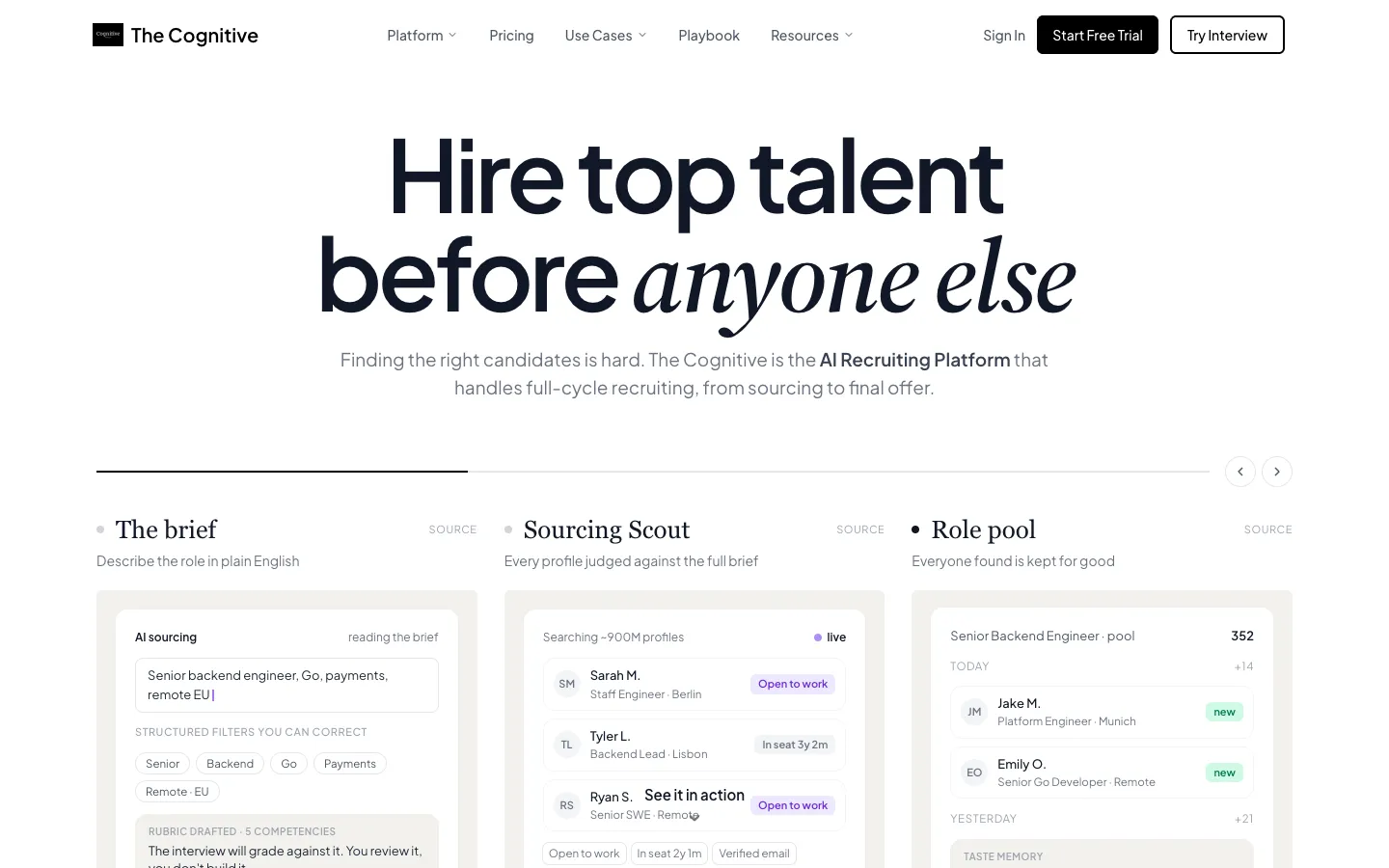
The Cognitive runs no events. It works on the two groups a fair leaves behind: people who never registered, and attendees nobody had time to talk to. For the first group, describe the role in plain English and it looks across about 900M public profiles, with a short reason for every match. Contact details use credits only when found: 4 for a personal email, and 12 for a phone number on Pro and above.
On Sourcing Pro and higher plans, outreach goes from your own Gmail or Outlook as a sequence of up to three emails, and it stops for anyone who replies. See AI sourcing.
For the second group, import the attendee list from a CSV file or a Google Sheet and invite the whole list to a live two-way AI video interview, 10 or 20 minutes long, in one step. Each attendee picks a slot with no account needed.
An interview scorecard: each criterion scored out of 5, with claims from the CV marked Verified, Unclear or Refuted.
It also connects with 100+ ATSs (see integrations).
Best for: teams whose hardest roles go to people who are employed and not job hunting.
Watch out for: no event hosting, booths or live chat rooms, so the fair itself needs an event platform such as vFairs or EasyVirtualFair. Email outreach needs Sourcing Pro or higher, and ATS sync needs Sourcing Max or Interviews Pro. Attendees take the interview on a laptop or desktop with a camera, not a phone.
Pricing model: credits on a monthly plan: 1 credit for each person a search shows, once, and 100 credits for each 20-minute interview you send an attendee. Sourcing and interviews are bought as separate plans. Plans start at $99 a month (see pricing).
2. vFairs: best for multi-employer virtual job fairs with branded booths

Verdict: the most complete platform here for fairs with many employers, with every scored capability built in.
vFairs is a general event platform for conferences, trade shows and fairs, and its job fair product is built for "Multi-Employer Hiring Events". Employers register and pay for booths themselves. Candidates submit resumes and job preferences at sign-up, then reach booth reps by live chat or 1:1 appointments, with smart chat queuing when booths get busy.
Recruiters run live screenings and group interviews in breakout rooms, and candidate data goes straight into your ATS. Reports cover booth visits, downloads and chats.
Best for: workforce agencies, governments and recruitment organizations hosting fairs with many employers.
Watch out for: recruiting is one use case among many, and it only reaches people who register.
Pricing model: quote by event type, including single-employer and multi-employer job fairs.
3. EasyVirtualFair: best for universities and workforce boards that want a free trial and hands-on support
Verdict: the easiest way for a university or workforce board to try a virtual fair before buying.
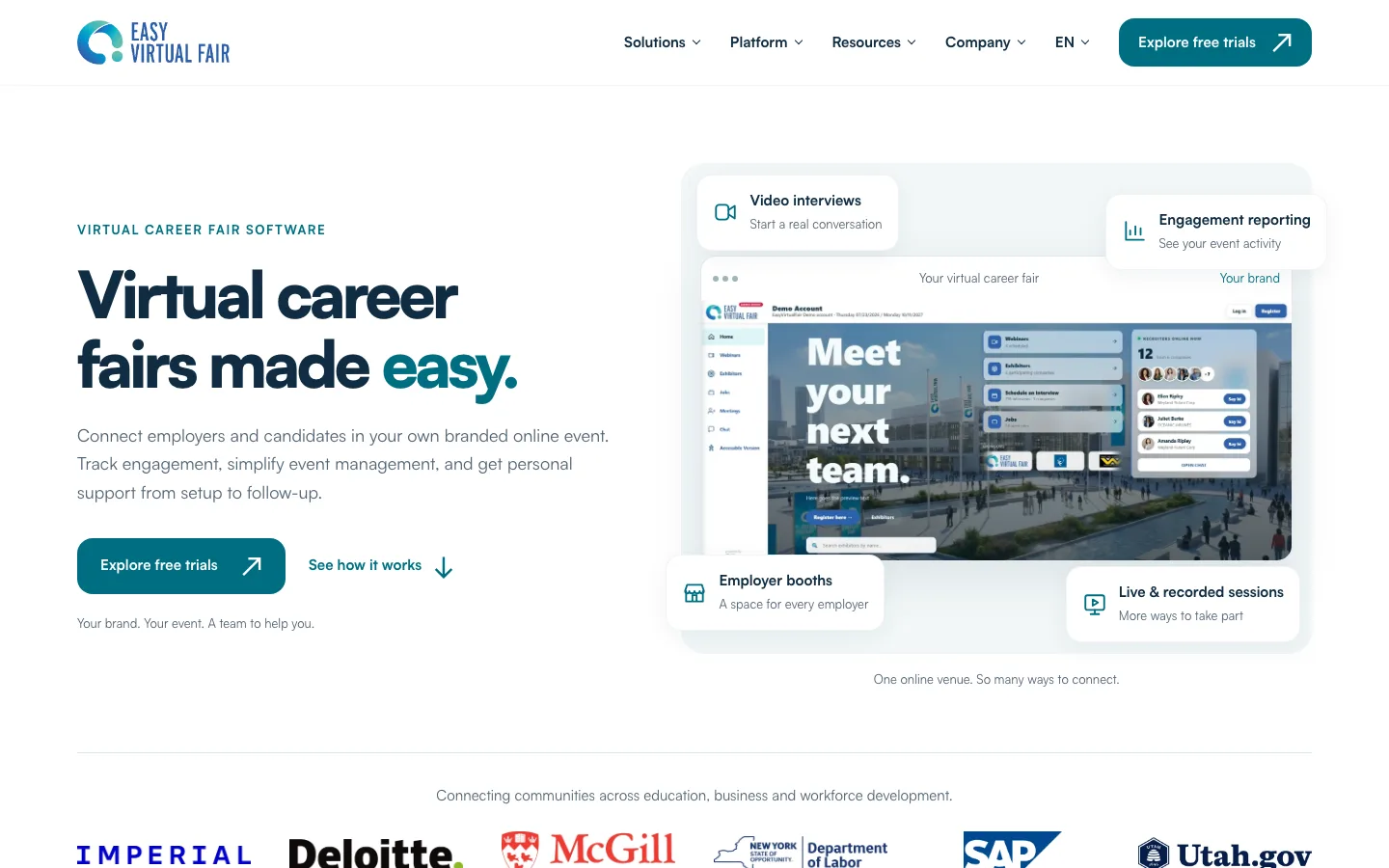
EasyVirtualFair runs branded virtual career fairs "directly in the browser", with live video chat, a webinar theater and unlimited booths. Employers get their own sign-up site, and organizers get tools to manage participating companies. Video rooms handle 1-to-1 and group calls with screen share, scheduling and waiting lines.
Every event gets a project manager. Attendee and chat logs export as CSV, to an ATS or by API. Most clients keep the fair open on demand for two to four weeks after the live day.
Best for: career centers and workforce boards running their first or fifth virtual fair.
Watch out for: screening rules at registration are custom work scoped with your team, and the free trial is for universities and workforce organizations, not companies.
Pricing model: single-event or annual license by quote; no card needed for the university or workforce trial.
4. Phenom Recruitment Events: best for enterprise teams that want attendees inside a talent CRM
Verdict: every check-in, score and note lands in its Talent CRM, so follow-up starts from one record.
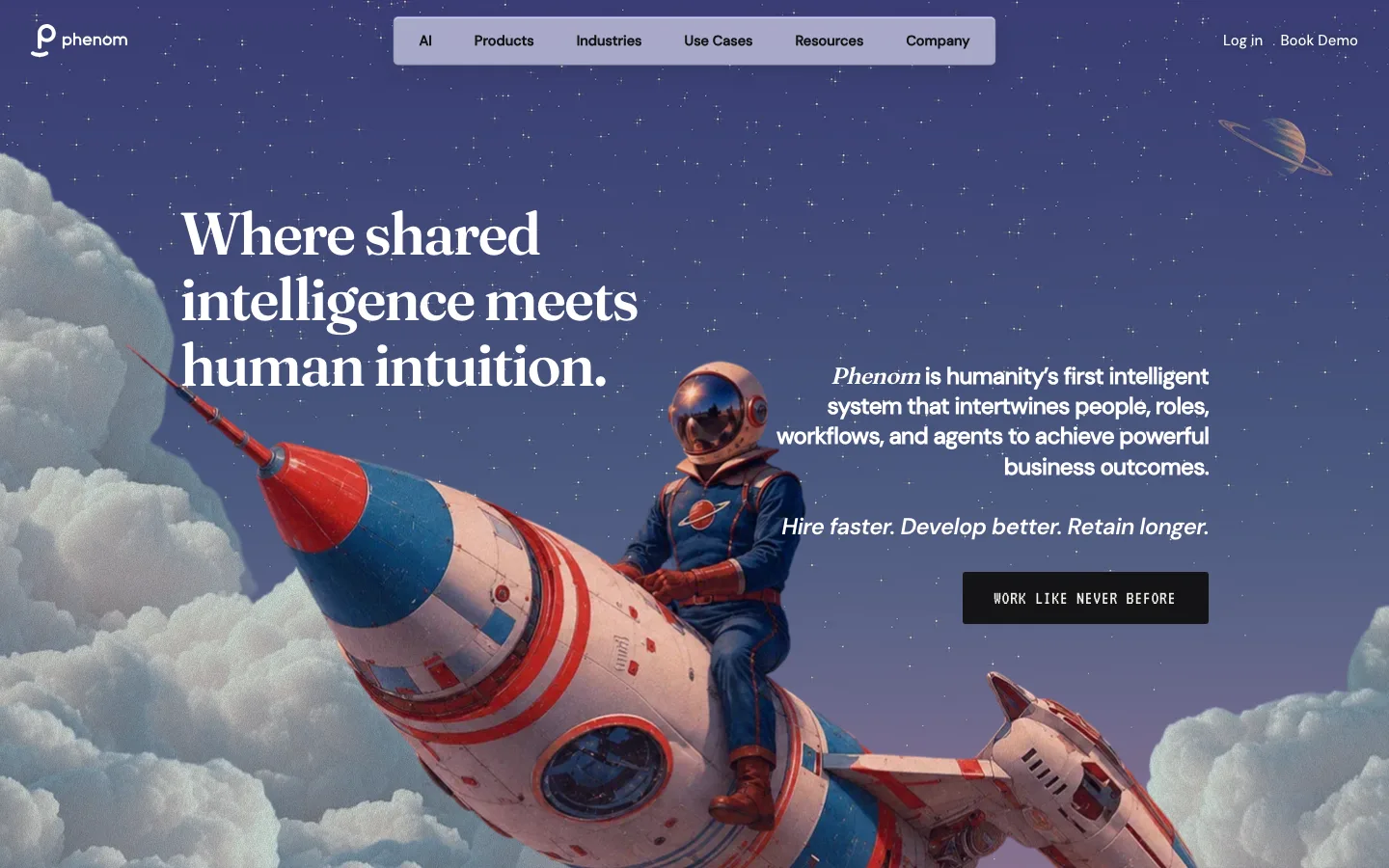
Phenom says registration, check-in, screening, follow-up and interviews "run in one place". You invite existing talent pools by email and SMS, registration forms include qualifying questions, and booths are grouped by business area. Attendees are ranked against the roles attached to the event, with the reasoning shown.
At in-person events, attendees check in with a QR code while recruiters score them from a phone. Virtual live sessions and breakout rooms come with Events Pro. Beyond the event, Phenom's AI sourcing searches the CRM and the open market together.
Best for: large employers that already run, or plan to run, Phenom's CRM.
Watch out for: virtual sessions need Events Pro, and it is built for one employer's events, not multi-employer fairs.
Pricing model: pricing and RFP requests by form.
5. Radancy Hiring Events: best for enterprise hiring events fed by programmatic job ads
Verdict: the pick when an event needs paid traffic to fill it.
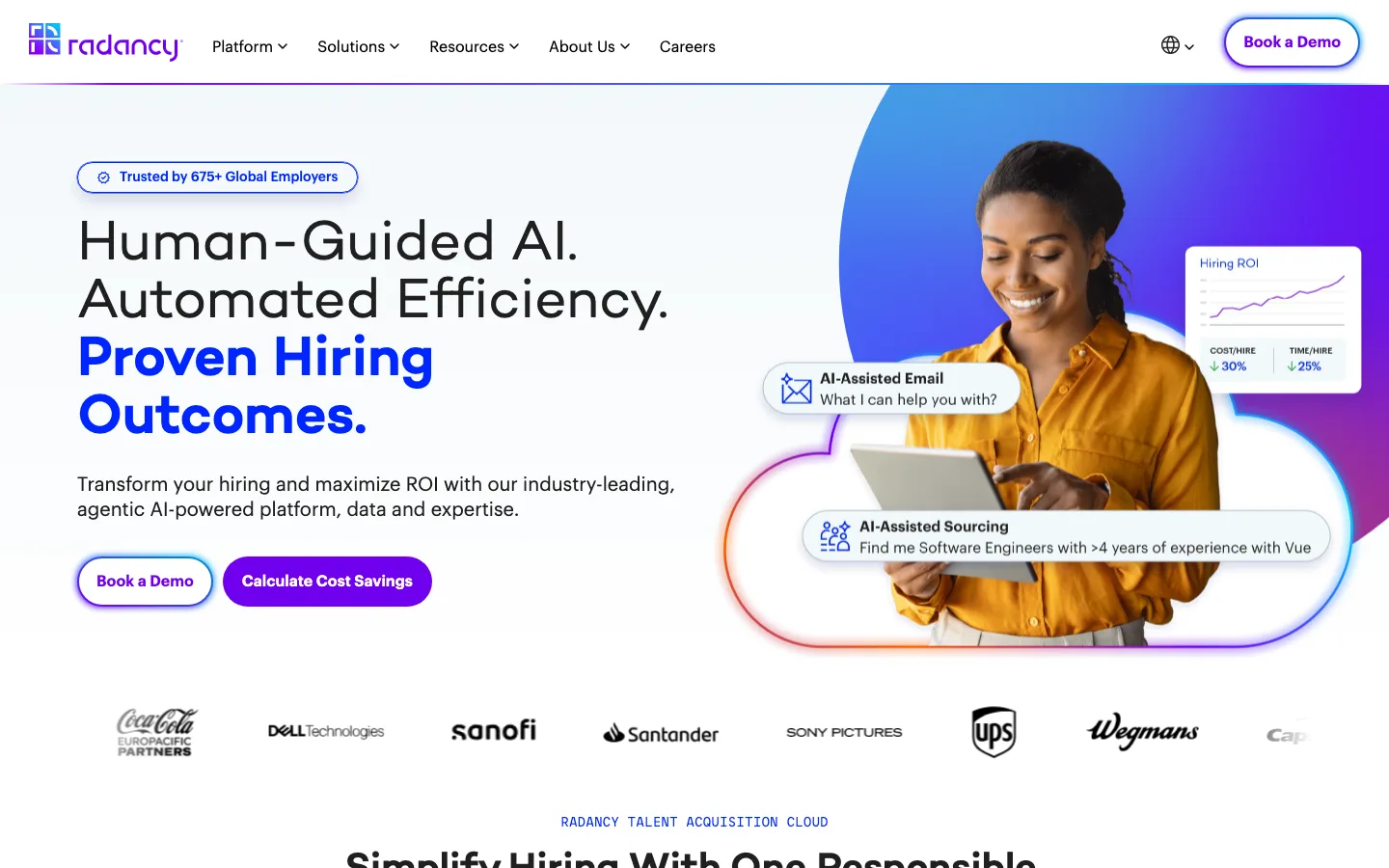
Brazen is now part of Radancy, sold as Radancy Hiring Events within its talent acquisition platform. Branded lobbies host the event, and virtual booths support 1:1 interviews, group sessions and webinars. Custom forms and knockout questions filter who attends, and scheduling tools connect recruiters and candidates before and during the event.
Programmatic ad campaigns drive registrations, and Radancy's CRM keeps engaging attendees afterwards.
Best for: large employers who need to fill an event, not just host it.
Watch out for: it comes as part of a wider talent acquisition platform and is built around one employer's events.
Pricing model: by demo; no pricing page.
6. Premier Virtual: best for workforce agencies and school districts running large public job fairs
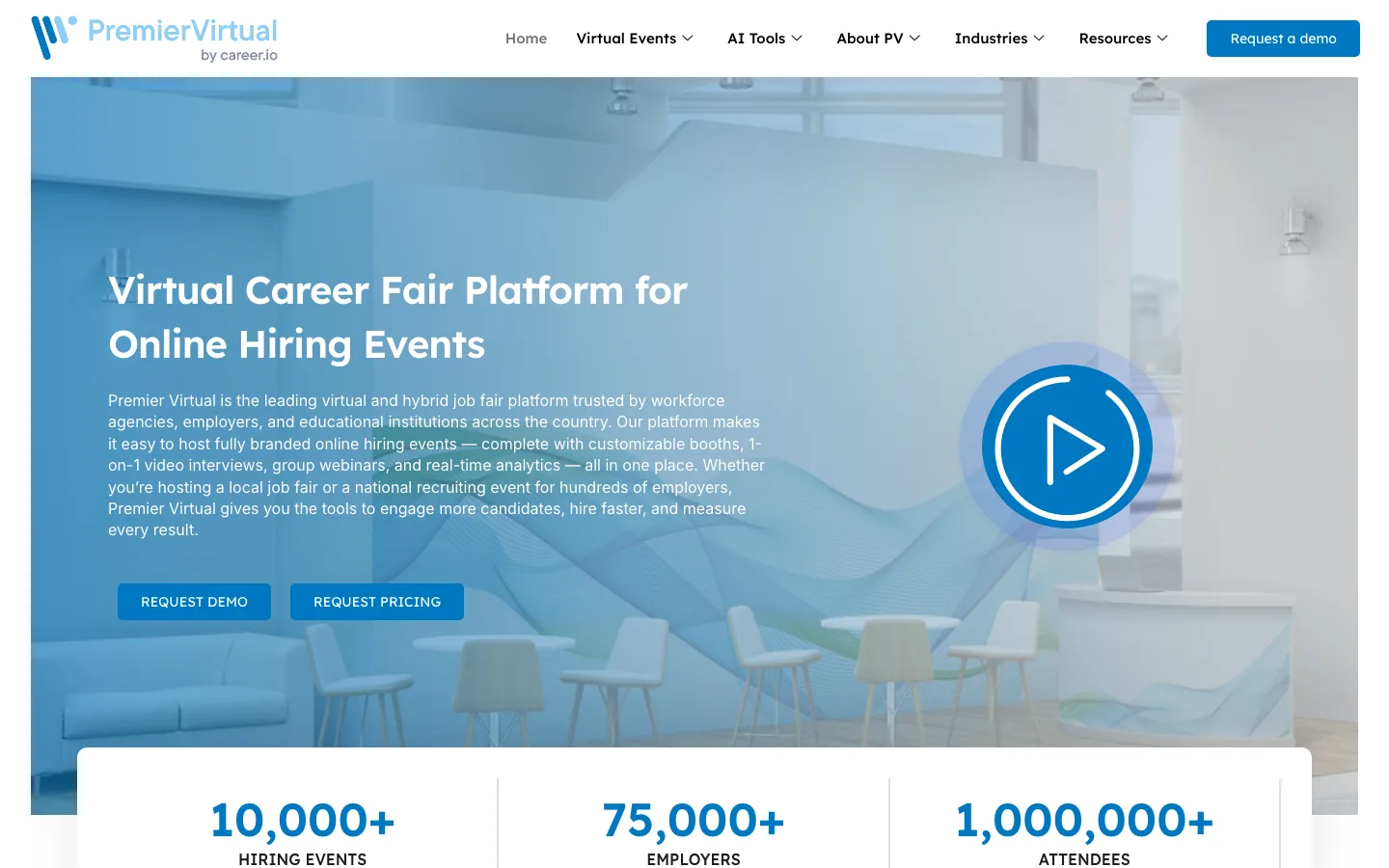
Verdict: a virtual fair built by a company that used to run in-person job fairs.
Premier Virtual calls itself a virtual and hybrid job fair platform for workforce agencies, employers and educational institutions, designed to "look and feel as close to a live event as possible". Each organization customizes its booth, job seekers text chat with recruiters, and employers can request a video interview on the spot.
Registration questions qualify job seekers, and resume and video resume features go further. Recruiters rate job seekers in real time, and a Client Success Manager runs an event debrief afterwards.
Best for: public workforce boards and school districts hosting fairs with hundreds of employers.
Watch out for: ask in the demo how attendee data gets into your ATS.
Pricing model: by request; no pricing page.
7. Yello: best for campus teams running career fairs and interview days

Verdict: event logistics built for early-talent teams, from check-in to self-scheduled interviews.
Yello's event software is "purpose-built for early talent teams". It plans, promotes, hosts and measures virtual events such as webinars and interactive sessions in the same system as in-person ones. Contactless check-in captures digital resumes, and candidates self-schedule interviews.
Follow-up campaigns go out by email and SMS, data syncs with major ATS providers, and Yello tracks event expenses, registration and ROI. WayUp is now Yello Sourcing, which reaches early-career candidates beyond the event.
Best for: university recruiting teams that attend many campus fairs a season.
Watch out for: built for early-career events; if you need a booth-style virtual floor, ask to see one in the demo.
Pricing model: by demo; no pricing page.
8. Paradox Conversational Events: best for high-volume hourly and seasonal hiring events

Verdict: registration, reminders, screening and scheduling run automatically, which suits hourly events.
Paradox "automates registration, reminders, screening, instant scheduling, and more" for traditional job fairs, campus events and fully virtual hiring events. People register through QR codes, landing pages, text or chat. Native and integrated video lets teams host virtual events and connect candidates with recruiters or hiring managers on the spot.
Candidates can register, communicate and interview from a smartphone, and the assistant answers in 100+ languages. Integrations run through an open API. For the wider hourly stack, see the best high-volume hiring software and the Paradox review.
Best for: employers hiring hourly and seasonal staff in large numbers.
Watch out for: if you need a booth-style virtual floor, ask to see one in the demo.
Pricing model: by demo.
9. Handshake: best for employers joining university career fairs at no cost
Verdict: a free way into university-run fairs, not a fair you host.
Handshake works differently from the others. University career centers host fairs on Handshake, and employers join them. Event and career fair RSVP management is included on the free Basic plan, as well as on Pro and Enterprise.
Promotion across multiple schools, unlimited attendee messaging, ATS integration and funnel analytics need Enterprise.
Best for: employers hiring students and recent graduates on a small budget.
Watch out for: early-career candidates only, and the employer does not host the fair.
Pricing model: free Basic plan, a Pro plan priced per month on the website, and Enterprise by quote.
10. hireEZ Recruiting Events: best for teams that already source in hireEZ

Verdict: event pages and registrations inside the sourcing tool you already use.
hireEZ Recruiting Events builds event pages from templates and sends invitations, confirmations and reminders automatically. It runs virtual, in-person and interview-focused events. You see registrations, check-ins and engagement as they happen, and the data syncs back into hireEZ, whose main product is sourcing. See the hireEZ review.
Best for: recruiting teams already on hireEZ that want event pages in the same system.
Watch out for: the events product centers on pages and registrations, so ask whether booths and live video rooms are included.
Pricing model: events by demo; hireEZ also publishes a solo sourcing plan with a 7-day free trial.
What if the people you need never come to a fair?
The people a fair cannot reach are often the ones who get hired. Across 165M applications in Gem's 2026 Recruiting Benchmarks Report, direct sourcing produced 11% of hires from 2.6% of applications. Job boards and company channels brought in roughly nine in ten applications, yet only about half of hires.
A fair is an inbound channel too: it waits for people to register. The Cognitive goes the other way. Describe the role and it returns people who match, each with a short reason.
Email the strongest matches from your own mailbox, then interview the ones who reply. More in passive candidate sourcing and the best recruiting outreach software.
When not to pick The Cognitive
- You need to host the fair. It has no event hosting, booths or live chat rooms. Pick vFairs for multi-employer fairs, or EasyVirtualFair if you want a trial first.
- Your audience is students. Handshake and Yello reach early-career candidates where they already are. See campus recruiting.
- You hire hourly staff at volume. Many hourly applicants only have a phone, and the AI interview runs on a laptop or desktop. Paradox handles phone-first hourly events.
Common mistakes, and how to start
- No screening at registration. Without questions or a resume at sign-up, recruiters sort people live, one chat at a time.
- No plan for the day after. Decide before the fair who follows up, by when and in which system.
A simple way to start:
- Host your next fair on the event platform that fits your audience.
- When it closes, import the attendee list into The Cognitive and invite the strongest people to a live AI interview.
- For the roles the fair did not fill, describe each one, review the matches and contact the best people directly.
The 7-day trial needs no card, and email outreach comes with Sourcing Pro and higher plans. Create a free account.
Sources
- NACE, "In-person Activities More Effective Than Virtual Ones for Recruiting Interns", 2025 Internship & Co-op Survey (247 organizations), April 2025. naceweb.org
- NACE, "Employers, Students Favor In-Person Career Fairs", 2024-25 Career Services Benchmarks (551 institutions), March 2025. naceweb.org
- Gem, "Key takeaways from the 2026 Recruiting Benchmarks Report", 1 December 2025 (June 2021 to May 2025; 165M applications, 1.2M hires). gem.com
- Vendor event, product and pricing pages: vfairs.com, easyvirtualfair.com, phenom.com, radancy.com, premiervirtual.com, yello.co, paradox.ai, joinhandshake.com and hireez.com.
Frequently Asked Questions
What is the best virtual job fair software?
For hosting the fair, vFairs scores highest here, with booths, live chat and video, screening at sign-up, ATS integration, reports and multi-employer fairs all built in. EasyVirtualFair suits universities and workforce boards, and Phenom and Radancy Hiring Events suit enterprise employers. For candidates who never come to fairs, The Cognitive ranks first, though it hosts no events.
Is there free virtual job fair software?
Yes, for employers joining university fairs. Handshake's free Basic plan includes event and career fair RSVP management. EasyVirtualFair offers a free trial with no card for universities and workforce organizations.
Do virtual job fairs still work?
They work as one channel, not the main one. NACE found median student attendance at virtual fairs fell from 295 in 2021-22 to 93 in 2023-24, while in-person attendance rose.
Do attendees need to download an app for a virtual job fair?
Not on most platforms. EasyVirtualFair runs in the browser with no app download, and Paradox lets candidates register, message and interview from a smartphone.
What happened to Brazen?
Brazen is now part of Radancy and sold as Radancy Hiring Events. It offers branded lobbies, virtual booths, knockout questions and programmatic ads to fill events.
Is The Cognitive a virtual job fair platform?
No. It runs no events, booths or live chat rooms. It finds candidates who skip fairs across about 900M public profiles and, on Sourcing Pro and higher plans, contacts them by email from your own mailbox. After a fair, you can import the attendee list from a CSV or Google Sheet and invite the list to a live AI video interview.
Related reading
- Campus Recruiting Software for Intern and Graduate Hiring: The 10 Best in 2026
- High-Volume Hiring Software: The 10 Best Tools for Screening Hundreds of Applicants in 2026
- Passive Candidate Sourcing: How to Find, Message and Hire People Who Are Not Applying
- Best Retail Hiring Software in 2026: 9 Tools for Store Teams and Store Leaders
- 10 Best CRMs for Staffing Agencies in 2026, Scored
- Best EOR Companies in 2026: 11 Employer of Record Providers Ranked, Plus the Step Before