Candidate Experience Platforms Explained: What They Cover, How to Measure Them and 8 Tools to Know
By Sparsh Goyal, Founder at The Cognitive. Published · Last updated
- A candidate experience platform is software that runs the candidate's side of hiring: communication, scheduling, screening, feedback and accessibility, usually built from 2 or 3 tools.
- Measure it with candidate NPS, drop-off by stage and median time to schedule, and fix the stage with the worst drop-off first.
- I run The Cognitive, which covers the screening step with a live AI interview candidates book themselves; Paradox, GoodTime, Calendly, Greenhouse, HireVue, Phenom and Survale are described from their own websites, read on 4 October 2026.
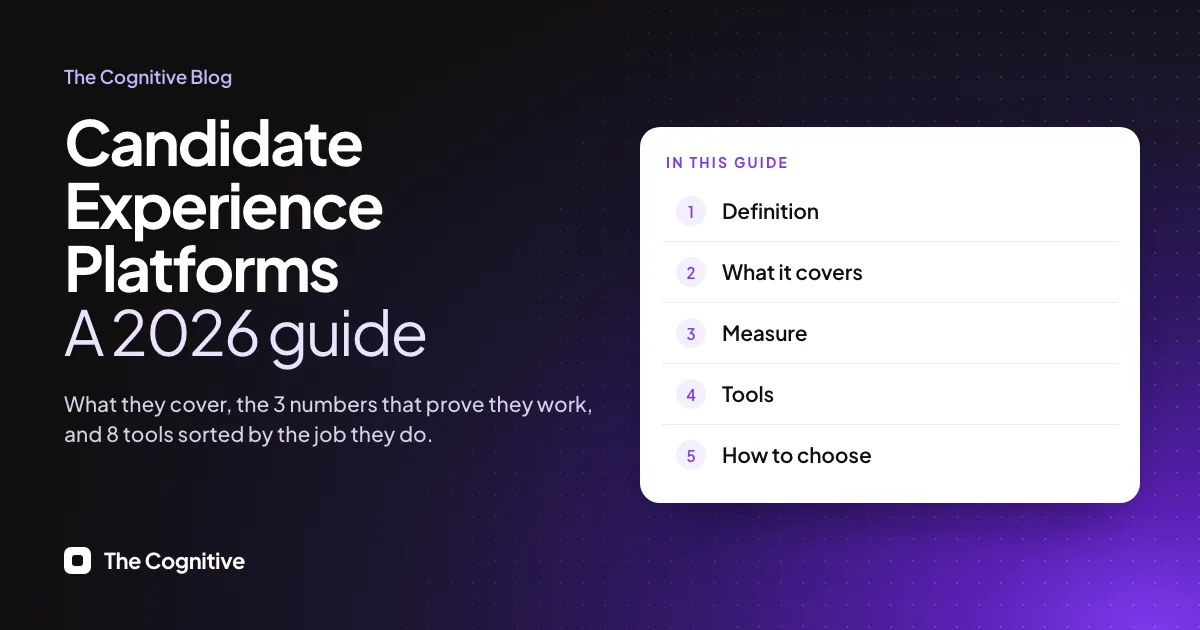
A candidate experience platform is software that runs the parts of hiring a candidate actually feels: how you contact them, how they book a time, how they are screened and whether anyone asks what it was like. Most teams build one from 2 or 3 tools rather than buying a single suite. The Cognitive covers the screening step: candidates book their own slot for a live AI interview, and the invitation tells them it is run by AI.
The stakes are measurable. In CareerPlug's 2025 Candidate Experience Report, 66% of candidates said a positive experience influenced their decision to accept an offer, and a poor one led 26% of job seekers to turn an offer down in 2024 alone.
Full disclosure: I run The Cognitive. Every other tool on this page is described from its own website, in its own words, read on 4 October 2026. I have not used them on a paid account.
What is a candidate experience platform?
A candidate experience platform is any system whose main job is the candidate's side of the process: messages, booking, screening, reminders and feedback. Vendors also sell it as candidate experience software or candidate experience management. The labels overlap, and so do the products.
Our page on candidate experience defines the idea itself and walks the journey stage by stage. This page is about the software, and it comes in 5 kinds:
- Conversational assistants. A chatbot or text assistant answers questions, screens and books interviews. Paradox is the best-known example.
- Scheduling tools. Self-scheduling links, panel coordination and reminders. GoodTime and Calendly sit here.
- Screening and interview tools. Video or AI interviews that replace the first phone screen. HireVue and The Cognitive sit here.
- Feedback and survey tools. Surveys at each stage, candidate NPS and benchmarks. Survale is built only for this.
- Suites. An ATS or talent platform that bundles several of the above. Greenhouse and Phenom are the examples on this page.
Pick by the stage where candidates leave you, not by the label on the box.
A recruiting platform is the wider category. It usually means an ATS, a sourcing tool or both, and it is built around the recruiter's workflow: jobs, pipelines, notes and offers. A candidate experience platform is judged from the other side of the table. The same product can be both, which is why Greenhouse appears below, but the questions you ask in a demo change. A recruiter asks how fast they can move someone to the next stage. A candidate asks how long they will wait to hear back.
The split matters when you budget. If your ATS already sends status emails and offers self-scheduling, you may only need a survey tool to measure the result. If it does neither, adding a survey first will just measure a problem you already know you have.
What does a candidate experience platform cover?
A complete setup covers 5 jobs. Few single products do all 5 well, so use this as a checklist against whatever you already own.
Communication
Candidates want to know where they stand. The worst gap sits after the interview, the stage where they have invested the most. Greenhouse's 2026 Candidate AI Interview Report, published 1 May 2026, found that 51% of people who completed an AI interview never heard back.
A platform should send status updates when a stage changes, not when a recruiter remembers. It should also stop messaging someone the moment they reply or opt out. In The Cognitive's outreach, a reply or opt-out on email or SMS stops both channels.
Scheduling
Every email that asks "does Tuesday work?" adds a day. Self-scheduling fixes that: the candidate gets a link, picks a slot and gets a reminder. Rescheduling should work the same way, without writing to anyone.
Our guide to interview scheduling software covers the tools, templates and availability emails in depth, so I keep this section short.
Screening
Candidate screening software decides who gets a human interview. It is also where candidate experience goes wrong fastest, because a badly designed screen feels like a wall. CareerPlug found 33% of job seekers had abandoned an application that required a one-way video interview.
Greenhouse's 2026 report points the same way. It surveyed 2,950 active job seekers: 38% had walked away from a hiring process because it included an AI interview, and another 12% said they would. The top trigger, at 33%, was a pre-recorded video scored by AI with no human present. The next, at 27%, was a company not saying how AI would be used. Format and disclosure matter more than whether AI is involved.
Feedback
You can't fix what you never asked about. A feedback layer sends a short survey after key stages, including to people you rejected, and rolls the answers into a score you can track by role, recruiter and location. The rejected group matters most because it is the largest and the quietest.
Accessibility
Ask every vendor 4 things before you buy. Does the candidate need an account? Does it work on a phone? Which languages does it support? What happens when a candidate asks for an adjustment, such as more time or a different format?
Ask for the accessibility statement in writing and test the flow yourself on a phone. Keep a human route open for anyone who asks for one. That is good practice whatever tool you use.
How do you measure candidate experience?
Measure candidate experience with 3 numbers a platform should give you without a spreadsheet: candidate NPS, drop-off by stage and time to schedule. The candidate experience guide lists the wider set of candidate experience metrics and a survey you can send this week. Here is what to ask a vendor to report.
Candidate NPS
Ask candidates how likely they are to recommend applying to a friend, on a 0 to 10 scale. Scores of 9 and 10 are promoters, 0 to 6 are detractors, and 7 and 8 count only in the total.
Formula: cNPS = % promoters minus % detractors. Example: 200 replies, 90 promoters (45%) and 50 detractors (25%) give a cNPS of 20.
Weight the sample toward people you did not hire, or the score flatters you.
Drop-off by stage
Drop-off is the share of candidates who enter a stage and never finish it. Track it per stage, because a single funnel number hides where the leak is.
Formula: stage drop-off = (candidates who started the stage minus candidates who completed it) ÷ candidates who started it × 100. Example: 120 invited to an interview, 84 completed it, so drop-off is 30%.
Split the invited group into "never booked" and "booked but didn't show". They have different causes: the first is usually the invitation, the second the reminders.
Time to schedule
Time to schedule is the gap between inviting a candidate and the candidate booking a slot. It is the cleanest test of a scheduling setup, because it measures waiting the candidate didn't choose.
Formula: time to schedule = booking date minus invite date, reported as a median per role. Use the median, because one candidate who books 3 weeks later will drag an average.
Which candidate experience tools are worth a look?
These are 7 candidate experience tools that each own at least one of the 5 jobs, plus The Cognitive. The list is not ranked; group them by the job you need done. I filled in every cell from the vendor's own site on 4 October 2026.
| Tool | Main job it covers | Best for | Candidate books own slot? | Pricing model (price on site?) |
|---|---|---|---|---|
| Paradox | Conversational assistant: chat, text, scheduling | High-volume and frontline hiring | Yes, through chat or text | Sold by demo (no) |
| GoodTime | Interview scheduling and candidate portals | Teams running panels and multi-day loops | Yes, self-scheduling and rescheduling | By candidates per year, not users (no) |
| Calendly | General scheduling links and reminders | Small teams on a budget | Yes | Per seat per month, free plan (yes, except Enterprise) |
| Greenhouse | ATS with surveys, self-scheduling and reminders | Teams choosing an ATS anyway | Yes, on all 3 plans | Custom by plan: Core, Plus, Pro (no) |
| HireVue | Video interviews, AI Interviewer and assessments | Enterprises standardising screening | Not stated on the pages I read | Sold by demo (no) |
| Phenom | Career site, scheduling and voice screening | Large employers wanting one suite | Automated Interview Scheduling | Sold by demo (no) |
| Survale | Stage-by-stage candidate surveys and benchmarks | Measuring cNPS across a big team | Not applicable | Sold by demo (no) |
| The Cognitive | Live AI video interview, plus sourcing | Fast first-round screens without phone tag | Yes, without an account | Monthly plans, AI Interview from $99/month (yes) |
Most teams need one tool from 2 or 3 of these rows, not all 8. Start with the stage that has your worst drop-off.
Paradox: best for high-volume and frontline hiring
Paradox calls itself "conversational hiring software", built around an AI assistant named Olivia that chats and texts with candidates, answers questions and offers interview slots. It also runs conversational career sites. Workday completed its acquisition of Paradox on 1 October 2025 and describes it as "a candidate experience agent". The strength is speed at volume: a text-first flow suits hourly applicants who will never open a desktop portal. The trade-off is buying it: it is sold by demo with no published price, and the Workday tie means Workday customers will get the most out of it. Our recruiting chatbots roundup compares it with similar assistants.
GoodTime: best for complex interview loops
GoodTime's homepage says it handles everything "from simple 1:1 interviews to multi-day panels", including interviewer selection, reminders and rescheduling. Candidates get branded portals where they can book and rebook their own interviews. The strength is the hard cases: coordinating 5 interviewers across time zones is where generic schedulers break. The trade-off is fit for small teams: "Pricing is based on the number of candidates annually, not the number of users", and the price comes as a custom proposal.
Calendly: best for small teams that need booking links today
Calendly's recruiting page promises to help you "interview candidates quicker, deliver the best candidate experience, and reduce your time-to-hire", and names Greenhouse, JazzHR, LinkedIn Recruiter and Zoho Recruit as integrations. Automatic reminders and round-robin booking come on its paid plans. The strength is cost and speed: it publishes per-seat monthly prices and has a free plan. The trade-off is that it is a general scheduler, so panels, interviewer training and candidate portals are not what it was built for.
Greenhouse: best if you are choosing an ATS anyway
Greenhouse lists "Configurable candidate survey", "Candidate self-scheduling", "Candidate interview reminders" and "Scheduling links" on all 3 of its plans, Core, Plus and Pro. Resume anonymization is on Pro only. The strength is having feedback and booking inside the system of record, so the survey data sits next to the stage data. The trade-off: "Greenhouse pricing is customized based on your company's hiring needs", so there are no figures to compare until you talk to sales.
HireVue: best for enterprises standardising screening
HireVue sells an AI Interviewer, live video interviewing and assessments under the line "Make confident talent decisions". Its homepage claims "92% candidate experience satisfaction", a vendor figure with no method shown next to it. The strength is breadth for large employers that want one screening system. The trade-off is price transparency: its pricing page shows no plans or figures and routes you to a demo.
Phenom: best for large employers that want one suite
Phenom describes an "Intelligent Career Site", "Automated Interview Scheduling" and a "Voice Screening Agent" in one platform aimed at hiring, development and retention. The strength is one system from career site to screening. The trade-off is scale: it is sold by demo with no published price, which suits enterprise buying cycles more than a 10-person team.
Survale: best for measuring candidate NPS across a big team
Survale calls itself "AI Powered Candidate Experience Software" and says it "automatically gathers feedback and combines it with operational data", filtered by recruiter, hiring manager, location and job. It also runs the CandE benchmark research program, so you can compare your scores with peers. The strength is measurement, which every other tool here treats as a side feature. The trade-off: it measures the experience and leaves the fixing to your other tools, and it is sold by demo.
Where does The Cognitive fit in candidate experience?
The Cognitive fits at the screening step, and it answers the 2 biggest complaints in Greenhouse's data: candidates not being told about AI, and candidates talking to a recording with nobody on the other side.
- The candidate books the slot. Candidates get an invitation and book their own time without creating an account. If someone hasn't booked, reminder emails go out, capped at 5 so nobody is chased forever.
- The invitation says it's AI. The invitation tells candidates the interview is run by AI, before they book.
- It is live and two-way. A live AI video interview of 10 or 20 minutes, in any of 9 languages, that asks follow-up questions on each answer, so candidates are answering a conversation rather than a camera.
- The rubric is fixed, the questions adapt. Every candidate for a role is scored against the same criteria, while the follow-ups react to what each person says.
Here is a recorded live interview for a go-to-market role:
The 5-minute recording shows the AI asking a candidate about an outbound email campaign they ran, then following up on what drove the reply rates and how they qualified the leads that came back. To feel it from the candidate's chair, take a practice AI interview yourself before you send one.
On the recruiter side, the report gives a 1 to 5 score per criterion, a weighted score out of 100, a suggested verdict, overall written feedback, the transcript and the recording. Nothing is rejected automatically, so a person still makes every call and sends every answer.
For measurement, each candidate carries a status per stage: Invite Sent, Scheduled, Completed, Pending Review, Approved or No Show. That is enough to count "never booked" against "no show" for your drop-off split. You can invite a whole list in one go, and for candidates imported from your ATS, a note with the score, summary and report link is written back to their record.
What it doesn't do: The Cognitive is not an ATS. It has no careers page, no candidate surveys, no funnel analytics and no scheduling for human interviews. Pair it with your ATS for those and with a survey tool for cNPS. AI Interview starts at $99/month and AI Sourcing at $49/month, on monthly plans you can cancel anytime.
Give candidates a first interview they can book tonight Invite a list, let each person pick a slot, and read a scored report for every interview. Start free
How do you choose a candidate experience platform?
Answer these 5 questions in order. The first one usually settles which row of the table you need.
Where do candidates drop out today?
Pull drop-off per stage for your last 3 roles before any demo. If people stall between invite and booking, buy scheduling. If they quit during the screen, fix the screen's format. If they vanish after interviews, you have a communication gap that software only half solves.
Does the screen tell candidates what it is?
In Greenhouse's 2026 data, 70% of candidates were never clearly told upfront that AI would evaluate them, and 21% found out once the interview had started. Read the vendor's actual invitation email. If it doesn't say plainly how AI is used, candidates will notice and some will leave.
Can candidates book and rebook without writing to anyone?
Self-scheduling should include rescheduling, reminders and a mobile-friendly page. Ask whether candidates need an account; every extra login is a place to lose someone.
Will it report cNPS, drop-off and time to schedule?
Ask the vendor to show those 3 numbers on their demo account. If they need an export and a spreadsheet, you will stop looking at them within a month.
Does it fit your volume and your budget?
Per-candidate pricing, as GoodTime uses, rewards low volume. Per-seat pricing, as Calendly uses, rewards a small team. Demo-only pricing usually means an annual contract. Ask for the pricing model before the first call.
How do you start improving candidate experience this month?
Pick one role with a lot of applicants. Measure its drop-off per stage and its median time to schedule this week. Then fix the worst stage first: a self-scheduling link if booking is slow, a clearer invitation if people quit the screen, or a status update rule if they vanish after interviews. Send a 3-question survey to everyone who finished, hired or not, and repeat the measurement in 30 days.
If the first screen is your bottleneck, run it through The Cognitive for that one role and compare the drop-off with your last phone-screen round. There is a free trial with 100 sourcing credits.
Fix the first interview, then measure the difference Candidates book their own slot, the invitation says it's AI, and every interview comes back as a scored report. Start free
Sources
- CareerPlug, "2025 Candidate Experience Report", read 4 October 2026: careerplug.com/candidate-experience
- Greenhouse, "63% of Job Seekers Have Faced an AI Interview. Most Haven't Had a Good One Yet", 1 May 2026, read 4 October 2026: greenhouse.com/newsroom/63-of-job-seekers-have-faced-an-ai-interview-most-havent-had-a-good-one-yet
- Bain & Company, "Measuring Your Net Promoter Score", read 4 October 2026: netpromotersystem.com/about/measuring-your-net-promoter-score
- Paradox, homepage, read 4 October 2026: paradox.ai
- Workday, "Workday Completes Acquisition of Paradox", 1 October 2025, read 4 October 2026: newsroom.workday.com/2025-10-01-Workday-Completes-Acquisition-of-Paradox
- GoodTime, homepage and pricing page, read 4 October 2026: goodtime.io, goodtime.io/pricing/hire
- Calendly, pricing and recruiting pages, read 4 October 2026: calendly.com/pricing, calendly.com/solutions/recruiting
- Greenhouse, pricing page, read 4 October 2026: greenhouse.com/pricing
- HireVue, homepage and pricing page, read 4 October 2026: hirevue.com, hirevue.com/pricing
- Phenom, homepage, read 4 October 2026: phenom.com
- Survale, homepage, read 4 October 2026: survale.com
Frequently Asked Questions
What is a candidate experience platform?
A candidate experience platform is software whose main job is the candidate's side of hiring: messages, interview booking, screening, reminders and feedback surveys. Most teams assemble one from 2 or 3 tools, such as an ATS, a scheduling tool and a survey tool. The Cognitive covers the screening step with a live AI video interview that candidates book themselves.
What are the best candidate experience tools in 2026?
The best candidate experience tool depends on the stage where candidates drop out. Paradox suits high-volume hiring by chat and text, GoodTime and Calendly handle scheduling, Survale measures candidate NPS, and Greenhouse and Phenom bundle several jobs in one suite. The Cognitive fits when the first screen is the bottleneck: candidates book a live AI interview of 10 or 20 minutes without an account.
How do you measure candidate experience?
Measure candidate experience with candidate NPS, drop-off by stage and median time to schedule. cNPS is the percentage of promoters (9 or 10) minus the percentage of detractors (0 to 6). Drop-off is the share of people who start a stage and never finish it, and time to schedule is the gap between invite and booking. Our candidate experience guide at thecognitive.io/answers/candidate-experience lists the wider set of metrics and a survey.
What is the difference between candidate experience software and candidate screening software?
Candidate screening software decides who gets a human interview; candidate experience software covers everything the candidate feels, of which screening is one part. Screening is where experience often breaks: CareerPlug found 33% of job seekers had abandoned an application that required a one-way video interview. The Cognitive runs a live, two-way AI interview instead of a one-way recording.
Is a recruiting platform the same as a candidate experience platform?
No, a recruiting platform is built around the recruiter's workflow, while a candidate experience platform is judged by what the candidate goes through. An ATS such as Greenhouse can do both, with candidate surveys and self-scheduling on every plan. Many teams keep their ATS as the recruiting platform and add one tool for the stage where candidates drop out.
Do candidates drop out of AI interviews?
Yes, some do, mostly when the AI is hidden or nobody is on the other side. Greenhouse's 2026 survey of 2,950 job seekers found 38% had walked away from a process because it included an AI interview; the top triggers were pre-recorded videos scored by AI with no human present (33%) and companies not saying how AI was used (27%). In The Cognitive, the invitation tells candidates the interview is run by AI, and the interview is live and two-way.
How can AI improve candidate experience?
AI improves candidate experience when it removes waiting: self-booked interview slots, instant answers to questions and a first interview that happens this week rather than next. It hurts when it is hidden or one-way. The Cognitive lets candidates book a live AI interview without an account, in any of 9 languages, and nothing is rejected automatically, so a person still makes every decision.
What is the best interview scheduling software for candidate experience?
The best interview scheduling software lets candidates book and rebook a slot without writing to anyone, and sends reminders. GoodTime suits complex panels, Calendly suits small teams with its free plan and published per-seat prices, and Greenhouse includes candidate self-scheduling on all 3 plans. Our interview scheduling software guide at thecognitive.io/blog/interview-scheduling-software compares them in depth.
How much does a candidate experience platform cost?
Most candidate experience platforms do not publish a price. Paradox, HireVue, Phenom and Survale sell by demo, Greenhouse customizes by plan, and GoodTime prices by candidates per year rather than users. Calendly publishes per-seat monthly prices with a free plan. The Cognitive publishes its plans: AI Interview starts at $99/month and AI Sourcing at $49/month.
Does The Cognitive send candidate experience surveys?
No, The Cognitive does not send candidate surveys or calculate candidate NPS. It runs the screening step: candidates book their own slot, take a live AI video interview of 10 or 20 minutes, and you get a scored report with transcript and recording. Pair it with your ATS or a survey tool such as Survale for cNPS.
Related reading
- Recruitment Chatbots Compared: 9 Conversational AI Tools, and What to Use When Chat Isn't Enough
- Interview AI Explained: How AI Interviewers Work for Employers and Candidates
- Data-Driven Recruitment, Sourcing First: 9 Metrics, Clean Data and the Decisions They Should Change
- Candidate Sourcing Channels Compared: Where to Find Candidates for Each Role in 2026
- Canditech Alternatives in 2026: 10 Tools, From Skills Tests to Live AI Interviews
- Equip Alternatives in 2026: 10 Tools for Skills Tests, Live AI Interviews and Sourcing