8 Best HackerRank Alternatives in 2026: What You Gain and Lose by Switching
By Sparsh Goyal, Founder at The Cognitive. Published · Last updated
- The best HackerRank alternative depends on why you leave: The Cognitive to find and interview engineers before a coding test, TestGorilla for one account, and CodeSignal for a like-for-like swap.
- HackerRank sells plans by candidate attempts per year with unlimited users on Starter and Pro, and charges for each extra attempt.
- The Cognitive runs no code, so teams that switch keep HackerRank or another coding tool for round two.
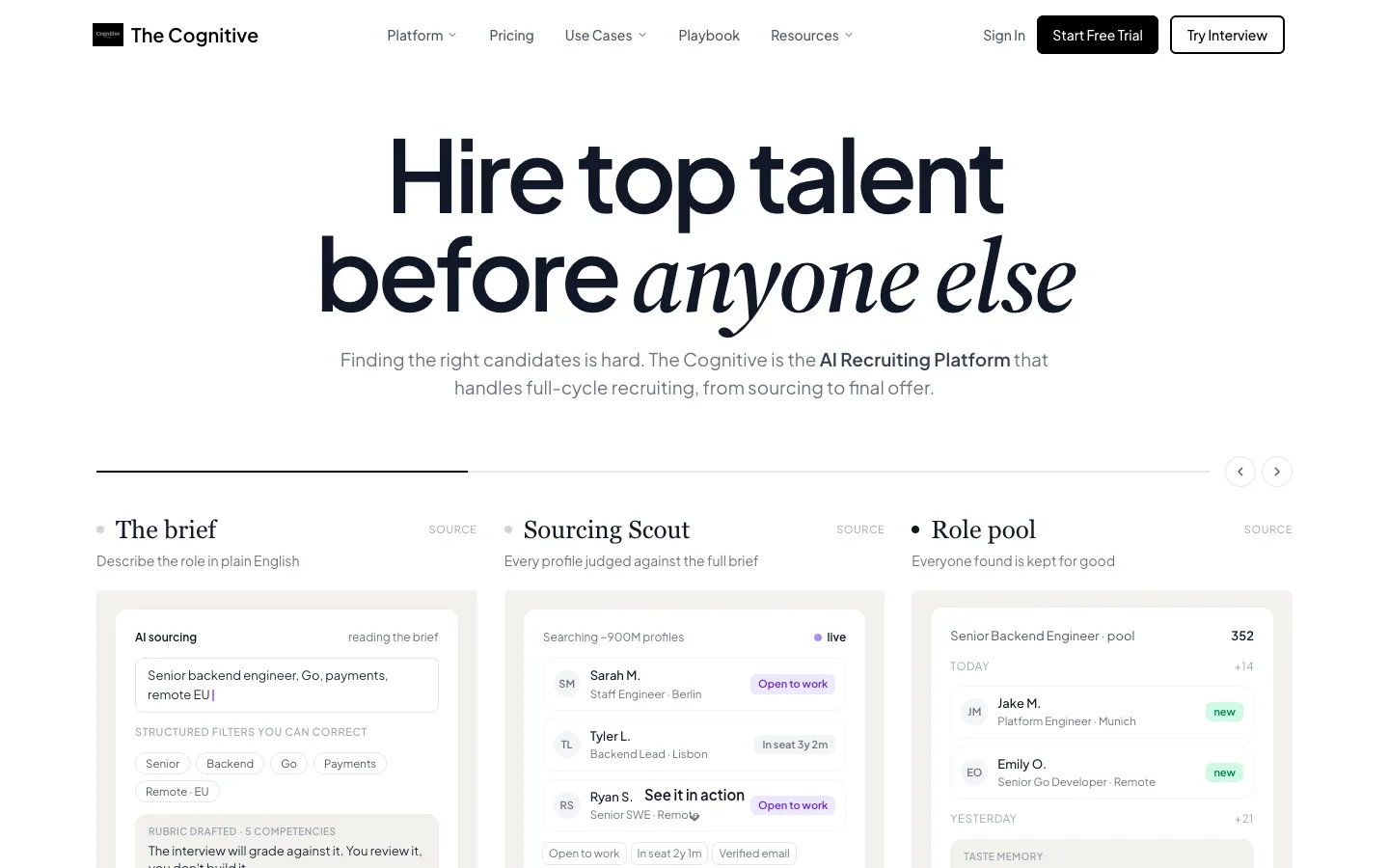
The best HackerRank alternative depends on why you are leaving. If too few strong engineers reach your HackerRank tests, The Cognitive ranks first. It searches outside profiles, emails people from your own mailbox and interviews them on live video before any test. It does not run code, so keep a coding tool for the next round.
TestGorilla puts sourcing, AI interviews and coding tests in one account. CodeSignal is the closest like-for-like swap. CoderPad suits teams that mostly run live coding, and Codility suits teams that want validated real-work tasks.
Disclosure: The Cognitive is our product.
The best HackerRank alternatives in 2026
- The Cognitive: best for finding and interviewing engineers before any coding round.
- TestGorilla: best for sourcing, AI interviews and skills tests in one account.
- CodeSignal: best for a like-for-like swap paid in credits.
- HackerEarth: best for hackathons and developer challenges alongside tests.
- CoderPad: best for live pair programming in multi-file projects.
- Codility: best for validated real-work tasks priced by invites.
- Woven: best for human-scored real-work assessments for senior roles.
- Karat: best for handing technical interviews to outside engineers.
Why do teams look for HackerRank alternatives?
HackerRank is still one of the most complete technical hiring platforms. Teams leave it for four different reasons, and each reason points to a different alternative.
Is the cost tied to how many candidates start a test?
HackerRank sells plans by candidate attempts per year, and attempts beyond your plan cost extra. If that is the pain, look at metering first. CodeSignal spends one credit pool across tests and interviews. Woven charges a platform fee plus a success fee per hire, with unlimited candidates assessed.
Do candidates dislike puzzle-style tests?
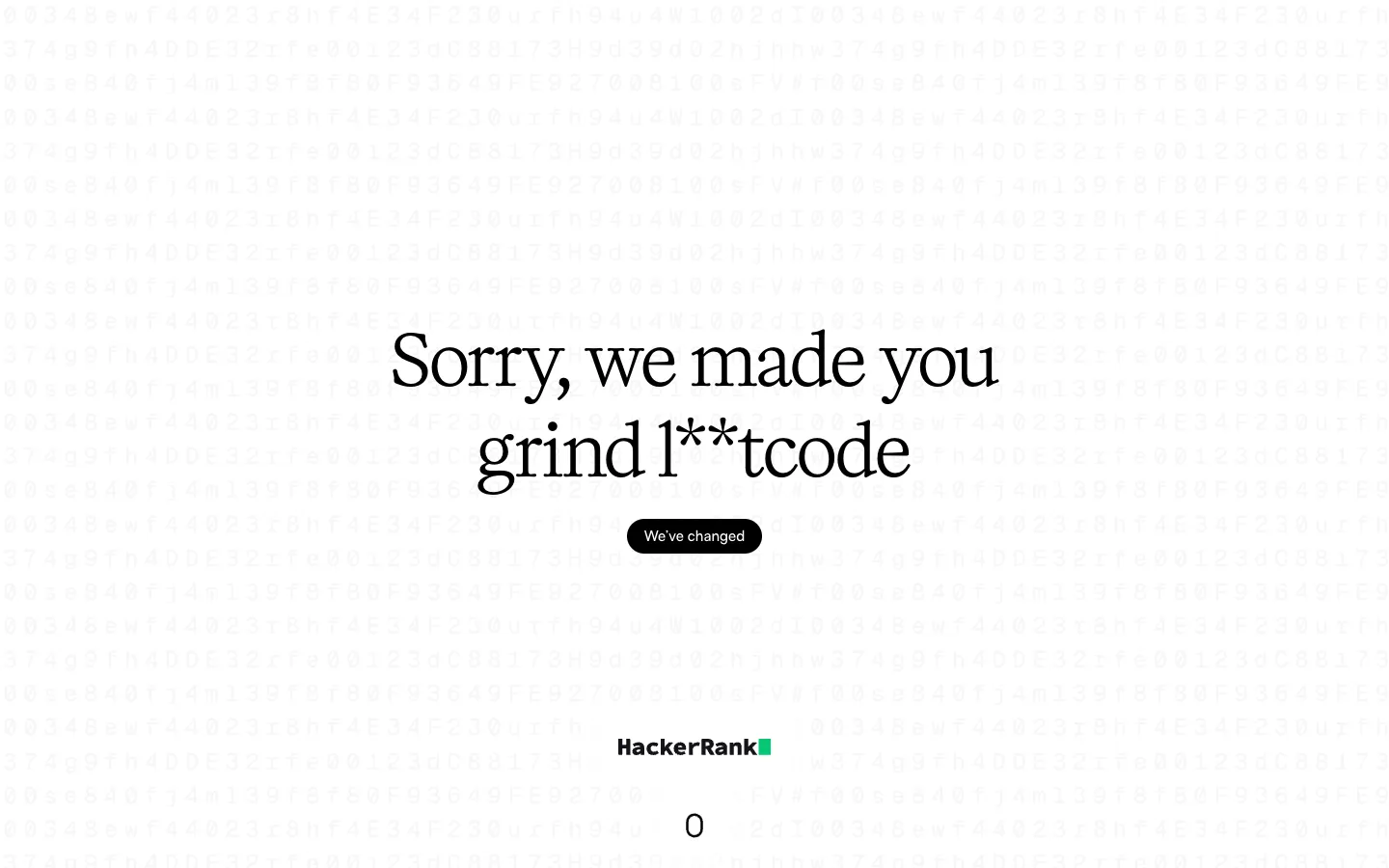
HackerRank now admits puzzle tests put candidates off. A banner on its homepage reads "Sorry, we made you grind l**tcode / We've changed". The same page pitches developers "who combine strong engineering fundamentals with AI fluency & great taste." Teams that want real-work tasks also compare CoderPad, Codility and Woven.
Has AI changed what your test must measure and catch?
Developer AI use is now the norm, and HackerRank's own homepage sells AI fluency. 84% of developers use or plan to use AI tools, per the Stack Overflow Developer Survey 2025. In a Gartner survey of 3,290 candidates in late 2024, 39% used AI while applying, and 29% of those used it to write assessment answers. HackerRank has moved too, with an agentic IDE and proctoring, so this is a reason to compare rather than to leave. For how webcam, screen and plagiarism checks differ, see the guide to AI interview cheating detection.
Is the real problem finding engineers to test?
A HackerRank test can only score the people who reach it, and engineering hiring is already interview heavy. Ashby's 2026 Talent Trends Report puts technical roles at 17.6 interviews per hire, up 52% on 2021. Gem's 2026 Recruiting Benchmarks Report found that direct sourcing produced 11% of hires from just 2.6% of applications, a fourfold yield. If too few strong engineers reach your HackerRank tests, swapping one coding test for another changes nothing.
What does leaving HackerRank change?
Leaving HackerRank changes the unit you pay for and the features your team has grown used to.
How does HackerRank charge?
HackerRank sells its plans by candidate attempts per year, with unlimited users on Starter and Pro. Starter and Pro prices are on its website. Going over your attempts costs extra per attempt, and Enterprise is quoted with custom attempts.
What do you give up when you leave HackerRank?
HackerRank lists these on its plans and product pages, so note the ones you use before signing elsewhere:
- Chakra, "an agentic interviewer that spins up a canvas with a real-world problem, observes how candidates work and evaluates judgment, critical thinking & AI fluency."
- Live coding on a real codebase, with an agentic IDE and a terminal, plus Scorecard Assist, which "auto-fills your interview rubric using transcripts, code, and test cases." Scorecard Assist is part of HackerRank's AI Add-on.
- Take-home Screen tests and pair-programming interviews in one account.
- Integrity tools: proctoring, AI plagiarism detection, session replay and device detection, plus a Screen-to-Interview Identity Match that uses facial recognition (sold in HackerRank's AI Add-on).
- Its developer community. HackerRank says it hosts more than 30 million developers, and customers can hire from that database directly.
No alternative below matches all five.
HackerRank alternatives compared
A Yes means the vendor's site says so. HackerRank sits in the last row for reference.
| Tool | Finds new engineers | Stops on reply | AI first round | Coding test | Live coding | Price on website? |
|---|---|---|---|---|---|---|
| The Cognitive | Yes | Yes | Live video | No | No | Yes |
| TestGorilla | Yes | Not stated | Free and Plus | Yes | No | Yes |
| CodeSignal | No | No | Yes | Yes | Yes | Yes |
| HackerEarth | No | No | Add-on | Yes | Yes | Yes |
| CoderPad | No | No | Recorded | Yes | Yes | Yes |
| Codility | No | No | No | Yes | Yes | Yes |
| Woven | No | No | Human-scored | Yes | No | Yes |
| Karat | No | No | Human-led | No | Yes | No |
| HackerRank | Own community | No | Yes (Chakra) | Yes | Yes | Yes |
How the ranking works
The ranking scores what a tool does before anyone opens a coding test. A tool earns one point per step it offers on any plan with a published price, as long as that step is not sold as a separate product. The three steps are finding engineers outside its own applicants or community, email follow-ups that stop when someone replies, and a conversational AI first-round interview. Ties go to a coding test, then live coding, then a price on the website. The last tie-break is any AI interview option: an add-on beats a recorded video, which beats none.
That rule puts The Cognitive first with 3 points, which anyone can check in the first three columns. TestGorilla scores 2. Its site describes sourcing and AI interviews but does not state follow-ups that stop on reply. CodeSignal scores 1, the same as HackerRank. The other five score 0 and are ordered by the tie-breaks, so Karat, with no coding test, comes last. If a coding test is all you need, read the list from TestGorilla down.
These tools are ranked using feedback from recruiters the founder talks with on LinkedIn, plus each vendor's own site and pricing page. Glider AI, DevSkiller (now SkillPanel, a workforce skills platform), iMocha and Qualified were considered and left out. One-way video tools that do not replace a coding test were left out too; those are in the best AI interview platforms guide.
The 8 HackerRank alternatives, swap by swap
Each section shows what you gain and lose by leaving HackerRank for that tool.
1. The Cognitive: best for finding and interviewing engineers before any coding round
Verdict: The Cognitive is not a coding test but the step before one, for teams whose HackerRank attempts wait on engineers who never apply.
The Cognitive pairs AI sourcing with live AI interviews for recruiters. Type the engineer you want in plain English, such as "staff data engineer, Spark and Airflow, Toronto". The search covers ~900M public profiles and explains each match in a line. A personal email costs 4 credits to reveal, and a phone number costs 12 on Pro and above.
What you gain: a pool beyond any one community. Outreach goes from your own Gmail or Outlook mailbox, and follow-ups stop when someone replies.
Engineers who reply can be invited to a live, two-way AI video interview, 10 or 20 minutes long, in a laptop or desktop browser. The interviewer asks role questions, including technical ones, and follows up on the answers. Each role keeps one fixed rubric, and the questions change with the conversation. The report scores each engineer against your criteria, with flags for signs of cheating such as a second screen or another face on camera. It connects to 100+ ATS, and results write back for candidates imported from your ATS.
What you lose: every way HackerRank proves code. Chakra's canvas, the agentic IDE, code plagiarism checks and HackerRank's developer community stay behind, because The Cognitive has no code editor, code execution or live coding pad. Keep HackerRank or another coding tool for round two, and it will see fewer, stronger people.
Best for: teams whose HackerRank attempts go unused because too few strong engineers apply.
Watch out for: keep a coding test if you need proof of working code. Outreach starts on Sourcing Pro, ATS sync sits on higher tiers, and The Cognitive does not replace your ATS.
Pricing model: two monthly plans, AI Sourcing and AI Interviews, bought separately. Plans start at $99 a month (see pricing). Credits: 1 per person a search shows, 4 per personal email, 12 per phone number and 100 for a 20-minute interview.
2. TestGorilla: best for sourcing, AI interviews and skills tests in one account
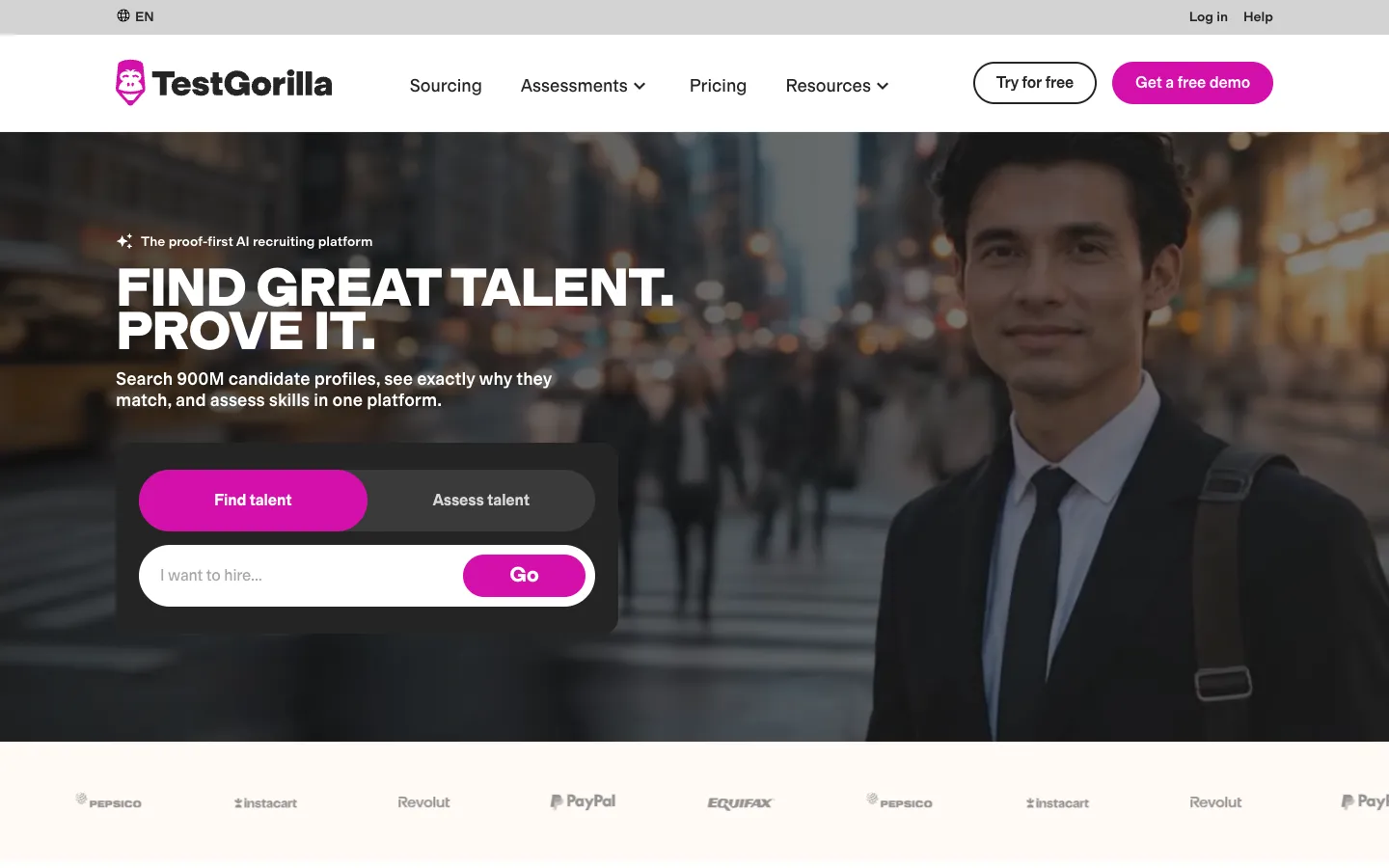
Verdict: TestGorilla is the one account here that combines sourcing, AI interviews and coding tests, so it adds sourcing without losing a coding test.
TestGorilla's homepage brands it "The proof-first AI recruiting platform". It promises to "Search 900M candidate profiles, see exactly why they match, and assess skills in one platform." You email people "from a connected mailbox".
What you gain: sourcing outside any community, a wide library of non-coding tests, and free plans to try both products. Contacting candidates starts on its paid Core plan. TestGorilla says the interviews "feel like a live call", with "dynamic follow-up questions in the moment", 3 to 9 structured questions that candidates complete on their own.
What you lose: coding depth. TestGorilla's universal coding tests cover up to 20 languages, and its site does not offer a live pair-programming interview.
Best for: teams hiring engineers and non-engineers from one account.
Watch out for: the full AI interview library, custom coding challenges and ATS integrations sit on the Plus plans. More options are in TestGorilla alternatives.
Pricing model: two products bought separately or together: Sourcing per seat and Assessments per account with credits, each with Free, Core and Plus plans, monthly or annual, prices published.
3. CodeSignal: best for a like-for-like swap paid in credits
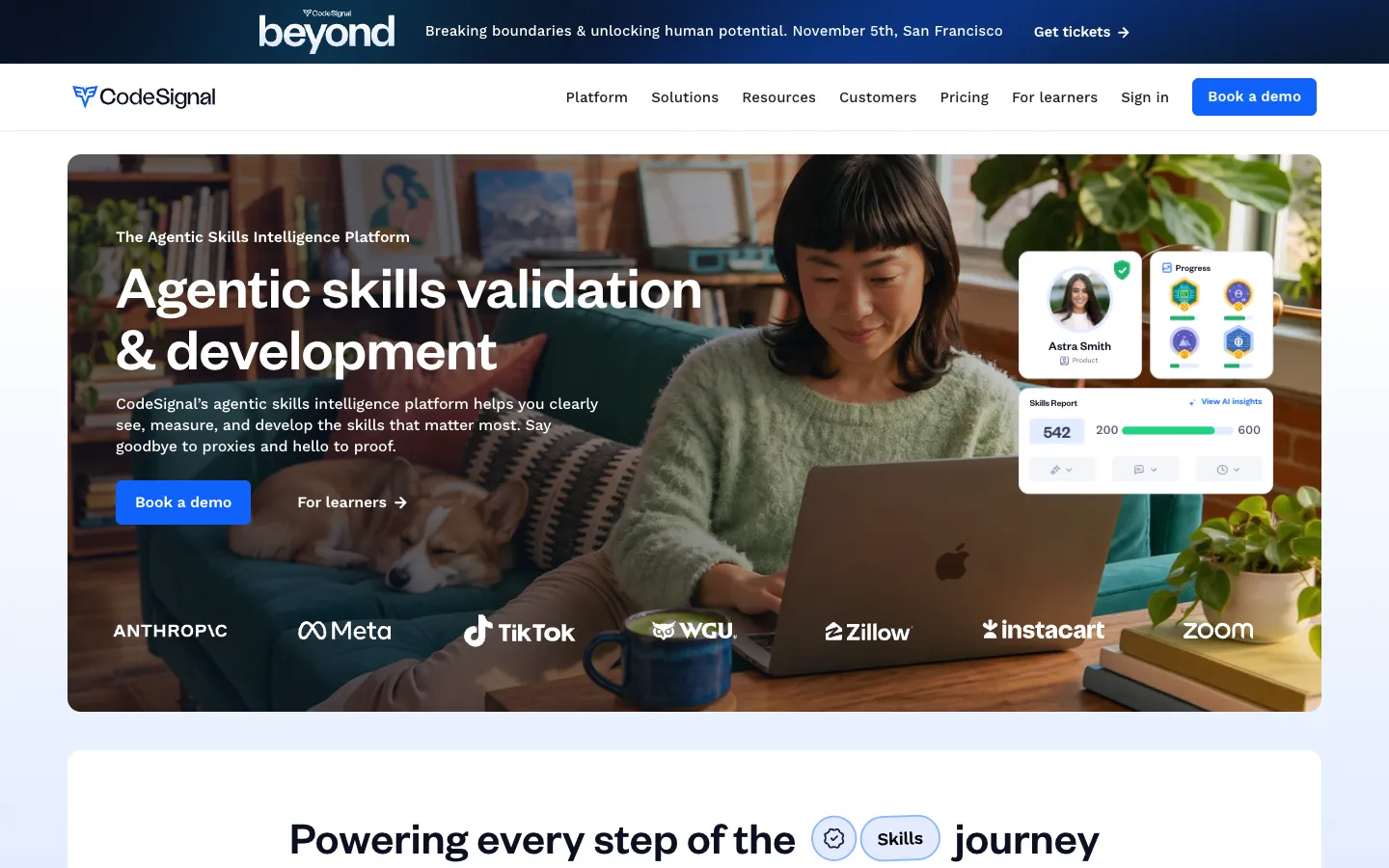
Verdict: CodeSignal is the least disruptive move. It has the same three parts as HackerRank, with a different unit of payment.
CodeSignal calls itself "The Agentic Skills Intelligence Platform". It sells an AI Interviewer for "structured, conversational interviews", assessments built as "job-relevant simulations", and live interviews "in a shared technical workspace".
What you gain: one credit pool, used "for Assessments & Interviews", instead of attempts. The entry plan includes "Product, Design, & Engineering AI Interviewers" and "AI Proctoring & ID Verification", so non-engineering roles fit the same account.
What you lose: little on the coding side, apart from HackerRank's developer community. CodeSignal does not search for outside candidates either.
Best for: teams happy with what HackerRank does but not with how attempts are metered.
Watch out for: Build lists no ATS integration and Grow lists Gem and Ashby. Workday, iCIMS and Oracle connections sit on the custom-priced Pro plan.
Pricing model: Build and Grow plans with credits for assessments and interviews, billed monthly or annually, prices published; Pro through sales. You can buy online.
4. HackerEarth: best for hackathons and developer challenges alongside tests
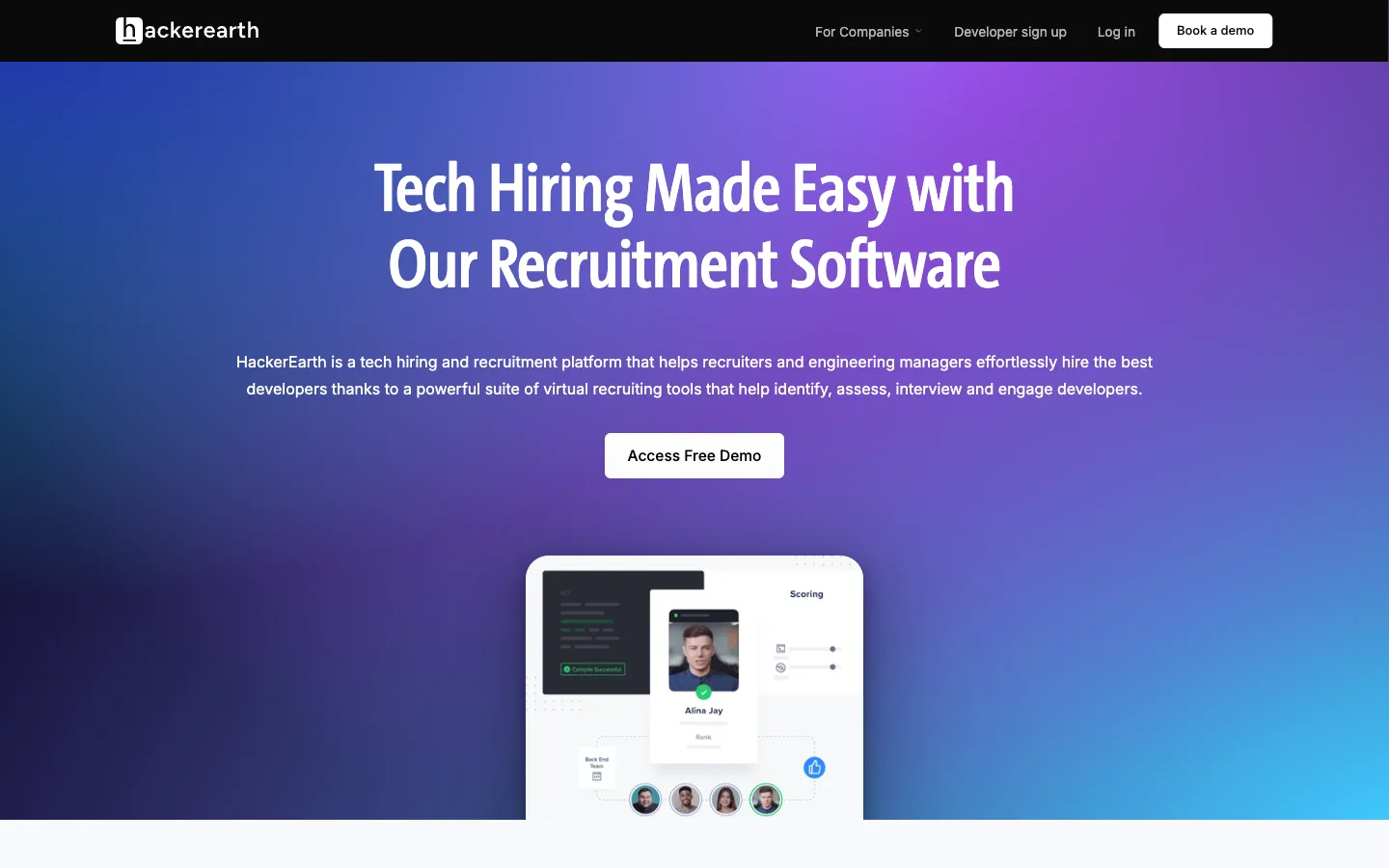
Verdict: HackerEarth brings developers to you through events, then tests them in the same system.
HackerEarth sells "Tech Hiring Made Easy with Our Recruitment Software". It tells employers they can "Engage over 10M+ developers through global hackathons and challenges", and its technical assessments cover "1,000+ skills and 40+ programming languages". FaceCode handles the live interviews.
What you gain: a way to attract developers through hackathons and hiring challenges. Plans run on monthly credits, the card is charged monthly, and you can cancel anytime.
What you lose: some language coverage, and the AI interviewer as part of the main plan. HackerEarth's AI Interviewer and AI Screener sit on their own pricing tab.
Best for: employer brands that already run or want to run developer events.
Watch out for: ATS integrations start on the Scale plan, and hackathon reach is not a search of outside profiles.
Pricing model: Growth and Scale monthly plans with credits per month, prices published, yearly billing available; Enterprise custom.
5. CoderPad: best for live pair programming in multi-file projects
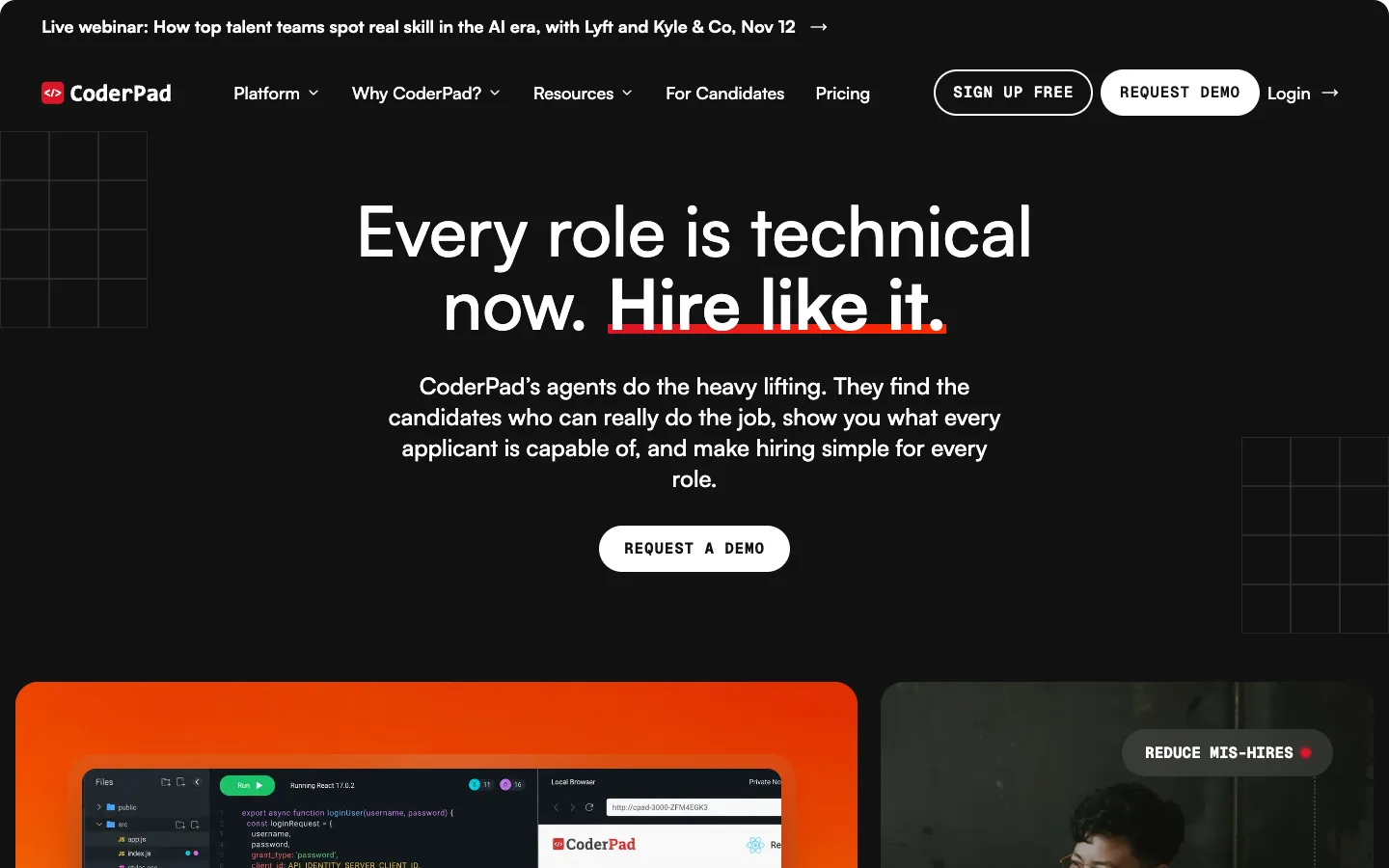
Verdict: CoderPad fits teams whose engineers live in the interview pad, not the test library.
CoderPad's homepage says "Every role is technical now. Hire like it." Its Screen product sets real-world coding tasks, and Interview opens a collaborative, multi-file IDE in 40+ languages and frameworks.
What you gain: an interview environment engineers know, with unlimited users and AI Assist on every plan. CoderPad says 96% of candidates finish its assessments.
What you lose: a conversational AI interviewer. CoderPad's Qualify uses "asynchronous video responses that candidates record on their own time" with an AI reviewer, which is a recorded first round, not a live one like Chakra.
Best for: teams where many engineers run live coding interviews.
Watch out for: CoderPad also meters an allowance of tests and interviews and charges per extra one, so it will not fix an attempts-pricing problem.
Pricing model: Starter, Team and Frontier Lite with published prices, monthly or annual, plus a charge per additional test or interview; Enterprise custom. Free trial.
6. Codility: best for validated real-work tasks priced by invites
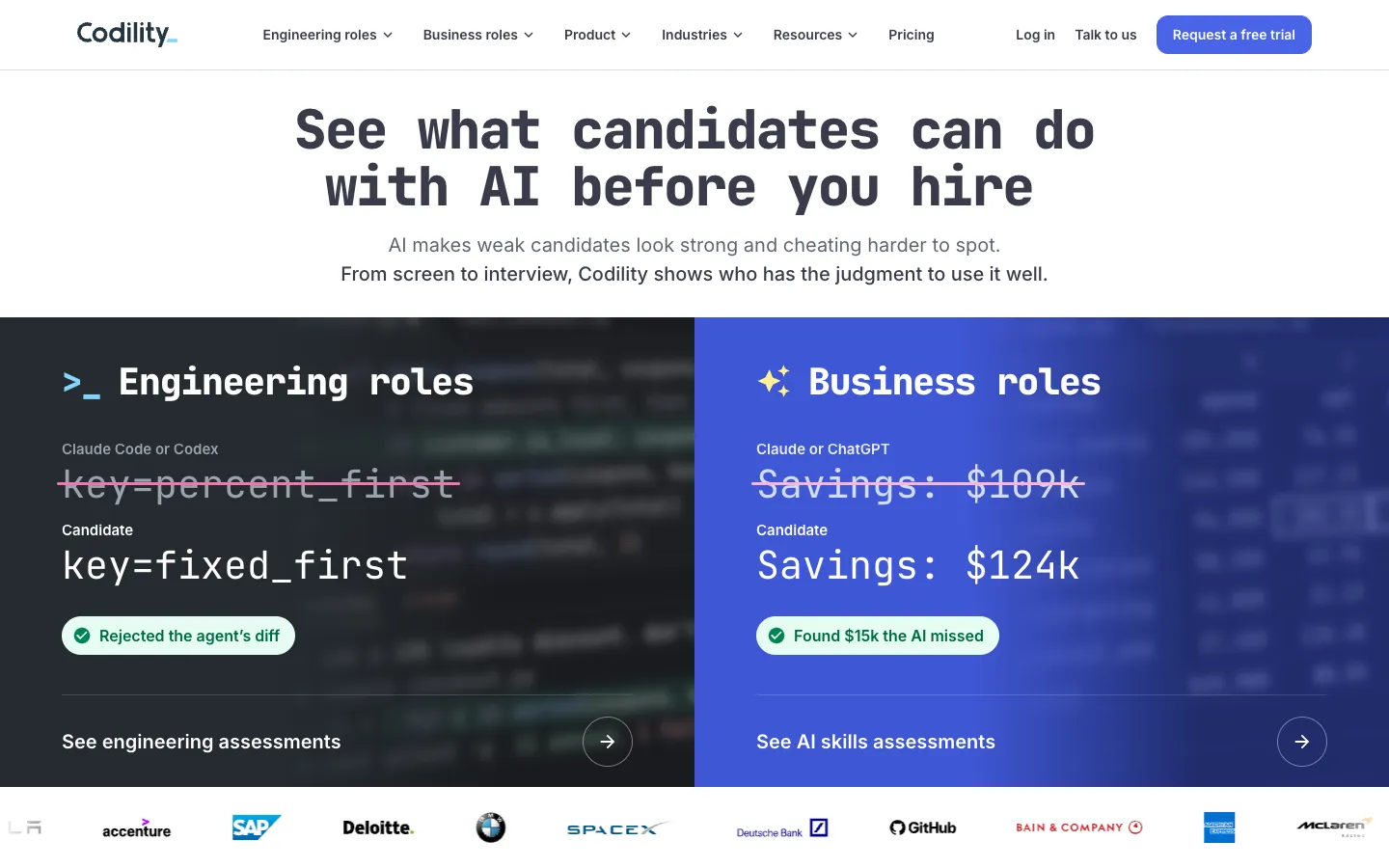
Verdict: Codility swaps attempts a year for invites a month and adds an ATS link on its online plans, with fewer seats.
Codility promises to "See what candidates can do with AI before you hire". It adds: "From screen to interview, Codility shows who has the judgment to use it well." It lists "1,300+ validated tasks in 80+ languages and frameworks".
What you gain: validated tasks across many stacks, one standard ATS integration on the online plans, and billing by invites a month. Its pricing page cites its own candidate survey. "9 in 10 candidates say the assessment gave them a fair chance to show their abilities."
What you lose: unlimited users, since online plans include 5 platform users and unlimited collaborators. Its site does not list an AI interviewer.
Best for: teams hiring across many stacks that want tasks close to real work.
Watch out for: ID verification, video proctoring and every ATS, including Workday and SAP, sit on Enterprise.
Pricing model: online plans by invites a month, monthly or annual, prices published; Enterprise by custom quote. Free trial on request.
7. Woven: best for human-scored real-work assessments for senior roles
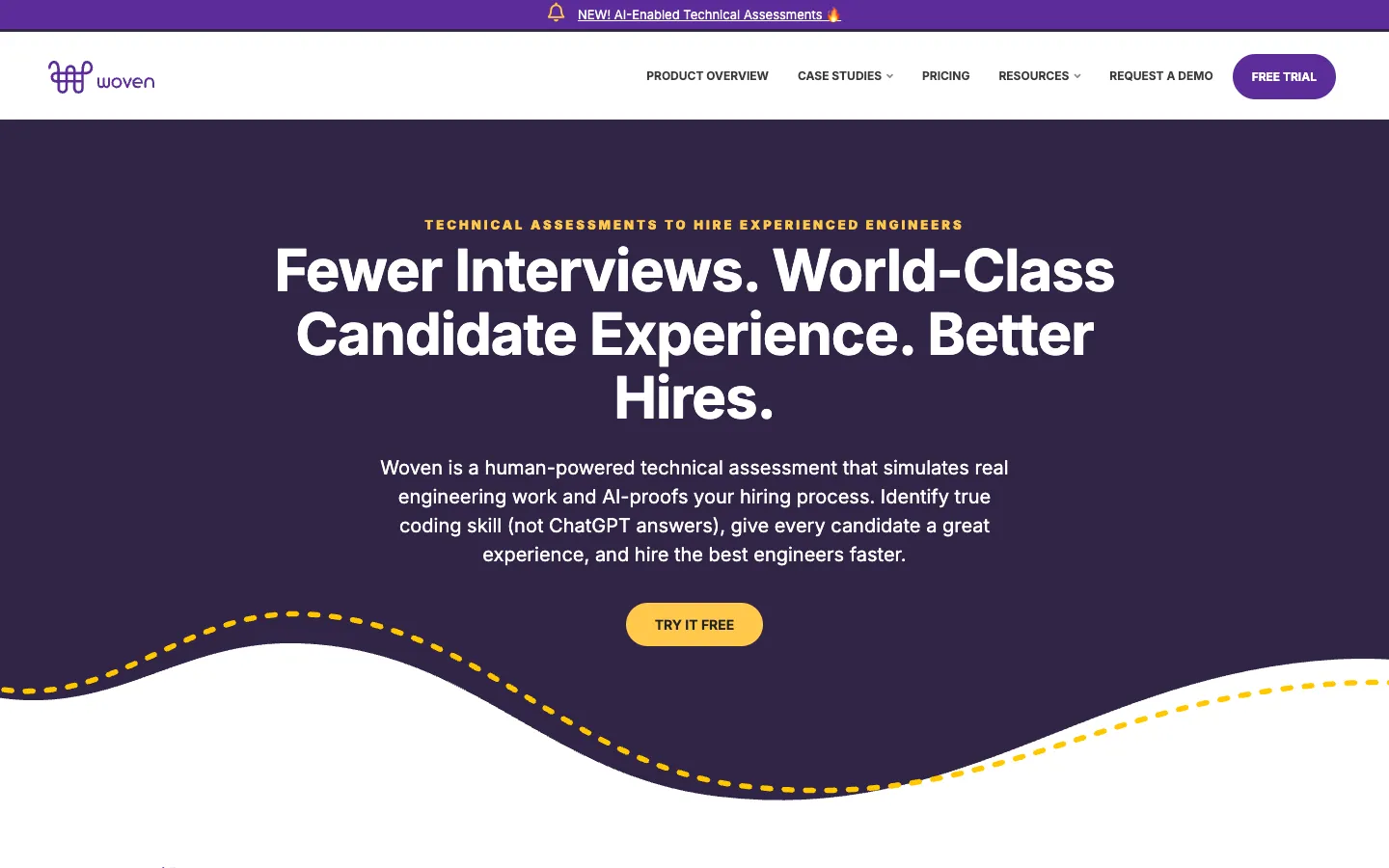
Verdict: Woven drops per-candidate metering altogether and puts engineers, not scripts, on the scoring.
Woven describes "a human-powered technical assessment that simulates real engineering work and AI-proofs your hiring process", with "Double-blind scoring by two certified engineers".
What you gain: unlimited candidates assessed for a monthly platform fee, with a success fee per hire paid on offer acceptance. Woven offers a "60-day Moneyback Guarantee AND a 365-day Success Guarantee".
What you lose: a live coding interview and an AI interviewer. Paying per hire suits a few senior hires better than many junior ones.
Best for: senior engineering roles where a human read of real work matters most.
Watch out for: cost scales with hires, the monthly plan covers assessments for up to 2 roles, and there is no live interview to pair with it.
Pricing model: monthly pay-as-you-go platform fee plus a success fee per hire, prices published; annual pre-paid plans by quote. Free trial.
8. Karat: best for handing technical interviews to outside engineers
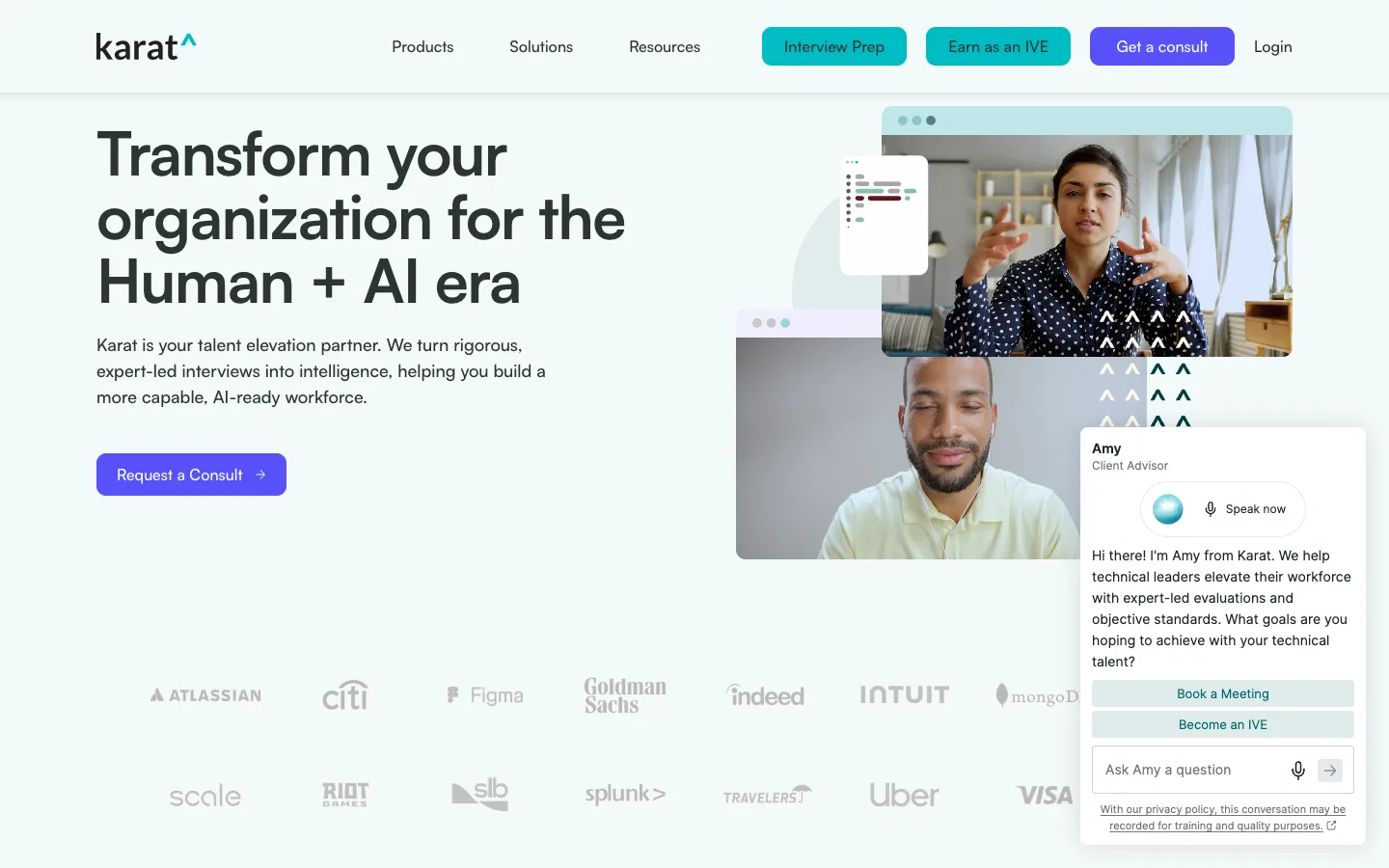
Verdict: Karat is a service, not a test library. Leaving HackerRank for Karat moves live technical interviews off your engineers' calendars.
Karat sells "Technical Interview Services for the Human + AI Era". Its Interview Engineers run the sessions, and Karat claims "600,000+ technical interviews".
What you gain: live technical interviews run by someone other than your engineers.
What you lose: a self-serve start, a published price and HackerRank's test library.
Best for: large engineering teams with more interviews than interviewers.
Watch out for: you start with a consultation, not a checkout. More interview services are in technical interview software.
Pricing model: no price on the website; "Request a Consult".
Should the first round be a coding test or an interview?
Whether you keep HackerRank or replace it, the coding test can move later for sourced engineers. Someone you contacted out of the blue owes you nothing, and a timed test from a stranger is easy to ignore. An applicant already asked to be considered, so sending them a test first still makes sense.
Engineers pay for the other side. Ashby's 2026 Talent Trends Report counts 5 interview events per technical hire. A spoken round ahead of the test protects those hours and stretches your attempts:
- Source outside HackerRank's community and email the engineers who fit (see technical recruiting tools).
- Put a spoken first round in front of the test, about what each engineer built and why.
- Spend HackerRank attempts only on people who pass, with one task that mirrors the job.
- Book engineer interviews for finalists.
The Cognitive handles the sourcing and the spoken round, the two steps before HackerRank. See the AI interviewer for software engineers.
When not to pick The Cognitive
- Strong engineers already apply to your roles. Sourcing adds little there. Put the budget into the test with CodeSignal, Codility or CoderPad.
- You need working code as evidence. The Cognitive runs no code, so keep HackerRank or another coding test.
- You want one account for sourcing and coding tests. TestGorilla does both, with free plans to try it.
- Late-stage interviews eat your engineers' hours. That is a job for Karat, whose engineers run the live technical rounds. The Cognitive stops at the first round.
- Your candidates only have phones. The live interview needs a laptop or desktop browser.
How to switch from HackerRank
Do not cancel first. Run the alternative on one or two roles while your HackerRank attempts last, and export your history before renewal.
Questions to ask in every demo
- What is the unit of payment? Attempts, credits, invites, tests or hires, and what happens in a month that doubles it.
- Which plan carries your ATS? Name yours, since several tools gate the big ones to a higher tier.
- How many seats come with it? HackerRank's Starter and Pro have unlimited users; not every alternative does.
- Where do new candidates come from? Applicants, a vendor community or outside profiles.
Start with The Cognitive
Pick one engineering role where the coding test gets too few strong takers. Write a two-line brief, edit the filters and see who fits. The 7-day trial needs no card. Outreach from your own mailbox and ATS sync come on the higher plans. Start free with The Cognitive.
Sources
- Ashby, Recruiter Productivity, 2026 Talent Trends Report (January 2021 to March 2026 data). ashbyhq.com
- Gem, "Key takeaways from the 2026 Recruiting Benchmarks Report", December 2025. gem.com
- Stack Overflow, 2025 Developer Survey: AI. survey.stackoverflow.co
- Gartner, "Gartner Survey Shows Just 26% of Job Applicants Trust AI Will Fairly Evaluate Them", 31 July 2025. gartner.com
- Vendor homepages, product and pricing pages: hackerrank.com, thecognitive.io, testgorilla.com, codesignal.com, hackerearth.com, coderpad.io, codility.com, woventeams.com, karat.com.
Frequently Asked Questions
What is the best alternative to HackerRank?
The best HackerRank alternative depends on why you are leaving. If too few strong engineers reach your HackerRank tests, The Cognitive sources them from outside profiles and interviews them on live video before the test. CodeSignal is the closest like-for-like swap, TestGorilla adds sourcing to coding and skills tests, and CoderPad and Codility suit live coding and real-work tasks.
How does HackerRank pricing work?
HackerRank prices plans by candidate attempts per year, with unlimited users on Starter and Pro. Starter and Pro prices are on its website, and Enterprise is quoted with custom attempts. Attempts beyond your plan cost extra per attempt.
Is there a free alternative to HackerRank?
TestGorilla is the closest to free. Both its sourcing and assessment products have free plans, though the free sourcing plan is browse and preview only and contacting candidates starts on its paid Core plan. CoderPad and Woven offer free trials, and CodeSignal, HackerEarth and Codility publish their prices. The Cognitive has a 7-day trial with no card.
CodeSignal vs HackerRank: what is the difference?
The main difference is the unit you pay for. HackerRank sells candidate attempts per year, while CodeSignal sells credits spent on assessments and interviews. Both offer an AI interviewer, coding assessments and live technical interviews, and neither searches for candidates outside its own platform.
Does The Cognitive run coding tests?
No, The Cognitive does not run code. It handles the steps before a HackerRank test: sourcing engineers, emailing them from your own mailbox and a live two-way AI video interview with role questions, including technical ones. Send the people who pass to HackerRank or another coding tool for proof of working code.
Related reading
- Technical Interview Software in 2026: 15 Tools for Coding Tests, Live Coding and AI Screens
- Technical Recruiting Tools: The 10 Best for Hiring Engineers in 2026
- TestGorilla Alternatives for 2026: 10 Tools for Skills Tests, AI Interviews and Sourcing
- Best Retail Hiring Software in 2026: 9 Tools for Store Teams and Store Leaders
- 10 Best CRMs for Staffing Agencies in 2026, Scored
- Best EOR Companies in 2026: 11 Employer of Record Providers Ranked, Plus the Step Before