Panel Interview: How to Run One and How to Ace One
By Sparsh Goyal, Founder at The Cognitive. Published · Last updated
- A panel interview is a coordinated assessment, not four people asking questions at once.
- Fair panels need a moderator, clear competency lanes, and a shared scorecard before the candidate arrives.
- Candidates do best when they answer the whole room, name assumptions, and keep each answer structured.
- Most panel interview mistakes come from overlap: repeated questions, vague criteria, dominant voices, and rushed debriefs.
- The debrief should start with independent scores and evidence, not the loudest opinion in the room.

A panel interview works when multiple interviewers assess one candidate against a shared structure: clear roles, distinct competencies, a common scorecard, and one moderator responsible for keeping the conversation fair and humane.
The awkward version usually looks efficient on the calendar. Four people join, each prepared in their own head, and nobody owns the first question. I still remember a Thursday panel where three interviewers started typing into the same blank notes section while the candidate took a sip of water and waited. No one had bad intent. The room just had no operating system.
That is the real lesson. A panel is not a group conversation with hiring attached. It is a coordinated assessment. Done well, it gives the candidate a fuller view of the team and gives the company better signal in less time. Done loosely, it creates repeated questions, uneven scoring, and a debrief where everyone sounds like they met a different person.
The same principle applies whether humans run the panel or whether you use AI recruiting software before the panel to reduce noise. The Cognitive, for example, sources candidates, runs deep live two-way AI interviews, and produces evidence-scored shortlists before a human panel ever spends an hour together. The human decision still matters. The structure around it matters more than most teams admit.
Key takeaways
- A panel interview should test distinct competencies, not repeat the same question through four different voices.
- The moderator is not optional. One person must own pacing, transitions, candidate clarity, and the close.
- Each interviewer needs a lane: product judgment, technical depth, collaboration, leadership, customer empathy, or another role-specific signal.
- Fair scoring starts before the call. If the rubric is vague, the debrief becomes opinion management.
- Candidates can ace a panel by answering the whole room, structuring responses, and asking clarifying questions when signals conflict.
What Is a Panel Interview?
A panel interview is a live interview where two or more interviewers assess one candidate in the same meeting, usually with each interviewer responsible for a different area of evaluation. The best panel interviews feel like one structured conversation, not several separate interviews compressed into one slot.
That distinction matters. A hiring team may call something a panel because there are multiple people on the call, but the format only becomes useful when those people are coordinated. If every interviewer asks about the same project, the team does not get more signal. It gets more versions of the same signal.
For candidates asking what is a panel interview?, the practical answer is simple: you are being assessed by several stakeholders at once. In a software role, that might mean engineering checks technical reasoning, product checks trade-off thinking, design checks collaboration, and a manager checks ownership. In a healthcare, sales, finance, or operations role, the lanes change, but the logic stays the same.
A panel interview is different from a serial interview. In a serial process, the candidate meets each person separately, often over several days. In a panel, those people share the room, which saves calendar time but increases coordination risk. The format has less margin for drift.
That is why panels can feel oddly unfair even when everyone is friendly. A candidate is not only answering questions. They are reading eye contact, switching between stakeholders, managing interruptions, and trying to understand what each person cares about. If the panel itself is unclear, the candidate carries that confusion for the team.
A panel interview should reduce duplicated effort, not transfer the team’s lack of structure onto the candidate.
The format works best for roles where multiple functions truly need to judge the same person. Engineering managers, product managers, design leads, account executives, nursing leads, customer support managers, and operations leaders often sit in cross-functional work. A panel can show how the candidate thinks with the actual people they would work with.
The format is weaker when the team is using it to look thorough without knowing what it wants to learn. Three interviewers asking, “Tell me about a difficult stakeholder” does not make the assessment more rigorous. It makes it repetitive.
This is one reason structured interviews matter. If you want a deeper primer on why interviews still matter when the process is designed well, the guide on why interviews are important in the hiring process breaks down the signal a good interview can reveal. The short version: interviews are useful when they test work-relevant judgment, not when they reward polish.
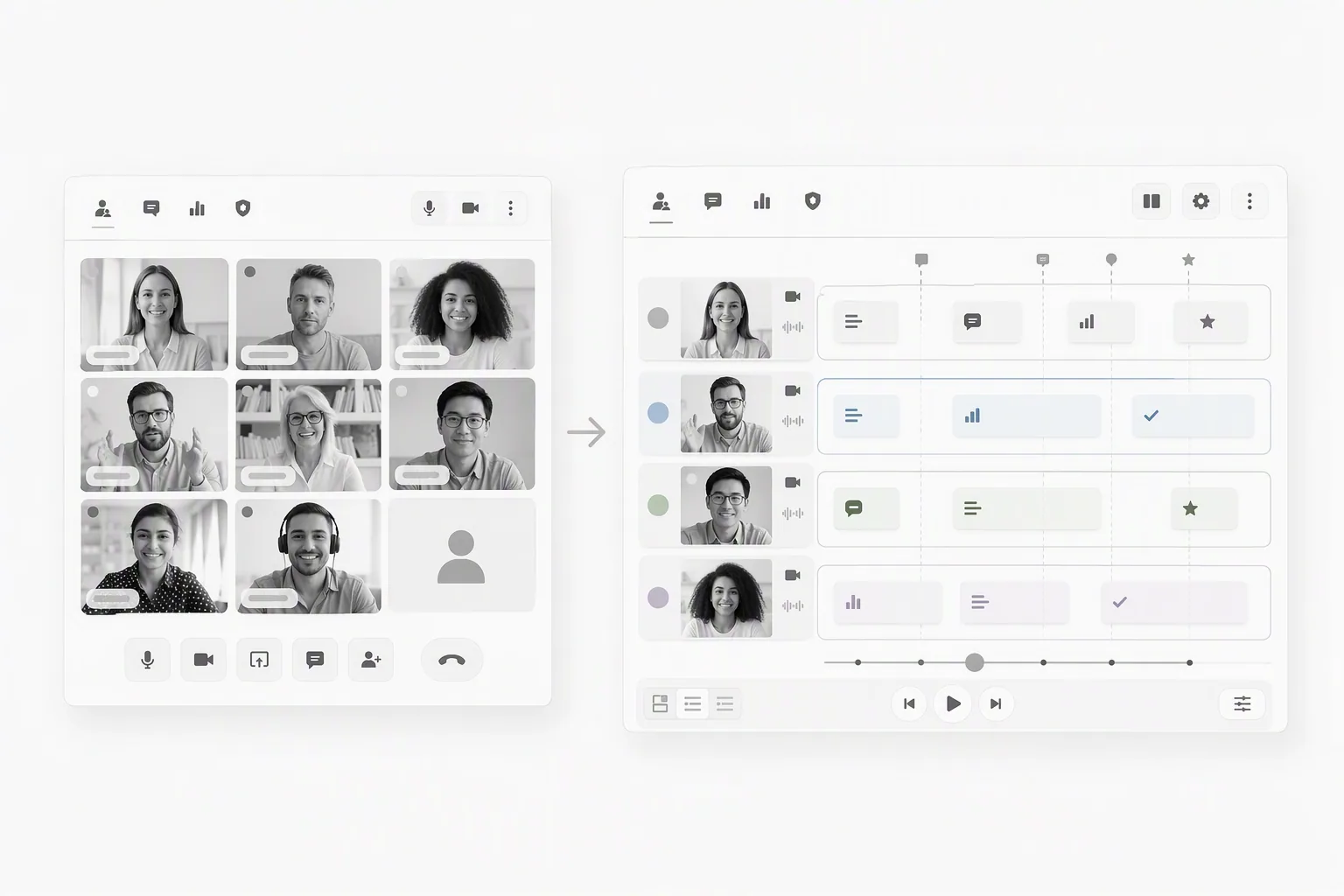
The Thursday panel that exposed this for me was not a disaster. The candidate was polite. The team was experienced. The calendar math looked good. But in the debrief, one person said the candidate seemed vague, another said thoughtful, and a third was unsure because they had not heard enough technical detail. We had not disagreed about the candidate. We had interviewed four different versions of the role.
That is the failure mode to avoid.
Panel Interview Format: How Should You Structure a Fair Panel?
A fair panel interview format has five parts: a defined agenda, assigned competencies, question lanes, a shared scoring rubric, and a moderator who manages the room. Without those pieces, the format may save time, but it will not produce a fairer hiring decision.
Here is the practical structure that works for most hiring teams.
| Panel stage | Who owns it | What happens | Why it matters |
|---|---|---|---|
| Opening | Moderator | Introduces the panel, explains the format, sets expectations | Reduces candidate anxiety and prevents awkward starts |
| Role context | Hiring manager | Gives a short version of the role, team, and success criteria | Anchors the interview in the actual job |
| Competency lanes | Each interviewer | Asks questions tied to one distinct signal | Prevents overlap and repeated questions |
| Follow-ups | Lane owner, then others | Probes reasoning, examples, and trade-offs | Tests depth instead of rehearsed answers |
| Candidate questions | Moderator | Leaves real time for the candidate to ask the panel questions | Turns the meeting into a two-way decision |
| Close | Moderator | Explains next steps and timing | Protects candidate experience and follow-through |
The first operational decision is timing. A 45-minute panel with four interviewers is tighter than it looks. If the candidate gets 5 minutes at the start and ten at the end for questions, each interviewer has roughly 7 minutes. That is not enough for sprawling curiosity. It is enough for one strong question and two follow-ups.
Panels fail when people try to fit full individual interviews into a shared slot. The calendar says 45 minutes. The design quietly assumes four separate 30-minute interviews. That math never works.
Start with competencies, not questions
The cleanest panel design starts with the job’s competencies. For a senior engineering manager, the team might assess:
- Technical judgment: Can they reason through architecture, incidents, and trade-offs?
- People leadership: Can they coach, hire, and manage performance without hiding behind process?
- Product sense: Can they balance engineering quality with customer impact?
- Cross-functional collaboration: Can they work well with design, product, support, and executives?
- Ownership: Do they take responsibility for outcomes, especially when things break?
Once the competencies are clear, assign each one to a person. Then write questions that reveal that competency. If you need a fast starting point, a role-specific AI interview rubric generator can turn the role into weighted criteria with strong and weak signals. The point is not to outsource judgment. The point is to make the judgment visible before the meeting begins.
A vague competency like communication is not enough. Communication with whom? About what? Under what pressure? A candidate who explains technical debt clearly to engineers may struggle to explain risk to a customer or CFO. Those are different signals.
Use a scorecard before opinions enter the room
A panel scorecard should be short, weighted, and anchored. You do not need twenty criteria. You need five or six that actually decide success in the role. Each one should define what weak, acceptable, and strong evidence sounds like.
For example, ownership should not mean “seems accountable.” It should be observable:
- Weak evidence: The candidate describes missed outcomes mostly through other people’s failures.
- Acceptable evidence: The candidate names their own decisions but gives limited detail on what changed afterward.
- Strong evidence: The candidate explains the failure, their role in it, the correction they made, and the system they changed so it would not repeat.
If your team is still using blank feedback forms, a structured AI interview scorecard generator can help create rating scales with behavioral anchors. A panel should never end with “I liked them” as the strongest data point.
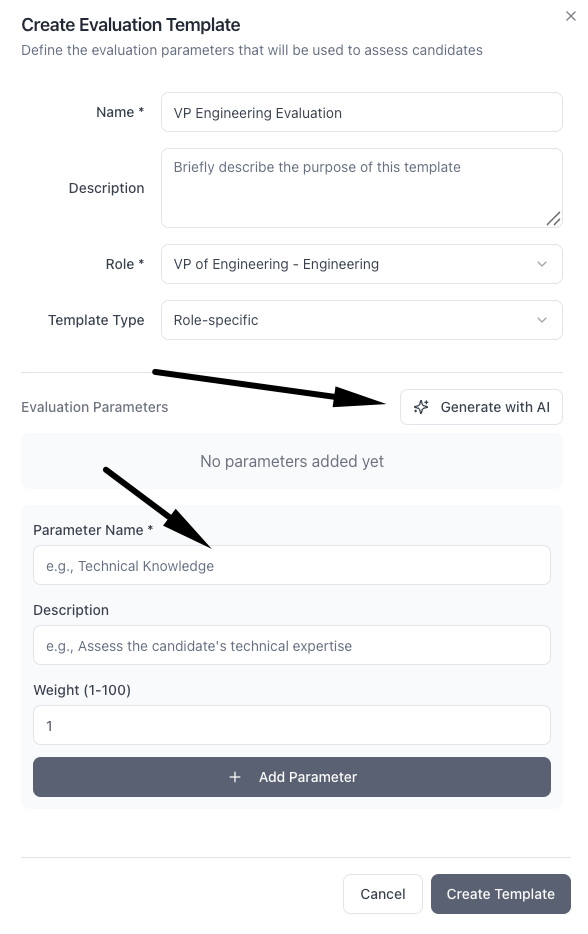
The Cognitive uses the same principle in its live AI interviews. When a role is set up, the team defines a rubric, criteria, and weights. The AI interviewer chooses each next question live based on the role, the rubric, the resume, and the candidate’s previous answer. The questions adapt, but the evaluation standard stays fixed. That is exactly what human panels should copy: flexible conversation, stable bar.
Make one person responsible for the room
The moderator is the quiet difference between a calm panel and a strange one. Their job is not to ask the most questions. Their job is to keep the conversation usable.
A strong moderator does five things:
- Starts the meeting and explains the format.
- Names each interviewer and their focus area.
- Controls transitions so people do not talk over each other.
- Protects time for candidate questions.
- Closes with next steps and follow-up timing.
This is especially important in remote panels. On video, silence is heavier. Two people unmuting at once feels clumsy. A candidate can misread a pause as disapproval when it is just someone finding the mute button. The moderator removes that friction.
Small mechanics change the whole experience. A sentence like, “I’ll guide us through the sections, and each person will cover a different part of the role,” tells the candidate the room has a plan. It also tells the panel to stay in lane.
How Do You Assign Roles to Each Interviewer?
You assign panel interview roles by giving each interviewer one primary competency, one backup follow-up area, and a clear rule for when to speak. The goal is to stop four smart people from chasing the same signal.
This is where many panels quietly break. Interviewers prepare individually, then arrive with good questions that overlap. Everyone wants to ask about collaboration. Everyone wants the incident story. Everyone wants the trade-off example. The result is repetition, not rigor.
Before the interview, the hiring manager should map interviewers to signals like this:
| Interviewer | Primary lane | Example question | What they should score |
|---|---|---|---|
| Hiring manager | Role ownership and scope fit | “Walk us through a goal you owned that crossed teams. What changed because of your work?” | Accountability, judgment, scope, follow-through |
| Engineering lead | Technical reasoning | “Tell us about a production issue where the obvious fix was not the right one.” | Debugging logic, trade-offs, depth, precision |
| Product partner | Customer and product judgment | “Describe a time you pushed back on a product request. What did you do instead?” | Prioritization, customer awareness, influence |
| Design or cross-functional partner | Collaboration under ambiguity | “How do you handle disagreement when the problem is not fully defined yet?” | Listening, clarity, conflict behavior, adaptability |
Notice what is missing: “everyone ask whatever you want.” That freedom feels respectful to experienced interviewers, but it often produces a worse result. Panels need constraint.
The lead interviewer should also decide the follow-up protocol. A simple rule works: the lane owner gets the first follow-up, then others can ask one clarifying question only if it adds new signal. If someone wants to jump in because they are curious, they wait. Curiosity is not the same as assessment.
This one is hard for senior people. Good interviewers are used to following threads. In a panel, every thread has a cost. A great follow-up from the wrong person can steal time from the competency nobody has covered yet.
Do not confuse stakeholder representation with assessment ownership
Some teams invite people to a panel because those people should “have a voice.” That is not wrong, but voice and assessment are different jobs. If someone is in the room only to meet the candidate, say that. If they are there to score a competency, define it.
A panel with two scorers and two observers can work. A panel with four undefined judges usually cannot.
There is also a seniority trap. The most senior person in the room often dominates, even when their competency is not the one being tested. The moderator needs permission to redirect. A useful phrase is, “I want to hold that for the debrief so we can make sure we cover the product lane.” Calm. Direct. No drama.
Use AI before the panel when the panel is too expensive to waste
A panel is one of the most expensive moments in the hiring process because it consumes several people at once. If four interviewers spend an hour with a candidate who was clearly not ready for the role, the cost is not one hour. It is 4 hours, plus context switching, plus the delayed work sitting behind it.
That is where AI in recruitment is useful when it is applied to the right problem. The Cognitive is built to source, interview, and shortlist before humans spend that panel time. Its AI sourcing tool lets teams search in plain English across talent profiles, reveal verified personal emails and direct phone numbers only when successful, run automated outreach sequences, and use an AI voice agent that calls candidates. Interested sourced candidates can move into AI interviews in one click.
Then the AI interviewer runs a deep live two-way video interview with a real human face and voice. It asks role-specific questions, listens, pushes back on vague answers, and digs deeper on strong ones. Every score is tied to a quote and timestamp. That gives the human panel a verified shortlist instead of a pile of resumes and hope.
Panels should be reserved for candidates worth the room.
How Can a Candidate Prepare for a Panel Interview?
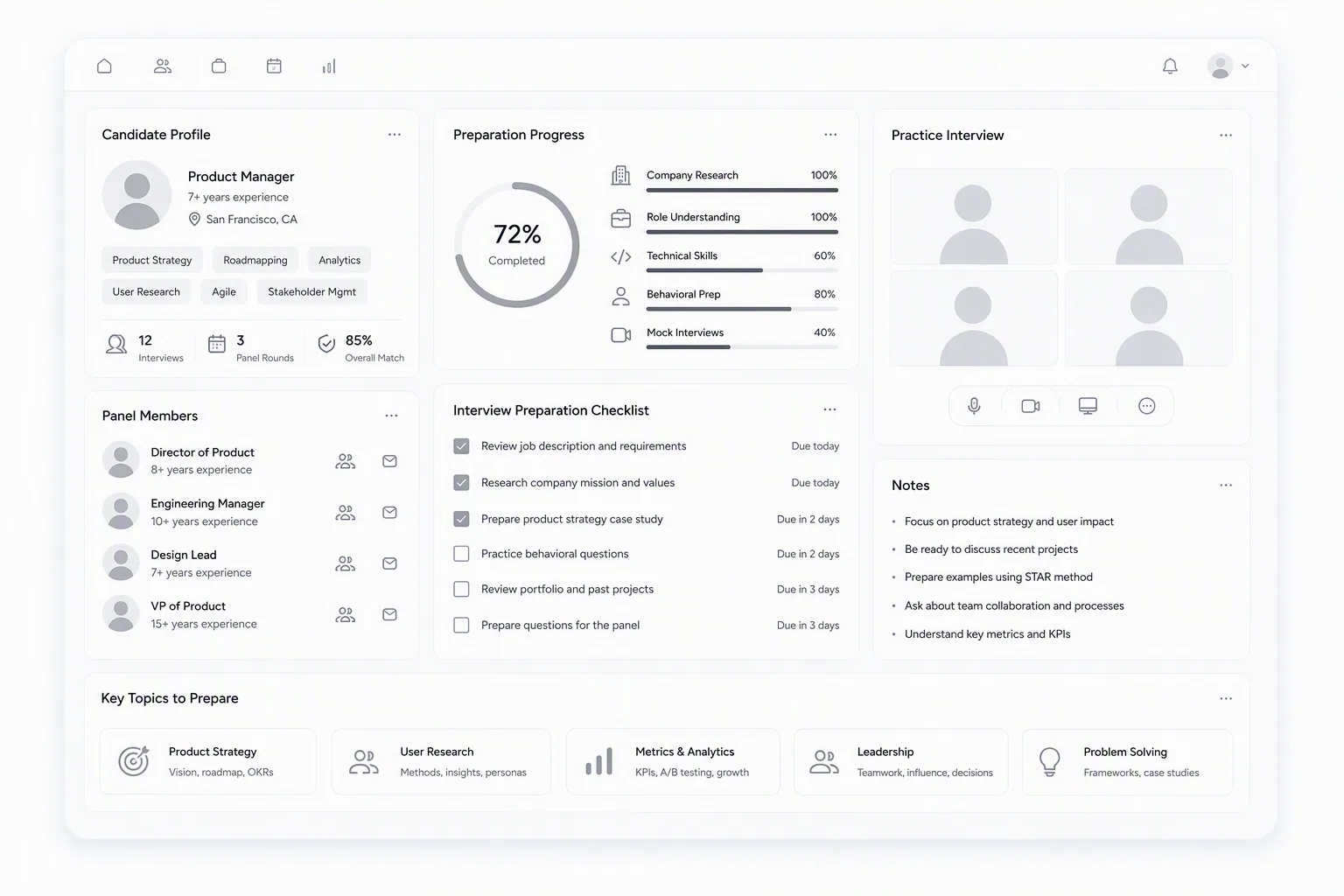
A candidate can prepare for a panel interview by understanding who is in the room, mapping each person to likely concerns, structuring answers clearly, and treating the meeting as a group conversation with individual signals. The goal is not to perform for the loudest interviewer. The goal is to help the whole panel see the evidence.
The candidate has a harder job than most teams realize. In a one-on-one interview, you can tune into one person. In a panel, you may have a hiring manager, a technical lead, a peer, and a cross-functional partner all listening for different things. A strong answer needs enough structure that each person can find what they came for.
Start by researching the panel
If the recruiter shares names, use them. Look up each person’s role, not to flatter them, but to predict their angle. A product leader may care about prioritization. A future peer may care about how you handle handoffs. A VP may care about scope, risk, and whether you can operate without constant direction.
If the company does not share names, ask. A simple note works: “Could you share who will be joining the panel and what each person is hoping to cover? I’d like to prepare well.” Good teams will appreciate the question. It signals that you take the process seriously.
Answer the question, then widen it for the room
The best panel answers have a clear spine. Use a simple structure:
- Context: What was the situation?
- Decision: What did you choose and why?
- Trade-off: What did you give up or risk?
- Result: What changed?
- Learning: What would you repeat or change now?
This structure works because it gives different interviewers different evidence. The technical person hears reasoning. The manager hears ownership. The product person hears trade-offs. The peer hears collaboration.
Do not over-script. A panel can tell when an answer has been polished into a speech. Prepare stories, not monologues. Know the facts: numbers, constraints, timelines, who was involved, what you personally did. Then let the answer breathe.
Make eye contact with the room, not just the question asker
On video, this means answering the person who asked, then briefly addressing the group. You can say, “That was the engineering side of it. The product trade-off was...” and bring others in. In person, make eye contact across the table, especially when your answer touches another stakeholder’s area.
This is not theater. It shows that you understand cross-functional work. The best candidates do not treat a panel like an interrogation. They treat it like the first working meeting.
Ask clarifying questions when the room sends mixed signals
Panels sometimes reveal internal tension. One interviewer asks about speed. Another asks about quality. A third asks about stakeholder alignment. If those priorities conflict, name the trade-off calmly.
For example: “It sounds like there are two concerns here: shipping quickly and reducing operational risk. Which one was the bigger constraint for the team in this role?”
That question does two things. It helps you answer better, and it shows how you handle ambiguity. Strong candidates are not afraid to clarify. They are afraid of guessing wrong and pretending they are certain.
Prepare questions for each stakeholder
The candidate question section is not filler. It is a chance to show how you think about the job. Bring two or 3 questions that different panelists can answer:
- For the hiring manager: “What would make this hire successful in the first 6 months?”
- For a peer: “Where does collaboration usually break down between this role and yours?”
- For a cross-functional partner: “What decisions does this person need to make well without slowing the team down?”
- For a technical lead: “Which technical trade-offs are most painful right now?”
Specific questions beat generic enthusiasm. A panel is evaluating whether you understand the work. Your questions are part of that evidence.
If the panel is messy, stay composed. You can still do well in a poorly run interview by answering clearly, checking assumptions, and keeping your tone steady. But the company should notice the burden it created. Candidate experience is not only about friendliness. It is about clarity.
What Are Common Panel Interview Mistakes?
The most common panel interview mistakes are no moderator, repeated questions, unclear scoring, dominant voices, vague competencies, and rushed debriefs. These mistakes make a panel feel efficient on the calendar but uneven in the room.
Most of them are not dramatic. That is why they persist. No one leaves thinking, “We failed.” They leave thinking, “That was a little awkward, but fine.” Then the debrief exposes the damage.
Mistake 1: no one owns the room
Without a moderator, the panel has to negotiate the format in front of the candidate. Who starts? Who follows? Who handles time? Who explains next steps? Those questions should never be solved live.
The fix is simple: name a moderator in the calendar invite. Give that person authority to interrupt gently, move the conversation forward, and protect the close.
Mistake 2: everyone asks the same thing
Repeated questions feel harmless because each interviewer phrases them differently. The candidate hears the same request three times: tell us about conflict, tell us about a hard project, tell us about influence. By the third version, the answer either sounds rehearsed or tired.
The fix is a question map. Put all planned questions in one shared doc before the interview. If 2 questions test the same signal, cut one or assign different follow-ups.
Mistake 3: the panel scores vibes instead of evidence
Vibe-based scoring hides behind confident language. “Sharp.” “Not senior enough.” “Good energy.” “A little vague.” Those phrases may point to something real, but they are not evidence by themselves.
Ask the second question: what did they say or fail to say that made you score it that way? If the interviewer cannot answer, the score is not ready.
The Cognitive’s approach to AI interview scoring is useful here because every score links to a specific quote and timestamp. Human panels should hold themselves to a similar standard. If a score cannot be tied to evidence, it should carry less weight.
Mistake 4: the loudest interviewer becomes the decision
Panels can create false consensus. A senior person speaks first, others soften their disagreement, and the debrief becomes a performance of alignment. This is especially risky when the senior person did not own the most important competency.
The fix is independent scoring before discussion. Everyone submits their scorecard first. Then the team compares evidence. That order changes the room.
Mistake 5: the candidate gets no clean close
A candidate should never leave a panel wondering whether the call ended because time ran out or because the team had what it needed. The close should include next steps, expected timing, and who they will hear from.
This matters even when the answer is no. A respectful close protects the company’s reputation and keeps the process honest.
Mistake 6: using a panel when another format would be better
Not every role needs a panel. If the team has not agreed on the role, do not use the candidate meeting to discover the disagreement. If the role requires deep technical work, a dedicated technical interview may need to happen before or after the panel. If the candidate is very senior, a smaller executive conversation may create better signal than a crowded group call.
A panel is a tool. It is not proof of rigor by itself.
How Should Teams Debrief After a Panel Interview?
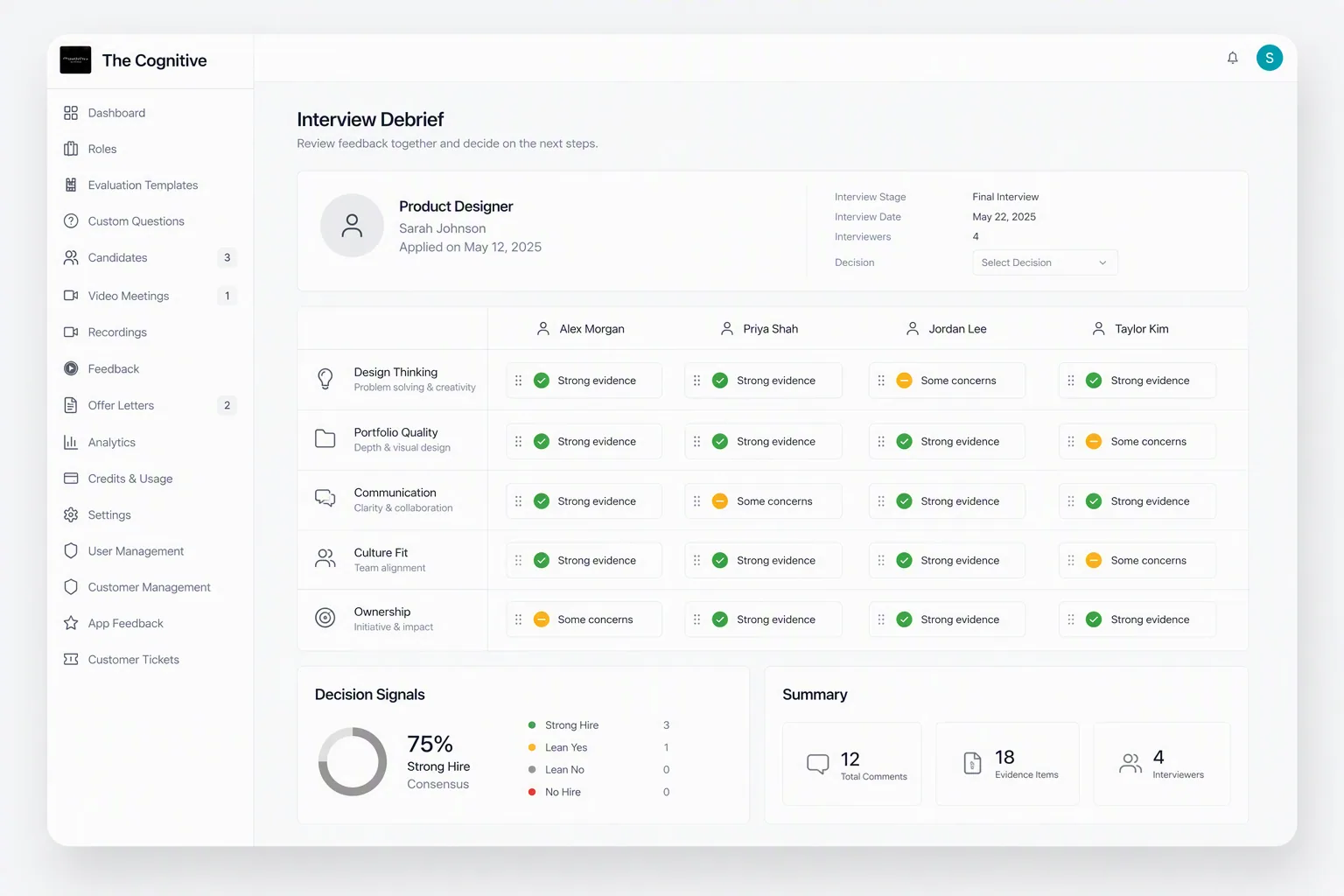
Teams should debrief after a panel interview by collecting independent scores first, then discussing evidence, resolving calibration gaps, and assigning clear next steps. A good debrief turns multiple perspectives into a decision instead of letting them compete as opinions.
The debrief is where the panel either pays off or falls apart. If everyone waits until the meeting to decide what they think, the conversation becomes social. People react to each other instead of to the candidate’s evidence.
Start with written scores before discussion
Each interviewer should submit their scorecard before hearing others. The scorecard should include ratings, notes, and the evidence behind the rating. This prevents the first speaker from anchoring the room.
A good debrief opening sounds like this: “Let’s start with scores by competency. No summary judgments yet. For each score, name the evidence.”
That sentence feels a little strict. Good. Debriefs need structure because humans are very good at turning partial impressions into certainty.
Separate disagreement about the candidate from disagreement about the role
This is the turning point many teams miss. If one interviewer says the candidate was vague and another says they were thoughtful, they may not actually disagree. They may have tested different things.
Ask: which competency are we discussing? A candidate can be thoughtful on product trade-offs and vague on technical depth. They can be strong on ownership and weak on stakeholder management. The panel’s job is not to average those impressions into a mood. It is to decide which signals matter most for the role.
This is where a weighted rubric helps. If technical debugging is 35% of success and collaboration is 15%, the team should not treat those signals equally. Weighting forces the hard conversation before the candidate is in the room.
Use evidence clips or exact notes, not memory
Memory gets worse fast after interviews. People remember confidence, fluency, and the last thing said. They forget caveats, numbers, and whether the candidate actually answered the question.
For human panels, that means taking notes in the right place and writing down exact phrases when possible. For AI-assisted evaluation, it means using full recordings, transcripts, and timestamped scorecards. The Cognitive’s live AI interviewer produces evidence-based scorecards where a hiring manager can click a score, such as “Problem Solving: 7/10,” and watch the exact clip that supports it. That is not a black-box score. It is reviewable evidence.
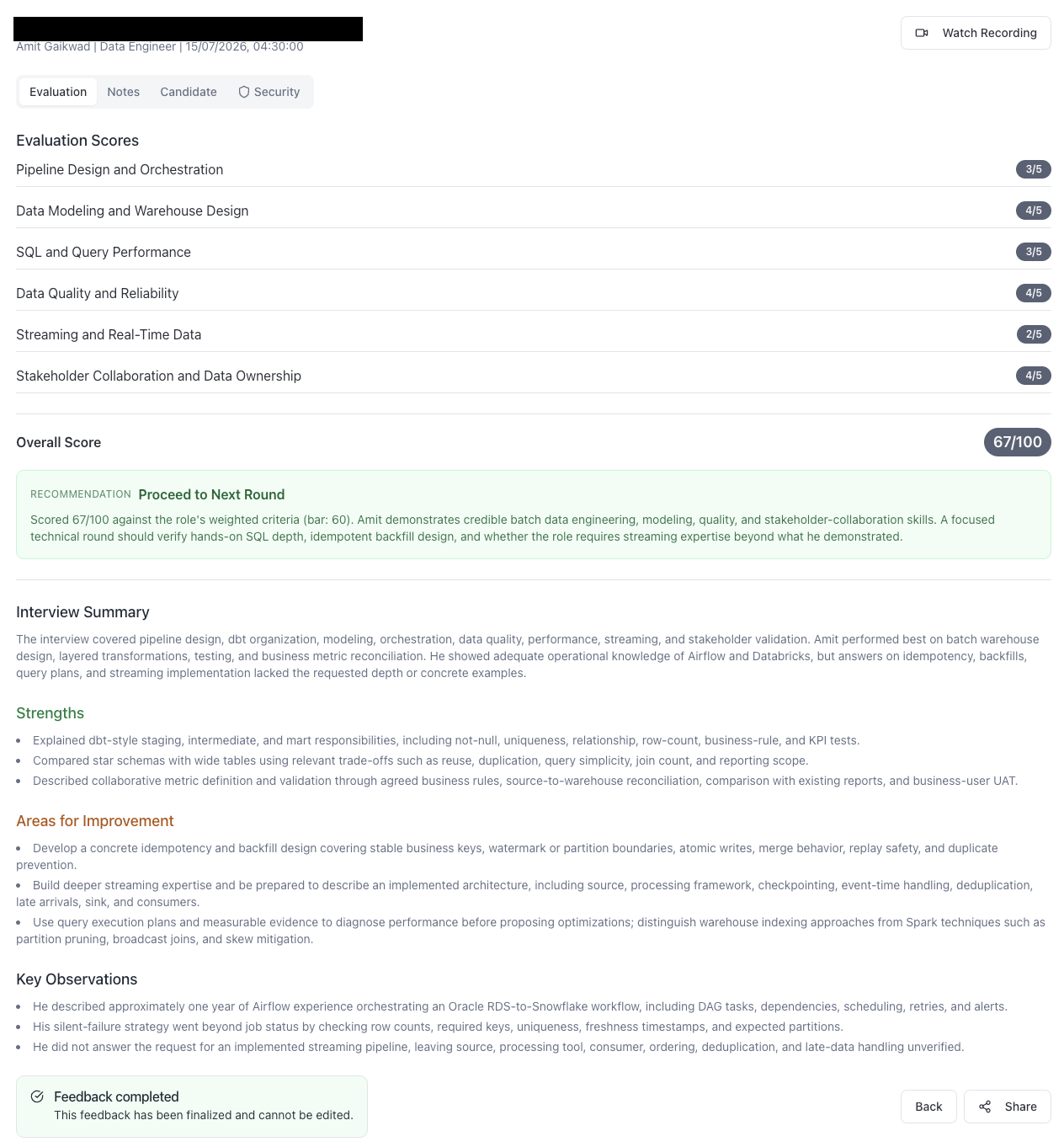
This matters for fairness too. A candidate should be judged on the same criteria as everyone else, not on whether the panel was tired, rushed, or charmed by a familiar background. Consistency is not cold. It is respectful.
Decide the next step in the room
A debrief should end with one of four outcomes:
- Advance: The candidate met the bar, and the next step is scheduled or triggered.
- Reject: The evidence does not meet the role’s required criteria.
- Hold for calibration: The team needs to compare against another candidate or clarify a role requirement.
- Run a targeted follow-up: One important competency is unresolved, and the next conversation has a narrow purpose.
Do not end with “let’s think about it” unless someone owns the thinking and the deadline. Slow follow-up is one of the quiet ways good candidates leave. Traditional hiring often stretches to 45 to 60 days, while strong candidates can be gone in about 10. If your panel needs 3 days to write notes, the process is already leaking.
The Cognitive was built for that bottleneck: AI sourcing finds candidates, outreach engages them, the AI voice agent can call them, live AI interviews run 24/7, and humans review evidence-backed shortlists. Teams can move from roughly 60-day cycles to under 10 because the slowest parts, scheduling, repeated interviews, and scattered feedback, stop controlling the pace. Interview plans start from $99/month, compared with the $60 to $80 of staff time a single manual interview can consume, and AI sourcing plans start from $49/month with credits spent only on successful contact reveals.
That does not mean every panel goes away. It means the panel becomes more valuable because humans spend it on candidates who have already shown real signal.
Send candidate follow-up that matches the evidence
The candidate should hear back with clarity. If they advance, tell them what comes next and when. If they do not, a short evidence-based note is better than a vague rejection. You do not need to write an essay. You do need to avoid pretending there was no decision logic.
A useful rejection note might say: “The panel saw strong product judgment, but the role needs deeper hands-on incident leadership than we heard in the examples. We are not moving forward for this role.” That is respectful because it is specific.
The next panel after that awkward Thursday felt different. The agenda was written. Each interviewer had a lane. The moderator opened the room, protected time, and closed cleanly. The candidate did not have to guess who wanted what. The debrief was shorter because the evidence had somewhere to go.
A strong panel interview does not ask a candidate to survive four interviewers at once. It gives every person in the room a clear job so the team can make a fairer decision.
If your panels are already strong, keep them. If they are expensive, inconsistent, or hard to schedule, test the structure on one role. Build the rubric, assign the lanes, and compare the next debrief to the last one. And if you want to see what a consistent evidence layer looks like before the human panel, you can try The Cognitive with 2 free interviews for one role, and judge it against your own candidates.
Frequently Asked Questions
What is panel interview in hiring?
A panel interview is a hiring interview where multiple interviewers assess one candidate in the same meeting. The format works best when each interviewer owns a different competency and the team uses one shared scorecard.
How many interviewers should be in a panel interview?
A panel interview usually works best with three to four interviewers. More than that often creates repetition, time pressure, and a worse candidate experience unless some attendees are clearly marked as observers.
What is the best panel interview format for fairness?
The best panel interview format includes a moderator, a short agenda, assigned competency lanes, structured follow-ups, and independent scoring before discussion. Fairness comes from using the same rubric and evidence standard for every candidate.
How should a candidate answer questions in a panel interview?
A candidate should answer the person who asked, then widen the answer to the room. The strongest answers use a clear structure: context, decision, trade-off, result, and learning.
How do you score a panel interview without bias?
Score a panel interview by having each interviewer submit independent ratings tied to specific evidence before the debrief. Tools like The Cognitive can help by producing timestamped scorecards from live AI interviews, but humans should still make the final decision.
Related reading
- What Is a Normal Cost Per Hire? Benchmarks by Seniority, Sector, Role and Region
- Candidate Sourcing Channels Compared: Where to Find Candidates for Each Role in 2026
- How Many Candidates Are Interviewed per Hire? 2025 and 2026 Benchmarks by Role and Stage
- Candidate Experience Platforms Explained: What They Cover, How to Measure Them and 8 Tools to Know
- Canditech Alternatives in 2026: 10 Tools, From Skills Tests to Live AI Interviews
- Data-Driven Recruitment, Sourcing First: 9 Metrics, Clean Data and the Decisions They Should Change