Recruiting Technology: The 8 Types and How They Fit Together
By Sparsh Goyal, Founder at The Cognitive. Published · Last updated
- Recruiting technology is the software a hiring team runs a hire on, in eight types: ATS, CRM, sourcing, outreach, interviewing, scheduling, assessments and analytics.
- In HR.com research from 2025, 78% of organizations used an ATS while 21% ran a recruiting CRM, and 43% of HR professionals rated their stack good or excellent.
- Vendors now sell several types at once, so the practical rule is to buy for the step that is stuck and check that every tool writes back to the ATS.
Recruiting technology, also called recruitment technology, is the software a hiring team runs a hire on: finding people, contacting them, assessing them and tracking them to an offer. It runs from sourcing and outreach to interviews and scheduling, and it ends in the applicant tracking system (ATS) that holds the record of every candidate.
The field splits into eight types: the ATS, candidate relationship management (CRM), sourcing, outreach, interviewing, scheduling, assessments and analytics. They are not equally common. In HR.com research from 2025, 78% of organizations used an ATS, while 21% ran a recruiting CRM. The same research found that only 43% of HR professionals rate their talent acquisition stack as good or excellent.
Many teams own the record keeper and little around it. The practical rule: buy for the hiring step that is stuck, and make sure every tool writes back to the ATS.
What are the types of recruiting technology?
The eight types of recruiting technology each own one part of a hire. The ATS keeps the record. The other seven either bring people into it, move them through it, or report on it.
| Type | What it does | Used by (HR.com, 2025) |
|---|---|---|
| ATS | Holds applicants, stages, notes and offers | 78% |
| CRM | Keeps passive and past candidates warm | 21% |
| Sourcing | Finds people who have not applied | Not measured |
| Outreach | Sends email sequences and tracks replies | Not measured |
| Interviewing | Runs or records interviews and scores them | 31% (video) |
| Scheduling | Books interviews across calendars | 28% (automated) |
| Assessments | Tests skills, work samples and traits | 31% (skills tests) |
| Analytics | Reports the hiring funnel | 35% |
Adoption figures: HR.com HR Research Institute, The Future of Recruitment Technologies 2025-26, a survey of 225 HR professionals in 2025. The report notes that the CRM figure comes from a smaller sample. No figure was reported for sourcing or outreach tools.
Most teams can store a candidate. Far fewer use analytics, video interviews, assessments, scheduling software or a CRM.
What does each type of recruiting technology do?
Applicant tracking system (ATS)
An applicant tracking system is the system of record for hiring. It posts jobs, takes applications, moves candidates through stages, stores interview feedback and holds the offer. It is close to universal at large employers: Jobscan's 2026 count detected an ATS at 97.4% of Fortune 500 companies. More than 40% of them use Workday for talent acquisition. Greenhouse and Lever are other widely used ATS options.
How AI changed it: many ATS vendors now screen and summarise applications, and several have added sourcing, scheduling or interview features of their own. The ranked comparison is in the best applicant tracking systems, and the basics are in what is an ATS. How an AI ATS differs from AI recruiting software is in AI recruitment software vs ATS.
Candidate relationship management (CRM)
A recruiting CRM keeps track of people who are not in an active process: passive candidates, silver medallists and past applicants. Talent pools, tags and nurture emails let a recruiter pick up with someone months later and know the history.
How AI changed it: CRMs now suggest past candidates for a new role instead of waiting for a recruiter to remember them. In Gem's 2026 Recruiting Benchmarks, nearly half (46%) of sourced hires came from rediscovered candidates. More in the recruiting CRM guide.
Sourcing
Sourcing software finds people who have not applied. It searches public profiles and other data, filters by title, skills, company and location, and returns a list of people a recruiter can approach. Sourcing matters most on roles where job posts go quiet, such as senior engineers or niche specialists.
How AI changed it: the recruiter now describes the role in plain English and gets a ranked list back. Before, that meant a Boolean string and hundreds of loose matches to read. hireEZ and Metaview both sell AI sourcing agents. How sourcing works step by step is in what is candidate sourcing.
Outreach
Outreach software sends the first message and the follow-ups. It runs email sequences, personalises each message from the profile and hands interested people back to the recruiter. It is usually sold as part of a sourcing tool or a CRM rather than on its own.
How AI changed it: tools now draft the first message from the profile and the role. A good sequence also stops the moment someone replies, so nobody gets a follow-up after saying yes or no. The craft of the message itself is covered in candidate outreach.
Interviewing
Interviewing software runs, records or scores interviews. The range is wide: video platforms for live calls, one-way recorded video, note-takers that summarise human interviews, and AI interviewers that run a first round themselves. In the HR.com research, 31% of organizations used video interviewing.
How AI changed it: volume forced the change. Ashby's 2026 recruiter productivity data counts 291 applications for every hire an average recruiter makes, up from about 100 in early 2021. Recruiters cannot phone-screen that many people, so AI now runs first-round interviews and writes up human ones. Ranked options are in the best AI interview platforms.
Scheduling
Scheduling software books interviews across candidates' and interviewers' calendars. It handles time zones, panels, reschedules and reminders, which is most of a coordinator's day. In the HR.com research, 28% of organizations used automated scheduling tools. GoodTime describes itself as automating complex interview scheduling, and several ATS platforms now include scheduling.
How AI changed it: candidates pick their own slots from live availability, and software now books multi-person panels without a coordinator trading emails. Paradox sells a conversational AI assistant that takes on routine hiring tasks, with customers that hire hourly staff at scale. The comparison is in interview scheduling software.
Assessments
Assessment software tests what a candidate can do: skills tests, work samples, coding tests, situational judgement and personality measures. In the HR.com research, 31% of organizations used skills assessments. Background checks and identity verification sit next to this category, from providers such as Checkr, which calls itself an AI-powered verification platform.
How AI changed it: tests are scored automatically, simulations replace multiple-choice questions, and integrity checks flag copied answers. TestGorilla, for example, now pairs skills tests and simulations with AI interviews. Options are compared in talent assessment tools compared and background check software.
Analytics
Recruiting analytics turns hiring data into reports: time to hire, pass-through rates by stage, source of hire, offer acceptance and recruiter load. In the HR.com research, 35% of organizations used recruitment analytics. Most of it lives inside the ATS; larger teams add a dedicated tool.
How AI changed it: a hiring manager can ask a question in plain language, such as which stage loses the most engineering candidates, instead of waiting for a report. The numbers worth tracking are in recruiting metrics and recruitment analytics software.
How do the pieces fit together in one hire?
The pieces of a recruiting stack fit together around one rule: the ATS holds the record, and every other tool either feeds it or reads from it. Follow a single sourced candidate to see why.
- Found: a sourcing tool finds them. Nothing reaches the ATS yet, so the search lives in the sourcing tool.
- Contacted: an outreach sequence writes to them. Their reply is the moment they should become a candidate in the ATS, with the conversation attached.
- Screened: an interview tool or an assessment scores them. The score and the notes belong on their ATS record, not in a separate inbox.
- Booked: a scheduler books the human rounds from the ATS stage.
- Decided: the hiring team reads everything in the ATS, and analytics reports on the stages afterwards.
- Kept: if they are not hired, the CRM keeps them for the next role.
Each handoff is where stacks break. In the HR.com research, 55% of organizations named system integration as a priority for the next two years. A tool that does not write back creates a second record, and second records are where candidates get lost.
How has AI changed recruiting technology?
AI has changed recruiting technology in two ways: it now does tasks that used to need a person, and it has blurred the lines between the eight types.
The tasks are the slow, repetitive ones. Software now searches for people from a written brief, drafts the first message, runs a first-round interview, books the panel and answers questions about the funnel. Adoption is uneven. In the HR.com research, 14% of organizations used AI extensively, 49% used it to some extent and 37% did not use it at all. Leaders expect that to move fast: in a Korn Ferry survey of 1,674 talent leaders (2025), 52% said they plan to add autonomous agents to their teams in 2026.
The pressure behind it is workload. In Gem's 2026 benchmarks, recruiters manage 13.4 open roles at a time and handle 93% more applications than in 2021. A team does not hire its way out of that ratio, so it buys software that removes steps.
The blurring shows in how vendors describe themselves. Greenhouse, long known as an ATS, now describes its offer as "Sourcing, interviewing and ATS solutions in one place." hireEZ describes agents that source, review, screen and schedule on top of an existing ATS. Metaview calls itself an agentic recruiting platform for hiring end to end.
A vendor's category label now says less than its product list, so compare tools by the hiring job they take off the team, not by the category they started in. The tools themselves are ranked in the best AI recruiting tools, and the interview side of the shift is in AI interviewing technology trends.
How do you choose recruiting technology?
Choose recruiting technology by starting from the step that is stuck, not from a list of categories. A team with too many applicants needs a different tool from a team with too few, even if both are told they need an "AI recruiting platform".
| If the problem is | Look at | Ask before buying |
|---|---|---|
| Too few good candidates | Sourcing and outreach | Does it send from your own mailbox and stop on a reply? |
| Too many applicants to read | ATS screening or AI interviewing | Are the scoring criteria fixed and visible? |
| Interviews take days to book | Scheduling | Does it see every panel member's calendar? |
| Hiring managers disagree | Interviewing and assessments | Is every candidate scored on the same criteria? |
| No one knows where hiring slows | Analytics | Does it read stage dates from the ATS? |
| Past candidates get lost | CRM | Can it search people already in your system? |
Three checks apply to every type:
- Write-back: ask exactly what the tool sends to your ATS and when.
- Evidence: for anything that screens or scores people, ask to see the recording, transcript or reasoning behind a score. A number without evidence will not survive a hiring manager's questions.
- Price: some vendors publish plans and some quote only. Greenhouse, for example, prices on hiring volume and organizational complexity. A published price lets a small team try a tool on one live role before signing anything.
Speed is the usual test of whether the stack works. In Ashby's 2026 data, business roles take a median of 30 days to fill and technical roles 40. Measure a team's own number before a tool goes in and again a quarter later. Ranked shortlists by buyer are in talent acquisition software, recruiting software by use case and the recruiting tools stack.
Where does The Cognitive fit in a recruiting stack?
The Cognitive covers three of the eight types in one account: sourcing, outreach and the first interview. It sits beside the ATS and sends its results there, rather than replacing it.
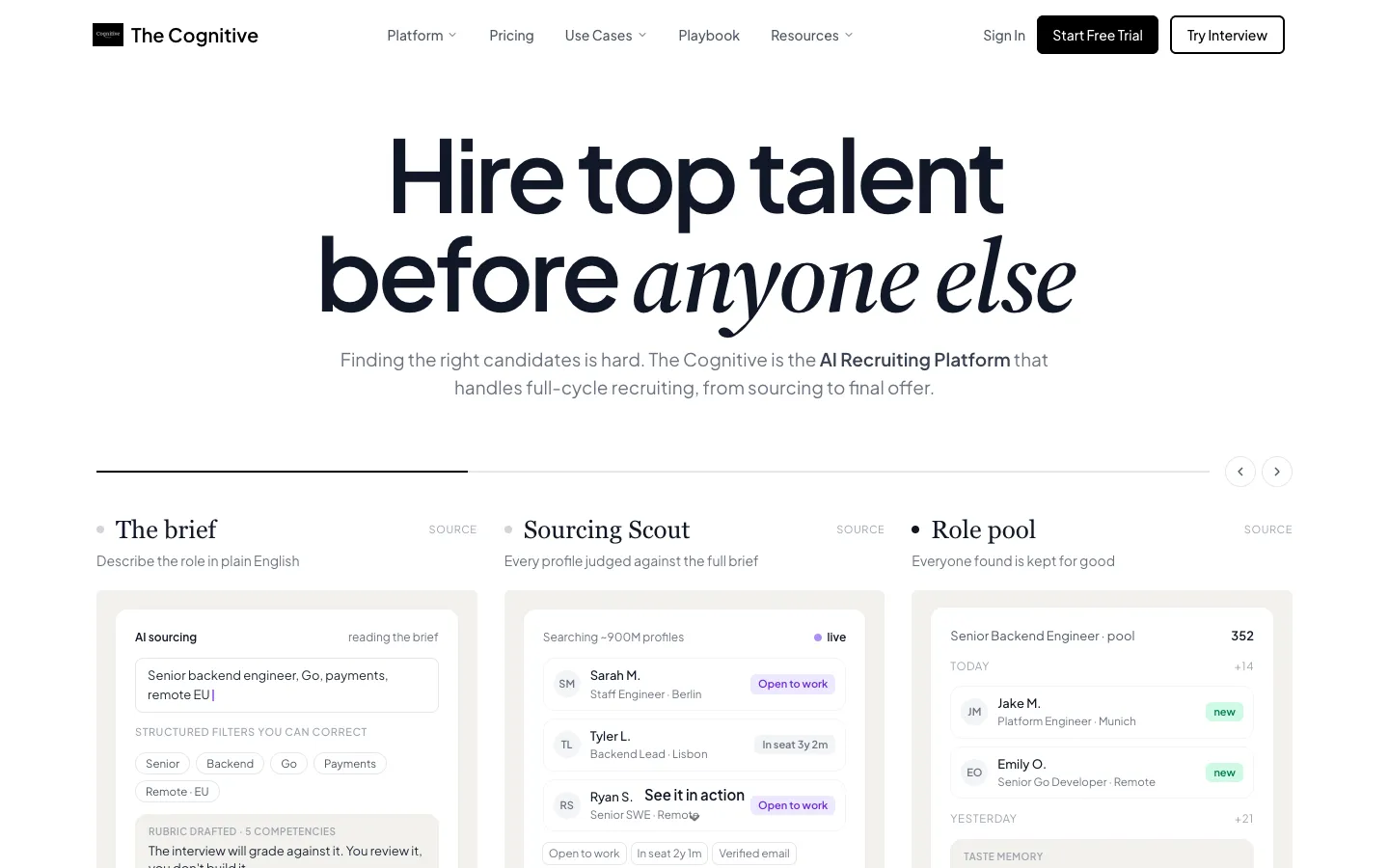
Sourcing starts with a brief, written the way a recruiter would say it out loud: a senior backend engineer with Go experience in Europe, for example. The search covers about 900M public profiles and returns people in ranked order, with a short reason for each match. For anyone worth contacting, the recruiter reveals a personal email; phone numbers come with Sourcing Pro and above.
On the Sourcing Team plan and on Sourcing Pro and above, outreach goes out as email from the recruiter's own mailbox, under their name, and a sequence ends as soon as the person writes back. When someone replies with interest, they join the role's list and the recruiter invites them to interview.
The first round is a live, two-way video interview with an AI interviewer. The recruiter sets it to 10 or 20 minutes, and the candidate joins from a laptop or desktop browser. The questions follow up on what the candidate says, while the scoring criteria stay fixed for the role. The recruiter gets a scorecard against those criteria.
On higher plans, The Cognitive connects to 100+ ATS, including Greenhouse, Lever and Workday. It imports candidates, sends shortlisted people to a job in the ATS, and adds interview results as a note on candidates who were imported from the ATS. Sourcing and interviews are sold as separate plans. Plans start at $99 a month. The product overview is on the AI recruiting software page.
When to skip The Cognitive
The Cognitive is not an ATS, so a team without one still needs one. It does not post jobs, take applications or run a careers page, so teams that fill most roles from inbound applicants get less from it. It does not schedule human interview rounds, run skills tests, do background checks, manage offers or report on the full funnel. Teams whose stuck step is any of those should start with the matching type above.
What mistakes should you avoid when buying recruiting technology?
Recruiting technology purchases tend to go wrong in four ways, and each can be caught before signing.
- Buying a category instead of fixing a step. An "all-in-one" label does not help if the stuck step is one the tool does weakly. Name the step first.
- Skipping the write-back question. A tool that keeps candidates to itself creates a second record, and hiring managers stop trusting either one.
- Adding tools without removing work. Each new tool should take a task off someone's week. If a recruiter now copies data between two screens, the stack got slower.
- Judging on a demo instead of a live role. A vendor's sample data always looks good. Run one real, open role through the tool before buying seats.
To start, pick the one open role that has been hardest to fill and write down where it is stuck: too few people, too many, slow booking or slow decisions. Then trial one tool for that step on that role, and check what lands in the ATS at the end.
If the stuck step is finding and screening people, run that one role through The Cognitive. The trial lasts 7 days, needs no card and covers up to 100 people from a brief; outreach is not included. Try The Cognitive free.
Sources
- HR.com HR Research Institute, The Future of Recruitment Technologies 2025-26, summary of the findings, eightfold.ai, 2025.
- Jobscan, Fortune 500 applicant tracking system research, jobscan.co, 2026.
- Gem, Key takeaways from the 2026 Recruiting Benchmarks Report, gem.com, 2025.
- Ashby, Recruiter Productivity, 2026 Talent Trends Report (109M applications, 247K jobs, January 2021 to March 2026), ashbyhq.com, 2026.
- Korn Ferry, Korn Ferry research unveils top talent acquisition trends shaping 2026 (1,674 talent leaders), kornferry.com, 2025.
- Vendor descriptions from each vendor's own site: Greenhouse (greenhouse.com and its pricing page), hireEZ (hireez.com), Metaview (metaview.ai), GoodTime (goodtime.io), Paradox (paradox.ai), TestGorilla (testgorilla.com), Checkr (checkr.com).
Frequently Asked Questions
What is recruiting technology?
Recruiting technology is the software a hiring team runs a hire on: finding, contacting, assessing and hiring people. It covers eight types: the applicant tracking system (ATS), candidate relationship management (CRM), sourcing, outreach, interviewing, scheduling, assessments and analytics. The ATS holds the record, and the other seven feed it or report on it.
What is the most common recruiting technology?
The applicant tracking system is the most common recruiting technology. HR.com research from 2025 found 78% of organizations using one, far ahead of recruiting CRMs at 21%. Among large employers it is close to universal: Jobscan detected an ATS at 97.4% of Fortune 500 companies in 2026.
What is the difference between an ATS and a recruiting CRM?
An ATS manages people in an active hiring process, while a recruiting CRM manages people who are not in one yet. The ATS holds applications, stages, feedback and offers. The CRM holds passive and past candidates in talent pools and nurture campaigns, so a recruiter can return to them for a later role.
Is an ATS the same as recruiting software?
No. An ATS is one type of recruiting software: the system of record for applicants, stages and offers. Recruiting software also includes tools that find people who have not applied, write to them, interview them and book interviews, and most of them send their results back to the ATS.
Is recruiting technology the same as HR technology?
No, recruiting technology is one part of HR technology. Recruiting tools cover the hire itself, from finding a person to the offer. The wider HR stack, such as an HRIS, payroll and performance software, takes over once the person is an employee.
How is AI used in recruiting technology?
AI in recruiting technology mostly takes over slow, repetitive steps. It searches for people from a plain-English brief, drafts outreach, runs first-round interviews, books interview panels and answers questions about the hiring funnel. In HR.com research from 2025, 14% of organizations used AI extensively and 49% used it to some extent.
How much does recruiting technology cost?
Recruiting technology is priced in a few common ways rather than at one going rate. Vendors charge per seat, by company size or hiring volume, by credits used, or by custom quote. Greenhouse, for example, quotes on hiring volume and organizational complexity, while other vendors publish plans. The Cognitive lists its plans on its pricing page, with Enterprise on custom terms. Plans start at $99 a month.
Where can I follow recruiting technology news?
The most useful recruiting technology news comes from recurring research rather than product announcements. HR.com's HR Research Institute, SHRM, LinkedIn's Future of Recruiting report and Korn Ferry's talent acquisition trends publish recurring research. Vendor benchmark reports, such as Ashby's Talent Trends and Gem's Recruiting Benchmarks, add data from hiring at many companies.
Related reading
- Recruiting Tools Every Talent Team Needs in 2026: 10 Picks Across the Stack
- Talent Acquisition Software: The 12 Best Platforms for TA Teams in 2026
- Which Recruiting Software Is Best in 2026? 10 Picks by Use Case
- Best Retail Hiring Software in 2026: 9 Tools for Store Teams and Store Leaders
- 10 Best CRMs for Staffing Agencies in 2026, Scored
- Best EOR Companies in 2026: 11 Employer of Record Providers Ranked, Plus the Step Before