How to Train Hiring Managers to Interview Well Without Slowing Hiring Down
By Sparsh Goyal, Founder at The Cognitive. Published · Last updated
- Train hiring managers by making evidence the shared language of every interview, not by asking them to ignore instinct.
- A useful interview rubric defines what good and weak answers sound like before managers meet candidates.
- The best debrief question is simple: which answer supports that conclusion?
- The Cognitive helps teams source, interview and shortlist candidates with evidence-backed scorecards tied to quotes and timestamps.
- Training fails when it stays theoretical, skips debrief habits or lets senior leaders stay exempt from the method.

To train hiring managers to interview well, teach them to collect comparable evidence: shared competencies, structured questions, scored rubrics and debrief habits that force each judgment back to a candidate answer. At The Cognitive, that evidence is the point.
A Tuesday debrief made the problem visible. 3 engineering managers had the same candidate packet in front of them and somehow described 3 different people. One said the candidate was strong. One said the signals were unclear. One wrote them off as not senior enough.
The recruiter had written ask for example? in the margin 3 times. Then the notes came out. They did not contain examples. They contained labels: strong, unclear, not senior enough.
That is where hiring manager training usually starts. Not in a slide deck. In the uncomfortable gap between confidence and evidence.

Key takeaways
- To train hiring managers well, make evidence the shared language of interviewing: exact answers, role criteria and scorecard notes that other people can compare.
- Instinct is useful early signal, but it becomes fair only when managers can point to the candidate answer that supports it.
- Structured interviews do not mean every candidate gets the same script. The fixed part should be the rubric, scoring bar and evidence standard.
- The Cognitive sources, interviews and shortlists candidates in one pipeline, then gives hiring teams evidence-backed scorecards tied to quotes and timestamps.
- The first useful training exercise is not a lecture. It is a real debrief where vague feedback is tested against the notes.
What does it mean to train hiring managers to interview well in practice?
To train hiring managers to interview well in practice means giving them a repeatable interview system: competencies, structured questions, scoring anchors, evidence-based notes and debrief rules. The goal is not to remove judgment. The goal is to make judgment visible enough that 3 smart people can compare it.
Most managers are not trying to be vague. They are busy, they know the work, and they have interviewed enough people to trust their read. That confidence can be useful. It can also hide the fact that each manager is interviewing from a different mental model.
One manager hears a debugging story and weighs technical depth. Another hears the same story and weighs ownership. A third listens for executive presence because the role has senior in the title. Nobody is wrong exactly. They are just not judging the same thing.
That is why interview training has to start before the interview. If the team has not agreed what the role needs, the debrief becomes a debate about taste.
The 5 parts of a trained interview system
A good training plan gives managers 5 simple habits they can use the same week:
- Competencies: name the 5 to 7 things the role actually requires, such as systems thinking, debugging, stakeholder judgment or ownership.
- Structured questions: prepare questions that reveal those competencies through real examples, not opinions about the candidate.
- Scoring anchors: define what weak, acceptable and strong answers sound like before the candidate walks in.
- Evidence notes: capture quotes, facts and behaviors instead of adjectives.
- Debrief discipline: ask each interviewer to cite the answer behind each score before opinions harden.
That list looks basic until you try to use it. The hard part is not writing a rubric. The hard part is getting managers to stop treating words like senior, strong and sharp as if everyone means the same thing by them.
They do not.
If senior means architecture depth to one person and calm stakeholder management to another, the candidate is being judged against 2 different jobs. You cannot fix that in the debrief. You fix it in the intake and the rubric.
A simple place to start is the role level. If seniority is the sticking point, use a competency map to define what junior, mid-level, senior and staff-level behavior looks like for the role. The free AI Competency Map Builder can turn a role and level into proficiency tiers that managers can argue with before interviews start.
What evidence-based notes look like
Most interview notes fail because they summarize a feeling without preserving the thing that caused it. A trained manager writes notes that someone else can audit.
| Vague note | Usable evidence note | Why it helps |
|---|---|---|
| Strong technically | Explained why the database rollback needed a write freeze, then named the data loss risk if replicas lagged. | Shows the exact technical signal and lets another reviewer test the judgment. |
| Not senior enough | Could describe the incident fix, but could not explain how they changed monitoring or team practice after it. | Connects seniority to ownership and learning, not vibe. |
| Good communication | Paused to define terms before walking a non-technical stakeholder through the latency trade-off. | Names the behavior instead of praising style. |
| Unclear | Answer changed 3 times when asked who made the final architecture decision. | Gives the debrief something concrete to discuss. |
This is the quiet upgrade. You are not asking managers to write essays. You are asking them to write the sentence that would make their score understandable next Thursday.
A good AI Interview Scorecard Generator helps here because it forces the team to define the scoring slots, the rating scale and the behavioral anchors before the interview. Blank scorecards invite blank feedback. Anchored scorecards make weak notes harder to hide.
What structured interviews should not become
Structured interviews get a bad reputation when teams confuse structure with bureaucracy. Nobody wants a manager reading questions like a compliance script while a candidate slowly loses interest.
The structure should sit under the conversation. The interviewer can still ask follow-ups, probe an unusual project, or move faster when an answer is already clear. What stays fixed is the rubric and the standard of proof.
This matters even more for candidate experience. A trained manager can run a conversation that feels natural while still producing notes the team can compare. If you want to go deeper on format choices, the guide to types of interview styles shows where structured, panel, technical and conversational formats fit.
The method should help managers think, not make them sound like robots.

How do you get started when you train hiring managers who already trust their instincts?
The fastest way to train hiring managers who trust their instincts is to use a real debrief and ask one question: which answer showed that? That question turns vague confidence into a visible evidence gap without accusing anyone of being careless.
The recruiter in that Tuesday debrief did not argue that the candidate was senior. They did not lecture the room about bias. They asked each manager to point to the exact answer that supported their conclusion.
The room got quiet.
Not because the managers were bad at interviewing. Because they had moved from a pattern they recognized to a conclusion they could not prove from the notes. That happens all the time. Smart people compress a lot of signal quickly, then forget to preserve the signal.
Training works better when the gap is discovered by the team, not announced by HR.
Step 1: pick one real role, not a generic training deck
Use a role the team is actively hiring for. A generic interview training session produces polite nodding and very little change. A real role creates useful friction because managers care about the outcome.
Bring the job description, the last 3 candidate packets, the interview notes and the debrief outcome. Do not start by asking whether the team liked the candidate. Start by asking what the role must prove.
For a senior backend engineer, that might be:
- Can debug production issues without guessing.
- Can explain system trade-offs under pressure.
- Can own ambiguous work across product and infrastructure.
- Can improve team practice after a failure.
- Can communicate clearly with engineers and non-engineers.
Those are not personality traits. They are observable job behaviors.
If the job description is too vague to produce those signals, fix that first. A messy JD creates messy interviews. The free AI Job Description Generator can turn 3 or 4 role notes into a clearer job post, and the AI JD Grader can catch vague language, cliches and bias before the role goes live.
Step 2: make the evidence gap visible
Take 10 minutes in the next debrief and sort feedback into 2 piles:
- Evidence: quotes, examples, specific decisions, observable behaviors and answers to follow-up questions.
- Interpretation: labels, impressions, guesses about motivation and broad phrases like culture fit or senior enough.
Both piles matter. Interpretation is not banned. It just cannot stand alone. The interpretation needs to point back to evidence.
The question is not do you trust your gut? The question is can your gut show its work?
A manager might say, “I do not think she has led work at the level we need.” That is a legitimate concern. The trained version is: “I do not think she has led work at the level we need because when asked about the migration, she described the implementation but not the sequencing, stakeholder trade-offs or rollback plan.”
Now the team can discuss the concern. Maybe another interviewer has contrary evidence. Maybe the rubric weighted the wrong thing. Maybe the candidate really is not ready. Either way, the room is finally arguing about the work.
Step 3: co-create the rubric with the managers
Do not hand managers a finished rubric like it came down from legal. That creates resistance, especially with experienced leaders. Build the first version with them.
The best prompt is simple: “What would a strong answer sound like from someone you would hire?” Then ask the inverse: “What answer would make you worried?”
For ownership, the anchor might look like this:
- 1/5: Blames the incident on other teams and cannot name what they changed afterward.
- 3/5: Owns their part of the issue but describes a narrow fix, usually limited to the task they controlled.
- 5/5: Names their mistake, explains the system change, and shows how they changed team practice so the failure was less likely next time.
Once managers help write that language, the rubric stops feeling like HR paperwork. It becomes their operating definition of good.
If you need a clean first draft, use the AI Interview Rubric Generator. Give it the role, level and must-have competencies. Then bring the draft to managers and ask them to edit the words until they sound like your bar.
Step 4: give managers question sets with follow-up paths
Untrained interviewers often ask questions that sound reasonable but do not produce evidence. “Tell me about a challenging project” can reveal something, but only if the follow-ups are sharp.
Better interview questions ask for a real situation, then force specifics:
- What was the problem?
- What options did you consider?
- What trade-off did you choose and why?
- What broke or surprised you?
- What did you change afterward?
The follow-ups are where the signal lives. A candidate can rehearse the first answer. It is much harder to fake the fourth follow-up when the interviewer asks for logs, constraints, trade-offs or the exact stakeholder conflict.
The free AI Interview Question Generator can help you build structured questions with scoring guidance, red flags and follow-ups for each competency. The point is not to memorize the list. The point is to give managers a path back to evidence when the conversation gets vague.
Step 5: run a 30-minute calibration before the next interviews
Calibration sounds heavier than it is. Pick one sample answer, have managers score it silently, then compare scores. If one person gives a 2 and another gives a 4, do not debate the candidate yet. Debate the anchor.
Ask:
- Which sentence made you score it that way?
- Which part of the rubric did you apply?
- What evidence would have moved the score up or down?
- Are we judging the same competency or two different ones?
This is the habit that makes debriefs shorter later. The team burns 30 minutes before the interviews so they do not burn 3 days afterward debating what senior means.
For a broader division of labor between recruiters and managers, the article on hiring manager responsibilities that make recruiters better is worth using as a manager pre-read. It makes the recruiter-manager contract explicit, which helps when you ask managers to change how they give feedback.
Which tools help train hiring managers without slowing hiring down?
The best tools to train hiring managers are the ones that change interview behavior at the moment it happens: rubrics, scorecards, question guides, note templates, calibration clips and evidence-backed interview platforms. Tools should reduce ambiguity, not create a new admin layer.
Hiring manager training fails when the tool becomes the event. A 60-slide training deck feels complete because everyone attended. Then the next debrief still says “strong hire” with no example attached.
Use tools as rails. The manager still drives the conversation, but the rails keep the interview from drifting into biography, charm or whatever problem happened to be on the manager’s mind that morning.
| Training need | Tool worth considering | Behavior it changes | Watch for |
|---|---|---|---|
| Managers disagree on what good looks like | Rubric with weighted competencies | Moves debate from taste to criteria | Too many criteria. Keep it near 6. |
| Interviews drift into casual conversation | Structured question guide | Gives managers a path to real evidence | Reading it like a script. |
| Notes are vague | Scorecard with evidence fields | Forces quotes, examples and observed behavior | Allowing “N/A” everywhere. |
| Debriefs are dominated by confident voices | Silent scoring before discussion | Protects independent judgment | Letting the most senior person speak first. |
| Managers forget what was said | Interview intelligence and note capture | Preserves evidence for later review | Trusting summaries without checking clips. |
| Candidate volume is bigger than manager capacity | The Cognitive AI recruiting platform | Sources candidates, runs deep live AI interviews and produces evidence-scored shortlists | Using AI as a black box instead of reviewing the evidence. |
Scorecards are the simplest behavior change
A scorecard should make it harder to submit bad feedback. If a manager gives problem solving a 4/5, the form should ask for the answer that earned the score. If they mark communication as weak, it should ask what the candidate said or did.
That sounds small. It is not.
A structured scorecard changes the interview because the manager knows they will need evidence later. They listen differently. They ask better follow-ups. They stop treating the debrief as the place where they figure out what they think.
If you use AI note tools, be careful. Notes are useful, but a polished summary can still hide weak evidence. The better test is whether the note points to the exact moment in the interview. We compared this in the guide to the best AI note taking apps for recruiters, with a focus on hiring evidence instead of meeting summaries.
Interview guides should teach follow-ups, not just questions
A question bank is only half a tool. The real training value comes from follow-up guidance.
For example, “Tell me about a production incident” is fine. The guide should then tell the manager what to probe:
- If the candidate jumps to the fix, ask what signals showed the system was failing.
- If they blame another team, ask what they controlled.
- If they describe the fix clearly, ask what they changed afterward.
- If they use vague words like scaling or optimization, ask for the bottleneck and the trade-off.
This is where hiring best practices become practical. Managers do not need theory in the moment. They need the next good question.
AI can help, but only if it produces evidence
An AI interview assistant is useful when it helps managers see what happened, not when it replaces their judgment with a mystery score. The line is simple: can the hiring manager click the score and see the answer behind it?
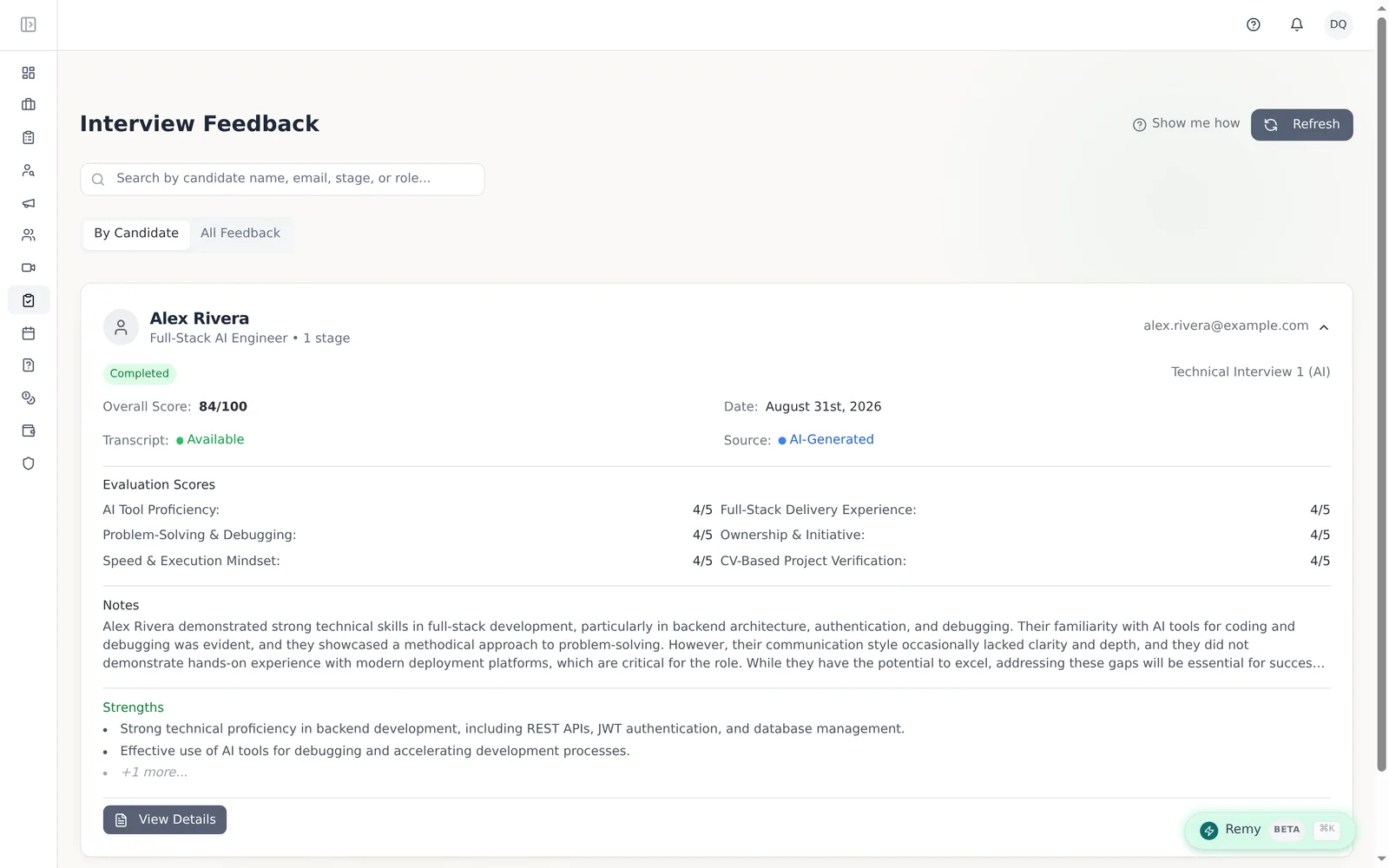
The Cognitive is built around that evidence layer. Its live two-way AI video interviewer appears with a real human face and voice, asks role-specific questions in real time, listens, pushes back on vague answers and digs deeper on strong ones. The rubric and scoring bar stay consistent for every candidate, while the next question is chosen live from the role, resume and previous answers.
Every scorecard ties judgments to quotes and timestamps. A manager can click a score like “Problem solving: 4/5” and review the clip that supports it. That is the same behavior you are trying to teach humans: no conclusion without evidence.
The Cognitive also solves the upstream capacity problem. Its AI sourcing searches roughly 900M talent profiles from a plain-English brief, enriches contact details from 30+ sources, reveals verified personal emails and direct phone numbers only when the reveal succeeds, runs outreach sequences and uses an AI voice agent to call candidates. Interested candidates can be pushed into AI interviews in one click, so sourcing and evaluation sit in one pipeline.
That matters for training because manager time is the scarce resource. If managers are drowning in interviews, they will not take better notes. They will take faster notes. A platform that sources, interviews and shortlists lets managers spend their human time on the candidates who have already produced evidence.
Teams can test this on one role with 2 free AI interviews and 100 sourcing credits. The useful test is not whether the demo looks polished. It is whether your hiring managers trust the scorecard enough to change the debrief.
Cost and speed matter because training has to survive real hiring pressure
Training that only works in a quiet week is not training. It is a workshop.
Manual interviews cost roughly $60 to $80 in staff time each, and hiring teams often lose 15 to 20 hours per week to interviews that produce thin notes. Traditional hiring can stretch 45 to 60 days, while top candidates are often gone in about 10. If your new training method adds delay, managers will quietly abandon it.
The Cognitive’s AI interview plans and AI sourcing plans each start at $99/month. Sourcing uses a separate credit balance: search results load 5 candidates at a time and cost 1 credit per person shown, verified emails cost 4 credits when revealed successfully, and phone numbers cost 12 credits when revealed successfully. Interview credits and sourcing credits are separate.
Do not make managers choose between speed and evidence. If the system asks them to slow down without removing any wasted work, they will revert to instinct by Friday.
What common mistakes make hiring manager training fail?
Hiring manager training fails when it teaches concepts but does not change the debrief. If managers still leave interviews with vague notes and still make decisions from memory, the training did not reach the operating layer.
This is where well-meaning teams slide backward. Everyone agrees rubrics are good. Everyone agrees feedback should be specific. Then a senior leader says, “I just did not feel seniority,” and the room nods because pushing back feels awkward.
The fix is not to scold people. It is to make the habit non-negotiable for everyone.
Mistake 1: training with slides instead of live evidence
Slides can introduce the method. They cannot train the muscle.
Use real notes from past interviews. Redact names if needed. Ask managers to rewrite the vague feedback into evidence-based feedback. The exercise is simple and a little uncomfortable, which is why it works.
“Not senior enough” is not feedback. It is a hypothesis. The interview note has to show the evidence for it.
Once managers see how often their own notes cannot support their conclusions, the training becomes practical. Nobody has to be the villain. The notes make the case.
Mistake 2: building a rubric with 14 criteria
Overbuilt rubrics look serious and fail in real interviews. A manager cannot hold 14 criteria in their head while listening carefully and asking follow-ups.
Keep the rubric near 6 weighted criteria. Mix technical depth, problem solving, communication, ownership and role-specific judgment. For leadership roles, add decision quality or team development. For senior technical roles, add architecture trade-offs or operational judgment.
The rule: if a criterion will not change the hiring decision, remove it.
A shorter rubric also helps with fairness. Candidates are more likely to be compared on the same real criteria instead of a long list where each interviewer quietly emphasizes a different slice.
Mistake 3: treating senior managers as exempt
This one is delicate. Senior leaders often have the strongest instincts and the weakest notes. They have earned trust, so nobody asks them to show their work.
Exempting them breaks the method.
If the VP can say “no hire” without evidence, everyone else learns that the rubric is optional. If the VP writes the clearest evidence note in the debrief, the team learns that the standard is real.
The recruiter does not need to challenge authority with theater. A calm question is enough: “Which answer should we attach to that concern?” Ask it the same way every time.
Mistake 4: ignoring debrief order
Debriefs go sideways when the loudest or most senior person speaks first. Everyone else starts adjusting. Sometimes they agree because they were persuaded. Sometimes they agree because it is easier.
Use silent scoring before discussion. Each interviewer submits their scorecard first, with evidence. Then the group reviews gaps. If one interviewer has a strong yes and another has a no, the question becomes: which criteria produced the disagreement?
This protects the candidate and the team. It also makes better use of the debrief because you spend time on real differences, not social momentum.
Mistake 5: auditing outcomes but not feedback quality
Most teams track time-to-hire, offer acceptance and pass rates. Fewer track whether feedback is actually useful.
Add a simple monthly audit. Pull 10 interview scorecards and ask:
- Does every score have evidence?
- Are the notes specific enough for another manager to understand?
- Do different interviewers use the rubric the same way?
- Are certain managers consistently vague?
- Are candidates rejected for criteria that were never in the rubric?
This is not policing. It is maintenance. Any interview system drifts unless someone checks the quality of the evidence.
If you already track recruiting metrics, add feedback quality to the same review. Time-to-hire tells you whether the process is moving. Evidence quality tells you whether it is moving for the right reasons.
Mistake 6: using AI without human review
AI hiring software should organize evidence, not make the final call. Humans decide who to hire.
The risk with any artificial intelligence interview or artificial intelligence scoring system is over-trusting the number because it looks precise. A score without evidence is just a polished opinion. A score with a quote, timestamp, rubric mapping and recording gives managers something to inspect.
That is why The Cognitive does not ask teams to trust a black box. It gives hiring managers the transcript, recording, scored criteria and the exact evidence behind each judgment. The final decision stays with people.

Mistake 7: forgetting the sourcing side of interview quality
Interview training cannot fix a bad candidate pool. If the role is unclear, the search is sloppy, or outreach reaches the wrong people, managers will spend interviews proving mismatches.
That creates a vicious loop. Managers sit through low-signal interviews, get tired, write worse notes and start trusting faster instincts. Then recruiters get vague feedback and struggle to adjust the search.
A better loop connects sourcing feedback to interview evidence. If candidates keep missing the same criterion, update the brief, the outreach and the evaluation bar. The Cognitive’s AI sourcing tool helps here because recruiters can search in plain English, reveal verified contacts when they need them, run outreach and push interested candidates into the same evidence-based interview process. For teams comparing sourcing options, the AI sourcing tool page explains the pipeline in more detail.
The one-pipeline model matters: The Cognitive sources, interviews and shortlists. A sourcing-only tool can find people but cannot prove they can do the job. An interview-only tool can evaluate applicants but cannot help build the top of the funnel. Training hiring managers works best when the evidence loop covers both sides.
Mistake 8: making training a one-time event
Interview training is closer to code review than onboarding. You do not do it once and declare the team trained forever.
New roles change the bar. New managers join. The market shifts. Candidate prep improves. The team starts using shorthand again because shorthand is easy.
Set a light rhythm:
- Run a 30-minute calibration when opening a new role.
- Audit 10 scorecards each month.
- Review one debrief where the team disagreed.
- Update the rubric when evidence shows the criteria are wrong.
- Coach managers privately when their notes stay vague.
That is enough for most teams. You are not building a university. You are keeping the interview bar from drifting.
How should you train hiring managers before the next debrief?
You should train hiring managers before the next debrief by choosing one active role, defining the evidence standard and requiring every conclusion to point back to a candidate answer. Start small enough that managers can use the method immediately.
The recruiter in the Tuesday debrief did not transform the team overnight. The next change was modest. The managers agreed on 6 criteria. They wrote 2 structured questions for each. They added a note field that asked for the answer behind the score.
At the next debrief, the conversation was still imperfect. One manager still said “not senior enough.” Then they caught themselves and added the example: the candidate described the task but could not explain the trade-off they owned.
That is what progress looks like. Better notes. Clearer debriefs. Fewer decisions based on gut feel alone.
If you want to test an evidence-backed model without rebuilding your whole process, run one role through The Cognitive. Source candidates from a plain-English brief, invite them to a live two-way AI interview, then put the scorecards in front of your hiring managers and ask the only question that matters: does this evidence make the decision clearer?
You can take a live AI interview yourself or test 2 free AI interviews on one role. The best way to train hiring managers is to make evidence the shared language of interviewing, so debriefs become clearer, fairer and easier to act on.
Frequently Asked Questions
How long should hiring manager interview training take?
Hiring manager interview training can start with 60 to 90 minutes for one active role, followed by short calibration sessions before interviews. The first session should define the rubric, rewrite vague feedback into evidence-based notes and practice scoring one sample answer.
What should be included when you train hiring managers for interviews?
Hiring manager interview training should include role competencies, structured questions, scoring anchors, evidence-based note examples and debrief rules. The practical test is whether every manager can explain a score by pointing to a specific candidate answer.
How do you calibrate hiring managers before interviews?
Calibrate hiring managers by having them score the same sample answer silently, then compare the evidence behind each score. If scores differ, discuss the rubric anchor, not the candidate, until the team agrees what weak, acceptable and strong answers sound like.
How do you measure whether hiring manager training is working?
Measure hiring manager training by auditing feedback quality, not only time-to-hire or pass rates. Pull 10 scorecards each month and check whether every score has evidence, whether managers apply the rubric consistently and whether debriefs produce clearer decisions.
Can AI help train hiring managers to interview better?
AI can help when it produces reviewable evidence instead of a black-box score. The Cognitive gives hiring teams live two-way AI interviews, fixed rubrics and scorecards tied to quotes and timestamps, so managers can learn what evidence-backed evaluation looks like in practice.
Related reading
- What Is a Normal Cost Per Hire? Benchmarks by Seniority, Sector, Role and Region
- Candidate Sourcing Channels Compared: Where to Find Candidates for Each Role in 2026
- How Many Candidates Are Interviewed per Hire? 2025 and 2026 Benchmarks by Role and Stage
- Candidate Experience Platforms Explained: What They Cover, How to Measure Them and 8 Tools to Know
- Canditech Alternatives in 2026: 10 Tools, From Skills Tests to Live AI Interviews
- Data-Driven Recruitment, Sourcing First: 9 Metrics, Clean Data and the Decisions They Should Change