AI Interviewer vs Human Touch: Why Hearing Every Candidate Is More Human Than a CV Cut
By Sparsh Goyal, Founder at The Cognitive. Published · Last updated
- Resume-first hiring often removes 95% of applicants before anyone hears them.
- Real human touch starts when more candidates get a fair chance to explain how they think.
- A live AI interviewer can interview every applicant and produce evidence for humans to review, while nothing is rejected automatically.
- Candidates distrust AI that decides, but accept AI that gives them a fair hearing when a person makes the call.
- Rejection can be more respectful when it rests on interview evidence, not silent CV elimination.
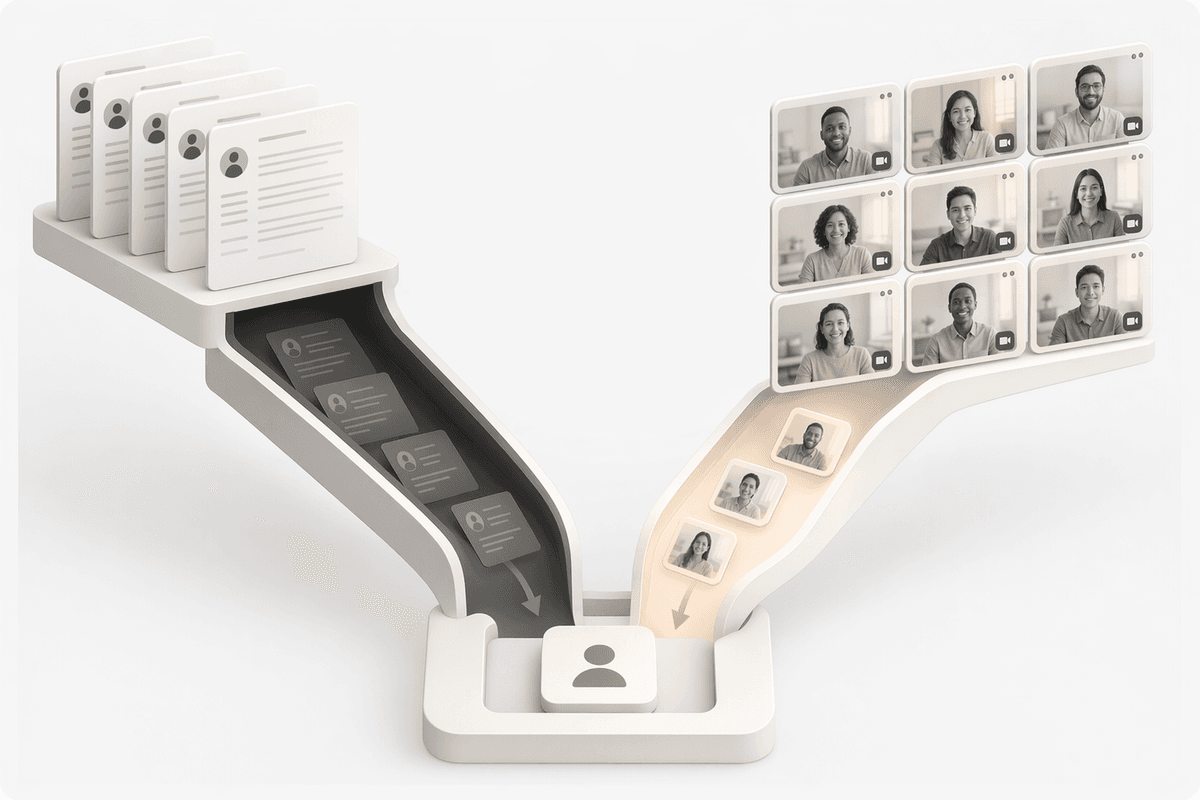
Human touch in hiring should mean every candidate gets a fair chance to show what they can do, and a person makes the final call on that evidence. An AI interviewer can deliver that better than a resume-first funnel, because it can hear every applicant instead of silently cutting most of them on a CV score. I run The Cognitive, which interviews candidates live with AI, and this is the argument I keep having with recruiters who worry AI will make hiring cold.
A recruiter met us for a demo of our AI interviewer. He said the thing everyone says when AI enters the hiring conversation: "We believe in keeping the human touch in hiring."
Beautiful sentence. Hard to disagree with. So I asked him to walk me through their process.
200 people apply. Their ATS collects the CVs. AI scores every CV and removes 190 people. Then the team speaks to the top 10.
"That is where we add the human touch."
Ah, yes. Nothing says human touch like silently eliminating 95% of the humans.
The other 190 never speak. They never explain their experience. They never show how they think. They never get a chance to prove that their badly formatted CV was written by a great engineer. They just disappear into a generic rejection email.
No conversation. No feedback. No proof. Just a machine deciding their written document wasn't worth a human minute.
The final 10 get a lovely human conversation. So the process is very personal, for the people the machine already liked.
The polite lie inside "human touch" hiring
Most companies use the phrase human touch to mean one thing: a human eventually talks to someone.
That's a very low bar.
If 200 people apply and 190 are removed before they can speak, the process isn't human. It's selective humanity: warmth at the bottom of a cold funnel.
Real human touch isn't only about who gets a final conversation. It's about whether candidates get a fair chance to show what they can do before the company rejects them.
That's why the interview still matters. A CV is a claim. An interview tests the claim. It shows how someone thinks when the answer isn't polished, rewritten or optimized by a tool. We wrote more on why interviews are important in the hiring process, but the short version is simple: interviews reveal the person behind the document.
And that's where modern hiring gets strange. Many teams say they want human judgment, then put their harshest judgment before any human contact happens.
What the resume-first funnel actually does
The usual hiring funnel looks clean on a dashboard:
- 200 applicants come in.
- The ATS collects the CVs and keeps the pipeline organized.
- AI scores the CVs on keywords, experience, titles, employers, schools and structure.
- 190 people disappear before any real conversation.
- 10 people get interviews, and the team calls that the human stage.
This isn't evil. It's math. Humans don't have enough hours to talk to 200 people by hand. A recruiter can't run 200 deep interviews for one role, and an engineering manager definitely can't. Greenhouse's March 2026 benchmark report found teams already spend 12.3 interview hours per hire, and applications per role rose from about 115 in 2022 to 244 in 2025 (read 5 October 2026). Interview every applicant by hand and the system breaks.
So companies solve the math problem with CV scoring. But CV scoring creates a new problem: it judges the document instead of the person.
An ATS is useful. It tracks candidates, stages, emails, offers and records. But it was never built to prove whether someone can do the job. If your process relies on the ATS plus CV scoring to decide who deserves a conversation, you're asking the wrong layer to make the hardest call. Our guide to AI recruiting software vs a traditional ATS covers the difference: the ATS organizes the pipeline, and the evaluation layer should judge actual ability.
Bad CVs hide good builders
A CV is often the least reliable artifact in the process.
Some strong candidates are bad at writing about themselves. Some have non-linear paths. Some worked at unknown companies. Some built excellent systems but didn't describe them with the right keywords. Some have gaps that make sense once you hear the story. Some are immigrants, shift workers, caregivers, career switchers or self-taught engineers whose experience doesn't fit a tidy template.
Meanwhile, weak candidates can have perfect CVs. They use AI to rewrite every bullet. They mirror the job description. They know how to name the right tools. They know that "Kubernetes", "distributed systems" and "ownership" look good in a list.
That's resume fiction. It isn't always lying. Sometimes it's just polish. But polish isn't performance.
When a company removes 190 people because their CVs didn't score high enough, it isn't protecting human touch. It's protecting the team from volume with a very blunt trade: fewer interviews, more hidden false negatives.
The best builder in your applicant pool may not be the person with the cleanest CV. It may be the person who can explain a rollback, debug a latency spike, or reason through a messy customer problem under pressure.
You can't see that from a PDF.
What an AI interviewer changes about human touch
An AI interviewer changes the math without deleting the humans.
Here's the model we explained to that recruiter:
- 200 people apply.
- All 200 are invited to an interview, which they book at a time that suits them.
- They answer real questions in real time.
- The interview is built for the role, with a rubric your team sets.
- They're evaluated on what they know, how they think and how they handle real situations.
- The strongest 5 move to the human round.
- For everyone else, the team still has scores, written feedback, recordings and transcripts.
- A person reads that report before making the final call.
This isn't a chatbot, and it isn't a one-way video form. The Cognitive's interviewer is a live, two-way AI video interviewer, and the invitation tells candidates up front that the interview is run by AI. It asks role-specific questions, listens, responds, pushes back on vague answers and follows up when an answer is strong. Interviews last 10 or 20 minutes and run in 9 languages.
For example, a backend candidate says, "I fixed a database issue that caused downtime." A weak process checks the box and moves on. A live AI interviewer asks: "Walk me through the rollback. What failed first? How did you confirm the fix? What would you change if the same incident happened again?"
That doesn't remove the human touch. It gives every candidate a shot at the kind of conversation only the top 10 used to get. If you want the mechanics, our guide on what an AI interviewer is and how it works breaks down the flow.
Live conversation beats silent elimination
The key difference isn't "AI or human". That framing is tired.
The real difference is silent elimination vs live evaluation.
Silent elimination says: your CV didn't score high enough, so you don't get to speak.
Live evaluation says: we'll hear you, ask role-specific questions, judge you on the same rubric as everyone else, and let humans review the evidence.
That's why live AI interviews matter. A live interview can adapt. If an answer is thin, it digs deeper. If an answer is impressive, it tests the edge. If the candidate gives a memorized line, it asks for specifics.
That's the difference between a script and a conversation. We explain it in what a conversational AI interview is, but the practical point is simple: a real conversation reveals reasoning, and a static CV score reveals formatting, keywords and pedigree.
There's also a candidate experience point people miss. One-way video tools can feel like talking to a wall, because nobody responds. A live, two-way format feels closer to speaking with a person, because the interviewer reacts to what you said and asks a natural follow-up. Candidates book their own slot from the invite, without an account and without waiting for a recruiter's calendar.
That matters. If your "human touch" process only works for people who pass a CV score and can match your calendar, it isn't as human as it sounds.
Humans should decide. They should not do the repetitive waste
The point isn't to remove recruiters or hiring managers from hiring.
The point is to stop wasting their time on low-signal work.
Humans are great at judgment calls. They're good at reading context, understanding team fit, selling the role, handling nuance and making the final decision. Humans are bad at repeating the same first-round conversation 200 times with perfect energy, perfect consistency and no fatigue.
That's where the old process breaks.
By candidate 17, even a great interviewer is tired. By Friday afternoon, the bar shifts. One person gets a deep technical follow-up. Another gets a lighter version because the interviewer is behind on meetings. A confident candidate gets extra credit for sounding sharp. A quieter candidate loses ground before their logic is tested.
That isn't human touch. That's human variability.
The Cognitive handles the volume and organizes the evidence. Humans make the final call, and nothing is rejected automatically. Hiring managers meet candidates who have already shown signal, and the hours that used to vanish into repetitive first rounds go back to the conversations that need a person.
If you're weighing where humans and AI each belong, the comparison between an AI recruiting assistant and a human recruiter is useful. The best setup isn't AI instead of people. It's AI for volume and consistency, people for judgment and relationships.
Evidence is more human than gut feel
The recruiter in the demo felt his process had more human touch because humans personally spoke to 10 candidates.
Fair. They did.
But what about the other 190?
In the all-interview model, every candidate leaves behind proof. The hiring team gets a report for each person: a 1 to 5 score for each criterion, a weighted score out of 100, a suggested verdict and written feedback on strengths, areas to improve and the reasoning behind the recommendation. The full transcript and recording sit underneath it.
So when a candidate scores 2 on ownership, a reviewer can read the feedback, open the transcript and find the moment where they blamed every failure on other people. When someone scores 5 on technical depth, the reviewer can hear them walk through the exact trade-off the role needs. The AI also probes up to 5 claims from the resume and marks each one verified, refuted or unclear, with evidence from the conversation.
That's AI scoring done properly. Not a black-box number. Not a mysterious "fit" score. Evidence humans can inspect. We cover this in detail in how AI interviews grade real evidence.
That's also better for the rejected candidate. A team may still send a short rejection. But internally, the decision rests on what the candidate actually said in the interview, not on a CV score they never saw.
Bias does not disappear because a human smiles at the end
Many teams worry about AI bias. They should. Any hiring system that affects people's careers should be tested, audited and watched closely.
But there's a blind spot here: resume-first hiring is already full of bias.
CV scoring can reward familiar schools, famous company names, polished writing, neat career paths and the exact keywords in the job post. Humans reviewing CVs can do the same thing, often faster than they realize. A 6-second scan isn't a moral high ground.
Then there's fear bias. Hiring teams often choose the candidate who feels safest on paper, not the one with the strongest ability. A known logo feels safer. A familiar background feels safer. A clean CV feels safer. That safety can quietly kill great hires, especially when the strongest candidate looks unconventional.
There's also attention bias. Interviewers stop listening. They anchor on the first strong or weak answer. They ask different follow-ups. They remember the charming story and forget the missing logic. If that sounds uncomfortable, it should. Our guide to bias in AI hiring covers both fear bias and attention bias.
A structured AI interview doesn't solve every fairness problem. But it gives every candidate the same criteria, the same role-specific bar, the same chance to answer and the same evidence trail. That's a stronger starting point than silently cutting 95% of people on CV shape. Structure is also what the research rewards: a 2022 meta-analysis by Sackett and colleagues found structured interviews had the highest average validity of the selection methods it reviewed.
The same guide explains what teams should audit, what to avoid and why evidence matters more than promises. Our bias and fairness page sets out how The Cognitive approaches it.
The rejection email we would rather send
If a candidate is rejected after only a CV score, the honest rejection would sound like this:
Thanks for applying. We did not speak with you. We did not test your skills. We did not hear your reasoning. Your CV did not rank high enough, so we moved on.
No company sends that. But that's what happened.
After a real interview, the rejection can be more respectful because the decision has evidence behind it. It can still be short. It doesn't need to become a coaching report. But it can be grounded in reality. Here's an illustrative example:
Hi Maya, thanks for taking the time to interview with us. We are not moving forward for this role. The strongest candidates showed deeper hands-on debugging in production incidents, especially around root-cause analysis and rollback decisions. Your communication was clear, and we appreciated the way you explained trade-offs. We will keep your profile in mind for roles that match that strength more closely.
That isn't perfect. It still stings. Rejection always does.
But it's more human than a generic "after careful consideration" note sent to someone who never got to speak. Our candidate rejection email templates have more versions you can adapt.
The hiring team benefits too. If a candidate asks for clarification, the team has the report and the recording. If a hiring manager wants to double-check a rejection, they can read the evidence. If a recruiter wants to back a non-traditional candidate, they can point to actual answers, not vibes.
What about the cost of interviewing everyone?
This is the objection that matters.
Interviewing all 200 by hand would be absurd. Nobody is arguing for that. Greenhouse counted 22.7 interviews per job and 12.3 interview hours per hire in 2025, and that's with most applicants never interviewed at all. Run a manual first round for a 200-person pool and those hours multiply into a huge time tax on recruiters and engineers.
The Cognitive changes the unit economics. AI Interview starts at $99/month, on a monthly plan you can cancel anytime. Each plan includes a monthly interview allowance, and past it you buy an interview top-up, so hearing another candidate no longer costs an hour of someone's day. Each interview comes back with the same rubric and the same evidence trail.
That means you don't have to choose between "interview everyone and burn the team out" and "delete 95% of people based on CVs". You can invite every applicant to a live interview, then send only the strongest 5 or 10 to the human round.
That's how teams shorten their hiring cycles. Not because humans care less, but because humans stop spending their week on repetitive early conversations and start spending it on candidates who have already shown signal.
That's the real promise of AI in recruitment. Not colder hiring. Not automation for its own sake. More signal, faster, with humans still making the decision.
Do candidates actually want a human or an AI interviewer?
The honest answer is that candidates say they distrust AI, then often prefer it once they've tried it.
- Pew Research found in April 2023 that 66% of US adults would not want to apply to an employer that uses AI to help make hiring decisions, and Americans opposed AI making the final hiring decision by 71% to 7%.
- A Gartner survey published in July 2025 found only 26% of candidates trust AI to evaluate them fairly.
- Yet in a field experiment with 70,884 applications, Jabarian and Henkel found applicants interviewed by an AI voice agent were 12% more likely to get offers, with humans making every hiring decision (read 5 October 2026).
Read together, the data says the same thing this article does. People don't want a machine deciding their future, and they're right. They do accept an AI that gives them a fair hearing, as long as a person makes the call. That's the line to hold: AI runs the conversation and organizes the evidence, people decide.
The better definition of human touch
Here's the definition I'd use:
Human touch in hiring means every candidate is judged on relevant evidence, and the final decision is made by people who can see that evidence.
It doesn't mean every applicant gets a 45-minute call with a recruiter. That doesn't scale.
It also doesn't mean only the top 5% get heard because a CV model liked them first.
The better middle ground is simple:
- Let the ATS collect the applicants.
- Let the AI interviewer run structured, role-specific interviews at volume.
- Let humans review the evidence and meet the strongest candidates.
- Let people make the final call.
That's a stronger hiring system than the old resume-first funnel, and a more honest one. The ATS collects the noise. The Cognitive extracts the signal. Humans decide what to do with it. The Cognitive can also grow the pool on purpose: its AI sourcing searches ~900M public profiles from a plain-English brief and can reveal verified emails and phone numbers, so the 200 aren't only whoever happened to apply.
If you're choosing a platform, don't ask only whether it has AI. Ask whether it gives more people a fair chance to show ability, whether the interview is live and two-way, whether scores are backed by evidence, and whether your team can trust the shortlist. Our guide to the best AI interview platforms gives you the vendor questions to ask.
How do you keep the human touch when you use an AI interviewer?
The tool doesn't decide whether your process feels human. These 6 habits do:
- Tell candidates it's AI before they start. In The Cognitive, the invitation says the interview is run by AI. Nobody should find out halfway through.
- Give them a person to contact. Make sure every candidate knows which recruiter to email with questions, accommodation requests or problems on the day.
- Let them pick the time. Self-booking respects shift workers, parents and people in other time zones.
- Read the report before you reject. Nothing in The Cognitive is rejected automatically. Make sure a person actually looks at the scores, the feedback and any integrity flag in context.
- Send specific rejections. One real sentence about what decided it beats a paragraph of "careful consideration".
- Keep humans on the final rounds. Team fit, selling the role and the offer conversation belong to people.
Give every applicant a fair interview Invite your whole pool to a live AI interview, read a scored report for each and let your team make the call. Start free
The coldest process is the one that never listens
The recruiter may still feel his process has more human touch.
His humans personally speak to 10 candidates.
With The Cognitive, all 200 get a chance to be heard. They answer real questions. They face the same bar. They leave behind evidence. Then humans review the strongest signals and make the final decision.
Very cold of us.
The truth is this: hiring doesn't become human because a recruiter speaks to the survivors of an automated CV cut. Hiring becomes human when people get a real chance to prove what they can do.
If you want to test that idea, run one role both ways. Let your current process pick the top 10 from CVs. Let The Cognitive interview the full applicant pool. Then compare the shortlists, the evidence and the time your team spent getting there. You can try a live AI interview yourself first, to see what your candidates would see.
That's the test that changes minds.
Run one role both ways Interview the full applicant pool with live AI and compare the shortlist with your CV-first process. Start free
Sources
- Greenhouse, The Hire Standard: Greenhouse benchmark report, North America, March 2026: PDF (read 5 October 2026)
- Pew Research Center, AI in Hiring and Evaluating Workers: What Americans Think, 20 April 2023: pewresearch.org
- Gartner, survey press release, 31 July 2025: gartner.com
- Jabarian and Henkel, Voice AI in Firms: A Natural Field Experiment on Automated Job Interviews, arXiv 2607.28222: arxiv.org (read 5 October 2026)
- Sackett, Zhang, Berry and Lievens (2022), Revisiting meta-analytic estimates of validity in personnel selection, Journal of Applied Psychology 107, summarized by SIOP: siop.org
Frequently Asked Questions
How can an AI interviewer make hiring feel more human?
It gives every applicant a chance to speak, explain their thinking and answer role-specific questions instead of being removed by a CV score. In The Cognitive, candidates book their own slot for a live, two-way AI video interview, and humans still make the final call by reviewing the scored report instead of guessing from a document.
Why is rejecting candidates based on CV scores a problem?
CV scores judge formatting, keywords, pedigree and written polish before anyone tests ability. That can hide strong builders with messy or unconventional resumes and reward weaker candidates who know how to optimize a CV. An interview tests the claim, which is why The Cognitive also probes up to 5 resume claims in each interview.
Does interviewing all applicants take too much time?
It would if humans ran every interview by hand. A live AI interview changes the math: candidates book their own slot, the AI runs the conversation, and your team reads a scored report afterwards. The Cognitive's AI Interview plan starts at $99/month on a monthly plan you can cancel anytime, so hearing more applicants does not mean more hours on your team's calendar.
What should a rejection email say after an AI interview?
It should be short, respectful and grounded in the role criteria. For example, it can say the team moved forward with candidates who showed stronger production debugging or deeper root-cause analysis, while naming a real strength from the interview. The Cognitive's written feedback on strengths and areas to improve gives you the material for that sentence.
Is human touch only about speaking to final candidates?
No. Human touch should mean candidates are judged on relevant evidence and humans review that evidence before deciding. Talking only to the top 10 after 190 silent rejections is a narrow version of humanity. With The Cognitive, every invited applicant gets a live interview and a person reads the report before any decision.
Can AI replace the human touch in recruitment?
No, and it shouldn't try. AI is good at running consistent first-round conversations at volume and organizing the evidence. People are better at judging team fit, selling the role, handling nuance and making the final decision. The Cognitive is built for that split: the AI interviews, nothing is rejected automatically, and a person makes every hiring call.
Do candidates trust AI interviews?
Many say they don't. A 2025 Gartner survey found only 26% of candidates trust AI to evaluate them fairly, and Pew found 66% of US adults would not want to apply to an employer that uses AI to help make hiring decisions. But a field experiment with 70,884 applications found AI-interviewed applicants were 12% more likely to get offers when humans made the decisions. In The Cognitive, the invitation tells candidates the interview is run by AI and a person decides.
Does The Cognitive reject candidates automatically?
No. The Cognitive returns a 1 to 5 score per criterion, a weighted score out of 100, a suggested verdict and written feedback, with the transcript and recording, but nothing is rejected automatically. Integrity signals such as tab switches are logged on the report for a person to review and are never scored. Your team decides who moves forward.
How do you keep the human touch when using an AI interviewer?
Tell candidates it's AI before they start, give them a recruiter to contact, let them choose their interview time, read every report before rejecting anyone, send specific rejections, and keep people on the final rounds. The Cognitive covers 2 of those by design: the invitation says the interview is run by AI and candidates book their own slot without an account.
Related reading
- Interview AI Explained: How AI Interviewers Work for Employers and Candidates
- Conversational AI Interview: How to Tell a Real Conversation From a Script
- AI Recruiting Assistant vs Human Recruiter: Which Delivers Better Candidate Quality?
- What Is a Normal Cost Per Hire? Benchmarks by Seniority, Sector, Role and Region
- Candidate Sourcing Channels Compared: Where to Find Candidates for Each Role in 2026
- How Many Candidates Are Interviewed per Hire? 2025 and 2026 Benchmarks by Role and Stage