Candidate Sourcing Platforms: What They Do and the 6 Best in 2026
By Sparsh Goyal, Founder at The Cognitive. Published · Last updated
- The best candidate sourcing platform for search, outreach and a first interview in one self-serve account is The Cognitive.
- Findem ReadySlate Lite suits small teams with no recruiter, SeekOut suits deep searches, Pin books intro calls, Juicebox has a free plan and Gem suits startups that want an ATS too.
- Check five jobs before you buy: search, contact details, email from your own mailbox, screening of the people found and ATS sync.
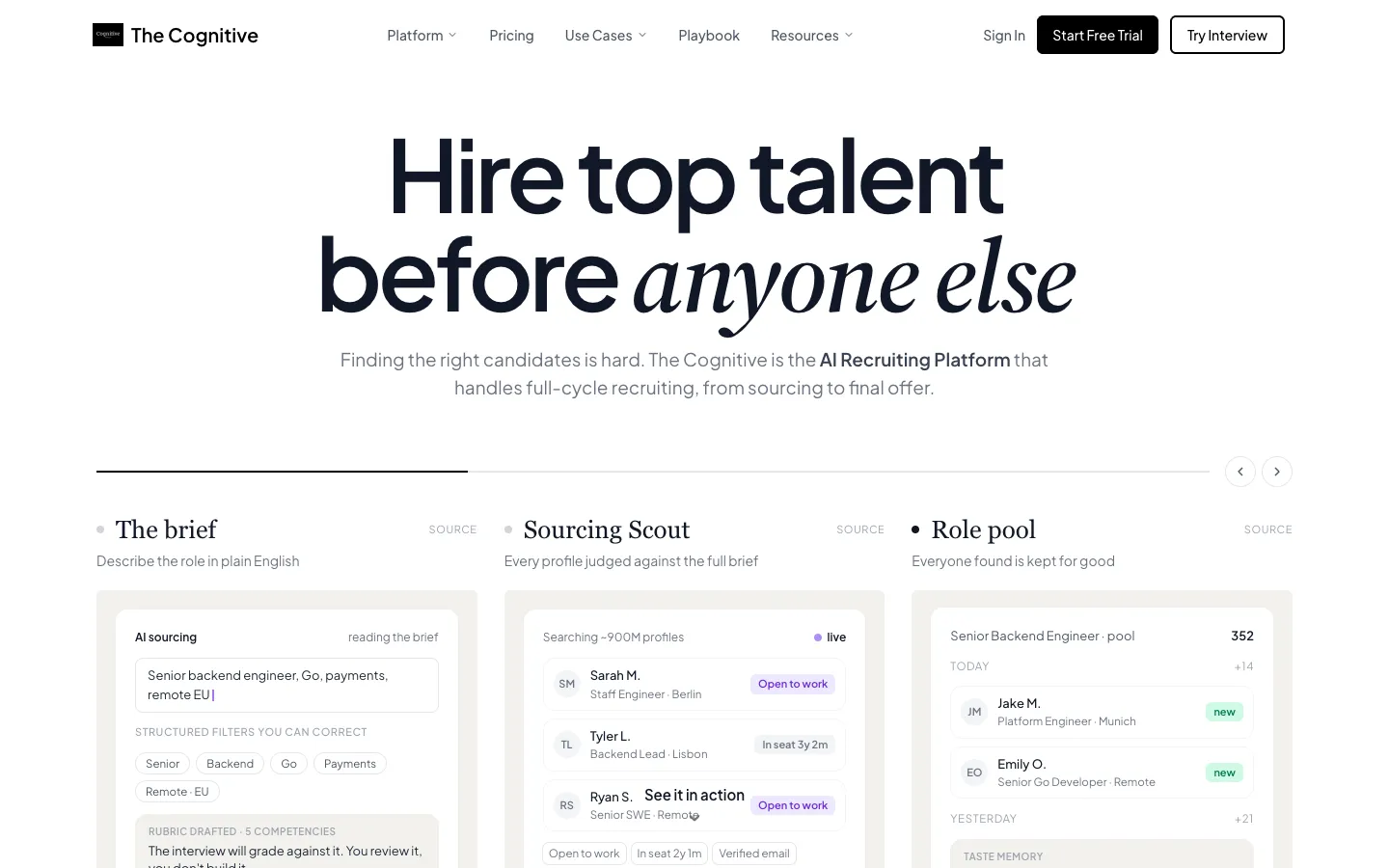
A candidate sourcing platform is recruiting software that searches a large pool of public profiles for people who have not applied, gets their contact details and helps you reach them. It is not the procurement software that shares the name. Gallup's Q4 2025 survey put 11% of U.S. employees in active job search and 40% more in watch mode. Nearly four in five people open to a move are only watching, so a job post reaches just part of the market.
The Cognitive is the best candidate sourcing platform for teams that want to search, reach out and interview in one self-serve account.
Disclosure: The Cognitive is our product.
The best candidate sourcing platforms in 2026
- The Cognitive: best for search, email outreach and a live AI interview in one account.
- Findem ReadySlate Lite: best for small teams with no recruiter.
- SeekOut: best for deep searches with fine filters.
- Pin: best for sourcing through to booked intro calls.
- Juicebox: best for plain-English search with a free plan.
- Gem: best for startups that want sourcing, a CRM and an ATS in one system.
What is a candidate sourcing platform?
A candidate sourcing platform is software for outbound recruiting: describe the person you need, and it returns people from outside your own database with a way to contact them. The activity itself is covered in what is candidate sourcing.
Gem's 2026 Recruiting Benchmarks Report, built on more than 165 million applicants, found that direct sourcing delivered 11% of hires from just 2.6% of applications. Job boards and company marketing channels produced about 90% of applications but only about half of hires.
Five nearby tools are often confused with a sourcing platform:
- Applicant tracking system. An applicant tracking system stores the people who applied. A sourcing platform goes out and finds people.
- Recruiting CRM. Keeps past candidates warm. It works on people you already know.
- Job board. Shows your post to people who go looking for it.
- Contact finder. Email and phone finders return contact details for a name you already have.
- Boolean helper. Boolean search generators write the search string and leave the searching to you.
The channel, such as LinkedIn, GitHub or referrals, is where people are; candidate sourcing channels compares them.
What does a candidate sourcing platform do?
A candidate sourcing platform does up to five jobs: search, contact details, outreach, screening and ATS sync. The last two decide how much work is left after someone replies.
1. Search outside your database. You type a brief or set filters, and the platform searches hundreds of millions of public profiles. Good platforms show the filters they read from your brief, so you can fix them and search again.
2. Contact details. Check whether you get a personal email, a phone number or both, and whether you pay per reveal or get a monthly allowance.
3. Outreach. The platform sends a short email sequence and stops it when the person replies. Sending from your own Gmail or Outlook keeps replies where you already work. In Ashby's 2024 study of half a million sourcing sequences, the average response rate was 19.6%, and campaigns using AI personalization drew 35.3% against 24.1% without it.
4. Screening the people it found. Most platforms leave this out, yet a yes reply still needs a first conversation. A platform that screens the people it found runs that conversation for you and returns a scored result.
5. ATS sync. People you source should land in your ATS, whether that is Greenhouse, Lever, Ashby or Workday, without copy and paste. Some platforms also search the ATS for past candidates.
How do the best candidate sourcing platforms compare?
| Platform | Best for | AI screen | Score /7 |
|---|---|---|---|
| The Cognitive | Search to interview, one account | Live video, 10 or 20 min | 7 |
| Findem ReadySlate Lite | Small teams, no recruiter | Voice, 5 min | 5 |
| SeekOut | Deep, filtered search | Inbound applicants, custom plans | 5 |
| Pin | Sourcing to booked calls | No, books calls | 5 |
| Juicebox | Free plan, plain-English search | No | 5 |
| Gem | Startups wanting an ATS too | No, ranks applicants | 3 |
Profile counts in each vendor's own words: SeekOut and hireEZ 1B+, Findem and Pin 850M+, Juicebox 800M, Gem 800M+, The Cognitive about 900M.
How it was ranked
Each platform gets one point per check:
- Searches a large pool of profiles outside your own database, in plain English or with AI.
- Gives you contact details for the people it finds.
- Sends email outreach from your own Gmail or Outlook, or on your behalf.
- Screens or interviews the people it found, with AI.
- Syncs with your ATS.
- Offers a free plan, free trial or free credits with no sales call.
- Shows a price on its own website.
| Platform | 1 | 2 | 3 | 4 | 5 | 6 | 7 |
|---|---|---|---|---|---|---|---|
| The Cognitive | Y | Y | Y | Y | Y | Y | Y |
| Findem | Y | N | Y | Y | N | Y | Y |
| SeekOut | Y | Y | Y | N | N | Y | Y |
| Pin | Y | Y | Y | N | N | Y | Y |
| Juicebox | Y | Y | Y | N | N | Y | Y |
| Gem | Y | N | N | N | N | Y | Y |
| hireEZ | N | N | N | N | N | Y | Y |
A point counts only when the vendor's own site puts the feature on a plan with a published price that you can start without a sales call. Anything the site does not state counts as no. SeekOut, Pin and Juicebox score no on ATS sync because it sits on custom plans or an add-on with no price shown. Gem's Startup Program is its own ATS, so it scores no on sync.
Ties go to the depth of the screen, then the vendor's stated profile count, then alphabetical order. Findem leads the four at five because it runs a voice screen; SeekOut (1B+), Pin (850M+) and Juicebox (800M) follow.
hireEZ and LinkedIn Recruiter are covered under Also worth knowing. Loxo, an agency ATS and CRM, and job boards such as Indeed, Wellfound and Dice fail the first check.
These platforms are ranked using feedback from recruiters the founder talks with on LinkedIn, plus each vendor's own site and pricing page.
Which platform does it all, end to end?
The Cognitive is the only platform in this list that runs a live AI video interview on the people it found, on self-serve plans with published prices. Findem ReadySlate Lite covers a shorter run with a 5-minute voice screen. hireEZ offers AI screening on plans priced by quote, and SeekOut's AI screening, also by quote, is for inbound applicants. More tools that pair the two are in sourcing and AI interviewing platforms compared.
How do you choose a candidate sourcing platform?
Who will run the searches?
A full-time sourcer wants fine filters, saved searches and a large pool. A hiring manager with no recruiter wants to paste a job description and get people back. If both will use it, check that the plan allows more than one seat. Enterprise teams that want screening and rediscovery on top of their ATS can look at hireEZ, SeekOut's custom plans or Gem.
Does it find the people you cannot find today?
Profile counts are vendor claims and hard to compare. Run your hardest open role on two platforms during the trial and count the results you would actually contact.
Whose mailbox sends the emails?
Email from your own Gmail or Outlook keeps replies in your inbox and your name on the message. Check that follow-ups stop on a reply, and that each email mentions something specific to that person.
What happens after someone says yes?
Ask where an interested reply goes and how many clicks it takes to start a first interview. A platform that screens the people it found saves the most hours at this step.
Do you also need to search your own ATS?
If you hold years of past applicants, rediscovery pays off: 46% of sourced hires in Gem's 2026 benchmarks came from rediscovered candidates, up from 26% in 2021. SeekOut and Gem do this on their larger plans; see candidate rediscovery.
How are candidate sourcing platforms priced?
Candidate sourcing platforms charge per seat per month, by credits for searches and contact reveals, by company size, or by custom quote. ATS sync usually sits on higher or custom plans, so ask which plan includes all five jobs you need. Typical models and seat limits are compared in AI recruiting software pricing.
The best candidate sourcing platforms, reviewed
1. The Cognitive: best for search, email outreach and a live AI interview in one account
Verdict: seven of seven checks, carrying a person from a plain-English search to a recorded first interview.
Write the brief the way you would explain the role to a colleague, and The Cognitive's AI sourcing returns people from about 900M public profiles, ten a page, each with a short reason for the match. From there you shortlist, reveal a personal email or phone number, or export to CSV. Searches also run from Claude through the Claude connector.
Emails go out from your own Gmail or Outlook, and the sequence stops once someone replies. People who say they are interested join the role, and you decide whom to invite.
The AI interview is a live two-way video call of 10 or 20 minutes, available in 9 languages. Your criteria for the role stay fixed, and the AI asks follow-up questions based on what each candidate says. You get a scored report, the recording and the transcript. The Cognitive syncs with 100+ ATS on higher plans.
Best for: recruiters and hiring teams who fill roles with people who never applied and want the search, the emails and the first interview in one place.
Watch out for: there is no always-on agent or human sourcer, so you run each search. Email outreach and phone reveals start on Sourcing Pro, and ATS sync needs a higher plan. It is not an ATS, does not search your own ATS history, has no Chrome extension or InMail, and does not post jobs.
Pricing model: AI Sourcing and AI Interviews are separate monthly plans. Plans start at $99 a month. A 20-minute interview uses 100 credits.
2. Findem ReadySlate Lite: best for small teams with no recruiter
Verdict: five of seven checks, and the only other platform here that screens the people it finds on a self-serve plan.
Findem describes ReadySlate Lite as "a self-serve AI recruiting agent in Findem Studio." You paste a job posting and pick a shortlist from "Findem's 850M+ profiles". The agent "emails candidates from your own mailbox" and runs "a five-minute AI voice screen on basic qualifications" with those who say yes. "You don't need an ATS or a recruiting CRM."
The trade-off is scope: Lite is "designed for early- and mid-career knowledge-worker roles", and the page does not say you get contact details yourself.
Best for: founders and small teams with no recruiter who would rather hand the first search, email and short screen to an agent.
Watch out for: senior roles, ATS sync and a long scored interview are outside Lite.
Pricing model: credits in Findem Studio. New accounts get some free, then top up as you go or pay per seat each month. Prices are on its site.
3. SeekOut: best for deep searches with fine filters
Verdict: five of seven checks, with a 1B+ profile pool and a 14-day free trial.
SeekOut calls itself "the agentic AI recruiting platform that runs on your terms" and promises to "search 1B+ profiles". Its self-serve Sourcing Core plan lists "Advanced filters (30+)", "Email integration + send on behalf", "AI multi-step campaigns" and 500 contact credits a month. SeekOut also runs inside Copilot, ChatGPT, Claude and Gemini, and has a Chrome extension.
ATS integration, rediscovery of silver medalists and AI screening of inbound applicants sit on custom annual plans. Core exports to Excel, PDF or an ATS, which is a file, not a sync. For a head-to-head, see SeekOut vs Juicebox.
Best for: recruiters who want filter-heavy search, and enterprises that will add rediscovery later.
Watch out for: ATS sync needs a custom contract, and its AI screening covers inbound applicants, not the people you source.
Pricing model: per seat. Sourcing Core has a published monthly or annual price; team plans are custom and annual.
4. Pin: best for sourcing through to booked intro calls
Verdict: five of seven checks, built to hand you a calendar of intro calls.
Pin promises to go "from job description to booked interviews". It "finds the strongest matches in 850M+ profiles", tells you why each person matches, then sends email "from your own Gmail or Outlook, on schedule, until they reply." Its AI interview scheduling books the intro call.
Pin books the call rather than screening first, so the first conversation is still yours to run. Its "120+ ATS integrations" are an add-on with no price shown on Solo and Professional, or part of Enterprise.
Best for: recruiters and agencies who want sourcing through to booked calls with little hands-on work.
Watch out for: no screen before the call, and the free plan sends email-only sequences.
Pricing model: a free plan, then per user per month on Solo (annual only) and Professional, with Enterprise custom. You can start free with no card.
5. Juicebox: best for plain-English search with a free plan
Verdict: five of seven checks, and an easy free start for a single recruiter.
Juicebox calls itself "the AI Recruiting Platform that learns how you search." It searches "800M global profiles and 30+ diverse data sources" and builds a ranked candidate pool. Sequences send from your Gmail or Outlook and can include social and call steps. Juicebox Agents, a paid add-on, offer "always-on sourcing that you control" and can auto-email or auto-shortlist.
ATS and CRM sync sit on the custom, annual-only Business plan, and the site describes no screening.
Best for: individual recruiters and small teams who want plain-English search and email sequences without a sales call.
Watch out for: no screen of the people found, and ATS sync needs a Business contract.
Pricing model: starts free with a capped number of searches. Paid plans are priced per seat each month, Business is quoted, and Agents cost extra per agent.
6. Gem: best for startups that want sourcing, a CRM and an ATS in one system
Verdict: three of seven checks on its self-serve Startup Program, with much more on custom plans.
Gem promises to "source, review, hire, and report. All in one place." Its AI Sourcing Agent offers to "search 800M+ profiles, surface your best past candidates, and reach anyone with verified contact info." Larger companies buy it beside their own ATS or as Gem All-in-One, on custom pricing.
The self-serve route is the Startup Program: companies under 30 employees get Gem All-in-One free for six months, then 50% off. Gem's AI App Review Agent ranks applicants, but its site describes no screening interview. For a head-to-head, see Gem vs Juicebox.
Best for: startups that want sourcing, a CRM and their first ATS from one vendor.
Watch out for: above the Startup Program, pricing is custom and starts with sales, and there is no AI interview.
Pricing model: custom by company headcount, with a published Startup Program tier.
Also worth knowing. hireEZ scores two: its solo plan shows a price and a 7-day trial but does not list what it includes. Its EZ Agent, "end-to-end agentic recruiting for enterprise teams", adds AI screening, a CRM, scheduling and "40+ native ATS integrations" on plans priced by quote; see hireEZ vs SeekOut. LinkedIn Recruiter's Hiring Assistant drafts personalized messages and takes on initial screening, with messages sent by InMail and plans sold through sales; see LinkedIn Recruiter alternatives.
When not to pick The Cognitive
Skip The Cognitive if any of these is true.
- You want sourcing to run while you are away. Juicebox Agents offer always-on sourcing that can auto-email or auto-shortlist. The Cognitive runs when you run a search.
- Your best candidates are already in your ATS. SeekOut's custom plans and Gem rediscover past applicants. The Cognitive searches public profiles, not your ATS history.
- You live inside LinkedIn. If you want a Chrome extension or InMail, SeekOut and LinkedIn Recruiter fit that habit. The Cognitive reaches people by personal email from your own mailbox.
- Your candidates interview from a phone. The live AI interview needs a laptop or desktop browser.
What should you ask in a sourcing platform demo?
- Will they run a live search on your hardest open role? A search on your own brief shows more than a prepared one.
- Which plan includes outreach, screening and ATS sync? Ask about the plan you would buy, not the one in the demo.
- Whose mailbox sends the emails, and when do follow-ups stop? Reply to a test sequence and watch what happens.
- Where does a yes reply go? Count the clicks from the reply to a first interview.
- Who scores the screen, and on what? Ask whether it uses your criteria and whether you get the recording and transcript.
- How is candidate data stored, and how is it deleted on request? Get the answer in writing before you import anyone.
To start, run one role you have struggled to fill through two platforms, and compare the people you would actually contact, not profiles viewed. On The Cognitive, write that role as a short brief and look at who comes back. Try it on that same role: the 7-day trial takes no card and covers your first 100 people. Start free with The Cognitive.
Sources
- Gallup, U.S. Worker Thriving Declines as Job Market Pessimism Grows (Q4 2025 survey of U.S. workers), March 2026. gallup.com
- Gem, Key takeaways from the 2026 Recruiting Benchmarks Report (165M+ applicants, June 2021 to May 2025), December 2025. gem.com
- Ashby, Talent Trends Report: Candidate Sourcing (half a million sequences, January 2022 to January 2024), March 2024. ashbyhq.com
- Vendor homepages and pricing pages: findem.ai, seekout.com, pin.com, juicebox.ai, gem.com, hireez.com, business.linkedin.com.
Frequently Asked Questions
What is the best candidate sourcing platform in 2026?
The Cognitive is the best candidate sourcing platform for teams that want search, outreach and a first interview in one self-serve account. It searches about 900M public profiles from a plain-English brief, emails people from your own Gmail or Outlook, and runs a live AI video interview with the people you invite. Findem ReadySlate Lite suits small teams with no recruiter, and SeekOut suits deep, filter-heavy searches.
Is there a free candidate sourcing platform?
Yes, Juicebox and Pin both have free plans, with limited searches on Juicebox and email-only sequences on Pin. SeekOut offers a 14-day trial with no card, hireEZ a 7-day trial on its solo plan, and Findem free starter credits. The Cognitive's 7-day trial takes no card and covers the first 100 people a search shows.
What is the difference between a candidate sourcing platform and an ATS?
A candidate sourcing platform finds people who have not applied, while an ATS manages the people who did. Most teams use both and sync sourced people into the ATS, so check which plan includes that sync.
How much does a candidate sourcing platform cost?
Candidate sourcing platforms charge per seat, by credits, by company size or by custom quote. The Cognitive, Juicebox, Pin, SeekOut's Core plan, Findem Studio, Gem's Startup Program and hireEZ's solo plan show prices on their sites, while team plans with ATS sync are often custom. At The Cognitive, AI Sourcing and AI Interviews are separate plans. Plans start at $99 a month.
Which candidate sourcing platform is best for a small team without a recruiter?
The Cognitive and Findem ReadySlate Lite suit small teams without a recruiter best. The Cognitive adds contact reveals and a 10- or 20-minute live AI video interview. Findem's agent emails people and runs a 5-minute voice screen for early- and mid-career roles. Gem's Startup Program fits very small companies that also want their first ATS.
Which candidate sourcing platform suits a recruiting agency?
Pin and The Cognitive suit agencies best, for different reasons. Pin sources and books intro calls, so recruiters spend their time on calls. The Cognitive sources and runs a recorded first interview, so each interviewed candidate comes with a scored report, recording and transcript. Juicebox is priced per seat and suits agencies that mainly want search and sequences.
How do candidate sourcing platforms handle contact details?
Most candidate sourcing platforms charge for contact details per reveal or include a monthly allowance. The Cognitive reveals a personal email for 4 credits and a phone number for 12 on Pro plans and above. SeekOut's Core plan includes 500 contact credits a month. Test a handful of reveals on a role you know well before you buy.
Related reading
- Candidate Sourcing Channels Compared: Where to Find Candidates for Each Role in 2026
- Recruiting Outreach Software: The 10 Best Tools for Reaching Candidates in 2026
- LinkedIn Recruiter Alternatives in 2026: 10 Ways to Find Candidates Beyond LinkedIn
- Best Retail Hiring Software in 2026: 9 Tools for Store Teams and Store Leaders
- 10 Best CRMs for Staffing Agencies in 2026, Scored
- Best EOR Companies in 2026: 11 Employer of Record Providers Ranked, Plus the Step Before