Hire a Recruiter: In-House, Agency, Freelance or RPO, and What Each Costs
By Sparsh Goyal, Founder at The Cognitive. Published · Last updated
- You can hire a recruiter five ways: in-house, an agency paid on placement, a retained search firm, a freelance or fractional recruiter, or an RPO provider.
- An in-house recruiter costs about $108,500 a year in wages and benefits (an estimate from BLS data), and SHRM's median recruiter handles 20 requisitions a year.
- Agencies charge a share of the hire's pay on placement, retained firms about one-third of first-year pay, and SHRM's 2025 median cost per hire was $1,200 for nonexecutive roles.
The cheapest way to hire a recruiter depends on how many roles you will fill. A full-time in-house recruiter costs about $108,500 a year in wages and benefits, an estimate built from BLS wage data and BLS benefit costs. In SHRM's 2025 recruiting benchmarks, the median was 20 requisitions per recruiter a year, and just 6 at organizations with fewer than 100 employees. The fewer roles you have, the harder a salary is to justify.
There are five ways to get a recruiter, plus a sixth that skips one:
- In-house recruiter: your own employee, for steady hiring.
- Agency on contingency: paid on placement, for one-off roles.
- Retained search firm: for senior or confidential seats.
- Freelance or fractional recruiter: for a time-boxed push.
- Recruitment process outsourcing (RPO): for large, forecastable volume.
- Run sourcing yourself in software such as The Cognitive, if someone on the team has a few hours each week.
When should you hire a recruiter?
Hire a recruiter when hiring has stopped being an occasional task and started eating the hours of the people who do it. A founder writing outreach at night, or a hiring manager who has run first calls for three months, is the usual sign. So is a role that has been open for twice as long as it should.
Plenty of companies get by without one. SHRM found that just over half of organizations (55%) have dedicated recruiters on staff, against 48% in 2017 and 58% in 2022. The other 45% hire without an in-house recruiter.
Three questions settle the timing:
- How many hires in the next 12 months? SHRM's median load is 20 requisitions a year per recruiter. A plan for five hires is not a full-time job. A plan for twenty is.
- Do the roles repeat? Ten account executives is one search run ten times. Ten different specialists is ten searches, and that favors outside help with the right networks.
- How fast must people start? SHRM's 2025 median time to fill was 44 days for nonexecutive roles and 45 for executive ones. If the plan needs people sooner, add capacity now, not after the first role slips.
What are your options: in-house, agency, freelance, RPO or do it yourself?
Each route suits a different hiring plan, and each has a catch.
| Route | Pick it when | The catch |
|---|---|---|
| In-house recruiter | Hiring is steady and roles repeat | The salary runs whether or not roles are open |
| Agency on contingency | One-off roles or an unfamiliar market | A fee on every hire; the share is negotiated, not published |
| Retained search | Senior or confidential seats | Paid whether or not you hire; one seat at a time |
| Freelance or fractional recruiter | A hiring push of a few months | Quality varies by person, so the checking is yours |
| RPO provider | Large volume you can forecast | Slow to set up; know-how leaves when the contract ends |
| Run sourcing yourself | Someone has hours to search and write to people | Nobody else runs the search or closes the candidate |
Agencies come in more shapes than the table shows, from temp staffing to executive search, and the firm types are compared in best staffing and recruiting companies. Retained search and headhunting are explained in executive search firms and what is headhunting. Contract hires placed by an agency are usually billed by the hour; the trade-offs are covered in contract vs direct hire.
When does recruitment process outsourcing make sense?
RPO makes sense when a company has to hire at scale for a year or more and has no team big enough to do it. The provider runs part or all of recruiting under the employer's name. Cielo, for example, sells both a full RPO service and a modular one. The setup takes time, and when the contract ends, the process knowledge often goes with the provider. The models and contract terms are covered in recruitment process outsourcing.
How much does a recruiter cost?
A recruiter costs a salary plus benefits if you employ one, and a fee if you buy the service. Each route has a different cost basis, and only some publish a figure.
| Route | Cost basis | Figure and source |
|---|---|---|
| In-house recruiter | Salary plus benefits | About $108,500 a year: a $75,940 median wage plus a 30.0% benefit share (estimate; BLS, 2025 and 2026) |
| Agency, permanent hire | A percentage of annual pay, on placement | No percentage disclosed (Robert Half 10-K, 2025) |
| Agency, contract worker | A fixed rate for hours worked | No rate disclosed (Robert Half 10-K, 2025) |
| Retained search | Retainer | About one-third of estimated first-year pay (Heidrick and Struggles 10-K, 2024) |
| Freelance or fractional | Hourly, retainer or per hire, set by the recruiter | No standard rate (Dover pricing page) |
| RPO | Management fee, per requisition, or blended | No figures published (RPO Association, 2024) |
| All methods together | Cost per hire | Median $1,200 nonexecutive, $10,625 executive (SHRM, 2025) |
The in-house figure, worked out
The BLS puts the median annual wage for human resources specialists, the occupation that includes recruiters, at $75,940 in May 2025. Its Employer Costs for Employee Compensation release for June 2026 says wages made up 70.0% of private-industry employer costs and benefits the remaining 30.0%.
If $75,940 is the 70%, the full cost is $75,940 divided by 0.70, or about $108,500 a year. Treat it as an estimate. The benefit share is an average across all private-industry jobs, not a recruiter figure. Recruiting software seats, job ads, a laptop and the manager's time all come on top.
Agencies, search firms, freelancers and RPO
Agencies charge a percentage, and the largest ones do not print it. Robert Half's annual report for 2025 says fees for successful placements "are paid only by the employer" and "are generally a percentage of the new employee's annual compensation." It does not say what percentage. For contract talent, "the customer pays a fixed rate only for hours worked." How agency fees are set, and how recruiters are paid from them, is covered in recruitment agency fees and commission.
For retained search, a public filing gives a figure. Heidrick and Struggles' annual report for 2024 says retained executive search firms are paid a retainer "equal to approximately one-third of the estimated first year compensation" of the hire.
No industry body or government source publishes a benchmark for freelance recruiter rates. Dover, which runs a marketplace of fractional recruiters, tells buyers that "Recruiters set their own rates and you choose the pricing model with them: hourly, retainer, or pay-per-hire." RPO is priced the same way, case by case. The RPO Association describes three models. One is a management fee paid monthly or hourly. Another is pay for performance, in which "each job requisition has an open fee, and each filled position has a close fee." The third blends the two.
For a yardstick across every method, SHRM's 2025 median cost per hire was $1,200 for nonexecutive roles and $10,625 for executive roles. That figure counts agency fees, job boards, referral bonuses, recruiter pay and recruiting systems together, divided by hires. How to work out your own is explained in what is cost per hire.
In-house recruiter or agency: which costs less at your volume?
An in-house recruiter costs less once there is enough work to spread the salary across. The table divides the $108,500 estimate by three workloads from SHRM's 2025 data.
| Requisitions a year | Where the number comes from | In-house cost per requisition (estimate) |
|---|---|---|
| 6 | SHRM median, organizations under 100 employees | About $18,100 |
| 20 | SHRM median, all organizations | About $5,400 |
| 50 | SHRM median, large organizations | About $2,200 |
To use it, take an agency's quote for one hire at the salary you plan to pay, and set it against the row nearest your plan. If the quote is higher than your row, an in-house recruiter is the cheaper buy at that volume. If it is lower, keep paying per hire.
Two cautions. SHRM counts requisitions a recruiter handles, not hires made, so the real cost per hire is higher than each row. And an agency charges nothing for a role it never fills, while a salary is paid either way. A company that hires in bursts can end up paying a recruiter through quiet months.
How do you hire an in-house recruiter?
Hire an in-house recruiter the way you would hire for any role you depend on: define the job, test the skill, check the record.
- Decide the scope. A sourcer finds and approaches people. A full-cycle recruiter runs every step from intake to offer. A first recruiter at a small company usually has to do both, plus set up the process.
- Write the job description around your roles. Name the functions they will hire for and the volume. A starting template is in the technical recruiter job description.
- Look where recruiters are. Referrals from hiring managers who rated a recruiter, LinkedIn, and recruiters who have placed people with you before as agency or contract staff.
- Test with a real role. Give finalists a live open role and ask how they would find the first ten people and what they would write to them. A good answer names where the people are, what the first message says and which role they would start with.
- Check pay before the offer. The BLS median of $75,940 is a starting point. Inside employment services firms, the BLS median for May 2025 is lower, at $60,550, so pay moves with sector and level.
The full interview set, with what good answers sound like, is in technical recruiter interview questions, and the end-to-end hiring guide is at hire a technical recruiter. Training paths for a new recruiter are in recruiter training.
What should you ask before you hire a recruiter or a firm?
Settle your own numbers first, because they decide the route. Then question the recruiter or firm.
Questions to answer before choosing a route
- How many hires in the next 12 months, and how many are the same role?
- Who on the team has hours each week to search, write to people and run first calls?
- Is any role confidential, so that it cannot be advertised or searched for openly?
- When must the first person start, and how far back from that date does the search need to begin?
Questions for an agency or a freelance recruiter
- Who will do the searching, and how? Ask how much of the shortlist comes from approaching people who are not applying, and how much from job posts.
- How many open searches are you carrying now? Gem's 2026 Recruiting Benchmarks Report found recruiters managing 13.4 open roles at a time. Far above that, ask how your role will get time.
- Can I see everyone you contacted, not just the people you submit? The full list shows how wide the search really went.
- Will you work inside our applicant tracking system? If not, agree how candidate records reach you.
Contract terms such as guarantees, exclusivity and candidate ownership are listed in "what to pin down before you sign" in recruitment agency fees and commission. An RPO contract checklist is in recruitment process outsourcing.
Can you run sourcing yourself instead?
Yes, if someone on the team can give it a few hours a week. The work a recruiter does before the first conversation is finding people, getting contact details, writing to them and running a first screen. Software can carry most of those hours. The relationship, the judgment call and the close still sit with a person.
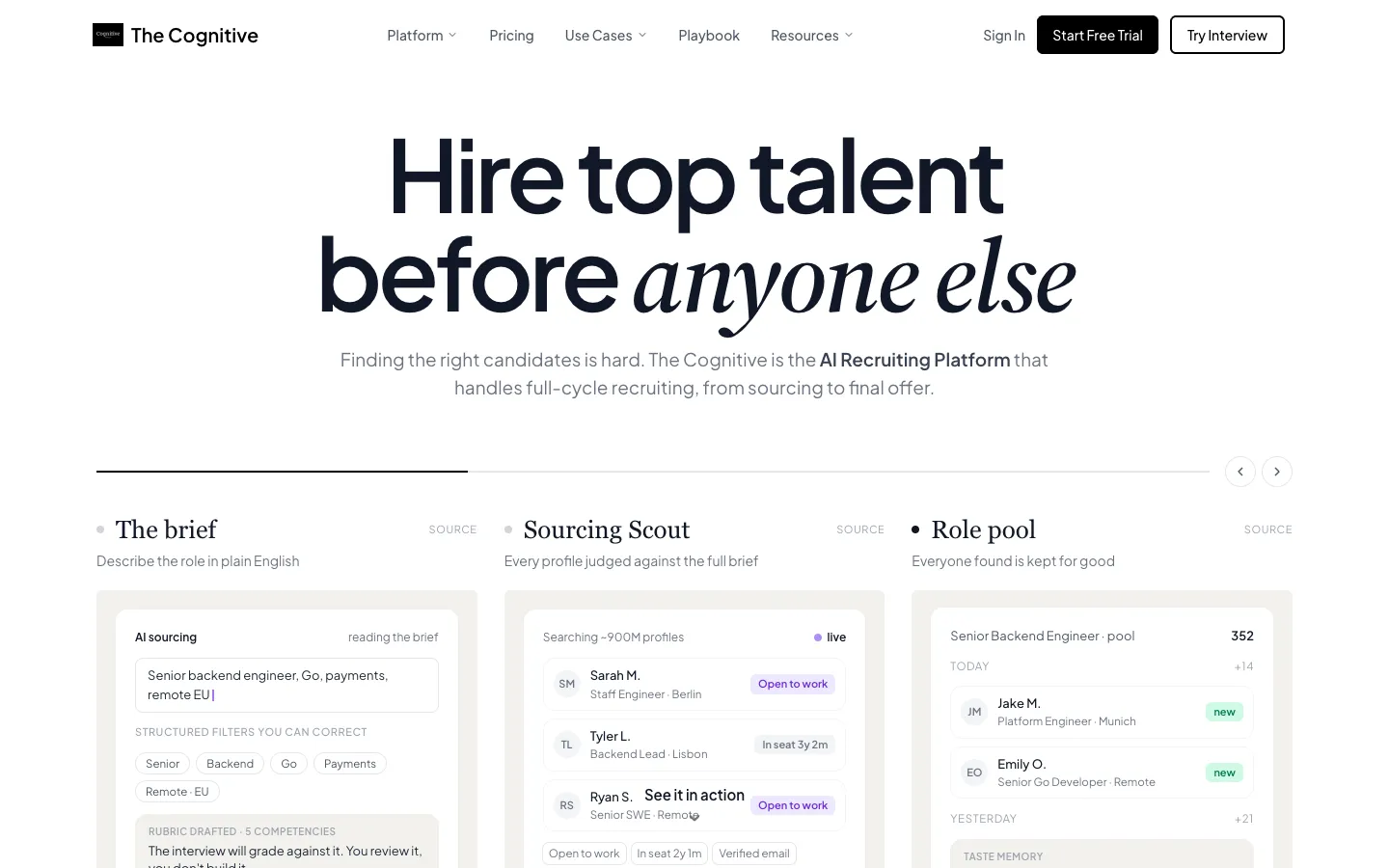
The Cognitive is built for that route. You describe the role in plain English, and the brief becomes search filters you can see and change. The search covers about 900M public profiles, and each person in the results comes with a short reason for the match.
Credits are spent per person, not per search: 1 for each person shown, 4 to reveal a personal email, and 12 for a phone number on Sourcing Pro and above. Email outreach is on the Sourcing Team plan and on Sourcing Pro and above. It goes out from your own mailbox, and the follow-ups end as soon as someone replies.
People who reply can then be invited, on an AI Interviews plan, to a live two-way AI video interview. You pick 10 or 20 minutes, the candidate joins from a laptop or desktop, and 9 languages are available. Follow-up questions depend on what the candidate says, and everyone for the role is scored on the criteria you chose.
The scorecard above sits next to the interview recording and transcript. A hiring manager can open a shared link that shows the scorecard and the recording. Higher plans add a connection to 100+ applicant tracking systems. Sourcing and interviewing are bought as two plans. Plans start at $99 a month; every tier is listed on the pricing page.
When to skip it
The Cognitive is software, not a recruiter. Nobody runs the search for you, takes the candidate's calls or negotiates the offer. Skip it, and hire a person or a firm, in four cases:
- A board-level or confidential search, where a retained firm's network and discretion are what you are buying.
- Nobody on the team has hours to run outreach and first calls. A tool with no one driving it fills no roles.
- High-volume hourly hiring that runs on job posts and applications. The Cognitive does not post jobs or collect applications.
- You need someone to sell the role and close candidates. That is a human job.
How to start
Start with the role that has the fewest candidates in play. Agree the brief with the hiring manager, run one search and read the first page of results before contacting anyone. A 7-day trial needs no card and covers the first 100 people your searches show, 100 in total across every search. The trial is for searching; writing to people needs the Sourcing Team plan or Sourcing Pro and above. Create a free account and run the first search.
Sources
- SHRM, 2025 Recruiting Executives Benchmarking: Insights to Maximize Recruitment (2,371 SHRM members, medians), shrm.org, 2025.
- U.S. Bureau of Labor Statistics, Occupational Employment and Wages: Human Resources Specialists, bls.gov, May 2025 data.
- U.S. Bureau of Labor Statistics, Employer Costs for Employee Compensation, June 2026, bls.gov, 2026.
- Robert Half Inc., Form 10-K for the fiscal year ended December 31, 2025, sec.gov, 2026.
- Heidrick and Struggles, Form 10-K for the fiscal year ended December 31, 2024, sec.gov, 2025.
- RPO Association, How Much Does RPO Cost? An Employers' Comprehensive Guide To RPO Pricing Models, rpoassociation.org, 2024.
- Gem, Key takeaways from the 2026 Recruiting Benchmarks Report, gem.com, 2025.
- Pricing models and descriptions from each company's own website: Dover (dover.com), Cielo (cielotalent.com).
Frequently Asked Questions
How much does it cost to hire a recruiter?
It costs about $108,500 a year to employ a recruiter in-house, or a fee per hire if you use an agency or search firm. The in-house figure is an estimate. It takes the BLS median wage for human resources specialists, $75,940 in May 2025, and divides it by 0.70, because BLS puts wages at 70.0% of private-industry employer costs. Agencies charge a percentage of the hire's annual pay on placement and do not publish it. Retained search firms charge about one-third of estimated first-year pay, according to Heidrick and Struggles' 2024 annual report. Across every method, SHRM's 2025 median cost per hire was $1,200 for nonexecutive roles and $10,625 for executive roles.
Is it cheaper to hire an in-house recruiter or use an agency?
An in-house recruiter is cheaper once there is enough steady hiring to spread the salary across. Divide the roughly $108,500 yearly cost by the requisitions you expect: about $18,100 each at 6 a year, $5,400 at 20 and $2,200 at 50, using SHRM's 2025 medians as workloads. Compare that with an agency's quote for one hire at your salary level. An agency still wins when hiring is rare or comes in bursts, because it charges nothing for roles it does not fill.
Who pays the recruiter, the company or the candidate?
The company pays, not the candidate. Robert Half's 2025 annual report states that fees for successful placements "are paid only by the employer" and that "No fee for placement services is charged to employment candidates." Job seekers can work with agency recruiters for free, but the recruiter works for the employer that pays the fee.
How many roles can one recruiter handle?
A recruiter handles about 20 requisitions a year at the median, according to SHRM's 2025 benchmarks. The figure rises with company size: 6 at organizations under 100 employees, 22 at medium, 50 at large and 60 at extra-large organizations. At any one moment, Gem's 2026 Recruiting Benchmarks Report found recruiters managing 13.4 open roles.
How long does it take a recruiter to fill a role?
It takes about a month and a half at the median. SHRM's 2025 data puts the median time to fill at 44 days for nonexecutive roles and 45 days for executive roles. Extra-large organizations take longer, about 60 days.
What is the difference between a contingency and a retained recruiter?
A contingency recruiter is paid only when you hire someone they found, while a retained recruiter is paid a retainer whether or not you hire. Contingency suits one-off roles in markets the agency knows. Retained search suits senior or confidential seats; Heidrick and Struggles reports retainers of about one-third of estimated first-year pay.
Can AI software replace a recruiter?
AI software can replace much of the finding and first screening, but not the relationship or the close. A tool such as The Cognitive searches about 900M public profiles from a plain-English brief and runs a live two-way AI video first interview scored against your criteria. Someone still has to run the outreach, judge the shortlist, sell the role and negotiate the offer. A team with no spare hours is better served by a recruiter.
Related reading
- What Is a Normal Cost Per Hire? Benchmarks by Seniority, Sector, Role and Region
- AI Recruiting Assistant vs Human Recruiter: Which Delivers Better Candidate Quality?
- Recruiting Software for Startups: 10 Picks for Founders Hiring Without a Recruiter
- Best Retail Hiring Software in 2026: 9 Tools for Store Teams and Store Leaders
- Top Accounting and Finance Recruiting Firms in 2026: 9 Firms and a Do-It-Yourself Option
- Best EOR Companies in 2026: 11 Employer of Record Providers Ranked, Plus the Step Before