How to Recruit Nurses: Strategies for Hospital and Clinic Recruiters
By Sparsh Goyal, Founder at The Cognitive. Published · Last updated
- To recruit nurses, brief by unit, specialty, shift and license state. Start with nurses you know, source the ones not applying, confirm the license in Nursys and interview around their shifts.
- An experienced RN takes 78 days to recruit and the hospital RN vacancy rate is 8.6%, according to the 2026 NSI report on 527 US hospitals.
- Retention is part of recruiting, since 22.7% of newly hired RNs left within a year in the same report.
To recruit nurses, write the brief by unit, specialty, shift and license state. Start with nurses you already know, then search for nurses who are not applying. Reach them with the facts that decide a move, confirm the license in Nursys and run a first interview that fits around their shifts. Then protect the first year.
An experienced registered nurse takes 78 days to recruit, according to the 2026 NSI National Health Care Retention & RN Staffing Report, a survey of 527 US hospitals. The same report puts the hospital RN vacancy rate at 8.6%, and 22.7% of newly hired RNs left within a year.
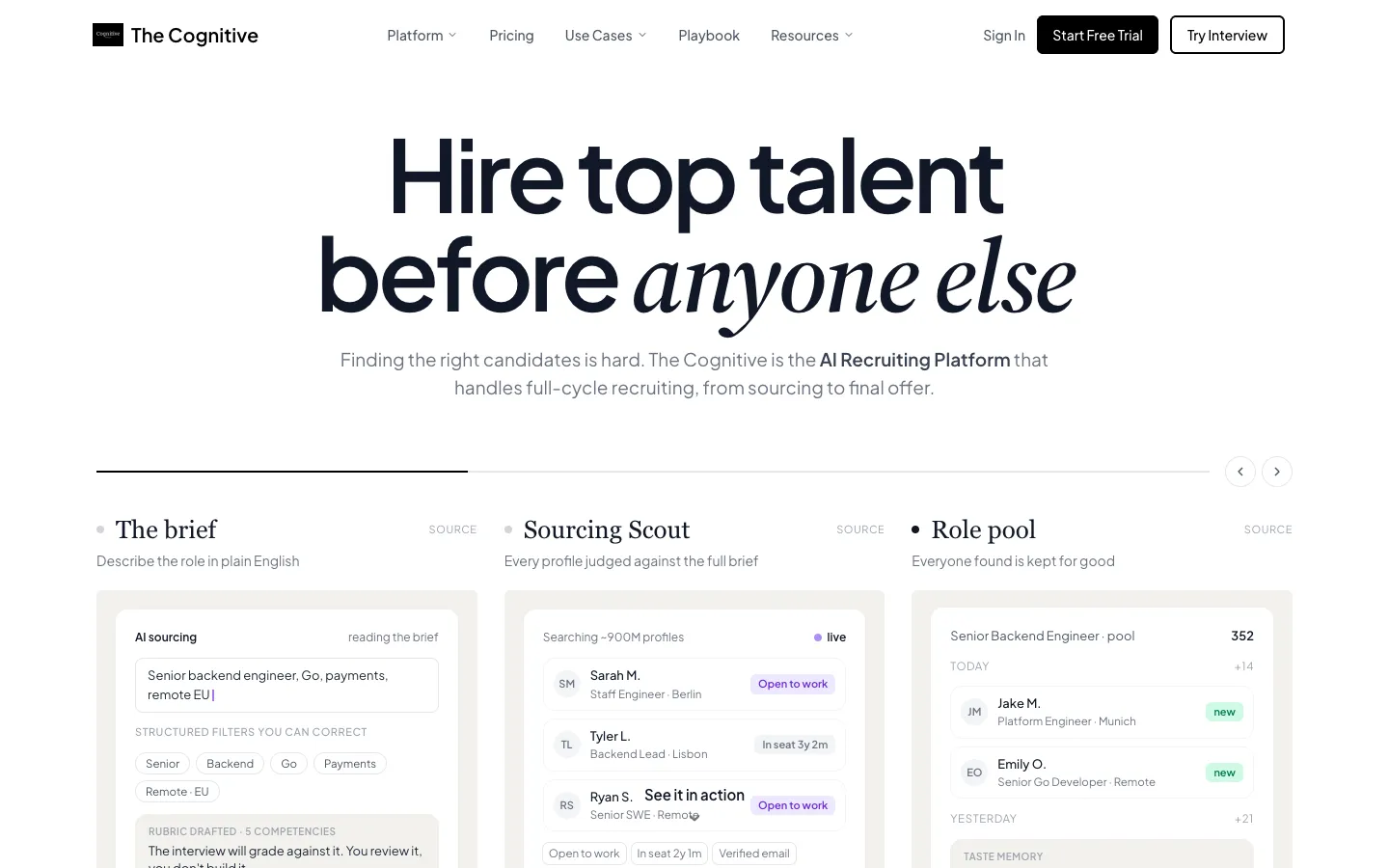
A sourcing tool such as The Cognitive can handle the search, the email outreach and the first interview. Credentialing stays with your team.
How do you recruit nurses?
Recruiting nurses means finding licensed RNs and LPNs for a specific unit, specialty and shift, reaching the ones who are not job hunting, and hiring them before another employer does. Seven steps cover it, in this order:
- Write the brief with the nurse manager. Unit, patient population, shift pattern, the license states you accept, certifications such as CCRN or CEN, and the pay range.
- Start with nurses you already know. Past applicants, former staff, contract nurses on your units and referrals.
- Source nurses who are not applying. Search by specialty and state, including nurses employed at other hospitals and recent graduates.
- Send a message built on the job's facts. Schedule, staffing, pay and orientation, with two follow-ups.
- Confirm the license. Nursys QuickConfirm is free.
- Interview around shifts. A short first round the nurse can book, then the nurse manager and a unit visit.
- Offer fast and plan the first year. Preceptor, orientation and schedule agreed before the start date.
Nurse recruitment strategies compared
No single channel staffs a nursing department. Each strategy reaches a different kind of nurse and moves at a different speed, so most hospitals run several at once.
| Strategy | Best for | Speed |
|---|---|---|
| Job boards and career site | Nurses already looking | Days, if pay and shift are shown |
| Outbound sourcing | Employed specialty RNs | Days to first replies |
| Past applicants and former staff | Nurses who know you | Fastest; already in your ATS |
| Employee referrals | Units with stable staff | Steady, slow to start |
| Schools and residencies | New graduates | Months |
| Converting contract nurses | Units using agency staff | Weeks, before the contract ends |
| Travel or agency nurses | Gaps that cannot wait | Fastest cover, but not a hire |
Only the first six rows add nurses to the payroll. Costs differ by channel: per post or per click for job boards, recruiter time for past applicants and sourcing, a referral bonus, residency program costs, any conversion fee in the agency contract, and an hourly bill rate for travel cover.
Why is recruiting nurses so hard right now?
Recruiting nurses is hard because national demand is large and steady, while supply in any one specialty and city is thin. The 2026 NSI report estimates the national RN shortage at 158,600 nurses.
| Figure | Number | Source |
|---|---|---|
| RN jobs in the US, 2025 | About 3.5 million | BLS |
| RN openings a year, 2025 to 2035 | About 180,800 | BLS |
| Median RN pay, May 2025 | $97,550 a year | BLS |
| Hospital RN vacancy rate | 8.6% | NSI 2026 |
| Unfilled RN FTEs, average hospital | 43 | NSI 2026 |
| Qualified applications turned away by nursing schools, 2025 | 92,672 | AACN |
| Nurses who left the workforce since 2022 | More than 138,000 | NCSBN 2025 |
The Bureau of Labor Statistics projects RN jobs to grow 6% from 2025 to 2035. The figure recruiters feel is the other one: about 180,800 RN openings a year, on average, across the decade.
New supply is limited by seats, not interest. The American Association of Colleges of Nursing counted 92,672 qualified applications that US baccalaureate and graduate nursing programs could not accept in 2025. The nursing faculty vacancy rate was 7.2%. Entry-level BSN enrollment rose 7.6% in 2025, so the new-graduate pipeline is growing, but slowly and on a graduation calendar.
Exits are the other pressure. A 2025 study from the National Council of State Boards of Nursing found that 39.9% of RNs and 41.3% of LPN/VNs intend to leave the workforce or retire within five years. Among nurses planning to leave rather than retire, about 41.5% named stress and burnout as the root cause.
Recruiting teams are not growing to match. In the 2026 NSI report, only 26.7% of hospitals plan to increase their recruitment budget, and 6.7% plan to add recruitment staff. With 0.26 recruitment FTEs per 100 employees, recruiter hours are the real constraint.
Where do you find nurses who are not applying?
Job boards reach nurses who are already looking. The larger group is employed, busy and open to a better unit or schedule, and that group has to be found. Across all roles, not only nursing, Gem's 2026 Recruiting Benchmarks found that direct sourcing delivered 11% of hires from just 2.6% of applications.
Past applicants and former staff
Your ATS already holds nurses who applied before, finalists who took another offer, and former staff who left on good terms. Check them at every opening before searching anywhere else. The method is in candidate rediscovery, and the case for rehiring is in boomerang employees.
Employee referrals
Nurses know nurses at other hospitals, and they know who is unhappy with their schedule. Keep the program simple: a clear bonus, paid on a known date, and a note to the referrer on what happened. The full setup is in employee referral program.
Nursing schools, clinical placements and residencies
Students who did a clinical placement on your unit already know the staff and the charting system, which makes hosting placements a slow but reliable channel. Nurse residency programs turn those graduates into staff nurses, and hospitals in the 2026 NSI report rated them 3.9 out of 5 for effectiveness.
Contract and travel nurses on your units
A travel nurse halfway through an assignment on your unit already knows the patients, the staff and the routines. Make the staff offer weeks before the contract ends, not on the last shift. Read the agency contract first, since some carry a conversion fee.
Nurses ready to move up
LPNs finishing an RN bridge program and med/surg nurses who want critical care training may already be on your payroll. An internal path fills a hard unit and keeps a nurse who would otherwise train elsewhere.
Specialty nurses at other employers
For experienced specialty roles, the people you want work at the hospitals, surgery centers and clinics around you. Reaching them takes outbound sourcing by specialty, setting and license. Message ideas for people who are not looking are in passive candidate sourcing.
How do you search for nurses by specialty and license?
Search for nurses by specialty, setting and license state before job title. A labor and delivery nurse and a home health nurse share a title and little else. A brief for a sourcing tool might read:
Registered nurse with at least two years in labor and delivery, Arizona license or a multistate compact license, open to 12-hour day shifts, within 30 miles of Phoenix. RNC-OB certification is a plus.
License state comes first because, in the words of the BLS, "Registered nurses must have a nursing license issued by the state in which they work." The Nurse Licensure Compact widens the map: 43 jurisdictions are part of it, and it lets a nurse whose home state is a member, and who holds a multistate license, practice in the other member states. Check whether your own state is a member before you count compact nurses in.
Confirm the license in Nursys
A license on a profile or résumé is a claim. Nursys describes itself as "the only national nurse licensure and disciplinary database". Its QuickConfirm lookup shows a nurse's license and discipline status for free, for participating boards of nursing. Run it as soon as a nurse agrees to interview, so a lapsed license or a discipline record surfaces before the manager spends an hour on the candidate.
For nurses you hire, Nursys e-Notify sends free license expiration and status updates by email for the nurses an employer enrolls. That keeps the check going after the start date.
Searching by specialty in The Cognitive
In The Cognitive, a recruiter pastes a brief like the labor and delivery one and gets a search across about 900M public profiles. The brief becomes filters for title, location, past employers and skills that the recruiter can edit, and each result shows a short reason for the match. Certifications such as CCRN or RNC-OB go in the brief.
On US clinical searches, a profile that matches an entry in the public NPI registry shows a badge that links to that registry entry. The badge is a lead for the license check, not the check itself. It appears only when a registry match exists, and a profile without it tells you nothing. The Cognitive does no credentialing, so Nursys and your credentialing team still confirm every license.
Ready-made Boolean and plain-English strings for ICU and new-graduate openings are on the hire a nurse page. SeekOut, hireEZ, Pin and Noon also sell sourcing to healthcare teams. SeekOut and nine other platforms for hospitals and agencies are compared in best healthcare recruiting software.
What should a nurse recruitment campaign say?
A nurse recruitment campaign is a set of messages and follow-ups aimed at one kind of nurse for one kind of opening. It works when it answers the questions a nurse asks before replying. Put these in the first message, not in a later call:
- The unit and patients. Bed count, patient population and acuity.
- The schedule. Shift length, days or nights, weekend rotation, and how schedules are made.
- Staffing. Typical ratio, and whether there is a charge nurse, float pool or unit secretary.
- Pay. The range and the differentials for nights, weekends and certifications.
- Orientation. How many weeks, and who precepts.
Schedule flexibility deserves the top line if you can offer it. In AMN Healthcare's 2025 survey of more than 12,000 registered nurses, 81% said flexible schedules would improve their working conditions. In the same survey, 61% planned a career change within the next year, a figure that includes switching jobs, departments or schedules, or retiring. A nurse who wants a different schedule is a candidate, even if they would never call themselves one.
A short first email that does this:
Subject: L&D day shift in Phoenix, self-scheduling
Hi Maria, your four years in labor and delivery stood out. Our L&D unit is hiring two day-shift RNs: 12-hour shifts, schedules booked six weeks ahead by the nurses themselves, a charge nurse on every shift, and a pay range of [range]. Would a 15-minute call this week work, at a time that fits around your shifts?
Creative nurse recruitment strategies that work are specific. A campaign signed by the nurse manager, an invitation to shadow a shift, or a message to travel nurses whose assignments end nearby all beat a generic "We're hiring RNs" post. Send two follow-ups in the same thread a few days apart, then stop.
The Cognitive sends this kind of sequence from the recruiter's own mailbox, and the follow-ups stop when the nurse replies. For job posts, start from the nurse job description.
How do you hire nurses faster?
Hiring nurses faster means shortening the wait between steps, because the shortage itself is out of a recruiter's hands. In the 2026 NSI report, the 78-day figure for an experienced RN ranges from 56 to 102 days by specialty. A recruiter controls the gaps between reply and interview, and between final interview and offer.
- Answer replies the same day. A nurse who replies on a day off may have taken another call by the next one.
- Let the nurse choose the interview time. A night-shift nurse cannot take a 10 a.m. phone screen.
- Combine the manager interview and the unit visit. One trip to the hospital instead of two.
- Approve the pay range before sourcing starts. The offer should not wait for a sign-off meeting.
- Start the Nursys check early. Run it when the interview is booked, not after the final round.
A first interview that fits around shifts
The first round in The Cognitive is a live two-way AI video interview for nurses of 10 or 20 minutes. The nurse books a time from the dates the recruiter sets, can start any time before that slot, and can reschedule or cancel from the same link. The invitation tells the nurse the interview is run by AI. Interviews run in 9 languages.
The questions follow up on what the nurse says, and the rubric stays fixed for the role, with criteria the recruiter sets, such as communication, prioritization and escalation. It is a first-round read, not a clinical skills assessment, and the nurse manager still runs the clinical conversation. Question ideas for both rounds are in the nurse interview questions.
The nurse manager can check each score against the recording.
A Toronto nurse staffing agency using The Cognitive reported that its time to first interview fell from 5 days to 3 hours. The healthcare staffing case study has the customer-reported details.
When to skip The Cognitive
The Cognitive does no credentialing, does not confirm licenses with state boards, and runs no background checks. It has no job posting, careers site or applicant intake, so a hospital whose openings fill from applicants gets more from its ATS. It does no shift scheduling, per diem contracts or travel staffing.
The AI interview needs a laptop or desktop with a camera, and it does not run on phones or tablets, so a nurse with only a phone between shifts cannot take it there. Email outreach comes with the Sourcing Pro, Max, Team, Business and Enterprise plans; the trial and the Sourcing Starter and Growth plans have none.
Should you use travel nurses or an agency, or hire directly?
Use travel or agency nurses to cover a gap now, and direct hiring to close it.
The cost explains why most hospitals want less of it. In the 2026 NSI report, nurse travel rates averaged $91 an hour and ranged to $160 an hour. 70.7% of hospitals said they want to reduce their reliance on travel and agency staff.
An agency fits a sudden rise in census, cover for leave, a new unit with a fixed opening date, or a specialty with no local supply. Direct hiring wins for openings that come back every year. A middle path sits in the strategies table: offer staff roles to contract nurses who already work your units. For the broader healthcare picture, including physicians and HIPAA questions, see healthcare recruiting.
How do you keep the nurses you recruit?
Keeping new nurses is part of recruiting them, because a nurse who leaves in year one restarts a search that averages 78 days. The 2026 NSI report puts hospital RN turnover at 17.6%, up 1.2 points. Of newly hired RNs, 22.7% left within a year. Those early leavers accounted for 29.0% of all RN separations.
Each exit has a price. NSI puts the cost of turnover for one bedside RN at $60,090, and each 1% change in RN turnover costs or saves the average hospital $295,000 a year. 74% of hospitals have a formal retention strategy, and 80.8% of those include steps to protect newly hired nurses.
Retention offers double as recruiting offers, so name them in the first message:
- A residency or transition program for new graduates.
- A named preceptor, not whoever is on shift.
- Schedule input, such as self-scheduling or a fixed pattern.
- No floating to other units during orientation.
- Check-ins at 30, 60 and 90 days with the nurse manager.
Common nurse recruiting mistakes
- One generic RN posting for every unit. An ICU nurse and a clinic nurse skip the same vague ad for different reasons.
- Waiting for applicants on specialty roles. Many experienced specialty nurses are not looking, so they have to be found.
- Treating a profile line or a badge as a license check. Confirm it in Nursys or with the state board.
- Interview slots in office hours only. Many of your candidates work nights.
- Counting hires but not first-year exits. A hire who leaves in month eight is a second vacancy.
To start, pick the one unit with the longest open requisitions. Write its brief with the nurse manager, work your ATS and referrals first, then source the rest by specialty and state. Track reply rate, time to fill and first-year turnover for that unit for one quarter before widening the plan.
Plans start at $99 a month. The Cognitive's 7-day trial needs no card and includes 100 sourcing credits, enough to see 100 people; the trial has no email outreach. Start free with The Cognitive.
Sources
- NSI Nursing Solutions, 2026 NSI National Health Care Retention & RN Staffing Report (527 hospitals, calendar year 2025 data), nsinursingsolutions.com, 2026.
- US Bureau of Labor Statistics, Occupational Outlook Handbook: Registered Nurses (May 2025 pay, 2025 to 2035 projections), bls.gov.
- American Association of Colleges of Nursing, Nursing Shortage Fact Sheet (2025 data), aacnnursing.org, 2026.
- National Council of State Boards of Nursing, NCSBN research highlights small steps toward nursing workforce recovery, ncsbn.org, April 2025.
- AMN Healthcare, 2025 Survey of Registered Nurses (more than 12,000 nurses), amnhealthcare.com, May 2025.
- Nurse Licensure Compact, nursecompact.com.
- Nursys, QuickConfirm and e-Notify, nursys.com.
- Gem, Key takeaways from the 2026 Recruiting Benchmarks Report, gem.com, 2025.
- Vendor sites for the healthcare sourcing tools named: seekout.com, hireez.com, pin.com, noon.ai.
Frequently Asked Questions
What is the best way to recruit nurses?
The best way to recruit nurses is to combine several channels, led by the nurses you already know and outbound sourcing by specialty and state. Check past applicants, former staff and contract nurses on your units first, add employee referrals, then search for employed specialty nurses at other hospitals. Job boards still reach nurses who are actively looking.
How long does it take to recruit an experienced nurse?
Recruiting an experienced registered nurse takes 78 days on average, according to the 2026 NSI National Health Care Retention & RN Staffing Report. The same report shows a range of 56 to 102 days depending on specialty. Recruiters shorten it by answering replies the same day, letting nurses book interviews around their shifts, and having the pay range approved before sourcing starts.
How do I check a nurse's license?
Check a nurse's license in Nursys QuickConfirm, a free lookup of license and discipline status, or with the state board of nursing. Nursys e-Notify then sends free license expiration and status updates by email for the nurses an employer enrolls. A license listed on a profile, a résumé or a sourcing tool's badge is a lead, not a confirmed license.
Can you recruit nurses from other states?
Yes, if the nurse is licensed to practice in the state where the job is. The Nurse Licensure Compact has 43 member jurisdictions and lets a nurse with a multistate license from one member state practice in the others. Nurses from non-compact states need a license from your state, so check your own state's status and build licensing time into the start date.
What metrics should nurse recruiters track?
Nurse recruiters should track time to fill, first-year turnover, vacancy rate, source of hire and offer acceptance. Reply rate matters for outbound sourcing, and agency hours matter for units that rely on travel staff. First-year turnover is the one most often left out, yet 22.7% of newly hired RNs left within a year in the 2026 NSI report.
Can an AI interview assess a nurse's clinical judgment?
No, an AI first interview gives a first-round read, not a clinical skills assessment. In The Cognitive, a nurse takes a live two-way AI video interview scored against criteria the recruiter sets, such as communication, prioritization and escalation. The nurse manager gets the recording and transcript. The nurse manager still runs the clinical interview and makes the decision.
What software helps recruit nurses?
Nurse recruiting usually combines an ATS for applicants with a sourcing tool for nurses who are not applying. Sourcing tools that market to healthcare teams include The Cognitive, SeekOut, hireEZ, Pin and Noon. The Cognitive searches by specialty and state, shows a badge linking to the public NPI registry entry on US clinical searches, and runs a live AI first interview. It does no credentialing.
Related reading
- Healthcare Recruiting Software for Hospitals and Staffing Agencies: The 10 Best in 2026
- AI Video Interviews for Healthcare Hiring: Key Features Recruiters Actually Need
- Passive Candidate Sourcing: How to Find, Message and Hire People Who Are Not Applying
- Best Retail Hiring Software in 2026: 9 Tools for Store Teams and Store Leaders
- 10 Best CRMs for Staffing Agencies in 2026, Scored
- Best EOR Companies in 2026: 11 Employer of Record Providers Ranked, Plus the Step Before