SourceWhale vs Juicebox in 2026: Agency Desk or AI Search?
By Sparsh Goyal, Founder at The Cognitive. Published · Last updated
- SourceWhale is an AI-native CRM and ATS that runs an agency's whole desk, while Juicebox is AI search across 800M+ profiles with outreach and agents.
- Pick SourceWhale for texts, WhatsApp, a dialer and placements in one system; pick Juicebox for fast search on a published per-seat plan with a free tier.
- Neither runs a candidate interview, which is where The Cognitive, a third option, comes in.
SourceWhale is now an AI-native CRM and ATS for recruitment agencies that runs the whole desk, from search and outreach to calls, notes and placements. It still syncs two-way with about 60 named systems, most of them CRMs and ATSs. Juicebox is AI candidate search across 800M+ profiles, with email sequences and Juicebox Agents, sold per seat with a free plan. Pick SourceWhale if you run an agency desk and want texts, WhatsApp, a dialer and your CRM in one system. Pick Juicebox if your bottleneck is finding people, you hire in-house or on a small team, and you want to start today on a published plan.
The choice matters because sourcing still pays. In Gem's 2026 Recruiting Benchmarks Report (December 2025), directly sourced candidates were 2.6% of applications but 11% of hires. Neither SourceWhale nor Juicebox runs a candidate interview, and a third option that does is covered below.
Disclosure: The Cognitive is our product.
SourceWhale vs Juicebox at a glance
Each cell reflects what the vendor's own website says.
| SourceWhale | Juicebox | |
|---|---|---|
| What it is | AI agency desk with its own CRM and ATS | AI search, outreach and sourcing agents |
| Built for | Recruitment agencies | In-house teams, plus agencies |
| Search | Your CRM plus public profiles | 800M+ profiles, 30+ sources |
| Pool size published? | No | Yes |
| Outreach | Email, SMS, WhatsApp, dialer | Email, plus call and social steps |
| After a reply | Stops; Inbox Agent drafts answers | Sequence stops on reply |
| AI agents | Campaign AI, Inbox Agent | Juicebox Agents (add-on) |
| CRM and ATS | Own CRM and ATS | Lighter CRM view |
| ATS sync | Two-way, about 60 named | 100+ claimed, Business plan |
| Pricing model | Quote after a demo | Per seat per month |
| Price on website? | No | Yes, except Business |
| How you start | Book a demo | Free plan, self-serve |
| Interview step | No; records your meetings | No |
What do SourceWhale and Juicebox do?
SourceWhale: one system for the whole agency desk
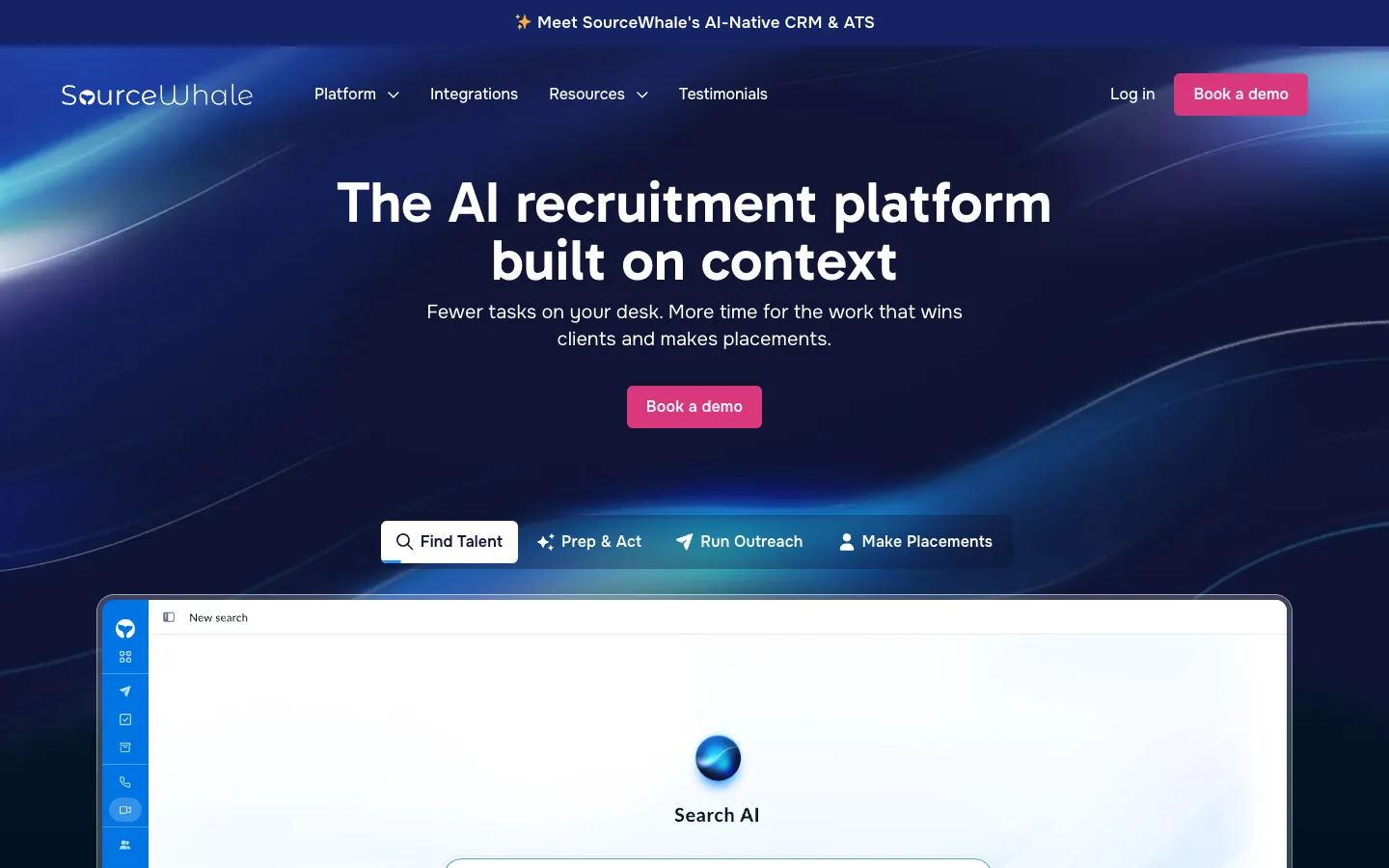
SourceWhale describes itself as "the AI recruitment platform that runs your whole desk, from first search to final placement." Its modules are Sourcing, Data, Outreach, Dialer, Notetaker, Inbox Agent, CRM & ATS and Data Refresh.
Many recruiters still know it as the outreach layer that sat on top of an agency's CRM. SourceWhale is now also a CRM and ATS. Its own system "combines a recruitment CRM and applicant tracking system in one place, so clients, candidates, jobs and BD all work from the same record." It also records placements, fees and invoicing. Moving over starts with field mapping and a sample migration of people, companies and projects.
You can still keep your current CRM and connect SourceWhale to it. The homepage says it is trusted by "thousands of recruitment agencies," and claims "17 hrs back per recruiter, per week."
Juicebox: AI recruitment search first, with outreach and agents around it
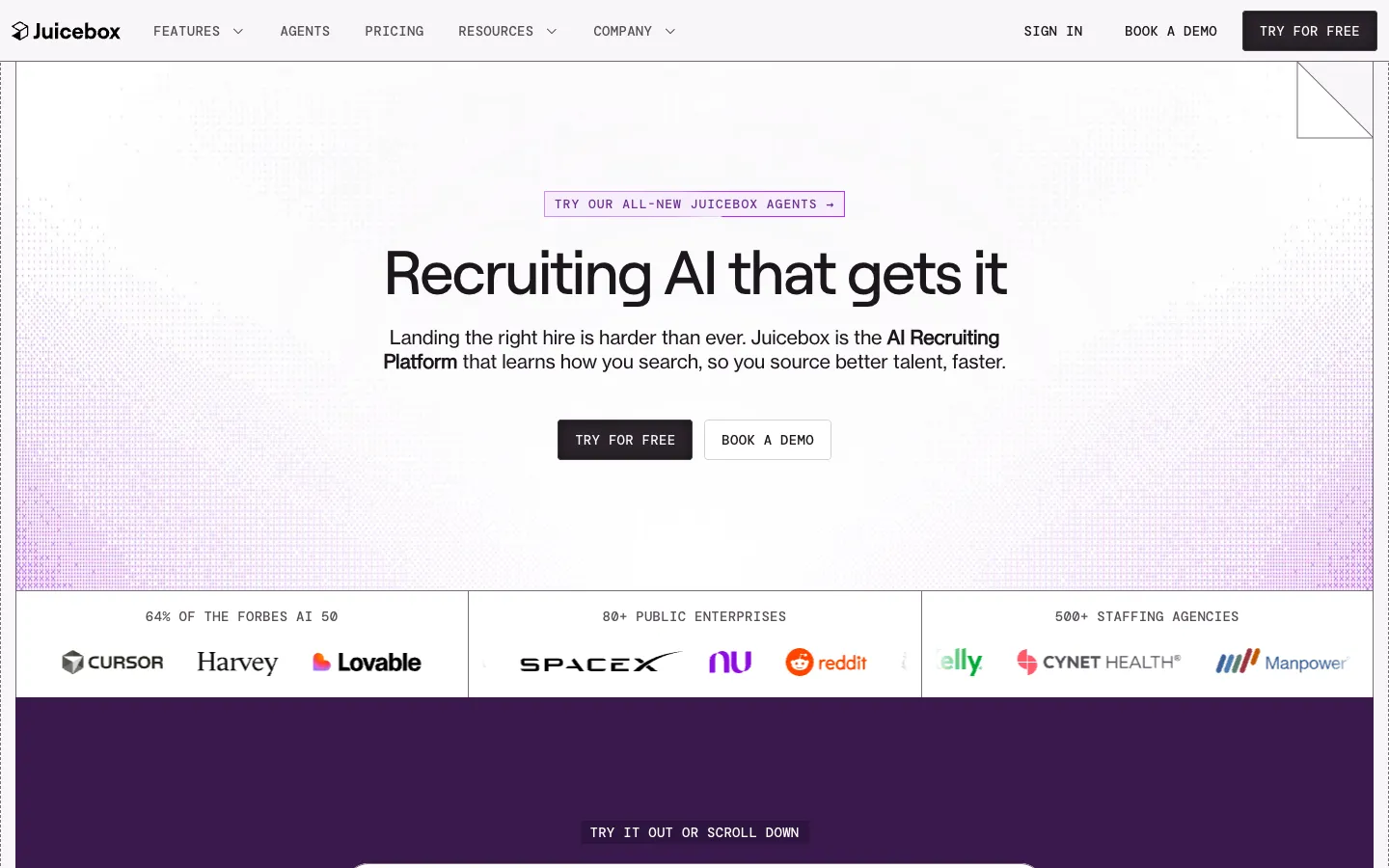
Juicebox calls itself "the AI Recruiting Platform that learns how you search, so you source better talent, faster." Its search, once marketed as PeopleGPT, takes a plain-English request, sets the filters for you and looks across "800M+ profiles from 30+ data sources."
Around the search sit email sequences, Juicebox Agents that source and email in the background, a CRM view, talent insights and an intake step for each new role. The customers named on its homepage are mostly in-house teams, such as Lovable, ezCater and Heidi Health, and it also cites "500+ staffing agencies." The Juicebox review covers each feature and plan in depth.
Which has better candidate search and data?
Juicebox is stronger for finding new names; SourceWhale is stronger for searching what your agency already knows.
SourceWhale asks you to "describe who you need" and "puts the strongest matches first." It searches your CRM and public profiles from the same brief, and you can mark each profile Yes or No, while Memory keeps the preferences you use again. Its distinct angle is depth inside your own records: "Most sourcing tools search fields. SourceWhale searches what was actually said," meaning calls, meetings, resumes and notes. It claims "9 in 10 results are genuinely the right fit."
For contact details, one search runs across multiple data providers, and emails and phone numbers are enriched automatically. It publishes no count of public profiles.
Juicebox publishes its pool: 800M+ profiles from 30+ sources. Juicebox "evaluates up to 5,000 profiles" to rank the best matches for a role, and an AI spotlight shows why a candidate matches. Talent insights on the Growth plan and up show where candidates live, their most common skills and average tenure. Emails and phone numbers are revealed with contact credits.
Your own database is worth searching first. In the same Gem report, 46% of sourced hires were rediscovered candidates already in a company's CRM or ATS, up from 26% in 2021. An agency with years of call notes gets more from SourceWhale's search. A team entering a new market, with little history to mine, gets more from Juicebox's open pool.
One G2 reviewer (June 2026) flagged a SourceWhale gap worth testing: "Lack of a resume keyword search feature is a basic feature that should be added."
Which is better for outreach and follow-up?
SourceWhale reaches candidates on more channels. Juicebox covers email well and leaves calls and social touches to you as steps in the sequence.
SourceWhale offers "email, SMS, and WhatsApp sent from your own mailbox, with follow-ups that trigger themselves," and lets you "plan email, texts and phone calls in one campaign." Its native dialer "records, transcribes, summarises, and logs every call straight into your CRM." Campaign AI drafts the sequence in your tone, a reply stops the campaign, the Inbox Agent drafts answers, and the Notetaker records and summarises meetings.
Juicebox builds sequences with "email, calls, and social touches in one sequence," connected to Gmail or Outlook. "When a candidate replies, the sequence stops automatically." You can send from a hiring manager's or a company leader's mailbox by connecting theirs. Juicebox Agents can run hands-off or pause at a checkpoint before the shortlist or the sequence.
Both automate follow-ups, and that is where replies come from. In Gem's Fall 2024 outreach benchmarks, built on more than 4 million sequences, a five-stage sequence received twice the replies of a one-off email. Only 12.1% of sequences drew an interested reply. Texts and calls give an agency desk more ways past that wall, which is SourceWhale's real advantage.
Where SourceWhale's own comparison is out of date
SourceWhale publishes a page titled "SourceWhale vs Juicebox." Some of its points hold: Juicebox's site lists no SMS, WhatsApp or dialer, and no agency CRM with placements and fees. Its FAQ also concedes that "if your bottleneck is finding candidates faster, Juicebox is a strong option." Other claims read differently against what Juicebox's own site says:
- "Email-only" outreach. Juicebox says its cadences include call and social steps. Juicebox sends the emails; the call and social steps are tasks for the recruiter.
- Replies handled manually. Juicebox says a sequence stops when the candidate replies, and its Agents track replies. What it lacks is an agent that drafts the answer, like SourceWhale's Inbox Agent.
- Limited conversation management. Juicebox has a CRM view with notes, tags, tasks and activity history. It is lighter than an agency CRM, but it is there.
- Pricing, free plan and Agents. The page does not mention Juicebox's published prices, its free plan or Juicebox Agents.
How do their CRM and ATS integrations compare?
SourceWhale offers "deep two-way CRM/ATS integrations" with about 60 named systems. They include Bullhorn, JobAdder, Vincere, Loxo, Recruit CRM, Recruiterflow, Crelate, Greenhouse, Lever, Ashby, Salesforce and HubSpot. Agencies can also replace their CRM with SourceWhale's own. One senior recruiter on G2 described an extra step with Bullhorn in March 2026: "we have to first add a candidate to 'People' and then manually push them into Bullhorn."
Juicebox claims "100+ ATS and CRM integrations." Its Bullhorn page lists read and write sync, roles imported from Bullhorn and duplicates flagged. Inside Juicebox, the CRM view gathers every profile you have viewed, messaged or synced from your ATS. Juicebox's pricing page reserves ATS and CRM sync for its top tier, Business.
For an agency on Bullhorn, both connect. With Juicebox, plan for the Business tier if the sync is a must. With SourceWhale, decide early whether it sits beside your CRM or replaces it, because that changes the project from a connection into a migration.
SourceWhale pricing vs Juicebox pricing
SourceWhale publishes no prices or plan names. Its pricing link opens a demo form that asks for company size and whether you are in-house or agency. There is no self-serve signup on the website; access starts with a demo and a quote.
Juicebox charges per seat per month and publishes prices for its Free, Starter and Growth plans. Business is a custom quote, sold on annual terms only, and paying yearly earns a discount. The Agents add-on is billed per agent each month. The free plan includes limited searches and a handful of contact credits, and teams can invite colleagues on Growth and Business.
In practice, you can test Juicebox on a live role this afternoon. SourceWhale starts with a sales conversation. The Juicebox review lists what each Juicebox plan includes.
Which should agencies and in-house teams pick?
Pick SourceWhale if:
- You run an agency desk where the client, the candidate, the job and the placement fee belong on one record.
- Your candidates answer texts, WhatsApp and calls faster than email.
- Years of call notes and meetings sit in your CRM, and you want search that reads them.
- You are ready to replace several tools, or to connect SourceWhale to a CRM you keep.
Pick Juicebox if:
- You hire in-house or on a small team, and finding new people is the slow part.
- You want a published per-seat price and a free plan to try first.
- Email sequences with call and social reminders cover your outreach.
- You want agents that source and email in the background while you work other roles.
Third-party comparisons of the two are rare. In one r/RecruitmentAgencies thread, a recruiter who used both rated Juicebox slightly ahead of SourceWhale and hireEZ ahead of both.
For other pairings, see Fetcher vs Juicebox, hireEZ vs Juicebox, SeekOut vs Juicebox and Gem vs Juicebox. If LinkedIn Recruiter is the tool you are weighing, read LinkedIn Recruiter alternatives. For a wider field, this list of Juicebox alternatives ranks ten more.
A third option: The Cognitive
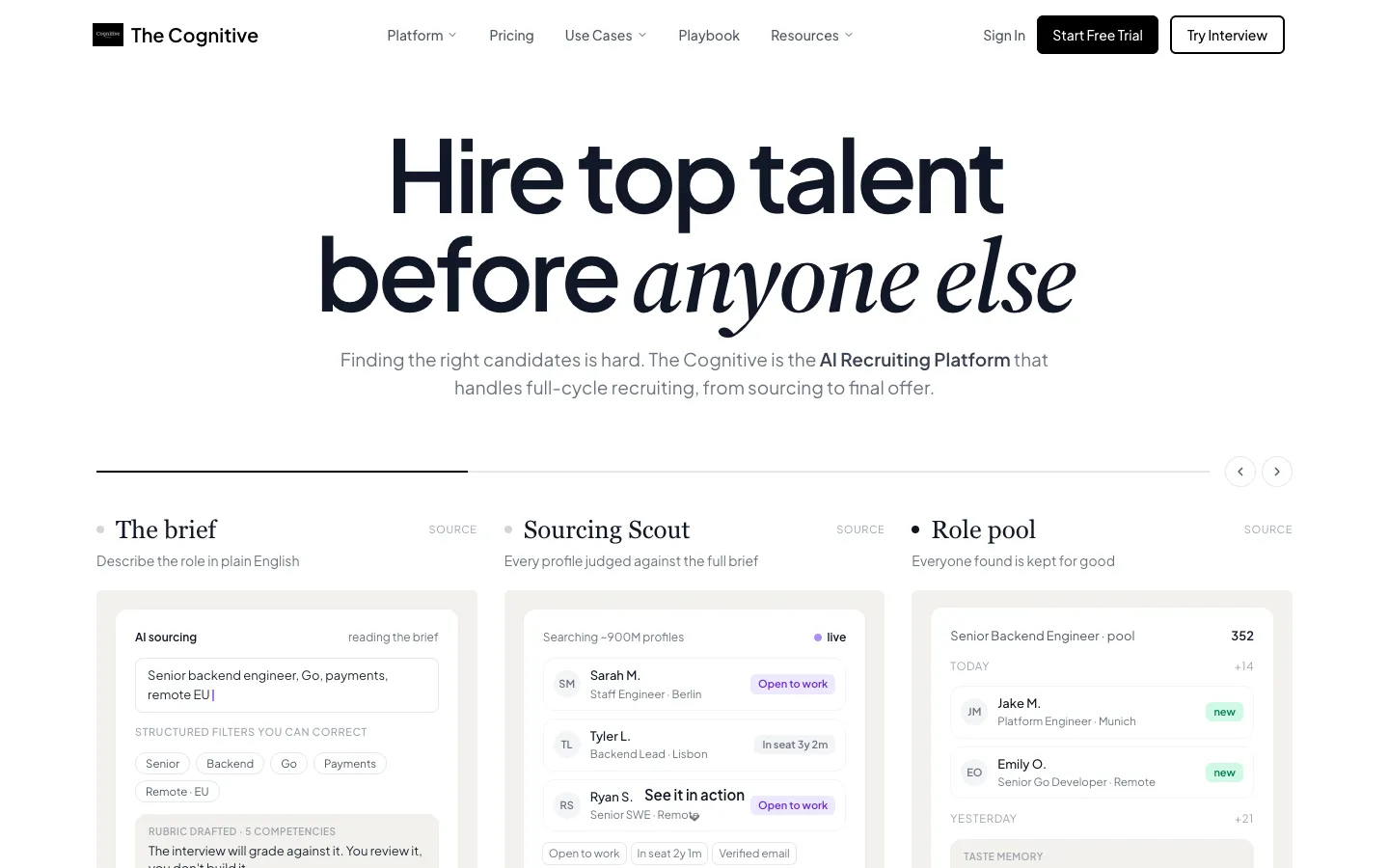
SourceWhale and Juicebox both stop at the conversation. The Cognitive finds people, emails them and then runs the first interview itself.
With AI sourcing, you describe the role in plain English and search about 900M public profiles. Each result carries a short reason for the match. Searching uses 1 credit for each person shown, charged once. A personal email is 4 credits to reveal; a phone number is 12, on Pro and above.
From Sourcing Pro up, the emails leave from your own mailbox. Each person gets a first email and two follow-ups, and the follow-ups halt the moment they reply. Anyone you shortlist can then sit a live two-way AI video interview in a laptop or desktop browser.
The AI asks role questions, follows up on the answers and leaves you a scored report. A 20-minute interview uses 100 credits. On higher plans, people sync with your ATS, one of 100+ it connects to.
Sourcing and Interviews are sold as separate plans, and each starts at $99 a month (see pricing). A 7-day trial needs no card.
When it is the wrong pick: The Cognitive is not a CRM or an ATS, and it has no dialer, texts or meeting notetaker. An agency that wants one system for clients, calls and placements is better served by SourceWhale. Candidates need a laptop or desktop for the interview.
To try it, run one open role through a search, shortlist the people who fit and send the sequence from your own mailbox. Start free with The Cognitive.
Sources
- Gem, "Key takeaways from the 2026 Recruiting Benchmarks Report", 1 December 2025. Gem blog
- Gem, "Recruiting email outreach benchmarks and best practices", Fall 2024 Edition (4M+ sequences, March 2023 to February 2024). Gem report (PDF)
- G2, SourceWhale reviews. G2 reviews
- Reddit, r/RecruitmentAgencies, sourcing tools compared by an agency recruiter, July 2026. Reddit thread
- SourceWhale pages on sourcewhale.com: homepage, CRM & ATS, Sourcing, Data, Outreach, Integrations, demo booking, and "SourceWhale vs Juicebox".
- Juicebox pages on juicebox.ai: homepage, Search, Outreach, Agents, CRM, Integrations, Bullhorn integration and pricing.
- The Cognitive homepage (thecognitive.io).
Frequently Asked Questions
What is the difference between SourceWhale and Juicebox?
SourceWhale runs an agency's whole desk, while Juicebox is built around finding people. SourceWhale has its own CRM and ATS, email, SMS and WhatsApp outreach, a dialer and a meeting notetaker. Juicebox searches 800M+ profiles from 30+ sources and adds email sequences, a CRM view and Juicebox Agents.
Is SourceWhale a CRM or an ATS?
Both. SourceWhale now sells its own combined recruitment CRM and ATS, with placements, fees and invoicing on the same record. You can also keep your current CRM or ATS and connect it, since SourceWhale syncs two-way with about 60 named systems, including Bullhorn, JobAdder and Vincere.
How much does SourceWhale cost?
SourceWhale does not publish pricing or plan names; its pricing page opens a demo form, and you get a quote after the demo. Juicebox, by contrast, publishes per-seat monthly prices for its Free, Starter and Growth plans, quotes its Business plan on annual terms and sells Agents as a paid add-on.
Does SourceWhale or Juicebox have a free trial?
Juicebox has a free plan you can sign up for online; SourceWhale's website offers a demo rather than a self-serve trial. Juicebox's free plan includes limited searches and a few contact credits, so you can test it on a live role before paying.
Which is better for recruitment agencies, SourceWhale or Juicebox?
SourceWhale is the better fit for most agencies that want one system for clients, candidates, calls and placements. Juicebox suits agencies whose main problem is finding new names quickly and who are happy with email sequences plus call and social reminders.
Do SourceWhale or Juicebox run AI interviews?
No, neither runs a candidate interview itself. SourceWhale's Notetaker records and summarises meetings your recruiters run. The Cognitive covers that step: it finds people across about 900M public profiles, emails them, and then holds a live two-way AI video interview. Its plans start at $99 a month.
What are the alternatives to both SourceWhale and Juicebox?
The Cognitive, hireEZ, SeekOut, Gem, Fetcher and Loxo are alternatives that cover the same ground. The Juicebox alternatives guide on The Cognitive's blog compares them, and more, on search, outreach and pricing model.
Related reading
- Juicebox Alternatives in 2026: 10 AI Sourcing Tools Beyond PeopleGPT
- Fetcher vs Juicebox: Fetcher Has Shut Down, So Where Do Its Users Go?
- AI Sourcing Tools Compared: The 10 Best for Finding Candidates in 2026
- Best Retail Hiring Software in 2026: 9 Tools for Store Teams and Store Leaders
- 10 Best CRMs for Staffing Agencies in 2026, Scored
- Best EOR Companies in 2026: 11 Employer of Record Providers Ranked, Plus the Step Before