6 Video Interview Questions and Winning Answers
By Sparsh Goyal, Founder at The Cognitive. Published · Last updated
Six video interview questions test focus, problem-solving, research, conflict handling, real-time thinking, and delivery, while winning answers use specific examples, clear structure, relevant detail, professionalism, and camera-aware communication. The Cognitive is AI recruiting software that sources candidates from ~900M profiles and interviews them live.
Prepare for success with 6 common video interview questions and winning answers to help you impress recruiters and confidently land your next job.
 The video interview is no longer a backup plan. For most candidates today, it is the actual first meeting with a company, camera, screen, and all. Yet most people still prepare for the questions and forget to prepare for the format.
- Quick tips that apply to any video interview, regardless of the question
- Six of the most common video interview questions
- What a weak answer sounds like versus a winning one for each
- A camera-specific tip for every question, so your delivery matches your content
1. Tell me about yourself
This is usually the opening question, and it sets the tone for the rest of the interview.
- What it's really assessing: Whether you can summarize your background with focus, not whether you can recite your resume.
- Weak answer: A chronological walk through every job since college, delivered in a flat tone with no clear point.
- Winning answer: A tight narrative connecting past experience to the role in front of you. For example, leading with the most relevant project, then briefly tracing how earlier roles built toward it, and closing with why this specific opportunity is the logical next step. The goal is a story with a clear throughline, not a list of job titles read in order.
- Video Interview -specific tip: Keep this answer under 90 seconds. On video, a long, unstructured opening reads as rambling faster than it would in person, since there is no shared room energy to carry it. If your key project needs structure, borrow the STAR method covered under the challenge question below, but keep it conversational
2. Describe a challenge you faced and how you solved it
One of the most common video interview questions across technical and non-technical roles alike.
- What it's really assessing: Problem-solving under real constraints, not a polished success story with no friction in it.
- Weak answer: A vague description with no specifics, such as "we had a tight deadline, and I worked hard, and we got it done."
- Winning answer: A specific situation with a clear obstacle, the actual steps taken, and a measurable outcome. Naming what went wrong first, then explaining the fix, builds more credibility than a story with no tension in it at all. Ending with what you'd do differently next time adds one more layer of self-awareness that interviewers notice.
- Video Interview -specific tip: Use your hands naturally within the frame while explaining steps. Small, controlled gestures keep energy up on video, where flat delivery reads as low energy more than it does face-to-face.
3. Why do you want to work here?
- What it's really assessing: Whether you have actually researched the company, or are giving a generic answer that could apply anywhere.
- Weak answer: "I've always admired this company" with no specific reference to what the company does or where it's headed.
- Winning answer: A specific detail tied to the company's product, mission, or recent direction, connected to your own skills or interests. Specificity signals genuine interest far more than enthusiasm alone.
- Video Interview -specific tip: Smile naturally when delivering this answer. On video, tone carries more weight than usual since body language below the shoulders is invisible, so warmth needs to come through your face and voice.
4. Tell me about a time you disagreed with a coworker or manager
- What it's really assessing: How you handle conflict and whether you can disagree professionally without becoming defensive or dismissive.
- Weak answer: Blaming the other person entirely, or claiming you never disagree with anyone, which usually reads as avoidance rather than diplomacy.
- Winning answer: A real disagreement, described without blame, focused on how it was resolved and what you learned from the exchange. Owning your part of the friction, even briefly, builds more trust than a story where you were simply right all along.
- Video Interview -specific tip: Watch your facial expression while recalling the disagreement. It is easy to unconsciously tense up on camera, and that tension reads clearly in close-up video in a way it would not across a larger room.
5. Walk me through how you'd approach [a relevant work scenario]
- What it's really assessing: How you think in real time, not whether you land on the single "correct" answer.
- Weak answer: Jumping straight to a solution without explaining any reasoning, or freezing when the scenario isn't one you've seen before.
- Winning answer: Thinking out loud, step by step. Stating assumptions, walking through the logic, and naming trade-offs shows the process interviewers actually want to see. This is where genuine video interview practice pays off, since talking through logic out loud rarely feels natural the first time you try it.
- Video Interview -specific tip: Narrate slightly more than you would in person. Without shared physical cues, verbalizing your thought process keeps the interviewer engaged and following along instead of losing the thread.
6. Do you have any questions for us
The closing question is one that candidates frequently underprepare for.
- What it's really assessing: Whether you're genuinely evaluating the role and company, not simply relieved the interview is over.
- Weak answer: "No, I think you covered everything," or a question about salary and benefits this early in the process.
- Winning answer: One or two thoughtful questions about the team, the role's first 90 days, or how success gets measured. This signals genuine interest and flips the dynamic, letting you evaluate them too.
- Video Interview-specific tip: Have your questions written down just off-screen. Glancing at notes briefly is far less noticeable on video than it would be in person, so there's no reason to rely on memory alone.
Quick tips for acing any video interview
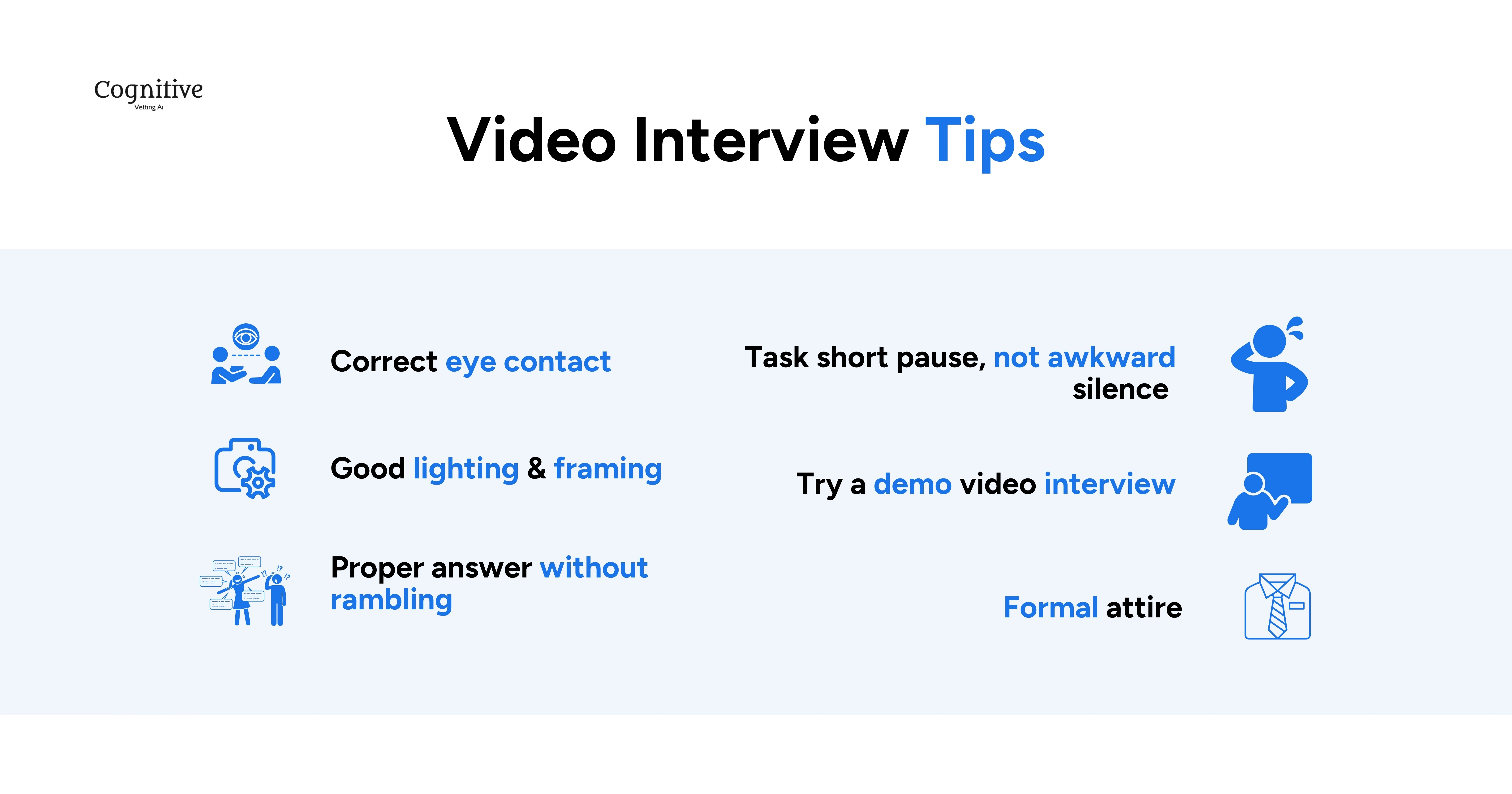
- Look at the lens, not the screen: Eye contact on video means looking at the camera, not the interviewer's face on your display. It feels unnatural at first, but it reads as confidence on the other end.
- Fix your lighting and framing: Face a window or lamp, not a wall behind you. Keep your head and shoulders centered in the frame with minimal clutter visible behind you.
- Structure answers instead of rambling: A simple framework, like situation, task, action, result, keeps you concise and keeps the interviewer following your point instead of waiting for it.
- Let silence exist: A short pause before answering reads as thoughtful on video, not awkward. Resist the urge to fill every gap with filler words.
- Test your setup beforehand: Camera, microphone, and internet connection, checked at least a day ahead, not 5 minutes before the call.
- Dress and set up as if it were in person: Full outfit, tidy background, phone on silent. Treat the format as a formality, not a lowering of the bar.
Bringing it together
Video interview questions haven't changed much from their in-person versions. What has changed is the medium delivering them, and that shifts how a winning answer needs to be built and delivered. Structure your content the way you always would, then adjust your delivery for the camera: eye contact with the lens, controlled pacing, and a setup that's been tested ahead of time.
Frequently Asked Questions
1. What is a video interview?
A video interview is a job interview conducted over webcam instead of in person, either live with a real interviewer or self-recorded, where a candidate answers set questions on camera. It's now a standard first step in hiring for most companies, not just a backup option.
2. How do I prepare for a video interview?
Preparing for a video interview means rehearsing your answers out loud, testing your camera, microphone, and internet connection in advance, and practicing in the same setup you'll actually use. Treating video interview preparation as separate from general interview prep is what usually makes the difference on camera.
3. What's the difference between live and pre-recorded video interview questions and answers?
Live video interviews involve a real interviewer asking questions in real time, while pre-recorded interview questions ask a candidate to respond alone on their own schedule, with no one present on the call. Companies often use recorded formats for early-stage video interview screening, then move to live rounds later.
4. What are on-demand interview questions?
On-demand interview questions let a candidate complete an interview whenever it suits them, rather than at a scheduled time with a live interviewer. This format is common in early online interview questions and initial screening, with responses reviewed by the hiring team afterward.
5. Where can I watch a sample interview video before my own?
Searching for a sample interview video or job interview sample video online can help you see typical pacing, framing, and delivery before a real call. The specific questions will still vary by employer, but the format and structure carry over.
6. Are video interview questions different from questions asked in person?
Yes, video interview questions usually cover the same core ground as in-person interviews, background, problem-solving, and motivation, but the delivery expectations differ. Eye contact with the camera, pacing, and framing all affect how an answer lands on video in ways they don't in face-to-face.
7. Do all companies use the same video questionnaire or format?
No. Some companies run a fixed video questionnaire with pre-set questions and no live interaction, while others conduct a fully live, adaptive video interview. The questions themselves tend to repeat across companies, but the format, live versus recorded, can vary significantly.
Related reading
- What Is a Normal Cost Per Hire? Benchmarks by Seniority, Sector, Role and Region
- Canditech Alternatives in 2026: 10 Tools, From Skills Tests to Live AI Interviews
- Affordable AI Recruiting Tools That Show Their Prices: How 10 Bill You in 2026
- Candidate Rediscovery: How to Re-Engage Silver Medalists and Past Applicants Before You Source
- Equip Alternatives in 2026: 10 Tools for Skills Tests, Live AI Interviews and Sourcing
- Data-Driven Recruitment, Sourcing First: 9 Metrics, Clean Data and the Decisions They Should Change