Lever Pricing 2026: Plans, Costs and What Buyers Pay
By Sparsh Goyal, Founder at The Cognitive. Published · Last updated
- Lever publishes no prices: it sells one Core Platform and three add-ons by quote, and Vendr reports a median of $15,536 a year across 321 purchases.
- Price scales with company size and hiring needs, and third-party sources disagree, with CostBench showing a $24,500 median from just 4 reports.
- Ask for the billing unit, each add-on priced alone, the implementation fee and a renewal cap in writing before you sign.
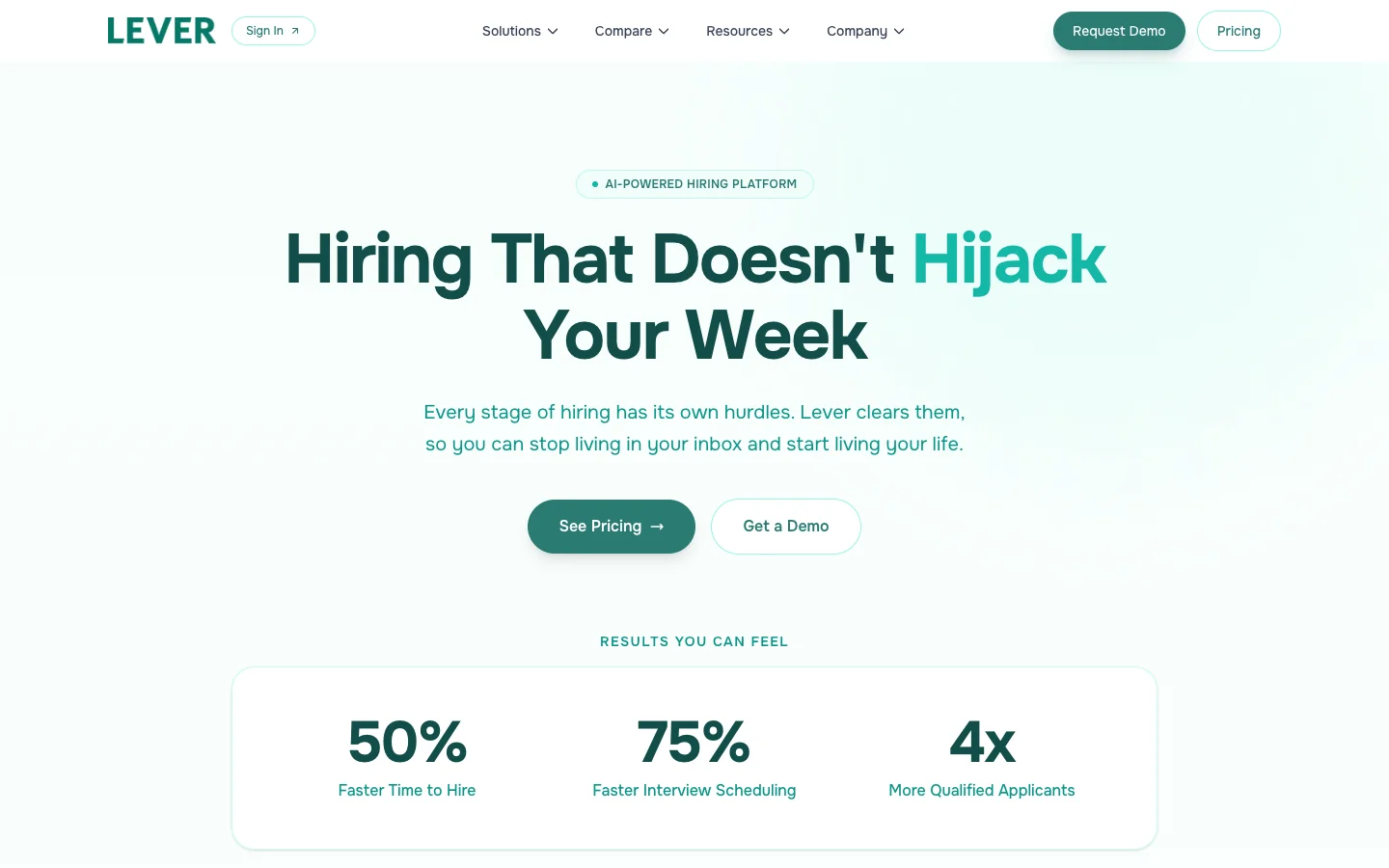
Lever does not publish prices. Its pricing page sells one Core Platform, which it calls an "AI-Powered Hiring Platform", plus three add-ons. Every one of them ends in the same button: "Get My Price Quote". Vendr, which tracks software purchases, reports a median of $15,536 a year across 321 Lever purchases, from $6,720 to $51,540 (October 2026).
That is buyer data, not a Lever list price, and other trackers disagree. Lever says pricing "scales based on your team size and hiring needs". No free plan or free trial appears on its site.
What plans does Lever sell?
Lever's pricing page has no named tiers. You get one core platform and a menu of add-ons, each priced by a sales rep.
| Plan or add-on | Price | What is included, in Lever's words |
|---|---|---|
| Core Platform: AI-Powered Hiring Platform | Quote only | "ATS & CRM in one"; "Powerful reporting"; "AI-powered screening"; "Unlimited AI interview transcripts and summaries"; "AI-powered fraud prevention signals" |
| Candidate Insights (add-on) | Quote only | Skills, fit and signals such as assessments and reference data, shown in the candidate profile |
| AI Screening by VONQ (add-on) | Quote only | Agent-based screening embedded in your career site, built for high application volume |
| Onboarding (add-on) | Quote only | Automated new-hire workflows, task management and document collection |
| Free trial or free plan | None listed | Demo only |
The core platform carries most of the weight. Lever's FAQ says every plan includes "our core applicant tracking system, candidate relationship management, advanced reporting and analytics, and key integrations". The ATS and the recruiting CRM come together, so you do not buy the CRM separately.
The add-ons are where a quote grows. Candidate Insights adds assessment and reference data to profiles, AI Screening by VONQ screens inbound applicants on your career site, and Onboarding covers the weeks after an offer is signed. If you only need to track applicants and nurture past candidates, question each add-on line by line.
What Lever asks before it quotes
The quote form has eight required fields: work email, first name, last name, company name, phone number, job title, company size and country. Company size is the one that matters: the form collects it before anyone talks to you. Expect the first number to be anchored to your headcount.
Older guides still list two plans called LeverTRM and LeverTRM for Enterprise. Lever's current pricing page shows neither name. A comparison that quotes those tiers is describing an older package.
How much do Lever customers actually pay?
Every public number for Lever comes from a third party, and they do not agree.
| Source, basis and date | Figure | Weight |
|---|---|---|
| Lever pricing page, October 2026 | No price; quote only | The only official word |
| Vendr, 321 purchases, October 2026 | Median $15,536 a year; low $6,720, high $51,540; 16% average saving | Largest sample: 321 deals |
| CostBench, Lever ATS page, 4 buyer reports, last verified June 2026 | Median contract $24,500 a year | Small sample from one source |
| CostBench, AI recruiting page, last verified July 2026 | LeverTRM $12,000 a year; LeverTRM for Enterprise $50,000 a year | Low; plan names no longer on Lever's page |
Vendr's median rests on 321 deals, so it is the best starting point for a budget. CostBench's $24,500 median comes from four reports, too few to plan around but a fair warning that larger deals exist.
The range matters more than the median. A $6,720 deal and a $51,540 deal are both Lever. Where you land depends on the drivers below. Ask the rep what Lever costs for your size, your hiring volume and your add-ons.
What drives the cost of Lever?
Lever names its own drivers across its pricing page and homepage: company or team size, hiring volume, feature needs, the products and integrations you choose, support level and implementation requirements. Vendr's Lever page adds the ones buyers see in contracts: employee count, active requisitions, user seats, contract term and add-on modules. Vendr describes Lever as an annual subscription.
- Headcount. Company size is a required field on the quote form, and both Lever and Vendr name it.
- Hiring volume. Lever says "hiring needs", and Vendr says active requisitions. More open roles usually means a larger quote.
- Seats. Vendr lists user seats as a factor. Lever does not say whether it bills per seat, per employee or both.
- Add-ons. Each of the three is quoted separately. Vendr says add-ons often add 10 to 30% to total contract value.
- Contract term. Vendr says multi-year terms often bring 15 to 30% lower annual costs, in exchange for a longer commitment.
Get the billing unit in writing. Lever speaks of "team size", which could mean employees or recruiters, and it decides what happens to your bill when the company grows or the recruiting team shrinks.
What does Lever cost for a 100, 500 or 1,000 person company?
No current public source breaks Lever's price down by company size. Lever publishes no size bands, and Vendr's live page gives one median and one range with no split by headcount. If you want a price per size band before a sales call, Workable prints one for every plan and Ashby prints one for companies up to 100 employees.
What hidden costs come with Lever?
Lever and the cost trackers tell two different stories here. Lever's comparison page against Greenhouse says its pricing comes "with no hidden fees or forced add-ons". CostBench and Vendr both list costs outside the subscription line. A fee agreed in the order form is not hidden, but it is easy to miss.
| Cost | Reported range | Source |
|---|---|---|
| Implementation and onboarding | $5,000 to $25,000; or a few thousand dollars to mid-five figures | CostBench, one source; Vendr |
| Data migration | $3,000 to $8,000 | CostBench, one source |
| CRM sourcing and nurture add-ons | $5,000 to $10,000 a year | CostBench, one source |
| Advanced Analytics | $18 to $32 per employee a year | CostBench, one source |
| HRIS integration support | $4,000 to $6,000 a year | CostBench, one source |
| Renewal increases | For example 3 to 7% a year | Vendr |
| Renewal increases | 8 to 15% a year; auto-renew, one-year minimum | CostBench, one source |
Treat the CostBench lines as prompts for questions, not as prices. Some of them, such as a separate CRM add-on, describe items Lever's current page lists as part of the core platform. If your quote includes a line for something the pricing page calls standard, ask why.
Time is a cost too. Lever says "most customers are fully implemented within weeks, not months", and its Greenhouse comparison page says "typical migrations take about six weeks".
How do you negotiate a Lever quote?
Vendr reports buyers saving 16% on average, which suggests the first number is rarely the last.
- Price the core alone first. Get the core platform quoted on its own, then each add-on as a separate line. Bundles hide which piece costs what.
- Trade term for price. If you are confident in Lever, a multi-year term is where Vendr sees lower annual cost. If you are not, keep it to one year.
- Cap the renewal. Vendr cites escalators of 3 to 7% a year and CostBench 8 to 15%. Ask for a written cap before you sign, not at renewal.
- Bring a second quote. Greenhouse also sells by quote, and Ashby, Workable and JazzHR print at least some prices.
Six questions to put to the rep, mapped to Lever's own price drivers:
- What is the billing unit, and what does each extra employee or seat cost?
- How many open requisitions does this quote assume?
- Which of the three add-ons are in this number, and what is each one alone?
- Is there an implementation or migration fee, and what data moves over, including past candidates and notes?
- What is the renewal increase, the notice period, and will you cap it?
- Which integrations are included, and which carry a separate charge?
For how other applicant tracking systems charge, see our guide to ATS pricing.
Is Lever worth the price?
Lever is worth a look if you want an ATS and a recruiting CRM in one product and you hire at a steady pace. Lever describes itself as "built for growing and enterprise teams" and calls itself "the best talent acquisition software for mid-market businesses" (Lever's own claim). It is owned by Employ Inc., which also sells JazzHR and Jobvite, and it states it is SOC 2 Type II certified.
The fit is weaker in three cases:
- A small team with a handful of roles a year may pay for CRM depth it never uses. Published-price tools are easier to budget.
- A team flooded with inbound applicants may need the AI Screening add-on to cope, which raises the quote.
- A team whose real problem is finding people who never applied is paying ATS prices for a sourcing problem.
For a full look at the product beyond price, read our Lever review.
Cheaper or different options to Lever
If the ATS itself is the problem, another ATS is the answer. If the real cost is the time spent finding and screening people, a different kind of tool may matter more. (The Cognitive is our product.)
| Tool | Best for | Pricing model | Price on website? |
|---|---|---|---|
| The Cognitive | Sourcing and AI interviews beside Lever; not an ATS | Separate AI Sourcing and AI Interviews plans, monthly or yearly, with credits | Yes, each from $99 a month |
| Greenhouse | Structured hiring | Quote; Core, Plus or Pro | No |
| Ashby | Reporting built into the ATS | By company size, usage and commitment | Entry plan only |
| Workable | Seeing a price before a sales call | Three plans by employee band; extra AI credits by quote | Yes |
| JazzHR | Small businesses under 250 employees | Published plans, monthly or yearly | Yes |
1. The Cognitive: best for finding and interviewing people who never applied
Verdict: not a Lever replacement, but a published-price way to fill the top of a Lever pipeline.
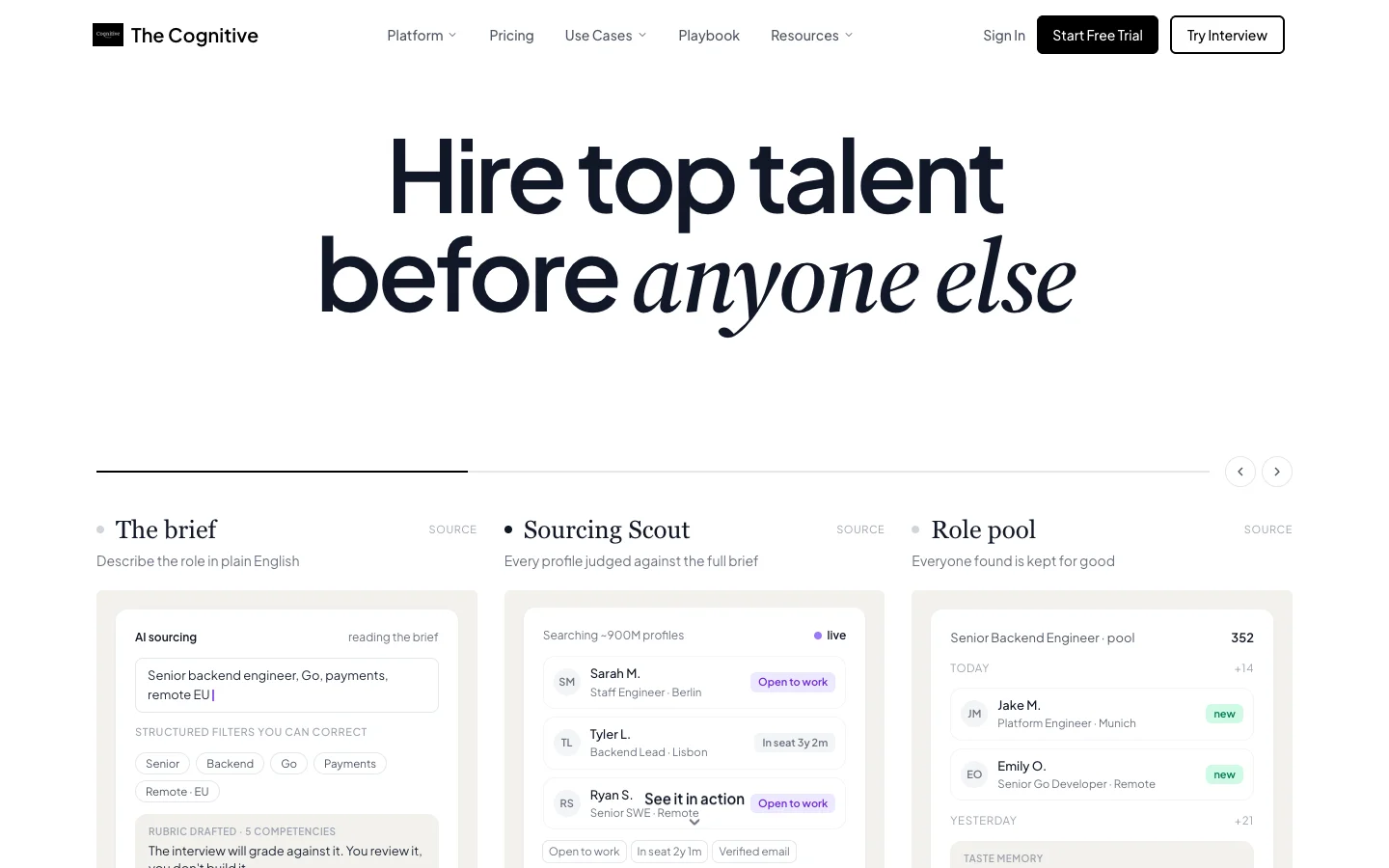
The Cognitive is an AI recruiting platform that finds people, emails them and interviews them. Describe the role in plain English and it searches about 900M public profiles, with a short reason on every result for why the person fits. On Sourcing Pro and above, you email candidates from your own Gmail or Outlook, and replies come back to your inbox.
Candidates who say yes take a live AI video interview, 10 or 20 minutes long, on a laptop or desktop. The AI asks role questions and follows up on what they say, and you get a scored report against your criteria. On higher plans, people you find sync with 100+ ATS, Lever included. Gem's 2026 benchmarks found sourced candidates "nearly eight times more likely to be hired than inbound applicants".
The Cognitive does not post jobs, collect applications, send offers or onboard. If you have no ATS, you still need one.
Best for: teams that run Lever, or plan to, and need candidates from outside their applicant pool.
Watch out for: it is not an ATS; email outreach starts on the Sourcing Pro plan and ATS sync on higher plans, not the entry plan.
Pricing model: AI Sourcing and AI Interviews are separate plans, each from $99 a month, monthly or yearly, with credits for searches, contact reveals and interviews. See pricing.
2. Greenhouse: best for structured hiring
Verdict: the closest like-for-like rival, and just as quote-driven.
Greenhouse says its pricing "is customized based on your company's hiring needs", with three plans, Core, Plus and Pro, each behind a demo. Vendr reports a Greenhouse median of $26,553 a year across 887 purchases, so on Vendr's data the typical Greenhouse deal runs higher than the typical Lever deal.
Best for: teams that want a structured hiring process and are ready to choose between Core, Plus and Pro with a sales rep.
Watch out for: no published price, so you face the same negotiation as with Lever.
Pricing model: quote only, by plan. More in our Greenhouse pricing guide and the Greenhouse vs Lever comparison.
3. Ashby: best for reporting built into the ATS
Verdict: the one quote-style ATS here that prints an entry price, if you have up to 100 employees.
Ashby shows a price for its Foundations plan, for companies up to 100 employees. Plus covers 101 to 1,000 employees and Enterprise larger companies, and Ashby says "our pricing is based on company size, usage, and commitment". Vendr reports an Ashby median of $20,878 a year across 167 purchases.
Best for: teams that want ATS, recruiting CRM and analytics in a single product.
Watch out for: only the entry plan has a printed price.
Pricing model: by company size, usage and commitment. See Lever vs Ashby.
4. Workable: best for seeing a price before a sales call
Verdict: the simplest way to see a real number before you commit.
Workable prints prices for all three of its plans, Standard, Premier and Enterprise, by employee band, and offers a 15-day free trial with no credit card. It now sells recruiting together with HR tools, and notes that the free trial does not include Workable Agent.
Best for: companies that want to see a price and test an ATS before talking to sales.
Watch out for: its plans bundle recruiting with HR tools, and its AI agents run on credits bought separately.
Pricing model: published plans by employee band; large AI credit bundles by quote.
5. JazzHR: best for small teams that want a published price
Verdict: Lever's smaller sibling, priced in the open.
JazzHR is also owned by Employ Inc. It publishes three plans, Hero, Plus and Pro, billed monthly or yearly (yearly saves up to 24%), with some add-ons billed by usage. Its standard pricing does not apply to staffing or recruiting agencies, multi-location businesses or organizations with over 250 employees.
Best for: small businesses under 250 employees.
Watch out for: agencies and larger companies fall outside standard pricing.
Pricing model: published plans, monthly or yearly, plus usage-based add-ons.
For ten full alternatives with feature detail, see Lever alternatives.
How to start
Before you book a Lever demo, write down three numbers: employees, recruiter seats and open roles for the next twelve months. Ask for the core platform priced alone, then each add-on, and set the total against Vendr's $6,720 to $51,540 range. Get the billing unit, implementation fee and renewal cap in writing.
If what you are really short of is candidates, run one hard role through The Cognitive first and see who exists for it before you spend more on tracking. There is a 7-day free trial. It needs no card. Start free with The Cognitive.
Sources
- Lever, pricing page (lever.co/pricing), homepage (lever.co) and Lever vs Greenhouse page (lever.co/alternative/lever-vs-greenhouse), October 2026.
- Vendr, Lever pricing and buyer data; Greenhouse; Ashby, October 2026.
- CostBench, Lever ATS pricing, last verified 14 June 2026.
- CostBench, Lever AI recruiting pricing, last verified 17 July 2026.
- CostBench, Lever ATS hidden costs, last verified 14 June 2026.
- Gem, Key takeaways from the 2026 Recruiting Benchmarks Report, 1 December 2025.
- Greenhouse (greenhouse.com/pricing), Ashby (ashbyhq.com/pricing), Workable (workable.com/pricing) and JazzHR (jazzhr.com/pricing), pricing pages, October 2026.
Frequently Asked Questions
How much does Lever cost per year?
Lever does not publish a price, but Vendr reports a median of $15,536 a year across 321 Lever purchases (October 2026). Vendr's deals range from $6,720 to $51,540, with buyers saving 16% on average. CostBench shows a higher $24,500 median, but from only 4 buyer reports. Lever itself says pricing scales with team size and hiring needs, so your quote depends on headcount, hiring volume and add-ons.
Does Lever have a free trial or free plan?
No, Lever's website lists no free trial and no free plan. Its pricing page offers a quote form and its homepage offers a demo. If you want to test software before you buy, Workable lists a 15-day free trial with no card. The Cognitive also offers a 7-day free trial with no card, for sourcing and AI interviews.
Is Lever priced per user or per employee?
Lever does not say. Its pricing page says pricing "scales based on your team size and hiring needs", and its homepage names company size and hiring volume. Vendr lists employee count, active requisitions and user seats as factors in Lever contracts. Ask the rep for the billing unit in writing, because it decides how your bill changes as you grow.
What is included in Lever's Core Platform?
The Core Platform includes Lever's ATS and recruiting CRM in one, plus reporting and several AI features. Lever lists "ATS & CRM in one", "Powerful reporting", "AI-powered screening", "Unlimited AI interview transcripts and summaries" and "AI-powered fraud prevention signals". Candidate Insights, AI Screening by VONQ and Onboarding are separate add-ons, each priced by quote.
Does Lever charge for implementation?
Lever names no implementation fee and says its pricing has "no hidden fees or forced add-ons". Third parties report otherwise: CostBench, from one source, lists implementation and onboarding at $5,000 to $25,000 and data migration at $3,000 to $8,000. Vendr describes implementation as a few thousand dollars to mid-five figures. Ask for any fee in writing; Lever says typical migrations take about six weeks.
How long is a Lever contract?
Lever does not publish contract terms. Vendr describes Lever as an annual subscription and says multi-year terms often cut the annual cost by 15 to 30%, in exchange for a longer commitment. CostBench, from one source, reports that Lever contracts auto-renew with a one-year minimum. Ask for the renewal date, notice period and any auto-renewal clause in writing.
Is Lever cheaper than Greenhouse?
On Vendr's buyer data, yes: Lever's median is $15,536 a year and Greenhouse's is $26,553. Both sell by quote only, so your own quotes depend on headcount and add-ons. Price both for the same team. See our Greenhouse pricing guide for detail.
Related reading
- Lever Alternatives in 2026: 10 ATS and Recruiting Platforms Compared
- Best Retail Hiring Software in 2026: 9 Tools for Store Teams and Store Leaders
- 10 Best CRMs for Staffing Agencies in 2026, Scored
- Best EOR Companies in 2026: 11 Employer of Record Providers Ranked, Plus the Step Before
- Best Sourcing Tools for Recruiters in 2026: 12 Tools by Job
- 9 Best AI Executive Search Tools in 2026, Scored