Best Fetcher Alternatives in 2026: 8 Tools After the Shutdown
By Sparsh Goyal, Founder at The Cognitive. Published · Last updated
- The best Fetcher alternative for most teams is The Cognitive, which finds, emails and interviews candidates before they reach you.
- Fetcher shut down on 16 October 2026 after Juicebox bought its assets, and Fetcher deletes remaining account data after 19 November 2026.
- Findem ReadySlate Lite ties on points with a 5-minute voice screen, Juicebox is the path Fetcher chose, and Pin books intro calls for you.
Fetcher is gone. Juicebox announced on 6 October 2026 an agreement to acquire Fetcher's assets, and the Fetcher platform shut down on 16 October 2026, the last day to request a full export. Fetcher says it will securely delete all remaining account data after 19 November 2026. Anything a former customer did not export is gone or going, and the next tool has to cover the job Fetcher's team did: screening people before they reached you.
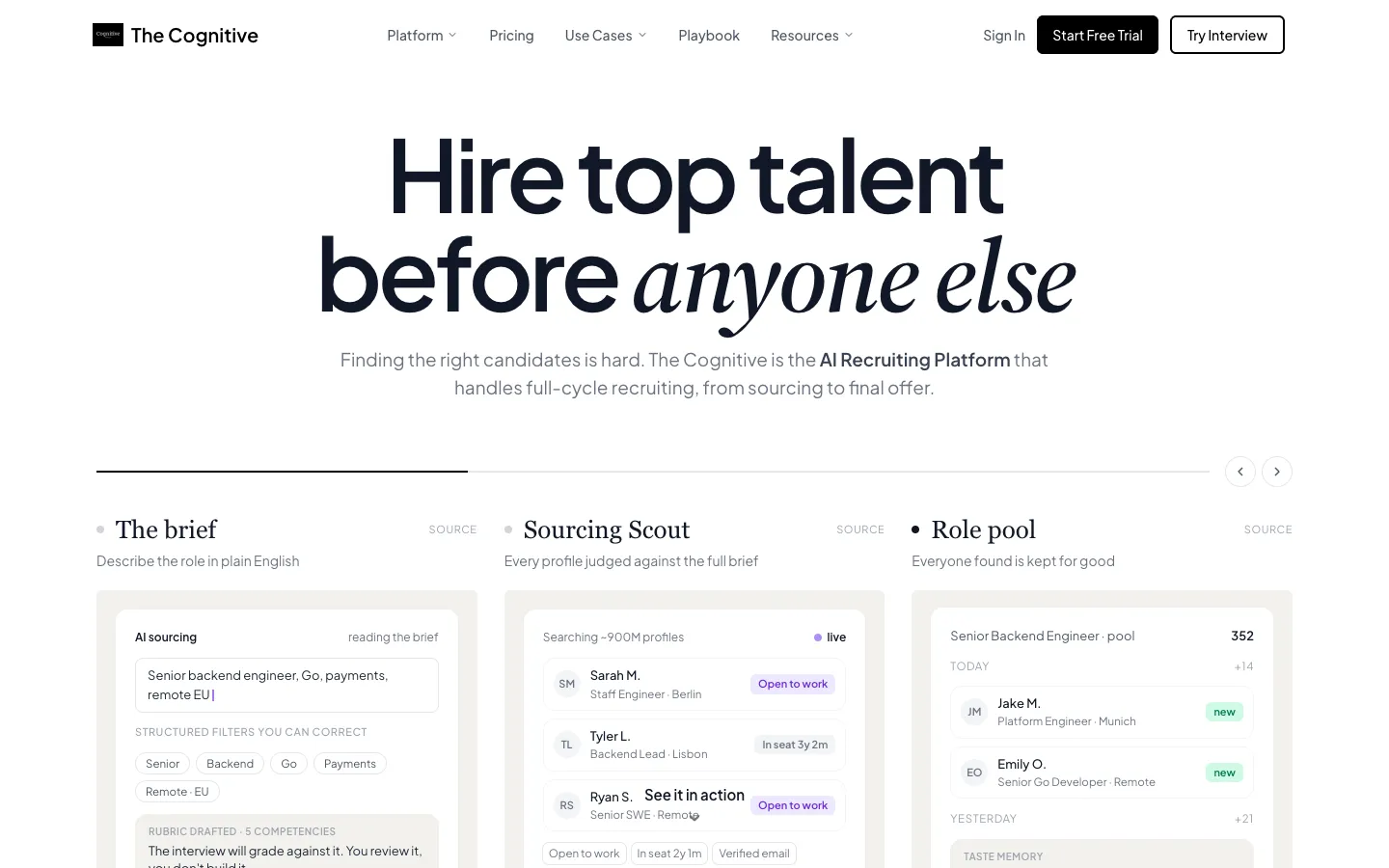
The best Fetcher alternative for most teams is The Cognitive. Describe the role in plain English, search about 900M public profiles, email people from your own mailbox and send them a live AI video interview, so candidates arrive screened. Findem ReadySlate Lite ties The Cognitive on points and suits small teams that want an agent with a short voice screen. Juicebox is the path Fetcher itself chose, and Pin takes you from search to booked calls.
Disclosure: The Cognitive is our product.
The best Fetcher alternatives in 2026
- The Cognitive: best for finding, emailing and interviewing candidates in one account.
- Findem ReadySlate Lite: best for small teams that want an agent to find, email and briefly screen people.
- Juicebox: best for former Fetcher customers who want the replacement Fetcher named.
- Pin: best for sourcing through to booked intro calls on autopilot.
- SeekOut: best for enterprise search across outside profiles and past applicants.
- Gem: best for teams that want sourcing, CRM and analytics, or a full ATS, in one system.
- hireEZ: best for enterprise teams that want sourcing, screening and scheduling agents over the ATS they keep.
- Noon: best for teams happy to buy an unlimited agent through a sales call.
What happened to Fetcher?
Fetcher shut down on 16 October 2026, ten days after Juicebox announced on 6 October that it had agreed to acquire Fetcher's assets. Juicebox's announcement reads: "Today, we're sharing that Juicebox has reached an agreement to acquire Fetcher's assets. As Fetcher retires its platform over the coming weeks, we'll be here to welcome their customers."
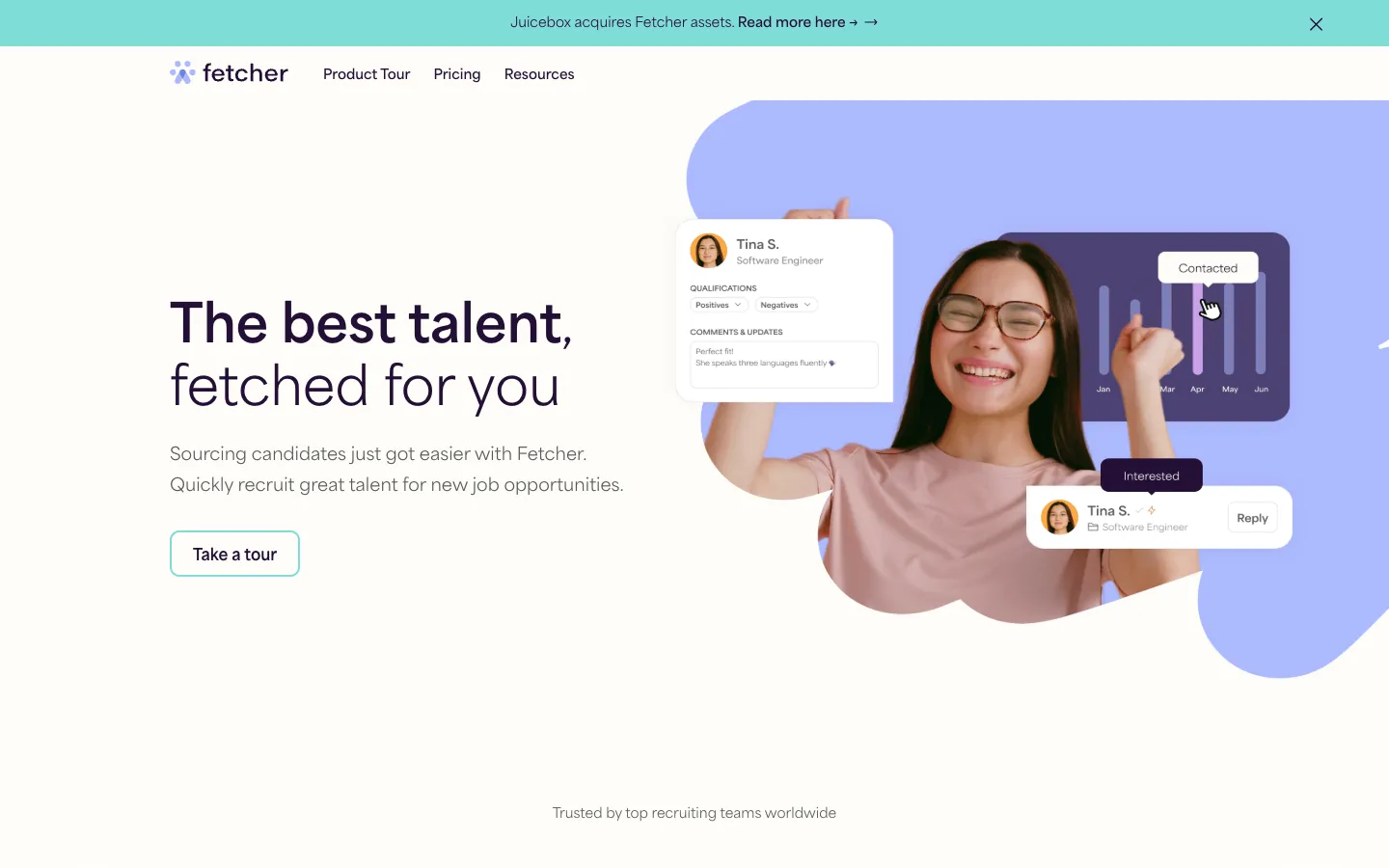
Fetcher sold software plus people. In Juicebox's words, Fetcher "pioneered human-in-the-loop recruiting software in 2016." Fetcher's homepage described an "expert team, paired with AI" sourcing profiles for each role, which customers reviewed in batches and added to email campaigns.
Fetcher can no longer be bought, and its homepage now carries a banner about the Juicebox deal.
If you used Fetcher
- Your data. Exports closed on 16 October. Nothing moves to Juicebox automatically: "your Juicebox account starts fresh." Deletion follows after 19 November 2026.
- Running sequences. If Fetcher sent from your connected Gmail or Outlook, "candidate replies keep arriving in your inbox after shutdown." If Fetcher sent on its own, "replies won't be received after October 16."
- Integrations. Fetcher disconnected every integration on its side. It recommends revoking Fetcher's Google or Microsoft access and deleting the Fetcher API key in your ATS.
Whatever you exported is worth keeping: in Gem's 2026 Recruiting Benchmarks Report, rediscovered candidates accounted for 46% of sourced hires, against 26% in 2021. The guide to candidate rediscovery covers how to reuse it.
What should a Fetcher replacement do?
Fetcher described its own value plainly: "At Fetcher, our team screened talent before they hit our pipeline." These five questions sort the replacements.
Who screens candidates before you meet them?
Gem's 2026 Recruiting Benchmarks Report found recruiters handling 93% more applications than in 2021 and managing 13.4 open roles at a time. Without a screen, every reply becomes a call on your calendar.
Does it search a large pool outside your own database?
Look for plain-English search over hundreds of millions of public profiles, not enrichment of names you paste in. Sourcing pays off: in Gem's 2026 Recruiting Benchmarks Report, directly sourced candidates were 2.6% of applications yet produced 11% of hires.
Does outreach go from your own mailbox?
The shutdown showed why: replies to mail sent from your own Gmail or Outlook kept arriving, while replies to Fetcher's own sending stopped. Ashby's sourcing study (March 2024) found a 19.6% average response rate across half a million sequences. Campaigns using AI personalization got 35.3%, against 24.1% for those without it.
Does it keep sourcing without you?
Fetcher mapped its sourcing service to Juicebox's Agents, which "can take over that work 24/7." Weigh a background agent if a steady flow matters more than control over each search.
Can you start without a sales call?
Fetcher published its monthly plans. A published price and a free start let you test a replacement on a live role this week.
How were the 8 Fetcher alternatives ranked?
Two tables follow: what each tool does, then the points behind the order. "Not stated" means the vendor's site is silent.
| Tool | Screens candidates? | ATS | Price on website? |
|---|---|---|---|
| The Cognitive | Live AI video, 10 or 20 min | 100+ ATS, higher plans | Yes |
| Findem (Lite) | 5-minute AI voice screen | Job import only | Yes (credits) |
| Juicebox | Not stated | Business plan | Yes, except Business |
| Pin | Books calls | Add-on or Enterprise | Yes, except Enterprise |
| SeekOut | Custom plan | ATS export on Core | Core plan only |
| Gem | Ranks applicants | Startup tier or custom | Startup plan |
| hireEZ | Enterprise plan | 40+ ATS, enterprise | Solo plan only |
| Noon | Voice agent, sales-led | 20+ ATS | No |
| Tool | Points earned | Total |
|---|---|---|
| The Cognitive | Search, Mailbox, Screen (2), ATS, Free, Price | 7 |
| Findem | Search, Mailbox, Screen (2), Agent, Free, Price | 7 |
| Juicebox | Search, Mailbox, Agent, Free, Price | 5 |
| Pin | Search, Mailbox, Agent, Free, Price | 5 |
| SeekOut | Search, Mailbox, ATS, Free, Price | 5 |
| Gem | Search, ATS, Free, Price | 4 |
| hireEZ | Free, Price | 2 |
| Noon | None on a published-price plan | 0 |
How the points work
Fetcher was a published-price product whose team screened candidates for you. So a capability scores only when the vendor's site offers it on a published-price plan, without a sales call. Eight points are possible:
- Search (1): plain-English or brief-based search outside your own database.
- Mailbox (1): email sent from your own Gmail or Outlook.
- Screen (2): the product screens or interviews candidates itself; double, because it was Fetcher's team's job.
- ATS (1) for sending shortlisted candidates into your ATS (importing a job alone does not count), Agent (1) for a background agent that keeps sourcing, Free (1) for a free plan or trial, and Price (1) for a published price.
Ties break in this order. First, a scored interview of 10 to 20 minutes against your own criteria beats a 5-minute screen on basic qualifications. Then comes the tool Fetcher itself named, then alphabetical order.
The Cognitive and Findem tie on 7, and The Cognitive ranks first on the first tie-break. Juicebox, Pin and SeekOut tie on 5: Juicebox ranks first on the second tie-break, then Pin and SeekOut alphabetically. Gem's points come from its startup program (up to 100 employees); larger teams buy through sales. hireEZ's solo plan does not itemize search, so it scores only for its trial and price.
Loxo, SourceWhale and LinkedIn Recruiter were considered and left out as not Fetcher-shaped.
The 8 best Fetcher alternatives, reviewed
1. The Cognitive: best for finding, emailing and interviewing candidates in one account
Verdict: the closest software match to Fetcher's team, because candidates reach you after an interview, not just a reply.
The Cognitive is AI sourcing and live AI interviews in one account. Describe the role in plain English and it searches about 900M public profiles and gives a short reason for each match. Reveal a personal email or a phone number for the people you want, then send email sequences from your own Gmail or Outlook. Follow-ups stop when someone replies.
Anyone on the shortlist can take a live, two-way AI video interview: an AI interviewer on video, the candidate on camera. You pick 10 or 20 minutes. The rubric is fixed per role and the questions follow each answer, in any of 9 languages.
You get a scored report against your criteria, with the recording and transcript. Shortlisted people can then go to an open job in one of 100+ ATS it connects to.
Best for: recruiters and small teams that want candidates found, contacted and interviewed before they spend their own time.
Watch out for: there is no human sourcer, so you run each search. Outreach starts on Sourcing Pro or Team, phone reveals on Pro and above, and ATS sync needs a higher plan. There is no Chrome extension.
Pricing model: AI Sourcing and AI Interviews are separate monthly plans, each from $99 a month. Credits: 1 for each person a search shows (once), 4 for a personal email and 12 for a phone number on Pro and above. A 20-minute interview uses 100 credits. Price on website: yes.
2. Findem ReadySlate Lite: best for small teams that want an agent to find, email and briefly screen people
Verdict: the closest in spirit to Fetcher's done-for-you model, with a short screen rather than an interview.
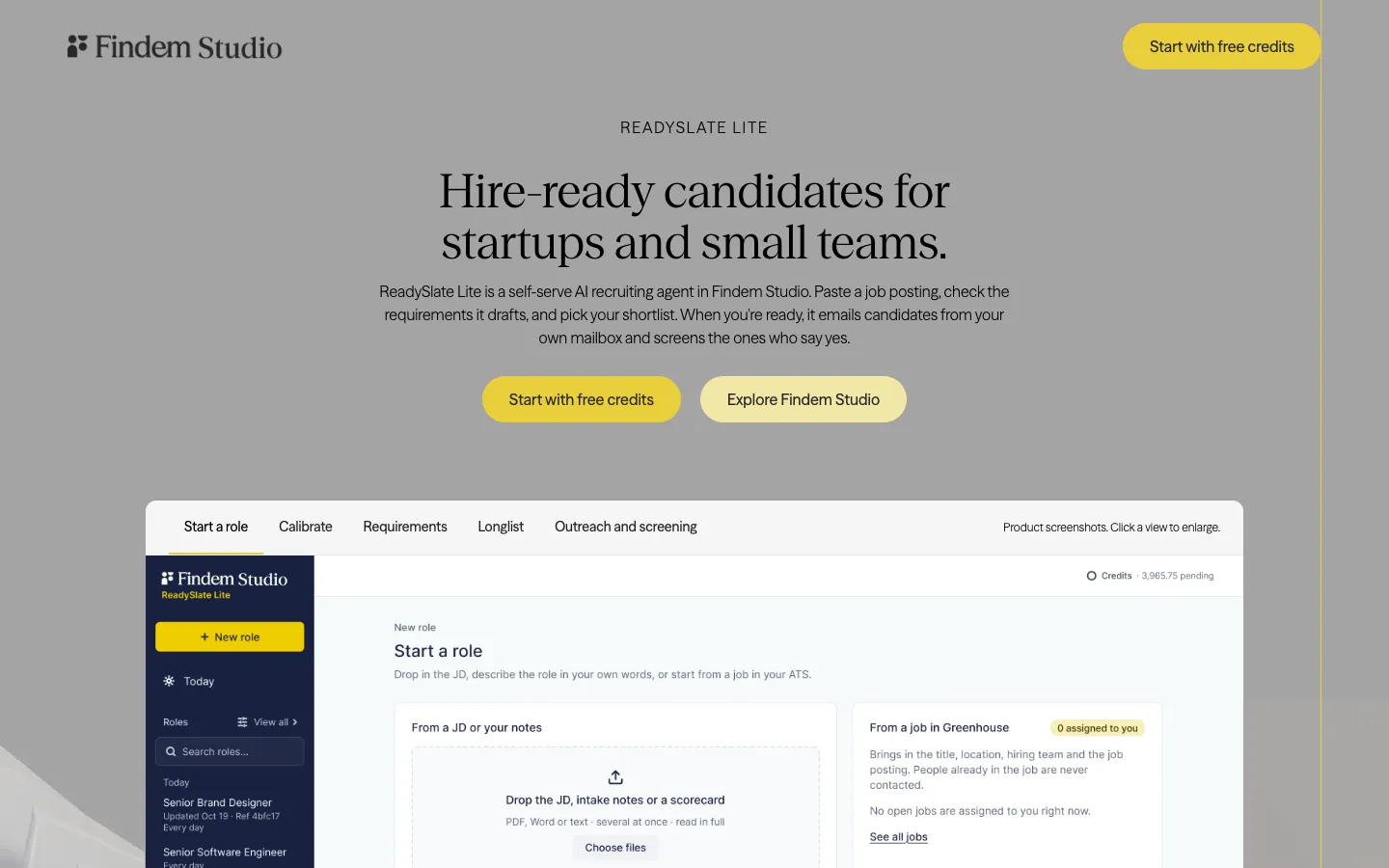
Findem calls ReadySlate Lite "a self-serve AI recruiting agent in Findem Studio. Paste a job posting, check the requirements it drafts, and pick your shortlist." When you are ready, "it emails candidates from your own mailbox and screens the ones who say yes." You pick from "a candidate list that keeps growing," much like Fetcher's batches.
The screen is "a five-minute AI voice screen on basic qualifications." Findem says Lite is "designed for early- and mid-career knowledge-worker roles" and leaves out the skills assessments of Findem Enterprise. "You don't need an ATS or a recruiting CRM," Findem says. Lite can start a role from a job in your ATS, but it claims no way to send candidates back to it. More in the Findem review.
Best for: small teams hiring early- and mid-career knowledge workers who want an agent doing the legwork.
Watch out for: the screen is five minutes on basic qualifications, senior roles sit outside Lite's stated scope, and candidates do not flow back into your ATS.
Pricing model: Studio credits, with free starter credits for new accounts, then pay-as-you-go top-ups or a per-seat monthly subscription. Price on website: yes.
3. Juicebox: best for former Fetcher customers who want the replacement Fetcher named
Verdict: the official landing spot, with strong search and agents, but nothing that screens candidates for you.
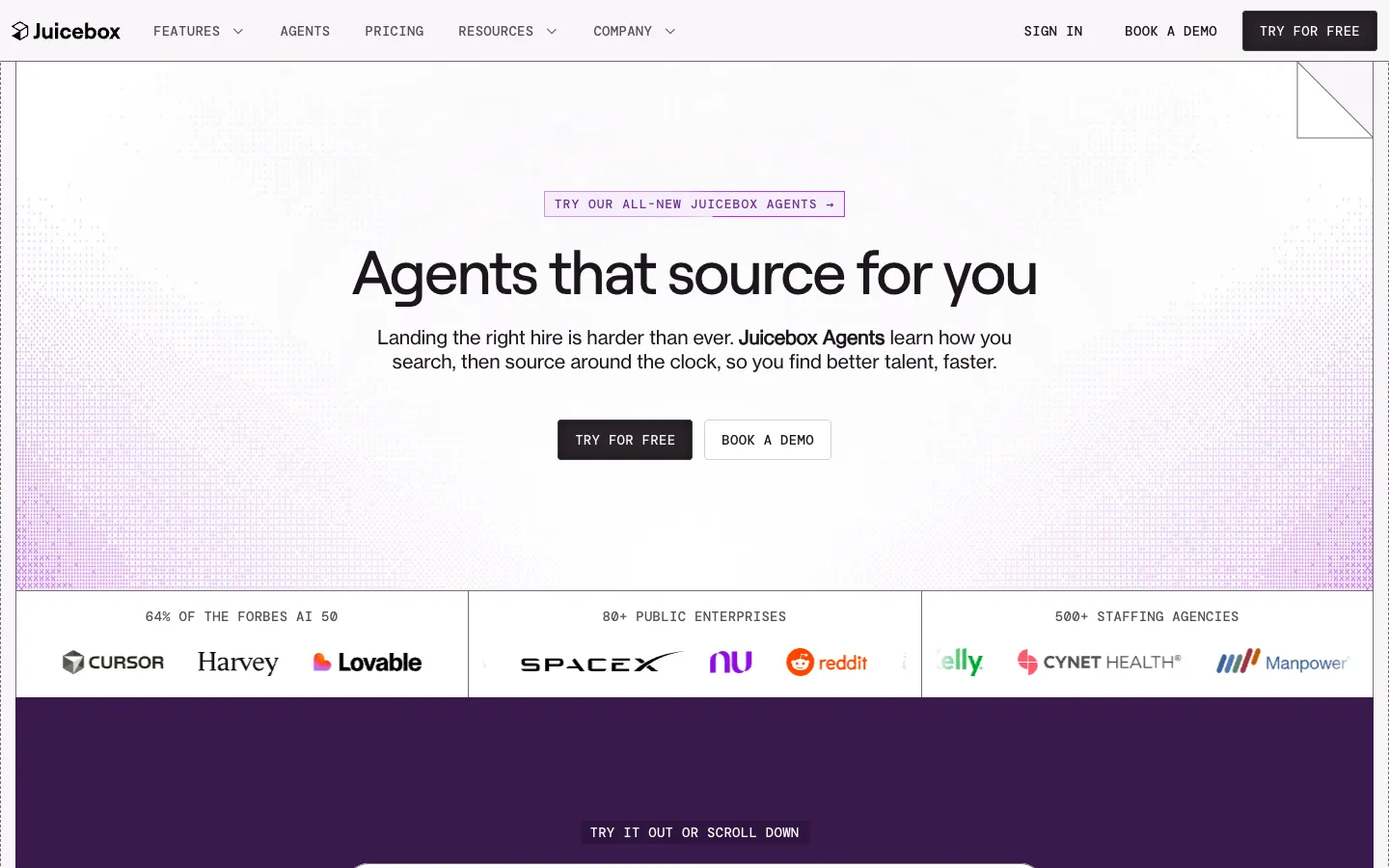
Juicebox calls itself "the AI Recruiting Platform that learns how you search." Fetcher's own map sent "Fetcher sourcing" to Juicebox search and "Fetcher-assist" to Juicebox Agents, sold as "Always-on sourcing that you control" and "set to auto-email or auto-shortlist." Sequences send through Gmail or Outlook, and "when a candidate replies, the sequence stops automatically."
Fetcher customers get an offer through 19 November 2026, if their team has not used Juicebox or taken a Juicebox demo in the past six months. See the Juicebox review and Juicebox alternatives.
Best for: Fetcher customers who mainly used it for sourcing.
Watch out for: no screening or interviews stated, ATS sync only on the custom Business plan, and Agents cost extra.
Pricing model: a free plan with limited searches, then per seat per month, Business by custom annual contract, and Agents as an add-on per agent per month. Price on website: yes, except Business.
4. Pin: best for sourcing through to booked intro calls on autopilot
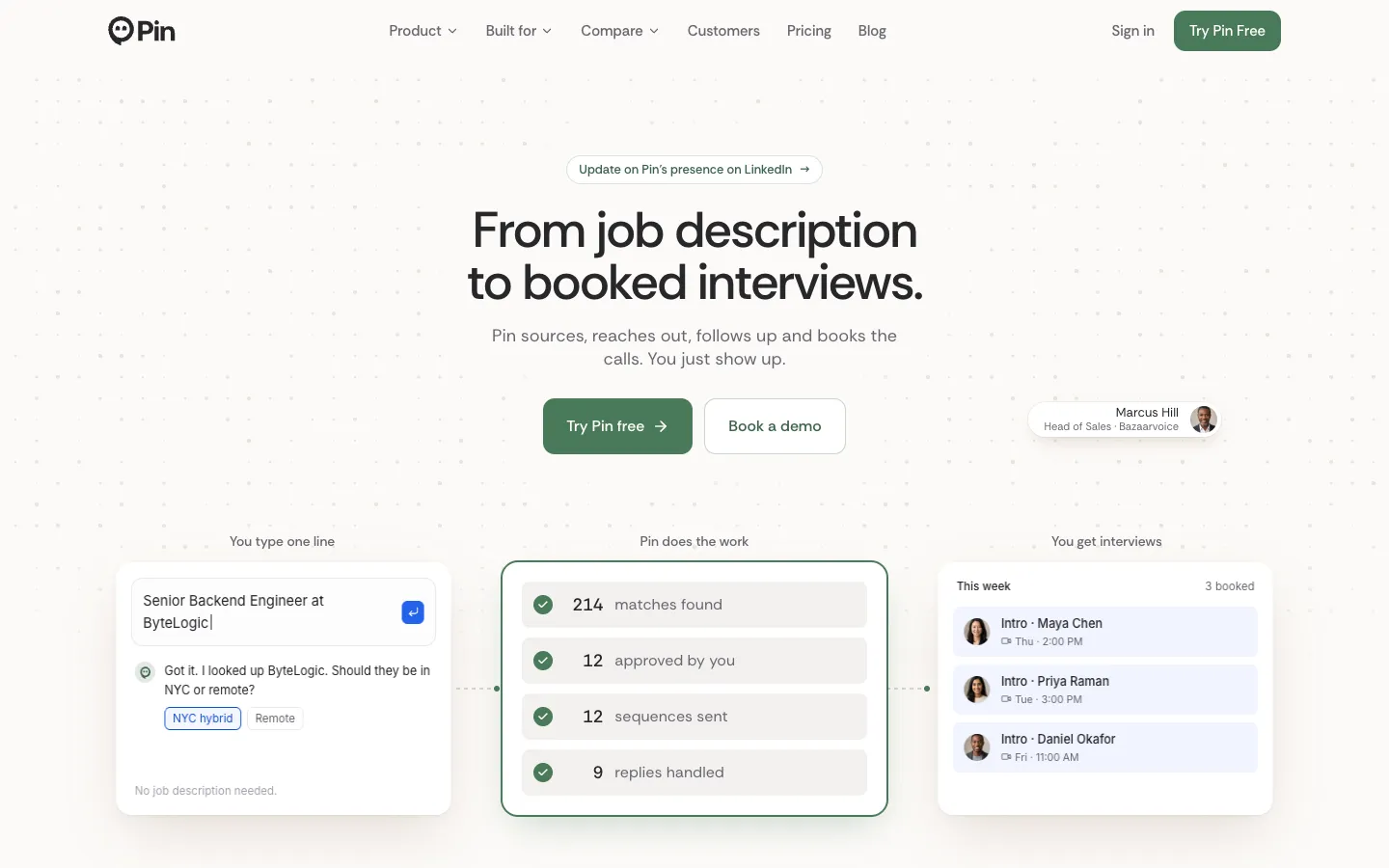
Verdict: the most hands-off way to fill your calendar, but every call it books is still yours to take.
Pin promises "From job description to booked interviews. Pin sources, reaches out, follows up and books the calls. You just show up." It searches "850M+ profiles," "then it tells you why each person matches," and sends outreach "from your own Gmail or Outlook, on schedule, until they reply."
You choose how much to hand over, from "Hands-On Co-Pilot" to "Full Autopilot." Pin offers times you are free and sends the invite; it does not screen anyone. It lists "120+ ATS integrations," but sync is an add-on below Enterprise. See Pin alternatives.
Best for: recruiters who want booked intro calls with little setup.
Watch out for: no screening before the call, and ATS sync is a paid add-on on the self-serve plans.
Pricing model: free forever with email-only sequences; paid plans per user per month, Solo billed annually; Enterprise by custom quote. Price on website: yes, except Enterprise.
5. SeekOut: best for enterprise search across outside profiles and past applicants

Verdict: deep search you can try free; screening sits on custom plans.
SeekOut calls itself "the agentic AI recruiting platform that runs on your terms," across "1B+ candidate profiles." You can "take SeekOut for a test drive: 14 days free," with no card, on the self-serve Sourcing Core plan. Even Core includes email integration with sending on your behalf and export to your ATS.
The AI screener, which SeekOut says "conducts video interviews with candidates," sits in the Full Recruiting Funnel plan, which is custom and billed annually. See the SeekOut review.
Best for: enterprise teams that want one search across the open web and past applicants.
Watch out for: screening needs the custom Full Recruiting Funnel plan, billed annually, and two-way ATS integration sits on custom plans too.
Pricing model: Sourcing Core self-serve with a published price and a 14-day free trial; other plans custom, billed annually. Price on website: Core plan only.
6. Gem: best for teams that want sourcing, CRM and analytics, or a full ATS, in one system
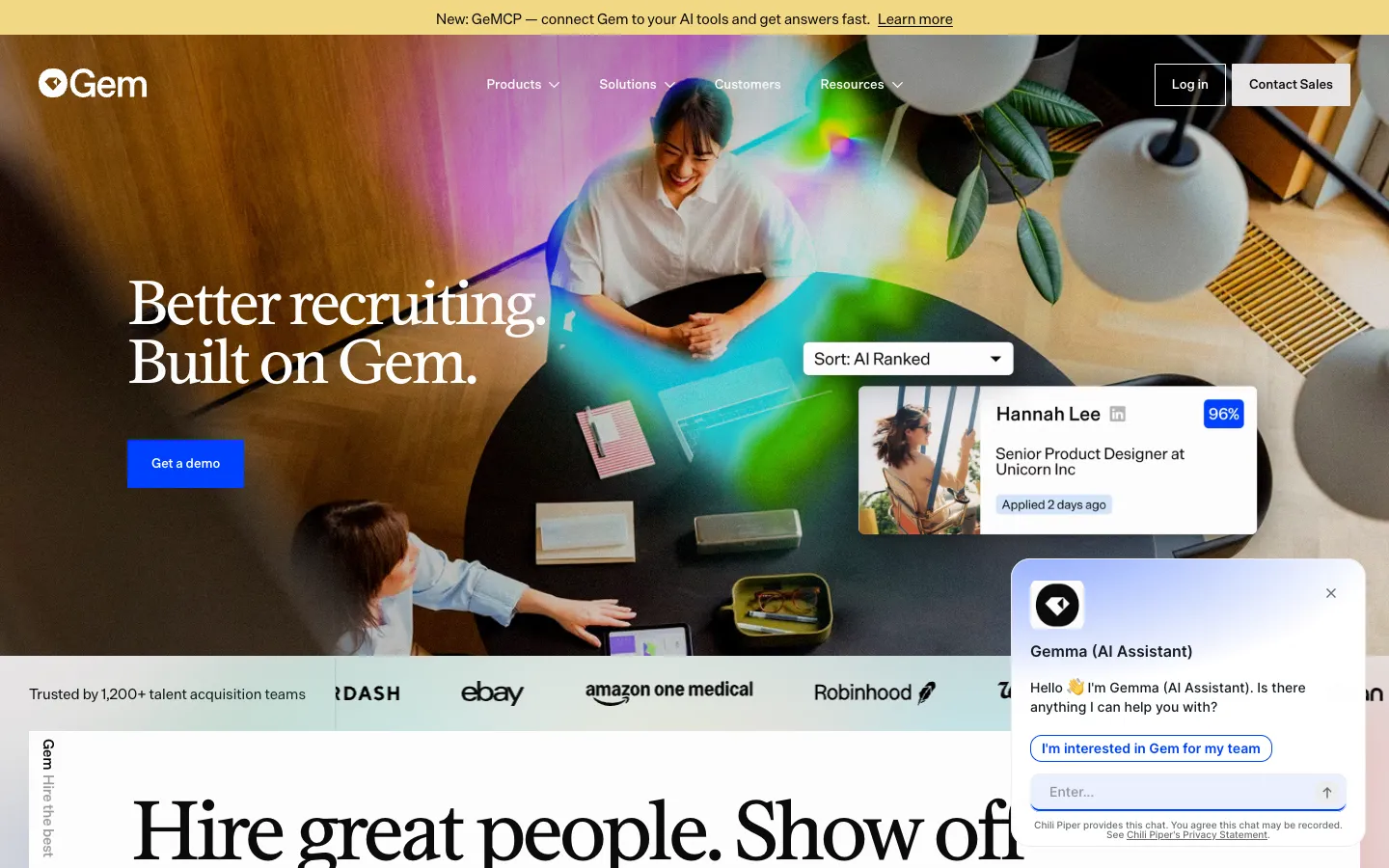
Verdict: a bigger system than Fetcher, strongest on rediscovery and reporting.
Gem promises "Source, review, hire, and report. All in one place." Its AI Sourcing Agent can "search 800M+ profiles, surface your best past candidates, and reach anyone with verified contact info." You run it beside your ATS or as "Gem All-in-One," its own ATS.
An "AI App Review Agent" ranks applicants, but Gem does not describe a screening interview. Its startup program, which includes AI Sourcing, CRM and ATS, gives small companies a real path in: "Under 30 employees? You get Gem All-in-One free for six months, then 50% off," with reduced rates up to 100 employees and no sales call. See the Gem review.
Best for: in-house teams wanting sourcing, CRM and analytics together, and startups under 100 employees.
Watch out for: no screening interview, and teams over 100 employees go through sales.
Pricing model: custom, "based on your company's FTE count," with a published startup price for 1 to 10 FTE. Price on website: startup plan only.
7. hireEZ: best for enterprise teams that want sourcing, screening and scheduling agents over the ATS they keep

Verdict: a full agent stack for large teams, sold through sales.
hireEZ describes "your entire hiring pipeline, run by agents you direct," on top of your ATS: "Let agents source, review, screen and schedule." Its features include "Conversational AI Screening" and an "AI Interview Scheduler," and it claims "40+ native ATS integrations." See the hireEZ review.
Screening, scheduling and ATS work sit in the enterprise product, priced "to the tools it replaces" after a four-week verification.
Best for: large teams that want screening and scheduling handled by agents while keeping their current ATS.
Watch out for: screening is not on a published-price plan, search is not itemized on the solo plan, and sending from your own mailbox is not stated on its site.
Pricing model: enterprise by quote; a solo plan lists a monthly price and a 7-day free trial. Price on website: solo plan only.
8. Noon: best for teams happy to buy an unlimited agent through a sales call
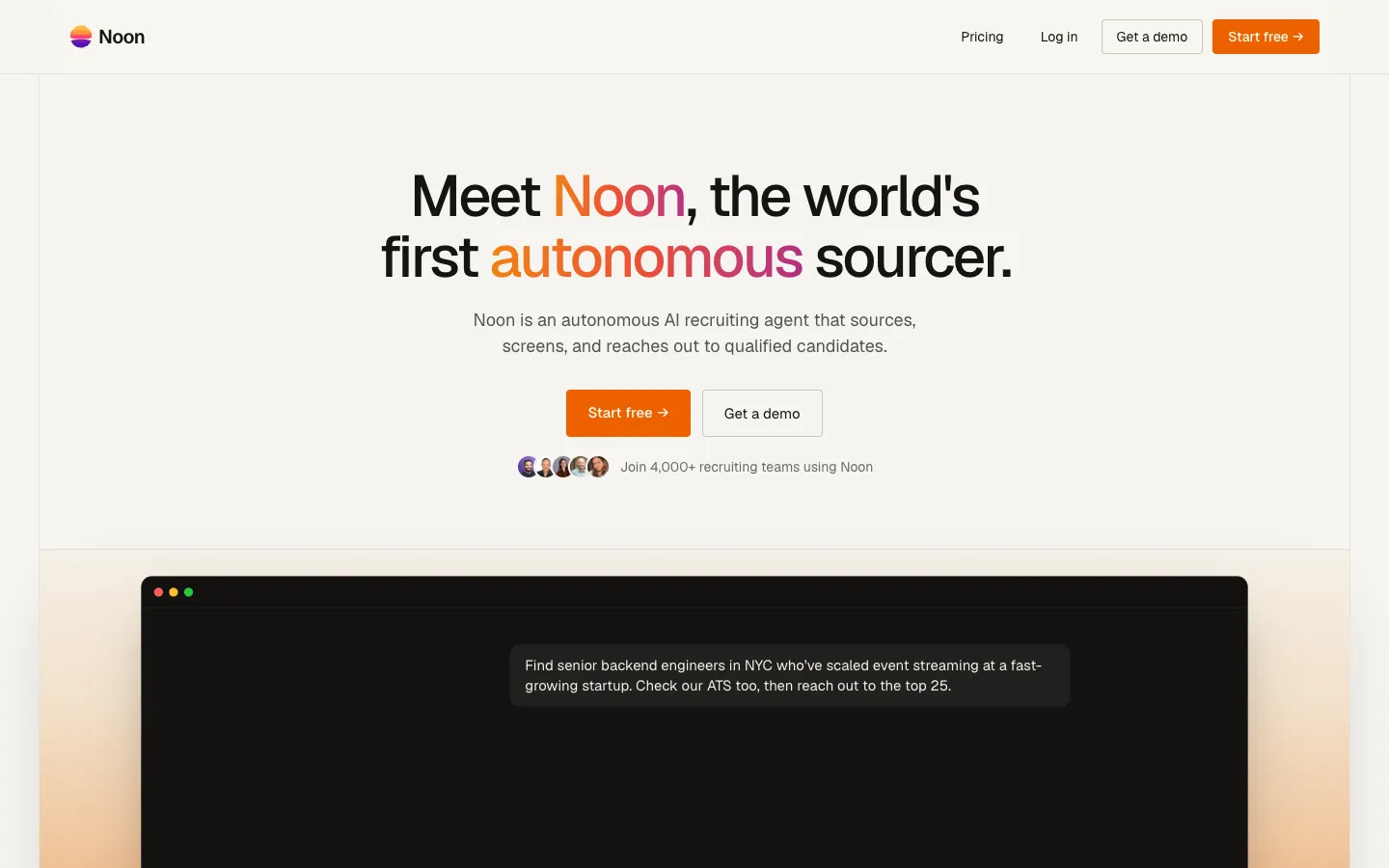
Verdict: strong features, all behind a quote, so it scores nothing here.
Noon bills itself as "the world's first autonomous sourcer," an agent "that sources, screens, and reaches out to qualified candidates." Its "voice agent screens every candidate, responds to what they say, and scores each call against your rubric." One plan includes unlimited sourcing, agents and seats, email and SMS outreach, and "20+ ATS integrations."
"Pricing is quote-based and set per team, so there's no public price list," and its "Start free" buttons open a booking calendar. See Noon alternatives.
Best for: teams wanting unlimited agents with voice screening, bought through sales.
Watch out for: no published price and no way to start without a call.
Pricing model: one plan, quote-based per team, with a "10X ROI guarantee" on annual subscriptions. Price on website: no.
Which tool does it all, end to end?
The Cognitive is the only tool here that sources, emails from your own mailbox, runs a live AI interview and syncs with your ATS, all on plans with a published price. Findem ReadySlate Lite finds, emails and screens, but claims no way to send candidates into your ATS. SeekOut and Gem search and connect to an ATS on published plans but do not screen there. Noon and hireEZ add screening only on quote-based plans. Juicebox and Pin stop before the screen.
A reply says someone is open to a chat; a scored interview says whether the chat is worth your time. For broader lists, see the best AI sourcing tools and recruiting outreach software.
When not to pick The Cognitive
- You want sourcing done for you while you sleep. Juicebox Agents, Pin on autopilot or Findem's growing list keep working between your sessions. The Cognitive runs when you search.
- You need an ATS of record. The Cognitive connects to 100+ ATS but is not one. Gem All-in-One is.
- Your candidates will only use a phone. The live AI interview needs a laptop or desktop browser. Findem ReadySlate Lite screens by voice instead.
- You want Fetcher's handover. If the Juicebox offer before 19 November 2026 decides it, take it and add screening later.
How do you switch from Fetcher?
Take these questions into any demo or trial:
- Who talks to the candidate first, for how long, and what do I get afterwards?
- Can I load my exported Fetcher list and avoid emailing those people twice?
- Does email go from my own Gmail or Outlook, and do follow-ups stop on a reply?
- Which ATS do you sync with, and on which plan?
- What can I use today without talking to sales?
Then run one open role, ideally one Fetcher used to fill, through a single tool for two weeks, and count replies, screens and people you would hire. The Cognitive's 7-day trial needs no card and shows your first 100 people free. Start free with The Cognitive.
Sources
- Juicebox, "Juicebox acquires Fetcher assets," David Paffenholz, 6 October 2026. juicebox.ai
- The Fetcher Team, "Juicebox & Fetcher" (shutdown notice and FAQ), October 2026. fetcher.ai (archived copy at web.archive.org)
- Gem, "Key takeaways from the 2026 Recruiting Benchmarks Report." gem.com
- Ashby, Talent Trends Report: Candidate Sourcing, March 2024. ashbyhq.com
- Vendor homepages and pricing pages: thecognitive.io, fetcher.ai, findem.ai (ReadySlate and ReadySlate Lite), juicebox.ai, pin.com, hireez.com, seekout.com, gem.com, noon.ai.
Frequently Asked Questions
What is the best alternative to Fetcher?
The Cognitive is the best Fetcher alternative for most teams, because it finds people, emails them from your own mailbox and runs a live AI video interview before you meet them. Findem ReadySlate Lite ties on points with a shorter voice screen, and Juicebox is the replacement Fetcher itself named.
Is Fetcher shutting down?
Yes, Fetcher has already shut down: the platform closed on 16 October 2026. Juicebox announced on 6 October 2026 an agreement to acquire Fetcher's assets, and Fetcher can no longer be bought.
Can I still export my Fetcher data?
No, exports closed on 16 October 2026, the day the platform shut down. Fetcher says it will securely delete all remaining account data after 19 November 2026, and nothing moves to Juicebox automatically.
Is Juicebox the official Fetcher replacement?
Yes, Juicebox acquired Fetcher's assets and Fetcher pointed its customers there. Fetcher customers get an offer through 19 November 2026 if their team has not used Juicebox or taken a Juicebox demo in the past six months.
Which Fetcher alternative screens or interviews candidates?
The Cognitive runs a live AI video interview of 10 or 20 minutes, scored against your criteria. Findem ReadySlate Lite runs a 5-minute AI voice screen on basic qualifications. Noon and hireEZ screen on quote-based plans, and SeekOut does on a custom plan.
How much did Fetcher cost, and which alternatives publish prices?
Fetcher sold published monthly plans by sourcing volume, including one with a dedicated human sourcer, but it can no longer be bought and its plans are gone from its pricing page. The Cognitive, Findem, Juicebox and Pin publish prices for self-serve plans; hireEZ, SeekOut and Gem publish only a solo, core or startup price; Noon is quote-only.
What is the best Fetcher alternative for a small team or startup?
The Cognitive suits small teams that want to start without a sales call, with a 7-day trial that needs no card. Plans start at $99 a month. Findem ReadySlate Lite is built for small teams hiring early- and mid-career knowledge workers, and Gem gives companies under 30 employees Gem All-in-One free for six months.
Related reading
- Juicebox Alternatives in 2026: 10 AI Sourcing Tools Beyond PeopleGPT
- AI Sourcing Tools Compared: The 10 Best for Finding Candidates in 2026
- Recruiting Outreach Software: The 10 Best Tools for Reaching Candidates in 2026
- Best Retail Hiring Software in 2026: 9 Tools for Store Teams and Store Leaders
- 10 Best CRMs for Staffing Agencies in 2026, Scored
- Best EOR Companies in 2026: 11 Employer of Record Providers Ranked, Plus the Step Before