AI Screening Tools: The 12 Best for Candidate Screening in 2026
By Sparsh Goyal, Founder at The Cognitive. Published · Last updated
- The best AI screening tools for hiring in 2026 are The Cognitive for sourcing-led hiring, hireEZ for phone screens inside sourcing, and Ribbon and Classet for frontline roles.
- Pick the format your candidates will answer first: phone for hourly roles, live video for professional ones, text for knock-out questions.
- The Cognitive screens by live AI video on a laptop or desktop only, so choose a phone screener when candidates apply from their phones (The Cognitive is our product).
63% of US job seekers have already been interviewed by an AI, according to the Greenhouse 2026 Candidate AI Interview Report. For many of them, that AI ran the first screen, the short call that used to sit on a recruiter's calendar. AI screening tools now run that call by phone, live video, chat or an async step. (The Cognitive is our product.)
The best AI screening tools for hiring in 2026 are The Cognitive for sourcing-led hiring and hireEZ for a phone screen inside a sourcing system. Ribbon and Classet suit frontline and hourly roles on any phone, Tenzo and Alex suit enterprises that want phone and video with fraud checks, Paradox handles text knock-out questions, and Truffle suits lean teams that screen async. The Cognitive finds the people first, then pre-screens them in a live, two-way AI video interview. Because that interview needs a laptop or desktop browser, pick a phone screener when your candidates apply from their phones.
The best AI screening tools for candidates in 2026
- The Cognitive: best for pre-screening the people you sourced, in a live AI video interview.
- hireEZ: best for an AI phone screen inside an enterprise sourcing system.
- Ribbon: best for frontline hiring on any phone.
- Tenzo: best for enterprise phone and video screens in 40+ languages.
- Outhire: best for one AI recruiter that screens applications and runs phone or video interviews.
- Alex: best for a multichannel first round with identity checks.
- HeyMilo: best for applicant-flooded teams that want voice, video, SMS and knock-out forms.
- Truffle: best for lean teams that screen applicants async.
- Classet: best for hourly and trades hiring, including call-to-apply.
- ConverzAI: best for staffing firms that live on the phone.
- Paradox: best for chat and text knock-out screening with scheduling.
- Phenom Voice Screening Agent: best for enterprises already running Phenom.
What are AI candidate screening tools?
AI candidate screening tools are software that decides, with a recruiter, which applicants or sourced people move to a human interview. They do it in one of two ways: by reading the CV, or by holding the first screening conversation and handing the recruiter a transcript, a summary or a score.
This list covers the second kind, the AI pre-screen. It replaces the short recruiter phone screen that checks the basics: is this person qualified, available, in the right place and still interested. A CV screen reads a document, while a pre-screen talks to the person and can ask a follow-up when an answer is vague. If ranking CVs is your bottleneck, see our list of AI resume screening software.
AI screening software is also narrower than an AI interview platform. An interview platform can run any round, and a screening tool runs only the first. For the full interviewer comparison, see our list of AI interview platforms, and for running a screen by hand, our pre-screening interview guide.
The tools differ most in the format of that first conversation. There are four:
- AI phone call. An AI voice calls the candidate, or the candidate calls in, and runs a short structured screen. Nine tools on this list do it. It works on any phone, which is why it leads hourly and frontline hiring.
- Live AI video. An AI interviewer and the candidate meet on video in a browser. The Cognitive runs only this format, and Alex, Tenzo, HeyMilo, Outhire and Ribbon offer video next to phone. Video suits professional roles, where the first screen goes past availability and pay.
- Chat and text. The candidate answers screening and knock-out questions by SMS, WhatsApp or chat. Paradox is built on this, and HeyMilo and Alex offer it next to voice. See our list of recruiting chatbots for more.
- Async. The candidate records answers, takes an assessment or fills in qualification checks on their own time. Truffle leads here, and our guide to one-way video interview software covers the recorded format.
Most pre-screens start with knock-out questions: work authorization, shift availability, a licence, a location. Our free pre-screening questions generator writes a set for any role.
How do the best AI candidate screening tools compare?
Nine of the twelve screen by phone. Five also find candidates. Four publish a price.
| Tool | Best for | Formats | Finds people? | Pricing model | Price on site? |
|---|---|---|---|---|---|
| The Cognitive | Sourced candidates | Live AI video | Yes | Plans + credits | Yes |
| hireEZ | Sourcing teams | Phone (voice or chat) | Yes | Per seat; enterprise quote | Solo only |
| Ribbon | Frontline roles | Phone, video | Yes | Volume tiers | No |
| Tenzo | Global enterprise | Phone, video, WhatsApp, email | Yes | Quote | No |
| Outhire | Applications plus interviews | Phone, video, resume screen | Yes | Volume subscription | No |
| Alex | Identity checks | Phone, video, SMS, WhatsApp | No | Quote | No |
| HeyMilo | Applicant floods | Phone, video, SMS, forms | No | Not stated | No |
| Truffle | Lean teams | One-way video, assessments, checks, resume ranking | No | Tiers + credits | Yes |
| Classet | Hourly and trades | Phone, call-in, SMS | No | Interview allowance | Yes |
| ConverzAI | Staffing firms | Voice, SMS, email | No | Not stated | No |
| Paradox | Text knock-outs | Chat, SMS | No | Quote | No |
| Phenom | Phenom customers | Phone | No | Quote | No |
How did we choose these AI screening tools?
Every tool here runs the candidate's first screening conversation itself, by phone, video, chat, text or an async step, according to its own website. Tools that only score a CV were left out. Mokka was dropped because its site is a "Launching Soon" page, and Carv and Noon because neither homepage says how it screens. Sapia.ai, Humanly and Workstream were considered too; Sapia.ai and Humanly appear on our list of AI interview platforms.
Each tool was judged on five criteria: the pre-screen formats it runs, whether it also finds candidates, whether the AI decides or only advises, what it checks for cheating and identity, and whether you can start self-serve with a published price.
We ranked these tools using feedback from hundreds of recruiters we talk with on LinkedIn, plus each vendor's own site and pricing page.
The order follows a rule you can recompute from the table. Tools that find people and screen them come first, ordered by how easily you can start: a published price, then a free trial, then neither, with more formats breaking ties. Screen-only tools follow, ordered by how many formats they run. At the same count, live formats come before async-only, then a published price, then the alphabet. The Cognitive sits first in that group, ahead of the tie-break, because it is the only listed tool that runs a live, two-way AI video interview on the people it sourced, in a self-serve account with published prices.
How do you choose the best AI hiring software for candidate screening?
Which format will your candidates actually answer?
Pick the format your candidates can take where they already are. A warehouse applicant between shifts will answer a call or a text, and will not open a laptop for a video interview. A product manager weighing three offers will sit a video call, and a text quiz tells you little about them. Match the format to the role first, then compare vendors inside that format.
Are you screening applicants, or people you found?
Most pre-screening tools wait for applications, and there are plenty: Gem's 2026 Recruiting Benchmarks found recruiters handling 93% more applications than in 2021. The same Gem data found sourced candidates nearly eight times more likely to be hired than inbound applicants.
So if your best hires come from people who never applied, you need a tool that finds them first. Of the twelve here, The Cognitive, hireEZ, Ribbon, Tenzo and Outhire do both.
Will candidates take an AI pre-screen?
Most will, if you tell them what to expect. In the Greenhouse 2026 Future of Hiring Candidate Report, nine in 10 US candidates said they are open to an AI interview, and only 7% would refuse one outright. Advance notice was their top ask, at 55%, and 49% want to know a human will review their answers.
Skip the notice and you lose people. In Greenhouse's May 2026 report, 70% of US job seekers were never clearly told upfront that AI would evaluate them. And 38% had walked away from a hiring process because it included an AI interview.
Does the AI decide, or only advise?
Ask whether the tool can reject anyone on its own. Several vendors say it cannot. Classet says it "never rejects anyone", Truffle says "the AI never auto-rejects anyone", and Phenom calls its voice screening score advisory. The Cognitive rejects no one automatically either.
Candidates notice. In Greenhouse's May 2026 report, 46% wanted the option to request a human interview instead.
How does it catch cheating and stand-ins?
Alex compares a government ID with a live selfie and adds a proctoring layer. Tenzo says it watches "40+ signals". The Cognitive logs tab switches, camera off and copy and paste.
The Cognitive also checks every few seconds that a face is in view and facing the screen, and how many faces there are. Those signals go to the hiring team and are kept out of the score. Our guides to AI interview cheating detection and candidate verification platforms go further.
Can you start without a sales call, and what will a month cost?
Four of the twelve publish a price: The Cognitive, hireEZ (its Solo plan), Classet and Truffle. The Cognitive, Truffle, Ribbon and hireEZ's Solo plan offer a free trial, and Classet's trial includes free interviews. The rest start with a demo.
The pricing model decides what makes the bill grow. Seats follow team size, volume tiers and interview allowances follow applicant count, and credits follow the work done. Before you sign, model one real month: how many people you will screen, in which format, and the bill if that number doubles.
The 12 best AI screening tools, reviewed
1. The Cognitive: best for pre-screening the people you sourced, in a live AI video interview
Verdict: The Cognitive is the pick when the people you want to screen have not applied yet: it finds them, writes to them and pre-screens them on live video.
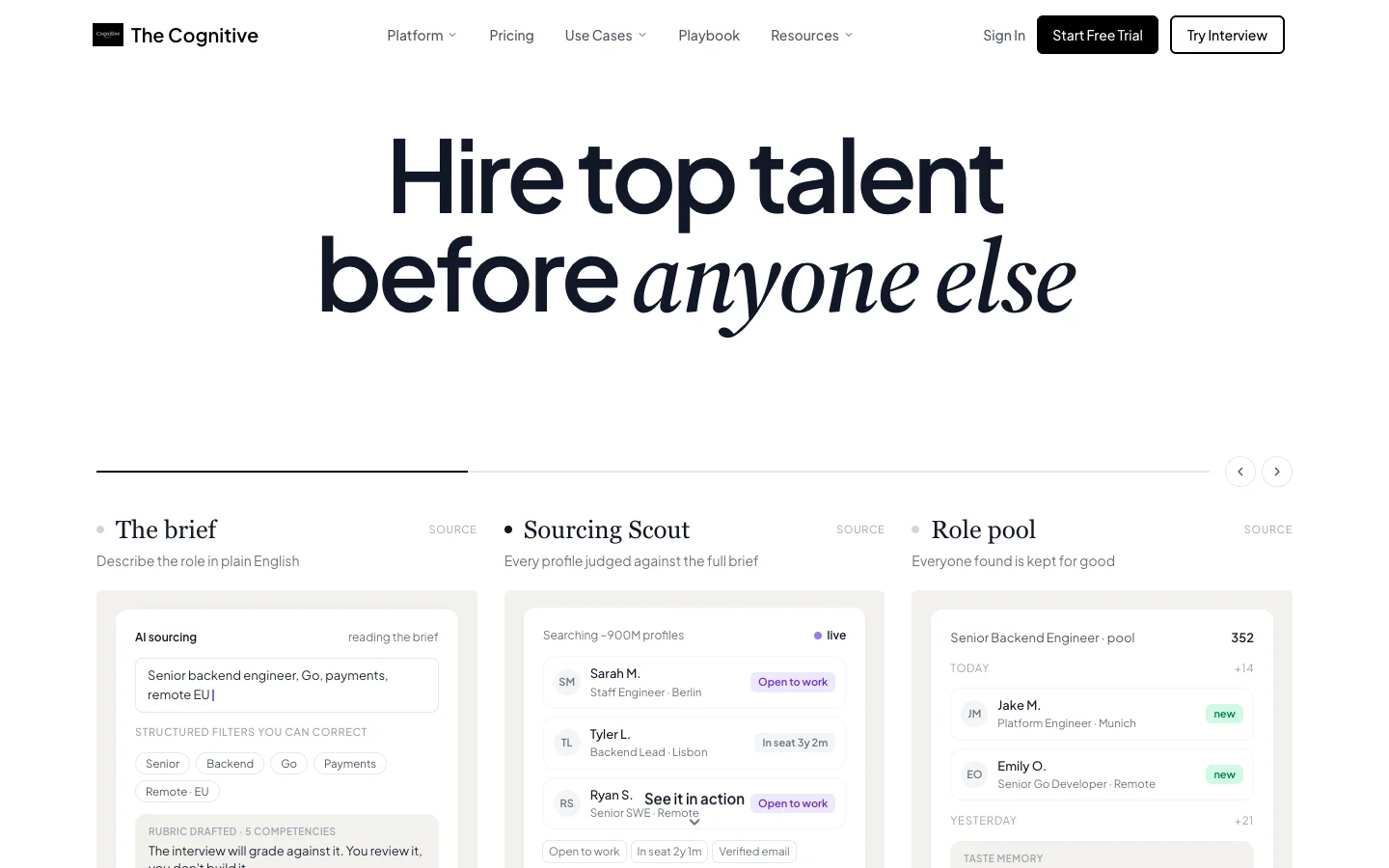
The Cognitive is AI recruiting software that runs sourcing, outreach, live AI interviews and ATS sync from one account. A plain-English role brief searches about 900M public profiles, 10 people a page, and each card gives one or two reasons the person matched, so you know why they are there before you spend credits on a reveal. Emails go out from the recruiter's own Gmail or Outlook, under their name, and stop once the person answers.
The pre-screen itself is a live, two-way AI video interview. An AI interviewer appears on video, the candidate joins on camera, and you set 10 or 20 minutes for the role. The rubric stays fixed while the questions move with each answer, so "I owned the migration" gets asked how. Every criterion you set gets a score, and the report shows how each CV claim held up, with the transcript as evidence.
Candidates pick their own slot and get email reminders. The booking page tells candidates the interview is run by AI, and states that it does not analyse facial expressions, voice tone, emotions or personality. No one is rejected automatically. It connects with 100+ applicant tracking systems (ATS) to import and export candidates. For the search side, see our AI sourcing tools.
Best for: recruiters, founders and agencies who source their own candidates and want the first screen on video, without a sales call.
Watch out for: video only, on a laptop or desktop, so there is no phone, text or one-way option for candidates who apply from phones. It does not post jobs or take applications. Outreach needs Sourcing Pro, and ATS sync needs Interview Pro or Sourcing Max.
Pricing model: monthly plans plus credits, with prices on the site. AI Sourcing and AI Interview are billed separately, and each starts at $99 a month. Each person a search shows uses 1 credit, a personal email 4 and a phone number 12 (Pro and above), and a 20-minute interview uses 100 credits. The 7-day free trial asks for no card and covers 100 sourcing credits and 2 AI interviews.
2. hireEZ: best for an AI phone screen inside an enterprise sourcing system

Verdict: hireEZ suits sourcing teams that want the first phone screen to happen where they found the candidate.
hireEZ began as a sourcing platform and says it searches "1B+ profiles across 45+ platforms". Its AI Screening product will "pre-screen candidates automatically with AI phone interviews", and the homepage describes those conversations as voice or chat. The homepage now leads with EZ Agent, pitched as "Enterprise Hiring, Run by Agents. Recruiters Decide."
Search and first screen sit in one system, so nobody copies a shortlist between tools. The screen is by phone rather than video, and the product is framed for enterprise hiring teams.
hireEZ publishes a price for its Solo plan, with a 7-day trial, and sells enterprise plans by quote. The pricing page does not say whether AI Screening comes with Solo, so ask.
Best for: enterprise sourcing teams that want sourcing and an AI phone screen in one platform.
Watch out for: AI Screening may sit outside the self-serve plan.
Pricing model: per seat; Solo price published with a 7-day trial; enterprise by quote.
3. Ribbon: best for frontline hiring on any phone

Verdict: Ribbon is the pick for frontline roles where the candidate has a phone and five spare minutes, not a laptop.
Ribbon sells "AI interviews for frontline hiring". Interviews run by phone or video, and Ribbon stresses that it "works on any phone". Ribbon also sources, and says its database holds "+1B candidates". It supports 10 languages and says it has a bias audit under New York City's Local Law 144.
The biggest news is on Ribbon's own site: a banner says "Ribbon has signed an agreement to be acquired by Dayforce". If you run Dayforce, ask how Ribbon will fit into it. If you do not, ask what the deal means for other HR integrations and for pricing.
Ribbon offers a 7-day free trial behind a "Start for free" button, so you can try it without a demo. Plans are tiered by hiring volume, with no number on the site. The site lists SOC 2 Type II in its FAQ but shows a Type I badge, so ask which report you will get.
Best for: frontline and hourly employers who want a self-serve start.
Watch out for: the pending Dayforce acquisition and mixed SOC 2 wording.
Pricing model: tiers by hiring volume; 7-day free trial; no price on the site.
4. Tenzo: best for enterprise phone and video screens in 40+ languages

Verdict: Tenzo fits enterprises hiring across many countries that want phone and video screens with fraud and bias controls built in.
Tenzo runs voice AI phone interviews and video interviews, reaches candidates by WhatsApp and email, and supports 40+ languages. Its fraud detection watches "40+ signals", and a de-biasing layer removes protected-class information. Candidates can opt out of the AI interview, which answers the Greenhouse finding that many want a route to a human.
Tenzo lists 57+ integrations with bi-directional ATS sync. Its rediscovery agents search your ATS and, it says, "the web, proprietary databases, and more" for new people.
Best for: multinational employers screening high volumes in many languages.
Watch out for: no public price, and its sourcing is sold inside an enterprise quote, so you cannot try it self-serve.
Pricing model: custom quote; no price on the site.
5. Outhire: best for one AI recruiter that screens applications and runs phone or video interviews

Verdict: Outhire fits teams that want one named AI recruiter to read every application and interview the promising ones.
Outhire's AI recruiter is called Joel: "Joel screens every application and interviews candidates around the clock, in 10+ languages." Interviews run by phone or video, with adaptive follow-up questions. Outhire also sources, and says it searches "500M+ profiles".
It lists 50+ integrations, naming Teamtailor, Greenhouse, Workday and Ashby, and says it holds SOC 2 Type 1. Resume screen, interview and sourcing in one product is the draw. Plans, Pro and Business, are priced by hiring volume with no number on the site and no trial mentioned, so a sales conversation comes first.
Best for: teams that want resume screening and phone or video interviews from one AI recruiter.
Watch out for: no published price and no trial.
Pricing model: subscription (Pro, Business) by hiring volume; no price on the site.
6. Alex: best for a multichannel first round with identity checks
Verdict: Alex is the pick when the first round has to meet candidates on their preferred channel, with proof they are who they say.
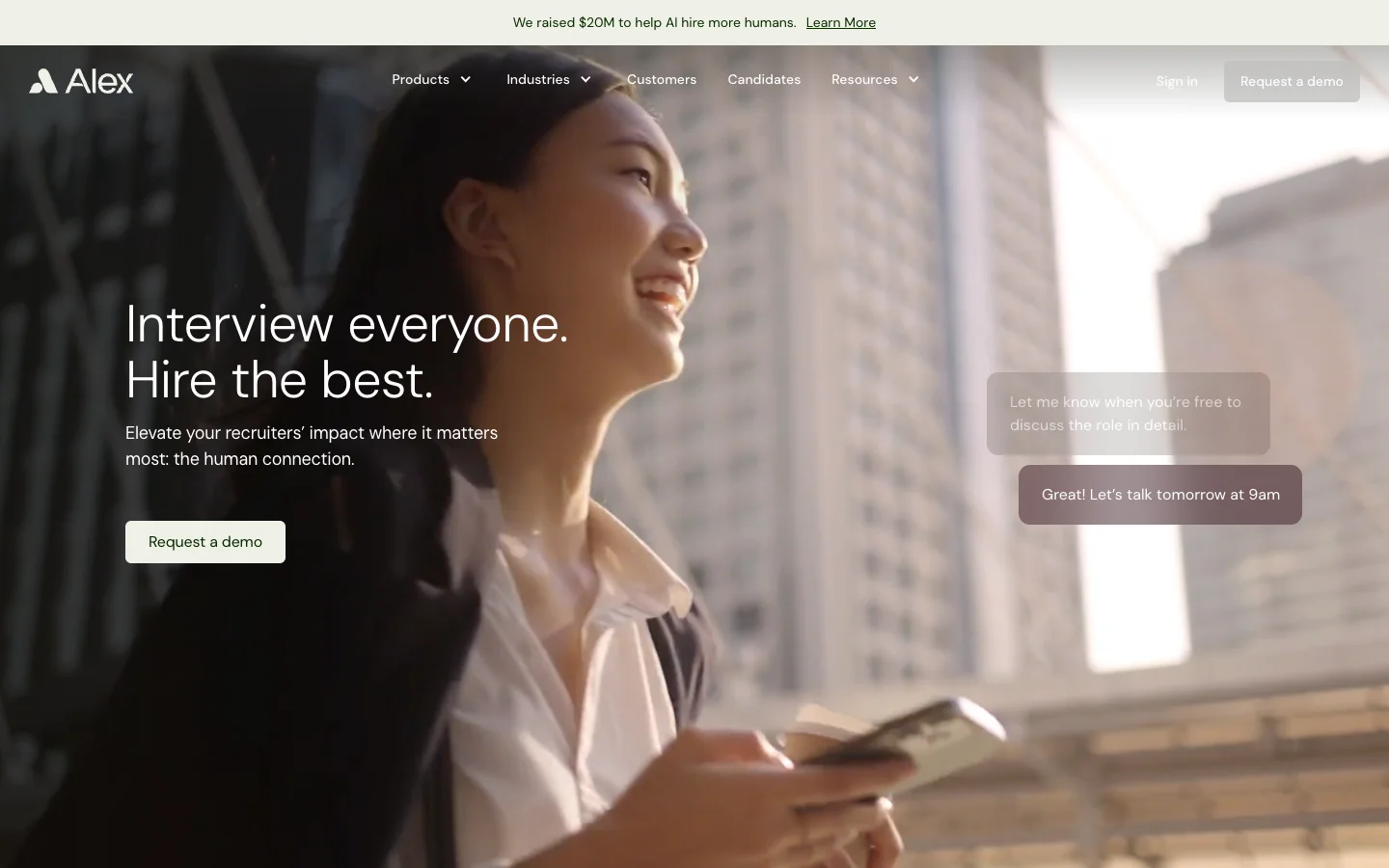
Alex is the company formerly called Apriora; apriora.ai now redirects to alex.com. Interviews run by phone, video, SMS or WhatsApp, so one process covers a candidate who prefers a call and one who prefers to type.
The identity layer has three parts. Identity compares a government ID with a live selfie, Proctor watches the interview, and Verify gives a fraud score. For remote roles that draw stand-ins, that is work a recruiter cannot do on a phone call.
Alex lists 33+ ATS integrations, and its Talent Match feature looks back through candidates already in your ATS rather than finding new ones. The pricing page redirects to a demo form. Our Apriora review covers the product under its old name.
Best for: remote and high-volume roles where identity fraud is a real risk.
Watch out for: demo-led, and it screens applicants and past candidates only.
Pricing model: quote via demo; no price on the site.
7. HeyMilo: best for applicant-flooded teams that want voice, video, SMS and knock-out forms
Verdict: HeyMilo is for teams drowning in applications that want every applicant screened in the format that suits the role.
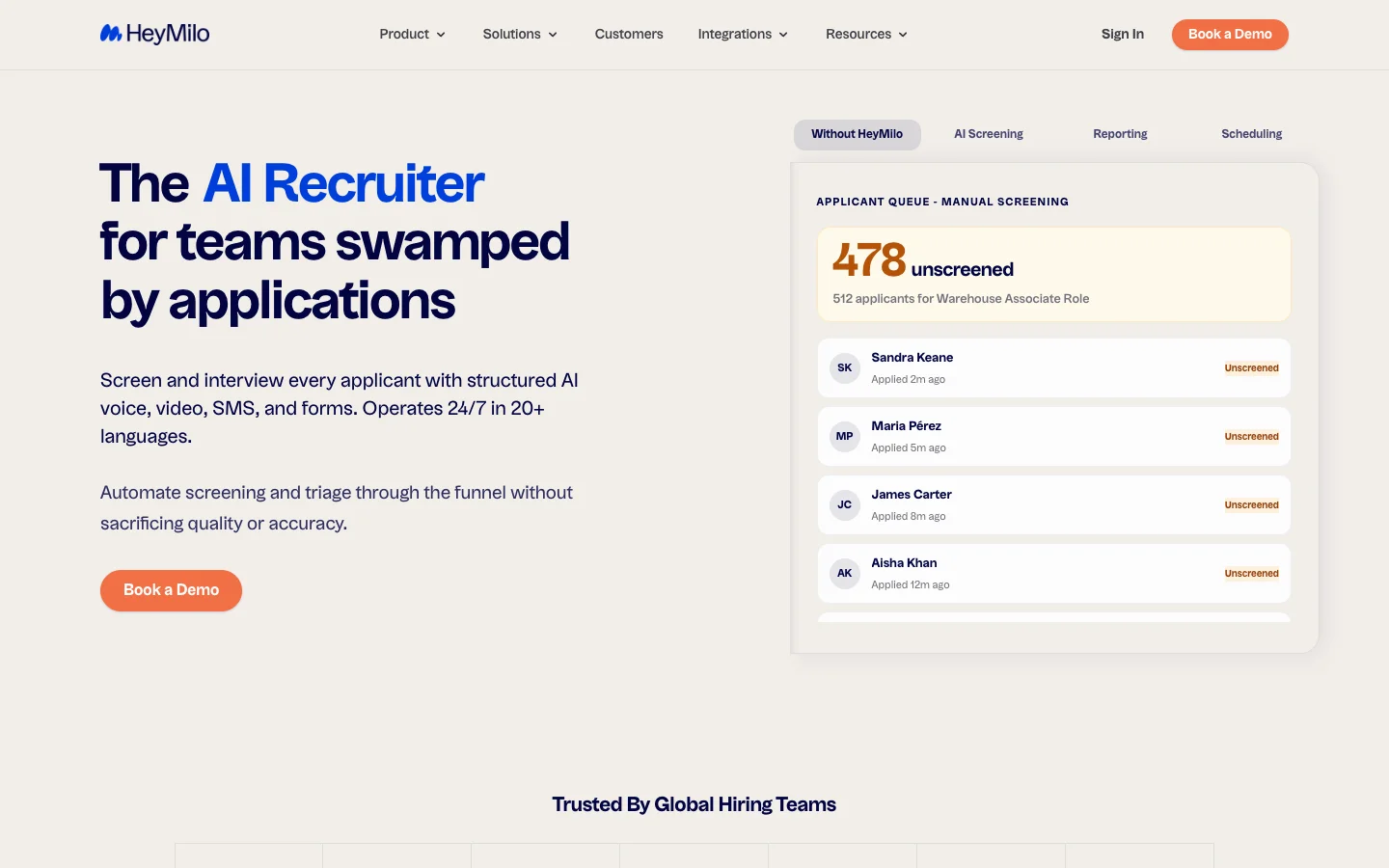
HeyMilo will "screen and interview every applicant with structured AI voice, video, SMS, and forms." The forms handle "eligibility knockouts", so yes or no questions are settled before anyone spends time on a call. Phone screens and scored two-way video cover the rest, in 20+ languages. HeyMilo says it runs third-party bias audit checks, without naming the auditor.
HeyMilo also offers an MCP server and a public API, so your own tools and agents can call it. Named ATS integrations include Workday, UKG, Ashby, SmartRecruiters and Bullhorn, which spans enterprise, mid-market and staffing. Forms for knock-outs, voice for volume roles and video for skilled ones all sit in one product.
Best for: recruiting teams with more applicants than hours, across mixed role types.
Watch out for: no pricing model on the site, and an unnamed bias auditor, so ask for the audit itself.
Pricing model: not stated; demo only.
8. Truffle: best for lean teams that screen applicants async
Verdict: Truffle suits small hiring teams that want applicants screened on the candidate's own time, at a price they can see.
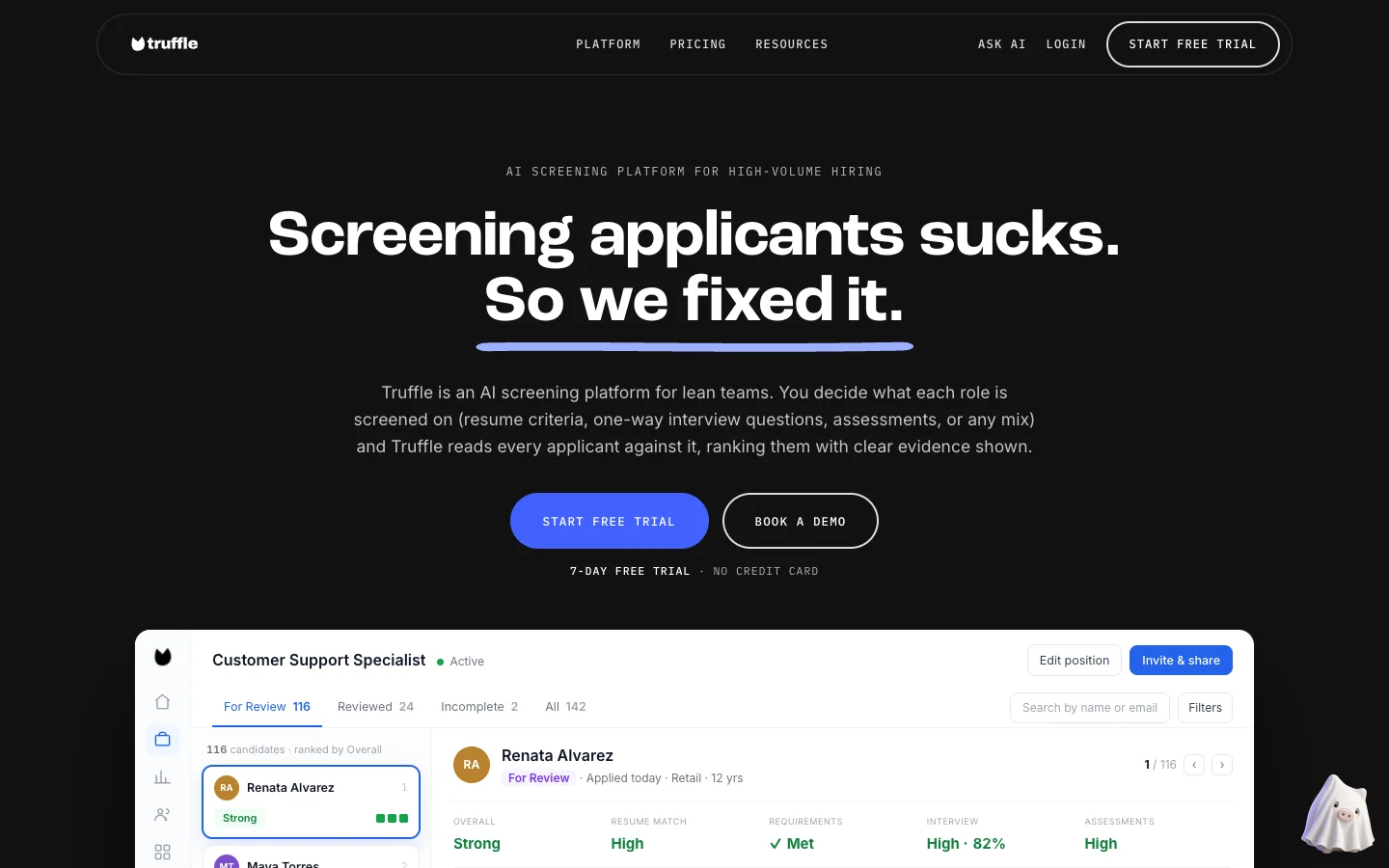
Truffle calls itself "an AI screening platform for lean teams." It works async: resume ranking, one-way video, assessments and qualification checks such as "Authorized to work", sold as a way to "catch the hard nos early". It runs no phone screen and no live AI interview. It syncs directly with Ashby, Pinpoint, Breezy and Indeed, and reaches other systems through Zapier.
Candidates answer when it suits them, and you review when it suits you. A recorded answer cannot be followed up, though, so a vague reply stays vague until a human call. Our guide to async vs live AI interviews weighs the two.
Best for: lean teams screening a steady applicant flow without a recruiter on the phone.
Watch out for: no live follow-up questions, and no phone or live video.
Pricing model: tiered subscription with credits, prices published; 7-day free trial with no card.
9. Classet: best for hourly and trades hiring, including call-to-apply
Verdict: Classet fits hourly and trades employers who want every applicant phoned around the clock, with a price they can see first.
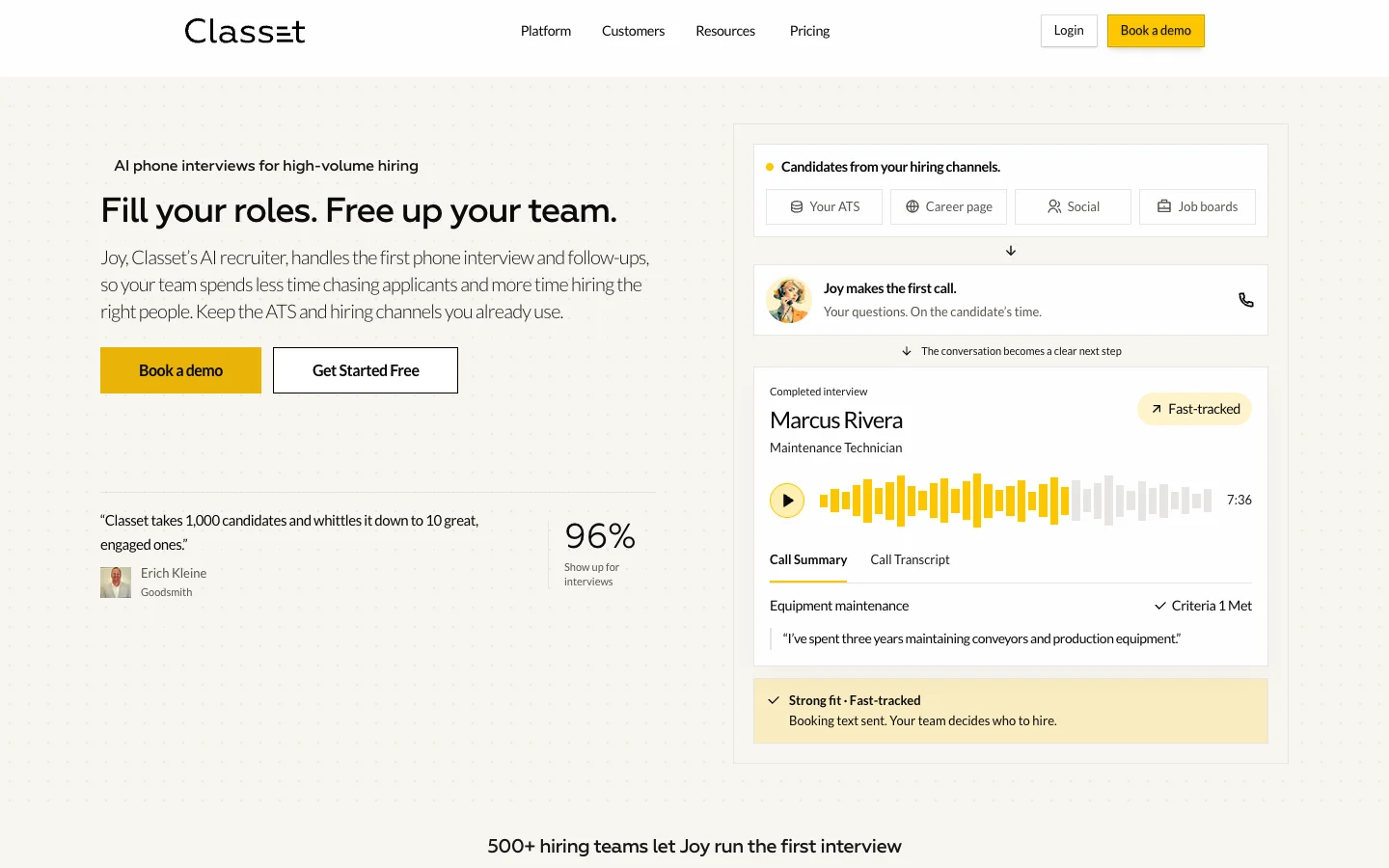
Classet sells "AI phone interviews for high-volume hiring". Its AI recruiter, Joy, "handles the first phone interview and follow-ups", calling 24 hours a day. A Call to Apply number lets candidates ring in, and Classet suggests putting it on your truck, jobsite or careers page. Follow-ups go by SMS and email.
Rather than cut anyone, Classet flags fast-track candidates against your criteria. It connects directly to Indeed, and its Hiring Hub serves teams with no ATS at all. Plans carry an interview allowance, and the ATS Sync plan is scoped on a call.
Best for: hourly and trades employers, including teams without an ATS.
Watch out for: phone-first, so it adds little for salaried professional roles.
Pricing model: subscription with an interview allowance, prices published; ATS Sync plan by call.
10. ConverzAI: best for staffing firms that live on the phone
Verdict: ConverzAI is built for staffing firms whose recruiters spend the day calling people already in the database.
ConverzAI titles its site "World's Leading Automation for Staffing Firms". Its Virtual Recruiter leads interviews by voice call, with SMS and email around them, and writes results back to the ATS. It also reactivates candidates who have gone quiet, which matters to agencies whose best asset is a pool of past applicants.
It lists SOC 2 Type II, HIPAA and third-party bias auditing; HIPAA matters if you place people into healthcare. Every feature assumes a staffing desk with open orders, so a corporate team hiring a few salaried roles will find it built for someone else. Our list of staffing software covers the rest of an agency's stack.
Best for: staffing and recruitment agencies with large candidate databases.
Watch out for: no pricing model on the site, and little reason to buy it outside staffing.
Pricing model: not stated; demo only.
11. Paradox: best for chat and text knock-out screening with scheduling
Verdict: Paradox is the pick when the pre-screen is a handful of yes or no questions and the next step is booking an interview.
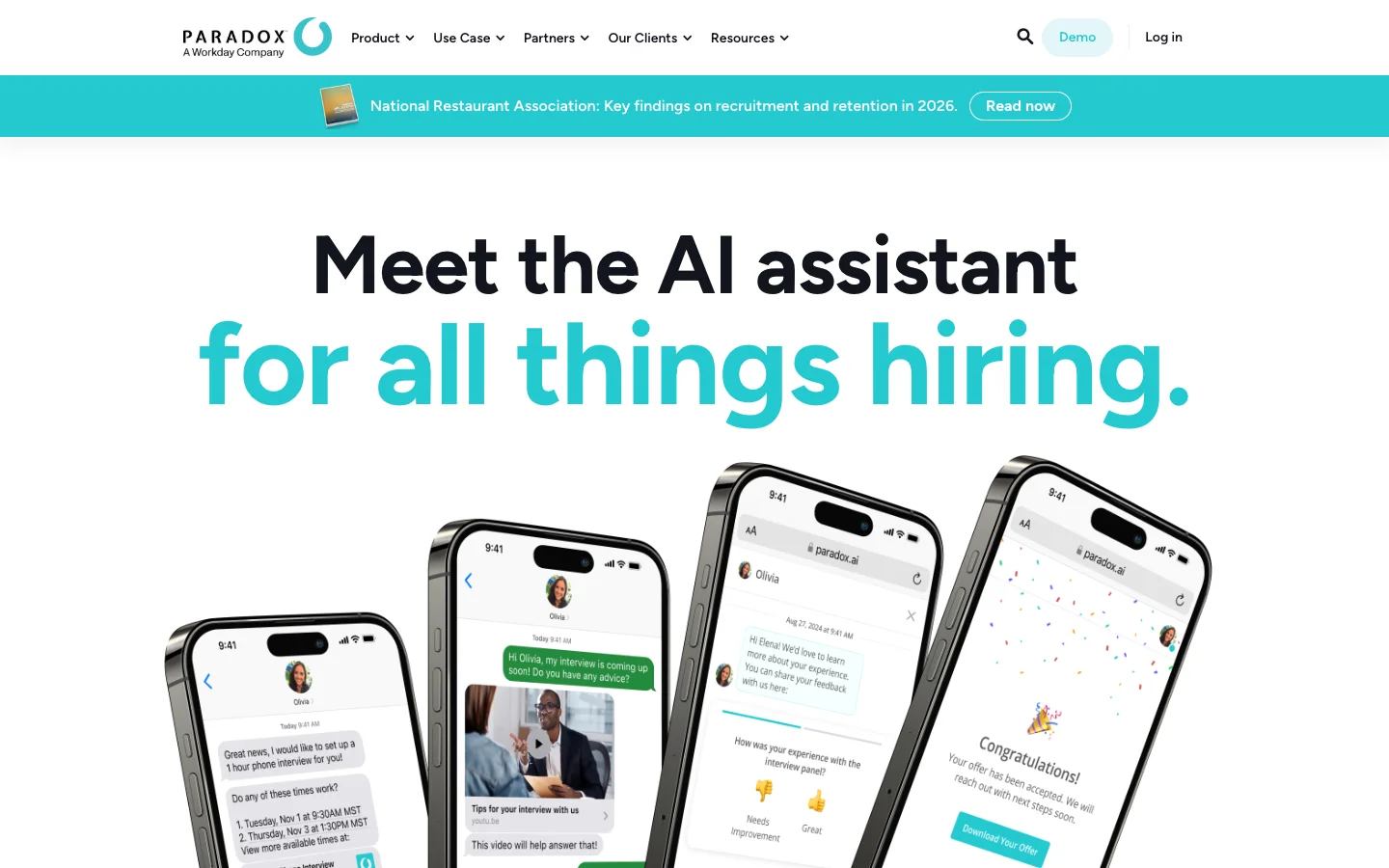
Paradox calls itself "the AI assistant for all things hiring." Its screening is written for text: "Validate important qualifications upfront, through chat or text." Once the candidate passes, the same assistant books the interview. Paradox is now part of Workday, and its logo reads "A Workday Company".
Its site describes no voice screen, so the first conversation is typed. For hourly hiring that is often right: the candidate answers four questions on the bus and has a slot by the time they get home. A text knock-out tells you whether someone meets the bar, though, not how well they think. See our Paradox alternatives and Paradox review.
Best for: frontline employers who screen on fixed requirements and need interviews booked fast.
Watch out for: no voice or video pre-screen on its site.
Pricing model: quote via demo; no price on the site.
12. Phenom Voice Screening Agent: best for enterprises already running Phenom
Verdict: If your company already runs Phenom, its Voice Screening Agent is the pre-screen to test first.
Phenom describes the agent as "conversational voice AI that conducts role-specific screens around the clock, in multiple languages". It "returns structured transcripts, summaries and scores against company-defined rubrics", and Phenom says it covers 53 languages. In Phenom's own blog, the score is advisory and cannot reject a candidate on its own. HR Executive named the agent a 2026 Top HR Product.
Phenom presents it as part of the Phenom platform, so it makes most sense for existing customers, who get it without connecting a new vendor.
Best for: large employers on the Phenom platform hiring in many languages.
Watch out for: phone only, and demo-led.
Pricing model: quote via demo; no price on the site.
Which AI screening tool covers hiring end to end?
The Cognitive is the only platform on this list that runs hiring end to end in one account: it sources candidates, emails them from the recruiter's own mailbox, screens them in a live AI video interview and syncs the results to the ATS. Every other tool here starts later in the chain or stops sooner.
hireEZ, Ribbon, Tenzo and Outhire come closest, since each both finds people and screens them, but none pairs a live AI video interview with a self-serve account and published prices. The rest screen applicants who arrive from a job board or an ATS, so you still need a separate tool to find and reach people who never applied.
End to end matters most when the bottleneck is the handoff. A shortlist that moves from a sourcing tool to an email tool to a screening tool loses people at every step. If you want the wider field of all-in-one platforms, our lists of recruitment software, hiring software and recruiter software compare them by job.
When is The Cognitive the wrong AI screening software?
Our pre-screen is a live AI video interview that starts from sourcing, and several common pre-screening jobs need something else:
- Your candidates apply from phones. The interview runs only in a laptop or desktop browser, and phones and tablets are blocked. Ribbon, Classet or hireEZ screen by phone.
- You hire hourly workers by the hundred. Even a 10-minute video interview asks more of a shift applicant than a phone call. Classet and Ribbon are built for that volume.
- Your pre-screen is a few yes or no questions. Paradox, or HeyMilo's forms, settle knock-outs by text faster than any interview.
- You want async screening. There is no one-way recorded mode. Truffle has one.
- You need job posting and an application inbox. The Cognitive does not post jobs or take applications. Keep your ATS, or look at Classet's Hiring Hub if you have none.
- You want ATS sync on an entry plan. It starts at Interview Pro or Sourcing Max.
What should you ask in an AI screening software demo?
Seven questions separate a pre-screen you will keep from one you will switch off in a quarter:
- Which formats can a candidate choose? Ask to see the phone, video and text versions, not just the one in the demo.
- What does the candidate see before the screen? Ask for the exact invitation and consent wording.
- Can the AI reject anyone? Get the answer in writing, and ask who sees a low score.
- How are follow-up questions chosen? A fixed script and an adaptive interview give you very different evidence.
- What fraud checks run, and where do they show up? Ask whether they change the score or only flag for review.
- What goes back to your ATS? Ask which fields, for which candidates, and whether stages move.
- What does one real month cost? Give your screen count and ask for the bill.
To start, take one open role and run the pre-screen on real candidates for two weeks, then compare the shortlist with what your team would have picked by phone. If you source for that role, a free account of The Cognitive is enough to find people and put two of them through an AI interview. Start free with The Cognitive.
Sources
- Greenhouse, 2026 Candidate AI Interview Report (2,950 job seekers, 1,200 in the US), 1 May 2026.
- Greenhouse, 2026 Future of Hiring Candidate Report (2,800+ job seekers in five countries), 20 October 2026.
- Gem, Key takeaways from the 2026 Recruiting Benchmarks Report, 1 December 2025.
- Phenom, press release on the HR Executive 2026 Top HR Product award (phenom.com), 15 September 2026, and blog post on voice screening at enterprise scale (phenom.com), 7 October 2026.
- Vendor pages: hireEZ homepage, AI Screening page and pricing page (hireez.com); Ribbon homepage (ribbon.ai); Tenzo homepage and pricing page (tenzo.ai); Outhire homepage and pricing page (outhire.ai); Alex homepage (alex.com); HeyMilo homepage and pricing page (heymilo.ai); Truffle homepage (hiretruffle.com); Classet homepage (classet.ai); ConverzAI homepage (converzai.com); Paradox homepage (paradox.ai); Phenom homepage (phenom.com).
Frequently Asked Questions
What is the best AI hiring software for candidate screening in 2026?
The best AI hiring software for candidate screening depends on the format your candidates will answer. The Cognitive suits sourcing-led hiring: it finds people across about 900M public profiles and screens them in a live AI video interview, with plans from $99 a month. For phone screens at volume, Ribbon and Classet suit frontline and hourly roles, Tenzo and Alex suit enterprises, and Paradox handles text knock-out questions.
What is the best all-in-one AI screening and recruiting software?
The Cognitive is the best all-in-one pick for teams that source their own candidates. It is the only platform on this list that sources candidates, emails them from the recruiter's own mailbox, screens them in a live AI video interview and syncs results to the ATS in one account. hireEZ, Ribbon, Tenzo and Outhire also find and screen people, but none pairs a live AI video interview with a self-serve account and published prices.
Can AI pre-screen candidates over the phone?
Yes, nine of the twelve tools on this list run AI phone screens. They are hireEZ, Ribbon, Tenzo, Outhire, Alex, HeyMilo, Classet, ConverzAI and Phenom's Voice Screening Agent. Classet also takes inbound calls through a Call to Apply number. The Cognitive does not screen by phone; its pre-screen is a live AI video interview in a laptop or desktop browser.
How is an AI phone screen different from a recruiter phone screen?
An AI phone screen asks the same structured checks as a recruiter, but it can call every applicant at any hour and returns a transcript and a summary. A recruiter call is still better for selling a hard-to-fill role, reading a senior candidate and handling questions the script did not expect. Most teams use the AI screen for the first pass and keep the recruiter for the people who pass it.
Is there a free AI screening tool or free trial?
Yes, several AI screening tools let you start free. The Cognitive has a 7-day free trial with no card, 100 sourcing credits and 2 AI interviews. Truffle and Ribbon offer 7-day free trials, hireEZ has a 7-day trial on its Solo plan, and Classet's trial includes free interviews. Our free pre-screening questions generator at thecognitive.io/knockout-questions writes knock-out questions for a role.
Do AI screening tools reject candidates automatically?
Several tools on this list say they do not. Classet says it "never rejects anyone", Truffle says "the AI never auto-rejects anyone", Phenom calls its voice screening score advisory, and The Cognitive rejects no one automatically. Ask every vendor to confirm this in writing, because 46% of US job seekers in Greenhouse's 2026 Candidate AI Interview Report wanted the option to request a human interview.
Do candidates have to be told an AI is pre-screening them?
Tell them, every time. In Greenhouse's 2026 Candidate AI Interview Report, 70% of US job seekers were never clearly told upfront that AI would evaluate them. In Greenhouse's 2026 Future of Hiring Candidate Report, advance notice was the top candidate ask, at 55%. In The Cognitive, the booking page tells candidates the interview is run by AI.
Is it legal to use AI screening tools in hiring?
Yes, AI screening is legal, but some places add duties for automated hiring tools. New York City's Local Law 144, for example, covers automated employment decision tools, and Ribbon says it has a bias audit under it. Keep a person on every decision, tell candidates in advance, and see our guide to AI screening software compliance at thecognitive.io/blog/ai-screening-software-compliance.
Does AI candidate screening software integrate with my ATS?
Most do, but the depth varies. The Cognitive imports and exports with 100+ applicant tracking systems, with ATS sync on Interview Pro, Sourcing Max and Business plans. Tenzo lists 57+ integrations, Outhire 50+ and Alex 33+. HeyMilo names Workday, UKG, Ashby, SmartRecruiters and Bullhorn, Truffle syncs with Ashby, Pinpoint, Breezy and Indeed, and Classet connects to Indeed or runs its own Hiring Hub.
Related reading
- AI Interview Platforms Compared: The 10 Best for First-Round Screening in 2026
- Best Hiring Software in 2026: 12 Hiring Tools by Stage
- Best Recruiter Software in 2026: 13 Tools for Recruiters
- Best Retail Hiring Software in 2026: 9 Tools for Store Teams and Store Leaders
- 10 Best CRMs for Staffing Agencies in 2026, Scored
- Best EOR Companies in 2026: 11 Employer of Record Providers Ranked, Plus the Step Before