Metaview Review: From Interview Notes to Recruiting Agents
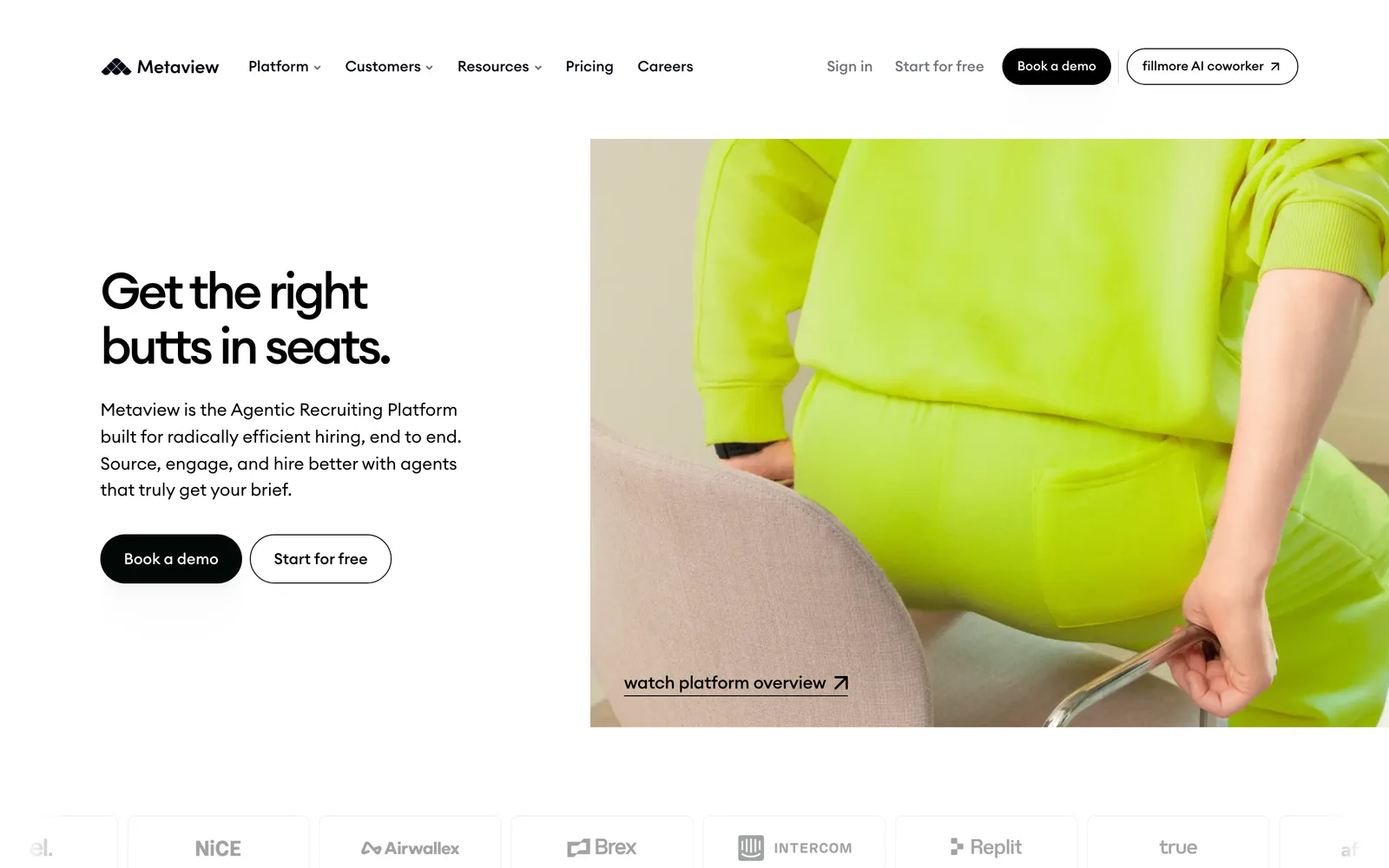
Metaview is an agentic recruiting platform that started as an AI interview notetaker. The notetaker records video, phone and in-person interviews and fills your ATS scorecards. Newer agents source candidates, review applications and run AI voice screens that candidates take "whenever suits them". It rates 4.8 out of 5 on G2 from 132 reviews.
I run The Cognitive, which competes with Metaview on AI screening, so weigh this review with that in mind. Every Metaview fact below was read on metaview.ai and its G2 page on 4 October 2026.
Metaview at a glance
| Metaview (read on metaview.ai, 4 Oct 2026) | |
|---|---|
| Category claim | "the Agentic Recruiting Platform built for radically efficient hiring, end to end" |
| Notetaker | Meet, Teams, Webex, Zoom, phone and in person; bot-free option |
| Sourcing | Autonomous sourcing agent; no profile count published |
| Interview format | AI voice screen taken on the candidate's own time; notes on your own interviews |
| Evidence behind a score | Screens recorded, transcribed and scored against your rubric |
| Integrations | Greenhouse, Ashby, Workday, Lever, iCIMS, SmartRecruiters and more |
| Pricing visibility | Free, Pro and Max published per user; Enterprise custom |
| G2 rating | 4.8 out of 5 from 132 reviews |
What does Metaview do?
- Takes interview notes built for hiring. Metaview "maps interview answers straight into your scorecards", and captures coding sessions, including the shared screen.
- Covers phone and in-person interviews. Phone calls "run through the Metaview switchboard".
- Screens candidates by voice. The Screening agent asks follow-ups and runs role-plays, and Metaview says "A human always makes the final decision."
- Sources and reaches out. fillmore "finds candidates, runs personalized outreach, and books screening calls autonomously."
How does Metaview work, step by step?
- 1. Connect your calendar and ATS. The notetaker joins scheduled interviews, or records through the desktop app with no bot.
- 2. Interview. Notes and completed scorecards post to the candidate's ATS record.
- 3. Screen. You link a Screening call to an ATS stage. Candidates take it on phone or desktop, in one of 18 listed languages, and you review the recording, transcript and score.
- 4. Source. You describe the role by voice, text or upload, and the agent returns profiles and learns from feedback.
Metaview pricing: how is it priced?
Metaview publishes prices on metaview.ai/pricing under the line "Pick what you need. Pay for what you use." Pricing is per user per month and set per agent, with tabs for Sourcing, Application Review, Notetaker and all agents. The Sourcing tab shows Free (the first 100 profiles sourced free), Pro, Max and a custom Enterprise tier.
Reports is a flat-fee add-on. The full platform with every agent is custom-priced through sales.
Where does Metaview not fit?
These limits come from Metaview's own pages and its users.
- No live video interview at a booked time. Screening is a voice call taken on the candidate's own time; video is optional and used to watch for cheating.
- The notetaker records interviews your team runs, so the interviewer's hour stays.
- The sourcing agent publishes no database size or contact-data detail, so it is hard to compare before a trial.
- API access is a complaint. A 0.5-star G2 review from July 2026 said "We want to integrate deeply with Metaview, but there's no API."
What do Metaview reviews on G2 say?
Metaview holds 4.8 out of 5 on G2 from 132 reviews, read on 4 October 2026: 126 five-star, 3 four-star, 1 three-star and 2 one-star. G2's own summary says users praise "ease of use" and "accuracy in note-taking", and that "customization options for templates could be improved." Among G2's tagged themes, Features (13 mentions) and Ease of Use (9) lead the pros, and Integration Issues (7) leads the cons.
The praise is about notes. A tech recruiter said notes that took 1 to 2 hours are "ready in 5 minutes". Most reviews on G2's first page date from 2025, so they speak to the notetaker more than to Screening or Sourcing.
Where does Metaview sit in a recruiting stack?
| Job in the stack | Metaview's position |
|---|---|
| Sourcing | Yes: sourcing agent and fillmore |
| Recruiting CRM | Not positioned as a CRM; integrates with Gem |
| Applicant tracking | No. Writes notes, scorecards and decisions into your ATS |
| Screening and interviewing | AI voice screen, plus notes on interviews your team runs |
Metaview sits beside your ATS, closest to the interview. It is strongest where your team already talks to candidates, and newest at the top of the funnel.
How does Metaview compare with alternatives?
Our Metaview alternatives guide covers the field. For notes alone, buyers usually compare BrightHire, Greenhouse's notetaker and Ashby's AI Notetaker. For sourcing, Juicebox is the closer specialist: see Metaview vs Juicebox and our Juicebox review.
Metaview also appears in two wider rankings. Our list of the best interview intelligence platforms compares its notetaker with the other tools that record and summarise interviews your team runs, and the best AI interview platforms covers tools where the AI runs the first round itself, on voice or live video.
Who does Metaview suit?
- In-house teams on Greenhouse, Ashby, Lever or Workday whose interviewers lose time to notes and scorecards.
- Executive search firms and agencies that interview by phone or in person and send summaries to clients.
- High-volume hiring where 50+ people apply per opening, which is where Metaview says Screening has "the strongest impact".
- Less of a fit if you want the first interview run live on video at a time the candidate books.
Verdict: who should buy Metaview, and who should not
- Verdict: the notetaker is what users rate highest, covering video, phone and in-person interviews. The agents are newer and less proven in reviews.
- Buy it if interview notes and scorecards are your biggest time sink, or you run voice screens at volume.
- Look elsewhere if you need a published database and contact data (compare Juicebox or hireEZ), or a live, two-way AI video interview.
- Before you commit, run the notetaker on 10 real interviews and check the scorecards it fills.
Disclosure: who published this
The Cognitive publishes this review and competes with Metaview. I kept every Metaview claim to its own site and its G2 page, and described absences as absences.
For comparison, The Cognitive does not record your own interviews, so it does not replace a notetaker. It searches ~900M public profiles, then runs a live, two-way AI video interview of 10 or 20 minutes at a slot the candidate books, scoring each criterion from 1 to 5. AI Sourcing and AI Interview each start at $99/month.
Sources
- Metaview homepage, https://www.metaview.ai/ (read 4 Oct 2026)
- Metaview interview notes, https://www.metaview.ai/interview-notes (read 4 Oct 2026)
- Metaview Screening, https://www.metaview.ai/screening (read 4 Oct 2026)
- Metaview Sourcing, https://www.metaview.ai/sourcing (read 4 Oct 2026)
- Metaview pricing, https://www.metaview.ai/pricing (read 4 Oct 2026)
- Metaview on G2, https://www.g2.com/products/metaview/reviews (read 4 Oct 2026)
Frequently Asked Questions
What is Metaview?
Metaview is an agentic recruiting platform that began as an AI notetaker for interviews. It now adds a sourcing agent, application review, AI voice screening and reporting.
Does Metaview do candidate sourcing?
Yes. Its sourcing agent runs a web search from your intake call or brief, and fillmore adds outreach. Metaview does not publish a profile count.
Does Metaview publish pricing?
Yes, for its self-serve tiers. Free, Pro and Max are priced per user per month and set per agent; Enterprise and the full platform are custom.
Is Metaview a sourcing tool or a screening tool?
Metaview is now both, but it is best known as an interview notetaker. Its Screening agent runs AI voice screens and its sourcing agent finds candidates, while most G2 reviews praise the notes.
What are the main alternatives to Metaview?
For interview notes, the main Metaview alternatives are BrightHire, Greenhouse's notetaker and Ashby's AI Notetaker. For sourcing, Juicebox and hireEZ; for a live AI video interview, The Cognitive. Our Metaview alternatives guide compares them.
What do Metaview reviews say?
Metaview reviews are strongly positive: 4.8 out of 5 on G2 from 132 reviews as of 4 October 2026. Users praise ease of use and note accuracy; the common complaints are template customisation, integration issues and, in one review, no API.
Is Metaview worth it?
Metaview is worth it if your interviewers spend real time on notes and scorecards, because that is what users rate. For sourcing or a first interview on video, test a specialist alongside it.
Does Metaview run AI interviews?
Yes, as voice screens. Its Screening agent holds an adaptive voice conversation that candidates take "whenever suits them", on phone or desktop, and scores it against your rubric. Video is optional and used to watch for cheating.
Does Metaview need a bot to join my calls?
No. Metaview says its "notetaker supports note-taking without a bot joining the call" through its desktop app, and phone interviews run through its switchboard.
Metaview alternatives guide · Best interview intelligence platforms · Metaview vs Juicebox · Eightfold AI vs Metaview · HireVue vs Metaview · Juicebox review · All vendor reviews · AI Recruiting Software Guide · Deep AI Interviews · Pricing