AI Recruiting Software Market Overview 2026: 7 Tools Compared
Published · Last updated
In 2026, the split in this market is not between "AI" and "non-AI." It is between tools that assist recruiters and tools that replace recruiter work entirely. The Cognitive is AI recruiting software that sources candidates from ~900M profiles and interviews them live.
Compare AI recruiting software by what each covers: candidate sourcing, AI interviews, and evidence-scored shortlists, with published pricing.
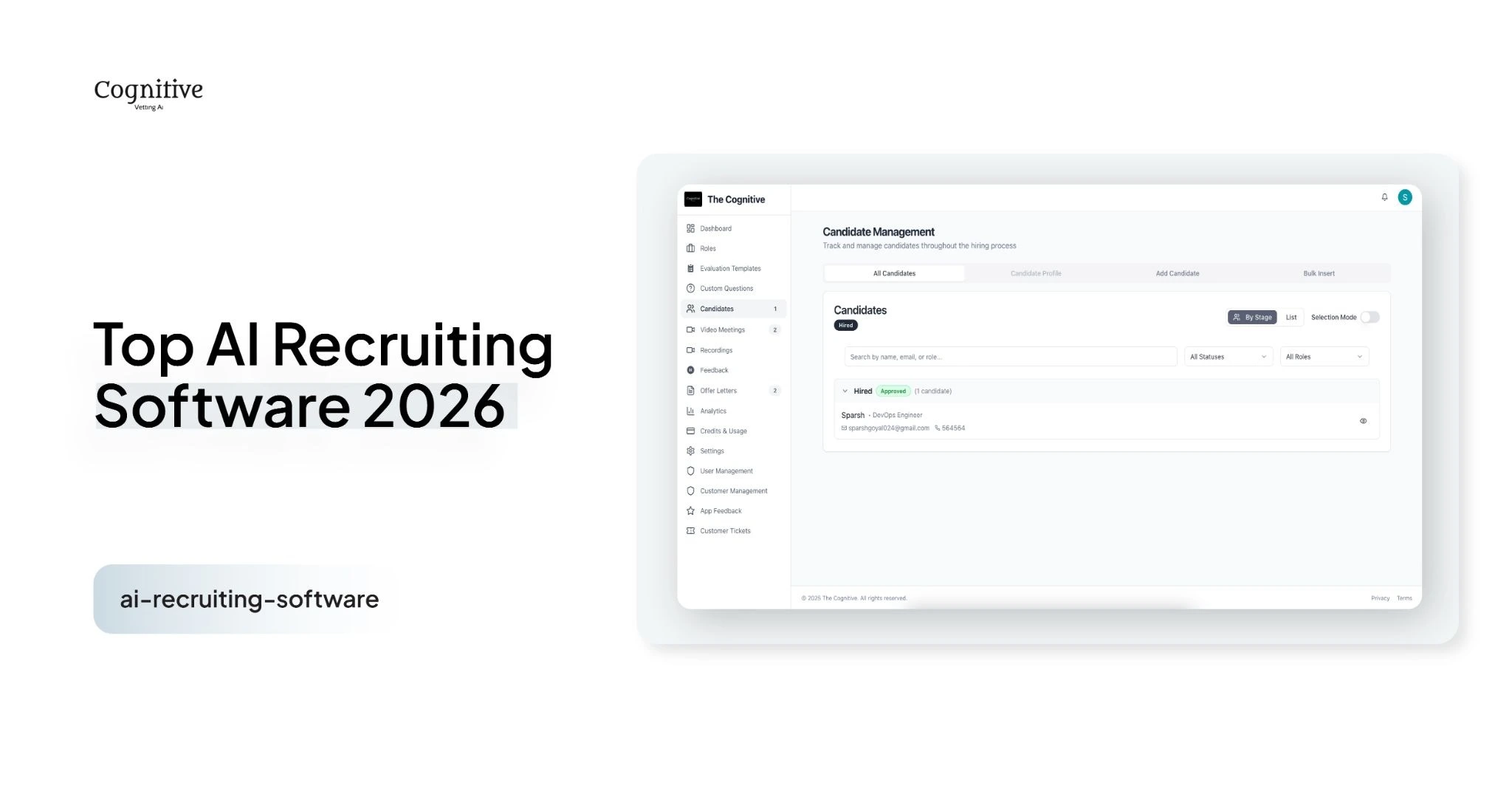
In 2026, the split in this market is not between "AI" and "non-AI." It is between tools that assist recruiters and tools that replace recruiter work entirely. Most buyers are paying for the first category while hoping for the second.
Understand which bottleneck is costing you the most. Is it sourcing, screening, interviewing, or pipeline visibility? Based on this, buy the tool that targets that specific problem.
Remember that generalist platforms do not beat specialists at the layers that matter most.
Keep reading to:
See how each of the 7 tools is categorized and compared
Understand what "AI" actually means in each product (it varies more than vendors admit)
Use the bottleneck checklist at the end to diagnose your actual problem before you spend
The "AI Recruiting" Label Is Doing a Lot of Heavy Lifting
Then you look at the product and find a scheduling bot with a chatbot interface.
The gap between what AI recruiting software promises and what it actually automates is the widest it has ever been, because the category exploded faster than buyer literacy kept up.
Here is what "AI" means across the tools in this list:
What They Call It | What It Actually Does | Automation Depth |
AI Sourcing | Scrapes and ranks candidates from public databases | Low-Medium |
AI Screening | Keyword filtering + basic scoring on resumes | Low |
AI Scheduling | Suggests times, sends calendar invites | Low |
AI Interview (async) | Records candidates answering fixed questions | Medium |
AI Interview (adaptive) | Live two-way conversation that follows up on weak answers | High |
AI Assessment | Structured scoring on cognitive or skills-based tests | Medium |
Full-Funnel AI | All of the above in one system | Medium-High |
Let’s look at the top AI recruiting software in the market below. We have curated a list of tools that are helpful and used widely across the globe.
The 2026 AI Recruiting Software Market: 7 Tools Compared
1. The Cognitive: Best for Autonomous AI Video Interviewing
Best for: SMBs and mid-market hiring teams that need to conduct real, evaluation-grade interviews at scale without adding headcount or scheduling overhead.

Pricing:
a flat monthly subscription (from $99/month).
No per-seat fee.
No annual contract floor.
Most AI recruiting software touches the interview process without entering it. The Cognitive is designed differently.
It runs live, two-way video interviews using a photorealistic AI face and a natural-sounding voice. The AI reads the candidate's resume before the session starts, builds a role-specific question set, and adapts in real time based on what the candidate actually says. When an answer is vague or insufficient, the AI follows up. It does not move on.
That last part is what separates it from every other tool on this list.
What The Cognitive actually does:
Adaptive live follow-ups. The AI probes weak answers the way a trained interviewer would. It does not move to the next question on a fixed script. This is not keyword scoring; it is evaluation.
Resume-contextualized questioning. No static question banks. The AI builds each interview from the candidate's actual background, adjusted for the role.
Timestamp-linked scorecards. Every score in the post-interview report links to the specific video moment where it was earned. Hiring managers review verdicts with evidence, not AI-generated summaries that they have to trust on faith.
Live fraud detection. Tab switching, multiple faces on camera, browser extension use, and camera-off behavior are flagged in real time during the session, not detected after the factZero-touch workflow. Invite → live AI interview → scored report. A recruiter does not need to touch the process between those two endpoints.
What it replaces:
The Cognitive is designed to replace one or more human interview rounds. Teams that currently have candidates sitting in a week-long scheduling queue waiting for a 3-person panel can replace that round with an AI interview. Same depth of evaluation. No scheduling. Instant turnaround.
Hiring managers will be able to use their own face and voice as the AI interviewer, allowing them to conduct first-round interviews at scale without blocking a single hour of their calendar.
What it does not do: ATS pipeline management. Sourcing and outreach are now built in: plain-English candidate search, verified emails and phone numbers, automated sequences, and an AI voice agent feed candidates straight into the interview layer. It integrates with your existing ATS.
The entry tier for HireVue, the enterprise incumbent, starts at $35,000/year before implementation. For a 50-person company making 80 hires per year, The Cognitive costs $400–$640 total. HireVue is not available at that scale for anything close to that number.
2. HireVue: Best for Enterprise-Scale AI Video Assessment

Essential tier starts at approximately $35,000/year.
Enterprise contracts average $49,855 annually and can exceed $145,000.
Implementation costs $15,000–$40,000 additional (Vendr, 2026).
HireVue has been in the AI video interview market longer than most of its current competitors have existed. It handles async video, live video, AI-powered assessments, coding challenges, and game-based cognitive testing, all at volume, across 40+ languages.
AI candidate scoring is not available at the Essential tier. It sits at Enterprise. Teams evaluating HireVue because they want an AI-driven ranking need to budget for the higher tier on day one, not after implementation.
Year-one all-in cost for a mid-market enterprise:
$50,000 base (Enterprise tier)
$25,000 implementation
$10,000 assessment modules
$5,000 integration work
Total: $90,000 for year one. For 200 hires, that is $450 per hire from this tool alone — before you account for the ATS, sourcing tool, or scheduling software it does not replace.
Bottom line: HireVue is the defensible enterprise choice. It is not a viable option for SMBs, and its pricing model does not scale down gracefully.
3. Greenhouse: Best for Structured Hiring Process and Interview Consistency

Pricing:
Small-mid market: $6,000–$15,000/year.
Mid-market: $15,000–$30,000/year.
Enterprise: $30,000–$100,000+/year.
Annual renewal increases of 8–15% are reported consistently.
Greenhouse is an ATS. It does not conduct interviews. It structures the process around them.
What it does better than anything else on this list: it forces every interviewer into the same evaluation framework. Scorecard templates, structured question kits, competency rubrics, approval workflows, and offer letter automation. When a hiring manager fills out a Greenhouse scorecard, they are answering the same questions as every other hiring manager who reviewed a candidate for that role.
Where it fails:
Implementation takes 4–8 weeks, done properly. Teams that rush setup, skipping job template builds, scorecard libraries, and HRIS field mapping, end up with an expensive system they underuse. A Greenhouse implementation partner typically adds $2,000–$8,000 to the first-year cost.
Greenhouse's strongest analytics features are also locked behind the Advanced and Expert tiers. Teams signing at Essential frequently discover mid-contract that the reporting they actually need requires an upgrade.
Who should not buy it: Any team hiring fewer than 20 roles per year. The implementation overhead and cost do not return ROI at that volume.
4. Lever: Best for CRM-First Recruiting and Talent Pipeline Building
Best for: Companies that want to treat recruiting as a long-term pipeline discipline, not a reactive search, particularly those with ongoing hiring needs in competitive talent markets.

Pricing:
Custom pricing.
Starter tier reportedly begins around $3,500/year.
Professional and Enterprise tiers are negotiated.
Lever was acquired by Employ Inc. in 2022; pricing has shifted toward bundled HR suite conversations.
Lever combines an ATS with a native CRM (candidate relationship management), which is rare in this market. Most ATS platforms bolt sourcing and outreach on as an afterthought. Lever built the CRM functionality first.
What this means in practice:
Candidates who applied 18 months ago and were passed over can be tagged, segmented, and re-engaged automatically when a new matching role opens
Recruiters can build talent pools by skill set, geography, or source — not just by job
Outreach sequences run directly from the same system that manages the pipeline, so candidate history follows them across conversations.
Nurture campaigns run to passive candidates without manual effort from the recruiter.
Where it struggles:
After the Employ Inc. acquisition, Lever's positioning has shifted toward bundled sales conversations that include Jobvite and other Employ products. Buyers looking for a standalone Lever contract report longer sales cycles and less pricing flexibility than pre-acquisition. Implementation quality also varies more than Greenhouse, per consistent G2 reviewer feedback.
5. Workable: Best All-in-One AI Recruiting Platform for SMBs

Pricing (publicly listed, 2026):
Starter: $189/month (2 active jobs)
Standard: $299/month
Premier: $628/month
Enterprise: Custom (~$1.50–$4.50/employee/month)
Workable's AI Recruiter is its headline feature: a sourcing engine that surfaces candidates from 200+ platforms and adds them to the pipeline without manual search. For SMBs that struggle with thin applicant pools, this is the clearest ROI case.
Where it does not go:
Workable's automation is assistive. It speeds up recruiter tasks; it does not replace them. AI screening is limited compared to AI-first interview platforms. Keyword matching, not evaluation. Teams growing past roughly 300 employees will find the Enterprise per-employee pricing scaling in ways disconnected from actual recruiting activity.
A real frustration: Workable moved from per-job to flat pricing, but the starting prices increased significantly in the process. Year-one cost is predictable. Year-two and three with renewal increases often surprise buyers.
6. Gem: Best AI-First Full-Funnel Recruiting Platform
Best for: Scaling companies (100–1,000 employees) with a dedicated recruiting team currently managing multiple disconnected tools like ATS, CRM, sourcing, outreach, scheduling, analytics, and paying for all of them separately.

Pricing:
Starts around $300/month for small teams.
Plus and Enterprise plans require a sales conversation. Custom pricing based on company size.
Gem bills itself as the only AI-first all-in-one recruiting platform. The claim has more substance than most competitors' AI positioning. Its AI agents are integrated at the platform level, not bolted onto an existing ATS workflow.
Where it struggles:
The configurability that makes Gem powerful also makes it complex. Teams without a dedicated recruiting ops admin or a rev ops-equivalent function on the HR side will hit a steep learning curve. At $300/month as a floor, it is not cost-justified for companies hiring fewer than 30 roles per year.
7. Manatal: Best Budget-Accessible AI ATS for Lean Teams

Pricing (2026, publicly listed):
Professional: $15/user/month
Enterprise: $35/user/month
Enterprise Plus: $55/user/month
Custom: Negotiated for large teams
Manatal is the most accessible AI recruiting software on this list by a significant margin in terms of price. For a 3-person recruiting team, the full Enterprise tier costs $1,260/year. That is less than 2 months of Workable's Standard plan.
Where it falls short:
Manatal's reporting is functional but not deep. Teams that need source-of-hire analysis, time-in-stage breakdowns, or multi-requisition forecasting will hit the ceiling of what the platform can produce. Customer support response times are also cited as a consistent gap in enterprise-tier reviews.
Head-to-Head Comparison Table
Tool | Category | Best For | Starting Price | Interview Depth | Native ATS | Fraud Detection |
The Cognitive | AI Video Interviewer | SMB to mid-market, interview automation | from $99/month/interview | Live adaptive AI, two-way | Via integration | Yes (live, real-time) |
HireVue | Enterprise AI Video + Assessment | Fortune 500, compliance-heavy enterprise | ~$35,000/yr | Async + live + AI scoring | Via integration | Partial |
Greenhouse | ATS + Structured Interview Design | Mid-market, consistency problems | ~$6,000/yr | Scorecard kits only | Native | No |
Lever | CRM-First ATS | Pipeline building, competitive talent markets | ~$3,500/yr | Basic scheduling | Native | No |
Workable | All-in-One SMB ATS | SMBs, generalist hiring | $189/month | Basic scheduling | Native | No |
Gem | AI-First Full-Funnel Platform | High-volume teams, tool consolidation | ~$300/month | AI notetaker only | Native | Yes (applications) |
Manatal | Budget AI ATS | Agencies, lean teams, emerging markets | $15/user/month | None (AI scoring only) | Native | No |
Why "AI Recruiting Software" Is Not One Category
Buyers evaluating this market make one repeated mistake: they compare tools across categories as if they solve the same problem.
They do not.
Here is the breakdown of what is actually broken in your hiring process:
If your problem is finding candidates:
Your pipeline is thin before interviews even start
Sourcers spend the majority of their time on LinkedIn manually
You lose roles to competitors because you cannot move fast enough on sourcing
Fix: Gem (high-volume), Workable AI Recruiter (SMB), or a dedicated sourcing tool
If your problem is the interview process:
Scheduling a single interview round takes 3+ business days
Interview quality varies depending on who conducts it
Hiring managers give vague feedback with no structure
You lose candidates during the interview stage because the turnaround is slow
Panel availability is your single biggest scheduling bottleneck
Fix: The Cognitive (AI conducts the interview), HireVue (enterprise), Greenhouse (process consistency)
If your problem is pipeline visibility and tracking:
Candidates fall out of the funnel because no one followed up
Hiring managers cannot see the status without asking a recruiter
You have no data on why roles take as long as they do
Fix: Greenhouse, Workable, or Lever
If your problem is budget:
You need structured hiring workflows, but cannot justify $15,000+/year
You are a 3-person team or a recruiting agency
Fix: Manatal
The Bottom Line
Most of what gets sold as AI recruiting software is workflow acceleration with a chatbot interface. A small number of tools are genuinely replacing recruiter work, not speeding it up.
Match your tool to your actual problem:
AI-conducted interviews plus built-in sourcing at SMB price: The Cognitive
Enterprise AI video and compliance: HireVue
Interview consistency and process structure: Greenhouse
Talent pipeline and CRM-first recruiting: Lever
All-in-one ATS for growing SMBs: Workable
Full-funnel AI for high-volume teams: Gem
Budget-accessible AI screening for lean teams: Manatal
Time-to-hire at 44 days costs real money between $4,000 and $9,000 per unfilled role per month in lost productivity (SHRM). That is a business problem, not an HR metric.
The tools to fix it exist. Most buyers are just using the wrong one for the wrong layer.
Stop losing candidates to outdated screening mechanisms. Use an AI video interviewer today. Book a Demo or Try a Live Interview.
Frequently Asked Questions
What is AI recruiting software?
AI recruiting software is a category of tools that uses artificial intelligence to automate parts of the hiring process, including sourcing, screening, interviewing, and scoring candidates. The degree of automation varies significantly across platforms. Some assist recruiters with tasks like surfacing profiles or sending calendar links. Others, like The Cognitive, conduct full live interviews and deliver scored evaluation reports with no recruiter involvement in between.
How is AI recruiting software different from an ATS?
An ATS (Applicant Tracking System) is a pipeline and records management tool. It tracks where candidates are. AI recruiting software acts on that pipeline by sourcing, evaluating, or interviewing candidates autonomously. Most ATS platforms have added AI features, but their core function is visibility and record-keeping, not automated action.
Does AI recruiting software actually reduce time-to-hire?
AI recruiting software reduces time-to-hire only when it targets the right bottleneck. Tools that automate sourcing cut sourcing time, but do not touch interview delays. Tools that conduct interviews autonomously eliminate the scheduling queue entirely. Buying a sourcing tool when your delay is in the interview stage produces no measurable improvement in time-to-hire.
Is AI recruiting software suitable for small businesses?
AI recruiting software is suitable for small businesses, but the pricing model matters as much as the feature set. Enterprise platforms like HireVue start at $35,000 per year and are not viable for most SMBs. Per-interview platforms like The Cognitive, priced at a flat monthly plan with no annual minimum, scale directly with hiring activity. Workable and Manatal are also accessible at SMB budgets.
What is the difference between AI screening and AI interviewing?
AI screening filters candidates by checking whether they meet minimum criteria, typically through resume keyword matching. AI interviewing evaluates whether a candidate can actually do the job through adaptive questioning, follow-ups on weak answers, and evidence-linked scoring. Most platforms marketed as AI interview tools in 2026 are screening tools. A genuine AI interviewing platform adapts to what the candidate says in real time and does not move on when an answer is insufficient.
Can AI recruiting software detect fake or AI-generated candidates?
AI recruiting software can detect fraudulent candidates, but the depth varies by platform. The Cognitive flags fraud in real time during live interviews, including tab switching, multiple faces on camera, and browser extension use. Gem detects suspicious signals within applications before the interview stage. Most ATS platforms, including Greenhouse, Lever, and Manatal, do not include fraud detection as a native feature.
How do I choose the right AI recruiting software for my company?
Choosing the right AI recruiting software starts with identifying which part of your hiring funnel is broken. If your pipeline is thin, the problem is sourcing. If scheduling and interview delays are extending time-to-hire, the problem is the interview layer. If evaluation quality varies by interviewer, the problem is process structure. Each requires a different category of tool. Buying a full-funnel platform when only one layer is broken adds cost without fixing the actual problem.
Related reading
- 10 Recruitment Automation Tools to Cut Admin Time
- Online Recruiting Software: Cloud vs On-Prem, Explained for Teams That Own the Mess
- Applicant Tracking System for Small Business: 4 Tool Types That Actually Fit
- One-Way Video Interview Software vs Live Video: Which Should You Use?
- AI Powered Recruitment Software: 8-Point 2026 Feature Checklist
- Candidate Assessment Tools: 7 Buyer Tests Before You Sign